Wine Shipping Laws by State in 2026: Permits and Limits
Check wine shipping laws by state for 2026: winery and retailer rules, permits, volume caps and taxes for every state that restricts delivery.
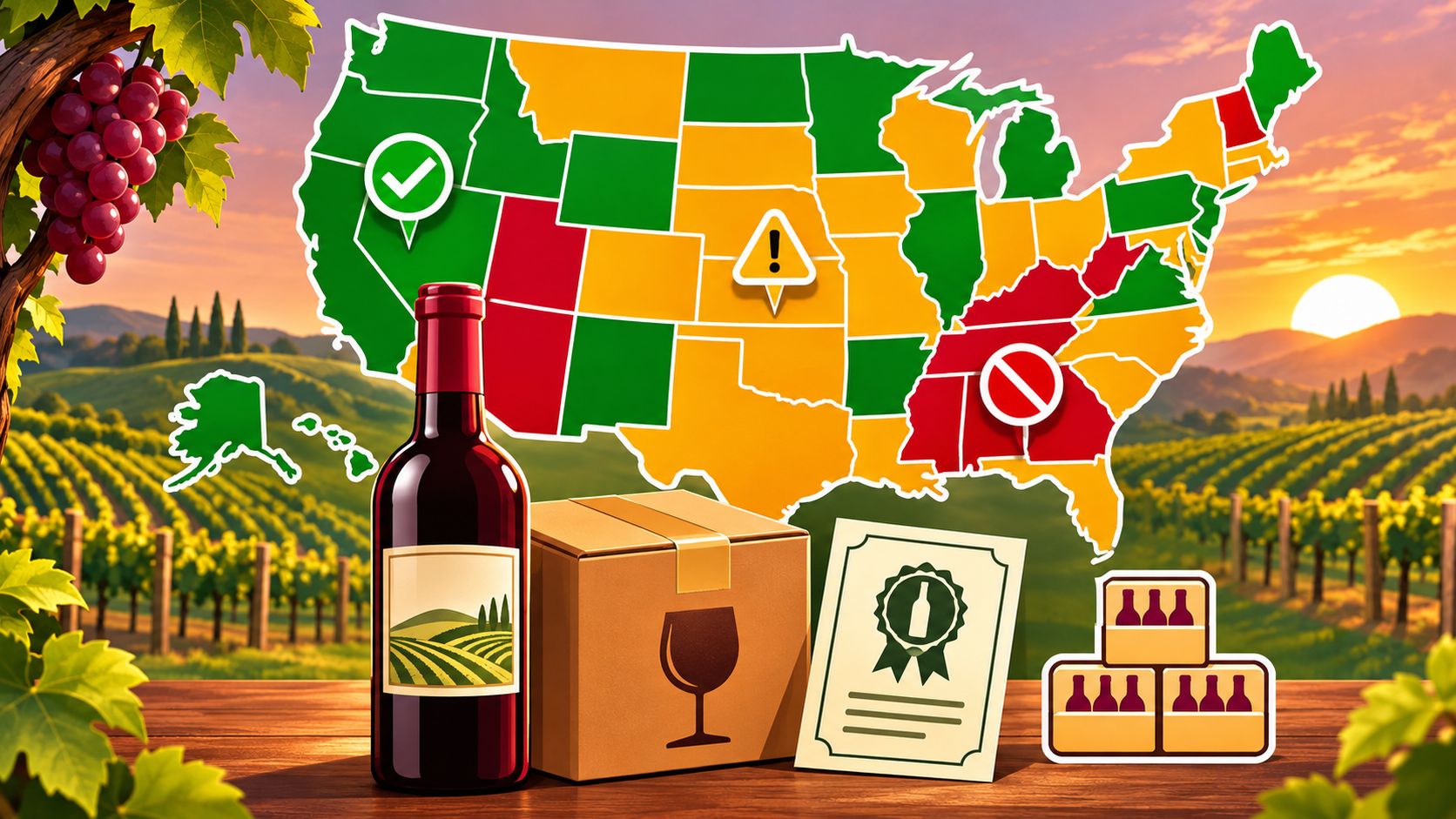
Search "wine shipping laws by state" and most results show a colored map: green ships, red doesn't. That map answers one question, whether a state permits some form of direct shipment, and it hides the five that decide whether a bottle arrives. Whether the seller holds the right license. Whether the product category is authorized. Whether the address already hit its cap. Whether taxes and filings are set up. Whether the destination is a place the state allows wine to land.
Read the table further down as a set of starting positions, not verdicts. Each row records what a winery needs before shipping into the state and what the state says about volume. Because states publish different fields, some entries state a case count and others state the rule that governs volume.
The channel is large enough that states watch it closely. 47 states and the District of Columbia allowed direct-to-consumer wine shipping by domestic wine producers in 2024, according to Sovos ShipCompliant's licensing count. In the first half of 2024, direct-to-consumer shipments totaled 3.1 million cases worth $1.8 billion, per Sovos's mid-year shipping report, and California took 28.2% of 2023 shipment volume against Texas's 7.1%, according to Sovos and WineBusiness Analytics.
Wine Shipping Rules at a Glance by State
| State | Winery direct shipping | Volume limit |
|---|---|---|
| California | DTC permit or California winegrower license | Unlimited |
| Georgia | Permit required for each shipping winery | Annual cap per person or address set by state rule |
| Idaho | Permit required for each shipping winery | Annual cap per person set by state rule |
| Indiana | Permitted; wineries registered as primary wholesale sources excluded | Two caps: one per consumer, one across the winery's permit year |
| New Jersey | Producers under a state-set production ceiling | Annual cap per person set by state rule |
| North Dakota | Out-of-state direct-shipper license plus sales-and-use-tax permit | No case cap in the license terms; returns and records decide compliance |
| Wyoming | Out-of-state shipper's license | 12 cases per household |
| Oklahoma | Direct wine shipper's permit, personal use only | Annual cap per resident set by state rule |
| Illinois | Winery shipper's license; small-winery self-distribution exemption | Self-distribution capped at 5,000 gallons to Illinois retail licensees |
| Washington | Wine-shipper permit with monthly reporting | No case cap published; filings decide compliance |
| Arkansas | Delivery to an adult consumer's private residence in a wet county | No case cap; local, state, liquor and per-gallon excise taxes apply |
| Mississippi | Direct-to-consumer shipping permitted from 2025 | No case cap stated in the 2025 statute |
| Delaware | Not permitted; winery direct shipping an exception as of August 2025 | Channel closed |
| Utah | Not permitted; winery direct shipping an exception as of August 2025 | Channel closed |
| Rhode Island | Off-site wine shipments prohibited | Channel closed |
Read down the third column and three shapes appear, each demanding a different check. A numeric cap names a case count and a unit, per person, per household, per address or per permit year, and the unit is where most compliance systems break. A permit requirement names a license, then drags fees, filings and renewal dates behind it. A channel restriction closes the door for every seller or for one category of seller, which is what Delaware, Utah and Rhode Island do. Where a state publishes no fixed count, the row marks the cap as state-set rather than guessing: each regulator's published rule carries the figure that binds, and it changes without notice.
Automate Alcohol Shipping Compliance
Block orders to restricted states automatically. 3-day free trial.
Start Free TrialRead the third column before the second. A permit gets a winery into a state. The volume column decides whether the next case can go.
A "Permitted" cell clears winery shipping and nothing else. It says nothing about retailers, marketplaces or third-party fulfillment, and it says nothing about the destination address. Arkansas shows why that gap matters: the state permits delivery, but only to a private residence in a wet county, so a statewide yes still fails at a dry ZIP code. Where a cell names a tax permit, a monthly filing or an excise duty, as North Dakota, Washington and Arkansas do, those obligations travel with every case shipped. Treat each row as the first of several checks, not as clearance to send.
Why Shipping Permission Varies by State
One court decision explains the shape of the whole map. In Granholm v. Heald, decided in 2005, the Supreme Court struck down state rules that let in-state wineries ship directly to residents while excluding wineries from other states. The Court held that the discrimination violated the Dormant Commerce Clause: a state may regulate direct-to-consumer wine shipments, but it can't favor its own producers.
The two seller categories then took opposite paths. Winery direct shipping was permitted in 27 states in 2005, against 48 states projected for summer 2025 when Mississippi's law was scheduled to take effect, as Wine Spectator's review of state shipping laws sets out. Out-of-state retailer shipping went the other direction, from 18 states in 2005 to 12 states plus Washington, D.C. today, per the same review.
Both counts descend from a shared set of controls: licensure in the destination state, tax paid there, consent to that state's jurisdiction, regulatory reporting, and an adult signature at delivery. Each state wrote its own version with its own thresholds and deadlines, so two neighbors can both require "a permit" and mean two different documents.
That's why the phrase matters less than the entity. "Wine shipping permitted" and "retailer shipping permitted" are separate statements, and only one of them describes your business.
How Seller Type Changes What You Can Ship
Two sellers can hold the same bottle, ship to the same ZIP code, and get different answers from the same regulator. The variable is the license, not the wine.
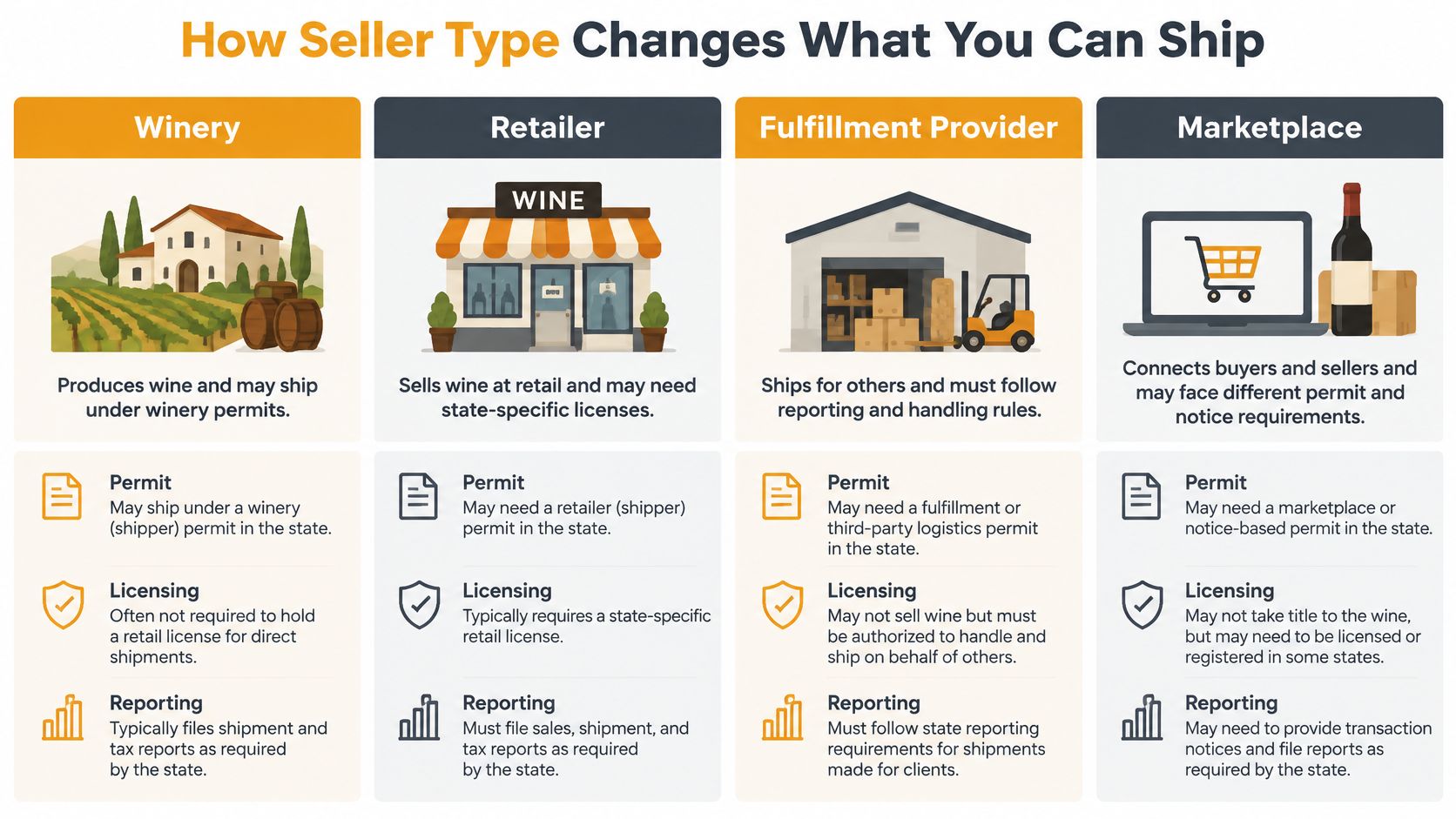
Washington makes the split visible. An out-of-state winery needs a wine-shipper permit and must file monthly reports even in a month with no sales, while an out-of-state retailer faces a separate endorsement and its own reporting obligation, as the Washington State Liquor and Cannabis Board describes. Same destination, same bottle, two different filing stacks.
Indiana adds a constraint that never appears on a map. A winery registered as a primary wholesale source can't use the state's direct-to-consumer channel at all, and permitted wineries face both per-consumer and aggregate shipment limits. A license that looks current on paper can be ineligible for the channel you're selling through.
Free Alcohol Compliance Audit
Selling alcohol online? We'll review your WooCommerce store's shipping compliance for free.
| Seller type | Authorization in destination state | Reporting or fee |
|---|---|---|
| Winery | Out-of-state wine-shipper permit (Washington) | Monthly reports, including months with no sales |
| Retailer | Separate endorsement (Washington) | Its own reporting obligation |
| Fulfillment provider | Logistics-shipper license (North Dakota) | Separate annual fee |
| Marketplace | Permit held by whichever party is the seller of record | Follows the license holder's filings |
Marketplaces sit furthest from the license. The party of record that holds the permit is the party the state will pursue, so a marketplace that takes payment without holding the license is selling something it can't ship. Ask who appears as seller of record on the invoice before you ask whether the state is green.
The question per seller type: which entity holds this destination state's license for this transaction, and is that entity me?
Carrier setup is its own gate. Alcohol service, adult-signature delivery and account approval all come before the first order, which is why a walkthrough of a FedEx alcohol shipping account setup belongs on the pre-launch list rather than in a support ticket after a failed pickup.
Volume Caps and How States Count Them
A cap without a counting unit is a number without a rule. Twelve cases means one thing per household, another per person, and a third per delivery address that a dorm, an office mailroom or a vacation rental can share with strangers.
Three Units, Three Outcomes
Take two adults at one address in a state that caps shipments at 12 cases per household. Both can order, but they draw on the same 12, so the household's second buyer doesn't get a fresh allowance. Rewrite the same cap per person and the address can legally receive 24. Rewrite it per address and a second apartment in the same building resets nothing, because the state counts the delivery point rather than the people behind it.
Georgia's entry covers both bases at once with 12 cases per person or address per year, which closes the split-address workaround. Indiana pairs a per-consumer number with a winery-wide one: 24 cases per consumer and an aggregate of 5,000 cases per permit year, as the Wine Institute's direct-shipping table lists. Under that structure a winery can satisfy every individual buyer and still exhaust its aggregate before the permit year closes.
What the Counter Has to Store
The buyer is the unit of measure, not the cart. A checkout that counts only the current basket approves the thirteenth case of the year because the first twelve arrived in separate orders.
- Normalize the delivery address. Strip apartment suffixes and standardize street types so one household doesn't read as three.
- Tag product category separately from shipping eligibility. A category field that says "alcohol" can't tell wine from cider when a state authorizes one and not the other.
- Run two clocks. Some states count a calendar year, others a permit year that starts on the licensee's anniversary, and some count by month.
- Route, don't just reject. When a threshold is close, send the order to review with the reason attached, so a buyer under their own limit isn't lost to a hard block.
Reference tables of this kind are informational rather than legal advice, and the Wine Institute says so on the page itself. Whatever you build from them should be checked against the regulator's own language.
Permits, Fees and Tax Filings to Expect
A statewide yes is only the first gate. The permit that authorizes a shipment also creates tax accounts, filing obligations and record duties that continue after checkout.
North Dakota shows the full stack: an out-of-state direct-shipper license, a sales-and-use-tax permit, a $50 annual fee, quarterly sales-tax filing, annual excise-tax and direct-shipment reporting, and records kept for at least three years. A fulfillment warehouse that prepares shipments on the licensee's behalf needs its own logistics-shipper license and pays a $100 annual fee, as the Wine Institute's North Dakota summary lays out. Two licenses can stand behind one order.
Wyoming illustrates why the license and tax sides should not be merged. Beyond the out-of-state shipper's license, a seller still has to map the state's tax treatment to the invoice, filing account and shipment records before the first bottle moves.
Illinois splits its rules by producer size. Wineries shipping directly to consumers need a winery shipper's license, while a self-distribution exemption covers small wineries producing under 25,000 gallons a year, with up to 5,000 gallons of direct sales to Illinois retail licensees, as the Illinois commission's shipping report details. Washington separates the path by seller type: wineries use a wine-shipper permit, retailers require a separate endorsement, and shipping advertisements must display the permit or license number.
| State | Permit or license | Annual fee | Tax | Filing | Retention |
|---|---|---|---|---|---|
| North Dakota | Out-of-state direct-shipper license plus sales-and-use-tax permit | $50 | Sales and use tax, plus excise tax | Quarterly sales-tax return, annual excise and shipment reports | At least 3 years |
| Wyoming | Out-of-state shipper's license | Set at licensing | State tax treatment for direct shipments | Filing schedule set by the tax account | Keep shipment and tax records |
| Washington | Wine-shipper permit for wineries, separate endorsement for retailers | Set at licensing | State taxes on direct sales | Filing schedule set by the license terms | Keep reports for audit |
| Illinois | Winery shipper's license | Set at licensing | State taxes on direct sales | Set by the license renewal cycle | Keep with the license file |
The entity holding the paperwork has to exist before the first permit application. Entity formation, state registration and tax accounts typically precede alcohol permits; a Florida business startup checklist provides a general model for those early business-setup steps. Wine-specific licensing then sits on top of that foundation.
Tax setup is the recurring obligation most likely to be misaligned at checkout. The mechanics of how state excise taxes affect online alcohol sales and shipping should be worked through before the first filing.
Recent Changes and Where Delivery Still Fails
A state turning green is the least reliable signal in this business. Access widened in 2025 and shipping got harder, not easier, in the states that opened.
Mississippi began permitting direct-to-consumer wine shipping in 2025, and Arkansas removed its requirement that the consumer place the order in person at the winery, as Wine Business reports. Arkansas kept every part that decides whether a delivery happens: the wine must go to an adult consumer's private residence in a wet county, and the shipper collects local sales tax, state sales tax, liquor sales tax and a per-gallon wine excise tax.
Where a Green Check Fails
- County status. Dry counties exist inside states that permit wine shipping, so the state line is not the last boundary that matters.
- Residence type. A rule that allows delivery only to a private residence blocks offices, hotels, gift addresses and freight forwarders.
- Local tax registration. A shipper registered for state sales tax but not the local jurisdiction can't collect what the destination requires.
- Adult signature. Proof of age at the door is part of the delivery, not a carrier preference, and a shipment left without it fails the requirement.
- Shipment caps. The household that hit its annual limit last month is blocked in an otherwise open state.
By August 2025, Delaware and Utah remained exceptions for winery direct shipping, and Rhode Island prohibited off-site wine shipments. Three states, three different reasons a bottle fails to arrive, and none of them visible in a yes column.
A statewide yes is a permission, not a delivery address. The county, the residence type and the tax registration decide the rest.
Rules move on legislative effective dates, not on your release schedule. A rule set that was accurate at launch can go wrong in a week, and nothing in a static table tells you it happened. That's why customer messaging matters as much as the rule itself: "prohibited statewide" and "restricted at this destination" are different messages. A buyer in a dry county who is told only that "we can't ship to your state" will argue, because the state's own website says wine shipping is legal.
How Buyers Can Check Before They Order
Buyers meet the same patchwork from the other side. Three wineries can quote three different answers for one address, and only one of them is right for that bottle, that license and that county.
- Confirm the seller holds a permit. Check the winery's shipping page or the destination regulator for a direct-shipping permit that covers wine from out-of-state producers. A retailer shipping into the same state may need a different authorization or none at all.
- Check the county. In states that tie delivery to wet or dry status, a statewide yes doesn't reach a dry county, so look up the county before you fill a cart.
- Verify the address type. Where the state requires a private residence, a work address, hotel or package locker will fail at the point of delivery.
- Expect an adult at the door. Signature and proof of age are the standard condition of alcohol delivery, so plan for someone over the legal age to receive the box.
- Know your household count. If the state caps shipments per household or address, the winery has to refuse the order that crosses the line, and asking first saves the return.
- Read the refusal message. "Prohibited statewide" means the channel doesn't exist for that seller type. "Restricted at this destination" means your county, address or volume is the blocker, and the fix may be a different address rather than a different state.
Taxes may also appear at checkout. States that require collection add state, local and excise amounts to the order, so a price quoted before the address is entered is rarely the price paid.
Rules change after legislative effective dates. An order the same winery accepted last year can be refused this year for a reason that has nothing to do with you.
Product, Carrier and Volume Checks Before Each Shipment
Start with a cart that holds a bottle of wine and a bottle of hard cider, shipping into a state that authorizes wine only. The wine line is fine and the cider line isn't, which is why product eligibility has to live in its own field instead of riding along on a shipping flag.
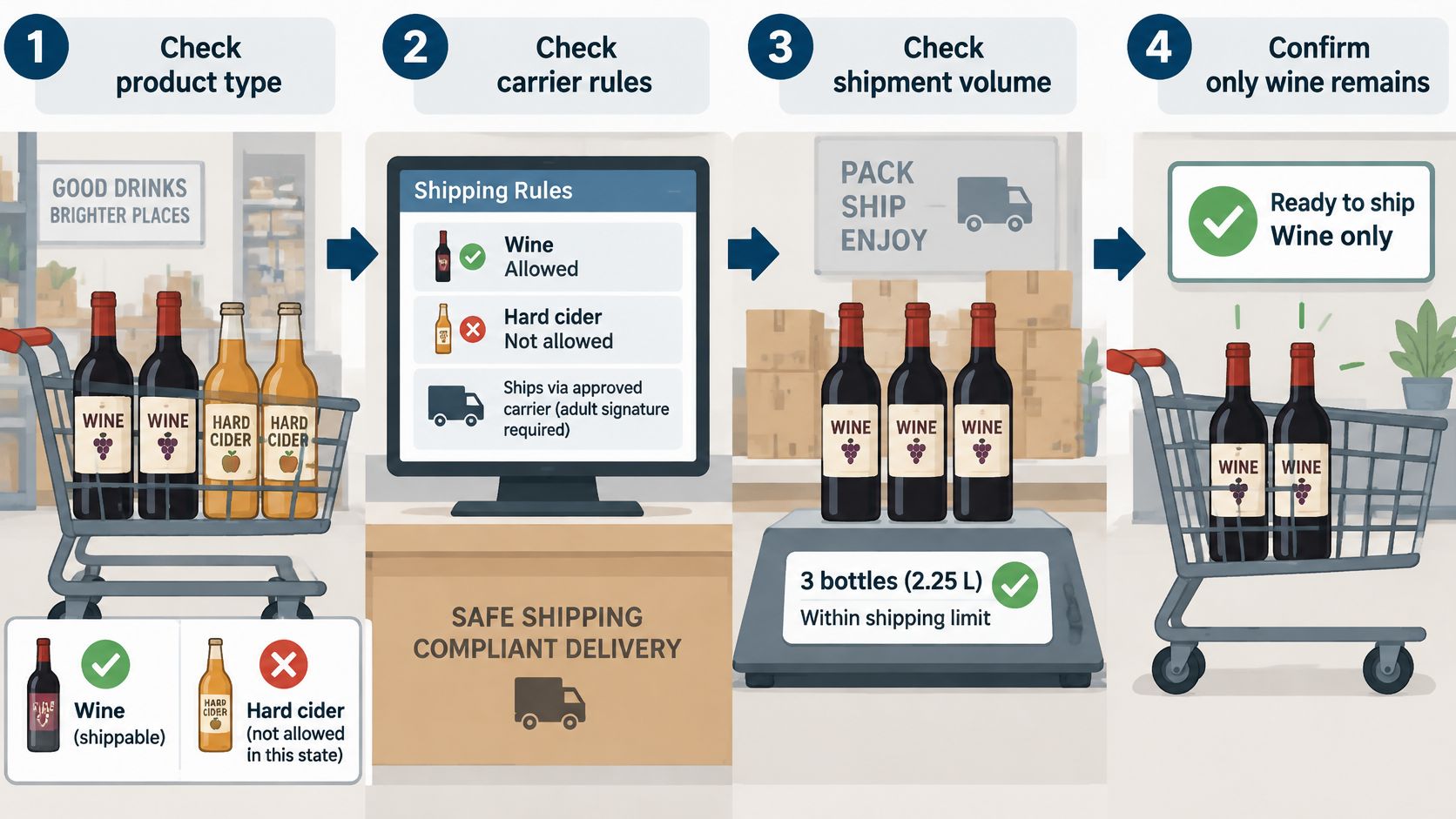
Run the checks in this order on every order, not once at setup.
- Confirm seller type and license. Verify that the winery, retail or marketplace status holds the permit the destination requires, and check for registrations that bar direct shipping outright, such as a primary wholesale source registration in Indiana. The license you hold decides the channel you can use.
- Resolve the destination properly. Take the state from the ZIP code, then check county status and any local tax or residence rule attached to that address. A ZIP that straddles a county line is where manual review earns its keep.
- Match product eligibility. Confirm the state authorizes the category in the cart, whether that's wine alone or wine with cider and mead, and store eligibility apart from shipping eligibility. One authorized category doesn't carry its neighbors.
- Count volume in the state's unit. Apply the per-person, per-household, per-address, calendar-year or permit-year counter, then block or route the order if it would cross the cap. The count follows the recipient across orders, not the basket.
- Confirm tax registration and deadlines. Check that the destination's sales-tax account is open, the excise obligation is understood, and the filing calendar has the date on it. An unfiled return is a bigger problem than a late shipment.
- Check carrier and signature. Require adult-signature service where the state mandates it, confirm the carrier is on any approved list, and block prohibited recipient types. If you're weighing carrier integrations for signature requirements, this roundup of top shipping tools for online stores covers the practical differences.
- Record the evidence. Keep the permit number, the tax filings and the shipment records for the period the state requires, because an audit asks for documents and not recollections. The carrier's own alcohol rules sit alongside these; the specifics of shipping wine with UPS are a useful cross-check on service levels and signature options.
- Set effective dates and re-check. Attach a start and end date to every rule and revisit it after each legislative session. A rule with no expiry is a rule waiting to become wrong.
Practical rule: if the product category isn't authorized in the destination, no carrier service level and no signature option makes the shipment legal.
Set Up State Rules Before Your Next Order
The choice at the end of all this is simple: keep checking orders by hand, or move the state rules into checkout. Manual review survives a handful of destination states. It collapses when a catalog spans dozens of states, several product categories and annual counters that reset on dates nobody wrote down.
Start from the lookup table. Enter each state with its permit requirement and volume rule, then add the channel closures for Delaware, Utah and Rhode Island, and the county and residence limits for states like Arkansas. That gives you a rule set built on the same units the statutes use. For a winery shipping to a short list of states, the allow-only form is faster: one rule on the wine category names the permitted destinations and blocks everything else. Keep the whole list in a single rule, because allow-only rules on the same category add up, and splitting the list across separate rules ends up permitting nothing.
Ship Restrict applies that model inside WooCommerce and Shopify, controlling where products can ship by US state, city and ZIP code, so a rule matches the destination at the level the law uses. The two platforms differ on one edge case. On WooCommerce, when a ZIP code and a state disagree in an address, the check uses the state the ZIP code belongs to. On Shopify, the ZIP code is checked as entered. Every decision is logged: the address checked, the category and tag IDs found on each product, which rules matched, which rule restricted an item, and any ZIP code and state mismatch, so a compliance review can trace a blocked order back to the rule that blocked it.
The first concrete step today is to list every destination state your catalog ships to, then place one sample order to each and read the result before going live.
Wine shipping rules change on legislative effective dates, and the states that opened in 2025 added restrictions as often as they removed them. Ship Restrict keeps destination rules at the state, city and ZIP level inside WooCommerce and Shopify checkout, and a wine order that hits a restriction is stopped before payment instead of after a refund. Set up your destination states as rules, date them against each legislative change, and read every decision in the log. Visit Ship Restrict to see how the rule set maps to your catalog.
Automate Alcohol Shipping Compliance
Stop worrying about restricted states. Ship Restrict handles it automatically.

Cody Yurk
Founder and Lead Developer of ShipRestrict, helping e-commerce businesses navigate complex shipping regulations for regulated products. Ecommerce store owner turned developer.
Automate Alcohol Compliance
- Block restricted states
- No more cancellations
- Set and forget
3-day free trial · Card required