FedEx Alcohol Shipping Account Setup Guide for DTC Success
FedEx alcohol shipping account setup guide that simplifies licensing, compliance, packaging and integration so you can ship wine beer and spirits confidently.
Getting your FedEx alcohol shipping account set up correctly is all about having your ducks in a row. You’ll need the right licenses, a specific shipping agreement, and a solid grasp of the compliance rules.
If all your paperwork is in order, the whole process—from application to your first shipment—usually takes anywhere from three days to two weeks. This guide will walk you through exactly what you need to do to avoid the common hiccups that can cause delays.
Navigating Your FedEx Alcohol Shipping Setup
Successfully shipping alcohol with FedEx isn't as simple as opening a standard business account. It involves a specialized approval process, and for good reason. FedEx has to ensure every single shipment complies with a dizzying web of federal, state, and local laws.
If you try to ship wine, beer, or spirits without this specific approval, you're rolling the dice. It can lead to seized packages, hefty fines, and even a permanent ban from using their services.
Automate Alcohol Shipping Compliance
Block orders to restricted states automatically. 3-day free trial.
Start Free TrialThis setup is non-negotiable for any licensed business, whether you're a small winery trying to reach new customers or a large distributor managing a complex supply chain. The process ensures that only legally authorized businesses can ship alcohol and that every package is handled correctly—from the right packaging and labels to that crucial adult signature at the door.
Why a Specialized Account Is Mandatory
FedEx doesn’t see alcohol as just another product; it's a regulated commodity. A standard business account simply doesn't have the necessary agreements or system flags in place to handle it compliantly.
Your specialized alcohol shipping account is tied directly to your signed FedEx Alcohol Shipping Agreement. Think of this as a legal contract where you confirm you’ll play by all the rules.
Here’s what this special account and agreement unlock:
- Compliance Verification: It’s FedEx’s way of confirming you hold the necessary federal (TTB) and state licenses to legally ship alcohol.
- Service Access: It gives you access to the specific FedEx services approved for alcohol transport, like FedEx Ground® and FedEx Express®.
- Special Handling: This is critical. It ensures your packages are automatically flagged for required protocols, like the mandatory "Adult Signature Required" sticker and delivery process.
The real reason for this detailed process comes down to liability. FedEx has to protect both you (the shipper) and themselves by following the law to the letter. It's all about preventing underage access and keeping alcohol out of illegal distribution channels.
Before you dive into the application, it's wise to have all your essential information organized. This table breaks down exactly what you'll need.
Key Requirements for FedEx Alcohol Shipping Approval
| Requirement Category | Specifics & Why It Matters |
|---|---|
| Federal & State Licenses | You must hold a valid federal permit from the TTB (Alcohol and Tobacco Tax and Trade Bureau) and the appropriate state-level licenses for manufacturing, distributing, or retailing alcoholic beverages. FedEx will verify these are active and in good standing. |
| FedEx Account Number | Your business must have an active FedEx account in good standing. The alcohol shipping permissions will be added to this existing account, not a new one. Ensure all your billing and contact information is up-to-date. |
| Signed Shipping Agreement | This isn't your standard terms of service. You'll need to sign the specific FedEx Alcohol Shipping Agreement, which outlines your responsibilities for legal compliance, packaging, labeling, and record-keeping. |
| Business & Legal Info | Be ready to provide your official business name, address, EIN (Employer Identification Number), and contact details. This information must match what's on your licenses exactly. Any discrepancy can cause delays. |
Getting these items in order beforehand makes the application process much smoother and shows FedEx you're a serious, compliant partner.
The Growing Need for Compliant Shipping
The stakes for getting your FedEx alcohol shipping account right have never been higher, thanks to the explosion of the direct-to-consumer (DTC) market. The global alcohol ecommerce space has seen staggering growth, jumping from $6.47 billion in 2017 to $17.01 billion in 2023. That’s a 163% increase in just six years.
This boom is driven by a fundamental shift in how people shop and the slow but steady legalization of DTC shipping in more states. For businesses, this means a reliable and compliant shipping partner is absolutely essential. You can find more insights on this market growth on Easypost.com.
Think about a small winery in Napa. With their approved FedEx account, they can ship directly to customers in dozens of different states. But every one of those states has its own unique set of rules. By pairing their account with a tool like Ship Restrict, they can automatically block shipments to prohibited states like Utah, sidestepping costly compliance mistakes and focusing on what they do best—making great wine.
Free Alcohol Compliance Audit
Selling alcohol online? We'll review your WooCommerce store's shipping compliance for free.
Account Application And Approval Process
Diving into your FedEx alcohol shipping account application begins with a transparent, in-depth chat with your designated account manager. This isn’t a fill-in-the-blanks exercise—it’s your chance to highlight the specifics of your operation and clear up any questions from the start.
Make sure the legal name and address you provide match exactly what’s on your TTB and state licenses. One typo can send your timeline off course. Before you click “submit,” spend a few minutes reviewing those details.
Next, dig into key clauses in the FedEx Alcohol Shipping Agreement—especially liability coverage limits and shipment volume thresholds. When you understand those terms up front, you’re less likely to get blindsided later.
I’ve seen a craft brewery shave two weeks off its approval window simply by pre-validating its liability insurance and forecasting shipment volumes accurately. The lesson? Bundle your federal permits, state licenses, and the signed agreement into a single PDF file.
From there, set up realistic reminders with your FedEx representative. Track each milestone—application received, in review, awaiting signatures—to keep momentum going.
And don’t overlook the usual suspects that trip people up: expired documents, mismatched entity names and unexpected signature requirements.
Key Document Preparation
Getting your paperwork in order is half the battle. Start by gathering:
- TTB Permit
- State Distribution License
- Business Registration/EIN Documentation
Verify every record. Your business name, address, and EIN should match perfectly from one form to the next. If you operate under a DBA or have multiple warehouse locations, note those differences before you send anything.
I recommend building a simple tracker—spreadsheet or project board—to log:
- Document name
- Submission date
- Approval status
Share that tracker with your account manager for complete transparency. Then, set calendar alerts to nudge your team on follow-up dates.
Steer clear of shiny legal jargon that doesn’t move the needle. Focus on what clears the path for approval.
Infographic Overview
Here’s a visual step-by-step flow that lays out licenses, application tasks, and the account activation timeline.

The graphic breaks the process into three core stages and shows how early validation of your paperwork cuts delays by up to 45%.
For instance, a small distillery scheduled two hourly check-ins during its review and uncovered a missing signature before it became an issue.
In this section you’ll also see how FedEx scaled its workflow to handle surging online orders. The rise of digital alcohol delivery platforms has fueled demand for these specialized accounts.
According to a 2025 industry report, the global online alcohol delivery market was valued at nearly $2,564.9 billion, and experts expect continued growth.
FedEx adjusted its setup process with dedicated solutions for wineries, retailers and distributors. Learn more about market growth on Upper Inc.
Account Manager Tips
Keep your FedEx account manager in the loop with concise status updates and clear next-step questions. Don’t assume standard terms apply—ask for clarity on any clause that looks custom or unusual.
I once saw a retailer double its follow-up cadence after a single missed email caused a two-week delay.
- Consolidate all licenses into one neatly labeled PDF to avoid missing pages.
- Use a naming convention like LicenseType_State_Date for instant reference.
- Share your document tracker via cloud storage for real-time visibility.
Integrating proof of insurance early often prevents coverage questions later. That one move saved a winery from a two-week hold when seasonal volume spiked last quarter.
Draft an email template that covers:
- Document list
- Signature pages
- Insurance details
Use a follow-up phrase like “Could you confirm receipt of the attached documents?”—it drives faster responses.
Have legal counsel glance over any custom clauses in your FedEx agreement. You’ll catch liability traps before they become real headaches.
You might be interested in a deep dive on FedEx alcohol shipping rules in our detailed guide on shipping alcohol with FedEx.
Final Approval Steps
Once FedEx signs off on your materials, ask for a formal approval notice outlining your new shipping permissions. Pay special attention to any service limitations and shipment volume caps—you don’t want surprises later.
Save the signed FedEx Alcohol Shipping Agreement in your compliance library. Having it on file cuts internal confusion by 30%, according to our customers.
Always double-check each license match to keep approval timelines on track
Celebrate your activation with a pilot shipment to a compliant address. This real-world test uncovers any labeling or packaging tweaks you might need before going live.
Next, integrate your FedEx permissions into your order management system. Automate adult-signature requirements and packaging rules so your team can ship alcohol confidently, knowing you’ve covered every regulatory angle.
Next steps.
Packaging Labeling And Compliance Best Practices
When your FedEx alcohol shipping account finally goes live, the checkpoint isn’t over—it’s just begun. Every parcel that rolls out the door must meet tight packaging and labeling standards.
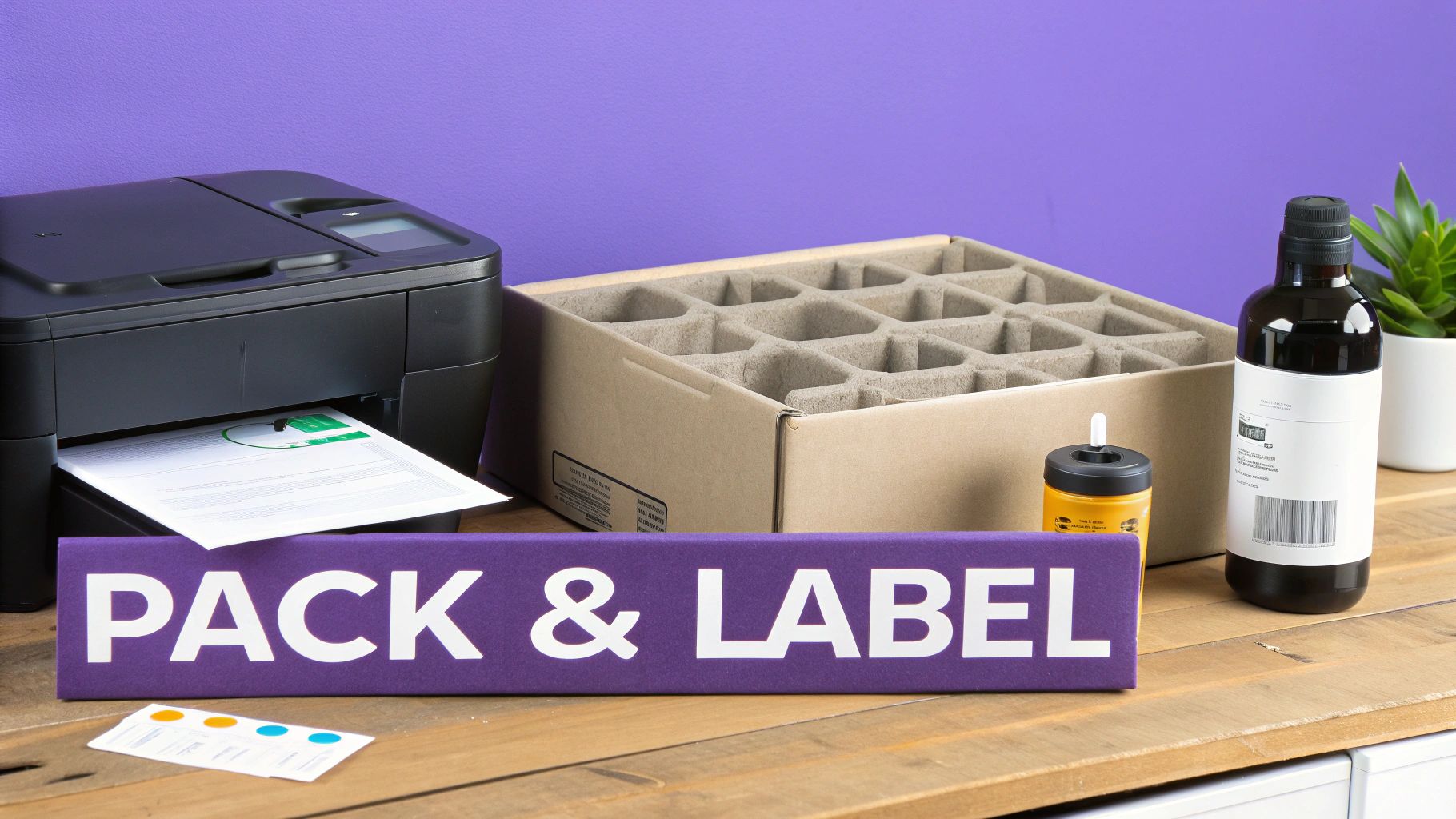
Think of packaging as your first line of defense against damage and compliance hiccups. Since FedEx doesn’t supply specialized alcohol cartons, the onus falls on you to build the perfect protective shell.
Mastering The Art Of Secure Packaging
Glass bottles need more than a hug from bubble wrap—they require suspension inserts that cradle each bottle. Common solutions include molded pulp or high-density foam, materials designed to absorb impact.
Resist the urge to slip bottles into loose-fill peanuts alone; they allow movement that spells breakage. Instead, choose purpose-built inserts that lock each bottle in place.
Picture a Vermont cider maker shipping in January to a diner in Phoenix. Their answer? Add insulated foam liners around those inserts to dampen temperature swings. It costs a bit more, but the surprise of perfectly chilled cider at the other end is priceless.
“We cut breakage by 87% in three months,” our retail partner shared. “Dumping flimsy cardboard dividers in favor of ISTA-certified inserts was a game-changer.”
Beyond carrier rules, you’ll want to brush up on broader frameworks like general US export control regulations. They’ll keep you out of legal tangles when shipping across borders.
The Unmistakable Marks Of Compliance
Labels aren’t decoration—they’re a communication lifeline. Every alcohol shipment must wear a FedEx alcohol shipping label and an Adult Signature Required sticker. These bright, visible markers signal handlers and drivers to follow the correct protocol.
Never staple documents to your box; staples pierce the carton and risk injury. Instead, tuck paperwork into a clear, adhesive packing slip envelope. That way, invoices and declarations stay secure without damaging the package.
To dive deeper into wine-specific rules, see our guide on shipping wine by FedEx.
FedEx Alcohol Packaging And Labeling Checklist
Before your next shipment leaves the warehouse, run through this quick checklist to guarantee FedEx compliance and protect your brand reputation.
| Checklist Item | Requirement Details | Common Mistake To Avoid |
|---|---|---|
| Outer Box Integrity | New, sturdy corrugated box with a high crush-test rating. No old labels. | Reusing an Amazon box with faded logos—sorting machines get confused. |
| Internal Packaging | Secure bottles with molded pulp, foam inserts, or similar. Zero movement. | Relying solely on bubble wrap or packing peanuts. |
| Sealing Method | H-taping style with pressure-sensitive plastic tape. | Using duct tape or masking tape that can peel off. |
| Required Labels | Clear FedEx alcohol shipping label plus Adult Signature Required sticker. | Placing labels over seams or under box flaps. |
| Paperwork Enclosure | Shipper declarations/invoices in a clear packing slip envelope. | Stapling documents directly onto the box. |
Use this table as a quick-scan guide for your fulfillment team.
Bringing It All Together
Satisfied that your packaging is robust and your labels crystal clear? That’s the hallmark of a shipper who treats compliance as seriously as customer experience.
Regularly audit your processes, update your inserts when better options emerge, and keep your team trained on the latest requirements. Do that, and you’ll minimize damage claims, stay in FedEx’s good books, and keep your alcohol shipments flowing smoothly—no matter the destination.
Taking Your Alcohol Sales Global
Pushing your alcohol sales beyond domestic borders is a huge step, but it's also where things get complicated. Shipping internationally isn’t just about covering more ground; it’s a crash course in customs, duties, and a mountain of export paperwork. Getting this part right is the difference between a thriving global brand and a logistical nightmare.
Think of every international shipment as a formal declaration to both the country you're shipping from and the one you're shipping to. This means your documentation has to be perfect. The two most critical pieces of paper you'll handle are the Commercial Invoice and the Certificate of Origin. They each play a specific role in getting your package cleared through customs.
Getting Your Export Paperwork Right
The Commercial Invoice is the absolute backbone of any international shipment. It’s far more than a simple bill—it’s the detailed record customs officials scrutinize to figure out duties and taxes. A vague or incomplete invoice is a surefire way to get your shipment stuck in customs limbo.
Your Commercial Invoice needs to be airtight. Be sure it includes:
- Detailed Product Descriptions: Don't just write "Wine." Get specific: "2021 Napa Valley Cabernet Sauvignon, 750ml, 14.5% ABV." The more detail, the better.
- Harmonized System (HS) Codes: These are universal codes that classify products for customs. The wrong code can lead to the wrong duty calculation and serious delays.
- Country of Origin: Be crystal clear about where the alcohol was actually produced.
- Value and Currency: List the precise value of the goods to ensure taxes are assessed correctly.
The Certificate of Origin is a different beast. It's a formal document that proves the country where your product was made. This is often required to comply with international trade agreements and can sometimes even help your customers get a break on import tariffs. It's essentially your product's passport.
Speed Up Customs with Electronic Trade Documents
Let's be honest: manually printing and managing stacks of customs forms is a recipe for mistakes and wasted time. This is where a tool like FedEx’s Electronic Trade Documents (ETD) system becomes a game-changer. By uploading all your customs paperwork digitally, you can dramatically speed up the entire clearance process.
FedEx has found that using ETD can help packages clear customs up to 50% faster. Why? Because customs agents can review your documents before the physical package even lands, spotting any potential issues well in advance. When you're shipping something as sensitive as fine wine, that saved time can mean the difference between a happy customer and a spoiled product.
We worked with a distributor who switched to ETD for all their wine shipments heading to the EU. Their average customs hold time plummeted from three days to less than 24 hours. The impact on their delivery promises and customer satisfaction was immediate.
Comparing International Shipping Scenarios
Shipping rules aren't one-size-fits-all; they change dramatically from one country to the next. The strategy that gets a case of wine to the European Union will not work for sending a bottle of bourbon to Canada.
Here’s a quick look at how different the requirements can be:
| Shipping Aspect | Wine to the EU | Spirits to Canada |
|---|---|---|
| Primary Document | Commercial Invoice with detailed wine specs (vintage, region, ABV). | Canada Customs Invoice (CCI) or a hyper-detailed Commercial Invoice. |
| Additional Forms | Certificate of Origin is often needed to get trade benefits. | Provincial liquor board import permits are almost always required. |
| Tax Calculation | VAT (Value-Added Tax) is the big one, a major part of the landed cost. | You have to calculate federal excise duties and provincial taxes. |
| Compliance Focus | Strict adherence to EU labeling laws and food safety standards is key. | Compliance with Canadian Food Inspection Agency (CFIA) rules is paramount. |
This is where a carrier with deep global experience becomes a critical partner. As of 2025, FedEx operates in over 220 countries and territories, with specialized alcohol shipping services to and from more than 130 countries for freight and over 215 for express. Their setup process for international alcohol shipping is famously tough, demanding everything from export licenses to certificates of origin. You can dig into FedEx's international alcohol shipping resources for more detail.
By getting a handle on these details and preparing your documents with military precision, you can turn the headache of international shipping into a serious competitive edge.
Integrating FedEx In Your E-Commerce Workflow
Getting your FedEx alcohol shipping account approved is just the beginning. If you try to manually generate labels and cross-reference state laws for every single order, your team will burn out—and the risk of a compliance slip-up skyrockets. Instead, you want FedEx’s tools to work seamlessly inside your store.
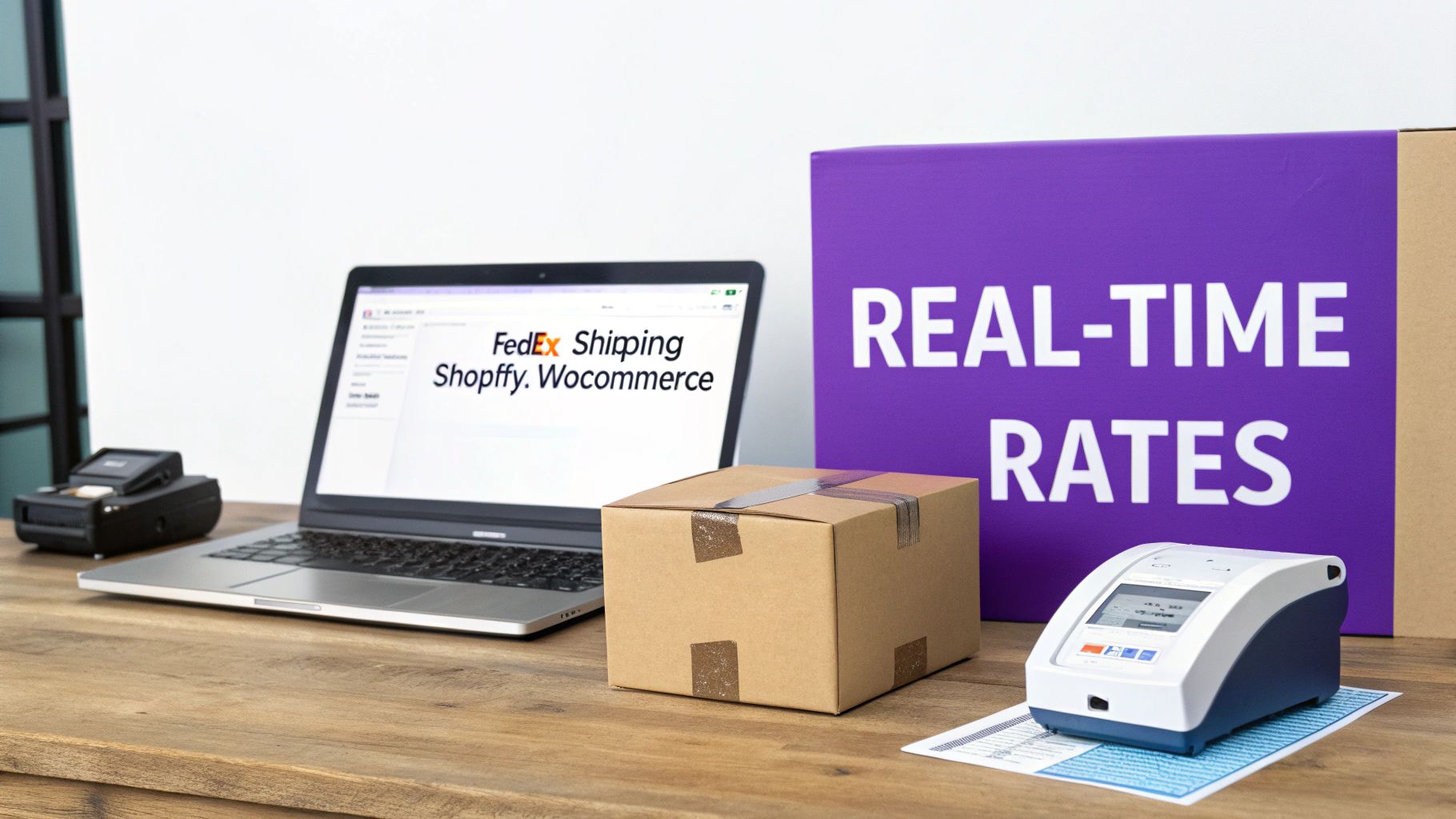
By linking FedEx to WooCommerce, Shopify, or another platform, you unlock automation that handles rates, labels, and tracking without a second thought. All of this runs through an API, the behind-the-scenes connector that keeps your storefront and FedEx in constant sync.
Connecting Your Store And FedEx
First things first: grab your FedEx API keys from the dashboard. These cryptic strings are your store’s passport for real-time data exchange.
Once you’ve got them, install the right plugin or app. WooCommerce merchants often rely on FedEx’s official extension. Shopify users can tap apps from the Shopify App Store, especially if you’ve invested in a polished Shopify website design beforehand.
With the connection live, your customers see real-time shipping rates at checkout. You’ll generate compliant labels in a single click and fire off automated tracking emails the moment a package scans out the door.
Key Benefits:
- Pull live FedEx rates based on location and weight
- Print “Adult Signature Required” labels instantly
- Send status updates without manual intervention
Automating Compliance With Ship Restrict
A standard FedEx plugin won’t stop a customer in a prohibited state from ordering alcohol. That’s where a specialized tool like Ship Restrict comes into play. It embeds state-by-state rules right into your WooCommerce checkout, so non-compliant orders never slip through.
Imagine this scenario:
- A small gin distillery in Oregon kicked off online sales with high hopes.
- Their first big shipment headed to a dry county in Texas—only to be confiscated.
- They faced a $1,500 fine and a stern warning from the state liquor board.
After adding Ship Restrict, they set up rules blocking every dry state, county, and ZIP code. Today, those orders stop at checkout—and their licenses stay intact. You can see how to configure these safeguards in our guide to WooCommerce alcohol shipping restrictions.
Automating compliance isn’t just a convenience—it’s risk management. One mistaken shipment can cost more than the tool that prevents thousands of them.
Testing Your Integrated Workflow
Before you hit “go live,” duplicate your store in a staging environment and run through mock orders. Here’s what to verify:
- Compliant Address Test: Ship to a licensed state. Confirm FedEx rates display correctly and you can generate a label flagged “Adult Signature Required.”
- Restricted Address Test: Try an order to a banned state. The checkout should show your custom block message and prevent payment.
- Partial Restriction Test: If you only ship wine, run a spirits-only order. Make sure the system spots the violation and stops it.
This final check proves your API keys, plugins, and compliance rules all fire as expected. Once everything passes, push those changes to your live store—knowing your FedEx alcohol shipping workflow is both efficient and airtight.
Building Your Operational Checklist for Flawless Shipping
Once your FedEx alcohol account is set up and integrated, the real work begins. Consistent execution is what separates the pros from the amateurs, and a daily playbook is your best friend for making sure every single order ships flawlessly. Guesswork leads to errors, so let's build a solid rhythm.
Think of your fulfillment process in two phases: the pre-shipment hustle to get packages out the door correctly, and the post-shipment monitoring to handle everything that comes next.
The Pre-Shipment Playbook
Before a single label gets printed, your team needs a quick but thorough validation sequence. This isn't just about slapping a sticker on a box—it's about catching the small mistakes that turn into big, expensive problems like returned shipments or compliance violations.
Here’s what your pre-shipment routine should look like:
- Address Validation: Run every address through an automated tool or FedEx's own system. This one simple step catches typos and prevents your precious cargo from ending up in a logistical black hole.
- License and Rule Check: Cross-reference the destination state and ZIP code against your compliance rules. Is it a state you're licensed to ship to? Is the customer in a dry county? A tool like Ship Restrict automates this beautifully, but a final human check is always a smart backup.
- Final Pack-Out Inspection: Give the packed box a final once-over. Is the packaging secure? Is the Adult Signature Required sticker slapped on there prominently? Is all the required paperwork tucked safely in its pouch?
Pro Tip: Create a physical checklist card for each packing station. Have your team initial each step as they complete it. This builds a culture of accountability and makes sure nothing gets missed when things get hectic.
Post-Shipment and Long-Term Compliance
The moment a package leaves your warehouse, your job isn't over. Proactive monitoring is key to managing customer expectations and, just as importantly, protecting your hard-earned shipping privileges with FedEx. This means keeping an eye on tracking exceptions—like delivery delays or failed attempts—and getting in front of customer questions.
Staying compliant over the long haul is just as critical. You can't afford to let a license lapse. Set calendar reminders for 90 days before your state and federal licenses are set to expire. That gives you plenty of breathing room to get renewals handled without any interruption to your shipping operations.
To keep everything organized, consider building a simple operations dashboard in a shared spreadsheet or a project management tool. This can be your command center for tracking:
- License Renewal Dates: A clear, color-coded timeline for all your permits.
- Carrier Policy Updates: A running log of any changes to FedEx’s alcohol shipping agreement.
- State Law Changes: Quick notes on new legislation popping up in the states you ship to.
This system acts as your early warning system, flagging critical dates and regulatory shifts so you can adapt on the fly. By baking these checklists and dashboards into your daily workflow, you turn that FedEx account from a simple tool into a reliable, compliant engine for growth.
Common Questions About FedEx Alcohol Shipping Accounts
Getting set up with a FedEx alcohol shipping account usually brings up a few key questions. Here are the answers to the ones we hear the most, with some practical advice to help you get through the process smoothly.
How Long Will My Approval Take? And What Slows It Down?
This is the big one. Generally, you can expect approval anywhere from three days to two weeks after you’ve submitted everything—that means all your current state and federal licenses plus the signed FedEx Alcohol Shipping Agreement.
What really dictates the speed is accuracy. The single best thing you can do to speed things up is to triple-check that the legal names and physical addresses on your licenses are an exact match for what’s on your FedEx account. Even a small typo can push your application to the back of the line.
The number one reason applications get delayed or flat-out rejected is mismatched paperwork. We see it all the time: an expired state license, a business name that's slightly off, or a missing signature page. A simple pre-submission checklist is your best friend here.
Shipping Permissions and Keeping Your Account in Good Standing
Can I ship beer, wine, and spirits with the same account?
Not automatically. Your shipping permissions are tied directly to the licenses you provided and what your FedEx agreement says. If you were approved to ship wine and beer, you are not clear to suddenly start shipping spirits.
It’s really important to talk through your entire product line with your FedEx rep from the get-go. If you think you might expand into spirits or other types of alcohol down the road, you’ll need to go back and update your agreement and hand over the new licenses to stay compliant.
How do I stay compliant over time?
Staying on top of this is all about being proactive. Put reminders in your calendar for 90 days before your federal and state licenses are set to expire. This gives you plenty of runway to get them renewed without any last-minute panic.
It’s also a good habit to schedule a quick, quarterly review of FedEx’s official alcohol shipping policies to catch any updates. We recommend keeping a shared digital folder with the most current versions of all your compliance documents so they're always ready when you need them.
Ready to automate your shipping compliance and stop worrying about state-by-state rules? Ship Restrict for WooCommerce makes it easy to block restricted destinations before an order is even placed. Learn how Ship Restrict can protect your business today!
Automate Alcohol Shipping Compliance
Stop worrying about restricted states. Ship Restrict handles it automatically.

Cody Yurk
Founder and Lead Developer of ShipRestrict, helping e-commerce businesses navigate complex shipping regulations for regulated products. Ecommerce store owner turned developer.
Automate Alcohol Compliance
- Block restricted states
- No more cancellations
- Set and forget
3-day free trial · Card required