What Does Flat Rate Shipping Mean: A Complete Guide for 2026
Understand what does flat rate shipping mean and how it stacks up against weight-based rates. A must-read for WooCommerce firearms sellers in 2026.
Flat rate shipping means one fixed fee per order or per package, even when the package's weight or destination changes, and firearms sellers need to layer compliance checks on top before checkout completes. For USPS Priority Mail Flat Rate, that fixed-fee model covers packages up to 70 lb, with prices starting at $11.00 at a Post Office and the Small Flat Rate Envelope listed at $11.12 commercial pricing or $12.90 at the Post Office (USPS Priority Mail Flat Rate).
A customer lands on your checkout page, sees one shipping number, and either buys or bails. If you run a WooCommerce store for regulated goods, that number can't be the last gate in the flow. The address still has to pass state, county, city, or ZIP restrictions before the order should ever move forward.
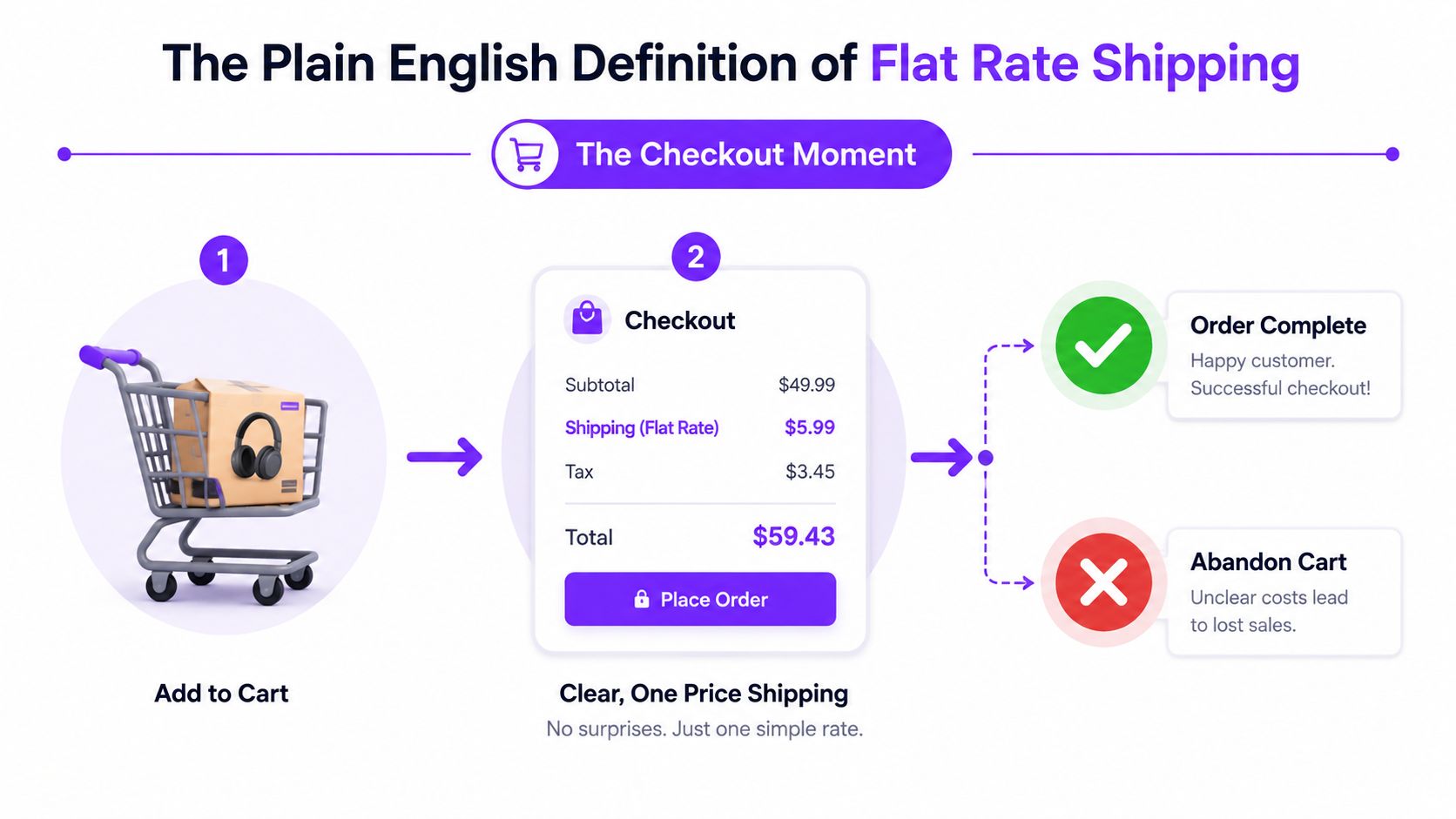
The Plain English Definition of Flat Rate Shipping
A merchant rarely thinks about shipping in the abstract. You're looking at a cart, the customer is waiting, and the shipping line has to make sense fast enough to keep the order alive. Flat rate shipping is the simplest possible promise in that moment, one fixed price instead of a rate that changes every time the destination or package details change.
Carrier flat rate and store-set flat rate
There are two meanings people lump together. The first is carrier flat rate, where USPS, UPS, or FedEx charge a fixed fee for a specific box, envelope, or container, regardless of the package's weight up to the carrier limit. USPS Priority Mail Flat Rate is the clearest example, because it lets customers ship to any U.S. state for one price as long as the parcel stays under 70 lb (USPS Priority Mail Flat Rate).
Automate Shipping Compliance
Block orders to restricted states automatically. 3-day free trial.
Start Free TrialThe second is store-set flat rate, which is a checkout rule you program into WooCommerce. Shopify describes this as a fixed shipping charge that can be general or conditional, so a merchant can set different flat rates for domestic, international, or higher-value orders (Shopify on flat rate shipping rules). That's the part many store owners miss. The same phrase can mean the carrier's box pricing or your own checkout pricing.
Practical rule: if the customer sees one shipping line and you can explain it in one sentence, you're working with a flat rate model.
For regulated-goods merchants, the destination rules sit above both versions. A fixed shipping fee doesn't override a blocked ZIP code, a restricted state, or a product that needs a different fulfillment path. That's why the job is not just defining the rate, it's defining when the rate is allowed to appear at all.
The cleanest way to say it to a customer is simple, honest, and consistent. Flat rate shipping means they pay one set amount, but only after the store confirms the order is eligible to ship.
For a tighter carrier-side example, the box format and USPS pricing model are broken down well in this flat rate shipping box guide, which is useful if you need to match packaging to a specific rate class.
How Flat Rate Stacks Up Against Other Shipping Models
Flat rate sounds straightforward because it removes some of the math. The problem is that shipping math doesn't disappear, it just moves somewhere else. If you sell accessories, serialized parts, and ammunition in the same store, the pricing model has to match the order shape, not your preference for simplicity.
Where each model fits
Weight-based shipping prices the order by actual parcel weight. It works best when product weights are consistent and easy to model, but it can get awkward when a light item ships in a large box or when the carrier's dimensional logic makes the actual cost jump. Zone-based shipping adds distance into the equation, so nearby buyers may pay less than distant ones, which is logical but can create checkout friction when customers see the number change by ZIP code.
Real-time carrier rates pull live pricing from UPS, FedEx, or USPS APIs. That's useful when you want the quote to mirror the carrier, but it can produce jarring swings for the shopper. Free shipping thresholds can increase order size, but they also hide the shipping cost inside your margins if you don't model them carefully.
A flat rate is easiest to explain, but not always easiest to defend financially.
Shipping Pricing Models Side by Side
| Model | How the price is set | Best for | Main risk for firearms merchants |
|---|---|---|---|
| Flat rate | One fixed checkout amount | Compact accessories, boxed kits, predictable parcel types | Can overcharge light orders or undercharge bulky ones |
| Weight-based | Based on parcel weight | Catalogs with stable item weights | Dimensional packing surprises |
| Zone-based | Based on destination distance | Stores serving a wide geography with variable freight cost | Checkout friction from ZIP swings |
| Real-time carrier rates | Live API quote from the carrier | Mixed catalogs, serialized items, odd parcel profiles | Rate shock at checkout |
| Free shipping threshold | No shipping charge after a minimum order value | Cart-building promotions | Margin erosion if the threshold is set badly |
Table-rate shipping sits between these options and flat rate because it lets you price by rule instead of by one universal number. The difference is control. A store can say, “this group of items gets this rate under these conditions,” rather than pretending every order behaves the same way. That's why the table rate shipping guide is worth reading if you need more than a single flat number.
Free Shipping Compliance Audit
We'll review your WooCommerce store's shipping compliance for free.
For firearms merchants, the decision usually comes down to whether the order is mechanically simple or operationally sensitive. If the shipment is small, dense, and allowed everywhere you ship, flat rate can be a clean checkout rule. If the order changes based on destination, product class, or carrier handling, a more granular model usually fits better.
Concrete Pricing Scenarios You Can Run Today
The fastest way to understand flat rate shipping is to compare it to what you already pay. Don't start with theory. Start with one SKU, one destination, and one carrier invoice. Once you do that, the pattern usually becomes obvious.
A compact accessories order
A 2 lb optics order is a good test case because it's heavy enough to matter but still compact. If you can fit it into a USPS Priority Mail Flat Rate Small Box, the carrier's fixed price is easy to compare with your calculated postage to the same ZIP (USPS Priority Mail Flat Rate).
That comparison answers the question. If the calculated rate is lower than the flat rate, the flat option is working against you. If the calculated rate is higher, the flat option is protecting your margin and giving the shopper one less reason to hesitate.
A denser order that rewards the fixed fee
A 12 lb range bag often makes more sense under flat rate than under weight-based pricing, especially when the parcel shape stays inside the carrier's allowed container. Flat rate shines here, because the buyer sees one clean number and you avoid turning a routine accessories order into a shipping puzzle.
The key is not the item count, it's the parcel profile. If the bag fills the box well and stays under the carrier's limit, flat rate can be the quieter, safer choice for both sides of the transaction. If it forces you into a larger box than needed, the fixed fee can become the expensive option.
A lightweight order that should probably not use flat rate
A $35 accessory order is where flat rate often loses to a free-shipping threshold strategy. If the item is light and the margin is tight, charging a fixed rate can make the cart feel unnecessarily expensive. That's a customer experience issue first, and a margin issue second.
Use the math the same way every time. Compare the fixed fee, the calculated rate, and the order value, then decide whether the order should qualify for a threshold promotion or a standard shipping charge. If you want a carrier-side pricing reference for box classes, this flat rate box pricing breakdown is useful as a starting point.
Why Flat Rate Is a Double-Edged Sword for Firearms Sellers
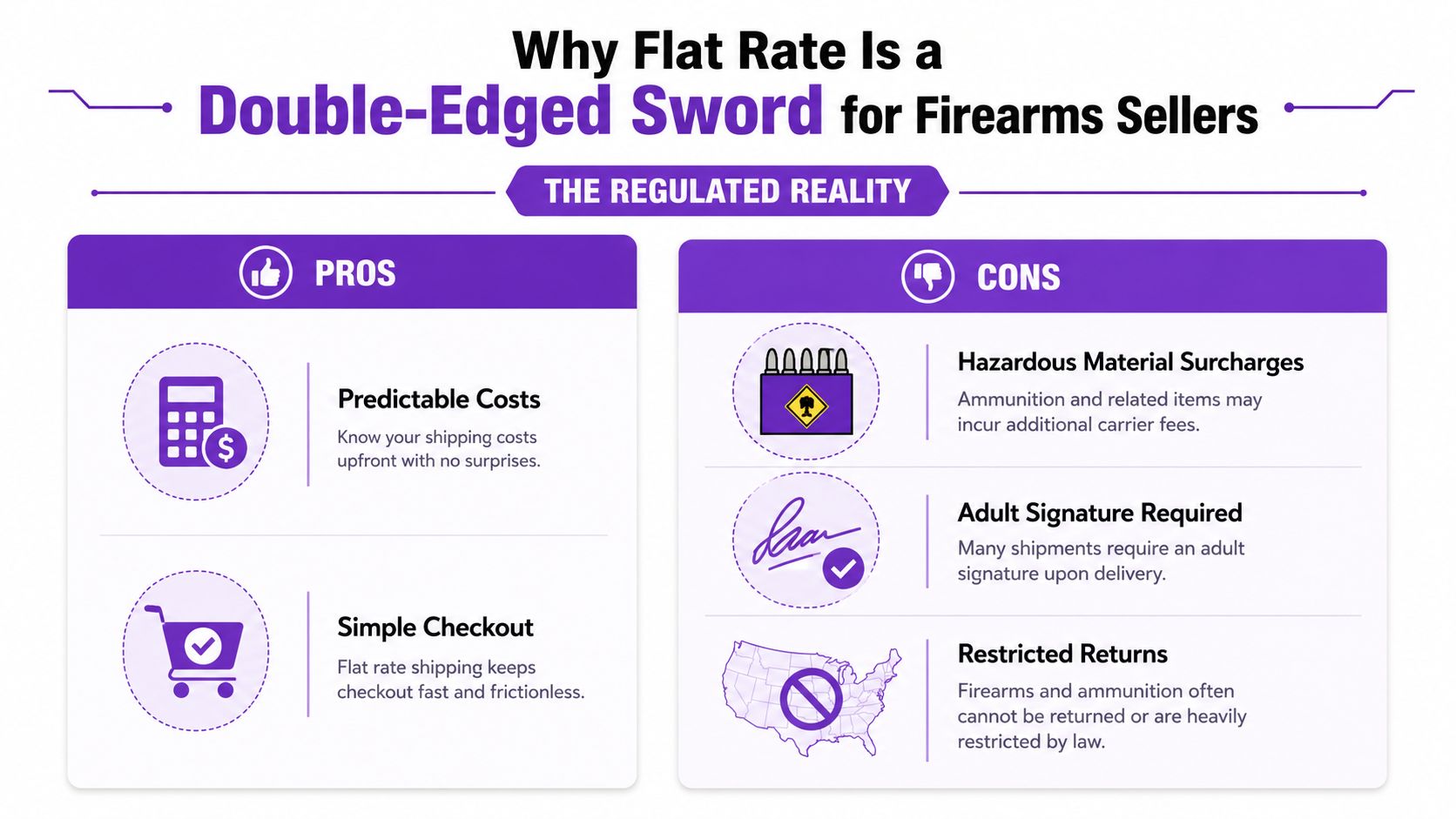
In a firearms store, shipping isn't only about cost. It's about whether the destination can legally receive the product, whether the carrier requires extra handling, and whether the package can move without creating a compliance mess. Flat rate helps with one part of that puzzle, but it doesn't solve the rest.
Where flat rate helps
Flat rate works well for heavy, compact accessories and for bulky items where the shipping cost would otherwise be hard to predict. It also keeps checkout cleaner. A customer doesn't want a shipping quote that changes three times because the package size, zone, and destination all interact in ways they can't see.
It can also reduce confusion around routine fulfillment items, like large cleaning kits or organized accessory bundles. When the order shape is stable, the fixed fee is easy to communicate and easier to support if a customer asks about it later.
Where flat rate quietly fails
Flat rate does not erase restrictions on ammunition, adult signature requirements, or destination blocks. USPS Priority Mail Flat Rate exists as a carrier model, but that doesn't mean every regulated item belongs in it, and it doesn't mean every destination is eligible (USPS Priority Mail Flat Rate). A fixed shipping price is still the wrong answer if the order can't legally ship to the selected address.
There's also a workflow problem with returns. If a shipment can't cross a state line on the way back, the original shipping model never had a chance to solve the core issue. The merchant still needs a compliance decision before the rate is useful.
Bottom line: shipping price comes after shipping eligibility, not before it.
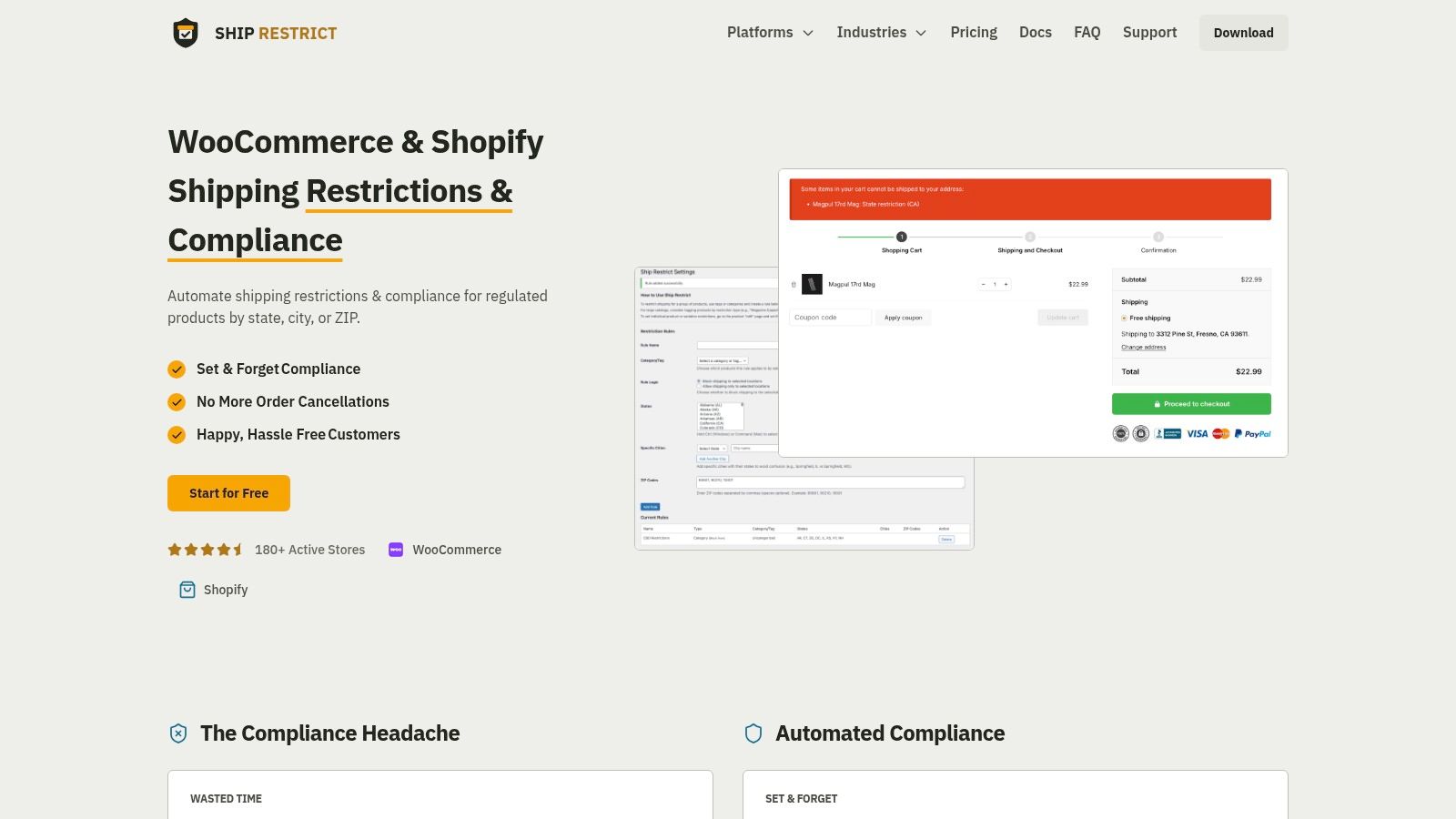
That's where a restriction layer becomes part of the pricing conversation. A tool such as Ship Restrict automates WooCommerce address checks by state, county, city, or ZIP before checkout completes, so the store can block an invalid shipment before the customer ever treats the flat rate as a promise.
Setting Up Flat Rate Shipping in WooCommerce the Right Way
WooCommerce makes flat rate easy to turn on, but easy setup can hide a bad workflow. The shipping method itself is only one piece. If the store sells regulated products, the destination needs to be validated before the shopper sees a final shipping number.
Build the rate in shipping zones
Start in WooCommerce Settings → Shipping → Zones and create a domestic zone that matches where you ship. Add Flat Rate as a shipping method in that zone, then set the cost field to match your pricing logic. WooCommerce supports simple per-order math, per-item math, and percentage-of-cart style setup, so you can tailor the rule to the catalog instead of forcing every SKU into the same pattern.
If your catalog is mixed, keep the logic readable. A small accessory order might use one flat fee, while a larger bundle might need a different rule or a different zone. Don't bury the logic in a spreadsheet if WooCommerce can hold it clearly in the admin.
Put compliance before the rate
Flat rate only matters after the address is allowed. That means the restriction engine has to run before WooCommerce calculates shipping, not after the customer has already committed to payment. If the address is invalid, the shopper should see a clear explanation immediately instead of a broken checkout or a refund later.
One useful implementation reference for rate logic and broader shipping practices is rewards shipping best practices. The takeaway is simple, shipping math only works when the storefront is telling the truth about what the order costs and where it can go.
For regulated goods, the operational sequence matters more than the rate itself. I'd rather see a store block a bad address early than calculate a beautiful flat fee for an order that can't ship.
You can also pair setup with a short maintenance checklist.
- Create rule sets in bulk: Load common restricted destinations together instead of editing one ZIP at a time.
- Use scheduled updates: Keep restriction rules aligned with policy changes or state-level changes.
- Set admin notifications: Make sure the team knows when a blocked order pattern starts repeating.
- Test edge cases: Run domestic, border-state, and restricted ZIP scenarios before you trust the checkout.
If you prefer a video walkthrough of the compliance side, use the embedded guide below after you've seen the basic setup in the image.
Messaging and Policy Wording That Prevent Chargebacks
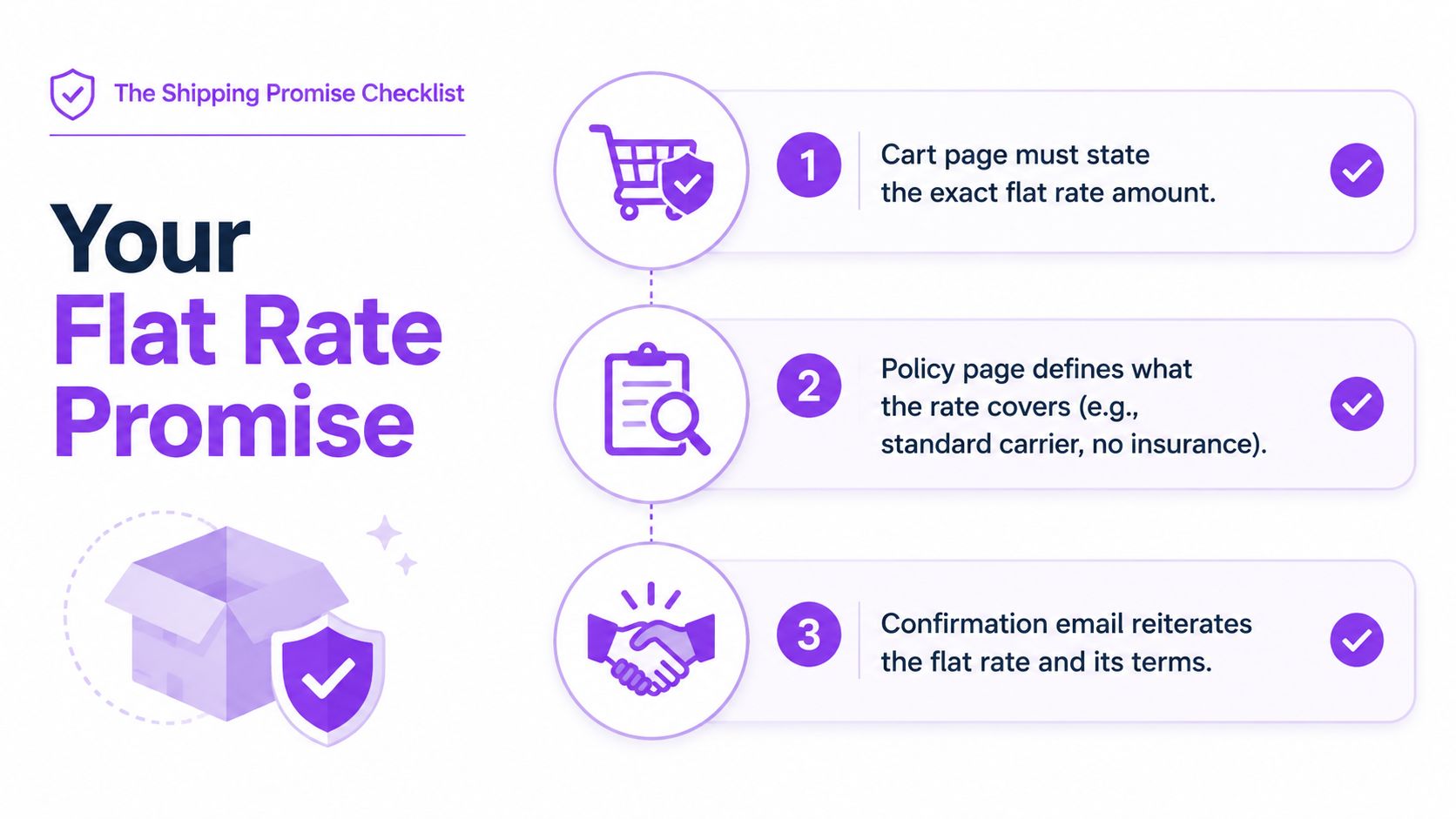
Flat rate is a promise, not just a number. If the customer sees a fixed fee at checkout, your cart, policy page, and confirmation email all need to say what that fee covers and where it stops. The faster that language matches the fulfillment process, the fewer cancellations and chargebacks you end up handling.
Say what the fee includes
Your cart should say the flat rate amount plainly. Your policy page should define whether that fee includes standard carrier service only or whether it excludes add-ons like insurance, oversized handling, or special delivery requirements. Your confirmation email should repeat the same terms so the customer doesn't discover a gap after payment.
That language matters even more when the order can't legally ship to the selected destination. If the store blocks an order, the message should explain the restriction clearly and calmly. The customer may not like the answer, but they're far less likely to dispute it if the rule was visible before they paid.
Use plain copy that reduces friction
Bad copy sounds defensive. Good copy sounds operational.
-
Before: “Shipping will be calculated after review.”
-
After: “A flat shipping fee will appear only for addresses that qualify under our shipping policy.”
-
Before: “Some items may not ship to your state.”
-
After: “If an item is restricted in your destination, checkout will stop and explain why before payment.”
That kind of wording helps because it frames the rule as part of checkout, not as a surprise later. If you're using a regulated-destination block, Ship Restrict can display custom checkout messages so the customer sees the reason the order can't continue instead of an empty dead end.
Putting It All Together for a Small Firearms Store
A practical WooCommerce setup usually splits the catalog by shipping behavior. Accessories can often live on a flat rate rule. Serialized parts may need live carrier rates plus adult signature handling. Ammunition often needs a different cost model altogether because the carrier handling is different from a normal parcel.
For a store that wants a broader operations reference, the MD TECH TEAM OMS guide is a useful companion when you're thinking about how shipping logic fits inside order management, not just checkout.
The clean version of the workflow is simple. Configure zones, set the flat rate math, validate the destination before the rate appears, update cart and policy language, then review one month of orders for surprises. If a rate looks good but the shipping rules are wrong, the checkout may still be broken.
The sentence to remember is this. Flat rate is only useful when the destination is eligible and the package profile fits the promise you made at checkout.
If you need to keep restricted orders from reaching checkout in the first place, Ship Restrict can automate the address checks that flat rate shipping depends on. Visit Ship Restrict to see how WooCommerce shipping restrictions, custom customer messages, and regulated-destination blocking fit into the same checkout flow.
Automate Shipping Compliance
Stop worrying about restricted states. Ship Restrict handles it automatically.

Cody Yurk
Founder and Lead Developer of ShipRestrict, helping e-commerce businesses navigate complex shipping regulations for regulated products. Ecommerce store owner turned developer.
Automate Shipping Compliance
- Block restricted states
- No more cancellations
- Set and forget
3-day free trial · Card required