Flat Rate Shipping Box: A Guide for Firearms Retailers
Learn when a flat rate shipping box saves you money on firearms & parts. This guide covers costs, profitability, legal issues, and WooCommerce compliance.
A customer loads a cart with magazines, a trigger, and a dense parts kit. Your checkout shows one shipping price when they're in a nearby state, then a very different number when the same package is going cross-country. You tweak packaging, rerun rates, and watch margin disappear one order at a time.
That problem hits firearms retailers harder than most stores. A lot of FFL inventory is compact, heavy for its size, and regulated in ways that make a shipping mistake more expensive than a simple refund. A flat rate shipping box can solve part of that problem, but only when you use it for the right products, the right destinations, and the right checkout logic.
Why Predictable Shipping Costs Matter for FFLs
New store owners usually focus on product cost, transfer workflow, and payment risk first. Shipping sneaks up later. Then the first batch of dense accessory orders goes out, and you realize the box cost wasn't the issue. The freight math was.
A firearms retailer doesn't just ship light apparel and stickers. You ship magazines, slides, parts kits, optics mounts, and other compact items that can get expensive fast under calculated methods. One order looks profitable until the destination changes. Another looks easy until the carrier charge wipes out the margin you expected to keep.
Automate Shipping Compliance
Block orders to restricted states automatically. 3-day free trial.
Start Free TrialWhere the pain shows up first
The worst surprises usually come from orders that look small on the packing bench.
- Dense accessories: A small footprint doesn't mean a cheap shipment. Metal parts, bundled accessories, and kits can drive cost up quickly under weight and zone pricing.
- Mixed carts: One customer combines a few simple items, and suddenly your package no longer fits the cheapest packaging option.
- Customer expectations: Buyers hate seeing shipping recalculated upward late in checkout, especially on commodity products where they can compare stores in seconds.
Practical rule: If shipping cost changes often enough that you hesitate before quoting it, you don't have a pricing system. You have a recurring margin leak.
Predictability matters because it helps you set customer-facing rules that you can defend. If you know a certain package type gives you a stable cost ceiling, you can build offers around it. That improves quoting, reduces manual intervention, and makes your support inbox quieter.
Why this matters more in a regulated business
In a normal eCommerce store, a shipping mistake is mostly operational. In an FFL environment, it's operational and compliance-related. Staff already have to think about destination rules, product restrictions, carrier policies, and packaging standards. If shipping cost also varies wildly, every order becomes a manual decision.
That's where flat rate starts to earn its place. Not because it's always cheapest. It isn't. It earns its place because some regulated product categories benefit from a shipping method that removes part of the uncertainty.
When I train new staff, I tell them to separate shipping into two questions. First, is this legal and carrier-acceptable to send this way. Second, is this packaging and service profitable. A flat rate shipping box can simplify the second question, but it never replaces the first.
Flat Rate Versus Calculated Shipping Explained
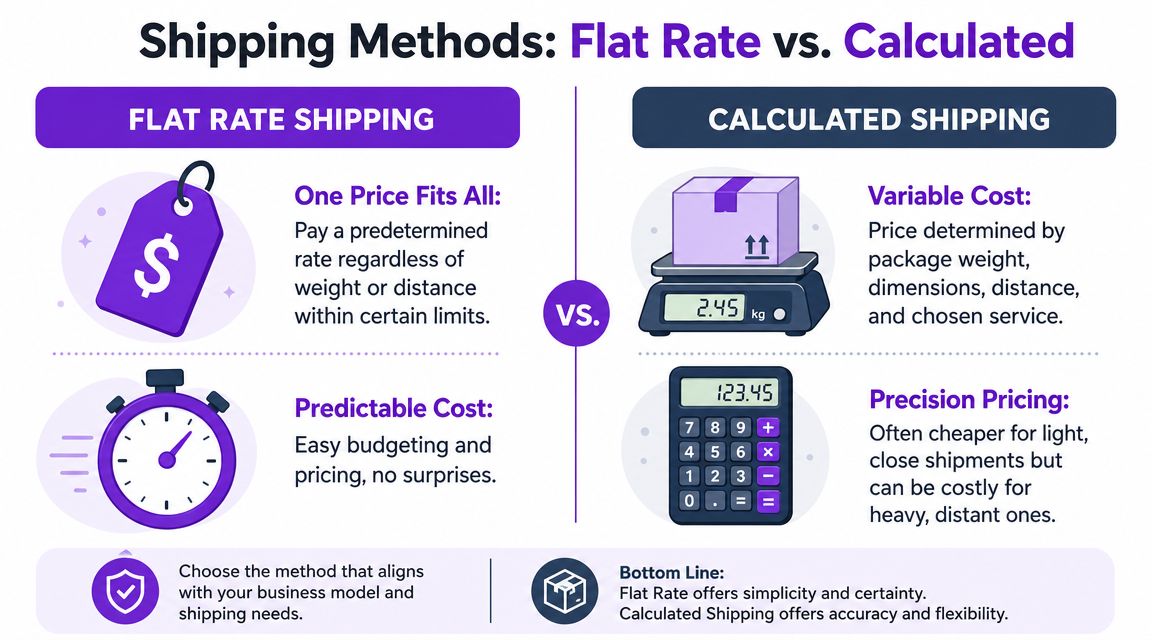
Think of flat rate shipping like a fixed-price buffet. You pay one set amount for the container, and the cost doesn't change based on how far the package travels within the service rules. Calculated shipping is closer to ordering à la carte. Weight, dimensions, destination, and service level all influence the final number.
For firearms retailers, that difference isn't academic. It changes how you quote shipping, how your WooCommerce rules should work, and how much manual review your staff has to do.
What flat rate actually means
The clearest U.S. example is USPS Priority Mail Flat Rate. USPS states that flat rate packages can weigh up to 70 lbs and still ship for the same price nationwide, with no zone-based pricing. USPS lists a Small Flat Rate Box at $13.65 retail and $12.10 commercial, while a Medium Flat Rate Box is $24.80 retail and $21.17 commercial. USPS also shows Medium Flat Rate Box outside dimensions of 11 1/4″ × 8 3/4″ × 6″ for top-loading and 14″ × 12″ × 3 1/2″ for side-loading on its Priority Mail page at USPS Priority Mail Flat Rate pricing and dimensions.
Free Shipping Compliance Audit
We'll review your WooCommerce store's shipping compliance for free.
That model is attractive because the destination doesn't change the price. If you can make the product fit the approved box and stay within the service rules, you know your ceiling before you print the label.
How calculated shipping works in practice
Calculated shipping reacts to the shipment itself.
- Weight matters: Dense products usually cost more as they get heavier.
- Distance matters: Longer-travel shipments often cost more than local or regional ones.
- Box choice matters: A poor packaging decision can increase the charge even before the order leaves your bench.
This method is often better when the product is light, close to the destination, or too awkward for flat rate packaging. It's also useful when you want the customer to pay the exact transportation cost instead of a broad average.
Flat rate removes zone math. Calculated shipping rewards precision, but only if your packaging data is clean and your catalog is classified correctly.
Which model creates fewer surprises
For a new FFL operator, flat rate usually wins on simplicity. Staff can learn box-fit rules faster than they can learn shipping-zone economics. That's valuable when your team is already juggling age-gated items, regulated parts, and address restrictions.
Still, a flat rate shipping box isn't a universal answer. If the order is light, the fixed charge can overshoot what the shipment would have cost under a standard service. If the item doesn't fit safely, forcing it into a flat rate workflow is a packing mistake disguised as a pricing strategy.
Matching Flat Rate Box Sizes to Firearm Products
The fastest way to misuse a flat rate shipping box is to think in shipping services instead of product shapes. Start with the inventory. Then match the item to the box, not the other way around.
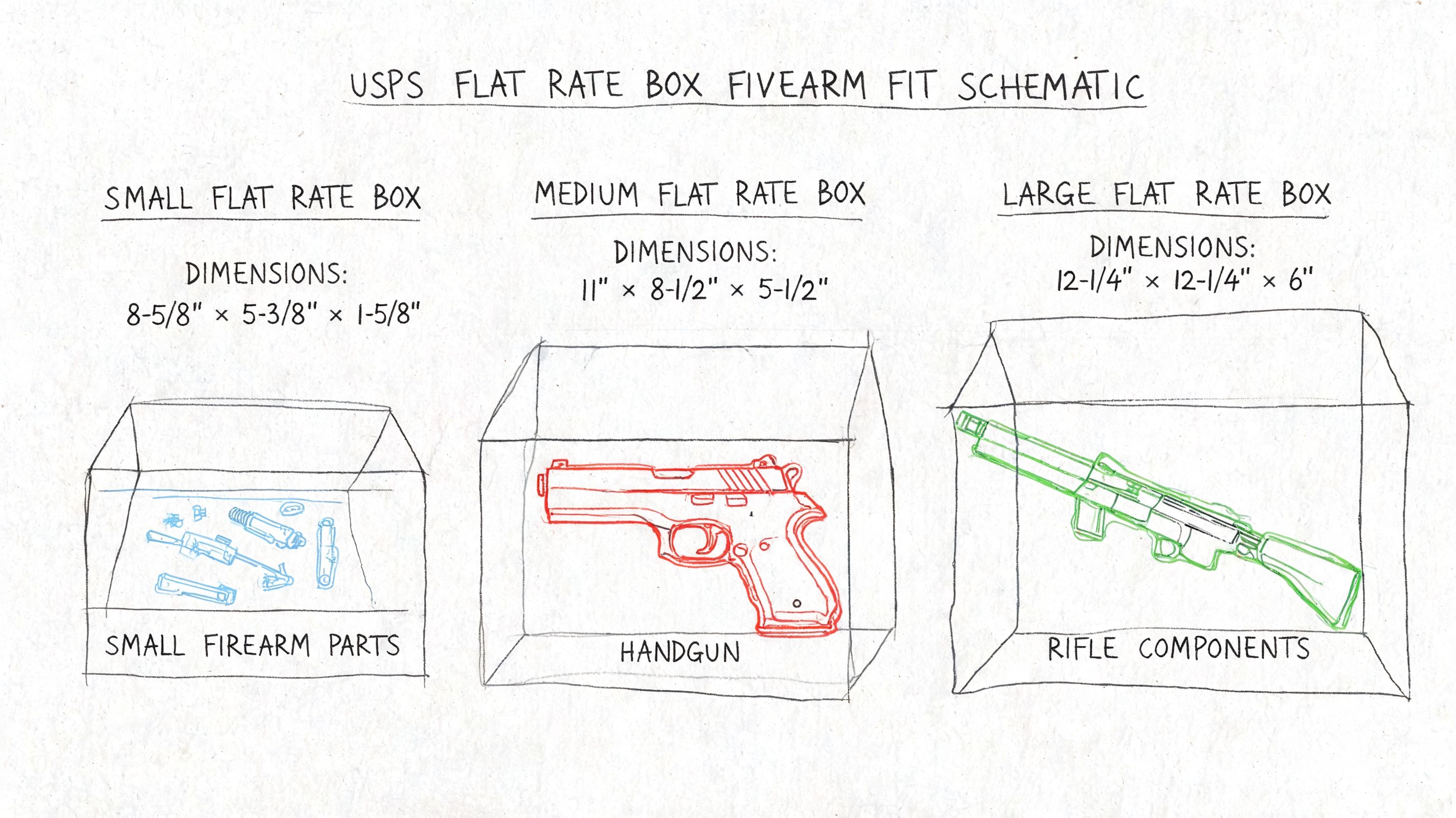
USPS Flat Rate boxes are built around fixed dimensions and a 70 lb domestic maximum weight cap, so the pricing model depends on the container type rather than dimensional weight or distance. USPS lists the small box at 8-5/8" × 5-3/8" × 1-5/8" inside, the medium top-loading box at 11" × 8-1/2" × 5-1/2" inside, and the medium side-loading box at 13-5/8" × 11-7/8" × 3-3/8" inside in its USPS Flat Rate Quick Reference.
Quick reference for common FFL inventory
| Box Type | Internal Dimensions (inches) | Common FFL Items |
|---|---|---|
| Small | 8-5/8" × 5-3/8" × 1-5/8" | Magazines, triggers, small optics mounts, springs, compact metal accessories |
| Medium top-loading | 11" × 8-1/2" × 5-1/2" | Parts kits, slides, bundled accessories, boxed small components |
| Medium side-loading | 13-5/8" × 11-7/8" × 3-3/8" | Longer accessory sets, flatter kits, bulk magazine orders, some stocks or handguards if packed carefully |
For a broader pricing overview tied to these box formats, see this breakdown of how much flat rate boxes cost.
How to think about fit
The small box works best when the item is dense and compact. Magazines are the classic example. So are triggers, small parts bundles, and some mounts. If the product needs significant padding or has awkward protrusions, this box gets cramped quickly.
The medium top-loading box gives you more vertical room. It's useful for chunkier kits, grouped accessories, and products that don't sit flat without wasted void space. If your staff is repeatedly stacking parts to make them fit, this version is often easier to pack cleanly.
The medium side-loading box helps when the item is longer and flatter. Some parts assortments and accessory bundles sit better here because you can spread them horizontally instead of piling them.
The right box isn't the smallest one the item can technically enter. It's the smallest one that lets the item travel without movement, crushed corners, or bulging seams.
What usually doesn't belong in flat rate
Some products are just bad candidates.
- Oddly shaped items: If the part needs too much filler to stay stable, your labor cost goes up and the fit advantage disappears.
- Fragile accessories: If the item needs custom foam, branded packaging, or oversized protection, your own box may be better.
- Products with carrier or legal complications: Box economics never override mailing restrictions or regulated-content rules.
For FFL operations, the best flat rate wins usually come from compact, heavy, non-fragile items that pack tightly and predictably.
Calculating Profitability with Flat Rate Shipping
A new store owner sees a USPS flat rate box, sees one posted price, and assumes the margin math just got easier. In firearms eCommerce, that shortcut causes two kinds of losses. One hits postage. The other hits process control when staff force regulated and non-regulated orders through the same workflow.
Flat rate works best as a lane, not a default.

Start with the comparison that matters
Profitability comes from comparing the flat rate box against the actual service you would ship if flat rate did not exist. For one order, that may be Ground Advantage. For another, it may be weight-based Priority Mail. For regulated products, it may not be USPS at all, which is why teams handling serialized items need a clear carrier decision path, not just a box-size chart.
Analysts at Shippo note that USPS flat rate pricing gets more competitive as shipments become heavier and move farther, while lighter parcels often price better under non-flat-rate services in the same carrier family. That is the right way to frame the decision: compare the exact product, destination, and allowed service options, then choose the cheaper compliant method for that shipment.
The margin test I use
For each SKU or bundle, check four costs together:
- Postage cost. Compare flat rate against the service you would otherwise buy for that same order.
- Packaging cost. Include void fill, tape, labels, and the cost of box breakage or repacks.
- Labor cost. If the item barely fits and staff spend extra time packing around corners, the box is costing more than the rate table shows.
- Compliance cost. A bad carrier choice for a regulated item can create refund work, intercepted shipments, or much worse.
That last one matters more for FFLs than many new operators expect.
A flat rate box can save money and still be the wrong operational choice if it encourages staff to treat every order the same. Teams need carrier rules that separate ordinary accessory shipments from restricted products. For carrier-specific handling, keep a written workflow tied to your checkout and warehouse process, such as this operational guide to shipping firearms with UPS.
Where flat rate usually earns its keep
Flat rate tends to hold up when the order is compact, dense, and going a meaningful distance. Magazine bundles, parts kits, and heavy accessory orders often fit that pattern. The farther the zone and the heavier the parcel, the more often flat rate deserves a serious look.
Where it usually fails is the light order that happens to fit the box. In that case, you are often paying a premium for predictability. That can still be acceptable if your checkout promise depends on a fixed shipping charge, but it should be a deliberate pricing decision, not an assumption.
I have seen stores keep flat rate on selected product groups for exactly that reason. Predictable shipping can reduce cart friction and make customer support easier, especially for stores with repeat accessory orders. Businesses outside firearms use the same logic when they are ordering paper cups and packaging nationwide. The difference for FFLs is that convenience never overrides carrier restrictions or product classification.
A practical review rule
Use flat rate at the product-family level first, then confirm it at the order level.
That means setting rules such as: heavy magazines and dense parts bundles get evaluated for flat rate, lightweight accessories stay calculated, and any regulated product follows the carrier and service rules tied to its legal status. This keeps margin decisions and compliance decisions connected, which is where many firearms retailers get into trouble.
Store-wide flat rate policy sounds simple. In practice, it blends together products with very different shipping economics and very different legal handling requirements. A profitable setup is narrower than that. It assigns flat rate only where the numbers work and the workflow stays compliant.
Compliance Rules for Shipping Regulated Items
A flat rate shipping box doesn't simplify the law. It simplifies the postage. Those are different things.
That distinction matters because firearms retailers can get lulled into thinking a standard USPS box is a standard compliance answer. It isn't. The contents still determine what you can ship, how you can ship it, and whether that carrier and service are even appropriate.
Start with content, not packaging
Before anyone reaches for tape, identify what the item legally is. A small unregulated accessory is not the same compliance problem as a serialized component or a complete firearm. Staff need a clear internal rule for product classification, because the wrong classification leads to the wrong carrier workflow.
For carrier-specific handling around regulated shipments, this guide on shipping firearms with UPS is a useful operational reference point.
Packaging rules that reduce risk
Regulated shipments need boring packaging. That's a compliment.
- Immobilize the item: The contents shouldn't shift inside the box. Movement causes damage, box failure, and unwanted attention at acceptance.
- Use enough internal protection: Flat rate packaging is standardized, not magical. Add padding where the product needs it.
- Keep the box clean and properly sealed: Bulging flaps, weak seams, and improvised closures invite problems.
A lot of FFL operators also benefit from looking outside their own category for packaging discipline. Businesses that specialize in ordering paper cups and packaging nationwide often publish straightforward shipping-policy language that shows how clear internal packaging standards reduce disputes and fulfillment errors.
If your team can't describe exactly what goes in the box, what documents are required, and why that service is allowed, the package shouldn't leave today.
Avoid assumptions that create legal exposure
Some common failures are operational, not malicious.
One employee assumes all parts can move through the same service. Another assumes a customer's state-level legality answers the whole question, when local rules may still matter. A third assumes the package can be labeled like any other eCommerce order without checking carrier rules for the specific item type.
That's why your shipping SOP needs a few essential checkpoints:
- Product identity: What is this item under your compliance policy?
- Destination legality: Is the product lawful to send to that exact address?
- Carrier acceptance: Does the carrier and service permit this item in this context?
- Packaging standard: Can you pack it securely without violating service rules or exposing contents?
Flat rate is a tool. Compliance is a process. Never confuse one for the other.
Automating Shipping Rules in WooCommerce
Most WooCommerce stores can create flat rate methods in a few minutes. The hard part isn't turning the feature on. The hard part is preventing the wrong customer from seeing the wrong option.
That matters for firearms eCommerce because a shipping method is more than a price. It's an invitation to place an order. If your store presents a nationwide flat rate option for a regulated product that can't legally ship everywhere, you've built risk into checkout.
Use shipping classes for economic logic
WooCommerce shipping classes are the cleanest way to separate product types with different fulfillment behavior. Dense accessories can sit in one class. Lightweight items can sit in another. Oversized or review-required items can sit in a third.
This guide to WooCommerce shipping classes for regulated catalogs is a practical starting point for structuring that setup.
A sensible approach looks like this:
- Compact dense items: Eligible for a flat rate shipping box when the packaging profile is predictable.
- Light accessories: Routed to calculated methods so you don't overcharge or eat margin.
- Manual-review products: Hidden from simplified shipping offers until staff confirm the shipment path.
Layer compliance on top of price logic
Native WooCommerce settings can handle a lot of rate presentation, but they don't solve every regulated-destination problem by themselves. Firearms retailers often need location-specific enforcement at the state, county, city, or ZIP level. That's where many stores get into trouble. The flat rate method is configured correctly from a pricing standpoint, but it's still visible where it shouldn't be.
A compliant setup should do two things at once:
- Show shipping methods based on product characteristics.
- Hide or disable those methods when the customer's destination conflicts with the item's restrictions.
What good automation actually changes
When rules are automated, staff stop acting as the last safety net for every order. The store prevents bad combinations before payment is finalized. That lowers manual review volume, reduces avoidable cancellations, and cuts down on the "we need to contact you about your order" messages that frustrate customers.
Automation doesn't replace judgment. It enforces judgment consistently at checkout.
For a firearms retailer, that is the actual benefit. You can use flat rate where it makes sense, calculated shipping where it protects margin, and location-aware restrictions where compliance demands it. The customer sees fewer confusing options, and your team spends less time cleaning up preventable mistakes.
Your Decision Framework for Using Flat Rate Boxes
A flat rate shipping box is best treated as a selective tool, not a house rule. If you apply it surgically, it improves both margin control and operational consistency. If you apply it everywhere, it starts charging you for convenience you didn't need.
When I look at an order, I want the answer to be obvious by the time it reaches the packing bench.
Use flat rate when these conditions line up
- The item is compact and dense: Magazines, metal accessories, and parts kits are stronger candidates than light, bulky products.
- The destination is far enough that zone pricing would hurt: Long-travel shipments are where fixed-price packaging has more room to help.
- The fit is clean: The product sits securely in the approved box without forcing the packer into awkward workarounds.
- The legal path is already confirmed: The destination, item type, and carrier workflow all check out.
Skip flat rate when these warning signs show up
A light item in a medium box is the classic bad decision. So is any product that needs unusual protective packing, or any order where the service creates compliance ambiguity your team then has to resolve manually.
Use calculated shipping when the shipment is light, local, or better served by your own packaging. Use a manual workflow when the product category demands review before any label is offered.
The simplest checklist
Before you enable or use a flat rate shipping box for a firearms-related order, ask:
- Is the item profitable under this box price, not just packable?
- Is the product lawful to ship to this exact destination?
- Does this carrier and service fit the product category?
- Can my store hide this method where it shouldn't appear?
If any answer is no, don't force the shipment into a flat rate model.
The retailers who do this well don't obsess over finding one perfect shipping method. They build a repeatable decision process. That's what keeps shipping costs predictable, checkout cleaner, and compliance risk under control.
If your WooCommerce store sells regulated products, Ship Restrict helps you enforce shipping restrictions before the order is completed. It gives firearms retailers a practical way to block restricted destinations, reduce manual review, and keep flat rate and calculated methods visible only where they belong.
Automate Shipping Compliance
Stop worrying about restricted states. Ship Restrict handles it automatically.

Cody Yurk
Founder and Lead Developer of ShipRestrict, helping e-commerce businesses navigate complex shipping regulations for regulated products. Ecommerce store owner turned developer.
Automate Shipping Compliance
- Block restricted states
- No more cancellations
- Set and forget
3-day free trial · Card required