How Much Are the Flat Rate Boxes? 2026 USPS Pricing Guide
Check 2026 USPS Priority Mail prices and sizes. See how much are the flat rate boxes and learn how to use them for secure, compliant shipping today.
USPS Priority Mail Flat Rate boxes cost $12.65 for Small, $22.95 for Medium, and $31.50 for Large at 2026 retail rates. If you buy postage through a commercial platform, those same boxes can drop to $11.20, $19.60, and $28.70.
If you run a firearms store on WooCommerce, that answer matters for more than postage math. You're probably looking at orders with dense parts, uneven destination restrictions, and customers who expect checkout to be clean and predictable. A steel accessory going across the country can wreck margin if you price shipping loosely. A regulated order going to the wrong ZIP can create a much bigger problem than margin.
That's why flat rate matters in this niche. It gives you a known packaging standard, a known postage cost, and a simpler way to structure fulfillment around products that already require tighter review. For firearms retailers, that consistency is operational. It helps your staff pack faster, quote cleaner shipping rates, and reduce avoidable errors when shipping parts and compliant accessories.
Introduction
An order looks profitable until the packing bench touches it. A customer buys a dense accessory bundle, the ship-to address is several zones away, and the rate shown at checkout no longer matches the actual cost once the team picks a box, adds internal padding, and confirms the order can move under your store's compliance rules.
Automate Shipping Compliance
Block orders to restricted states automatically. 3-day free trial.
Start Free TrialFor a firearms retailer, shipping decisions affect more than margin. They affect process control. Every extra packaging choice gives staff another chance to select the wrong service, miss a destination rule, or create a mismatch between what WooCommerce promised and what fulfillment can legally and safely ship.
USPS Flat Rate helps reduce that exposure because it standardizes part of the decision. Your team works from a short list of approved USPS box formats, a predictable postage method, and simpler rate logic at checkout. That matters if you sell heavy parts, compliant accessories, and other products that fit USPS packaging and can ship under your internal policy.
Why firearms retailers use it differently
Flat Rate works as an operations tool as much as a postage option.
- Standardized packaging: Staff can follow repeatable pack-out rules instead of choosing a new carton for every order.
- Cleaner WooCommerce setup: Fixed-box shipping is easier to map to products, shipping classes, and order rules than constantly shifting zone-based rates.
- Lower compliance risk: Fewer packaging and service choices reduce avoidable fulfillment errors, especially on orders that need destination review before label creation.
I have seen stores save money with Flat Rate, but the bigger win is consistency. If the product fits a known box, your staff already knows the packaging standard, and your compliance workflow allows USPS for that order type, Flat Rate usually makes fulfillment faster to train, easier to audit, and less error-prone.
The useful question is not just how much the flat rate boxes cost. The better question is whether Flat Rate gives your business a shipping method you can automate inside WooCommerce without creating new compliance problems. For many FFL retailers, it does.
USPS Flat Rate Box Prices and Sizes for 2026
A counter person grabs the wrong carton, a packer trims padding to force a fit, or someone prices the shipment from memory instead of the live label rate. That is how a simple outbound order turns into a damaged package, a postage adjustment, or an avoidable exception in your fulfillment log. Flat Rate works best when the box choice is standardized and your staff treats the USPS packaging rules as part of SOP, not a suggestion.
The boxes are free from USPS. The postage is what you buy. To use Flat Rate pricing, the order must ship in official USPS Flat Rate packaging and stay within USPS limits for that service.
For 2026, Priority Mail Flat Rate still gives you a fixed domestic price by box type rather than by zone, subject to the service rules and weight limit. For a firearms retailer running WooCommerce, that matters because fixed box logic is easier to control in the cart, easier to train on the warehouse floor, and easier to audit when you need to show that staff followed approved shipping methods.
Free Shipping Compliance Audit
We'll review your WooCommerce store's shipping compliance for free.
2026 USPS Priority Mail Flat Rate Box Prices and Dimensions
| Box Type | Inside Dimensions (Inches) | Retail Price (2026) | Commercial Price (2026) |
|---|---|---|---|
| Small Flat Rate Box | 8-5/8″ x 5-3/8″ x 1-5/8″ | $12.65 | $11.20 |
| Medium Flat Rate Box, top-loading | 11-1/4″ x 8-3/4″ x 6″ | $22.95 | $19.60 |
| Medium Flat Rate Box, side-loading | 14-1/8″ x 12″ x 3-1/2″ | $22.95 | $19.60 |
| Large Flat Rate Box | 12-1/4″ x 12″ x 6″ | $31.50 | $28.70 |
The Medium Flat Rate Box is usually the one to watch. It often gives enough room for dense parts orders, padded accessories, and multi-item kits without pushing you into the Large box price. The side-loading version also solves a practical problem many stores run into with longer boxed items or awkward part assortments that do not stack cleanly in the top-loading format.
Commercial pricing is where the margin shows up for stores buying labels through shipping software instead of at the retail counter. That difference is not just a postage issue. It affects whether you can safely offer a flat shipping method at checkout without eating avoidable cost on every qualified order.
The trade-off is discipline. Flat Rate only stays efficient if your pack-out rules are specific. Staff need to know which SKU groups are approved for Small, which orders can move in Medium, when protective material makes the fit fail, and when the shipment needs to leave the Flat Rate workflow entirely.
Two mistakes cause repeat problems. One is using a plain carton that happens to be close in size to a USPS Flat Rate box. That does not qualify for Flat Rate pricing. The other is trying to make a product fit a cheaper box after the fact. In practice, that leads to weak packaging, crushed corners, damaged contents, and manual rework that wipes out the savings.
For FFL retailers, the bigger operational value is standardization. If a WooCommerce order can be mapped to a known Flat Rate box and your compliance rules allow USPS for that shipment type, you get a cleaner fulfillment path with fewer packaging decisions, fewer pricing surprises, and fewer chances for staff to improvise where they should be following policy.
When Flat Rate Beats Calculated Shipping Costs
A customer in Zone 8 checks out with a compact order of steel parts, tools, and compliant accessories. If your store relies on live calculated rates alone, that cart can swing from profitable to irritating fast. If that same order cleanly maps to a Flat Rate box you already approve for USPS, the postage is predictable, the packing decision is already made, and your staff has less room to make a bad call.
That predictability matters more in a firearms business than in a general ecommerce store. Shipping cost is only part of the decision. The better question is whether Flat Rate reduces manual judgment at the packing bench while still keeping margin intact. In many FFL operations, that is where it wins.
Flat Rate usually beats calculated shipping when the order is compact, relatively heavy, and traveling far enough that zone-based pricing starts climbing. That often includes dense parts orders, armorer tools, maintenance kits, mounts, and other boxed goods that are small in footprint but expensive to ship by weight and distance.
The operational gain is just as important as the postage gain. Once a product group is assigned to a specific Flat Rate carton, your team can follow a fixed rule instead of checking dimensions and rates on every order. That makes it easier to build WooCommerce shipping logic around approved box profiles, approved shipment types, and USPS-eligible items. Fewer exceptions means fewer fulfillment errors.
Cases where Flat Rate usually makes sense
Flat Rate tends to work best when:
- The shipment is heavy for the box size: Dense items benefit from fixed pricing more than lightweight goods.
- The destination is several zones away: Distance is where calculated Priority Mail often gets expensive.
- The order can be standardized: Repeating the same box choice supports cleaner SOPs and less training drift.
- You want fewer compliance mistakes: A preapproved packaging path gives packers fewer chances to improvise on regulated orders.
Cases where calculated shipping still wins
Calculated rates are often the better choice when:
- The order is light: Fixed-price postage can cost more than necessary.
- The fit is marginal: Forcing a near-fit into Flat Rate creates damage risk and rework.
- The catalog is dimensionally inconsistent: Long, odd, or fragile items generate too many exceptions for a fixed-box workflow.
- The order needs carrier flexibility: Some shipments are better handled outside USPS based on product type, destination, or internal policy.
I look at Flat Rate as a control tool first and a postage tool second. If a box choice can be standardized, tied to approved SKUs, and enforced in your store workflow, the savings extend beyond the label. You reduce rating disputes, packing delays, and preventable staff errors.
If you also sell through marketplace channels, watch postal pricing changes closely. The broader impact of USPS surcharges on FBA is a reminder that shipping volatility affects channel strategy, margin protection, and customer-facing rate policies at the same time.
For most firearms retailers, Flat Rate is strongest when it supports a repeatable rule: this product set, in this approved box, by this allowed USPS method. That is how it stops being a simple shipping option and starts functioning as a cleaner compliance and fulfillment system.
Calculating Your Break-Even Point with Examples
A break-even rule needs to work at the packing bench, in WooCommerce, and during an audit of your shipping process. If staff have to rate the same SKU mix over and over, you are spending labor to recreate a decision you could have set once.
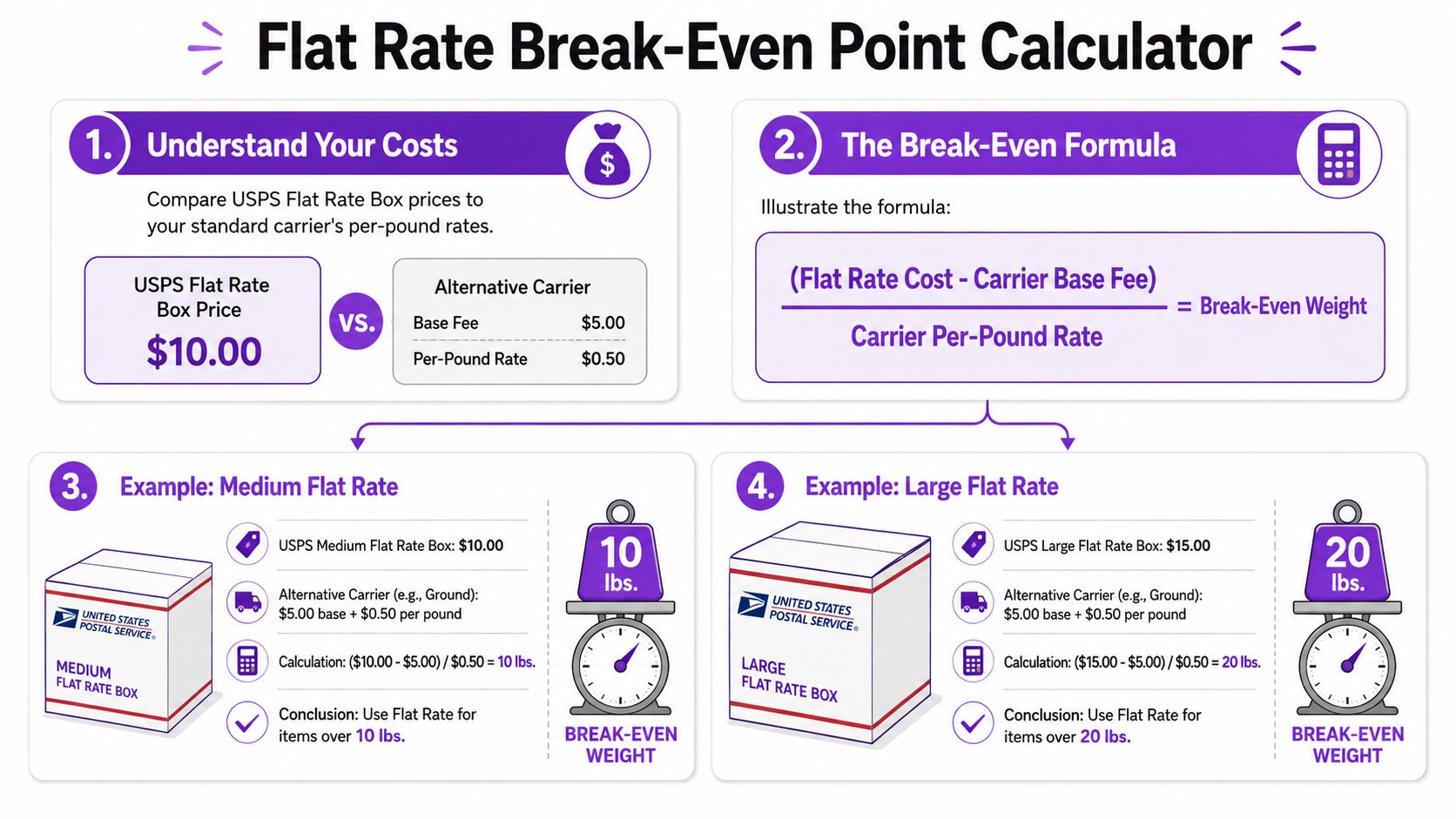
The practical question is simple. At what point does one approved Flat Rate box cost less, create fewer exceptions, and give your team a cleaner rule than calculated shipping?
A practical break-even method
Use actual orders, not estimates from memory.
- Choose the exact Flat Rate box you are willing to approve for that product family.
- Pull your commercial Flat Rate cost for that box from your current USPS pricing.
- Compare it to your normal calculated rate on the same package profile across your common zones.
- Add labor and exception handling to the decision, especially if staff often stop to compare services manually.
- Assign the result at the product or shipping-class level so WooCommerce can apply the rule upstream.
That last step matters more than many retailers admit. A one-dollar postage difference is easy to see. The cost of mis-boxing, staff hesitation, avoidable rate shopping, and inconsistent service selection usually does more damage to margin over time.
Example using the Medium box
Take a repeat order pattern. A dense bundle of parts fits one approved Medium Flat Rate box every time, with no repacking and no void-fill guesswork.
Now compare two outcomes. A lighter shipment going to a nearby zone may still price better with calculated Priority Mail. The same SKU mix, sent farther out or packed heavier, often crosses the point where the Medium Flat Rate price becomes the safer default.
That is the break-even decision in practice. You are not chasing the lowest possible label on every order. You are deciding when a fixed-price box gives you enough postal cost control and enough operational consistency to justify making it the standard rule.
For firearms retailers, that consistency has compliance value. If approved non-serialized parts always ship in one box type by one service path, your staff makes fewer ad hoc choices, your order notes stay cleaner, and your fulfillment workflow is easier to audit.
Example using the Large box
The Large box earns its place on heavier part orders and mixed accessory shipments that fit well but produce wide zone-based swings under calculated pricing. If your team regularly sees the same product group trigger rate surprises at checkout or at the label screen, that is a sign to test a Large Flat Rate rule.
I do not recommend memorizing edge cases. I recommend identifying which SKUs reliably fit, ship safely, and stay eligible for the USPS method you plan to offer. Then build that decision into the store instead of leaving it to warehouse judgment.
A sound break-even model includes three costs:
- Postage cost
- Packing time
- Exception risk
If Flat Rate is close on postage but clearly better on the other two, it often wins for operational reasons alone.
That is how a pricing question turns into a control system. Once you know the break-even point for your common SKU groups, Flat Rate helps standardize fulfillment, reduce avoidable shipping errors, and support rule-based automation in WooCommerce.
Shipping Regulated Goods with USPS Flat Rate
Flat Rate pricing doesn't override firearms law, carrier policy, or USPS mailing restrictions. You still need to decide first whether the product can move through USPS at all, then whether Flat Rate is the right service level for that product.
For firearms businesses, the safest approach is to separate products into categories before they ever reach the shipping bench. Firearms, serialized components, non-serialized parts, accessories, and prohibited materials should never be treated as one shipping class operationally.
Keep carrier eligibility separate from postage choice
A lot of shipping mistakes happen because staff jump straight to box selection. That's backward. Start with carrier eligibility.
In plain terms:
- Some products can move through USPS.
- Some products require a different carrier or different handling path.
- Some products should never be offered through a USPS Flat Rate method at checkout.
You also need to keep outward packaging discreet. Don't place markings on the outside that advertise firearm-related contents. Operationally, that means your internal labeling, pick workflow, and customer notifications need to do the identification work. The outer package should not.
For a detailed compliance reference around USPS mailing restrictions and permit issues, review USPS restricted mail permit requirements.
What matters most for FFL operations
The recurring control points are simple:
- Verify the item category first. Don't let a packer decide USPS eligibility from memory.
- Verify the recipient path. The receiving party must be legally allowed to receive that item.
- Use neutral exterior packaging signals. The label and outer box should stay compliant and low-profile.
- Document your internal decision logic. If a shipment type is USPS-eligible, define that once and train to it.
Many stores encounter difficulties. They build a strong product catalog but rely on tribal knowledge for shipping decisions. That works until a staff member is out, an order mix changes, or a restricted destination slips through because nobody checked carefully enough.
Shipping compliance fails in the gray areas, not the obvious ones.
USPS Flat Rate can be a useful tool for parts and compliant accessories, but only after you've separated “can this go USPS” from “which box should we use.” Those are different questions, and they need different controls.
Packaging Firearms and Parts Securely for Compliance
Official USPS Flat Rate packaging only helps if the item is packed correctly inside it. For firearms parts and dense accessories, poor packing creates two problems at once. You increase damage risk, and you increase the chance that someone on your team starts improvising with nonstandard packaging when the item doesn't fit the way they expected.
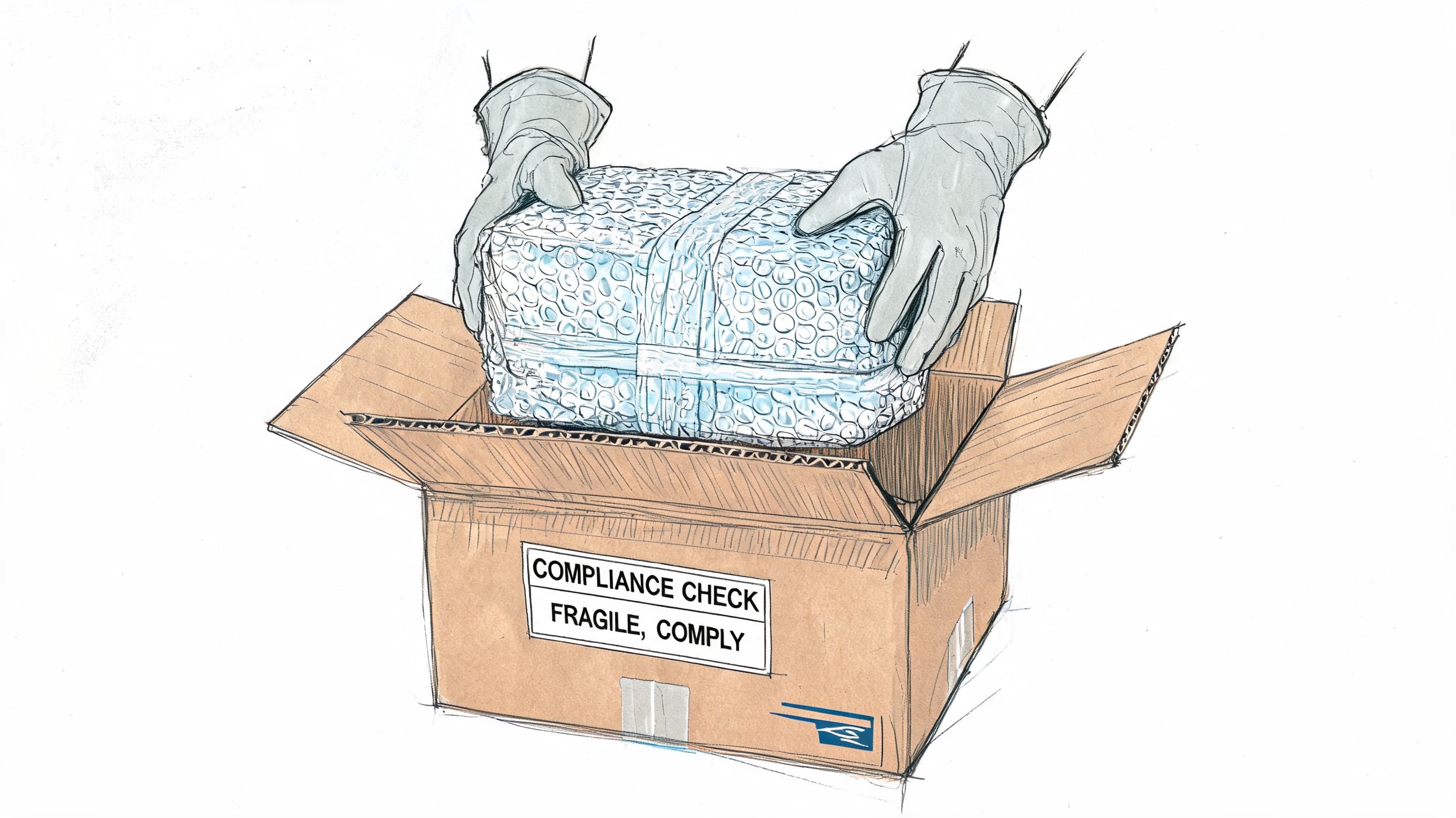
Pack for immobility, not just fit
A part that technically fits but shifts inside the box isn't packed well enough. Dense metal items can split internal void fill, bruise the box walls, or create obvious rattling that invites unnecessary scrutiny.
Good practice looks like this:
- Wrap the item first: Use internal protection that keeps hard edges from contacting the box.
- Eliminate movement: If the contents can slide, the package needs more internal structure.
- Support corners and edges: Flat Rate boxes are sturdy, but heavy corners still need buffering.
- Keep the exterior plain: Don't add branding or product cues that create avoidable attention.
Don't substitute your own box
Expensive mistakes are sometimes made by merchants. USPS Flat Rate pricing depends on using the official Flat Rate box. If your team swaps in a similar plain carton because you ran short on supplies, you've changed the service basis.
That's one reason it's worth keeping a written packaging SOP for each product family, along with reorder discipline for USPS supplies. If you handle firearms-related products in WooCommerce, firearms and ammunition shipping compliance for WooCommerce stores is a useful operational reference for building those procedures.
Free boxes still require planning
USPS supplies the boxes, but free doesn't mean frictionless. If your team waits too long to replenish, they'll start making bad substitutions under pressure. That usually leads to one of two outcomes. The package gets repriced, or the shipment gets delayed while someone repacks it properly.
The stores that handle Flat Rate well don't treat packaging as an afterthought. They treat it as part of compliance. That's the right mindset.
Configuring Flat Rate Options in WooCommerce
WooCommerce can handle Flat Rate cleanly if you set it up with product logic in mind. The mistake is treating “Flat Rate” as one generic shipping method for the whole catalog. A firearms store usually needs tighter mapping.
Start with your actual fulfillment behavior. If your team commonly ships certain dense accessories in Small boxes, others in Medium, and a narrow group in Large, your WooCommerce setup should reflect that reality instead of forcing one blended shipping price across everything.
A practical setup pattern
Use shipping zones and classes deliberately.
- Create shipping classes by box profile. Build classes that reflect how you pack products.
- Assign products to the right class. Do it at the product level, not at the order-review stage.
- Set Flat Rate amounts based on your true postage cost. If you buy commercial labels, configure around that number rather than retail walk-in pricing.
- Limit methods where needed. Don't show a box-based method for products that won't safely or lawfully move that way.
For stores with more complex architecture, customizations sometimes become necessary. If you're comparing how other commerce systems handle shipping logic, this case study on custom web applications for Magento stores is a useful reminder that shipping rules often outgrow default platform behavior.
Keep the logic readable for staff
Complicated shipping setups usually fail because only one person understands them. Keep naming conventions obvious.
A simple pattern works well:
- Small Flat Rate eligible
- Medium Flat Rate eligible
- Large Flat Rate eligible
- Carrier review required
That gives your operations team and developers the same language. If you need a foundation for organizing those product groupings, shipping classes in WooCommerce is the right place to start.
The best WooCommerce shipping setup is the one your staff can audit quickly when something looks wrong.
You don't need an elegant theory. You need a checkout and fulfillment system that matches the cartons on your shelf and the products in your catalog.
Automating Compliance with Ship Restrict and Flat Rate
An order clears at 4:47 p.m. for a serialized part, the customer picked a cheap shipping method, and your team is trying to close out the day. If checkout did not screen the destination and product rules correctly, the mistake has already happened. The label is just where the loss shows up.
Flat Rate works best as a control, not just a postage option. For firearms retailers running WooCommerce, fixed USPS packaging reduces variables at the packing bench, and shipping restrictions reduce bad orders before payment. Used together, they cut down on manual review, lower the chance of staff overrides, and give fulfillment a narrower set of approved paths.
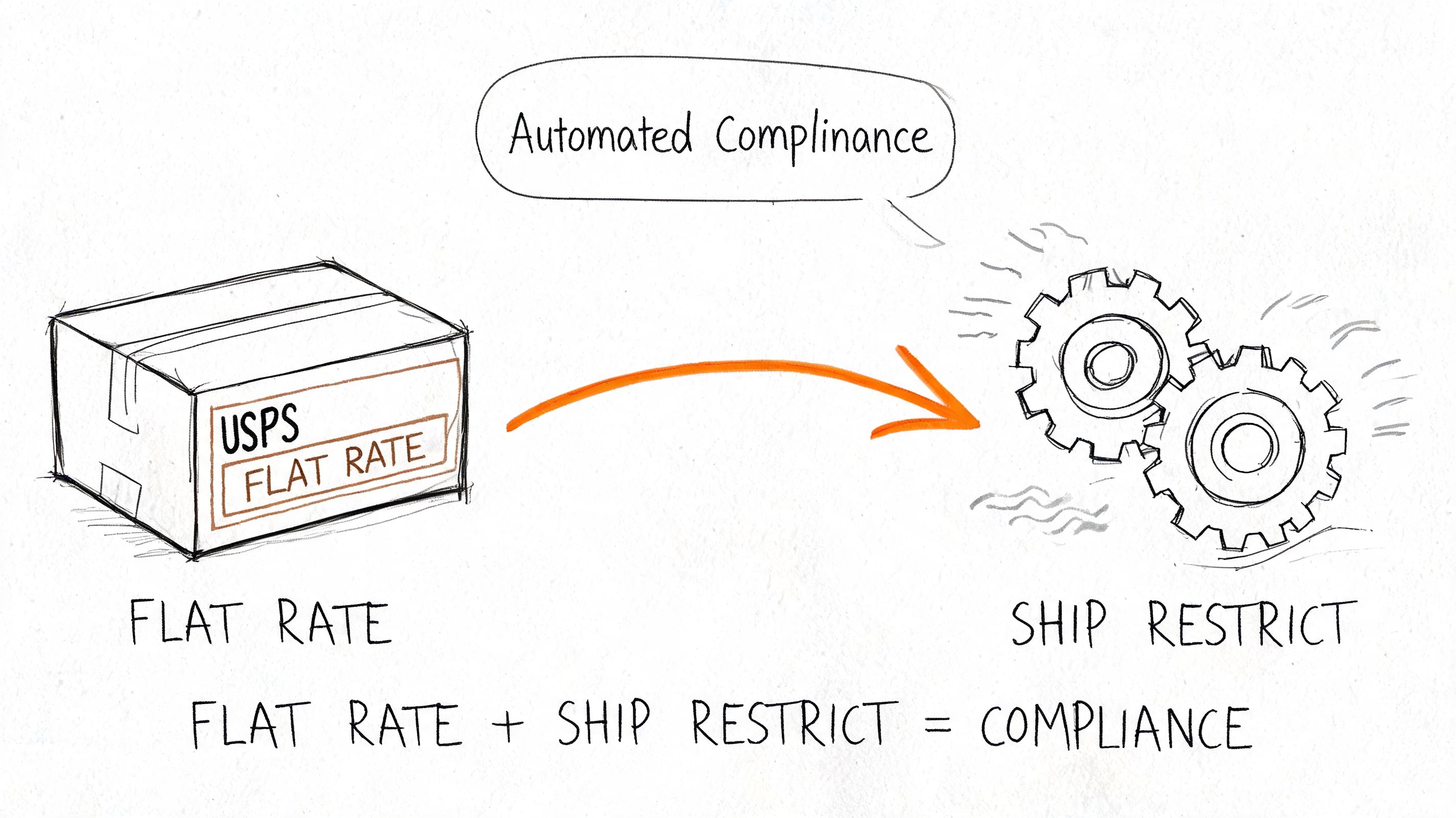
Where the savings really come from
The obvious savings is postage consistency. The more important savings is error prevention.
For a regulated catalog, every bad shipment creates extra handling. Staff have to review the order, void labels, explain the cancellation, restock inventory correctly, and document what happened. If the package leaves the building when it should not have, the problem gets more expensive and harder to clean up.
That is why Flat Rate and restriction logic fit together so well. One standardizes the carton and service level. The other controls who can see that option in the first place.
What a compliant automated workflow should do
A workable setup usually follows this order:
- Screen destination rules before the customer sees shipping methods
- Match eligible products to approved Flat Rate methods only
- Block restricted combinations at checkout, not after capture
- Pass fulfillment a short list of valid packaging choices
- Leave an audit trail that explains why a method was shown or hidden
That last point matters. If a customer challenges a canceled order or a staff member asks why a method disappeared, you need rule-based logic that can be checked quickly.
I have seen too many stores rely on tribal knowledge here. One warehouse lead knows which parts can go USPS. One customer service rep knows which states trigger review. That setup breaks the minute someone is out sick or a temporary employee starts packing orders.
Automation fixes that operational weakness. It turns compliance from a person-dependent process into a store rule.
If you're looking at broader automation trends in online retail, Cleffex AI for e-commerce covers the larger operational shift, even though firearms sellers still need category-specific controls and human oversight.
The safer workflow blocks the wrong shipment before payment and gives staff fewer chances to improvise.
For WooCommerce firearms stores, that is the core value of pairing Ship Restrict with Flat Rate. You get predictable packaging, cleaner checkout logic, faster fulfillment decisions, and fewer expensive compliance mistakes.
Frequently Asked Questions
Are USPS Flat Rate boxes free
USPS provides the branded Flat Rate boxes and envelopes at no upfront cost. You still pay postage, and for a firearms retailer, the primary issue is stocking the right box inventory before your team starts improvising with the wrong packaging.
I treat Flat Rate packaging like any other controlled shipping supply. If your Small and Medium boxes run out during a busy week, staff will substitute whatever is nearby. That creates preventable problems, especially when you have parts orders that were mapped to a specific service and box size inside WooCommerce.
Are Flat Rate boxes useful for APO FPO and DPO shipments
Yes, for eligible products they can simplify quoting and reduce pricing surprises. The bigger operational benefit is consistency. Military-address orders already need careful handling, so using a predefined Flat Rate method can reduce packing decisions and keep your checkout rules cleaner.
Keep those rules separate from your standard domestic flow. If your label platform presents APO, FPO, or DPO services differently, review that logic in testing before you publish the method at checkout.
What if the item is slightly too large for the box
Use a different approved package.
Do not trim the box, bow the sides, or force the flaps shut. Flat Rate only works when the item fits the official packaging as intended. In practice, forcing a marginal fit usually costs more than it saves. You end up with repacking, postage adjustments, damaged goods, or a fulfillment employee making a judgment call you should have handled in policy.
Should every firearms store offer Flat Rate at checkout
No. Offer Flat Rate only where it matches the product, destination, and compliance rule set you already enforce.
For dense parts, magazines where lawful, and compliant accessories, Flat Rate often makes sense because it gives you predictable packaging and simpler fulfillment. For oversized items, fragile products, or anything that triggers extra review, a calculated method or a restricted workflow is usually the safer choice. The goal is not to show more shipping methods. The goal is to show the right ones and remove the rest.
If you want to stop manually checking regulated destinations and prevent restricted orders before checkout, Ship Restrict gives WooCommerce firearms retailers a practical way to enforce shipping rules by state, county, city, or ZIP code. Pair that with a disciplined Flat Rate packaging setup, and you get a simpler operation, fewer preventable shipping errors, and a checkout flow that reflects your real compliance requirements.
Automate Shipping Compliance
Stop worrying about restricted states. Ship Restrict handles it automatically.

Cody Yurk
Founder and Lead Developer of ShipRestrict, helping e-commerce businesses navigate complex shipping regulations for regulated products. Ecommerce store owner turned developer.
Automate Shipping Compliance
- Block restricted states
- No more cancellations
- Set and forget
3-day free trial · Card required