Vendor Compliance Requirements: A Practical Setup Guide
Understand vendor compliance requirements across federal, state and contract layers. Follow an 8-step setup checklist and block restricted orders.
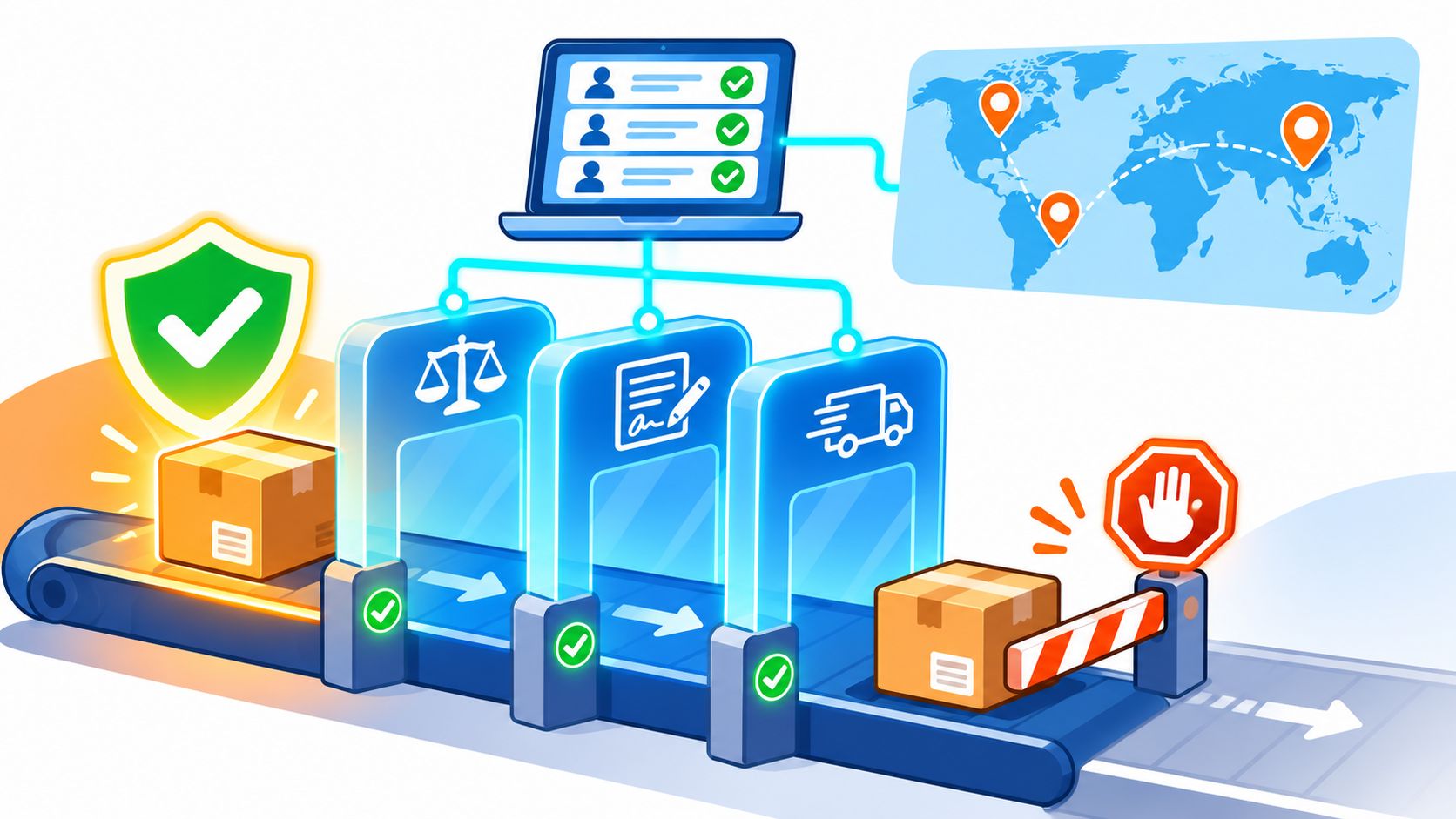
Most compliance guides tell you to build a tidy folder of signed questionnaires, W-9s, and insurance certificates, refresh it once a year, and call the job done. That advice falls apart the moment you sell regulated products online. A clean PDF collected in January will not stop a prohibited magazine from shipping into a restricted municipality in July, and it will not satisfy an auditor asking why your checkout accepted the order.
For sellers moving firearms, ammunition, hemp, blades, fireworks, or other regulated goods, vendor compliance requirements aren't an annual filing exercise. The obligation is proving compliance at the exact moment an order is accepted. That shifts the workload out of spreadsheets and into rule-level, evidence-backed controls that verify eligibility, destination legality, and supplier permissions before a card is charged or a box leaves the dock.
What Vendor Compliance Requirements Actually Cover
Traditional procurement guides frame compliance almost exclusively around upstream suppliers. When you run a regulated storefront, though, the customer-facing half of the equation is where fines, seized packages, and license actions usually start.
Vendor compliance requirements are the combined legal, contractual, and operational rules that determine whether a supplier, carrier, service provider, or buyer is eligible, whether a product is permitted at the destination, and what evidence proves both.
Those obligations fall across three distinct operational buckets: statutory law, binding contract terms, and internal execution steps like screening and record retention.
Automate Shipping Compliance
Block orders to restricted states automatically. 3-day free trial.
Start Free Trial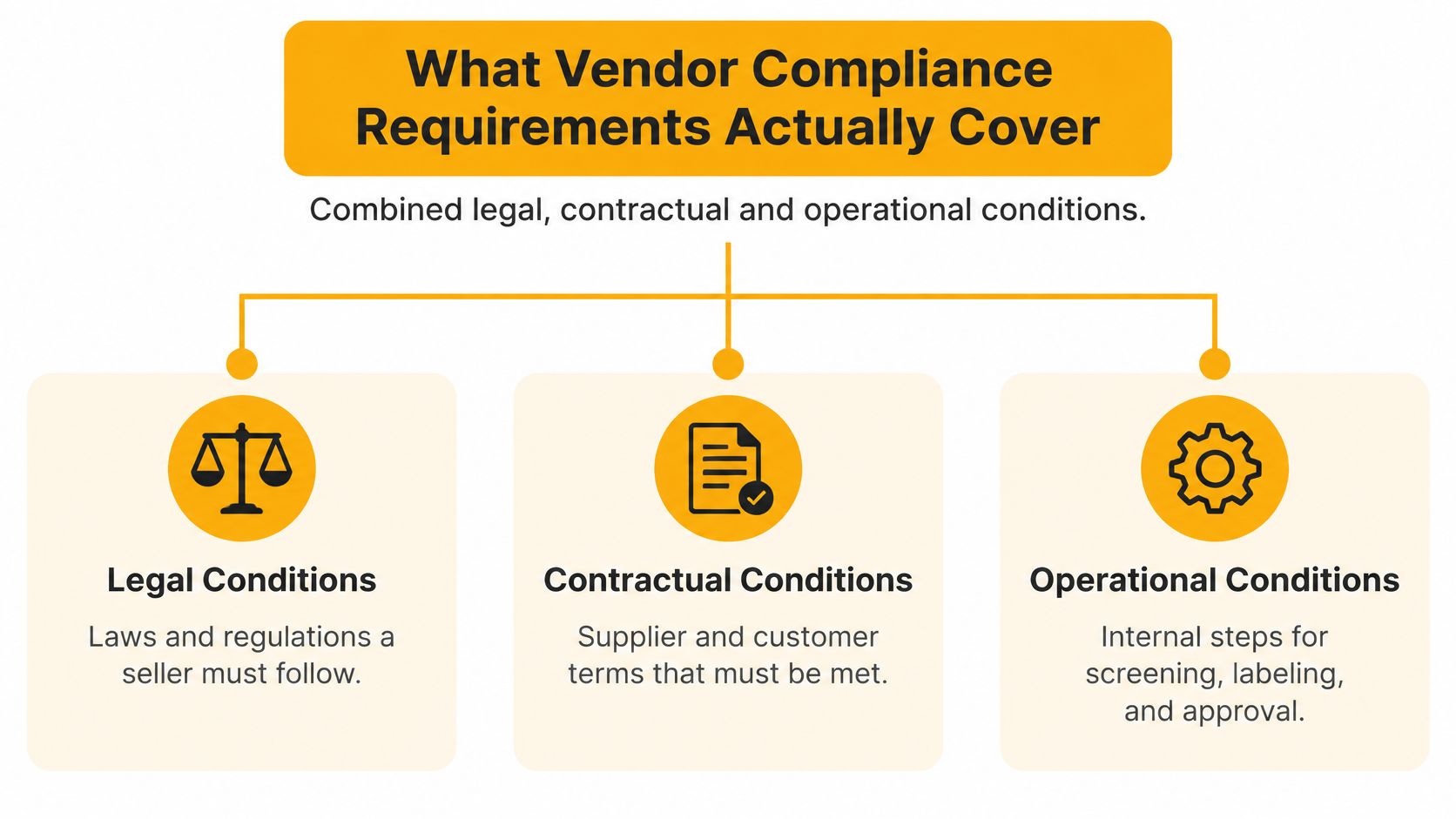
Mapping the Seven Operational Layers
In practice, you can't manage these obligations as one flat checklist because different teams hold the controls and different failures follow if a piece goes missing. Breaking the program into seven layers clarifies who owns each record and what breaks when it's skipped.
| Requirement layer | What it governs | Owner | Evidence | Failure if missing |
|---|---|---|---|---|
| Federal product and transfer rules | Firearms, ammunition, explosives, hazmat and age-restricted goods; FFL transfers and Form 4473 records | Compliance | FFL license, completed 4473, retention records | Federal enforcement, license action |
| State and local destination rules | Bans, licensing, age limits, blade length, THC thresholds, city and ZIP-level prohibitions | Ops and compliance | Rule set with effective dates and legal reasoning | Returned shipments, fines, penalties |
| Tax and nexus registration | Sales-tax collection when economic thresholds are crossed in a state | Finance and compliance | Registration certificates, threshold tracking | Back-tax assessment, penalties |
| Carrier and service restrictions | Which carriers and services accept which regulated goods | Ops | Carrier agreement, published restriction list | Refused packages, carrier penalties |
| Contract and insurance terms | Scope, compliance obligations, verification rights, liability and coverage | Legal | Signed contract, certificate of insurance | Uninsured loss, unclear liability |
| Data and software-supply-chain security | Checkout, inventory and order systems that hold address and eligibility data | Dev and security | Attestations, test reports, SBOM, access review | Data breach, tampered restriction rules |
| Recordkeeping and audit | Traceability of who approved what, when, and which rule version applied | Compliance | Audit log, rule version history, remediation notes | Inability to prove compliance after the fact |
For teams building their upstream governance alongside these catalog checks, Procright's vendor compliance guide lays out how supplier-side documentation fits into broader procurement workflows.
What catches most operators off guard is how tightly these seven layers interlock. You can buy stock from a fully vetted distributor, ship with an approved carrier account, and maintain current insurance, yet a single unverified city ban at checkout still turns that order into a non-compliant shipment.
The Legal and Contractual Requirements Behind the Layers
Every automated rule in your storefront traces back to a statute, a regulatory mandate, or a binding contract clause. If you don't anchor your configuration to those underlying rules, you end up guessing at edge cases whenever a shipment gets challenged.
Federal Transfer Rules and Permanent Records
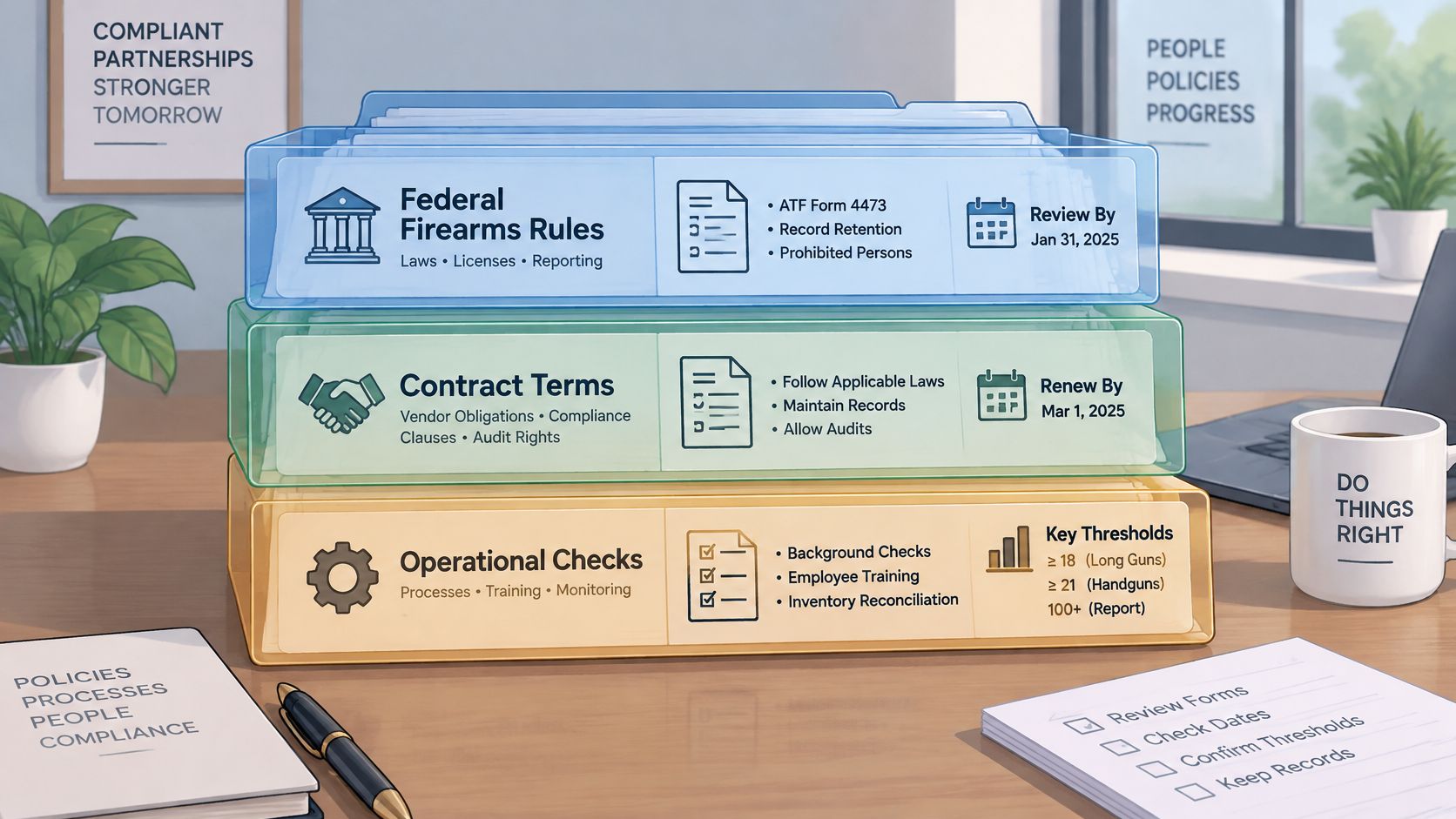
Firearms commerce shows how quickly compliance moves past simple checkout filtering into permanent transaction documentation. Under 27 CFR Section 478.124, a licensed manufacturer, importer, or dealer generally may not sell or otherwise dispose of a firearm to a nonlicensee unless the transaction is recorded on ATF Form 4473.
That federal rule also mandates retaining each completed Form 4473 as part of required business records until the firearms business or licensed activity is discontinued. Its historical base sits in the Gun Control Act of 1968, under which licensed importers, manufacturers, and dealers must keep records of importation, production, shipment, receipt, sale, and other disposition, with the Form 4473 information requirement applying since 1968.
Operationally, this means passing a ZIP code check is only step one. Regulated-product sellers still need SKU-level product classification, purchaser and recipient verification, pre-shipment holds for interstate transfers, and retrievable audit files. Automated geographic blocking stops preventable order mistakes, but it never replaces federal recordkeeping or transfer duties.
Destination Laws and Sales-Tax Nexus
State and municipal rules layer directly on top of federal law at the point of sale. Prohibitions on magazine capacities, blade lengths, hemp THC limits, and minimum buyer ages shift by state and sometimes by city or county, so every rule must carry an effective date and documented rationale.
Free Shipping Compliance Audit
We'll review your WooCommerce store's shipping compliance for free.
Destination monitoring also drives tax obligations. On June 21, 2018, the Supreme Court's decision in South Dakota v. Wayfair eliminated the old physical-presence rule, holding that South Dakota's economic-nexus threshold of at least $100,000 in annual sales or 200 transactions satisfied the constitutional "substantial nexus" requirement, according to the Multistate Tax Commission nexus update.
Thresholds vary by jurisdiction rather than following one national number. That same Multistate Tax Commission update records that Connecticut adopted a $250,000 sales-and-200-transactions threshold effective December 1, 2018, while Illinois enacted a $100,000-or-200-transactions threshold effective October 1, 2018. Your order system therefore has to track customer location, order value, transaction counts, and statute effective dates continuously.
Contract Clauses Tied to Proof
Strong vendor contracts translate regulatory duties into enforceable terms. Each agreement should specify exact services, payment terms, compliance obligations, verification rights, insurance coverage, subcontractor disclosure rules, and termination or data-return procedures.
Don't write a compliance clause without naming the artifact that proves performance. If a fulfillment partner promises age-verified delivery, the contract should specify the carrier scan logs or delivery-exception reports they must hand over on request.
Matching Control Strength to Vendor Risk Tier
Treating an office-supply vendor the same way you treat a firearms fulfillment warehouse or checkout gateway wastes compliance hours where risk is trivial and starves the vendors that could shut your store down.
Guidance from the U.S. Department of Justice on corporate compliance programs evaluates whether organizations assess third-party risk, document a legitimate business rationale for engaging each supplier, build review directly into procurement workflows, and reassess risk using ongoing operational data. I would start by scoring every supplier against five factors: product sensitivity, geographic exposure, data access, transaction volume, and regulatory impact.
Tiered Evidence and Review Cadence
Once you score a supplier, assign a tier that dictates both the onboarding packet and how often you re-verify their standing. Running a structured compliance risk assessment keeps those tier boundaries defensible when procurement pushes for faster onboarding.
| Risk tier and vendor type | Required evidence | Review cadence |
|---|---|---|
| Tier 1 high risk: regulated-product fulfillment, payment providers, checkout software, logistics | Eligibility documents, geographic restriction evidence, SLA evidence, escalation path, security test reports | Continuous checks plus annual re-certification |
| Licensed dealer partner (FFL) | Current FFL matched to ATF license records, approved territory, transfer-eligibility record | Before every firearm shipment |
| Tier 2 medium: shipping integrations, inventory sync, analytics using order data | Security questionnaire, software bill of materials for critical components, access review | Quarterly |
| Tier 3 low: general office and marketing tools | Signed attestation and policy acknowledgement | Annual |
Notice the separate track for licensed dealer partners. An annual folder check is useless if a dealer's license lapsed three weeks ago, so FFL status needs confirmation against current ATF records before every single firearm leaves your building. Before finalizing terms with any high-tier partner, reviewing supplier contracts before signing ensures your verification rights and escalation timelines are locked into the agreement.
Security Controls for Connected Software
Any supplier whose code touches your storefront, checkout, inventory feed, or customer database creates a direct compliance exposure. A compromised plugin or API key can alter shipping addresses, product eligibility flags, or geographic block lists on an otherwise airtight store.
Recommendations in the NIST cybersecurity supply chain risk management guide advise scaling supplier security requirements to the vendor's criticality and potential impact if compromised, while writing both the obligations and verification methods directly into the contract.
A questionnaire tells you what a software vendor claims on paper. Access reviews, test reports, and component inventories tell you whether their integration can tamper with your checkout rules.
For Tier 1 and Tier 2 technical vendors, bake these concrete requirements into your specification:
- Disclosure and component tracking: Require disclosure of relevant security features, functions, and vulnerabilities throughout the contract term, alongside a current software bill of materials (SBOM) or dependency inventory for critical components.
- Access and insider protections: Enforce authenticated API access, least-privilege permissions, and supplier personnel vetting with insider-threat controls.
- Patching and incident response: Set explicit vulnerability-notification timeframes, remediation commitments, incident-notification windows, and evidence of recent security testing.
- Clean exit terms: Specify termination workflows and data-return or destruction procedures so customer and order data doesn't linger on a former vendor's servers.
Verify these controls with evidence rather than trust. Review attestations and test reports, validate active API permissions, inspect software inventories, and log every open exception with a named owner and a firm deadline.
How to Set Up Your Vendor Compliance Workflow
Many teams stall because they try to write a 60-page policy manual before configuring a single checkout rule. You get far better protection by standing up an end-to-end operational workflow this week, where every step produces a concrete record.
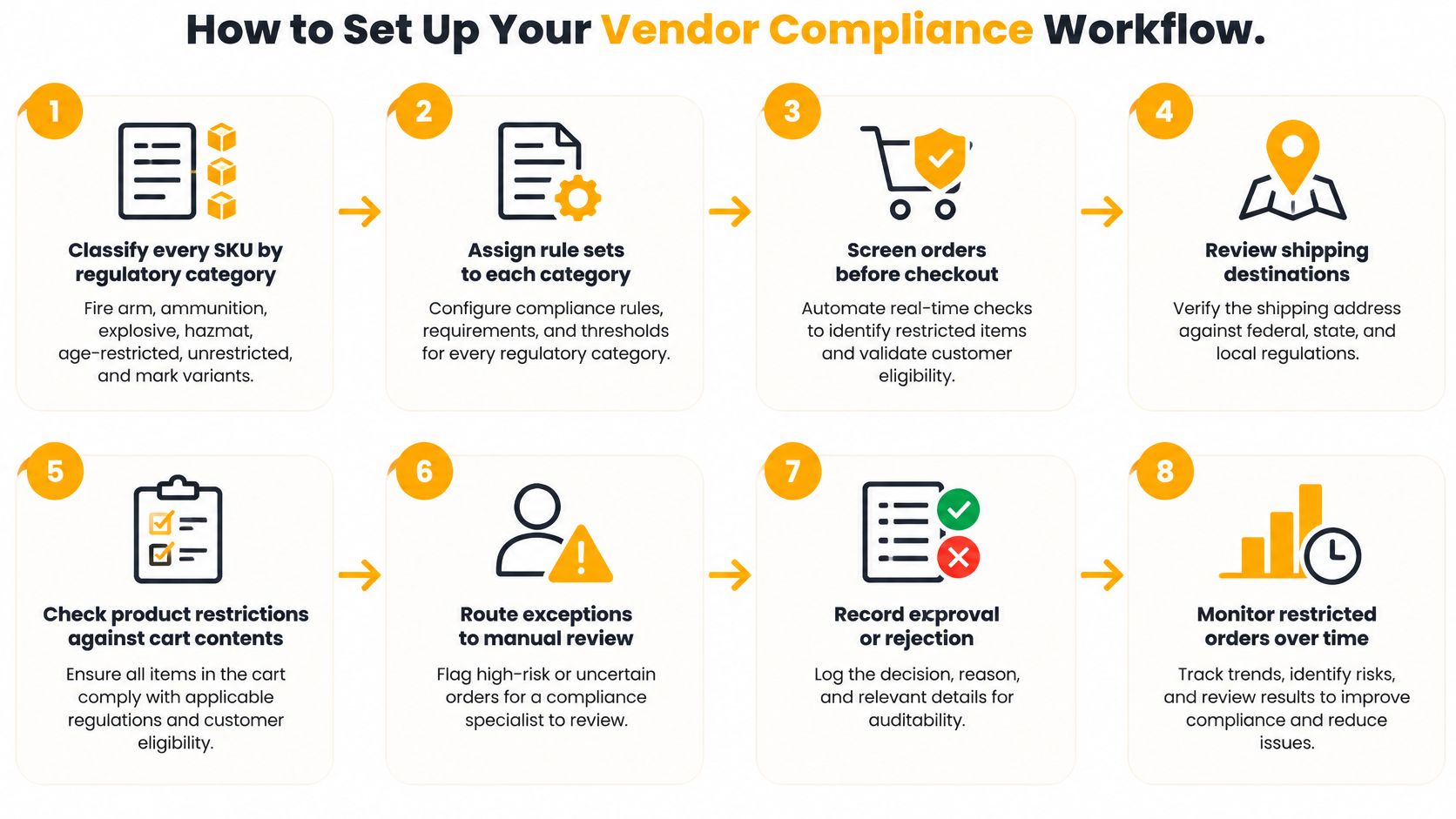
- Classify every SKU and variant by regulatory category. Tag each item as firearm, ammunition, explosive, hazmat, age-restricted, or unrestricted, and classify product variations separately. A 10-round magazine variant and a 30-round variant under the same parent product face totally different state rules, and the resulting catalog export becomes your baseline classification record.
- Build your destination rule register from current statutes. Document every state, city, and ZIP prohibition per category, recording the statute's effective date and plain-language legal reasoning. When an auditor or customer asks why an address was blocked, that register supplies the exact authority.
- Score and tier your active vendors. Group fulfillment warehouses, carriers, payment gateways, and store apps by risk level using the five factors from your tiering matrix. Keep the scored sheet in procurement so top-tier suppliers automatically trigger stricter onboarding evidence.
- Lock verification clauses into top-tier contracts. Update templates for high-risk suppliers to cover scope, audit rights, insurance minimums, software security disclosures, and data-return obligations. Filing the countersigned contract alongside the vendor's current certificate of insurance closes the legal gap.
- Encode destination rules with allow-only precision. When a regulated category is legal in only a handful of states, build one allow-only rule per category rather than maintaining a sprawling block list of dozens of states. Keep each licensed dealer's approved territory inside a single allow-only rule as well, because placing two allow-only rules on the same product forces a shipping address to sit inside both territories at once.
- Wire enforcement directly into checkout before payment. Configure your storefront so restricted orders halt at cart or checkout rather than slipping into the warehouse queue for manual cancellation. Following proven shipping restriction implementation best practices ensures validation runs cleanly without slowing down legitimate buyers.
- Assign recurring review cadences by control type. Run continuous validation for geographic shipping rules and license status, quarterly checks for vendor insurance and incident-response controls, and annual reviews for low-risk administrative paperwork. Log each completed cycle with the reviewer's name and date.
- Export your rule set and schedule legal reviews. Download a clean backup of your active rule file and tie calendar triggers to legislative effective dates. For a broader view of how governance documentation supports these operational checks, see Kons Law on compliance programs.
Every step in this sequence ends in a retrievable artifact, not good intentions. If you can't pull the classification sheet, rule version, or contract clause on demand, the control effectively doesn't exist.
A Firearms Order From Cart to Shipment Release
Abstract checklists make compliance sound tidy. Watching a single order move from cart to fulfillment shows where automated controls save money and where manual review drains margin.
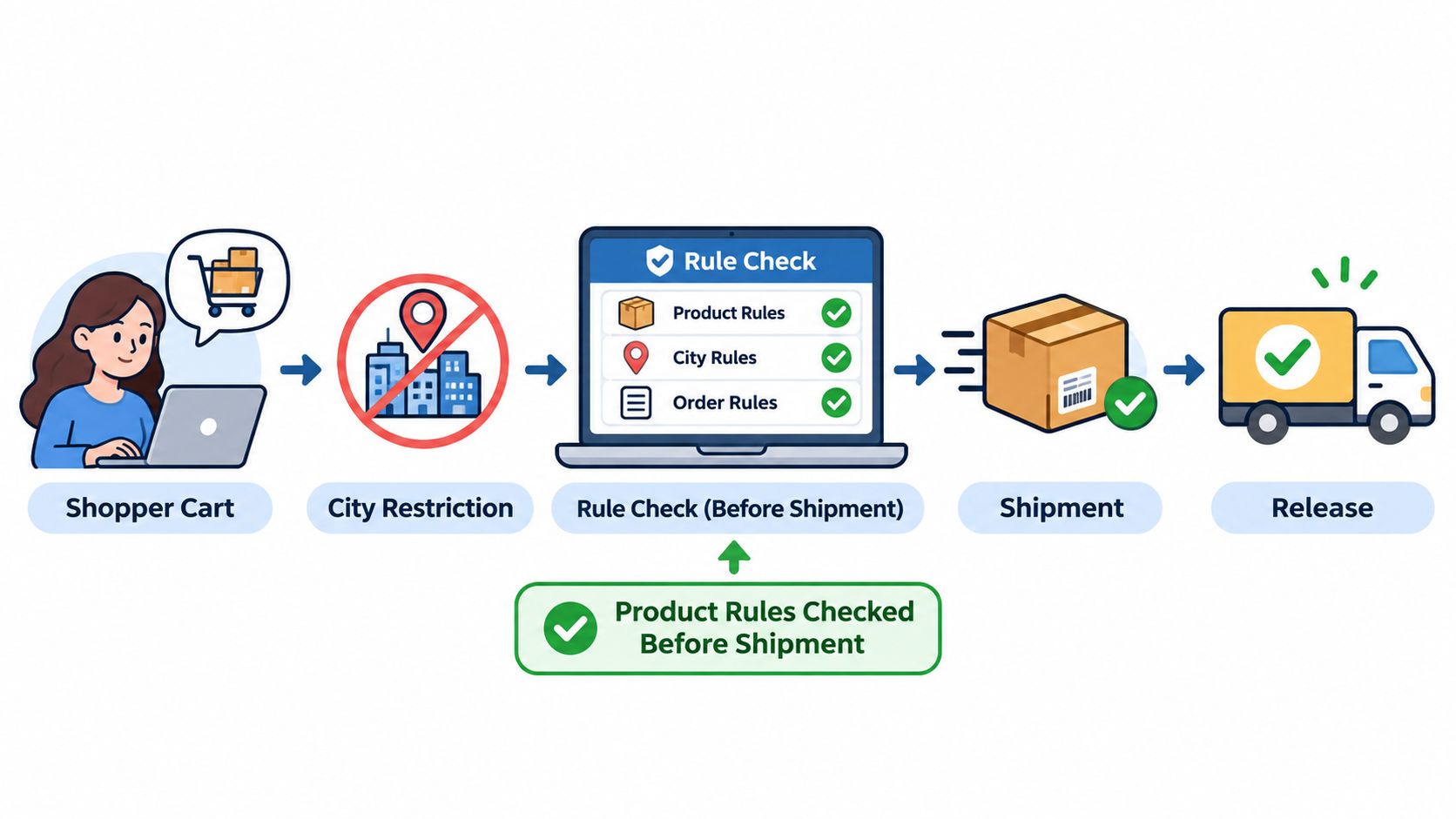
The Automated Checkout Path
Say a buyer living in a state that permits standard-capacity magazines, but inside a municipality that bans them, adds a restricted magazine variant to their cart and enters their shipping address at checkout.
Before payment authorization runs, the restriction engine evaluates variation restrictions first, followed by product-level restrictions. Within each level, it checks states, then specific cities, then ZIP codes. Even though the state passes, the city rule fires immediately and stops the transaction.
The buyer sees a direct message explaining that the selected magazine capacity can't ship to their city, rather than hitting a cryptic error or waiting two days for a cancellation email. On a permitted order going to an approved dealer, the dealer's territory sits in a single allow-only rule, and the order record stamps the exact rule version and effective date that cleared the shipment.
What the Manual Alternative Costs
Now trace that exact same magazine order through a store relying on manual oversight. Checkout takes the buyer's payment without complaint. Twelve hours later, an operations lead spots the city ban during a nightly spreadsheet sweep, voids the label, cancels the order, and initiates a refund.
The merchant absorbs payment-processing fees, burns staff time on support replies, pays restock labor if the warehouse already picked the bin, and risks a frustrated buyer filing a chargeback. Worse, if a second order slips past a tired reviewer on a busy Monday, the store holds zero timestamped proof showing which rule was supposed to run.
How the Pattern Generalizes Across Categories
This architecture works well beyond firearms. Take a storefront shipping hemp products subject to state-by-state THC limits: the checkout engine runs the same variation-then-product and state-city-ZIP hierarchy, swapping in the hemp rule set instead of the magazine rule set.
At the end of every blocked or cleared order, your system holds four audit-ready data points: the blocked transaction ID, the rule version that fired, the timestamp, and the responsible reviewer if an exception occurred. That record is precisely what a state attorney general or licensing inspector asks to see.
Scaling Rules Across Catalogs, Jurisdictions and Storefronts
Growing a regulated catalog breaks manual workflows fast. Adding more reviewers rarely fixes the bottleneck, because undifferentiated manual checks slow down clean orders while letting subtle, high-impact exceptions slip through during peak volume.
Staffing math explains why teams hit this wall across industries. In the Ncontracts third-party risk management survey, 56% of companies work with more than 100 vendors, the average vendor count climbed to 286 (a 21% year-over-year increase), and 73% of financial institutions operate with two or fewer full-time employees managing vendor risk despite over half overseeing 300 or more vendors. Those staffing figures describe financial institutions rather than e-commerce merchants, yet a two-person compliance crew at a growing online retailer faces the exact same ratio problem.
Prioritizing Controls by Harm and Reversibility
Instead of inspecting every order or every vendor equally, sort actions by potential harm and whether a mistake can be undone:
- Block before payment whenever a shipment violates a clear statutory or carrier prohibition. Once a restricted item leaves the dock, you can't undo the violation.
- Route to human review only when an order hits a genuine edge case, such as a law-enforcement exemption or an unverified FFL transfer request.
- Permit with documented monitoring for low-risk, unrestricted catalog items so paying customers move straight through checkout.
- Demand verified evidence from vendors touching regulated inventory, customer personal data, payment flows, or last-mile delivery.
Mechanics That Keep Large Rule Sets Stable
Once you manage hundreds of SKUs across multiple storefronts, four operational details separate calm operations from constant fire drills.
First, use scheduled activation and expiry dates for temporary bans and upcoming statutory changes. If a state law takes effect at midnight on the first of the month, or a local emergency restriction expires after thirty days, scheduling removes the risk of someone forgetting to toggle a rule manually.
Second, assign one named owner to every rule category and maintain a clean rollback path. If a newly published ZIP block accidentally shuts down valid orders, the owner should be able to restore the prior rule set immediately from the exported backup file.
Third, watch rule scoping when using presets. Preset rules apply across all products by default, so a store carrying both regulated gear and unrestricted apparel must narrow its rule targets to the regulated categories or collections to avoid blocking t-shirts.
Fourth, maintain multi-storefront parity with bulk rule creation and portable file imports. Building rules in batches and importing the exact same rule file across every WooCommerce or Shopify storefront ensures identical precedence everywhere, so Store A never blocks a shipment that Store B happily mails out.
Where Compliance Programs Break and How to Close the Gaps
Even well-staffed programs fail when leadership confuses document collection with active control. Questionnaires capture a snapshot of a single afternoon, while your risk shifts every time a legislature meets, a license expires, or a fulfillment partner hires a subcontractor.
The Venminder 2025 State of Third-Party Risk Management report illustrates that disconnect clearly: 55% of organizations updated vendor-risk questionnaires or due-diligence document requirements within the previous year, yet 49% experienced a vendor-related cyber incident in 2024. Asking for longer forms did not stop third-party failures.
Operational rule: Treat vendor documents as onboarding baselines, and treat live operational events as the trigger for compliance action.
Between annual reviews, watch for concrete operational shifts: changed shipping jurisdictions, expired dealer or carrier licenses, altered service scopes, newly added subcontractors, statutory rule changes, failed adult-signature deliveries, and unusual order spikes into restricted areas.
Six Failure Modes and the Controls That Stop Them
Each recurring compliance breakdown has a specific operational fix and a review rhythm that matches how quickly the underlying fact decays.
| Failure mode | Harm | Control | Cadence |
|---|---|---|---|
| Rule drift after a statute change | Non-compliant orders continue under an outdated rule | Scheduled rule review and scheduled activation and expiry of rules | On every legal change, plus quarterly |
| Expired vendor license not re-checked | Shipment to an ineligible recipient | License status verification | Continuous |
| New subcontractor mid-contract | Unvetted party handling regulated goods or data | Subcontractor disclosure clause plus re-review | Event-triggered |
| Compromised checkout or integration | Altered restriction, address or eligibility data | Least-privilege access, patch commitments, incident notification | Continuous with quarterly access review |
| Conflicting rules across product and variant levels | Wrong block or wrong pass on a variant | Variation restrictions checked before product restrictions, states then cities then ZIPs | At rule build and on review |
| Multiple storefronts drifting apart | One store blocks, another ships | Shared rule sets via import and export | Every update |
Preserving Proof That Survives an Audit
Running these checks only protects half your exposure; proving they ran at order time protects the other half. Configure your logging so every enforcement action records the rule version, effective date, blocked transaction, responsible reviewer, and remediation outcome.
Working through a dedicated shipping audit checklist helps verify that those logs are complete and retrievable before a regulator ever asks. Your core governance decision comes down to sorting every vendor and catalog attribute into two buckets: the live facts that demand real-time or event-triggered validation, and the low-risk administrative records that can safely wait for an annual review.
Start With the Orders You Block Today
A vendor file updated once a year does not prove that a restricted order was stopped when the buyer tried to pay. Pull the last 90 days of orders from restricted destinations. Count how many your team cancelled, refunded, or shipped anyway, and attach the staff hours and restocking losses to each group.
I would use that baseline before anyone rewrites policy language. The requirement that matters is the block at order acceptance, with a rule you can point to afterward. On WooCommerce, restrictions are enforced on the cart and checkout pages. On Shopify, they are enforced at checkout, before payment. Clear, configurable messages explain the restriction to the buyer before checkout, so the address failure is visible instead of arriving as a surprise after fulfillment.
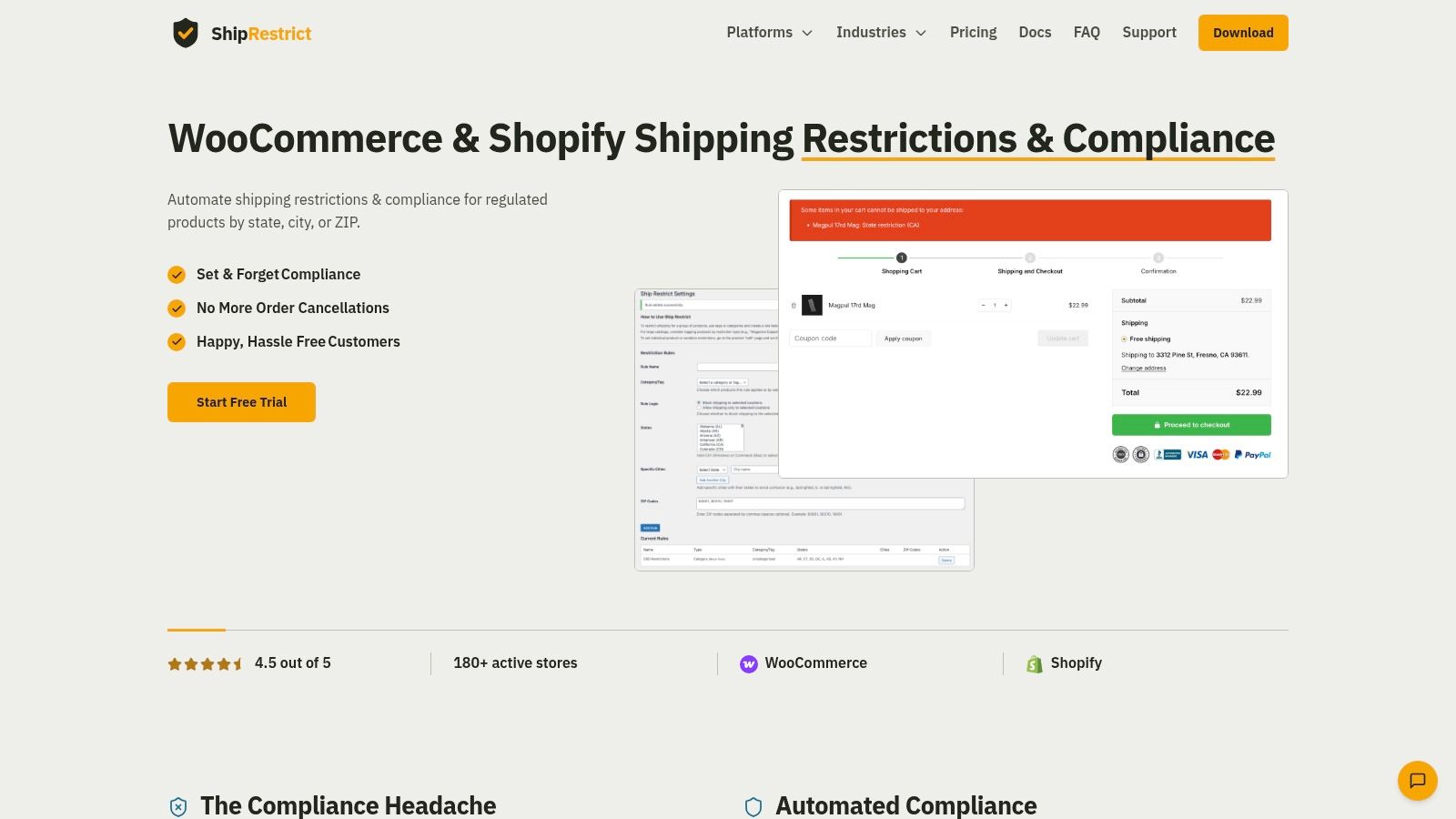
Checkout automation handles the geographic and point-of-sale layer. It never replaces federal recordkeeping. Merchants should confirm current requirements for their products with legal counsel and review their rules when laws change.
For WooCommerce or Shopify stores, Ship Restrict is one practical option. It combines state, city, and ZIP targeting, variant-level rules, bulk rule creation, and scheduled activation and expiry. Researched state presets come with restricted and high-risk states pre-classified and the legal reasoning attached. Rules export and import as portable JSON, which is the practical trade-off against rebuilding the same blocks storefront by storefront. Presets apply broadly, so a catalog that also includes unrestricted items still needs narrower rules rather than a blanket preset.
Your Immediate Four-Step Action List
Take these four steps before the next fulfillment cycle:
- Confirm statutory requirements with legal counsel: Verify current federal, state, and local rules for every regulated SKU you sell, and review the rule set whenever laws change.
- Map your 90-day leakage baseline: Quantify manual cancellations, refunds, and slip-through shipments so the highest-risk categories get fixed first.
- Export a clean rule backup: Save a portable copy of configured restrictions after every update, and review that backup when regulations change, so you can roll back or sync another storefront.
- Test a live restricted checkout: Put a restricted variant in the cart, enter a banned city or ZIP code, confirm the block triggers before payment, and read the customer message for that address.
If you run a regulated WooCommerce or Shopify catalog and want non-compliant orders stopped before payment instead of after fulfillment, look at Ship Restrict. It covers state, city, and ZIP shipping enforcement with variant-level targeting, scheduled rule changes, researched presets, and portable JSON backups so checkout rules stay aligned with the vendor compliance program. Visit Ship Restrict to see how it fits your store and catalog.
Automate Shipping Compliance
Stop worrying about restricted states. Ship Restrict handles it automatically.

Cody Yurk
Founder and Lead Developer of ShipRestrict, helping e-commerce businesses navigate complex shipping regulations for regulated products. Ecommerce store owner turned developer.
Automate Shipping Compliance
- Block restricted states
- No more cancellations
- Set and forget
3-day free trial · Card required