8-Point Shipping Audit Checklist for Compliance
Use this shipping audit checklist to verify regulated-product rules, addresses, packaging, records, workflows, and automation in WooCommerce and Shopify.

A shipping audit often fails because teams inspect the carrier invoice after the bad shipment has already left the warehouse. Modern audit guidance treats the checklist as a control over cost, service, fleet, documentation, and compliance traceability, not just billing cleanup, which is why the same workflow now touches quote-to-invoice checks, accessorials, claims, on-time delivery, carrier response time, empty miles, trailer dwell, and dedicated capacity use Instico Logistics. That shift matters for regulated ecommerce: the right test is not only whether freight was billed correctly, but whether the order should have been accepted at all, whether the shipment can be proven compliant later, and whether the business kept the evidence to defend its decision.
A practical shipping audit checklist starts with four questions on every control. What rule source did the team use, what edge case did they test, what evidence did they retain, and who owns the next retest. In a WooCommerce or Shopify store, Ship Restrict can reduce manual work on checkout blocking, geographic rules, scheduled restrictions, and rule portability, but it doesn't replace legal review of the product, the lane, the carrier, the label, or the documentation. The best operators use software to enforce the rule, then use the audit to prove the rule still matches reality.
1. Order Restriction Enforcement at Checkout
The first control is simple, and too many stores still get it wrong, the order must be blocked before payment is processed. That's the difference between a clean rejection and a messy refund, customer complaint, or shipment recall. Ship Restrict's WooCommerce guidance on blocking non-compliant orders before checkout shows the right model, restriction belongs in the checkout flow, not in a back-office cancellation queue How to block non-compliant orders before checkout in WooCommerce.
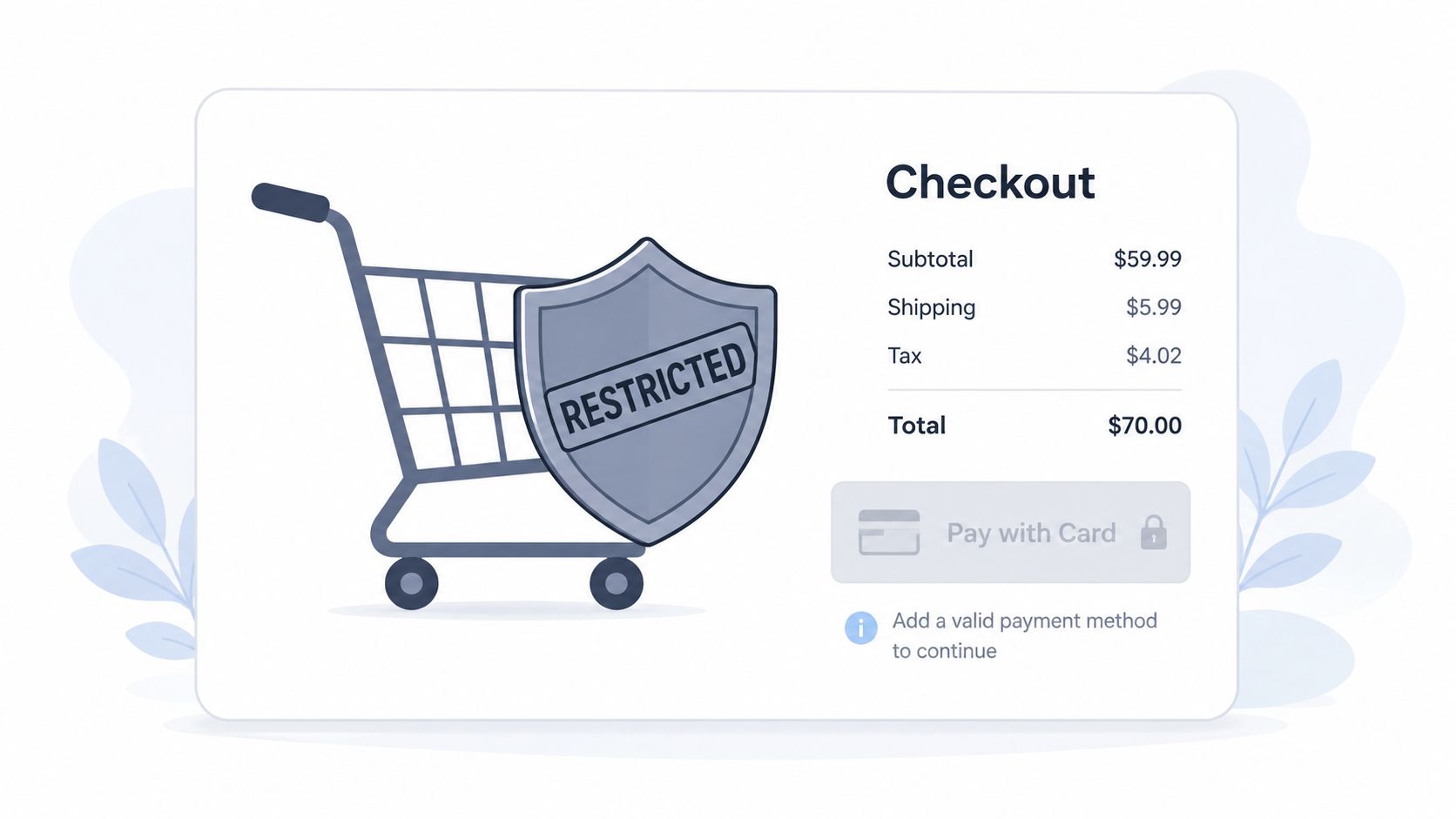
A strong audit test is to place realistic restricted orders and verify the site stops them at the exact point your policy says they should. For example, a firearms retailer should test an ammunition order into a prohibited city ZIP, a CBD brand should test a state where hemp derivatives are restricted, and a vape merchant should test an underage purchase path where age-verification rules apply. If the order gets through and someone notices later, the checkout control failed even if the customer was eventually refunded.
Automate Shipping Compliance
Block orders to restricted states automatically. 3-day free trial.
Start Free TrialPractical rule: If the user can complete payment for a prohibited order, the restriction is too late.
Retain screenshots of the blocked checkout, the cart contents, the address used, the date of the test, and the rule name or ID that triggered the rejection. Also keep the customer-facing message, because vague messaging can hide a real defect. “We can't ship there” is weaker than a message that identifies the legal or policy basis in neutral language, and it's harder for support to answer consistently.
The trade-off is clear. Tight rules reduce exposure, but rules that are too broad can hurt conversion or block lawful sales. That's why monthly test orders matter, especially after state and local law changes. If a rule update creates a spike in abandonment, the audit should flag that for legal and operational review instead of loosening enforcement without oversight.
2. Geographic Accuracy at the State, City, and ZIP Level
Geographic precision is where many shipping audits break down. A state-level block is easy to configure, but regulated products often depend on city or ZIP rules, and a broad restriction can create false positives just as easily as a narrow rule can create compliance failures. Ship Restrict's location-data guidance is useful here because it treats location as layered data, not a single yes-or-no field Location data accuracy.
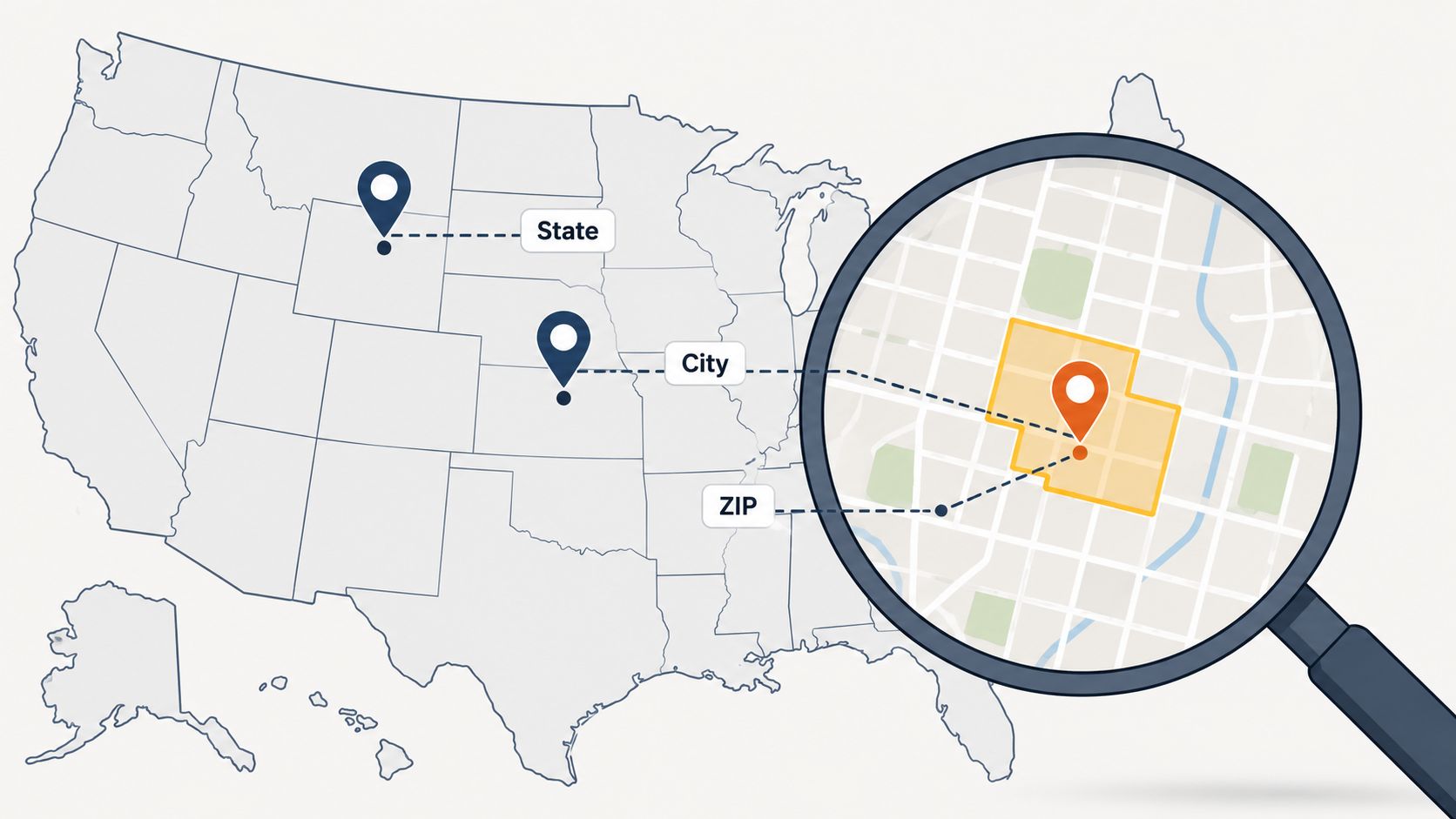
Audit the edge cases, not just the obvious ones. A firearms dealer may allow a product in rural Montana but block it in New York City. A CBD brand may find that some Illinois counties treat hemp derivatives differently. A vape retailer may need a ZIP-specific restriction for a city with its own age-sale enforcement. These are the locations where rule drift shows up first, because the team often copies a state rule and assumes the fine print will take care of itself.
A practical field test is to keep a small set of sample addresses that sit near borders, inside unique municipal bans, and in counties with conflicting local rules. Run those addresses through checkout after every policy change and after every major catalog update. If the wrong rule fires, capture the address, the exact rule path, and the customer-facing message, then assign a person to correct the map logic rather than patching it ad hoc.
Use state presets as a starting point, then layer city and ZIP customizations on top of them. Presets save time, but they don't replace jurisdiction-specific review.
The best evidence bundle includes the tested address, screenshots of the allowed and blocked outcomes, the date of the law or policy source you used, and a short note on why that geographic scope applies. That record matters because location rules age quickly. A rule that was correct for a municipality last quarter can become wrong after a local code update, and a broad restriction that “feels safe” may end up blocking lawful customers who never should have been touched.
3. Product and Variant Rule Completeness
A catalog can appear covered while individual variants remain unrestricted. The audit must test the product, its variants, bundles, tags, and collection memberships as separate control points. One ungoverned variant can bypass a rule applied correctly to the parent product.
Start with a catalog-to-rule reconciliation. Match each regulated category to its active restriction, then review products that were recently imported, renamed, duplicated, or separated for wholesale and retail use. A firearms retailer should verify every applicable ammunition SKU, not only its flagship products. A hemp or CBD brand should test dose-based variants individually. A vape distributor should check flavored and non-flavored lines separately because variant attributes may determine the restriction.
Free Shipping Compliance Audit
We'll review your WooCommerce store's shipping compliance for free.
For broader catalogs, review whether the store's product structure supports complete rule coverage. Teams handling multiple products can assess whether the Multi Product Ordering API preserves the required product and variant distinctions during ordering. The API does not replace legal review or checkout testing, but the mapping should show which product data drives the restriction.
WooCommerce and Shopify audits need operational evidence. Maintain a master mapping of categories, tags, collections, and variants to their rule status. Export the active rules and compare them with the catalog after bulk imports. Confirm that new products inherit the intended restrictions rather than entering the store as ungoverned items. Where Ship Restrict reduces manual rule application, test the resulting checkout behavior instead of treating automation as proof of compliance.
A useful control is a recurring count comparison between active rules and the catalog segment each rule protects. A count change can reveal a deleted tag, renamed collection, remapped category, or cloned product in another storefront. The checkout may still look normal while coverage has weakened.
The trade-off is speed versus certainty. Bulk setup helps regulated sellers configure large catalogs quickly, but every structural change should be followed by staging tests. Check one restricted variant, one permitted variant, and any bundle or product combination that could produce a different shipping outcome. Retest after correcting a mapping.
What to retain
- Catalog export: Capture the product and variant list used for the audit.
- Rule export: Save the active restriction set so changes can be traced.
- Variant tests: Document restricted, permitted, bundled, and recently added items where applicable.
- Change notes: Record uploads, tag changes, category remapping, and corrective actions.
4. Rule Scheduling and Activation or Expiry Dates
Time-based rule control is what keeps a shipping audit from becoming stale. Regulations change, temporary restrictions expire, and internal policy exceptions often have a fixed end date. If rules are left on forever, they can become overbroad. If they're turned on too late, shipments can go out before the business is ready.
The most reliable audit practice is to maintain a regulatory calendar with the law or policy trigger, the intended activation date, and the planned expiry or review date. Then test the scheduled behavior in staging before the live date arrives. That matters for a firearms retailer activating a new restriction on a law's effective date, a hemp brand responding to a temporary enforcement notice, or a nicotine seller updating age-restriction timing after a legislative change. The point isn't just that the rule exists, it's that it turns on and off when it should.
The evidence set should show the schedule, the reason for the schedule, and the test result from a pre-launch simulation. If a rule is meant to expire, the audit should verify that it disappears or deactivates on time. If it's meant to activate later, the test should confirm that early orders still flow normally until the trigger date arrives.
A practical way to avoid misses is to set reminder windows well before the activation date so someone has time to test, correct, and retest. That doesn't have to be complex. A shared calendar, a rule-change log, and one assigned owner can stop a lot of mistakes before they hit the checkout page.
Scheduled rules are only useful when someone checks them again after the law changes. Otherwise, they become old code with a compliance label.
This is also where software helps without taking over the job. Ship Restrict can schedule activation and expiry, which reduces manual follow-up, but the business still needs to review whether the legal basis is still current. Schedule automation handles timing. It does not interpret the law for you.
5. Customer-Facing Messaging Clarity and Consistency
Restriction messaging is an operational control, not a UX flourish. When a customer hits a blocked product or checkout restriction, the wording should explain the problem plainly enough that support does not have to interpret it later. Weak messaging creates confusion, extra tickets, and repeat attempts that consume time on both sides.
Use neutral, specific, and consistent language on product pages and at checkout. Avoid blame and avoid vague shorthand. A firearms retailer can use a compliance-focused message about state and local restrictions. A CBD brand can say the product is restricted in the customer's location and point to a compliance page. A vape merchant can state that age verification or jurisdiction rules prevent shipping to the entered address. Counsel should set the legal language, but the operations team still owns consistency.
Audit the customer path, not just the rule. Compare the product-page message, the checkout message, and any follow-up email or support script. If those texts disagree, the customer experience becomes harder to defend and the support team has to explain a rule the interface should have explained already. Keep screenshots or exported copies of the messages, plus the date they were last reviewed, so you can show what the customer saw at the time of restriction.
The trade-off is straightforward. Overly aggressive language creates friction, while overly soft language can make the company look inconsistent or evasive. The best messages state the rule without editorializing. That makes it easier for support to answer the same question the same way every time.
If you use a configurable messaging layer in WooCommerce or Shopify, test the wording after any rule update. A rule can be technically correct and still be operationally weak if the message is outdated or misleading. That is a real support risk because customers often decide whether to contact support based on the sentence they see in the moment. Clear messages also reduce avoidable tickets, especially when paired with automation like try Carti for Shopify support, which can route common restriction questions before they reach the inbox.
6. Audit Logging and Compliance Traceability
A shipping audit without logs is guesswork. Logs are what show a rule existed, that it fired correctly, and that a blocked order followed policy. For regulated sellers, that traceability matters because it is the evidence you may need if a regulator, attorney, or internal reviewer asks why a shipment was blocked or allowed.
Ship Restrict's record-keeping guidance treats restriction logs as part of the compliance file, not a side note Shipping restriction record keeping requirements. Audit the record itself. Confirm that blocked orders, rule edits, and exception handling are captured in a form you can review later. If a misconfigured rule allowed a prohibited shipment, the log should show when the error began and who changed the setting.
A reviewer should be able to answer four questions from the record, what happened, when it happened, who changed it, and what evidence supported the decision.
Use monthly log reviews to look for patterns, not just incidents. A spike in blocked orders can mean a location rule is too broad, a rule was copied incorrectly, or the product mapping changed without a matching update. Unusual admin activity can point to permission problems or process drift. Export and archive logs on a regular schedule, and keep them with the related rule change record so the audit trail stays connected.
The trade-off is clear. More detail makes review easier, but it also raises the need for clean structure. A stack of disconnected screenshots is not traceability. A structured log with the order, rule, date, and reason is. If your team uses workspace audit logs an opportunity, keep that same discipline here, with entries that let an auditor follow the trail without asking for a second system.
For regulated ecommerce, strong recordkeeping does more than prove a blocked checkout. It shows the business has a repeatable control across authorization, fulfillment, and review, which is what a mature audit program should demonstrate.
7. Cross-Platform Rule Consistency Across WooCommerce and Shopify
Many compliance failures don't come from the rule itself, they come from inconsistency between stores. A business can be careful on WooCommerce and sloppy on Shopify, or vice versa, and the customer experience will expose the gap quickly. That's why cross-platform consistency has to be part of the shipping audit, not a separate IT task.
The cleanest method is to maintain one master rule document, then push the same logic to every storefront in sequence. If the business runs a WooCommerce main site and a Shopify wholesale portal, the restriction set should match by product type, region, and schedule. If it sells through multiple stores, each one needs the same interpretation of the rule, the same messaging, and the same evidence standard for what gets blocked and why.
Portable rule sets help. JSON export and import can reduce re-entry mistakes and make it easier to compare what changed across platforms. A mixed WooCommerce and Shopify portfolio should also document how categories, tags, products, collections, and variants map to each other, because the same item name can mean different things in different systems.
A practical audit is to compare active rule counts and spot-check the same restricted scenario on both platforms. If one store blocks the order and the other lets it through, you have a compliance gap, not a minor configuration issue. The fix should start with the master document, then cascade outward so every storefront gets the same correction.
The benchmark from cross-border compliance in Brazil shows why phased rollout works when coverage gets large. One year after launch, the cited compliance program had 25 platform and logistics companies enrolled, covering roughly 67% of all cross-border e-commerce shipments entering the country World Customs Journal article. The lesson for shipping audits is straightforward, prioritize the highest-volume channels first, then expand coverage with standardized rules and clear ownership.
8. Regulatory Compliance Currency and Law Tracking
The last control is the one that keeps every other control from aging into irrelevance. Laws, guidance, and market practices shift, and a shipping audit only works if the team keeps the rule set current. Stale rules are dangerous because they can either block lawful orders or let prohibited ones through.
The best audit program treats law tracking as a monthly operating task. Subscribe to the sources your team uses, keep a change log, and assign someone to compare current rules against active store settings. If a state updates a product restriction, the business should know whether the checkout logic, the product mapping, the customer messaging, and the archived logs were all updated together. A rule that exists in the law but not in the store is a gap. A rule that still exists in the store after the law changed is also a gap.
The most useful evidence here is the change log. Record what changed, what triggered it, who approved it, and when the live update happened. That gives the reviewer a path from regulation to checkout control. It also helps when legal counsel needs to confirm that an interpretation wasn't copied forward from old guidance.
Major-market compliance is also moving toward product-level data, not just carrier billing accuracy. CPSC eFiling becomes mandatory in 2026 for certain consumer products entering the U.S., with certificate data transmitted at entry and fields such as manufacturer, test date, and lab contact information FedEx summary of CPSC eFiling requirements. That's a strong reminder that the audit lens has to include SKU-level compliance data, importer-of-record responsibility, and broker handoffs before tender, not just invoice accuracy after shipment.
The right question isn't “Did the invoice match?” It's “Was the order lawful, documented, and traceable before it ever left the checkout page?”
A mature shipping audit checklist therefore includes legal monitoring, catalog review, and evidence retention in the same operating rhythm. That's how teams keep the control current instead of treating it like a one-time setup.
8-Point Shipping Audit Checklist Comparison
| Audit Item | Implementation Complexity 🔄 | Resource Requirements & Efficiency ⚡ | Expected Outcomes / Impact 📊 | Ideal Use Cases 💡 | Key Advantages ⭐ |
|---|---|---|---|---|---|
| Order Restriction Enforcement at Checkout | Medium, integrates natively with Shopify; WooCommerce uses validation layer. | Low–Medium runtime cost; fast real-time checks if rules optimized. | Blocks non‑compliant orders pre‑payment; reduces chargebacks and returns. | High‑risk regulated sales needing pre‑payment blocking (firearms, CBD, vape). | Prevents post‑purchase cancellations; native checkout integration; better CX. |
| Geographic Accuracy (State, City, ZIP Level Verification) | High, multi‑level geodata and jurisdictional mapping required. | Medium–High maintenance for up‑to‑date city/ZIP databases; lookups must be optimized. | Minimizes over/under‑restriction; reduces illegal shipments and false positives. | Products with fragmented municipal regs (firearms, hemp/CBD, age‑restricted goods). | Fine‑grained control by state/city/ZIP; supports overlapping local rules. |
| Product and Variant Rule Completeness | Medium, initial catalog audit and mapping can be time‑intensive. | Medium, bulk tools speed setup; requires periodic sync with catalog changes. | Comprehensive catalog coverage; fewer compliance gaps and manual errors. | Large catalogs (hundreds+ SKUs) with many variants (ammo, gummies, flavors). | Bulk rule creation, JSON import/export, variant‑level precision. |
| Rule Scheduling and Activation/Expiry Dates | Low–Medium, calendar and scheduling UI; date accuracy needed. | Low, automates lifecycle but needs advance knowledge of effective dates. | Ensures timely enforcement/disablement; reduces forgotten or premature rules. | Temporary bans, phased law changes, pilot programs with known dates. | Automates activation/expiry; provides audit trail for rule lifecycles. |
| Customer‑Facing Messaging Clarity and Consistency | Low, message templates and dynamic insertion; legal review required. | Low–Medium, copywriting, translation, A/B testing and legal sign‑off. | Reduced support tickets and checkout abandonment; clearer customer expectations. | Stores where messaging affects conversion or customer confusion is common. | Customizable, dynamic messaging; improves trust and reduces inquiries. |
| Audit Logging and Compliance Traceability | Medium, requires logging, retention policies, and secure access controls. | Medium–High, storage, exports, and routine log review processes needed. | Defensible evidence for regulators; supports root‑cause analysis of failures. | Businesses facing regulatory audits, investigations, or litigation risk. | Timestamped, exportable logs linking blocked orders to triggering rules. |
| Cross‑Platform Rule Consistency (WooCommerce & Shopify) | High, platform differences require mapping and validation. | Medium, JSON versioning and synchronization processes; enterprise tools helpful. | Consistent enforcement across channels; fewer platform‑specific compliance gaps. | Merchants running both WooCommerce and Shopify storefronts. | Single source of truth via JSON; reduces manual duplication and drift. |
| Regulatory Compliance Currency and Law Tracking | High, continuous legal monitoring and interpretation required. | High, ongoing research, subscriptions, and legal counsel; frequent updates. | Rules remain current with law changes; reduced legal exposure and liability. | Companies in fast‑changing regulatory areas across many jurisdictions. | Researched state presets as baseline; demonstrates due diligence in audits. |
Turn the Checklist Into a Repeatable Compliance Control
The easiest way to use a shipping audit checklist is to sort every finding into three buckets. Immediate blockers are the issues that can cause a prohibited order, an invalid shipment, or a missing legal record, and they need same-day correction. Documentation gaps are the items where the control exists but the proof is thin, such as missing screenshots, missing log exports, or unclear ownership. Improvement opportunities are the process fixes that reduce future risk, like cleaner mapping, better message wording, or a tighter monthly review rhythm.
Once the findings are sorted, assign one owner to each rule family and one reviewer for the overall control. The owner should know the legal or operational basis for every restriction, not just how to flip it on in the admin screen. Then test both restricted and permitted scenarios, because a rule that only works in one direction isn't enough. Review the logs on a schedule, compare active rules against current laws, and recheck the catalog after new products, imports, or platform syncs.
Ship Restrict fits that workflow as an automation layer for WooCommerce and Shopify. It can help with checkout validation, geographic restriction logic, scheduled activation and expiry, customizable messaging, bulk configuration, and portable rule sets, which reduces a lot of repetitive manual work. It still doesn't replace legal interpretation, carrier requirements, packaging decisions, label review, return handling, contract terms, or staff procedures, and your audit should say that plainly.
The best programs don't just stop bad orders, they prove why the good ones were allowed. If you can show the rule source, the test case, the retained evidence, and the next review date, you've turned a checklist into a compliance control that can survive staff turnover, law changes, and store growth.
If you want to tighten checkout enforcement, geographic rules, and compliance logging in WooCommerce or Shopify, review Ship Restrict and map your current restrictions against the checklist above. A small set of rule tests and evidence captures can expose the gaps that matter most before they become blocked shipments, refunds, or regulator questions.
Automate Shipping Compliance
Stop worrying about restricted states. Ship Restrict handles it automatically.

Cody Yurk
Founder and Lead Developer of ShipRestrict, helping e-commerce businesses navigate complex shipping regulations for regulated products. Ecommerce store owner turned developer.
Automate Shipping Compliance
- Block restricted states
- No more cancellations
- Set and forget
3-day free trial · Card required