Location Data Accuracy for WooCommerce Compliance
Improve location data accuracy in WooCommerce, reduce compliance errors, and learn how Ship Restrict validates shipping rules state-by-state.
A 32% accuracy rate for publisher and exchange location data within 100 meters means 68% of those signals missed that bar in Thinknear's report, and that's enough to flip a restricted order from blocked to allowed in a checkout flow built on shaky coordinates. The same report said the industry's overall location score fell to 45 from 50 the prior quarter, the lowest accuracy level since tracking began in 2014 (Thinknear report summary).
A firearms order doesn't fail because a merchant forgot to care about compliance. It fails because a customer lands on the border of a county, the plugin trusts a coordinate that's a little off, and the store makes a legal decision in under a second.
Why a Single Coordinate Can Decide a Restricted Order
A borderline order usually doesn't look dramatic in the admin. It looks like a normal checkout, a normal address, and a normal customer who wants the item shipped fast. Then one signal nudges the result across a line the merchant can't afford to cross.
A location boundary can be state-level, county-level, city-level, or ZIP-level, but the operational problem is the same. The system needs to know whether the shipping destination belongs on the allowed side or the restricted side, and it has to know that before the order is accepted. That's why location data accuracy is a compliance issue, not just an analytics metric.
Automate Shipping Compliance
Block orders to restricted states automatically. 3-day free trial.
Start Free TrialThe practical danger is that the checkout stack often treats a single coordinate as if it were a verdict. It isn't. It's an input with error, and if that error moves the point a few blocks, the business decision can change with it.
Practical rule: if a coordinate can move an address across a prohibited boundary, it's not a safe stand-alone signal for enforcement.
For regulated WooCommerce stores, that matters more than almost anything else in the location stack. A merchant doesn't need a beautiful map pin, they need a trustworthy answer about where the order is going. The difference between those two things is where most compliance failures start.
The rest of the problem is that location signals age badly under pressure. Mobile devices, VPNs, stale address records, and coarse IP geolocation all produce enough uncertainty to break a simple yes-or-no rule. That's why production enforcement needs layered checks, not a single source of truth, and why a rules engine must be built to tolerate bad input without letting bad output through. For a useful starting point on how these rules are applied in WooCommerce, see location-based shipping restrictions in WooCommerce.
What Location Data Accuracy Really Means
Location data accuracy is the distance between a reported position and the true position. That sounds simple, but in practice it hides the whole error distribution, not just one number. A system can look decent on average and still fail badly at the edge cases that matter for regulated shipping.
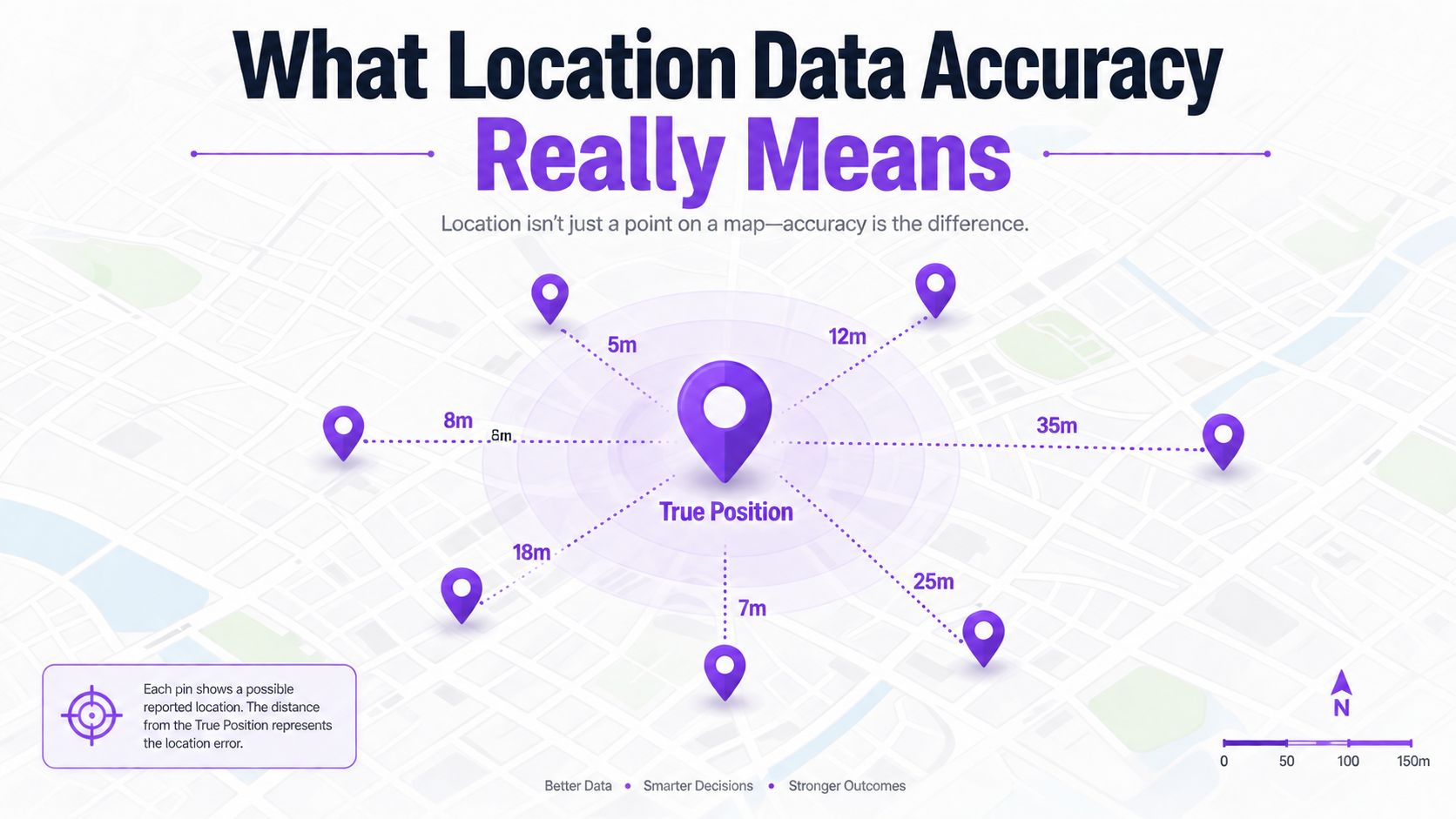
The signal matters more than the label
In a WooCommerce stack, “location” can mean several different things. It might be GPS from a device, IP geolocation from a network address, geocoding from a typed shipping address, or an address database that standardizes and validates what the customer entered. Each one answers a different question, and each one fails in a different way.
GPS gives a physical position, but only if the device can see the sky well enough to estimate it. IP geolocation guesses where a network connection appears to originate, which is often good enough for coarse regional routing but weak for exact boundaries. Geocoding converts text into coordinates, which is useful when the customer types an address but hazardous when the street name is ambiguous. Address databases improve standardization, but they still depend on how fresh and complete the underlying data is.
The main mistake is assuming all these sources are interchangeable. They're not. A signal that's fine for state-level filtering can be unsafe for ZIP-level enforcement, and a signal that works on desktop may collapse on a phone behind carrier NAT or a VPN. That's why compliance teams should ask what each signal can prove, not just what it claims to know.
Where the rough edges show up
The most useful mental model is to think of each source as a different layer of confidence. GPS is about physical proximity. IP is about network appearance. Geocoding is about text interpretation. Address databases are about normalization and reference quality. None of them, by itself, guarantees that the order belongs on the correct side of a boundary.
Free Shipping Compliance Audit
We'll review your WooCommerce store's shipping compliance for free.
For a technical lens on measurement and error interpretation, understanding lidar measurement accuracy is a helpful adjacent read because it treats positional error as something to benchmark, not admire. That's the right instinct for regulated commerce too.
The compliance takeaway is blunt. If you need to block a shipment into a prohibited city or county, your system needs more than a pretty location pin. It needs a tested workflow that maps messy inputs to a defensible yes-or-no decision.
Sources of Location Data and Where Each One Breaks
GPS is strong when the device has a clear view and the environment is cooperative. It gets weaker in urban canyons, near bridges, in tunnels, and indoors, where signal blockage and multipath distort the reading. The U.S. government's historical civilian benchmark of about 4 meter RMS horizontal accuracy and roughly 7.8 meters at 95% confidence is useful precisely because it reminds you that “good” GPS is still not boundary-proof (GPS accuracy reference).
IP geolocation has a different failure mode. It often maps a user to a network region rather than their actual street-level location, and that can be enough for broad rules but not for narrow ones. The same reference also notes that a commercial receiver can do better than 2.2 meters horizontal accuracy at 95% confidence under favorable conditions, which shows how much the quality envelope changes by method and environment (GPS accuracy reference).
The hidden breakpoints
Geocoding is vulnerable to ambiguity. A typed street name can resolve to the wrong side of a boundary if the parser chooses the wrong match or the user enters a partial address. Address databases are vulnerable to lag, because they can reflect a world that has already changed. Municipal changes, postal adjustments, and newly restricted areas don't wait for your import job to catch up.
A single source of truth doesn't exist here, only a stack of imperfect references that need to agree closely enough for the decision you're making.
That's why the idea of a “one-click location lookup” is so dangerous in a regulated shipping context. It sounds efficient, but it encourages false confidence. A strong enforcement stack should compare the entered shipping address, the resolved standardized address, and the applicable rule set, then require the result to survive obvious edge cases before it blocks or allows anything.
What the accuracy labels actually mean
Metrics like RMS, CEP, and NSSDA are not interchangeable marketing terms. They describe different ways of summarizing error. For compliance work, the most important part is not the label, it's whether the measurement method reflects real-world boundaries and real-world address patterns.
That matters because a merchant doesn't care whether a vendor sounds precise. The merchant cares whether a ZIP code, city, or county rule will hold up when a borderline order arrives tonight.
For a useful comparison point on how structured address capture fits into checkout workflows, compare static site form builders is a helpful reminder that form design changes data quality long before a rule engine ever sees the input.
Accuracy Metrics That Actually Map to Compliance Decisions
The best accuracy metric for compliance is the one tied to a real reference point. The National Standard for Spatial Data Accuracy does that by comparing a dataset against an independent higher-accuracy reference set and computing accuracy statistics from identical test points (NSSDA handbook). That's more useful than a vague vendor promise because it turns accuracy into a measured property.
For regulated shipping, that approach matters because the question isn't “Is the tool accurate?” It's “How often is it accurate enough for this boundary?” A single average hides too much. A boundary-sensitive workflow needs the median, the 95th percentile, and the 99th percentile error view, because those are the cases that reveal how often an order could drift to the wrong side of a rule.
The failure patterns merchants actually see
A VPN can make a customer appear to be somewhere else entirely. A geocoder can land a customer's street on the edge of the wrong municipal area. A stale address database can treat a recently changed boundary as if it never moved. Each of those failures looks small at the input layer, but the output can be a blocked lawful order or an allowed prohibited one.
The point is not that one metric is “bad” and another is “good.” The point is that compliance decisions need error distributions, not slogans. A system that only quotes one average can still fail the exact cases a regulated merchant cares about most.
If you want a second lens on why measurement quality matters, the broader lesson from sensor and mapping workflows is the same. Ground truth beats guesswork every time, especially when the penalty for being wrong is not a messy dashboard but an unlawful shipment.
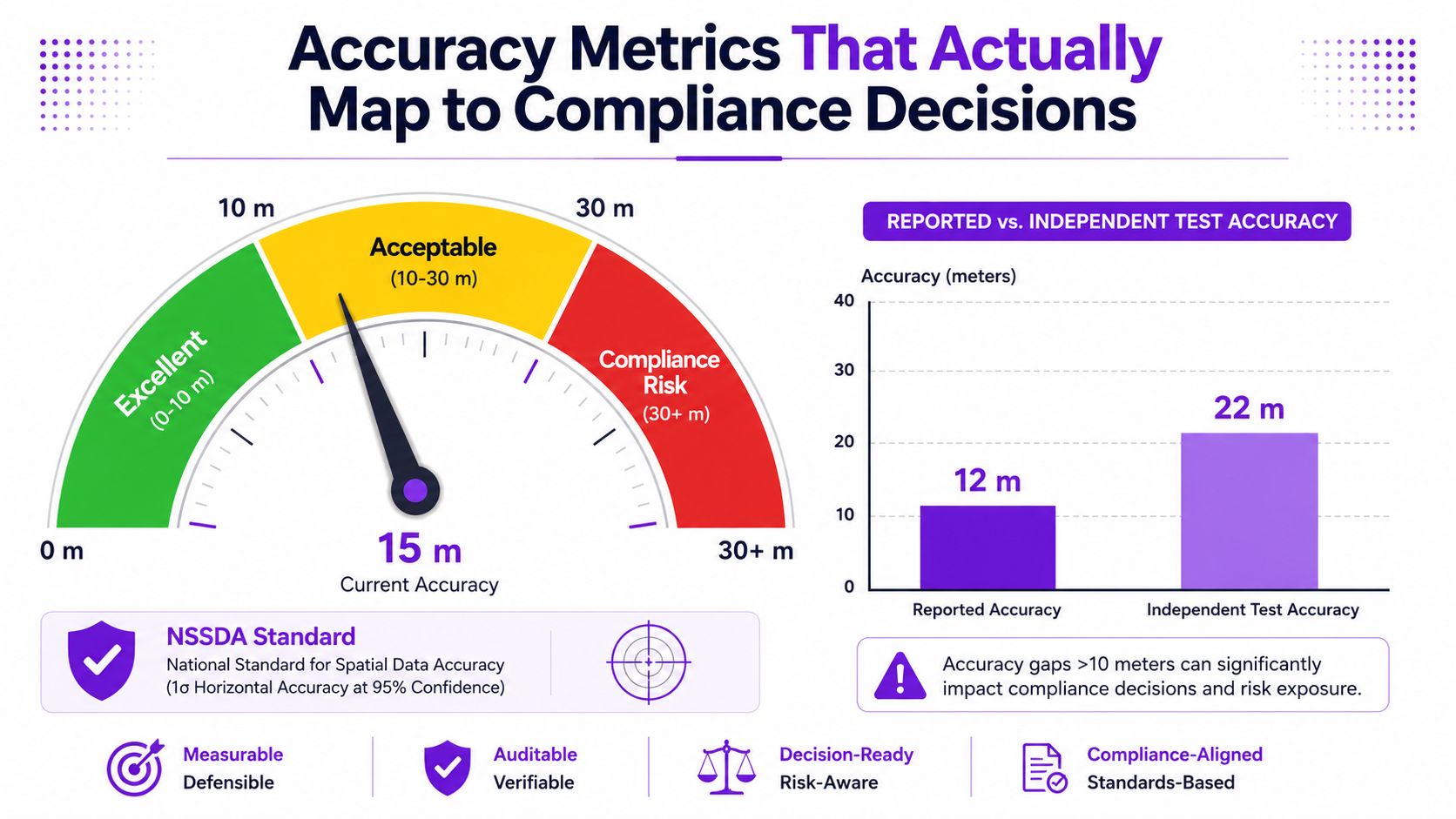
What to ask vendors and internal teams
Ask for the test method, not just the number. Ask where the control points came from, how many test points were used, and whether the results are reported across the full distribution of error. A location source that looks acceptable in a broad demo can still be too loose for a ZIP or city rule at checkout.
A practical review should include questions like these:
- What reference set was used? If there's no independent ground truth, the claim is weak.
- How are errors reported? Averages hide the tail, and the tail is where borderline orders live.
- Which environment was tested? Performance changes indoors, outdoors, and in obstructed areas.
- Which decision boundary is being protected? State, county, city, and ZIP all tolerate different levels of slop.
For teams that want a parallel on measurement discipline, the physics and mapping world has the same habit of using controlled references instead of vendor optimism. That mindset is the right one for compliance too.
How Wobbly Data Creates Real Compliance Failures
The first failure mode is the easiest to miss because it looks like a simple network issue. A customer connects through a VPN, the IP lookup lands in the wrong state, and the checkout flow either blocks a legal order or permits a restricted one. The merchant only sees a strange mismatch, but the root problem is that the network signal never represented the shipping location in the first place.
The second failure mode is more subtle. A typed address geocodes to the wrong side of a narrow boundary, especially when the street name is common or the boundary cuts through dense development. That's how an order can slip from a permitted ZIP into a banned adjacent ZIP without anyone noticing until the shipment is already in motion.
The third failure is usually the quietest
A stale address database can keep yesterday's geography alive long after a municipality changed its rules. The checkout looks clean. The address validates. The problem only surfaces when a shipment reaches a place that now falls under a new restriction. At that point, the merchant is handling a compliance issue after the fact, which is exactly the wrong time to discover it.
The right correction is not to trust one signal more aggressively. It's to make the stack less fragile. Validate the address server-side, normalize it against a current reference source, and apply the rule engine before the order is accepted. That prevents browser quirks, device spoofing, and client-side manipulation from short-circuiting the decision.
Operational rule: trust the entered shipping address as the business input, then test it against the rule set before checkout completes.
That approach works because it moves the decision point earlier and makes the logic auditable. A merchant can review why a block happened, what rule fired, and which address component triggered the result. That's a much stronger position than trying to explain why a label printed for a shipment that should never have been allowed.
Building a Validation Stack for WooCommerce
A good compliance stack starts with server-side address normalization. The address the customer types should be cleaned and checked on the server, not left to browser-side shortcuts that can be bypassed or mangled. From there, use an authoritative address reference that can recognize standard forms, common variants, and obviously bad inputs before the rule engine evaluates the order.
The next layer is rule freshness. Restricted geographies change, and the rule set needs to change with them. If the store sells regulated products, the system should refresh rules on a schedule, and the team should review newly restricted municipalities or ZIPs before they become live problems.
What the stack should do at checkout
A practical checkout stack should do four things in order:
- Normalize the address. Clean up abbreviations, ordering, and obvious formatting problems.
- Resolve the location. Map the address to the relevant state, county, city, or ZIP.
- Apply the rule set. Compare the resolved location to current shipping restrictions.
- Explain the outcome. Show a clear customer-facing message before the order is accepted.
That workflow reduces ambiguity and creates an audit trail. It also keeps enforcement tied to the shipping destination, not the customer's browser session or device location.
For a side-by-side look at how form structure affects downstream data quality, Static Forms' guide to customizable order forms is a useful reference. The form itself can either help you capture cleaner address data or make every later validation step harder.
Where trade-offs show up
Stricter validation adds friction. Some customers will mistype an address and need to correct it. That's a real cost, but it's far smaller than the cost of a misrouted regulated shipment. The goal is not to block more people, it's to make the block or allow decision defensible.
Bulk rule creation also matters when a store needs to cover a large set of restricted places quickly. Without that, teams end up hand-entering exceptions and missing edge cases. A rule-based system that supports state, county, city, and ZIP filters is much easier to keep current than a manual review queue.
Trade-offs Between Accuracy, Privacy, and Performance
A merchant doesn't need maximum possible location precision for every decision. Broad regional rules can work with coarse signals, while narrow compliance boundaries need tighter address parsing and better normalization. The right question is not “How accurate can we get?” It's “How accurate do we need to be for this rule?”
High-accuracy signals often come with more customer friction. Browser geolocation requests can feel invasive, and they can slow checkout. Coarser signals preserve speed and privacy, but they're a poor fit when a ZIP or city boundary carries legal weight. That tension is exactly why a regulated store should prefer structured address capture first and treat browser location as optional, not primary.
A simple decision framework
Use the strictness of the rule to set the strictness of the validation.
- State-level rule, coarse location data may be enough if the rest of the address is clean.
- County- or city-level rule, you need better address parsing and current boundaries.
- ZIP-level rule, you need careful normalization and scheduled rule updates.
Monitoring matters. If a store is making decisions on restricted products, it should periodically test the system against known edge cases and review how often the validation is behaving as expected. The point is not to chase perfect precision. The point is to keep the system honest enough that the rule boundary is enforced the way the business intended.
For planning around operational cost and control surfaces, PropLab's cost estimation tools guide is a useful reminder that the cheapest input is not always the lowest-risk decision. That idea applies directly to location data too.
<iframe width="100%" style="aspect-ratio: 16 / 9;" src="https://www.youtube.com/embed/AgRbxjrr5as" frameborder="0" allow="autoplay; encrypted-media" allowfullscreen></iframe>The best routine is boring on purpose. Structured address capture, scheduled rule refreshes, and periodic validation beats clever browser tricks almost every time in regulated commerce.
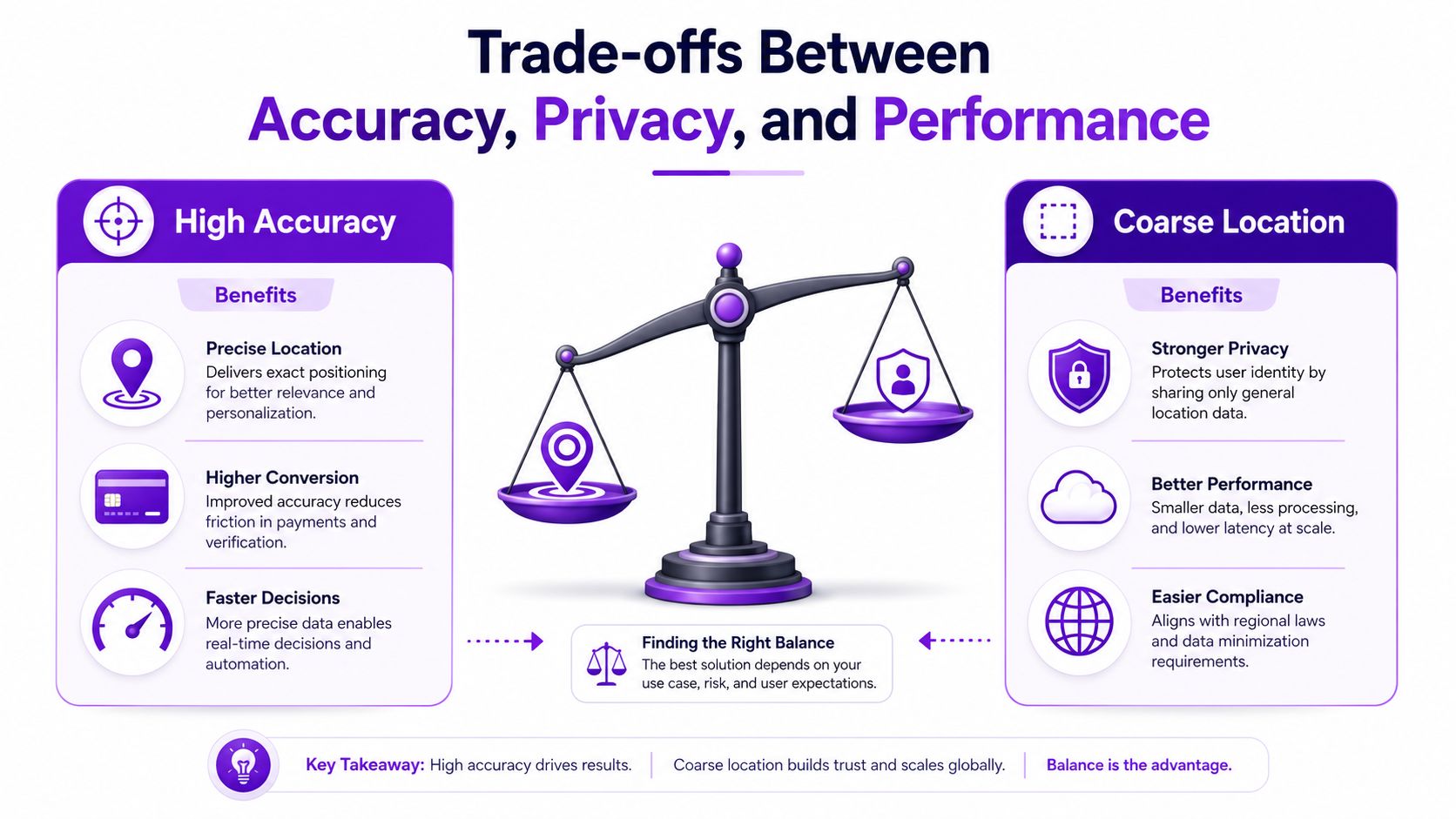
Monitoring and Testing That Keeps Accuracy Honest
A compliance stack can drift without obvious alarms. Address references age, municipal boundaries change, and edge cases that used to pass can start failing without notice. That's why the system needs scheduled testing, not just a one-time setup.
Start with monthly test orders to known restricted jurisdictions. Those tests should hit the same branches your real customers hit, because a green admin screen means little if the live checkout path behaves differently. Add scheduled rule updates from authoritative sources so the store doesn't rely on memory or manual cleanup.
What to watch in the dashboard
Track three operational outcomes: block, allow, and override. If overrides start to rise, it usually means the rule set is too strict, the address input is too messy, or the validation path is too brittle. If blocks are suddenly lower than expected, that deserves attention too, because it can mean the store is letting risky orders through.
A periodic comparison against a vetted address database helps catch drift before customers do. Use that comparison the way you'd use any quality audit, as a measurement against a reference, not a confirmation that the current system is fine. The earlier NSSDA section matters here because the same logic applies in production, compare against a trusted reference and look at the distribution, not a single average.
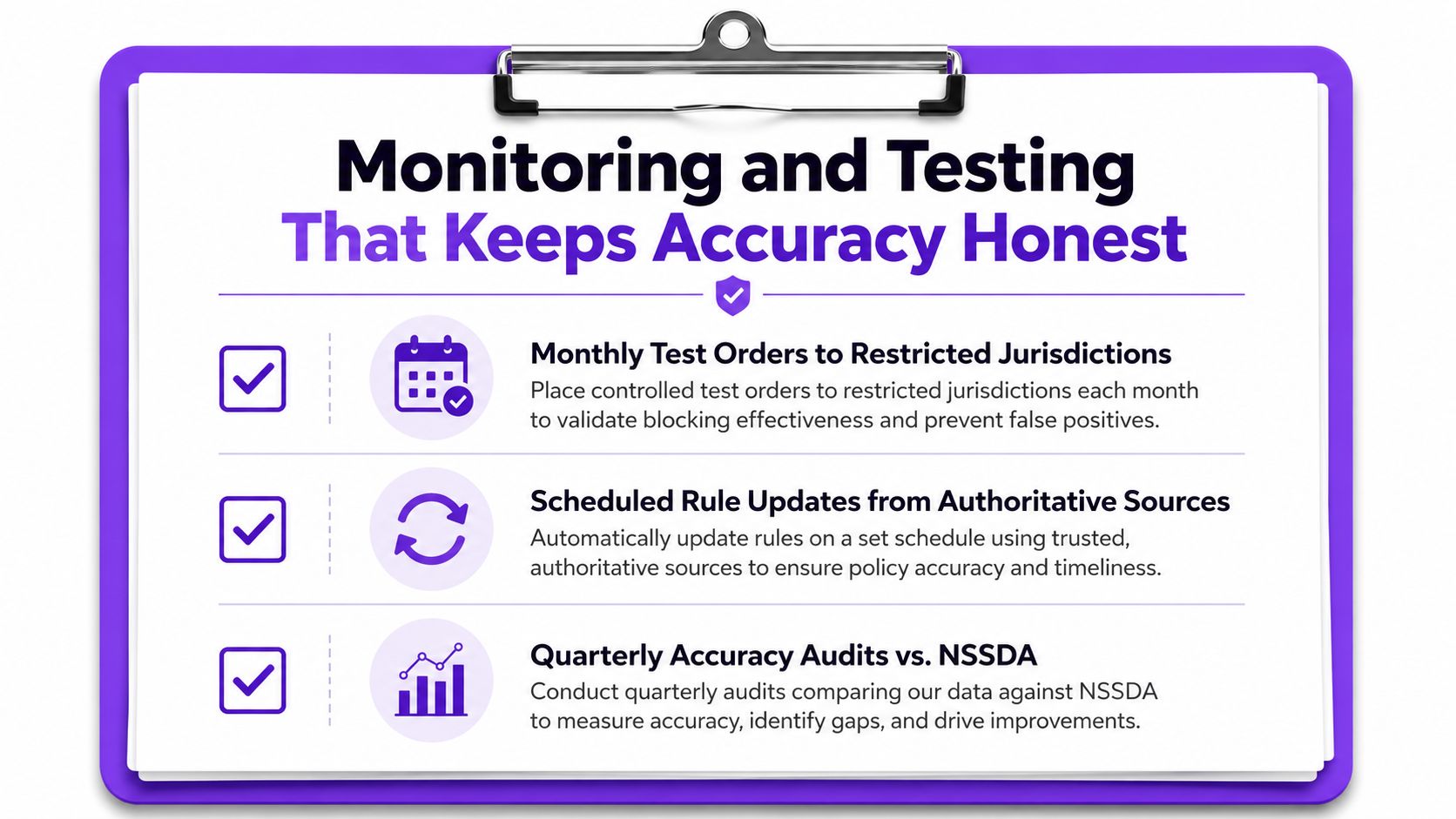
A short checklist for this week
- Run one test order through a known restricted boundary.
- Review your rule update cadence and confirm it's scheduled, not ad hoc.
- Compare a sample of addresses against your current reference data.
- Inspect override reasons and look for repeated patterns.
- Check whether the checkout decision is still happening server-side.
For a practical follow-up on improving the data path itself, how to improve accuracy is worth a look inside your WooCommerce workflow.
A regulated store doesn't get to treat location as a soft signal. If your current checkout still trusts a single coordinate, fix the workflow before the next borderline order does it for you. Ship Restrict can help you enforce state, county, city, and ZIP rules before checkout, so you're blocking restricted orders with a process built for compliance instead of hoping a map pin gets it right.
Automate Shipping Compliance
Stop worrying about restricted states. Ship Restrict handles it automatically.

Cody Yurk
Founder and Lead Developer of ShipRestrict, helping e-commerce businesses navigate complex shipping regulations for regulated products. Ecommerce store owner turned developer.
Automate Shipping Compliance
- Block restricted states
- No more cancellations
- Set and forget
3-day free trial · Card required