A Guide to Compliance Risk Assessment for Shippers
Learn to run a compliance risk assessment for shipping regulated products like firearms. Our guide covers risk scoring, controls, and automation.
You know the moment. An order comes in late in the day, the customer's address looks ordinary, and someone on your team opens the spreadsheet. One tab has state rules. Another has county notes copied from a forum thread. A third has ZIP codes someone added months ago after a returned package. Now you're asking the worst question in firearms eCommerce: “Do we know for sure this shipment is allowed?”
That's where most compliance failures start. Not with bad intent. With manual work, scattered rule tracking, and too much confidence in a process that can't keep up with local restrictions.
A proper compliance risk assessment fixes that. It turns compliance from memory and guesswork into a documented operating system for how your store evaluates, blocks, reviews, and updates shipping decisions. For firearms dealers, that matters most at the micro-geography level, where county, city, and ZIP-specific restrictions create the core operational risk.
Why a Compliance Risk Assessment Is Non-Negotiable
If your current process depends on a person checking orders against a spreadsheet, you don't have a reliable control. You have a fragile workaround.
Automate Shipping Compliance
Block orders to restricted states automatically. 3-day free trial.
Start Free Trial
That distinction matters because compliance risk doesn't sit still. Product rules change. Local ordinances change. Carriers have their own constraints. Your catalog changes. Your checkout flow changes. A process that worked for your store six months ago can, unnoticed, become the reason a restricted order slips through today.
What the baseline looks like now
This is no longer a niche best practice. White & Case reported in its 2023 benchmarking survey that 79% of corporate respondents conduct documented anti-corruption risk assessments, and 48% perform them annually or more frequently. The lesson is broader than anti-corruption. Documented assessment and regular review are now standard governance habits, not optional cleanup work.
For a firearms shipper, the implication is simple. A one-time policy memo or a static rules file isn't enough. If your business ships regulated products, your compliance decisions need to be reviewed as an operating practice.
Practical rule: If a shipment decision relies on someone “remembering the rule,” treat that as unmanaged risk.
Why this matters in day-to-day operations
A compliance risk assessment gives you a way to answer the questions auditors, partners, and your own team will ask after a problem appears:
- What risks did you identify: Not in theory, but in your actual ordering and shipping workflow.
- What controls did you put in place: Manual review, checkout restrictions, product gating, address validation, exception handling.
- How often did you revisit those controls: Enough to show the process stayed current.
- What changed after issues were found: A defensible record of improvement.
That's the difference between reacting to violations and protecting your business from compliance risks through a documented system. It's also the difference between a manageable mistake and the wider cost of shipping compliance violations, fines, fees, and consequences.
A lot of dealers think they need more effort. Usually they need more structure. The assessment gives you that structure.
Defining Your Assessment Scope Beyond State Lines
Most weak assessments fail at the first step. They define scope too narrowly.
A dealer says, “We ship only within approved states,” and thinks the scope is done. It isn't. If you sell firearms or related regulated products, state-level review is only the outer shell of the problem. The actual risk often sits below that level.
Free Shipping Compliance Audit
We'll review your WooCommerce store's shipping compliance for free.
The micro-geography gap
The most expensive assumption in firearms shipping is that state compliance equals shipping compliance.
A 2024 analysis cited by Scrut found that 62% of shipping violations for regulated goods came from failures to parse local jurisdiction rules rather than state laws. The same analysis notes that 40%+ of U.S. firearm shipping restrictions are enforced at the county or municipal level.
That's the micro-geography gap. It's the space between broad legal awareness and operationally useful rule enforcement.
If your assessment says “California” but your checkout logic can't distinguish one county or city from another, your scope is too broad to be useful.
What belongs in scope
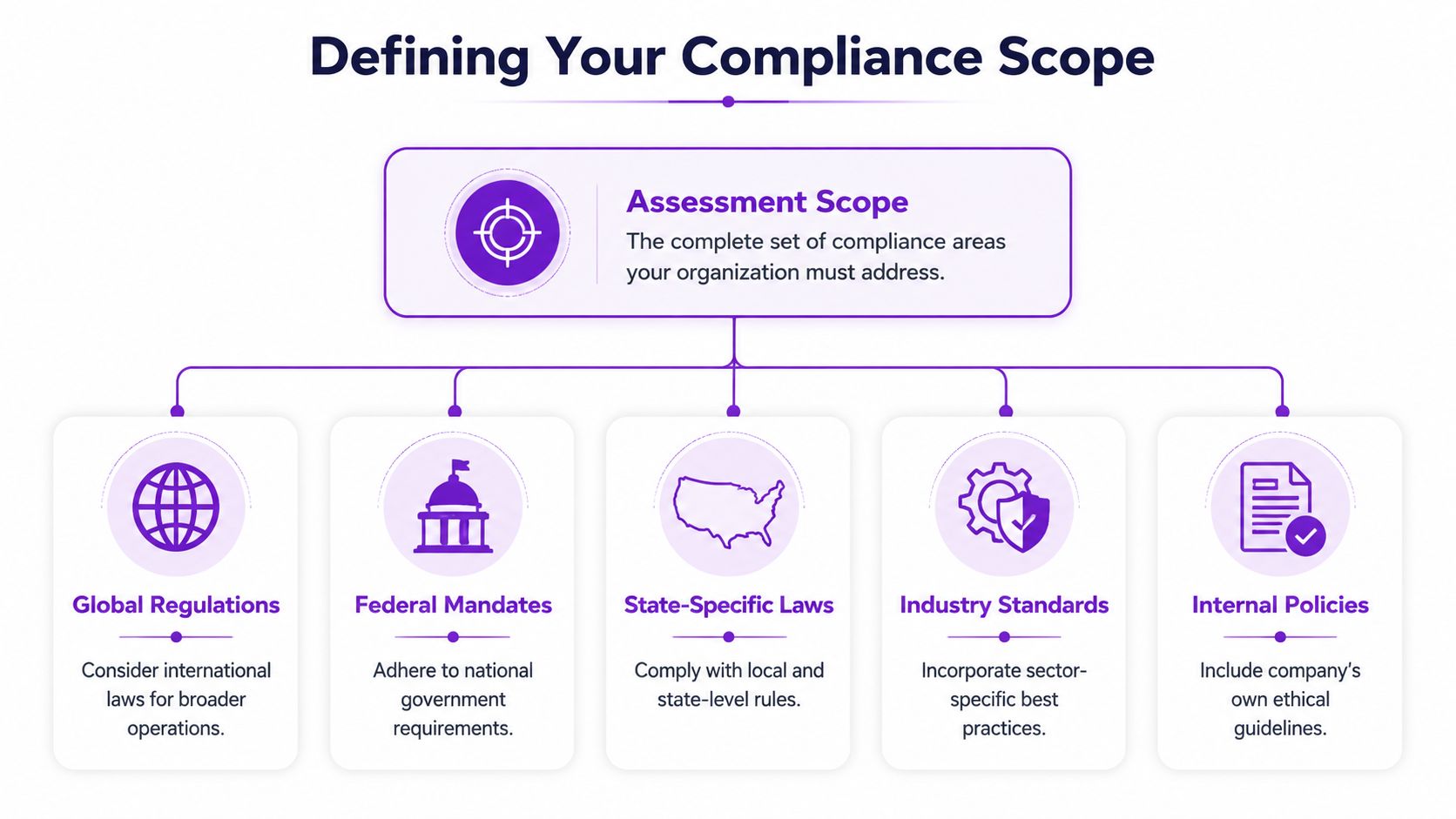
A practical compliance risk assessment starts by mapping the actual decisions your store makes. For firearms shippers, I'd define scope across five layers.
-
Products and variants
Separate complete firearms, serialized parts, magazines, ammunition, accessories, and anything else that may trigger different restrictions. -
Jurisdictions you can ship to Don't stop at states. Include counties, cities, and ZIP-code edge cases where local rules affect eligibility.
-
Sales channels
Your WooCommerce storefront is only one path. Include phone orders, invoice orders, customer service overrides, and any dealer-to-dealer workflows. -
Fulfillment behavior
Review how addresses are captured, how orders are flagged, who approves exceptions, and which carrier methods are available at checkout. -
Internal policy choices
Some merchants choose stricter rules than the legal minimum. Those decisions belong in scope too, because your staff still has to enforce them consistently.
A better way to frame the assessment
Instead of asking, “What laws apply to us?” ask three narrower questions:
- What can the customer place in the cart?
- What address combinations create shipping restrictions?
- Where can a human override the system?
Those questions produce a scope you can test. Legal summaries alone don't.
If your current process still treats local restrictions as an exception case, it's worth reviewing why county-level shipping restrictions make state compliance insufficient. That operational view is usually where the blind spots show up.
A scope is good when it matches how orders move through your store. It's weak when it mirrors how laws are written on paper but ignores how your team ships.
How to Identify and Score Your Shipping Risks
Once the scope is right, the next job is to name the risks clearly enough that your team can act on them. Vague labels like “shipping compliance issue” don't help. You need risks written as specific failure modes.
For firearms shipping, that usually means identifying where a restricted item, destination, carrier rule, or manual override could create a non-compliant order.
Start with risk identification
The fastest way to do this well is to gather input from the people who touch the workflow. That includes operations, customer service, whoever maintains products, and whoever handles exception orders. Good methodologies combine qualitative discussion with quantitative scoring, rather than relying on one or the other. Euronext's overview of compliance risk assessment methodologies describes this approach as combining group discussions with quantitative models and using probability and impact scoring to isolate the most severe threats.
In firearms eCommerce, common risk categories include:
-
Destination mismatch
A product is allowed in one part of a state but restricted in a county, city, or ZIP code the store doesn't screen correctly. -
Catalog classification errors
A restricted item is tagged too broadly, too narrowly, or not tagged at all, so the wrong checkout rule applies. -
Carrier incompatibility
The order passes your legal review but reaches a shipping method or fulfillment path that shouldn't be used for that product. -
Manual override failures
Staff approve an order outside normal logic without documenting why or verifying the destination correctly. -
Stale rule data
A local restriction changes, but your store still enforces the old rule because nobody updated it. -
Customer messaging gaps
The store allows checkout to proceed too far before disclosing that the destination is restricted, which creates support load and avoidable refunds.
Score each risk by likelihood and impact
You don't need a complex spreadsheet model to make this useful. You do need consistent categories.
Use the two axes described in the source above:
-
Likelihood
Improbable, possible, probable -
Impact
Acceptable, tolerable, unacceptable, intolerable
That gives you a matrix your team can use to rank what needs attention first.
| Impact | Improbable (Low) | Possible (Medium) | Probable (High) |
|---|---|---|---|
| Acceptable | Monitor | Monitor | Improve if practical |
| Tolerable | Monitor | Mitigate | Prioritize |
| Unacceptable | Mitigate | Prioritize | Urgent action |
| Intolerable | Prioritize | Urgent action | Immediate control required |
A worked example
Take this risk: A restricted magazine is sold to a customer whose ZIP code falls within a locality the store doesn't flag.
Likelihood might be probable if your store relies on state-level checks and staff manually review edge cases. Impact is likely intolerable because the order can progress far enough to create fulfillment work, customer conflict, and legal exposure.
That puts the risk in the highest-priority zone. The lesson isn't abstract. You shouldn't spend the next month refining low-impact edge cases while this one stays live.
The matrix doesn't replace judgment. It forces judgment into a format your team can defend.
What good output looks like
A solid risk register for this process should capture:
-
Risk statement
Written in plain language, tied to a real workflow failure. -
Affected products or categories
Not every rule applies to every SKU. -
Affected destinations
Include local jurisdiction detail where relevant. -
Current control
Manual review, checkout rule, address block, approval step, or none. -
Likelihood and impact score
Chosen consistently, not by gut feel in the moment. -
Owner
Someone has to maintain the rule or fix the gap.
If you want a practical operational lens for finding those gaps, a WooCommerce shipping compliance audit checklist is a useful complement to the scoring exercise. The key is that identification comes first, and scoring turns the list into a priority order.
Implementing Controls That Actually Work
A risk assessment without controls is just documentation. The point is to reduce the chance that a known risk becomes a shipped order.
The biggest choice here is whether you rely on manual controls or automated ones.
Manual controls versus automated controls
Manual controls sound flexible. In practice, they break under volume, staff turnover, and rule complexity.
A manual control might look like this: customer places order, staff reviews address, staff checks a spreadsheet, staff approves or rejects. That can work for a very small operation with a narrow catalog and limited destinations. It stops working once local restrictions multiply and the same person is also handling customer service, returns, and fulfillment exceptions.
Automated controls work differently. They enforce the rule at the point of decision. The store checks the item, destination, and configured restrictions before the order proceeds too far. That doesn't eliminate review. It eliminates avoidable exposure.
A Compliancy Group discussion of risk assessment pitfalls highlights two points that matter here. First, failing to test controls is a primary pitfall. Second, for regulated products, cataloging only federal laws while omitting state or county obligations leads to a 40% higher rate of order rejection and costly reverse logistics. That's why broad legal awareness isn't enough. The control has to map rules granularly and enforce them consistently.
What a usable control framework includes
The best controls aren't just blockers. They're operational.
-
Checkout validation
Stop non-compliant orders before payment or final confirmation where possible. -
Product-level restriction mapping
Different categories need different logic. One rule set won't cover every regulated item. -
Granular destination logic
County, city, and ZIP-level restrictions need to be configurable, not hidden in staff notes. -
Exception handling
If staff can override a rule, that action should be limited, documented, and reviewable. -
Customer-facing messaging
A blocked order should tell the buyer enough to reduce confusion without creating internal chaos.
Testing is where most teams cut corners
A control isn't effective because it exists in software or on a checklist. It's effective because you test it against real scenarios.
That means running sample orders through restricted and allowed addresses, checking overlapping rules, and confirming that product tags trigger the intended behavior. It also means testing what happens after updates. A control can fail unnoticed if no one verifies the rule logic after a change.
Here's a useful walkthrough to see how rule-based restriction logic works in practice:
<iframe width="100%" style="aspect-ratio: 16 / 9;" src="https://www.youtube.com/embed/bSwwv5XeMdQ" frameborder="0" allow="autoplay; encrypted-media" allowfullscreen></iframe>Field observation: The stores with the fewest shipping surprises aren't the ones with the longest policy manuals. They're the ones that turn policy into tested checkout behavior.
A control should reduce human dependence, not just give staff another document to consult.
Keeping Your Risk Assessment Current and Defensible
A compliance risk assessment becomes useful when it's maintained like an operating record, not stored like a one-time project file.
If an auditor, partner, or internal stakeholder asks how you manage firearms shipping risk, your answer shouldn't be “we have rules in the store.” It should be “here is the risk register, here are the controls tied to each risk, here is when we reviewed them, and here is what changed.”
What to document for defensibility
Defensibility comes from records that show thought, action, and follow-through.
Keep documentation that covers:
-
Risk inventory
The specific shipping and product risks you identified. -
Scoring rationale
Why a risk was rated probable or intolerable, not just the label itself. -
Control mapping
Which policy, workflow, or technical restriction addresses each risk. -
Ownership
Who updates rules, who reviews exceptions, who signs off on changes. -
Evidence of testing
Notes or logs showing restricted and allowed scenarios were checked. -
Change history
What was updated, when, and why.
A practical review cadence
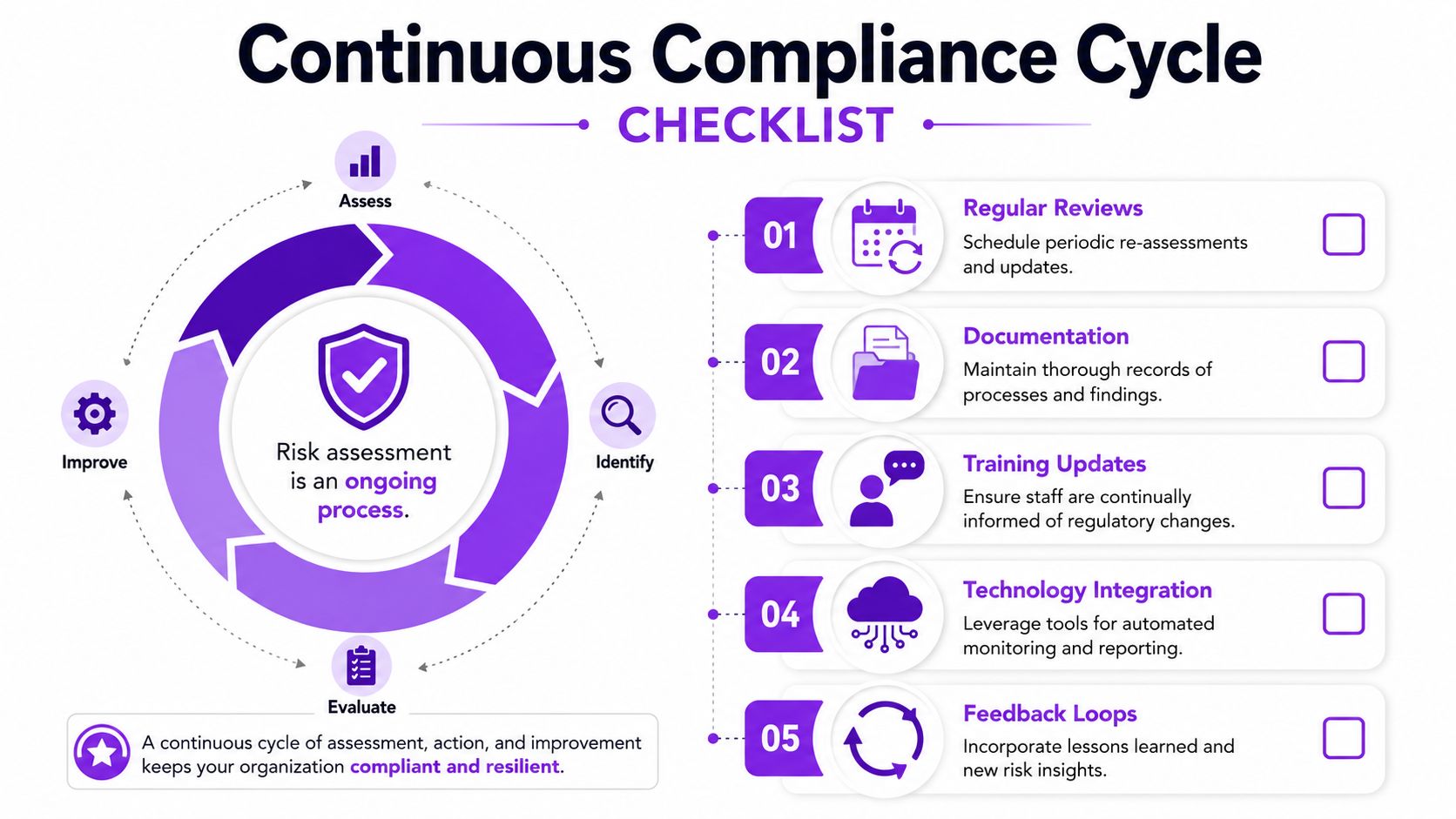
The schedule should be frequent enough to catch drift without burying the team in process. Ethico's guidance on assessments that drive action recommends quarterly remediation reviews, semi-annual pulse assessments on top risk areas, and triggered reassessments after major events such as new regulations or enforcement actions.
That cadence works well for firearms shipping because risk doesn't change evenly. Some periods are stable. Then a rule change, carrier issue, or product expansion makes your current controls outdated overnight.
What each review should cover
Quarterly remediation reviews
Focus on the open items from your last assessment.
- Unresolved control gaps
Which fixes are still pending. - Override activity
Whether staff are bypassing controls too often. - Support and fulfillment feedback
Where blocked orders or mistaken approvals are creating friction.
Semi-annual pulse assessments
Take a fresh look at your highest-risk areas.
| Review area | What to check |
|---|---|
| Local destination logic | Whether county, city, and ZIP restrictions still match current operations |
| Product categorization | Whether new SKUs and variants map to the right restriction rules |
| Checkout behavior | Whether restricted orders stop at the correct point in the flow |
| Exception process | Whether approvals remain limited and documented |
Triggered reassessments
Run these outside the calendar when something material changes.
New regulation, new product line, new carrier workflow, store redesign, or a real incident. Any of those is enough reason to reassess.
The businesses that stay defensible don't wait for annual planning to revisit known weak spots. They treat the assessment as a living record tied to actual operations.
Building an Effective Remediation Plan
Even well-run stores will eventually catch an issue. The test isn't whether a problem ever appears. The test is how your team responds once it does.
A remediation plan should be short, specific, and ready before you need it.
Step one contains the issue
Stop the affected shipment or order flow immediately. That may mean placing the order on hold, disabling a shipping method, or temporarily tightening a product restriction while the team verifies the rule. Speed matters more than elegance at this stage.
Step two finds the root cause
Don't settle for “someone missed it.” That's not a cause. Review the product mapping, destination logic, checkout behavior, and any manual approval that touched the order. Most repeat failures come from process design, stale rule maintenance, or unclear ownership.
Step three corrects the system and document the fix
Update the control that failed. Then record what happened, what changed, who approved the change, and whether you tested the correction. That documentation is part of the compliance risk assessment cycle, not a separate admin task.
A useful remediation record should answer four questions:
- What failed
- Why it failed
- What changed to prevent recurrence
- How the team verified the change worked
That's what maturity looks like in practice. Not perfection. Repeatable correction.
Compliance Risk Assessment FAQs
How often should a firearms retailer perform a compliance risk assessment?
Treat it as an ongoing process, not a once-a-year task. A full review can sit on a regular cadence, but local rule changes, catalog changes, new carriers, and checkout updates should trigger targeted reassessment when they affect shipping logic.
What's the difference between a compliance risk assessment and an audit?
A compliance risk assessment is proactive. You identify risks, score them, map controls, and fix weak points before they become incidents. An audit is typically retrospective. It checks whether controls and records hold up against a standard or a set of requirements.
Can a spreadsheet still work for shipping compliance?
For a very small catalog and limited destinations, a spreadsheet can support review. It doesn't scale well, and it's hard to defend when restrictions depend on county, city, or ZIP-level logic. The more your business relies on local rules and real-time checkout decisions, the weaker manual tracking becomes.
What makes an assessment defensible?
Clear scope, documented risks, consistent scoring, mapped controls, testing records, and review history. If you can show how a risk was identified, controlled, revisited, and corrected when needed, you're in a much stronger position.
If your store sells regulated products through WooCommerce, Ship Restrict gives you a practical way to turn a compliance risk assessment into enforceable checkout rules. Instead of relying on spreadsheets and manual ZIP-code checks, you can block restricted orders by state, county, city, or ZIP code before they become shipping problems.
Automate Shipping Compliance
Stop worrying about restricted states. Ship Restrict handles it automatically.

Cody Yurk
Founder and Lead Developer of ShipRestrict, helping e-commerce businesses navigate complex shipping regulations for regulated products. Ecommerce store owner turned developer.
Automate Shipping Compliance
- Block restricted states
- No more cancellations
- Set and forget
3-day free trial · Card required