Uptime Guarantee: Choosing the Best SLA for Your Store
Learn how an uptime guarantee works in SLAs and what 99.9% really means for regulated WooCommerce stores.
99.9% uptime still allows about 43.8 minutes of downtime per month and roughly 8.76 hours per year. That makes it a contractual target, not a promise of perfection.
Friday afternoon is exactly when a firearms store discovers that a checkout dependency has gone quiet. Orders stack up, a shipping-restriction plugin stops answering, and a customer in a strict state can slip into a path that should've been blocked before payment ever moved forward. If you've lived through that kind of outage, you already know the problem isn't just the server, it's the compliance exposure that follows every failed validation.
A practical warning worth reading is insights from Nutmeg Technologies, because downtime isn't abstract when your checkout is the control point. For a regulated WooCommerce store, one dead dependency can mean manual reviews, delayed shipments, angry customers, and a paper trail you'd rather not explain later. If your store uses a one-page flow, the risk is even sharper, because the validation step has to hold under pressure, not just in a sandbox, as this one-page checkout pattern shows in practice.
When Checkout Goes Dark on a Regulated Store
The outage usually doesn't start with a dramatic crash. It starts with a small dependency getting slow, then failing, then becoming the thing every order waits on.
Automate Shipping Compliance
Block orders to restricted states automatically. 3-day free trial.
Start Free TrialThe failure that looks like a glitch but behaves like a compliance event
A firearms retailer can lose more than revenue when shipping rules stop resolving. If a state-specific restriction feed, plugin call, or rule engine becomes unreachable during checkout, the storefront may still load while the actual compliance decision never completes. That's the dangerous part, the site looks alive to the customer, but the control that prevents illegal fulfillment has gone blind.
In that moment, the merchant has three bad options. They can block every order and take the revenue hit. They can let orders through and sort them out later, which is the worst choice. Or they can switch to manual review, which keeps the business alive but turns a fast checkout into a backlog of human work.
That's why uptime has to be treated as a legal exposure surface, not a vanity metric. A dependency that handles shipping restriction logic is not like a blog widget or a marketing banner. It sits on the edge of compliance, fulfillment, and customer trust, and the damage shows up in all three places at once.
If a system decides whether a restricted order can proceed, its downtime is a controls failure, not just an IT inconvenience.
The operational lesson is simple. A vendor can tell you the site is “available” and still leave you exposed if the checkout logic fails. The right question is whether the service keeps the compliance decision path alive under real load, with real addresses, in real time.
That's the mindset behind every SLA review I do now. I don't ask vendors whether they have uptime. I ask whether their outage definition matches the place my order validation breaks.
What an Uptime Guarantee Actually Means
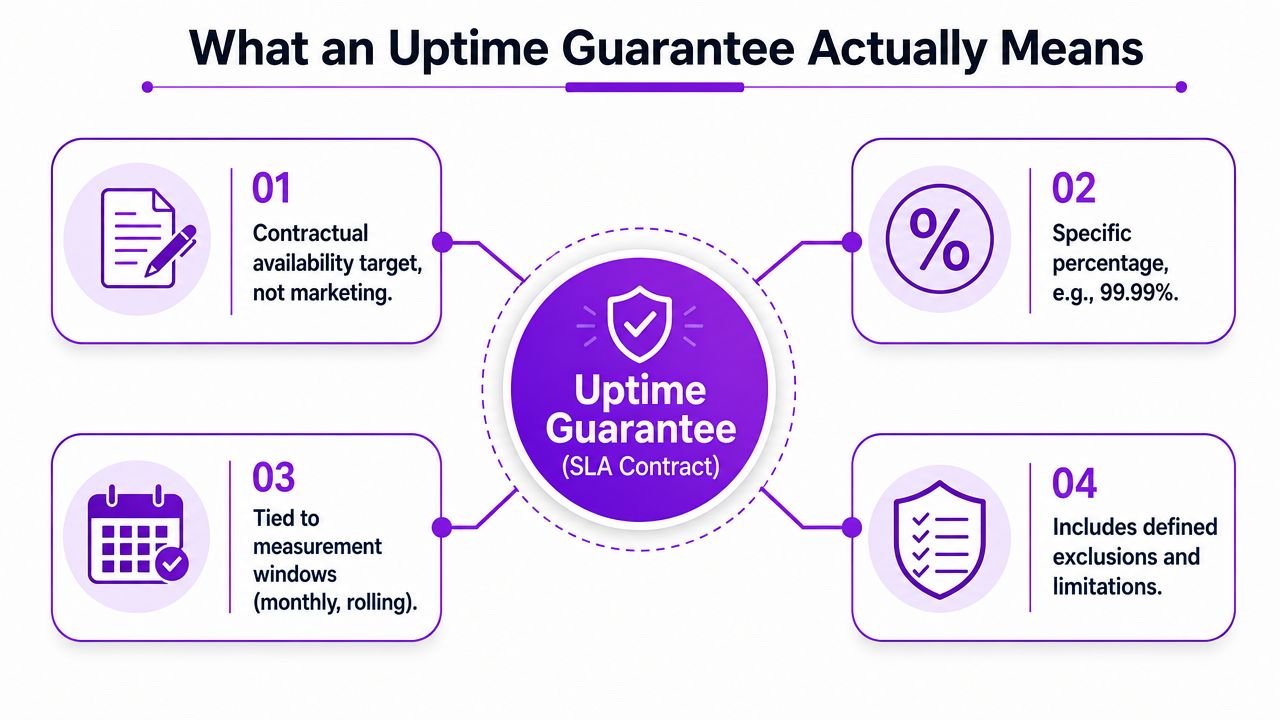
An uptime guarantee is a contractual availability target inside a service-level agreement, not a marketing line. It tells you how much service should be reachable over a defined window, then wraps that target in measurement rules, exclusions, and remedies.
The words that matter in the contract
Uptime is the percentage promise. Availability is the broader idea that the service can be used. MTTR, or mean time to repair, is how fast the provider expects to restore service after an incident. Service credits are the compensation mechanism when the promise is missed.
For a regulated WooCommerce store, the distinction between infrastructure uptime and application uptime matters. A server can be online while a checkout plugin fails to validate a shipping rule. If the vendor only measures network reachability, they can claim success while your compliance flow is broken.
Free Shipping Compliance Audit
We'll review your WooCommerce store's shipping compliance for free.
That's why the safest SLA language names the exact service being measured. Is it the host, the API, the plugin, or the end-to-end checkout path? If the promise doesn't specify that, it's too easy for the provider to define success in a way that ignores the moment your customer hits “Place order.”
What buyers usually miss
Most merchants focus on the percentage and stop there. That's lazy buying. The measurement window matters. The exclusions matter. The remedy matters. A guarantee without those details is just a headline.
Practical rule: if the SLA doesn't say how downtime is counted, it's not strict enough for a regulated store.
Treat the guarantee as a control document. It should tell you what counts as downtime, what gets excluded, how credits are claimed, and what happens if the problem keeps happening. If those pieces aren't written down, you're not buying reliability, you're buying optimism.
Reading the Nines in Real Time
The difference between uptime tiers isn't academic. Each extra nine cuts tolerated outage time by roughly a factor of 10, and that changes the operational risk fast. A vendor page such as 99.9% uptime guarantee may look reassuring, but you need to translate the headline into minutes, not vibes.
What the tiers actually permit
| Uptime Tier | Monthly Downtime | Yearly Downtime | Typical Fit |
|---|---|---|---|
| 99.5% | Qualitatively more outage than 99.9% | Qualitatively more outage than 99.9% | Budget-conscious workloads that can absorb interruptions |
| 99.9% | About 43.8 minutes | About 8.76 hours | Lower-stakes operations, or services with manual fallback |
| 99.99% | About 4.38 minutes | About 52.6 minutes | Client-facing or cloud-dependent workflows that need tighter control |
| 100% | No permitted downtime in the promise | No permitted downtime in the promise | Marketing language or the strictest contractual posture, depending on the vendor's SLA wording |
For regulated checkout, the jump from 99.9% to 99.99% is the difference between a tolerable nuisance and a serious control problem. A few minutes of failure can freeze a shipping-restriction check at the worst possible moment, which means orders pile up in limbo or slip into manual handling. That's why the “best” tier depends on the workload, not on bragging rights.
The right trade-off for a firearms store
I'd tolerate 99.5% only for non-critical support systems. I'd push toward 99.99% or higher for anything that decides whether a restricted order can move forward, because the cost of a validation outage lands directly on compliance and fulfillment. The point isn't to chase the biggest number. The point is to buy the level that matches the damage a missed decision can cause.
A lot of SLA marketing hides this reality. The percentage sounds clean, but the downtime allowance is what your team lives with. If the vendor can't explain the math in plain language, they're not ready to protect a regulated store.
Eight SLA Clauses That Decide Whether the Promise Holds
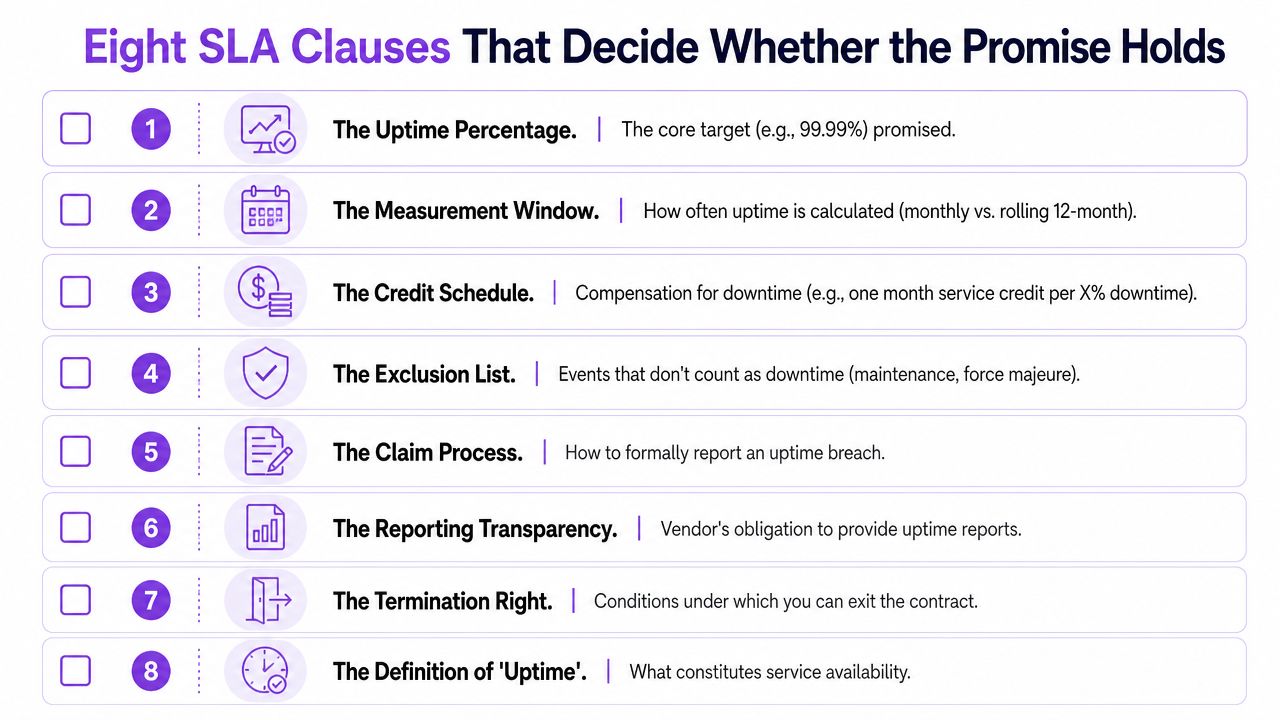
The SLA lives or dies in the clauses people skip. The percentage matters, but the rest of the contract decides whether that percentage has teeth.
Start with the measurement and the remedy
- The uptime percentage. This is the headline target. If it's vague, walk away.
- The measurement window. Monthly and rolling windows behave differently. Make the provider name the one it uses.
- The credit schedule. Historical SLA practice has included offers such as one month of free service if uptime falls below 99.99%, plus another month below 99.90%, and other vendors have marketed 100% network uptime commitments, which shows how service credits became a competitive differentiator in hosting and internet infrastructure markets as documented in historical SLA examples.
That credit structure sounds generous until you look at the exclusions.
Read the carve-outs like a lawyer
- The exclusion list. Scheduled maintenance, emergency maintenance, force majeure, customer-caused issues, and third-party failures are commonly excluded in SLA guidance from hosting SLA explainers.
- The claim process. If you have to jump through hoops to claim a credit, the remedy is weaker than it looks.
- The reporting transparency. Ask for uptime reports, not just a dashboard.
- The termination right. If the service keeps missing the target, you need a clean exit.
- The definition of uptime. If “up” only means the network is reachable, application-level failure can still leave you exposed.
For a regulated WooCommerce store, the red flag is simple. If the SLA only covers infrastructure while excluding the rule engine, plugin response, or third-party data source that your checkout depends on, the promise doesn't protect you. That's where merchants get trapped, because the vendor can say the service is online while your order validation is broken.
A second warning matters just as much. Some credits are the only remedy, not refunds, which means you can lose a critical day of sales and get little more than account credit in return. For a compliance-driven store, that's weak compensation.
Ask for the exclusion list before you ask for the price. The price is useless if the contract quietly excludes the failure mode that hurts you most.
A Sample Uptime Clause for a Plugin Like Ship Restrict
A useful SLA clause should read like something legal and operations can both live with. It should be specific enough to measure and narrow enough to matter.
A draft you can actually negotiate
Service Availability. The provider will maintain 99.99% monthly availability for the plugin's checkout validation service, measured end to end from the merchant storefront to the plugin response.
Measurement Window. Availability is measured monthly, using the provider's logs and an agreed third-party monitor. Short blips under the agreed threshold are excluded only if they do not interrupt a live checkout validation.
Response Commitment. The provider will acknowledge service-impacting incidents quickly and will publish incident updates until resolution. If the rule engine or data fetch path is degraded, the provider will treat it as downtime for SLA purposes.
Scheduled Maintenance. Maintenance windows must be announced in advance and kept outside merchant peak hours where practical.
Exclusions. Planned maintenance, customer misconfiguration, force majeure, and failures of merchant-controlled infrastructure are excluded. A state-regulatory data-source outage is excluded only if the vendor can prove the checkout decision path remained safe and functional without it.
Service Credits. If monthly availability falls below the target, the merchant receives service credit against the monthly fee, with the credit band increasing as uptime drops further.
What gets negotiated hardest is the middle of that clause. The merchant should press hard on whether a state-regulatory feed outage counts against uptime, because in a regulated store that feed can be the difference between safe blocking and a bad order slipping through. The merchant should also push on whether credits are capped at monthly fees, because a cap can make the remedy too small to matter.
A clause like this doesn't eliminate outages. It makes the failure visible, measurable, and expensive for the vendor. That's the point.
Measuring and Monitoring Uptime You Can Actually Trust
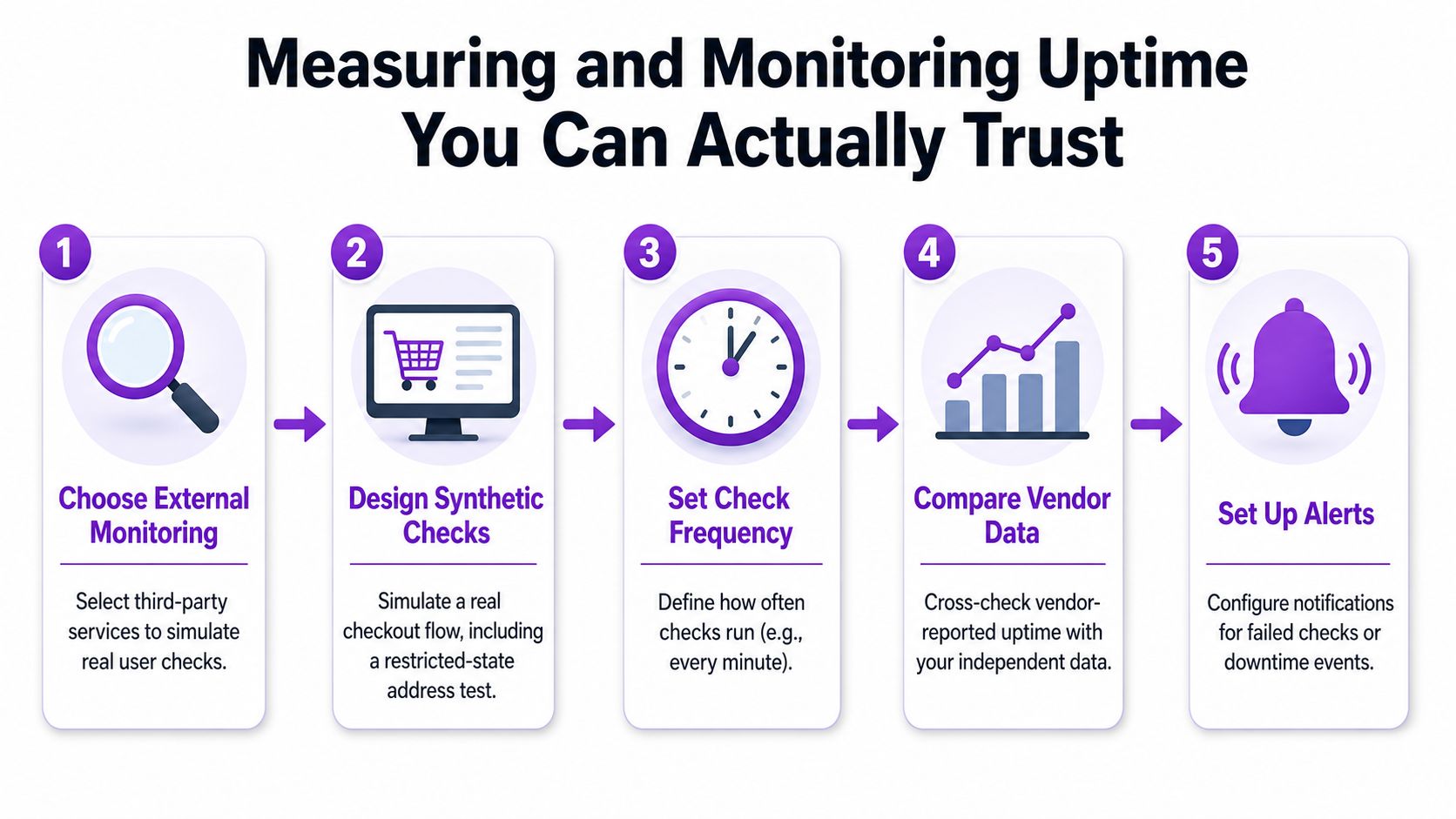
Trust the vendor less than your own monitor. If the SLA says one thing and your checks say another, the checks win.
Build checks that hit the real checkout path
Use external synthetic monitoring that simulates a real shopper, not just a server ping. That means checking the actual checkout flow, including a restricted-state address, so you know whether the compliance path responds when it matters. Internal monitoring is still useful, but it only tells you what the app thinks is happening.
The cleanest setup uses both. External checks catch customer-visible failure. Internal application monitoring watches rule-engine latency, error rates, and dependency failures inside the app. If one layer is healthy and the other is not, you learn something useful instead of assuming everything is fine.
For a regulated store, the monitoring question is never just “is the site up?” It's “can a valid order be screened correctly right now?” That's a different test, and it should be measured that way.
Make the data audit-friendly
A 24x7x365 status page helps, but it isn't enough on its own. You also want incident postmortems, timestamps, and a clear measurement window so you can line up vendor claims against your own logs. That matters during audits, when someone asks whether a failed validation was a true outage or a narrow exception.
If you need a technical baseline for that kind of setup, the monitoring guidance in this performance-focused Ship Restrict resource is a useful model for what to watch in a checkout path. The important part is discipline, not tooling brand names.
Measure the path the customer actually takes. Anything else is theater.
Short blips deserve a policy too. Decide in advance whether a brief failed check counts as downtime, then apply that rule consistently. If you change the rule after an incident, your uptime data stops being credible.
Mitigation, Contingency, and the Questions to Ask Vendors
An SLA is only half the playbook. The other half is knowing how your team behaves when the dependency fails anyway.
Keep checkout usable without pretending the outage is harmless
Your contingency plan should be short and specific. Use a degraded checkout mode that limits function instead of freezing the whole storefront. Keep a manual screening fallback ready for a temporary period, and make sure your customer-service team has a written message for shoppers who hit an interruption.
If a rule feed goes bad, roll back to the last known safe rule set before you improvise. That keeps the store operating while preserving the compliance posture. If you have a testing environment, use it to rehearse the rollback before you ever need it in production, as shown in this testing-environment guide.
For broader downtime thinking, the operational advice in slashing downtime with Finchum Fixes IT lines up with the same principle, reduce the blast radius before the incident hits. The best recovery plan is the one your team can execute without a debate in the middle of a Friday rush.
Ask vendors the questions that expose weak SLAs
- What is your real-time incident communication process? If they can't answer plainly, they probably don't have one.
- Can you provide historical, third-party uptime reports? Don't buy claims without evidence.
- How do you handle exclusions, and what is the exact claim process? Weak contracts hide in these details.
Negotiation rule: if the vendor won't commit to historical data, explicit MTTR, and a clean exit for chronic misses, keep shopping.
The right uptime guarantee is the one whose failure modes, remedies, and measurement method are all written down. That's the standard I'd use before renewing anything that touches regulated checkout. If you want a safer compliance workflow on WooCommerce, get Ship Restrict in front of your checkout now and review how its restriction logic fits into your SLA and monitoring plan before the next outage forces the issue.
Automate Shipping Compliance
Stop worrying about restricted states. Ship Restrict handles it automatically.

Cody Yurk
Founder and Lead Developer of ShipRestrict, helping e-commerce businesses navigate complex shipping regulations for regulated products. Ecommerce store owner turned developer.
Automate Shipping Compliance
- Block restricted states
- No more cancellations
- Set and forget
3-day free trial · Card required