Shipping Rates Australia 2026: WooCommerce Seller's Guide
Our 2026 guide helps WooCommerce sellers manage shipping rates australia. Calculate costs, find savings, and handle complex compliance for regulated goods.
You approve an order, print the label, and think the margin is fine. Then the final charge lands higher than the quote you used when you priced the product. The carton is slightly bigger than expected. The destination is regional. The carrier has adjusted rates for a busy period. If you sell regulated goods, there's a second hit: paperwork, classification, and address checks that nobody talks about when they show you a “simple” shipping calculator.
That's why shipping rates in Australia aren't just a checkout setting. They shape margin, customer trust, and whether an order should ship at all. For WooCommerce sellers, especially those handling regulated products, the primary task is building a shipping setup that reflects how carriers determine costs and how compliance operates.
Why Your Shipping Costs Are Destroying Your Profit
A common pattern looks like this. A new store owner sets a flat shipping price that seems fair, gets a few orders through, and then starts noticing that some orders feel oddly unprofitable. The product margin didn't change. The ad spend didn't change. Shipping did.
Part of the problem is broader than your store. During the COVID-19 pandemic, freight services as a share of total Australian import values doubled to approximately 7 per cent, and the Reserve Bank of Australia found that a 10 percentage point shock to global shipping cost inflation increases inflation for shippable goods in Australia by roughly 0.75 percentage points after two years in its analysis of shipping costs and Australian inflation. If your suppliers import stock, those cost pressures don't stay at the port. They flow into product cost, replenishment decisions, and your shipping thresholds.
Automate Shipping Compliance
Block orders to restricted states automatically. 3-day free trial.
Start Free TrialThe second problem is local execution. Generic calculators usually show a base transport price. They don't model all the little penalties that turn a “good enough” quote into a bad one at scale.
Practical rule: If you haven't checked the full landed cost of a product and not just the freight line, you're probably underpricing at least some orders.
That matters even more when you source internationally. A useful reference point is this guide to calculating landed costs for India-EU, not because you're shipping that exact route, but because it shows the right mindset: shipping, duties, taxes, and handling need to be priced together.
For a regulated-goods seller, the margin damage is worse when a shipment gets held, repriced, or cancelled after review. Cheap shipping that creates a compliance problem isn't cheap. It's rework, customer support time, and sometimes a lost customer you already paid to acquire.
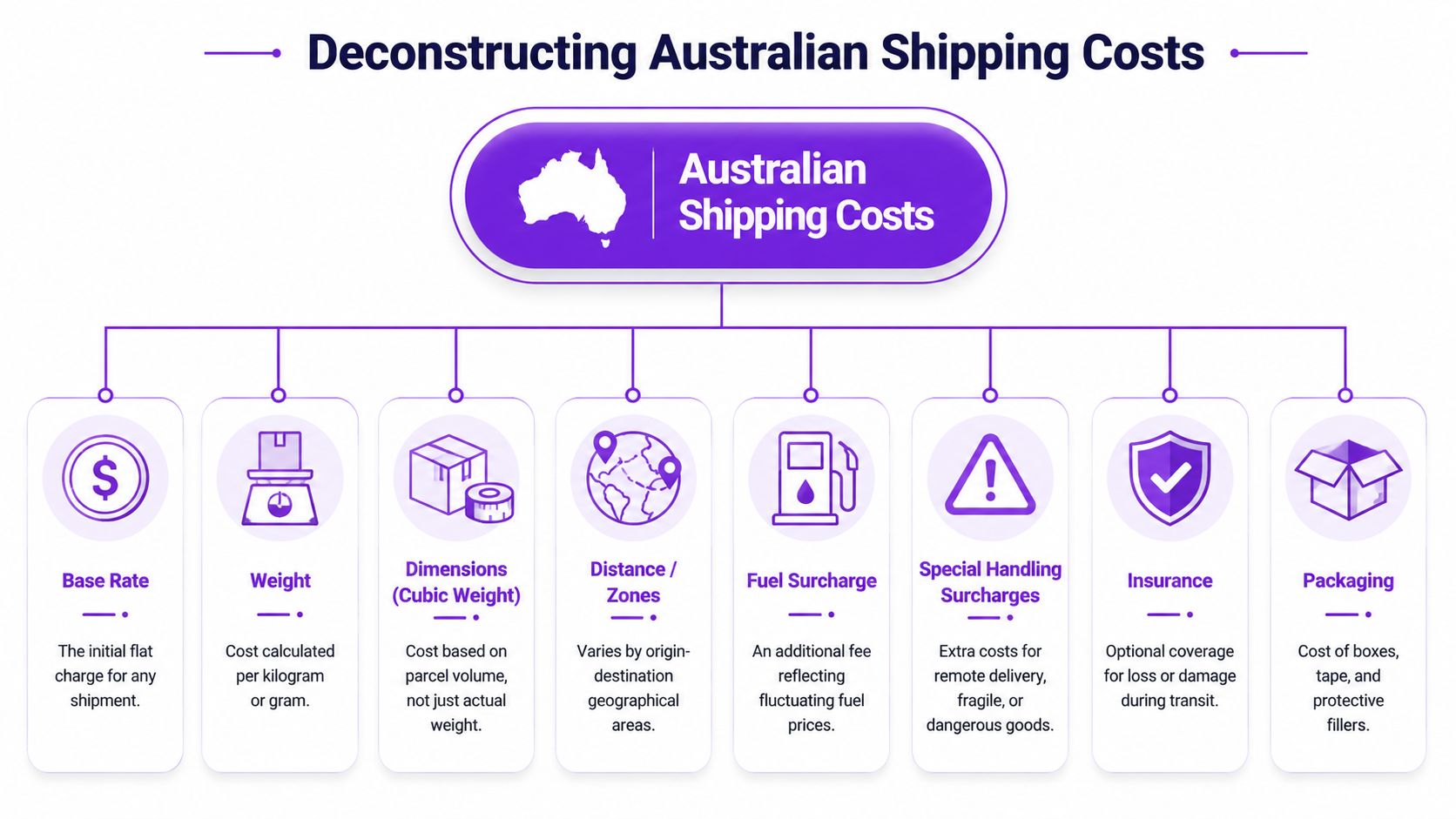
Deconstructing Australian Shipping Costs
A quote can look profitable at checkout and still lose money once the carrier invoice lands. Australian shipping costs change with destination, parcel shape, service rules, and surcharge triggers. If you sell regulated goods, there is another layer. Product classification, documentation, and extra handling can turn a low headline rate into an expensive shipment very quickly.
Start with route, parcel profile, and service rules
Base rate still matters, but it is only the starting point. Carriers price domestic freight by destination zone and by how the parcel fits into their network. Metro, regional, and remote deliveries do not move through the same cost structure, even when the item and service level stay the same.
Parcel profile is where many WooCommerce stores get caught. Actual weight is easy to see on a scale. Dimensional weight is where margin starts leaking. A light item in a large carton can be billed at a higher freight weight because it takes up more vehicle and sorting space. I see this often with oversized presentation boxes, long accessories, and protective packaging added to fragile or restricted products.
Surcharges are usually the real margin killer
The line items that do the most damage are usually added after a store owner has set a flat rate and moved on. Length fees, residential delivery fees, remote area surcharges, fuel adjustments, signature requirements, and manual handling charges can all sit outside the base transport number.
Length is a common example. Long parcels often trigger hard carrier penalties even when they are light. Australia Post publishes extra cover, service, and parcel guidance through its domestic parcel and letter services information, and carrier schedules across the market follow the same logic. If you sell knife accessories, sporting parts, or other awkward SKUs, packaging dimensions deserve as much attention as carrier selection.
Free Shipping Compliance Audit
We'll review your WooCommerce store's shipping compliance for free.
Peak periods make this worse. During major sales events and Christmas trading, carriers can add temporary surcharges or tighten service conditions. Generic checkout tools rarely account for that properly. Sellers then absorb the difference or spend December explaining revised shipping charges to customers.
International orders add another layer again. Weight breaks, service type, destination controls, and customs processing all affect the final bill. For a practical explanation of those cost drivers, read this guide on why international shipping costs climb so quickly.
A cheap base rate does not help if your parcel shape, destination mix, or product category keeps triggering exceptions.
Include compliance costs, not just transport costs
This matters more for regulated products. If a shipment needs an accurate HS code, product description, or destination check, that work has a cost even before customs or the carrier reviews it. The Australian Border Force requires goods to be classified correctly for import and export purposes, and its tariff classification guidance is a good reminder that product data affects clearance, duty treatment, and whether a parcel gets held.
For WooCommerce sellers, that means the shipping cost model should include operational effort as well as freight. A parcel that needs age-gating checks, restricted-destination screening, or extra paperwork is not equivalent to a standard accessory order, even if both fit in the same satchel.
What belongs in your cost model
Use a full-cost view for each shipment:
- Base transport charge: The carrier rate for the route and service level.
- Zone effect: Metro, regional, and remote destinations price differently.
- Actual weight: What the packed parcel weighs on the scale.
- Dimensional weight: What the carrier may bill based on carton size.
- Length or irregular parcel fees: Common for long, bulky, or awkward items.
- Fuel and peak surcharges: Often variable and easy to miss in basic calculators.
- Packaging cost: Cartons, satchels, inserts, void fill, labels, and tape.
- Insurance or signature options: Often sensible for higher-value orders.
- Compliance handling time: Classification checks, restricted-item review, and documentation.
- Exception risk: Returns, held parcels, address corrections, and customer support time.
Stores that quote from the base rate alone usually undercharge. Stores that price the whole shipment profile get closer to the true number and avoid nasty surprises on regulated orders.
Actionable Strategies to Lower Shipping Expenses
A new store owner usually notices the problem after the first busy month. Orders are coming in, customers are converting, then the carrier invoice lands and half the margin has disappeared into remote area fees, oversized parcel charges, and manual handling on products that should never have shared the same shipping rule.
Shipping costs fall when you reduce avoidable charges and stop underquoting at checkout. For WooCommerce sellers, especially those shipping regulated goods, that usually means changing packaging, product grouping, and service rules before asking a carrier for a better deal.
A practical way to compare service choices
Treat domestic pricing as a decision framework, not a fixed tariff sheet. The same parcel can be profitable on standard service and marginal on express once you factor in destination and handling.
| Destination | Standard Service (3-5 days) | Express Service (1-2 days) |
|---|---|---|
| Same-city metro | Usually the best fit for low-risk, routine orders | Better reserved for customers willing to pay for speed |
| Nearby regional centre | Costs rise enough to justify separate checkout logic | Can erode margin quickly on low-value baskets |
| Remote area | Needs tighter pricing rules and fewer blanket discounts | Best limited to urgent or high-margin orders |
If your store shows one flat price across all three, the cheap metro order is subsidising the expensive one.
Changes that cut cost fastest
- Trim carton size before you negotiate anything: Carriers bill a lot of Australian eCommerce freight on cubic volume, not just dead weight. Australia Post explains how it applies cubic pricing for domestic parcels in its guide to domestic parcel size and weight specifications.
- Split oversized and regulated SKUs into their own rules: Safes, long accessories, knives, aerosols, and other sensitive lines create extra cost even before freight moves.
- Default to standard service: Express should be an upgrade, not the baseline.
- Build shipping classes around parcel behaviour: If products pack differently, clear differently, or trigger different carrier rules, they need different logic. A quick guide to what table rate shipping means in WooCommerce is useful if you have outgrown flat rates.
- Optimise for common multi-item orders: Single-product packaging reviews help, but the bigger savings usually come from the combinations customers buy every week.
- Use separate rules for business and residential deliveries where it makes sense: Some carriers handle commercial addresses more efficiently, and missed delivery costs are often lower.
Budget for changing carrier charges
Rate cards are only part of the picture. Carrier invoices also move during the year through temporary fuel adjustments, peak surcharges, and service-specific add-ons. If you sell products that already need extra review, such as age-restricted or destination-restricted items, those variable charges hurt faster because your fulfilment cost base is already higher.
Set a shipping buffer into your pricing rules. Small enough to stay competitive, large enough to absorb seasonal movement without rewriting your checkout every week.
Do not promise a precise shipping charge months in advance if your carrier contract allows seasonal adjustments.
Where regulated sellers save the most
The biggest savings often come from preventing the wrong order from reaching the wrong service level.
A few examples:
- Put compliance-heavy SKUs into shipping classes that exclude cheap methods.
- Require manual review for products that need HS code checks on export orders.
- Stop free shipping from applying to long, bulky, or restricted items.
- Separate accessories from controlled products so low-risk baskets can still convert on reasonable rates.
That last point matters. If every item inherits the strictest shipping rule in your catalogue, you will overcharge simple orders and lose conversions you did not need to lose.
The shortlist to implement this week
- Measure your ten highest-volume cartons yourself.
- Identify products causing oversized fees, manual checks, or destination restrictions.
- Create separate shipping classes for bulky, regulated, and standard items.
- Review live checkout prices during peak periods and carrier surcharge windows.
- Test packed real-world orders against your WooCommerce rules before adding new product lines.
How to Configure Accurate Shipping in WooCommerce
Most WooCommerce stores start with the wrong shipping setup for one reason: the simplest settings are the easiest to turn on. They aren't the most accurate.
Start simple, but know the limits
Flat rate shipping is fine when your catalogue is narrow and your parcels are predictable. If every order fits similar packaging and ships to a tight geography, flat rate can keep checkout clean. Free shipping can also work if you've built enough margin into product pricing or if you want to set a threshold that encourages larger baskets.
The trouble starts when your products vary in size, destination, or handling requirements. That's when one flat number becomes a blunt instrument that overcharges some customers and undercharges the ones most likely to cost you money.
Move to table rates when your catalogue gets mixed
If you sell both compact accessories and oversized regulated products, table rates are usually the first serious upgrade. They let you build rules around weight, destination, item count, or shipping class.
If you need a primer on the concept itself, this overview of what table rate shipping means in WooCommerce covers the basics clearly.
A practical setup often looks like this:
- Small accessories: Standard domestic charge with broader free-shipping eligibility.
- Long-form products: Higher base rate or limited destination logic.
- High-risk items: Separate methods that force review or approved services only.
- Regional deliveries: Additional charge or no-express option.
Use dimensions, not just weight
A lot of stores enter product weights and stop there. That's not enough for accurate shipping rates Australia customers can trust. If the product is light but bulky, checkout will underquote unless dimensions are maintained properly at the product level and reflected in the package logic your plugin or carrier app uses.
At this stage, discipline matters. Every new SKU should have:
- Actual packed dimensions, not product dimensions from a supplier sheet
- Packed weight, not just item weight
- Assigned shipping class based on handling profile
- Service eligibility rules if the item can't use every carrier method
Without that, WooCommerce can only guess. Carriers don't guess when they invoice you.
Accurate shipping starts in your product data, not in your carrier account.
Live rates are the best fit for variable orders
For stores with mixed parcels, regulated items, and customers across metro and regional Australia, live carrier rates are usually the most defensible option. They're especially useful when the quote needs to reflect destination, weight, dimensions, and contract pricing in real time.
The value is that your checkout stops relying on averages. The verified data on international shipments notes that real-time API integrations, such as those offered by Australia Post, allow merchants to calculate variable rates based on contract pricing, destination, weight, and dimensions in the final quote, as described in this discussion of international shipping cost variables and carrier pricing.
Before you commit, watch a live setup example and compare it to your current rules:
<iframe width="100%" style="aspect-ratio: 16 / 9;" src="https://www.youtube.com/embed/EPpVXGbNiGY" frameborder="0" allow="autoplay; encrypted-media" allowfullscreen></iframe>A sensible WooCommerce progression
If you're rebuilding your setup, this order usually works:
- Begin with flat rate if your catalogue is tiny and uniform.
- Add shipping classes once products differ in parcel behaviour.
- Switch to table rates when destination and package profile start changing margin.
- Adopt live carrier rates when guesswork at checkout is costing you sales or profit.
- Layer compliance controls separately if any product has legal or carrier restrictions.
That last point matters. Pricing accuracy and shipping legality are different jobs. WooCommerce can quote a shipment that you still shouldn't send.
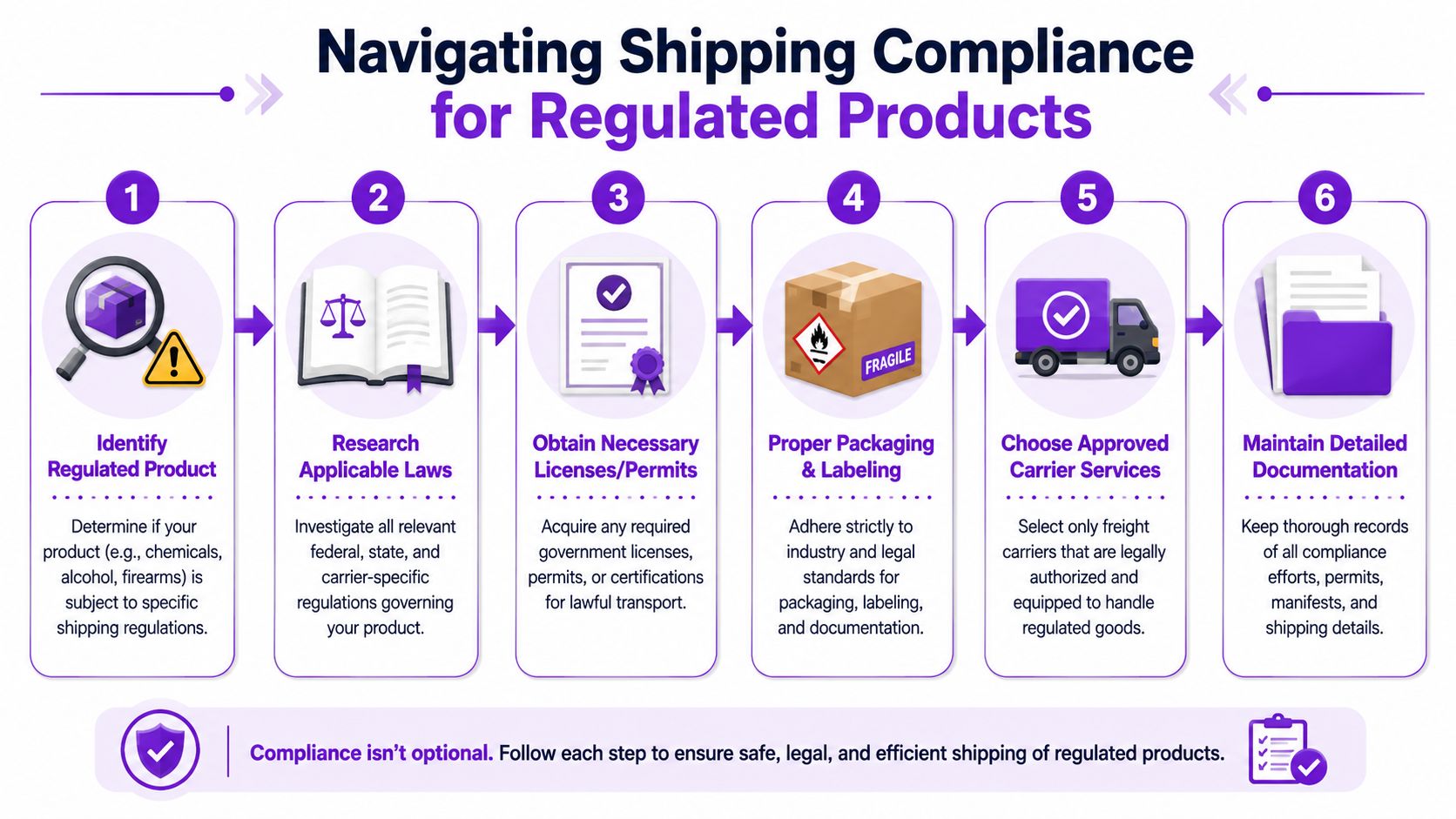
Navigating Shipping Compliance for Regulated Products
For regulated goods, cost matters, but compliance decides whether the order is even valid. A cheap label is meaningless if the destination, product category, or paperwork makes the shipment unlawful or carrier-ineligible.
Many store owners still handle this manually. They scan the order, review the address, check product type, and make a call. That can work at very low volume. It stops working once the store grows, staff changes, or product categories expand.
The hidden compliance cost isn't on the rate card
Generic shipping calculators focus on transport. They rarely account for classification and customs burden. For many international shipments, that's a serious gap.
According to Avalara's write-up, since the US $800 de minimis was removed for many shipments to Australia, every parcel requires accurate HS code classification and prepaid duties, and a 10% GST applies to most goods, which means misclassification can trigger costly recalculations that basic rate tools don't predict in its explanation of the compliance impact on Australia-bound shipments.
That's the part many sellers miss. The visible shipping charge may look acceptable, but the actual operational cost includes:
- HS code classification work
- Duties and GST handling
- Customs documentation review
- Manual intervention when details don't line up
- Customer support when an order is delayed or repriced
If you sell regulated products, add another layer. You also need to determine whether the product can move through that lane, to that destination, with that carrier, under that rule set.
Manual checks don't scale safely
A human review process sounds careful, but it creates inconsistent decisions. One staff member knows the edge cases. Another misses a postcode nuance. Someone ships an order based on product title rather than actual category and restrictions.
That inconsistency is expensive even before you hit a legal problem. It creates cancellations, relabelling, warehouse delays, and difficult customer conversations.
For regulated goods, the first shipping question isn't “What's the cheapest service?” It's “Can this order legally and operationally move?”
What a compliant workflow looks like
A practical workflow for regulated products should include these checkpoints:
- Classify the product correctly. Don't rely on broad product names.
- Validate destination eligibility before payment is finalised where possible.
- Match the carrier service to the product type. Not every approved product fits every carrier method.
- Store the reasoning behind restrictions and shipment decisions.
- Train support staff on exception handling so they don't override rules casually.
Many WooCommerce builds often fall short. They spend time on styling, payment gateways, and promotional logic, then leave shipping compliance as a manual back-office task. For regulated categories, that's backwards. Restriction logic should be treated as part of checkout infrastructure.
Cost control and compliance should work together
A strong setup doesn't separate shipping price from shipping permission. It combines them. If an item requires special handling, your store should account for that in both the available methods and the customer-facing charge. If an address is restricted, the customer should know before the order becomes a fulfilment problem.
That approach reduces two kinds of waste: underquoted shipments and invalid shipments. Both hurt margin. Only one tends to show up clearly on a carrier invoice.
Building Your Optimal Australian Shipping Strategy
The best shipping strategy isn't the one with the lowest advertised rate. It's the one that keeps margin intact, gives customers believable options, and prevents orders your business shouldn't ship.
For most WooCommerce stores, that means treating shipping rates Australia decisions as an operating system, not a plugin setting. Product data has to be accurate. Packaging has to reflect real packed dimensions. Checkout has to match destination and service reality. Compliance has to sit alongside pricing, not after it.
A useful way to pressure-test your current setup is to audit it in this order:
- Packaging first: Are your cartons larger than they need to be?
- Product data second: Do you have packed dimensions and weights for every SKU?
- Checkout logic third: Are flat rates masking regional, oversized, or regulated-item costs?
- Carrier fit fourth: Do your available methods match how you ship?
- Compliance last, but not optional: Can the order legally move to that address with that product mix?
If you want another perspective on how free delivery expectations affect buyer behaviour, this Cashback Australia free delivery guide is worth reading because it shows how customers think about shipping offers, not just how merchants cost them.
For merchants comparing platforms and workflows, it also helps to look at multi-carrier shipping solutions for WooCommerce. Not because more carriers automatically solve the problem, but because carrier choice only matters when your store rules, packaging, and checkout logic are already sound.
The stores that handle shipping well don't rely on luck. They review packed orders, test checkout rates against real cartons, and remove manual compliance guesswork wherever they can. That's how shipping stops being a silent profit leak and starts becoming an advantage.
If you sell regulated products on WooCommerce, Ship Restrict helps you automate shipping restriction rules before bad orders reach fulfilment. It's built for merchants who need precise location-based controls, fewer manual checks, and a safer compliance workflow without slowing down checkout.
Automate Shipping Compliance
Stop worrying about restricted states. Ship Restrict handles it automatically.

Cody Yurk
Founder and Lead Developer of ShipRestrict, helping e-commerce businesses navigate complex shipping regulations for regulated products. Ecommerce store owner turned developer.
Automate Shipping Compliance
- Block restricted states
- No more cancellations
- Set and forget
3-day free trial · Card required