Multi-Carrier Shipping Solutions: A WooCommerce Guide
Explore multi-carrier shipping solutions for your WooCommerce store. Learn key features and how to manage compliance for regulated products like firearms.
You're probably dealing with this already. One carrier is fine until it isn't. Rates move, service performance changes by lane, a promised delivery window slips, and someone on your team starts manually checking portals, spreadsheets, and carrier rules just to get orders out the door.
For WooCommerce stores, that pain compounds fast. Add multiple warehouse locations, customer expectations for better delivery choices, and the operational mess of label creation and tracking, and shipping stops being a back-office task. It becomes a margin and customer-experience problem.
For regulated goods, there's another layer that most shipping conversations miss. Choosing the best carrier is only half the job. The harder question is whether the order should ship at all.
Why Modern Stores Need More Than One Carrier
A modern online store rarely ships a clean, predictable parcel mix. Orders vary by destination, speed requirement, package profile, and service constraints. The carrier that looks cheapest on paper can be slower on a specific lane, trigger more exceptions during peak periods, or be the wrong fit for a specific region.
Automate Shipping Compliance
Block orders to restricted states automatically. 3-day free trial.
Start Free TrialThat's why multi-carrier shipping solutions have moved from “nice to have” to standard operating infrastructure for many merchants. Instead of forcing every order through one carrier account and one rate structure, these systems let teams compare options and route shipments with more control.
The broader market reflects that shift. The global market for multicarrier parcel management solutions is projected to grow from about $0.9 billion in 2024 to more than $2.06 billion by 2034, a projected 8.6% CAGR, as businesses adopt these systems to manage shipping complexity, according to Global Insight Services' multicarrier parcel management market outlook.
One carrier creates hidden fragility
Single-carrier setups feel simpler because they reduce admin overhead. One account. One invoice pattern. One operational playbook.
But they also create concentration risk. If service slips in a key region, if surcharge exposure changes, or if a peak-season bottleneck hits, the store has fewer options. That can hurt delivery promises, margins, and customer trust at the same time.
Practical rule: If your checkout promise depends on one carrier performing well in every zone and every season, your shipping stack is more fragile than it looks.
Why this matters more for WooCommerce merchants
WooCommerce stores often grow into shipping complexity before they plan for it. A merchant starts with a single carrier plugin, then adds another service for certain destinations, then brings in a regional option for better coverage or a specialized workflow. Soon the team is toggling between systems.
That's usually the point when a centralized platform starts making sense. It doesn't just improve execution. It creates a single operating layer for rate shopping, labels, tracking, and routing logic. If you're also evaluating regional carrier options for regulated products, that centralized control becomes even more useful because the carrier options isn't uniform across every shipment type and destination.
What Are Multi-Carrier Shipping Solutions
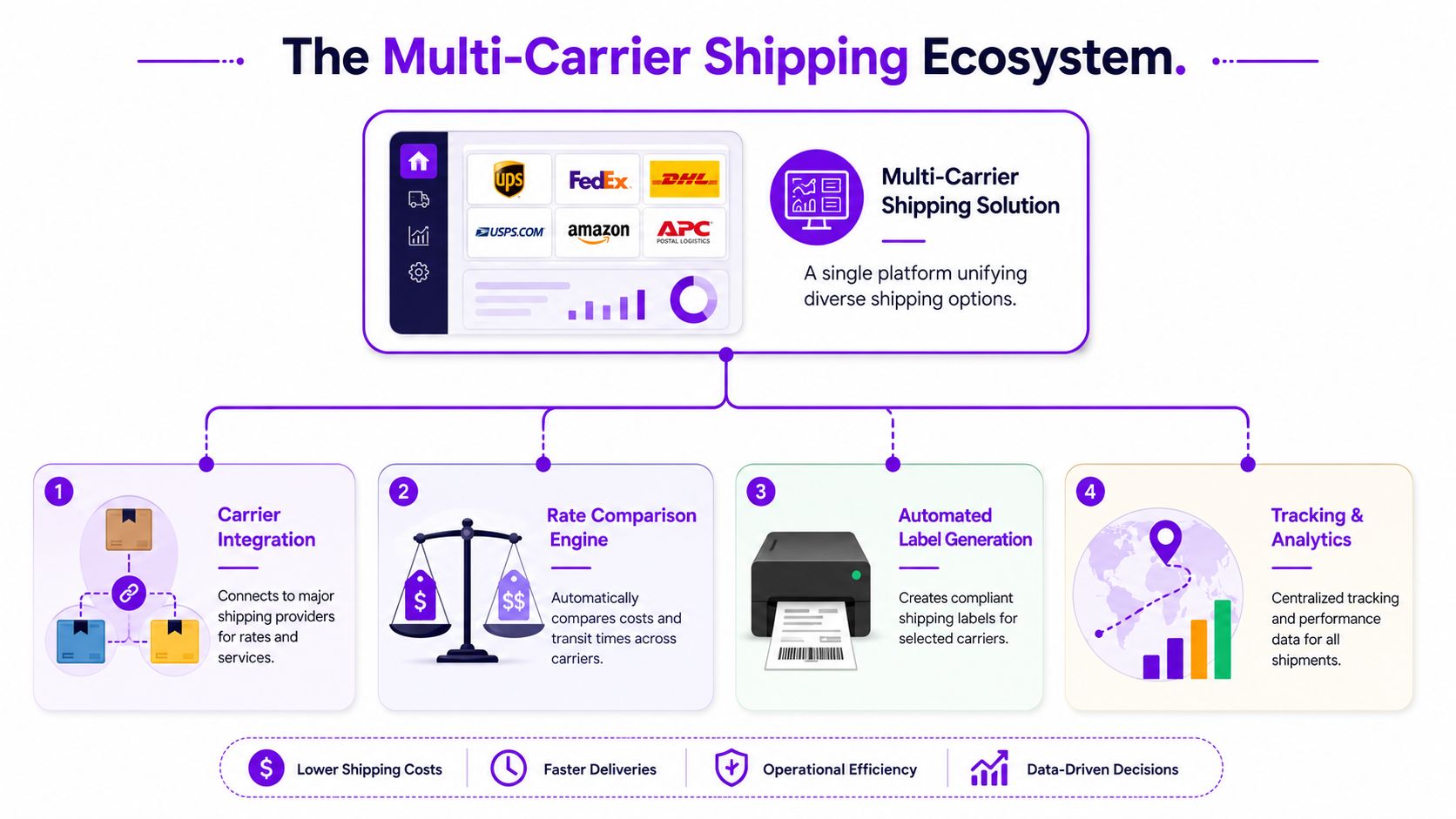
The simplest way to understand multi-carrier shipping software is to compare it to a travel aggregator, but for parcel fulfillment. Instead of checking airline sites one by one, you search once and compare options in one place. Shipping software does the same for carriers, services, and routing rules.
That analogy helps at a high level, but its core value is operational. A multi-carrier platform sits between your WooCommerce store and your carrier network, then standardizes what would otherwise be a jumble of different rate formats, label requirements, and service rules.
Free Shipping Compliance Audit
We'll review your WooCommerce store's shipping compliance for free.
The three parts that matter
Most systems are doing three jobs under the hood.
First, they ingest order data. That means pulling in the shipment details from WooCommerce or from connected systems like an OMS, ERP, or WMS.
Second, they compare carrier options. This usually includes real-time rates, service levels, and logic-based routing so the platform can decide which carrier fits a given order.
Third, they execute carrier-specific tasks through one interface. The platform generates the correct label, returns tracking data, and handles customs or service formatting without forcing your team to work separately inside each carrier environment.
Technically, these platforms centralize logistics by ingesting order data from an e-commerce store, comparing real-time carrier rates, applying routing rules, and normalizing carrier-specific label and customs data through a single API, as described in nShift's overview of multi-carrier shipping software.
What this looks like in a WooCommerce workflow
In practical terms, the store receives an order. The software reads the shipment details, checks available carrier services, applies any rules you've set, and returns the selected shipping method for label creation and tracking.
That's why these tools feel less like a plugin and more like a shipping control tower. They reduce manual decision-making and make the process more repeatable.
A good way to judge whether you need this layer is to ask one question. Are your current shipping tasks mostly “print label and go,” or are you making shipment decisions over and over again? If it's the second one, you're already doing routing work manually.
For teams trying to understand where standard WooCommerce settings stop being enough, this comparison of WooCommerce shipping classes vs restriction plugins when you need more helps clarify what belongs in shipping logic versus separate rule enforcement.
The best multi-carrier setups don't just connect carriers. They remove the need for staff to remember carrier-by-carrier exceptions every time an order ships.
Core Features That Drive Profit and Efficiency
The best software choices earn their place in operations because they change unit economics and reduce avoidable labor. The feature list matters less than what those features remove from your day.

A strong multi-carrier platform usually revolves around four capabilities: rate shopping, label automation, unified tracking, and returns handling. Each one affects a different part of fulfillment performance.
Real-time rate shopping
This is the feature most merchants look for first, and for good reason. By comparing carriers across price, zone, and service level in real time, businesses can reduce shipping costs, increase delivery speed, and build resilience. They can also use data such as on-time delivery, transit times, and exception rates to improve carrier choices over time, according to Shipium's guide to multi-carrier shipping.
The key phrase is over time. Good rate shopping isn't only about grabbing the cheapest label on a single order. It's about learning where each carrier performs well and where it doesn't.
For WooCommerce merchants, that affects more than warehouse efficiency. It can influence what customers see at checkout and whether the delivery promise is believable.
Label generation and routing consistency
Manual label workflows create two expensive problems. They consume staff time, and they increase process variation. When teams copy data between systems or pick services by habit, errors creep in.
A multi-carrier platform fixes that by applying shipping rules consistently. If an order matches a defined threshold, service type, or geography, the system follows the same logic every time.
That consistency matters in busy operations because exceptions don't stay small. One wrong service level choice becomes a late delivery. One bad label becomes a support ticket or a re-ship.
Here's a quick explainer on the operational side:
<iframe width="100%" style="aspect-ratio: 16 / 9;" src="https://www.youtube.com/embed/WFWSRQOSVyk" frameborder="0" allow="autoplay; encrypted-media" allowfullscreen></iframe>Unified tracking and fewer support interruptions
When tracking is fragmented across multiple carrier portals, customers feel the delay first and support teams feel it next. A unified tracking layer gives staff one place to monitor shipment status and investigate exceptions.
That doesn't just tidy up the dashboard. It cuts down on the internal scramble of figuring out which carrier has the package and what happened to it.
If your support team has to ask, “Which carrier did this go with?” before they can answer a customer, your shipping stack is leaking time.
Returns and analytics
Returns are where operational discipline either holds or falls apart. A centralized system gives you one process for return labels, status visibility, and carrier handling instead of rebuilding the workflow every time.
Analytics is the feature many merchants underuse. The useful metrics aren't abstract. They're shipment-level signals that tell you whether routing logic is helping. Look at service-level adherence, exception patterns, and where costs rise even when base rates look competitive.
For teams tightening fulfillment operations in regulated environments, pairing logistics automation with automated shipping compliance for WooCommerce stores helps separate shipping execution from legal eligibility checks. That separation is where many stores avoid expensive confusion.
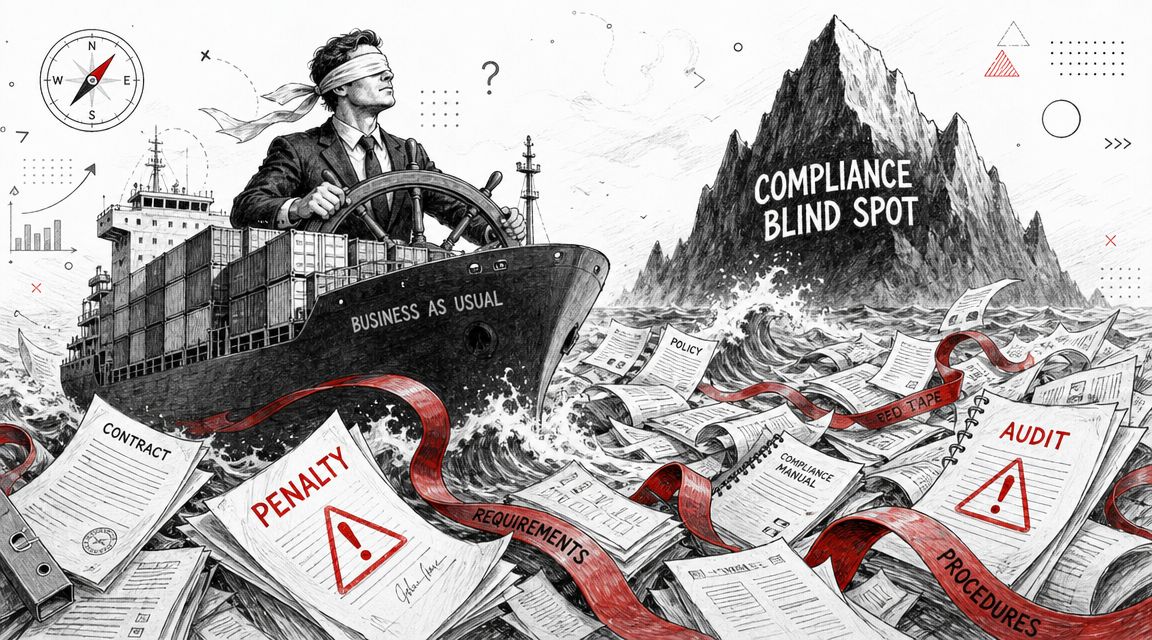
The Compliance Blind Spot in Regulated Shipping
Most shipping software is built to answer one question well. Which carrier should handle this package?
For regulated products, that is not the first question. The first question is whether the order is legal to fulfill to that destination.
That difference creates a serious blind spot. A frequent mistake merchants make is assuming shipping platforms also prevent illegal shipments. In reality, most multi-carrier systems select an available carrier for a route but do not determine whether a regulated product may legally be shipped to that specific address, as noted in ShipBob's discussion of multi-carrier parcel management.
Carrier rules are not the same as legal restrictions
Many store owners, developers, and operations managers often get tripped up here.
A carrier rule covers what a carrier will accept, how it needs to be labeled, which service types apply, and what documentation may be required. A legal restriction covers whether that product can be sold or shipped to the destination at all.
Those are separate decision layers. A carrier may be willing to service a route. That does not mean the shipment is lawful.
For firearms and other restricted goods, this distinction matters at the state, county, city, and ZIP level. A store can have flawless label automation and still create legal exposure if the order should have been blocked earlier.
Where stores usually fail
The failure pattern is predictable.
- Checkout allows the order: The cart accepts a destination without validating the product against location-specific restrictions.
- Shipping software does its job: The multi-carrier platform finds a serviceable carrier and generates the shipment path.
- Operations assumes that means “approved”: Staff see a valid shipping option and treat the order as compliant.
- The issue surfaces later: A manual review catches it late, the package is stopped, or worse, it ships.
That's not a software bug. It's a workflow design problem.
Shipping optimization happens after order eligibility. If your system reverses that order, you're automating risk.
Why generic logistics advice falls short here
Most multi-carrier guidance focuses on speed, flexibility, and backup capacity. Those are real benefits. But in regulated shipping, compliance has to sit upstream from logistics.
That means the store needs a rule engine that can evaluate the product and destination before payment or before fulfillment release. Without that gate, the shipping layer can only optimize an order it assumes is valid.
For firearms retailers, a lot of “modern shipping stack” advice encounters significant limitations. The software may be excellent at finding a route. It just wasn't designed to know whether the route should ever be used for that cart in the first place.
How to Choose a Solution for Your WooCommerce Store
The wrong way to choose multi-carrier software is to compare vendor feature grids and stop there. The right way is to evaluate how the tool fits your store's actual operating model.
For WooCommerce merchants selling regulated goods, the decision is not only about cheaper labels or broader carrier access. It's about whether the software supports a workflow that remains controllable when orders, restrictions, and exceptions start piling up.
The first filter is operational fit
Start with the basics. Does the platform integrate cleanly with WooCommerce? Does it create a checkout or fulfillment process your staff can manage? Does it support the carrier mix you need today, including specialized regional coverage if that matters to your business?
Then test for friction. Some shipping tools look efficient in demos but add too much backend complexity once they're live. If your team has to override routing manually all the time, the software isn't reducing work. It's relocating it.
If you're still shaping the broader store architecture, this guide on finding the right e-commerce platform is a useful planning resource because platform decisions affect what shipping and compliance layers you can support cleanly later.
Don't ignore the discount trade-off
There's a common assumption that more carrier options always mean lower costs. Sometimes they do. Sometimes they don't.
A critical issue often overlooked is that splitting shipment volume across multiple carriers can prevent a business from reaching gross-spend thresholds with a single carrier, which can dilute volume discounts and raise total shipping costs if the setup isn't managed carefully, as discussed in Parcel Industry's argument for when a single carrier can be more efficient.
That doesn't mean multi-carrier is the wrong choice. It means you need to evaluate it with discipline. The right question isn't “Can this compare rates?” The right question is “Will this improve total shipping performance after discount structure, admin burden, and compliance workflow are accounted for?”
Multi-Carrier Solution Selection Checklist
| Evaluation Criteria | What to Look For | Why It Matters for Regulated Goods |
|---|---|---|
| WooCommerce integration | Stable order sync, reliable label workflow, minimal checkout disruption | Prevents shipping logic from interfering with cart validation and order review |
| Carrier network | Support for the carriers and services you actually use | A broad network is useless if it misses your required service types |
| Rule engine quality | Flexible routing by geography, service level, or cost thresholds | Reduces manual routing decisions after an order is approved |
| Reporting visibility | Clear tracking, exception monitoring, and shipment history | Helps teams investigate issues without jumping between systems |
| Workflow compatibility | Ability to operate after compliance validation, not before | Keeps legal eligibility separate from logistics optimization |
| Admin overhead | Straightforward setup, maintainable rules, manageable staff training | Complex tools break down fast in small and mid-sized teams |
Questions worth asking vendors
Before you commit, ask these directly:
- What happens when an order needs manual review? You need to know whether the system can pause gracefully or whether it assumes every order should flow straight to fulfillment.
- Can routing occur after validation? For regulated stores, shipping selection should happen after the order is cleared.
- How visible are exceptions? Hidden exceptions become expensive exceptions.
- Will this reduce real work? If the answer depends on constant staff supervision, keep looking.
Integrating Ship Restrict with Your Shipping System
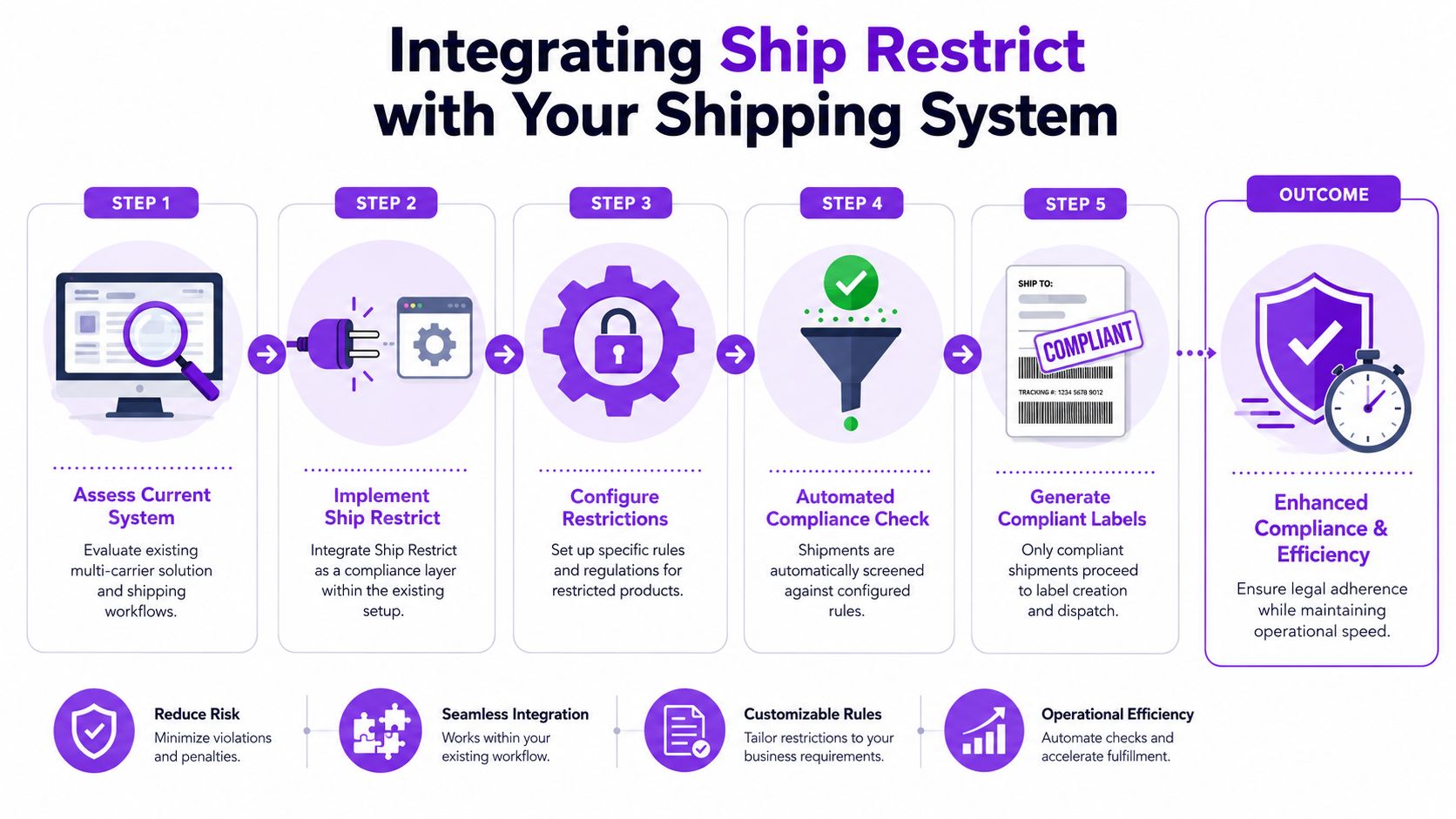
For regulated goods, the cleanest shipping stack uses two separate layers with two separate jobs. One layer determines whether the order is eligible. The other decides how to ship it efficiently.
That sequence matters. If logistics software runs before compliance validation, the team can create labels for orders that should have been stopped at checkout. If compliance runs first, the shipping system only sees orders that are already cleared for fulfillment.
The workflow that actually works
This is the operational sequence I recommend for WooCommerce stores selling restricted products:
-
Customer builds the cart
The storefront collects products, quantities, and destination details as normal. -
Compliance rules evaluate the order before payment
The system checks the cart contents against the shipping destination. If the destination is restricted for that product, the customer gets a clear message before the order moves any further. -
Only eligible orders continue to checkout
Payment and order creation happen only after the rule check passes. -
The approved order moves into the shipping layer
Now the multi-carrier platform can do what it does best. Compare services, apply routing logic, and generate the correct label. -
Fulfillment executes against a validated order
Warehouse staff work on shipments that have already passed eligibility checks, which reduces last-minute holds and manual intervention.
Why this order of operations matters
This setup protects two parts of the business at once.
On the compliance side, it stops bad orders before they become fulfillment problems. On the operations side, it keeps the shipping team from wasting time on orders that should never have reached label generation.
That's especially important for small and mid-sized stores where the same people often handle support, fulfillment, and exception management. If those teams are stuck manually checking whether a destination is legal after an order is paid, the workflow is already broken.
A compliant shipping stack should reject the wrong order early and route the right order automatically.
What to look for during implementation
When integrating a restriction layer with a multi-carrier platform, keep the build simple:
- Place compliance first: Product and destination validation should happen upstream from shipping selection.
- Keep responsibilities separate: Restriction logic should not be buried inside carrier-routing rules.
- Use clear customer messaging: If an order is blocked, the storefront should explain why in plain language.
- Test exception paths: Verify what happens when an order fails validation, needs review, or passes into fulfillment.
Teams often overcomplicate this by trying to make one system handle every decision. That usually leads to brittle logic and harder troubleshooting. The better design is modular. Eligibility first. Shipping second.
If your WooCommerce store sells firearms or other regulated products, Ship Restrict gives you the compliance layer most multi-carrier shipping solutions don't provide. It lets you enforce destination-based restrictions before checkout, so your shipping software only processes orders that are already eligible to ship. That means fewer manual reviews, fewer preventable mistakes, and a cleaner path from cart to compliant fulfillment.
Automate Shipping Compliance
Stop worrying about restricted states. Ship Restrict handles it automatically.

Cody Yurk
Founder and Lead Developer of ShipRestrict, helping e-commerce businesses navigate complex shipping regulations for regulated products. Ecommerce store owner turned developer.
Automate Shipping Compliance
- Block restricted states
- No more cancellations
- Set and forget
3-day free trial · Card required