Regional carrier options regulated products: A Practical Guide for Compliance
Regional carrier options regulated products: Learn compliance, carrier vetting, and setup tips for shipping restricted items.
When you’re shipping regulated products, leaning on regional carriers can be a much smarter play than just defaulting to the national guys. It’s not just about potentially lower costs; it’s a strategic move to tighten up your compliance and keep customers happy. The whole game is about finding the right partners—the ones who are actually licensed and experienced with your specific kind of product.
The Advantage of Regional Carriers for Regulated Goods
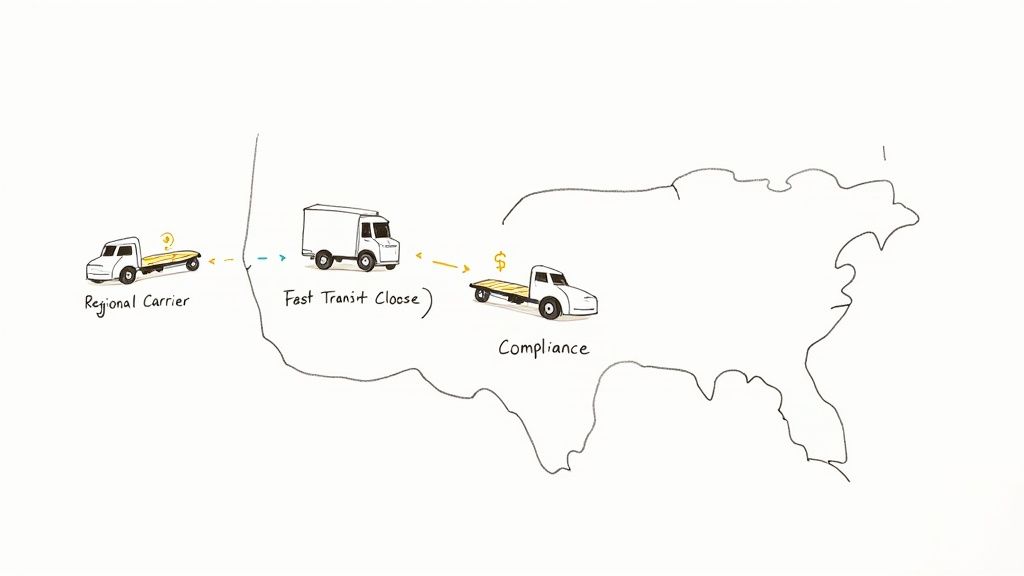
For anyone selling items like CBD, alcohol, or even certain hazmat materials online, shipping is a minefield. National carriers are the obvious choice for many, but their one-size-fits-all model often becomes a bottleneck. It can get restrictive and expensive fast when you're dealing with a patchwork of state and local rules. This is exactly where turning to regional carriers can completely change the game.
Understanding the Regional Edge
Regional carriers build their entire business around specific geographic areas. By zeroing in on a smaller territory, they develop a deep, almost instinctual expertise in the local shipping laws that govern regulated goods.
This focused approach almost always translates into some serious wins for e-commerce sellers:
Automate Shipping Compliance
Block orders to restricted states automatically. 3-day free trial.
Start Free Trial- Faster Transit Times: With routes dialed in for a specific region, your packages can get to customers 1-2 days faster than with a national carrier. That’s a huge boost for the customer experience.
- Lower Costs: A simpler logistics chain with fewer handoffs and shorter distances usually means real cost savings, especially on that crucial last-mile delivery.
- Specialized Handling: Let's be honest, many regional carriers are just better equipped to handle sensitive or fragile items. They can offer a level of care that the massive national networks often struggle to maintain.
This isn't some niche strategy anymore; it's a full-blown trend. Regional parcel carriers in the U.S. are on track to handle an estimated 2.3 billion packages in 2024. That's a massive leap from just 600 million back in 2019. This explosion shows how companies like OnTrac and Veho are capitalizing on the massive demand for quicker, more affordable local delivery. You can discover more about this significant market shift and what it means for online stores.
Navigating Compliance with Local Experts
For regulated products, the real killer feature is compliance. Think about it: a regional carrier that only operates in the Pacific Northwest is going to know the ins and outs of Washington and Oregon’s rules for shipping wine or vape products. That localized knowledge is priceless.
It dramatically cuts down your risk of running into costly fines, having shipments seized, or, worst of all, damaging your brand's reputation over a preventable mistake.
Key Takeaway: Choosing a regional carrier is about more than saving a few bucks on shipping labels. It’s about partnering with a logistics expert who lives and breathes the unique regulatory landscape of their service area. That’s a critical layer of protection for your business.
When you're shipping regulated products, picking a regional carrier is about way more than just comparing rate sheets. You're not just hiring a delivery service; you're handing over a critical piece of your compliance puzzle. One wrong move here can mean seized shipments, painful legal fines, and a brand reputation that's tough to rebuild.
The first thing to do is cut through the sales pitch and get straight to their documentation. Ask to see their specific licenses and permits. For example, if you're shipping anything classified as hazardous materials, they absolutely must have a valid DOT hazmat permit. Don't just take their word for it—ask for the paperwork and verify it.
Digging Deeper Than the Rate Sheet
Once you’ve confirmed they have the basic credentials, the real work begins. This is where you find out who’s a genuinely capable partner and who’s just trying to fill a route.
Your goal is to get a feel for their actual, hands-on experience with your specific type of product. For a better sense of how major carriers approach this, our guide comparing UPS, FedEx, and USPS for ammunition shipping shows just how detailed these policies can get.
Zero in on their day-to-day operational procedures with pointed questions:
Free Shipping Compliance Audit
We'll review your WooCommerce store's shipping compliance for free.
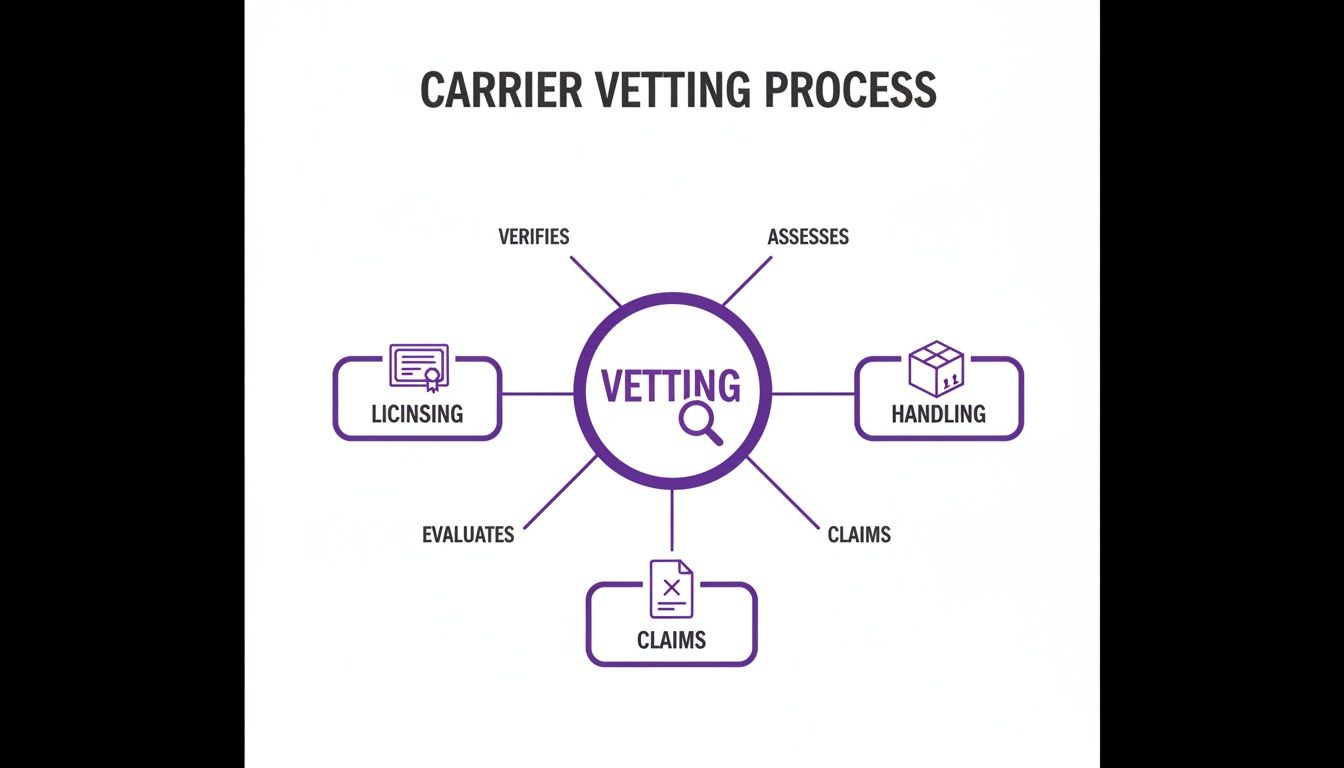
- Handling Protocols: How do their warehouse crews and drivers physically manage your products? Do they have training for temperature control, specific orientation (like "this side up"), or special stacking rules?
- Claims Process for Regulated Goods: What is their exact procedure if a regulated shipment gets damaged or goes missing? A vague answer here is a massive red flag. They should have a clear, documented process that acknowledges the unique headaches involved with your items.
- Track Record and References: Don't be shy about asking for references from other companies in your industry. A carrier who is confident in their service will be happy to connect you with other clients who ship similar products.
A carrier’s claims process for damaged regulated goods reveals their true level of expertise. If they can’t clearly explain how they handle a lost case of wine or a damaged shipment of CBD oil, they lack the experience you need.
Building Your Evaluation Scorecard
To keep things objective, I always recommend creating a simple evaluation scorecard. It’s an easy way to avoid getting swayed by a single factor like a cheap quote and forces you to take a more holistic view. If you want a broader perspective on vetting logistics partners, this guide on picking the right shipping vendor has some solid general advice.
You can even weight the categories based on what’s most critical for your business. For instance, compliance might be worth 50% of the total score, while on-time delivery stats account for 20%.
To get you started, here is a checklist I use to systematically compare potential regional shipping partners. It helps ensure no stone is left unturned.
Carrier Vetting Checklist for Regulated Products
| Evaluation Criteria | What to Look For | Importance Level (High/Med/Low) |
|---|---|---|
| Licensing & Permits | Verified, current licenses for your specific product type (e.g., alcohol, hazmat). | High |
| Industry Experience | Proven track record with products like yours; positive industry references. | High |
| Handling Procedures | Documented, clear protocols for storage, transport, and delivery. | Medium |
| Claims & Returns Process | A well-defined process specifically for regulated and high-value goods. | High |
| Technology Integration | Ability to integrate with your e-commerce platform for tracking and labeling. | Medium |
| Service Level Agreements | Contractually guaranteed delivery times and performance metrics. | Low |
Using a structured approach like this helps you confidently choose a regional carrier that isn't just affordable, but is genuinely equipped to protect your business. Think of this methodical vetting process as an investment in your company's long-term health and operational stability.
Building Your E-commerce Compliance Map
Once you've vetted your potential carriers, the real work begins: building a detailed compliance map. True compliance isn't just about finding a good carrier. It's a three-part equation: your product, the carrier's rules, and the destination's laws. A small oversight in any one of these areas can lead to seized shipments, hefty fines, and some seriously unhappy customers.
Creating this map means documenting every single variable in one central place. Think of it as your store's "source of truth," the master document that will power the logic for which shipping options show up at checkout. Without it, you're flying blind, just hoping that every order combination is legal.
Mapping Products to State and Carrier Rules
Start by opening up a spreadsheet. It doesn't have to be complicated. List every regulated product you sell down the first column. Then, across the top, create columns for each state and for every regional carrier you’re considering.
Now, you just have to methodically fill in the grid. Let's say you sell a specific brand of CBD tincture.
- State Laws: Go state by state. Mark "Yes" for states where it's legal to ship (like Colorado) and a clear "No" where it's banned (like Idaho).
- Carrier Rules: Dig into each carrier's specific policies. You might find that Carrier A is happy to handle CBD shipments to Colorado, but Carrier B refuses all CBD products, no matter the destination.
This simple process gives you a crystal-clear visual of what you can and can't do. You might discover a product is perfectly legal to ship to Texas, but only one of your four vetted carriers is actually licensed and willing to transport it there. This is exactly the kind of critical insight that prevents very costly mistakes down the line.
This kind of detailed map is the foundation for everything that comes next, especially setting up automated rules in your e-commerce store.
It’s also worth noting that high-risk products often attract high-risk buyers. As you build out your logistics map, you should also be tightening your security. Integrating the best practices for e-commerce fraud prevention is just as important as getting the shipping right.
Think Like a Regulator
This methodical approach isn't new; it's how other regulated industries have operated for decades. Just look at the U.S. airline industry, where the relationship between major and regional carriers is controlled with surgical precision.
Regional airlines are allocated specific, often shorter routes under strict FAA certifications. This isn't random—it's a carefully balanced system of network efficiency, safety, and cost. It's a surprisingly good analogy for what e-commerce merchants face when choosing regional carrier options for regulated products. You have to create your own controlled, compliant environment.
Key Insight: Your compliance map isn't a "set it and forget it" task. It's a living document. State laws change, and carrier policies get updated all the time. I recommend a full review of your map at least quarterly to ensure your shipping logic is still accurate and you're staying on the right side of the law.
Bringing Your Compliance Map to Life in Your Store
You've done the hard work and built your compliance map. That spreadsheet is your blueprint for staying on the right side of shipping laws, but it's not an active defense. Manually checking every single order against that map? That's a surefire way to introduce human error and burn through valuable time.
The real power comes when you translate that logic into automated rules inside your WooCommerce store. This is how you build a system that enforces compliance instantly at checkout, without you lifting a finger.
The goal is to make it literally impossible for a customer to complete a non-compliant order. This isn't just about preventing costly returns or fines; it’s about creating a smooth, transparent experience for your customers. They see exactly what's available to them upfront, which avoids the frustration of a canceled order later on.
Setting Up Your First Restriction Rule
Let's walk through a classic scenario. Imagine you sell a regulated vape product. Due to state laws and carrier agreements, you can only ship it to Nevada, and only your regional partner, "Carrier A," is licensed to deliver it there. Your national carriers, FedEx and UPS, won't touch it.
Here’s the logic you need to build:
When a customer in Nevada adds that specific vape product to their cart, the only shipping option they see at checkout should be "Carrier A."
But what if a customer from California tries to buy the same item? They should see no shipping options at all, effectively blocking the sale before it can become a problem.
This is what that rule looks like in practice:
- Condition 1: If the cart contains ‘Vape Juice X’.
- Condition 2: And if the shipping destination is ‘Nevada’.
- Action: Then, hide all shipping methods except for ‘Carrier A’.
This is the level of control you need when you're managing regional carrier options for regulated products. You're not just blocking states; you're dynamically showing specific carriers based on a combination of what's in the cart and where it's going.
How a Plugin Makes This Happen
This is where a dedicated plugin becomes essential. Instead of wrestling with custom code, you get a clear interface for building out all your compliance scenarios. You can set rules based on product categories, individual SKUs, shipping zones, or even get as specific as a single ZIP code.
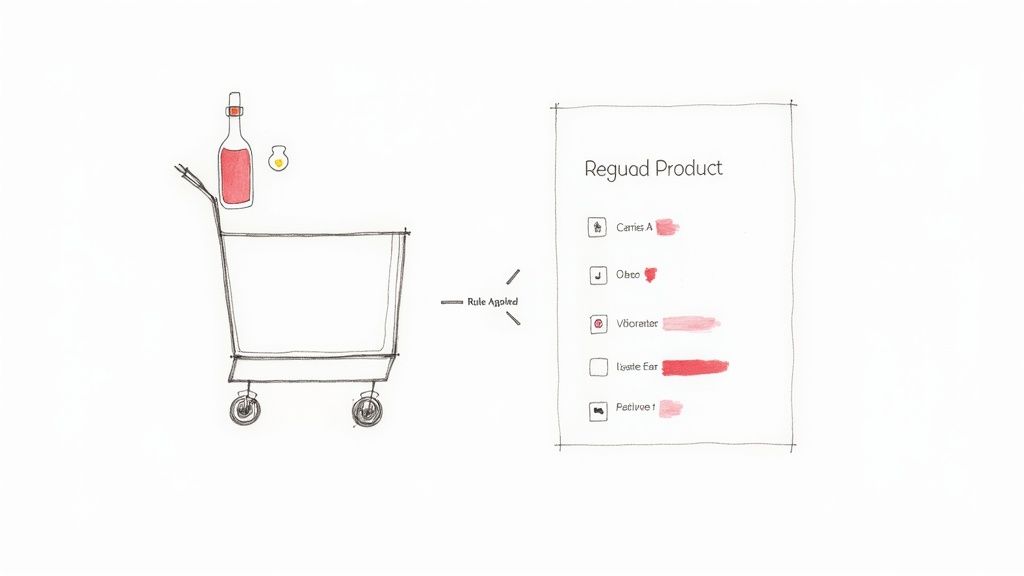
This kind of visual rule-builder is a game-changer. It turns complex "if-then" logic into a simple, step-by-step process that anyone can manage. For merchants in regulated industries, getting this right is non-negotiable. If you want to dive deeper into these kinds of setups, there are some great strategies for automated shipping compliance for WooCommerce stores that cover more advanced configurations.
Key Takeaway: The real magic is in how the rules stack. You can create one rule for your Nevada vape shipments, another for alcohol going to Texas, and a third that blocks all international orders for certain items. Together, these rules form an automated shield that enforces your entire compliance map on every single order, 24/7.
Testing and Maintaining Long-Term Compliance
Getting your shipping rules implemented is a huge step, but don't pop the champagne just yet. True compliance isn't a "set it and forget it" task. Think of your initial setup as building a fortress; now you have to walk the walls to make sure nothing gets through.
Without a solid testing plan, you’re basically running on hope—a terrible strategy when regulated products are involved. The whole point is to find and patch any gaps in your logic before they spiral into seized packages, angry customers, or a friendly letter from a regulator.
<iframe width="100%" style="aspect-ratio: 16 / 9;" src="https://www.youtube.com/embed/tcRrdbq08EU" frameborder="0" allow="autoplay; encrypted-media" allowfullscreen></iframe>Time to Try and Break Your Own Rules
Seriously. You need to actively try to circumvent your own restrictions. This means running a gauntlet of test orders that mimic every possible customer action, especially the ones you’re trying to prevent.
This goes way beyond just checking if a single state is blocked. It's about stress-testing the complex dance between specific products, destinations, and your carefully selected regional carrier options for regulated products.
Make a checklist and run through these scenarios every time you touch your shipping logic:
- The Prohibited State Test: Easy one first. Add a restricted item to the cart and try to ship it to a state where it's banned. The only acceptable result is zero shipping options and a blocked checkout.
- The Carrier-Specific Test: Add an item that can only ship via a specific regional carrier. When you enter an address in a valid state, you should see that carrier and only that carrier.
- The Mixed Cart Test: This is where things get interesting. Combine a regulated product with a totally normal, non-regulated one. The shipping options should automatically default to the rules for the most restrictive item in the cart.
- The Quantity Limit Test: If a state or carrier limits how many of an item you can ship in one box, test what happens when a customer tries to order more. Does it block them? Does it split the shipment correctly?
Be ruthless in your testing. If you can find a way around your own rules, you can bet a customer will stumble upon it eventually. It’s far better to discover these loopholes yourself than to find out from a carrier who just suspended your account.
Set Up a Routine for Long-Term Upkeep
Compliance is a moving target. State laws, carrier policies, and federal regulations are in constant motion. What's perfectly fine to ship today might become a felony next month. This is exactly why ongoing monitoring isn't just a good idea—it's non-negotiable.
Put a recurring event on your calendar for a quarterly compliance audit. This is dedicated time to review your entire shipping setup from top to bottom. If you need a structured game plan, our WooCommerce shipping compliance audit checklist will walk you through every critical point.
Here’s what to focus on during each audit:
- Check Carrier Policies: Pull up the websites for every regional carrier you use. Hunt down their terms of service, prohibited items list, or any shipping bulletins. Look for changes.
- Scan for New Laws: Use industry news sites, legal blogs, or state government sites to see if any new shipping laws have been passed in the states you serve.
- Validate Your Rules: Fire up that testing checklist you made and run through all the scenarios again. This confirms your rules in Ship Restrict are still working perfectly after any WooCommerce updates or other site changes.
This simple, proactive cycle turns compliance from a panicked, reactive fire drill into a predictable part of doing business. It’s the single best way to protect your brand, avoid fines, and keep shipping your products with confidence.
Regulated Shipping FAQs
Navigating the world of regulated shipping always brings up tough questions. Getting straight answers is critical for building a compliant, efficient shipping strategy—especially when you're trying to balance national carriers with specialized regional partners.
Here are some of the most common questions we see from e-commerce merchants trying to get it right.
What Are the Biggest Mistakes to Avoid When Choosing a Carrier?
The most common—and costly—misstep is choosing a carrier based on price alone. You absolutely have to dig deeper and verify their specific licenses and, just as importantly, their experience shipping your exact product type.
Never assume that because a carrier handles one type of regulated good, like lithium batteries, they’re automatically cleared to handle another, like alcohol or CBD products. They often aren't.
Another huge error is failing to scrutinize their returns process for regulated items. Reverse logistics can be even trickier than outbound shipping. Many carriers have entirely different rules for returns, and some won't handle them at all. Always get this clarified in writing before you sign anything.
How Should I Handle Product Returns?
Returns for regulated products demand a separate, well-documented game plan. First things first: confirm if your chosen regional carrier even handles return shipments for your items. Some flat-out don't, which means you'll need a completely different logistics partner just for your reverse logistics.
Your store's return policy needs to be painfully clear to the customer. It should spell out specific packaging instructions or even require them to drop the item off at a designated facility. Remember, the rules for shipping an item back to you are just as strict as they were for shipping it out in the first place.
A seamless return process is a cornerstone of customer retention. But when you're dealing with regulated goods, compliance must always trump convenience. Clearly communicating your return limitations upfront prevents customer frustration and protects your business from accidental violations.
Can I Use a Hybrid Shipping Strategy?
Absolutely. In fact, a hybrid approach that blends regional and national carriers is often the smartest, most effective strategy. It lets you optimize for both cost and coverage, creating a serious competitive advantage.
For example, you can set up your WooCommerce store to automatically offer a speedy, cost-effective regional carrier for any destination inside their service area. For all other states outside that zone, your store can simply default to a national carrier like UPS or FedEx.
This setup ensures you can serve your entire customer base while still taking advantage of the speed and cost benefits of regional partners wherever you possibly can.
Ready to stop gambling with compliance and start automating your shipping rules? With Ship Restrict, you can build a powerful, automated defense that enforces your compliance map on every single order. Take control of your regulated shipping today.
Automate Shipping Compliance
Stop worrying about restricted states. Ship Restrict handles it automatically.

Cody Yurk
Founder and Lead Developer of ShipRestrict, helping e-commerce businesses navigate complex shipping regulations for regulated products. Ecommerce store owner turned developer.
Automate Shipping Compliance
- Block restricted states
- No more cancellations
- Set and forget
3-day free trial · Card required