Revenue vs Profit Margin: A Practical Guide for eCommerce
Revenue vs profit margin explained for eCommerce sellers. Learn formulas, real examples, and how shipping rules affect your bottom line.
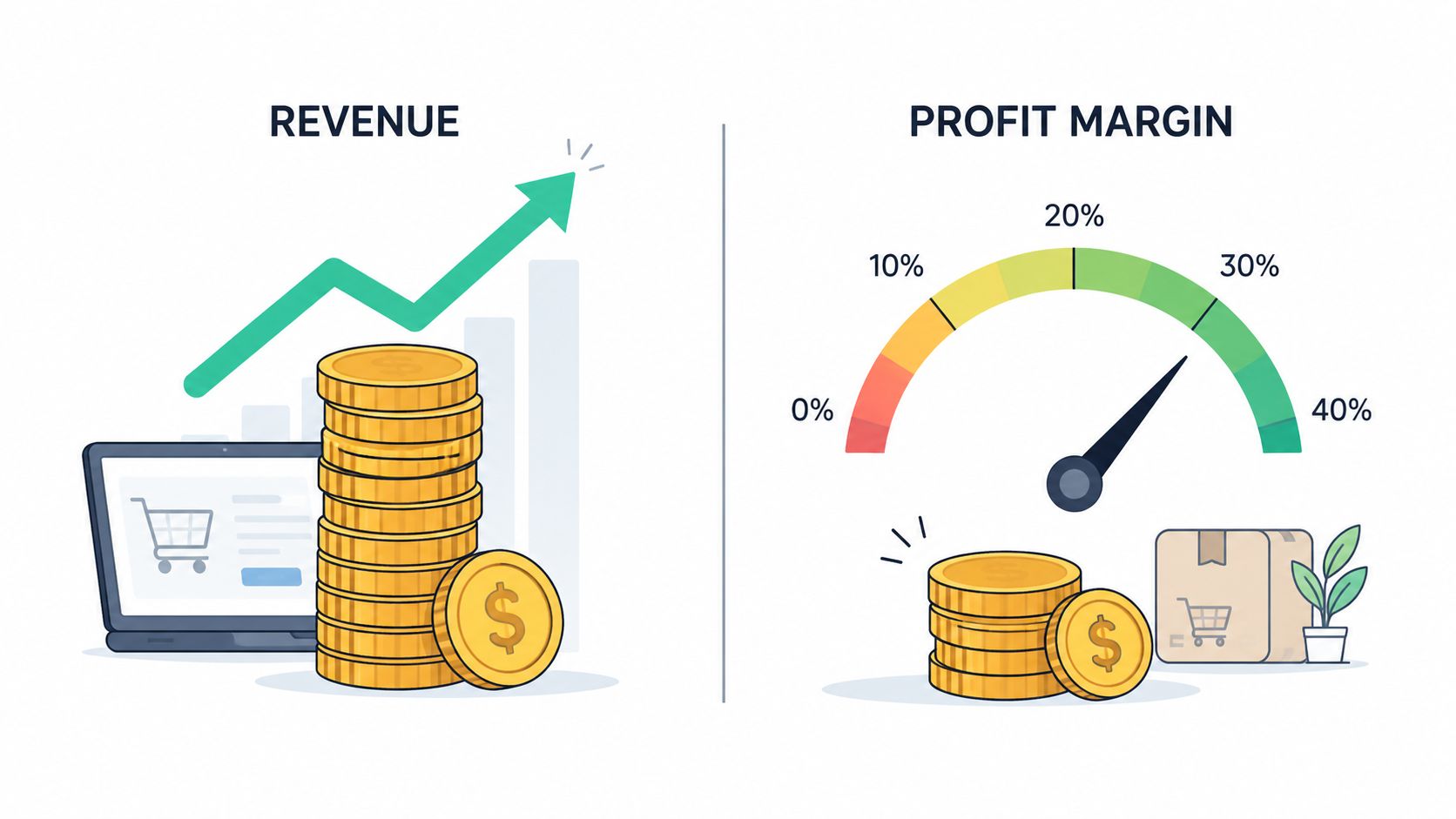
You can feel the problem before you can name it. Orders are coming in, the dashboard looks busy, and revenue is trending the right way, but cash is tighter, the ops queue is longer, and your team keeps pulling orders back for review because a ZIP code, state rule, or restricted product slipped through. That's the moment when revenue vs profit margin stops being a finance lesson and starts being an operating system problem.
| Criterion | Revenue | Profit Margin |
|---|---|---|
| What it tells you | Demand and sales volume | How much of that demand survives costs |
| What it hides | Expenses, returns, review labor, chargebacks | Less hidden, but still depends on how you define costs |
| Best used for | Topline growth tracking | Profitability and sustainability |
| Common failure mode | Celebrating sales that don't pay the bills | Watching the ratio without fixing the cost stack |
| Regulated eCommerce relevance | High order count can mask risk | Compliance overhead shows up here fast |
When Growing Sales Quietly Shrinks Your Margins
A regulated seller can post a strong month on paper and still end up with a worse business. The orders are there, the ad account is spending, and the revenue line keeps climbing, but every noncompliant shipment creates work that never appears in the topline. Manual review, return handling, restocking, chargebacks, carrier penalties, and legal exposure all live below the revenue line, which is why a seller can grow and still feel financially stuck.
The trap is volume without filtration
The distinction matters because revenue measures demand, while margin measures whether demand pays for the operation behind it. The top line only tells you that customers bought something. It doesn't tell you whether your team had to spend fifteen minutes checking a state rule, whether a carrier flagged the package, or whether the order turned into a return that ate the sale.
That's why general advice about “grow faster” often breaks down in patchwork-regulation categories. A seller shipping age-restricted or state-restricted products can absolutely create more sales and still damage cash flow if the growth brings more exceptions than clean orders. The useful question isn't just whether orders increased, it's whether the marginal order left enough behind after compliance overhead to matter.
Automate Shipping Compliance
Block orders to restricted states automatically. 3-day free trial.
Start Free TrialPractical rule: if a sales lift also raises cancellations, review time, and post-sale exceptions, the business may be buying revenue at the expense of profit.
A lot of teams only realize this after the month closes. By then, the support inbox is full, the warehouse has already touched the bad orders, and finance is trying to explain why the revenue line looks fine while cash feels thin. If returns are a recurring problem in your catalog, reduce returns with SelfServe is a useful starting point for thinking about how bad-fit orders drain margin after checkout.
The better habit is to treat revenue as the demand signal and margin as the viability signal. In regulated eCommerce, those are related but they're not interchangeable, and the gap between them is where operators usually lose money.
Revenue, Gross Margin, and Net Margin Defined
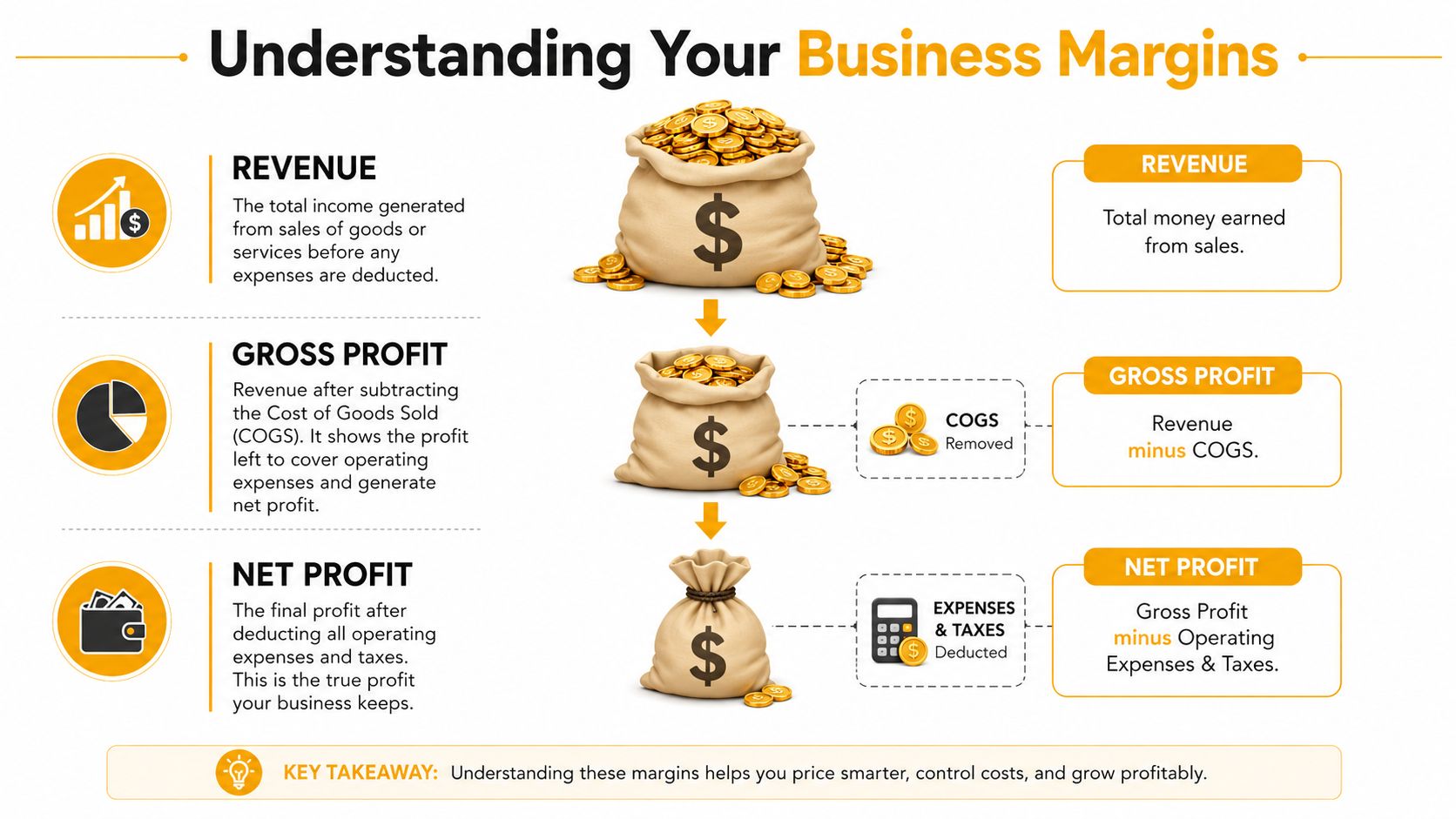
Revenue is the gross top line before expenses. Gross profit is revenue minus cost of goods sold, and net profit is what remains after operating expenses, taxes, interest, and one-time costs are removed. Those layers matter because each one answers a different business question, and regulated sellers need all of them to see the complete picture.
The standard formulas are simple. Gross margin = (Gross profit / Total revenue) × 100. Net margin = (Net profit / Total revenue) × 100. That means the percentage version is just a normalized way to compare businesses, SKUs, or channels that don't bring in the same dollar amount.
A compact month-end example
Suppose a regulated seller books $120,000 in monthly revenue. Direct product cost, regulated handling fees, and inbound fulfillment total $72,000, so gross profit is $48,000. Gross margin is therefore 40% using the formula above.
Now add the rest of the operating stack. Shipping labels, payment processing, support time, and compliance tooling push operating expenses high enough that net profit ends up at $9,000. Net margin is 7.5% using the same formula. The business still sold well, but a large share of the top line disappeared into the cost structure before it reached the bottom line.
That's the right way to read margin in this category. Gross margin is the better lens for product mix, SKU selection, and fulfillment economics. Net margin answers the existential question, whether the business is viable after everything hits the P&L.
Gross margin tells you whether the unit economics work. Net margin tells you whether the company survives.
A practical finance team doesn't choose one and ignore the other. It uses gross margin to decide where to place capital, and net margin to decide whether the entire operating model deserves more scale. If you only watch revenue, you're measuring demand without checking whether the machine underneath it is profitable.
Free Shipping Compliance Audit
We'll review your WooCommerce store's shipping compliance for free.
Revenue and Profit Margin Compared Side by Side
The cleanest way to compare the two metrics is by decision context. Revenue is a volume metric, so it's useful when you care about demand, growth, or funnel size. Profit margin is a quality metric, so it's useful when you care about whether sales are worth the operational strain they create.
| Revenue vs Profit Margin Decision Criteria | Revenue | Profit Margin |
|---|---|---|
| Measures | Gross sales generated | Profit retained after costs |
| Hides | Costs of acquisition, fulfillment, support, and compliance | Depends on which costs are included |
| Time horizon | Good for daily and weekly demand tracking | Better for weekly, monthly, and quarterly quality checks |
| Unit of analysis | Store, channel, campaign, or period | SKU, channel, customer cohort, or business overall |
| Best for | Topline growth and demand validation | Product mix, efficiency, and survivability |
| Weak spot in regulated catalogs | Can rise while bad orders pile up | Can look healthy only if the cost stack is measured correctly |
The important row is what each metric hides. Revenue hides the price of serving the order. That matters more in regulated categories because compliance tooling, support burden, and geo-restriction rules can change profitability by state, ZIP, or variant. A segment can look like a winner in revenue terms and still be a weak performer once the exception-handling cost is included.
For ad and channel analysis, the choice of tool also matters. If you're deciding whether a campaign should stay live, choose ROAS or ROI with the cost structure in mind, because a channel can look efficient on sales alone and still fail the profit test once returns and compliance work are added.
Match the metric to the decision
Use gross margin when you're asking which SKUs deserve more push, which bundles should stay live, and which fulfillment patterns are eating too much contribution. Use operating margin when you're judging channel efficiency and overhead load. Use net margin when you're asking whether the business can keep standing after taxes, interest, and every other non-product cost are paid.
That sequencing matters. Teams sometimes use revenue to justify more spend before they've proven the order can survive the cost stack. In regulated eCommerce, that's backwards. The right decision starts with the margin lens, then works back to the revenue driver.
Where Regulated Sellers Lose Margin
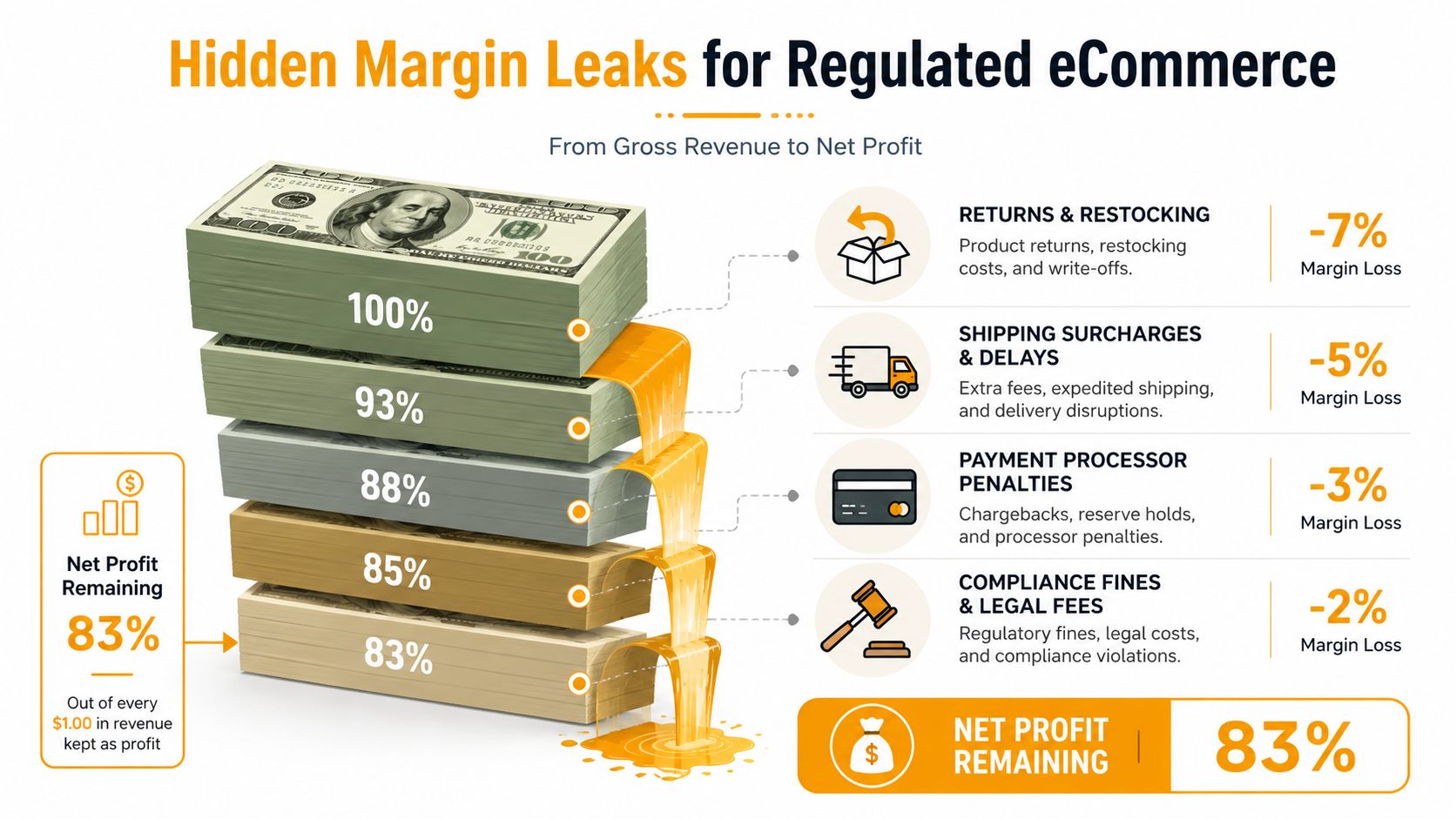
The biggest leaks usually don't announce themselves as “compliance costs.” They show up as routine operations: a return that should never have shipped, a chargeback that took an hour to dispute, a carrier issue that came from a bad label, or a staff member manually checking orders against state, city, and ZIP rules. Revenue grows on the surface while those costs collect underneath it.
The cost stack that revenue ignores
Returns and restocking are the first drain. A bad order doesn't just reverse the sale, it also creates reverse logistics, warehouse handling, and customer support work. Chargebacks and dispute fees come next when a restricted item reaches the wrong jurisdiction or the buyer challenges the transaction. Carrier penalties and rejected-label fees add another layer when shipments don't meet the rules a carrier enforces. Then there are the hours your team burns on manual vetting, which is quiet but expensive because it repeats on every questionable order.
The finance point is simple. Revenue does not show acquisition cost, delivery cost, operating expenses, payback period, or cash-flow pressure, which is why margin analysis is often more useful than topline revenue alone. That's especially true for regulated sellers, because order-cancellation handling, manual review, and noncompliant shipments can erode profitability even when sales are increasing. The business can look active and still be bleeding.
A more useful way to think about it is this, every noncompliant order adds friction before it adds value. If the order goes through, you pay to process it. If it gets reversed, you pay again to unwind it. Either way, the margin hit is real.
Why margin beats topline for these categories
Many operators focus on demand first and fix leakage later. That usually leaves the cleanup bill in operations and the optimism in sales. When the catalog includes restricted products, the better order of operations is to protect margin at the point of sale, then scale the clean demand that remains.
Hidden costs of non-compliance in regulated product shipping is worth reading if you're mapping where those leaks show up in shipping workflows. The pattern is always the same, the revenue line looks healthy while the exception path drains the business.
<iframe width="100%" style="aspect-ratio: 16 / 9;" src="https://www.youtube.com/embed/tV3DLV4KRa4" frameborder="0" allow="autoplay; encrypted-media" allowfullscreen></iframe>If you want the fastest path to better margin, reduce the leaks before chasing more volume. That's where operational efficiency is found.
How Checkout Compliance Preserves Both Numbers
The best compliance work happens before payment, not after shipment. If a checkout rule blocks a noncompliant order at the moment of purchase, the seller keeps the clean revenue and avoids the downstream cost cascade. That protects revenue and margin at the same time, which is why checkout enforcement is one of the few moves in this space that doesn't ask you to choose between growth and profitability.
Why prevention beats cleanup
A bad order that slips through can consume staff time, generate support tickets, require restocking, and trigger a dispute. Even when the exact dollar amount varies by business, the structure of the loss doesn't. You pay to process the order, then you pay again to unwind the mistake, and the margin impact follows the same path every time.
That's why the checkout layer matters more than a post-purchase cleanup process. A rule-based block stops the sale before money changes hands and before the warehouse, carrier, and support team touch the order. In practical terms, the blocked order is the cheapest order in the system, because it never becomes an exception.
Block the order before payment, and you preserve both the sale quality and the operating margin.
A short operating example
Take a month in which a team spends 2 hours manually reviewing questionable orders. If that labor keeps happening every week, the cost compounds even before a bad shipment lands. Add one noncompliant shipment that makes it through, and the seller now carries the restocking work, possible dispute handling, and the customer service time that comes with it.
A checkout rule that stops that order costs nothing per incident after it's configured, because the loss never enters the fulfillment pipeline. That's the point most sellers miss. A compliance block doesn't just prevent legal exposure, it also protects the profit you would've spent cleaning up the mistake.
For platform-specific examples, improve checkout experience is useful because the checkout has to be clear enough for legitimate customers and strict enough for restricted ones. A clean message reduces confusion, and clear enforcement reduces exception work.
The practical takeaway is simple. Good compliance is not a revenue killer. It's a margin filter that keeps compliant demand and removes the orders that would've eaten your profit after the sale.
Practical Steps to Lift Margin Without Hurting Revenue
Margin improves fastest when the business attacks cost at multiple points in the order lifecycle. Price hikes alone are a blunt instrument, and in regulated categories they can push demand into the wrong places without fixing an underlying leak. The stronger play is to tighten product economics, fulfillment efficiency, returns handling, and checkout enforcement together.
Prioritize the levers that protect both sides of the P&L
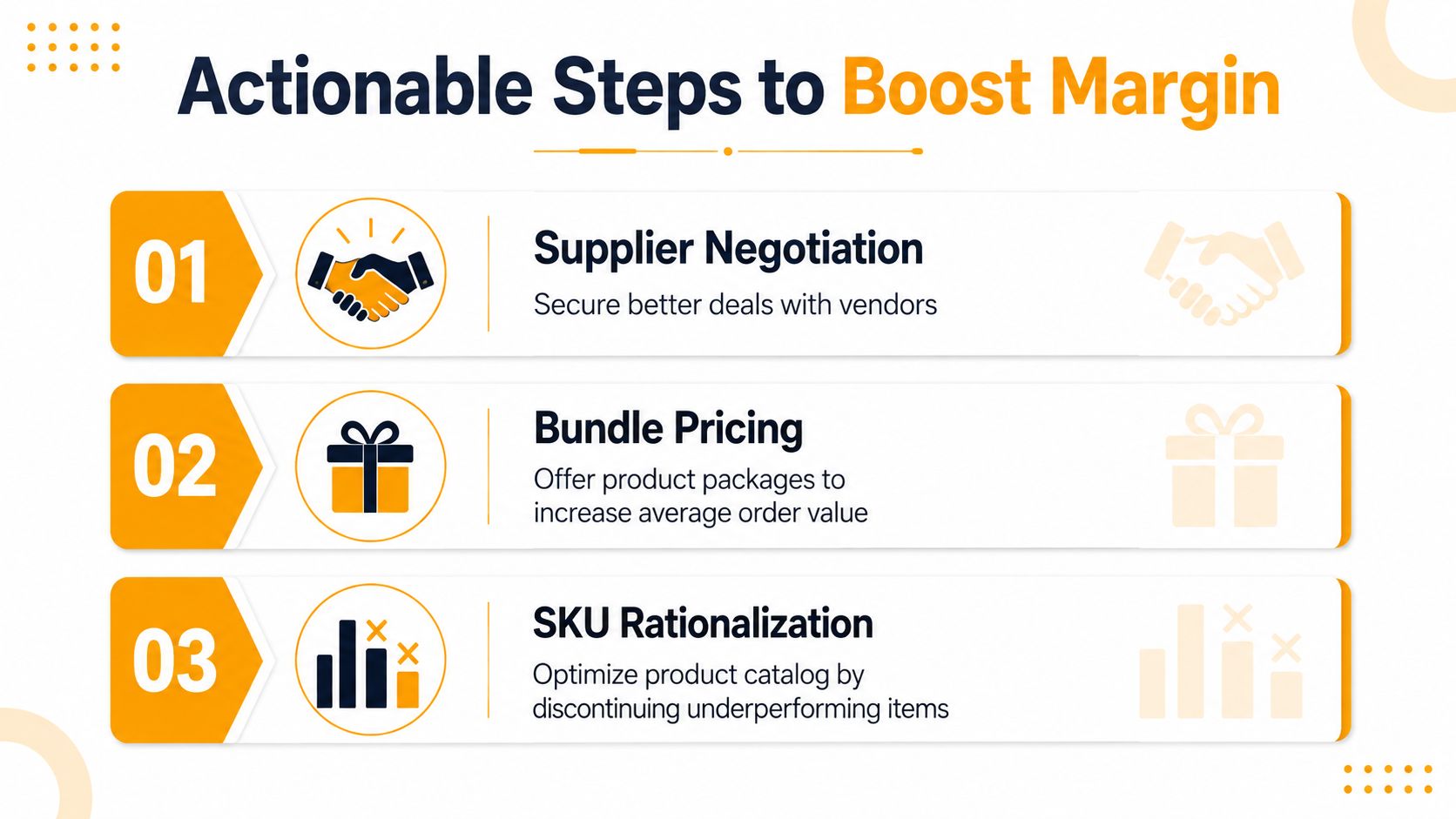
- Tighten supplier and SKU economics. Push harder on vendor terms, rework bundles, and cut low-value SKUs that absorb attention without contributing enough margin.
- Reduce fulfillment drag. Zone-skipping, better carrier negotiation, and accurate address validation all help lower the cost per order without starving demand.
- Cut return volume upstream. Product pages should set expectations clearly, and checkout messaging should warn customers before they commit to a restricted or misaligned order.
- Automate state, city, and ZIP enforcement. Rule-based blocking removes manual review hours and keeps the team from re-checking the same exceptions repeatedly.
- Schedule rule changes instead of chasing them manually. Temporary restrictions and law changes are easier to absorb when activation and expiry are built into the process.
- Consolidate rule maintenance across stores. Import/export and sync workflows matter when you're managing more than one storefront, because duplicated configuration burns time and creates inconsistency.
- Track gross and net margin weekly. Revenue alone won't tell you when compliance overhead is creeping up. Margin will.
If you're pressure-testing pricing changes, dynamic pricing example is a useful reference point for thinking about how price, demand, and policy can move together without creating avoidable waste. That kind of analysis belongs in the same conversation as margin, not beside it.
For retention work, retention marketing strategies for Shopify is relevant because repeat demand is only valuable when the repeat customer doesn't come with hidden exception costs. Retention should deepen profit, not just repeat volume.
The best operators don't try to “save margin” in one department. They make the order cleaner, cheaper, and easier to keep from the moment a customer starts checkout.
Which Metric Regulated Sellers Should Watch Weekly
Weekly, the best KPI is gross margin by channel and product variant. Revenue still matters, but only as the demand signal. Net margin matters for sustainability, but it moves too slowly to guide week-to-week action, especially when compliance issues and SKU mix can change profitability by state or product type.
The dashboard should show revenue next to gross margin, not instead of it. Add net margin by channel for a broader view of viability, and include a count of restricted-order attempts so the team can see whether enforcement is stopping losses before they hit the P&L. That combination gives operations, finance, and marketing the same read on performance without hiding the compliance leak behind a strong sales week.
In regulated categories, margin discipline is the strategy. Revenue is the byproduct of getting it right.
Ship Restrict helps regulated WooCommerce and Shopify sellers block noncompliant orders before payment, which is exactly where margin gets protected and cleanup costs get avoided. If you're shipping age-restricted, state-restricted, or otherwise regulated products, visit Ship Restrict to see how checkout enforcement can help keep your revenue clean and your profit margin intact.
Automate Shipping Compliance
Stop worrying about restricted states. Ship Restrict handles it automatically.

Cody Yurk
Founder and Lead Developer of ShipRestrict, helping e-commerce businesses navigate complex shipping regulations for regulated products. Ecommerce store owner turned developer.
Automate Shipping Compliance
- Block restricted states
- No more cancellations
- Set and forget
3-day free trial · Card required