Mailing a Package to Mexico: Step-by-Step Guide
Master mailing a package to Mexico with our step-by-step guide covering carriers, customs forms, packing tips, and cost-saving strategies.
You've got a box ready, a label half-printed, and a nagging feeling that one wrong form could leave the package sitting in customs for days. That feeling is justified. Mailing a package to Mexico looks simple on the surface, but the main work starts before you buy postage, because the outcome depends on what you're sending, who you're sending it to, and whether the contents are treated as a personal parcel or a business shipment.
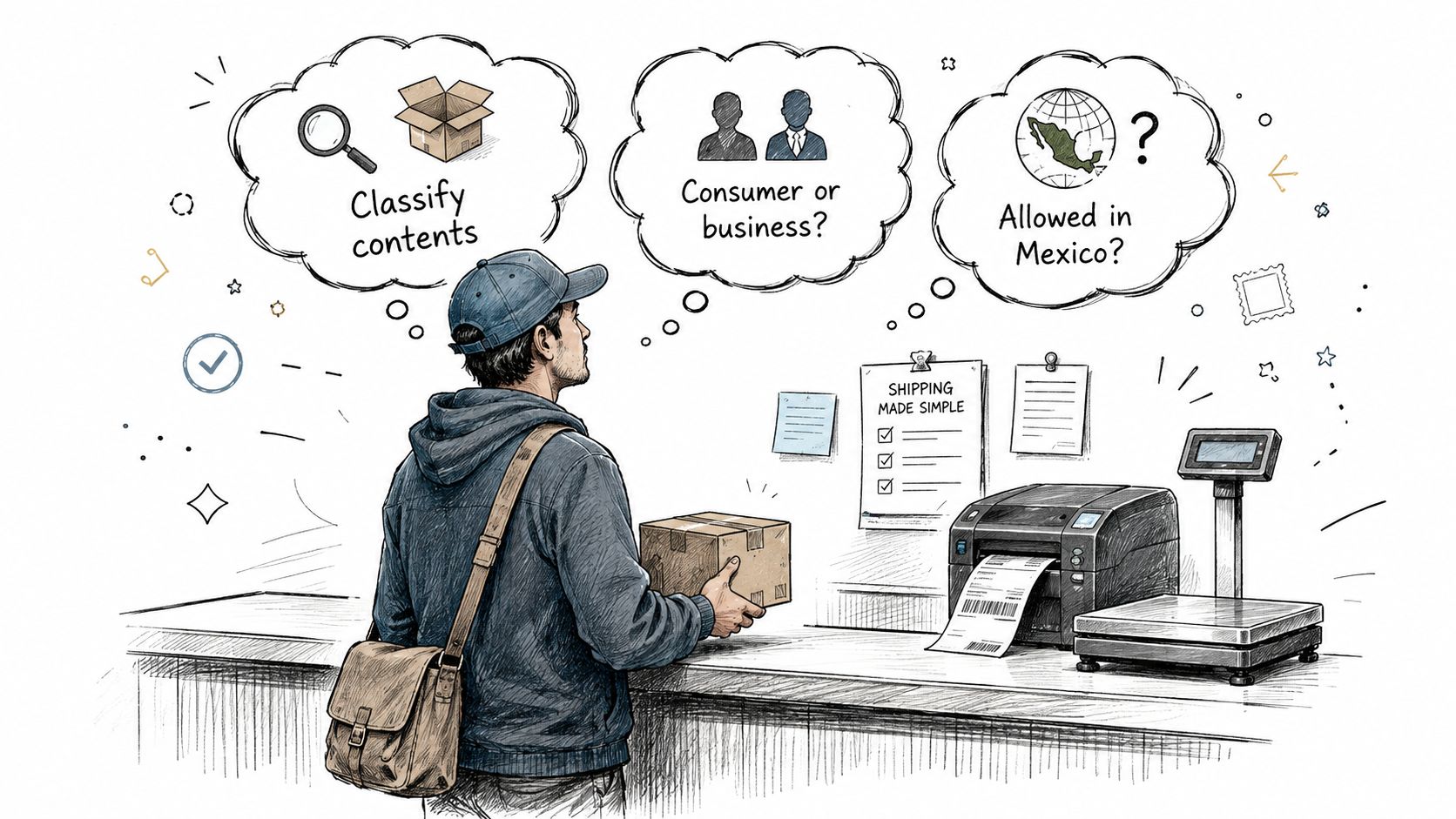
The biggest mistake is picking a carrier first and asking questions later. If you classify the contents badly, skip the recipient's tax details when they're needed, or miss an item restriction, the label won't save you. The right sequence is much more deliberate, start with the contents, then the recipient type, then the admissibility and paperwork.
If you want a broader cross-border lens while you think through those first decisions, the operational framing in cross-border trade insights from Axcnh is a useful companion piece. It reinforces the same point that matters here, border shipping is a process problem as much as it is a postage problem.
What Most People Get Wrong Before They Mail a Package to Mexico
The first error is treating the shipment like a domestic parcel with an international label. People see the destination, pick a carrier, and assume the rest will sort itself out. That's how packages get stuck, because customs does not care how convenient the checkout flow felt.
Automate Shipping Compliance
Block orders to restricted states automatically. 3-day free trial.
Start Free TrialClassify the contents before you price the label
Before you compare postage, name exactly what's inside. A candle, a phone accessory, a sample, and a supplement do not behave the same way at the border, even if they fit in the same box. If you can't describe the item clearly, you're not ready to ship it.
The second mistake is ignoring whether the recipient is a consumer or a business. That distinction changes documentation, and it changes how customs reads the parcel. A gift to a friend is not the same workflow as a sample going to a shop or a resale order going to a company.
Practical rule: if you're still writing “miscellaneous items” in your notes, you haven't classified the shipment well enough to print a label.
Check admissibility before you commit to transit speed
A lot of senders discover restrictions after they've packed the box, which is too late. Mexico-bound shipments can run into issues if the contents are regulated, restricted, or missing product-specific paperwork. That's why the opening decision isn't “Which carrier is fastest?”, it's “Can this item move at all, and under what documentation?”
The rest of the process gets easier once those three questions are answered. Is the item clearly classified, is the recipient a consumer or a business, and is the item allowed into Mexico in the first place. If those are settled, carrier choice becomes a tactical decision instead of a guess.
Choosing a Carrier and Service Level for Mexico
A parcel headed to Mexico can be a simple gift, or it can be a shipment that needs clean paperwork and tighter handoff control. USPS, FedEx, UPS, and DHL all serve the route, but they solve different problems. USPS is often the first comparison point for U.S. senders because the postal service publishes clear service tiers. Priority Mail International is officially estimated at 6 to 10 business days, while Priority Mail Express International is estimated at 3 to 5 business days. USPS-linked guidance also shows retail pricing for Mexico starting at $59.50 for a Flat Rate Envelope in 2025, with commercial base pricing listed at $56.10 USPS international shipping services.
FedEx, UPS, and DHL are usually picked for stronger tracking depth, better handoff control, or more predictable customs support on commercial shipments. A casual gift with straightforward contents can fit USPS well, especially if the recipient does not need detailed delivery visibility. Time-sensitive documents, or any parcel that needs tighter end-to-end oversight, usually fit a private courier better.
Match the service to the job
A low-value gift is usually the least demanding case. If the item is small, clearly admissible, and not urgent, USPS gives you a postal path with published speed tiers. A time-sensitive document pushes the choice toward an express service, because speed and tracking matter more than shaving a little off postage.
Recurring small-business shipments change the equation. Once you are shipping regularly, the key question is how the carrier handles customs paperwork, delivery updates, and exceptions. Many merchants prefer courier tools at that point, even when the label price is higher, because fewer handoff gaps means fewer calls about missing parcels.
Free Shipping Compliance Audit
We'll review your WooCommerce store's shipping compliance for free.
The cheapest label is not always the cheapest shipment. If customs stalls or the recipient cannot clear the parcel, the savings disappear fast.
Heavier parcels, especially repeat inventory or samples, need more than a transit-time comparison. Documentation support and acceptance rules matter just as much as the delivery estimate. Postal service can still work, but only when the box fits the service limits and the paperwork is clean. A practical shortlist usually looks like this, USPS for straightforward personal parcels, express couriers for speed and visibility, and the courier network that handles customs more cleanly when the shipment has business implications.
For a second reference point while comparing service types, this Mexico shipping restrictions guide helps show how carrier choice changes once the contents themselves become the deciding factor.
Filling Out Customs Forms the Right Way
The customs form is where most avoidable mistakes happen. Not because senders are careless, but because they write for convenience instead of classification. Customs needs specific data fields, and vague entries invite inspection.
Complete the form in the order customs expects
Start with full sender and recipient details, then list each item individually. Add the quantity, weight, country of origin, and declared value for each line item. USPS guidance also calls for the proper customs form workflow, and Mexico-bound USPS shipments may require PS Form 2976-B, with supplemental documentation in some cases for duty-payment guarantees USPS international shipment preparation.
The description is where precision matters most. “Electronics” is weak. “Wireless headphones, one pair, plastic and metal housing, country of origin China, declared value $40” is much better because it tells customs what the item is. Specificity reduces ambiguity, and ambiguity is what slows packages down.
A clean example beats a vague one
A pair of headphones worth $40 should not be entered as “electronics, $40.” That line tells customs almost nothing. A better declaration names the item, quantity, value, and origin, so the officer can match the description to the box and the invoice.
Strong customs line: wireless headphones, 1 pair, declared value $40, country of origin listed clearly, with the form matching the packing contents.
If you're shipping anything that could be duty-sensitive or documentation-heavy, avoid guessing on the value and avoid compressing multiple items into one generic line. Incomplete forms create delays because the recipient may need to answer questions before the parcel clears. The goal is simple, give customs enough information to classify the shipment without needing follow-up.
Personal Gifts Versus Small Business Shipments
Most generic guides fall short here. A birthday gift and a commercial sample can look similar in a box, but customs doesn't treat them the same way. The difference is not academic, it changes the documents, the recipient details, and sometimes the release speed.
What changes when the parcel is commercial
For a personal package, the workflow can be relatively light if the contents are straightforward and the value stays within the relevant threshold. Mexico guidance cited in 2026 notes a $50 USD duty-free threshold for personal packages and a $117 USD duty-free threshold under USMCA in certain cases, with every import declaration requiring the recipient's RFC tax ID as of 2025 Mexico shipping costs and customs guidance. Once a shipment is commercial, that simplicity starts to disappear.
Commercial shipments can require a commercial invoice, packing list, bill of lading or air waybill, and sometimes a Mexican Entry Form or broker support cross-border shipping guidance for Mexico. That's the documentation gap most consumer-facing articles never explain. A small eCommerce order, a sample for a store, or a repair part going to a company can all trigger business-style handling even if the parcel is physically small.
Use the recipient type to choose the workflow
If you're mailing to a friend or relative, ask whether the item is personal, clearly described, and likely to stay within the duty-free rules. If you're mailing to a business, assume you need cleaner documentation from the start. In practice, that often means confirming the recipient's RFC before the label is printed, because the declaration can't be finished properly without it.
A good rule is to separate your shipments into two buckets. Personal gift shipments need accuracy and admissibility. Business shipments need accuracy, admissibility, and documentation discipline that matches a commercial import. The box may be the same size, but the customs path is not.
Packing and Labeling Standards That Prevent Damage and Rejection
A parcel can fail before customs reviews it if the box is weak, too large for the contents, or labeled badly. Mexico-bound deliveries also depend on clear, correctly placed labels, because last-mile problems usually start with address mistakes, not transit alone. Good packing is compliance, not just presentation.
Build the parcel so it survives inspection and handling
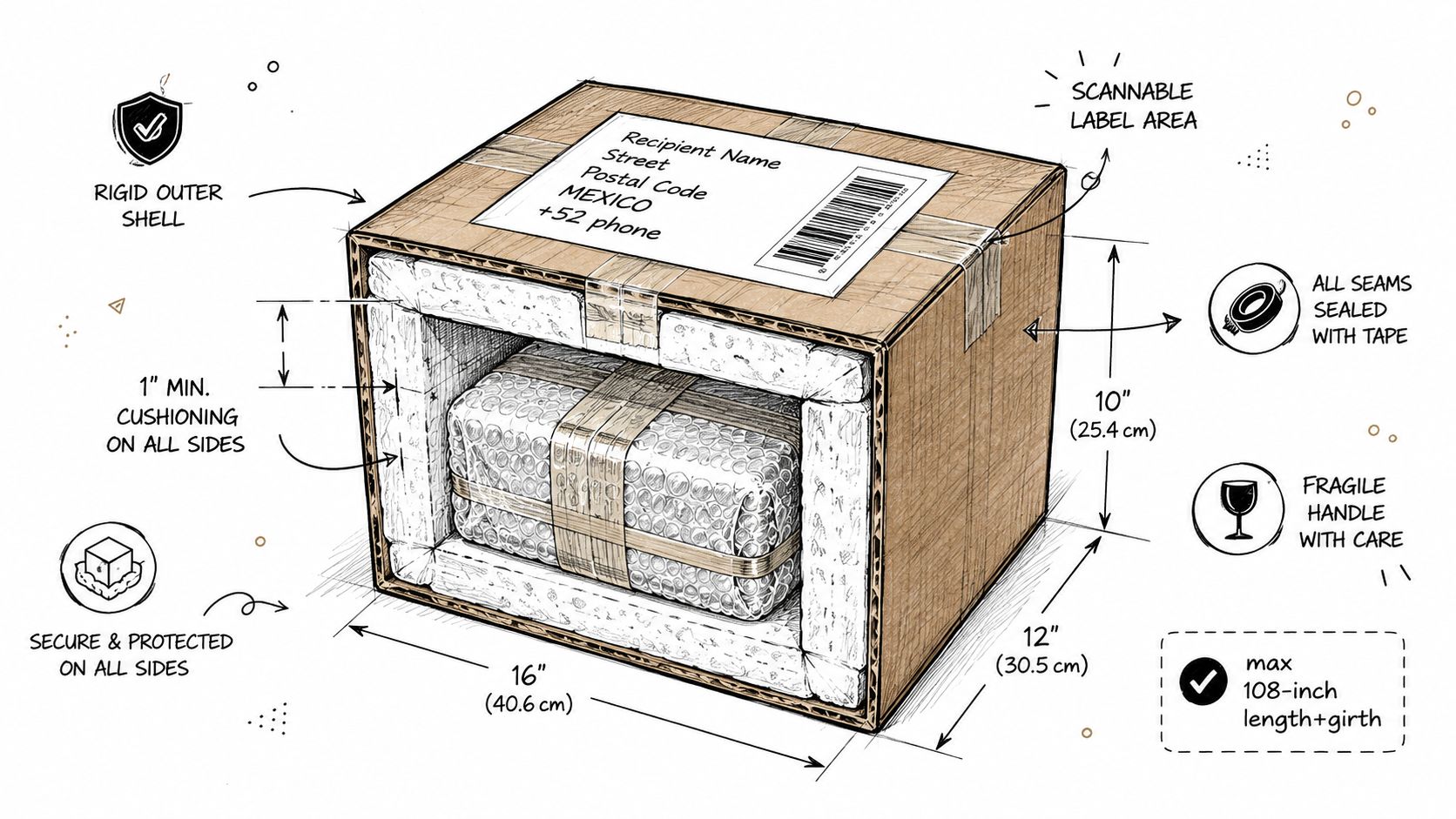
Courier guidance for Mexico emphasizes rigid outer packaging, at least 1 inch (2.5 cm) of cushioning space, and sealing all seams with 2-inch (5.1 cm) tape Mexico shipping packaging guidance. That standard protects both the contents and the paperwork. If the carton flexes, crushes, or opens in transit, the shipment is more likely to be delayed or refused.
Use strong ecommerce postal boxes when you are packing items that need a firmer shell around them. A stiff carton keeps pressure off the corners, helps labels stay readable, and reduces the odds of the customs pouch tearing loose. That matters even more if the box will be stacked with other freight or handled several times before delivery.
You also need to respect the USPS maximum combined length-and-girth limit of 108 inches USPS Mexico shipping guidance. If the parcel goes beyond the service limit, it is not a preference issue. It will not move through that channel.
Keep the address and label clean
Use the full recipient name, correct postal code, country name, and a reachable phone number. Mexican address errors are painful because the local delivery network often cannot guess what you meant. If the label is crooked, smudged, or wrapped around an edge, barcodes and customs forms lose scan quality.
Put the shipping label on the largest flat surface and keep the customs form visible but protected from scuffing. Label on top, customs form adjacent or inside the pouch, and no tape over barcode areas unless the label is designed for it. If you are using standardized cartons, this international flat rate shipping box guide helps you judge whether the box fits the shipment or forces the contents into the wrong container.
Restricted and Regulated Items That Catch Senders Off Guard
Many senders focus on the obvious bans first. Firearms, alcohol, tobacco, currency, and explosives are easy to rule out. Headaches usually come from regulated goods that look ordinary until customs asks for proof.
The items that trigger problems most often
Prescription medications, over-the-counter supplements, processed food, used clothing, cosmetics, and some electronics can all draw more scrutiny than expected. Mexico's rules can involve permits or product-specific approvals from agencies such as COFEPRIS and SENASICA, and misclassification or missing standards paperwork can lead to inspection, delay, or seizure Mexico regulated shipping guidance. A box can look harmless and still be held because customs checks admissibility, not intent.
A bottle of vitamins is a common failure point. If the sender treats it like generic merchandise and skips the right classification, the parcel can sit for review. A refurbished phone creates a different problem, because electronics can raise questions about condition, valuation, and supporting paperwork. In both cases, the cheap shipping option stops being cheap once the parcel stalls and someone has to fix the declaration.
Why misdeclaration is the real risk
The bigger problem is usually a shipment that is technically sendable but poorly described. Customs cannot tell from a vague declaration whether the item needs a permit, a product approval, or an origin-specific review, so the parcel slows down while the paperwork catches up.
Regulated categories need more than a label and a box. The sender has to know whether the item is admissible, whether it needs agency clearance, and whether the description on the declaration matches what is inside. If those three pieces line up, the odds of a clean release improve. If they do not, even a small package can sit in the system while someone verifies what is inside.
For repeat shipments, customs holds are often a paperwork problem, not a packing problem. A good rule set should flag the item before the label prints, which is why how long packages stay in customs matters for anyone shipping regulated goods on a regular basis.
If the shipment is tied to a business order, the paperwork gets stricter fast. Tax IDs, item classification, and consignee details need to match the commercial reality, and small mistakes here create the kind of hold that is harder to resolve than a simple address correction. That is also where document automation advice for insurers becomes relevant, because clean document handling reduces the odds of missing forms, mismatched descriptions, or a customs file that looks incomplete on review.
Tracking, Insurance, and Compliance Automation for Frequent Shippers
A parcel to Mexico can look straightforward until the claim, the label, and the customs file stop agreeing with each other. For frequent shippers, the work is keeping those three pieces aligned, especially when some orders are personal gifts and others are small-business shipments that need RFC tax IDs, tighter item classification, and cleaner paperwork.
Once you ship to Mexico regularly, rate shopping is only part of the decision. Reliability, tracking depth, and customer communication matter more than saving a little on postage, because a low-cost label is no help if the parcel is stuck with no clear status or no usable audit trail. That matters even more for business orders and regulated goods.
Choose visibility that matches the risk
Basic tracking is acceptable for a one-off gift. Repeated cross-border shipments need more control. Signature confirmation helps prove handoff, and declared-value insurance matters when the contents are expensive or hard to replace. Mexico channel reliability can shift quickly too, so the transit setup should match the risk rather than assume every parcel will move the same way.
For senders who need a practical reference on customs delays, how long packages stay in customs is worth reviewing before you promise delivery dates or choose a service level. It gives a clearer sense of what happens when a parcel is held for inspection, missing data, or a classification question.
That is also why compliance belongs in checkout, not in a cleanup queue after the order has already gone out. If a product cannot ship, the customer should know before payment or label creation. The same logic applies to insurance and document handling, because a package with the right coverage but the wrong paperwork still slows down.
Operational takeaway: the strongest workflow blocks bad orders before they become support tickets, failed labels, or customs holds.
A rules-based system like Ship Restrict can stop a package before checkout when the shipping destination or product conflicts with store rules. For merchants handling regulated goods, that kind of gating follows the same sequence you want for Mexico-bound parcels, classify the item first, then choose the carrier, then complete the customs path.
A few habits keep the process steady. Use flat-rate options for dense small items when the box fits the service, consolidate orders when that reduces handling, and compare commercial versus retail postage before you print. Keep the checklist beside the packing station. Contents classified and admissible, carrier and service level chosen, customs forms complete, recipient details verified including RFC for business shipments, and packaging standards met.
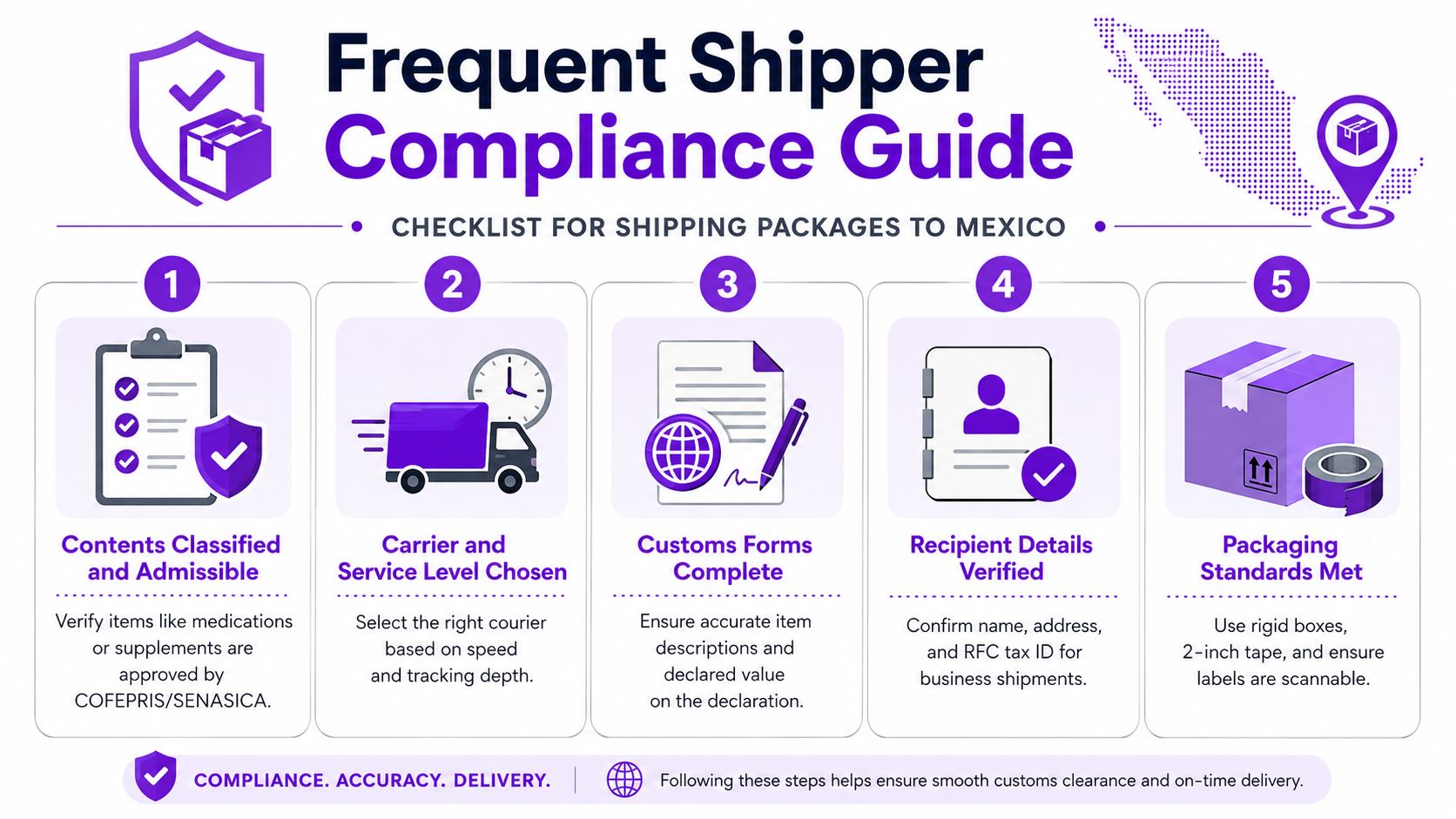
The package moves smoothly only when those checks happen before pickup. A cheap label can still become the most expensive shipment on your desk if customs needs clarification, the address is wrong, or the contents should have been classified differently. Spend a few minutes on classification and paperwork now, and you avoid days of delay later.
Insurance documentation should receive the same discipline. If your team handles multiple shipping policies, document automation advice for insurers is relevant because structured documents reduce missing forms, mismatched descriptions, and files that look incomplete during review.
<iframe width="100%" style="aspect-ratio: 16 / 9;" src="https://www.youtube.com/embed/zxXriXSthmw" frameborder="0" allow="autoplay; encrypted-media" allowfullscreen></iframe>If you're shipping to Mexico as part of a store workflow, Ship Restrict can help you stop restricted orders before they become compliance problems and customer complaints. Visit Ship Restrict to see how rule-based shipping controls fit into a cleaner checkout and fulfillment process for cross-border orders.
Automate Shipping Compliance
Stop worrying about restricted states. Ship Restrict handles it automatically.

Cody Yurk
Founder and Lead Developer of ShipRestrict, helping e-commerce businesses navigate complex shipping regulations for regulated products. Ecommerce store owner turned developer.
Automate Shipping Compliance
- Block restricted states
- No more cancellations
- Set and forget
3-day free trial · Card required