How Long Do Packages Stay in Customs? Get Them Faster
Discover how long do packages stay in customs, common delays, and tips for faster clearance. Our 2026 guide covers documentation, duties, and merchant insights.
Most packages clear customs in 1 to 3 days, and many routine imports clear in under 24 hours when the paperwork is accurate and nothing gets flagged. Air freight often clears in 1 to 2 days, sea freight usually takes 2 to 4 days, and express carrier shipments can clear within a few hours.
That's the answer merchants want when they search how long do packages stay in customs. It's also the answer that causes trouble, because it sounds simple enough to treat customs like a short waiting room instead of a decision point.
If you're checking a tracking page for a high-value order and seeing “in customs” with no movement, you're probably trying to answer two separate questions at once. First, is this still normal. Second, is there a problem that needs action right now.
Those are not the same question. A shipment can sit briefly because the port is busy, and that often resolves on its own. Another shipment can sit because the invoice is wrong, the HS code doesn't match the product, duties haven't been paid, or a regulated item triggered a review. Waiting helps in the first situation. Waiting makes the second one worse.
Automate Shipping Compliance
Block orders to restricted states automatically. 3-day free trial.
Start Free TrialFor merchants, especially those selling regulated products, customs delays are rarely random. They usually trace back to missing data, messy classification, payment friction, or product-specific scrutiny. If you're also dealing with post-purchase confusion, this guide on solving tracking issues for Shopify merchants is useful because many “stuck” complaints start as visibility problems before they become actual customs problems.
Import costs also shape the decisions merchants make before a package ever reaches the border. If you're trying to understand the broader economics behind landed cost and carrier choices, this breakdown of why international shipping is so expensive connects the dots well.
The Answer You Want vs The Reality of Global Shipping
A customer places an international order on Monday, sees rapid carrier scans through Tuesday, and by Wednesday the tracking page freezes at “in customs.” At that point, the question every merchant asks is simple: are we looking at a normal queue, or a hold that needs intervention?
That distinction matters more than the headline timeline.
A package can cross an ocean faster than it clears a bad invoice, an unpaid duty bill, or a regulator's request for supporting documents. I see merchants lose time because they treat every customs delay as one generic problem. It is not. Routine volume backlog usually clears with patience. A compliance hold usually gets worse while everyone waits.
What a normal customs stay looks like
For a routine shipment with clean data, customs clearance is often measured in hours to a few days, not weeks. That expectation holds best for standard consumer goods, complete commercial invoices, accurate product descriptions, and a delivery setup that does not leave duties hanging with the buyer.
The working range merchants should use is simple:
- Routine parcel clearance: often same day to a few days if documents, valuation, and classification are consistent
- Air shipments: usually faster than ocean because the file moves through a tighter operational chain
- Sea shipments: often slower because port handling, container flow, and terminal congestion add time
- Express carrier shipments: often clear faster because carriers like DHL, FedEx, and UPS run integrated brokerage processes
Those timelines are only useful if the shipment is routine. The broader cost and service trade-offs behind that are tied to carrier model, mode, and destination complexity. This breakdown of why international shipping gets expensive explains why faster, more controlled shipping options usually cost more.
Free Shipping Compliance Audit
We'll review your WooCommerce store's shipping compliance for free.
Why the simple answer breaks down
“In customs” is a status. It is not a diagnosis.
Two shipments can show the same tracking message while sitting in completely different conditions. One is waiting behind a heavy daily intake at a busy facility. The other has stopped because the declared description says “parts,” the HS code points to something else, duties are unpaid, or customs wants proof the product can legally enter the country.
That second category is where merchants get hurt.
If duties or taxes are not paid after arrival, the shipment can move into General Order status under U.S. Customs procedures after 15 days, which creates a much more serious recovery problem than an ordinary delay. U.S. Customs and Border Protection explains that timeline in its guidance on General Order merchandise. Merchants selling internationally should know this deadline cold, especially for DDU or DAP shipments where the buyer is expected to pay on delivery.
For customer-facing teams, this is also where communication discipline matters. A shopper may report a “lost package” when the actual issue is a customs payment request or a document mismatch. If your support team is working through those complaints, this guide on solving tracking issues for Shopify merchants is useful because it helps separate visibility problems from actual shipping exceptions.
The practical question is not “how long does customs take?” It is “what is customs waiting for?” That is the difference between a delay that clears on its own and a hold that requires action now.
The Standard Customs Clearance Timeline
Customs clearance is usually fast when the file is clean and the shipment fits an ordinary import pattern. The trouble for merchants is that “in customs” can describe two very different situations. A parcel can be waiting its turn in a routine queue, or it can be stopped at a specific checkpoint because customs, the carrier broker, or another agency needs something before release.
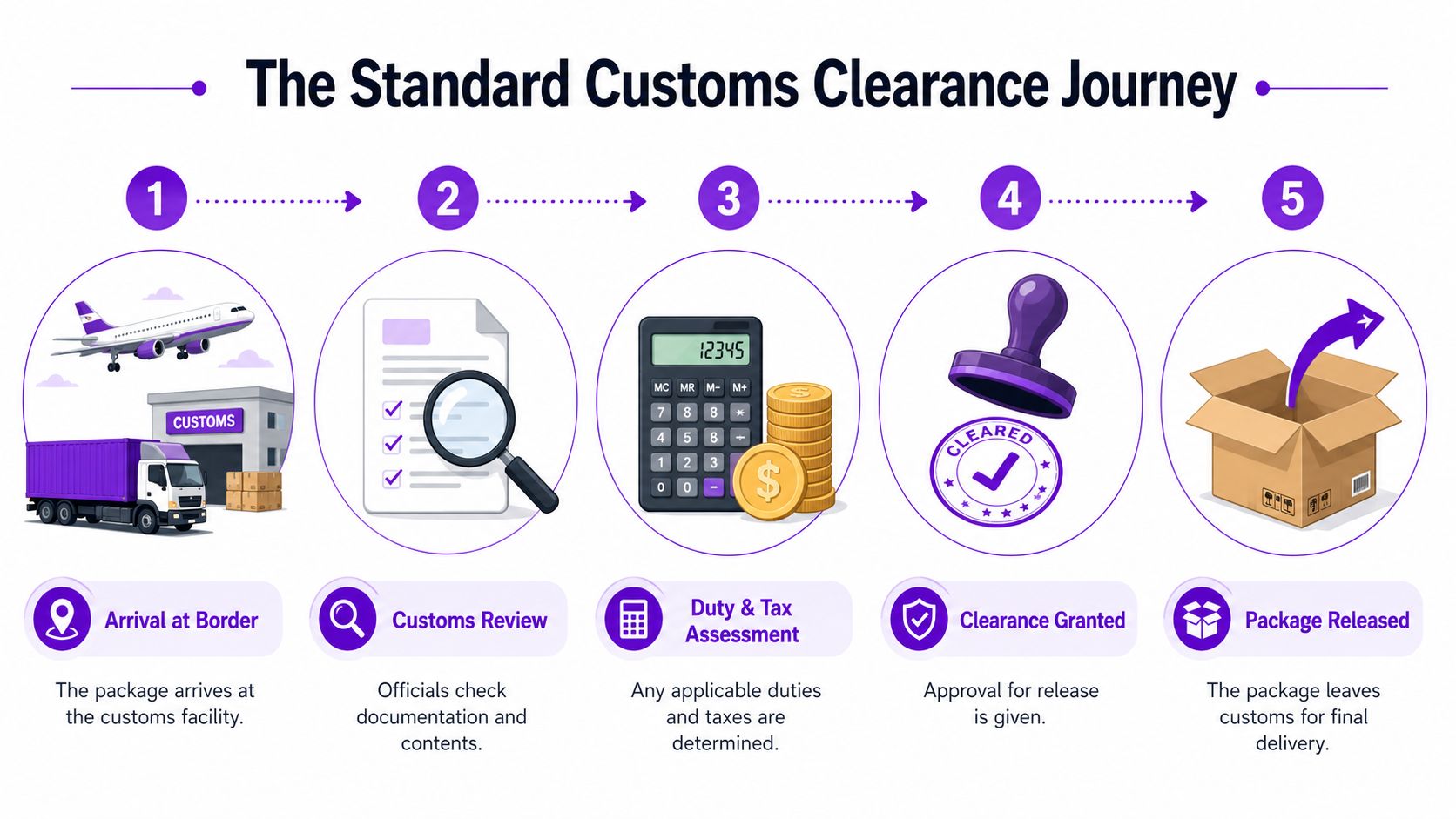
The five stages most shipments pass through
-
Arrival at the border facility
The carrier tenders the shipment into customs processing. The parcel has arrived in-country, but it is not yet cleared for delivery. -
Data and document review
Customs or the carrier's brokerage team checks the commercial invoice, declared value, product description, consignee details, and tariff classification. If the entry data is incomplete or inconsistent, clearance slows down here. -
Duty and tax assessment
Authorities determine whether import charges apply and whether another approval is required before release. If the shipment is sent under terms that leave the buyer responsible for payment, this step can add avoidable delay. -
Release or inspection decision
Many parcels are released after document review. Others are selected for inspection, document requests, or referral to another agency. -
Return to the delivery network
After release, the shipment goes back to the carrier for linehaul or final-mile delivery.
Mode and carrier setup change the timeline
The same product can clear on very different schedules depending on how it moved. Express networks often clear faster because transportation and brokerage sit under one operating model. Standard air cargo can still move quickly, but handoffs between airline, ground handler, broker, and customs can add time. Ocean freight usually has a longer administrative path, especially at congested ports or when container exams are involved.
Carriers themselves describe customs processing as a step that can range from same-day release to multiple days depending on the shipment details, destination rules, and whether customs requests more information. DHL explains that customs clearance timing depends on the destination country, the commodity, and the completeness of the paperwork in its customs services overview.
That is why merchants should avoid promising delivery dates based only on transit time.
Payment terms directly affect release speed
I see this mistake often with cross-border ecommerce. The parcel moves normally until duties are assessed, then nothing happens because the buyer did not expect to pay import charges at delivery or misses the carrier's payment notice.
Your shipping terms decide who needs to act at that moment. A merchant that uses the wrong duty model for its customer base will create customs friction even with accurate paperwork. If you are reviewing checkout and fulfillment policy, this guide on DDP vs DDU for international shipping gives the practical difference.
The standard timeline is short. The exceptions are what stretch it. Merchants who understand each clearance stage can tell the difference between ordinary queue time and a stop that needs action.
Why Packages Get Delayed Common Hold Triggers
A package can arrive in the destination country on schedule and still stop cold at customs for reasons that are predictable and preventable. From the merchant side, the pattern is usually the same. The shipment file does not clearly support what the parcel is, who is importing it, what it is worth, or who is paying the charges tied to entry.
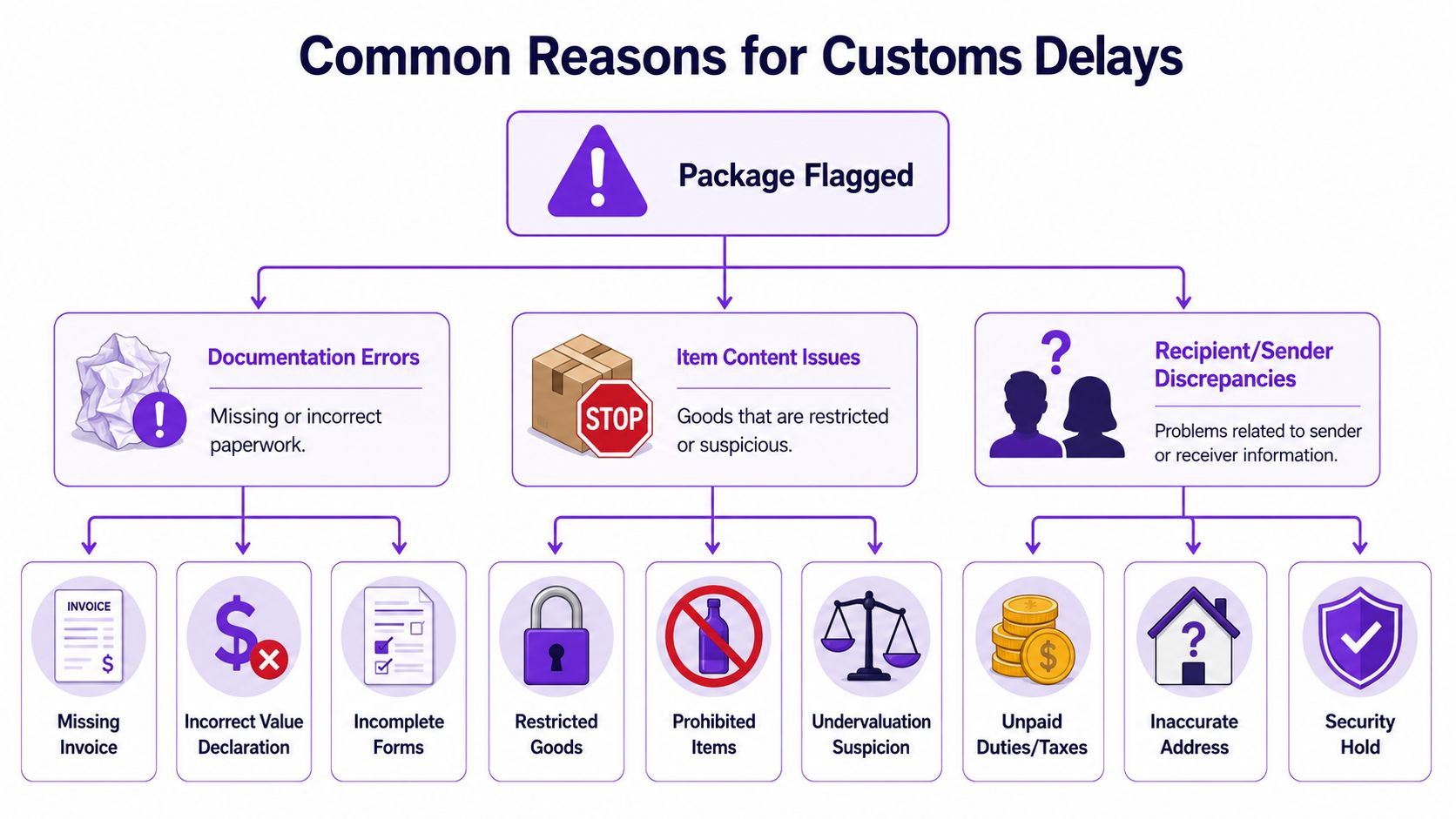
Documentation problems cause the most avoidable delays
In day-to-day cross-border shipping, paperwork errors create more holds than any other issue you can directly control. Carriers and customs teams can work through high volume. They cannot clear a shipment confidently if the invoice, classification, consignee data, and declared value do not line up.
ParcelsApp's summary of customs hold causes says routine clearance often finishes in 1 to 3 days, while incomplete documentation, missing importer identifiers, unpaid duties, safety requirements, or inspection can push the shipment out by several more days or longer. Its benchmark also notes that 80% of routine imports clear within 24 hours, while flagged shipments average 2 to 5 days, based on industry benchmarks summarized by ParcelsApp.
The recurring failure points are usually straightforward:
- Vague product descriptions: “Accessory,” “component,” or “parts” does not give customs enough to classify the item confidently.
- HS code conflicts: The tariff code suggests one product, but the commercial description suggests another.
- Declared value problems: The order total, invoice value, and product type do not make sense together.
- Incomplete importer details: The broker or carrier cannot match the shipment cleanly to the receiving party.
- Missing duty and tax setup: No one is clearly responsible for charges, or the buyer never responds to the payment request.
That last point gets overlooked. A package can sit in customs even when the goods themselves are acceptable if the entry cannot move forward because duties, taxes, or brokerage charges are unresolved.
Inspection holds are operational delays, not always merchant mistakes
Some packages are selected for x-ray, document review, or physical examination even when the paperwork is clean. That is part of customs enforcement, especially for higher-risk commodities, first-time importers, undervaluation concerns, or shipments routed through busy gateways.
For U.S. imports, Customs and Border Protection explains that imported cargo may be examined to verify admissibility, classification, value, or compliance with other agency requirements, and those exams can delay release depending on exam type and port conditions, as described on the CBP cargo examination page.
The merchant mistake is assuming every hold is random. It is not. Inspection may be random or targeted, but contradictory paperwork turns a short exam into a long one because the officer or broker now needs clarification before release.
A short explainer helps illustrate how these holds happen in practice:
<iframe width="100%" style="aspect-ratio: 16 / 9;" src="https://www.youtube.com/embed/gzz4-f8PQAg" frameborder="0" allow="autoplay; encrypted-media" allowfullscreen></iframe>Holds stay in place until someone resolves the underlying issue
Customs does not clear a shipment because time passed. It clears when the file supports release and the required payments, permits, or product details are in place.
Unicargo's overview of customs processing times says minor documentation issues may be corrected quickly, while inspections, missing paperwork, and regulatory questions can stretch clearance into weeks. It also notes that merchants who submit complete data and handle duty payment proactively often cut delay time substantially, based on this Unicargo analysis of customs processing times.
For merchants, the practical lesson is simple. Treat a customs hold as a diagnosis problem first. Confirm whether the shipment is waiting in a routine queue, waiting for payment, missing documents, or being reviewed for compliance. The actual problem is usually bad data, missing money, or a product category that triggered extra scrutiny.
Backlog vs Compliance Holds A Critical Distinction
Merchants often talk about customs delays as if they all belong in one bucket. That's a mistake.
A backlog delay usually means the shipment is waiting its turn. A compliance hold means customs or the carrier needs something specific before the shipment can move. Those two situations look similar in tracking. They require very different responses.
What a backlog delay looks like
A routine backlog shows up when import volume is heavy, staffing is tight, or a specific port is slow that week. In that case, the shipment may just be sitting in queue with no action required from you.
If the package clears after a short wait, it was probably backlog. If it doesn't, assume there's a compliance issue until someone confirms otherwise.
When tracking hasn't changed for several days, don't rely on the status label. Ask the carrier whether the shipment is pending review, awaiting payment, missing documents, or sitting in a volume queue.
What a compliance hold looks like
Compliance holds are active problems. Something about the package, payment, product category, or documentation needs intervention.
The most overlooked example is General Order, often shortened to GO. This is not a normal backlog. It's what happens when duty problems go unresolved.
A key customs distinction that many guides miss is this: 40% of U.S. packages held over 14 days are in General Order status because duties were not paid, not because they were stuck in routine inspection. If duties remain unpaid for 15 days, the cargo becomes GO merchandise and can sit in a bonded warehouse for 6 months before auction, according to this explanation of General Order delays and unpaid-duty holds.
That changes the merchant response completely. If you think the package is “just delayed,” you wait. If it's GO merchandise, waiting is how you lose control of the shipment.
Customs Delay Types Compared
| Delay Type | Cause | Typical Duration | Required Action |
|---|---|---|---|
| Routine backlog | High volume, local congestion, staffing pressure | Usually short, but varies by port | Monitor and confirm status with carrier |
| Inspection hold | Scan, document check, or physical examination | Can add days, and sometimes much more depending on exam depth | Wait, but stay available for requests |
| Documentation hold | Missing invoice, inconsistent value, incorrect classification, missing permits | Lasts until corrected | Submit corrected paperwork fast |
| Duty-payment hold | Duties or taxes not paid | Can escalate quickly if unresolved | Pay immediately or confirm payer responsibility |
| General Order hold | Duties unpaid long enough to trigger GO status | Can extend to long-term bonded storage | Escalate at once through carrier or broker |
The practical takeaway is simple. A package sitting in customs isn't one problem. It's a label covering several very different problems.
Navigating Holds for Regulated Goods and Firearms Parts
A merchant ships an optic mount or trigger component on Monday, sees no movement by Friday, and assumes the parcel is stuck in the same queue as everyone else's. That assumption causes expensive mistakes. With regulated goods, a delay often starts as a compliance question, not a volume problem, and the fix is usually documentation, licensing, or consignee verification.
Products tied to firearms, weapon accessories, dual-use controls, or product-specific import rules get more scrutiny because customs is checking more than admissibility. Officers may need to confirm the exact item, the declared use, the buyer, the destination country's rules, and whether another agency needs to review the file.
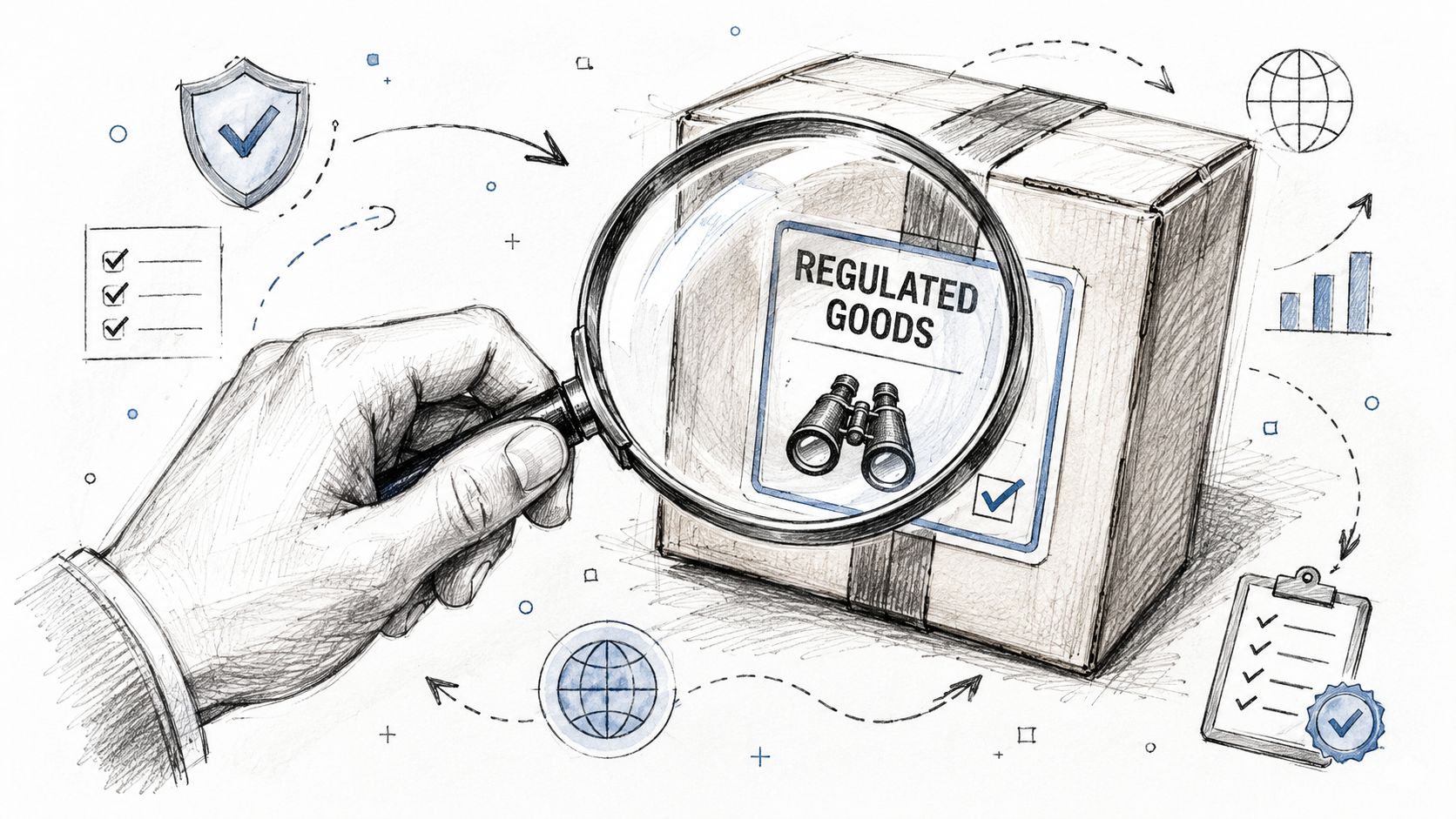
Why regulated shipments attract more scrutiny
For ordinary consumer goods, customs can often clear a parcel from the invoice and electronic data alone. Regulated shipments are different. Broad product names, weak technical descriptions, or missing support documents can turn a routine review into a hold because the file does not clearly show what the item is and whether import conditions have been met.
That is why regulated shipping starts before label creation. The file may need permits, end-use details, model-level descriptions, or recipient credentials that a standard retail parcel would never require.
For firearms-related and other controlled categories, this guide to cross-border restricted goods documentation is a useful pre-shipment reference.
What usually goes wrong
The failure points are usually administrative, but they carry real consequences.
- Descriptions are too vague: “Accessory,” “parts,” or “sporting goods” can trigger questions instead of clearance.
- The paperwork does not match the product: Model, value, quantity, or classification details conflict across the invoice, listing, and customs data.
- Required permits or declarations are missing: If the category needs supporting authorization, customs will wait for proof.
- The consignee is unprepared: Brokers or customs request information, and the buyer does not respond fast enough.
- The merchant treats the hold like a normal backlog: Days get wasted waiting when the shipment needs documents or payment action.
That last point matters most. A regulated parcel can be fully lawful and still sit for a long time because the shipment file does not prove that clearly enough.
Compliance holds do not behave like routine delays
Routine backlog delays usually clear with time. Compliance holds usually clear with information.
That distinction matters even more for regulated goods because once a parcel is waiting on a document review, license question, or duty issue, the clock is no longer tied to normal transit expectations. It is tied to how fast the broker, carrier, merchant, and consignee can satisfy the request. If duties are also left unresolved, the shipment can move into the General Order path discussed earlier, which is where delays become much harder to reverse.
My practical advice is simple. For regulated products, treat document review as part of fulfillment, not post-shipment customer service. Merchants that do this well do not rely on “faster shipping.” They send parcels with enough detail to survive scrutiny on the first pass.
Proactive Strategies to Minimize Customs Delays
The cheapest customs delay is the one you prevent before pickup. Once a package is in the hold queue, your options narrow and your response time starts to matter more than your original transit speed.
That's why the winning approach is operational discipline, not customer service triage after the fact.
The merchant checklist that actually helps
- Perfect the commercial invoice: Use specific product names, material details, and descriptions that match the actual goods. “Optic mount for sporting rifle” is better than “mount.” “Threaded barrel component” is better than “part.”
- Use accurate HS classification: Classification mistakes create suspicion fast. If the product is regulated or borderline, review the code carefully before scale exposes the problem.
- Declare real transaction value: Undervaluation doesn't save time. It creates holds, requests for proof, and credibility problems.
- Plan duty handling before checkout: If the buyer may need to pay, make that unmistakably clear. If you can structure shipments so duties are handled upfront, you remove one of the easiest ways for parcels to stall.
- Choose carriers with strong brokerage support: Some carriers are much better at spotting documentation issues before the shipment hits customs.
What works and what doesn't
What works is boring. Consistent SKU data. Reusable invoice templates. Product descriptions reviewed by someone who understands customs language. A process for checking whether a destination country treats the item as ordinary, sensitive, or prohibited.
What doesn't work is relying on speed upgrades to compensate for weak documentation. It also doesn't work to leave duty payment ambiguous and hope the buyer watches every email from the carrier.
A lot of merchants also underestimate customer communication. If you ship internationally, the post-purchase message should explain that customs may contact the recipient, duties may need attention depending on terms, and delayed response can slow release.
Build controls before the shipment exists
The best compliance systems stop risky orders before anyone prints a label. That matters most for regulated catalogs, where one bad order can create far more damage than one delayed order.
For WooCommerce merchants selling restricted goods, the right move is to automate the rule checks that humans miss under pressure. That includes destination-based restrictions, product-based restrictions, and messaging that tells the buyer why an order can't proceed.
The fastest customs clearance starts before checkout, with product data, restriction rules, and duty handling already decided.
If you sell regulated products on WooCommerce, Ship Restrict helps stop non-compliant orders before they become customs holds, returns, or seizures. It lets you automate shipping restriction rules by state, county, city, and ZIP so your team isn't manually checking addresses for every order. That's especially useful for firearms retailers and agencies managing complex compliance logic across multiple stores.
Automate Shipping Compliance
Stop worrying about restricted states. Ship Restrict handles it automatically.

Cody Yurk
Founder and Lead Developer of ShipRestrict, helping e-commerce businesses navigate complex shipping regulations for regulated products. Ecommerce store owner turned developer.
Automate Shipping Compliance
- Block restricted states
- No more cancellations
- Set and forget
3-day free trial · Card required