DDP vs. DDU: A Guide for Regulated Goods Shipping
Understand the DDP vs. DDU choice for regulated goods. Learn how DDP and DDU impact costs, compliance, and customer experience for cross-border firearms sales.
An international order looks profitable until the package lands in customs, the carrier asks the buyer for duties and tax, and the customer refuses delivery. In firearms retail, that mess gets worse fast. You're not just dealing with a return or an angry email. You may be dealing with a controlled product, a carrier exception, a destination restriction, and a shipment that should never have moved in the first place.
That's why DDP vs. DDU isn't a narrow shipping choice for regulated goods sellers. It affects checkout friction, delivery success, support volume, and legal exposure. For a firearms dealer on WooCommerce, the main question often isn't only who pays import charges. It's whether the order is lawful and operationally viable before the label is printed.
The International Shipping Dilemma
An international order can go wrong after it leaves your warehouse and before the customer ever sees it. A buyer places an order for a firearm accessory or another restricted item. Checkout clears, your team packs it, export paperwork is filed, and the carrier accepts the parcel. Then customs or the carrier stops release because duties, tax, recipient documents, or import approval are still missing.
At that point, the shipping term is only part of the problem. The customer sees a delay and an unexpected request for money or paperwork. Your staff sees a support case, a shipment exception, and a possible return. For firearms dealers, there is another layer. Some orders should have been blocked before fulfillment because the destination, product type, or buyer documentation did not line up with local rules.
Automate Shipping Compliance
Block orders to restricted states automatically. 3-day free trial.
Start Free TrialThat is why international shipping for regulated goods needs more than a rate table and an Incoterm selection. It needs controls around product classification, destination screening, and paperwork before the label is printed. This guide to cross-border documentation for restricted goods is a good starting point for tightening that process.
Two shipping models, two very different outcomes
DDP and DDU, now commonly replaced by DAP, lead to very different operational results.
Under DDP, the seller takes responsibility for import charges and usually manages more of the clearance process through delivery. Under DDU or DAP, the buyer is expected to pay duties and taxes on arrival and may need to respond to the carrier or customs before the package is released.
That distinction matters, but it does not solve the core regulated-goods risk. A prepaid shipment can still be detained, refused, or destroyed if the item is restricted in that jurisdiction, the consignee cannot legally receive it, or the documentation does not match the product. Dealers who treat DDP vs. DDU as a pricing decision miss the core failure point. The bigger question is whether the order is lawful and shippable at all.
DDP vs DDU Who Pays for What
DDP and DDU/DAP get confused because sellers often discuss them as “who pays customs.” That's correct, but incomplete. The better way to think about them is who owns the import problem.
Under DDP, the seller owns that problem through final delivery. Under DDU/DAP, the buyer owns the import charges and clearance side once the shipment reaches destination.
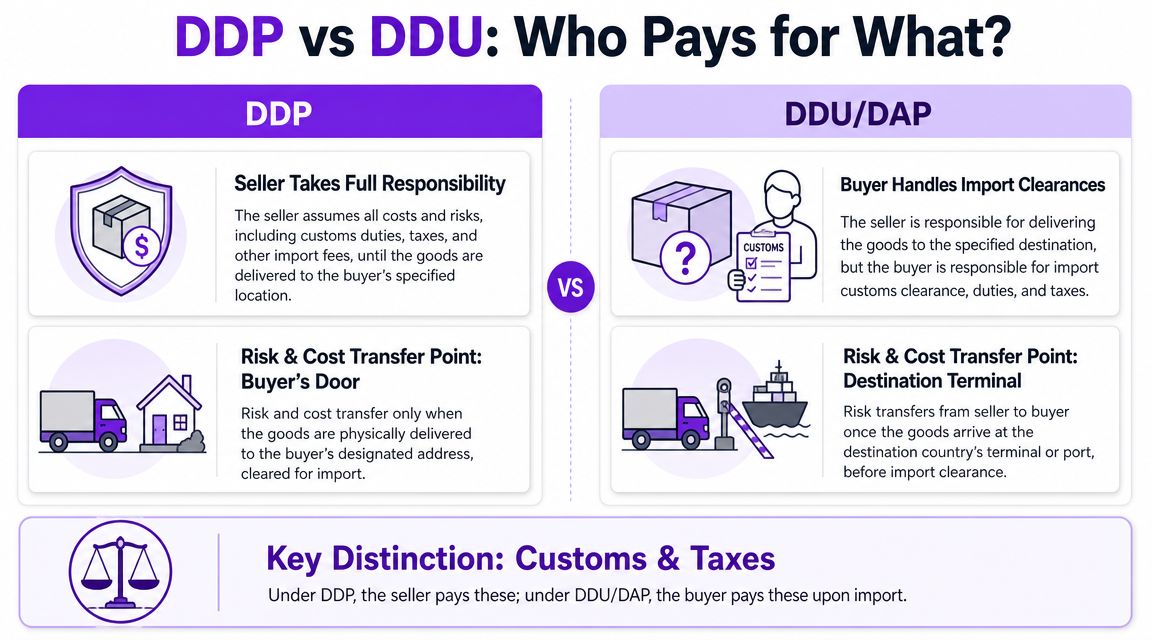
Responsibility breakdown that matters in practice
DCL states that under DDP, the seller is responsible for all costs and risks until the goods are delivered to the final destination, including import duties and taxes. With DDU/DAP, the seller's responsibility ends upon arrival at the destination country, leaving the buyer to handle import clearance, duties, and taxes (DCL explanation of DDP and DDU differences).
| Responsibility | Delivered Duty Paid (DDP) | Delivered Duty Unpaid (DDU/DAP) |
|---|---|---|
| Duties and taxes | Seller pays | Buyer pays |
| Import clearance | Seller arranges and funds | Buyer handles on arrival |
| Checkout presentation | Full landed cost can be shown upfront | Lower upfront price, with charges later |
| Delivery friction | Lower if landed cost is accurate | Higher if buyer delays or refuses payment |
| Financial surprise for buyer | Usually reduced | Common risk point |
| Operational burden | Heavier on merchant | Heavier on recipient |
What that means for a firearms merchant
For a WooCommerce store selling regulated goods, the difference shows up in daily operations:
Free Shipping Compliance Audit
We'll review your WooCommerce store's shipping compliance for free.
- DDP pushes work upstream. Your team has to estimate duties and taxes, align product data, and make sure customs documentation is right before dispatch.
- DDU/DAP pushes friction downstream. The package may move with a cheaper-looking checkout, but the customer becomes the clearance bottleneck.
- Risk transfers differently. DDP keeps more commercial responsibility on your side until delivery. DDU/DAP leaves the recipient exposed to last-mile customs payment and release problems.
- Insurance and support consequences change. If your business controls more of the shipment journey, your support team also owns more of the customer conversation when something goes wrong.
DDP is usually cleaner for consumer-facing commerce. DDU/DAP is usually simpler for the seller only if the buyer understands the border process and is willing to handle it.
That last point matters. Firearms retailers often sell high-consideration products. Buyers are less tolerant of uncertainty when the item is expensive, controlled, or time-sensitive.
The Hidden Costs of Customer Experience
A customer in Germany orders a high-value accessory from your WooCommerce store. Checkout looks affordable under DDU. Three days later, the carrier asks for import charges, the parcel stalls, and your support inbox fills up with the same question: “Why am I paying more now?”
That is the customer experience problem with DDU and DAP. The issue is rarely transit time. It is whether the buyer knows the full landed cost before the order is placed. FreightAmigo reports that showing duties and taxes at checkout can improve conversion, and it also links unexpected import charges to cart abandonment in cross-border eCommerce (FreightAmigo guide to DDU/DAP vs DDP for eCommerce).
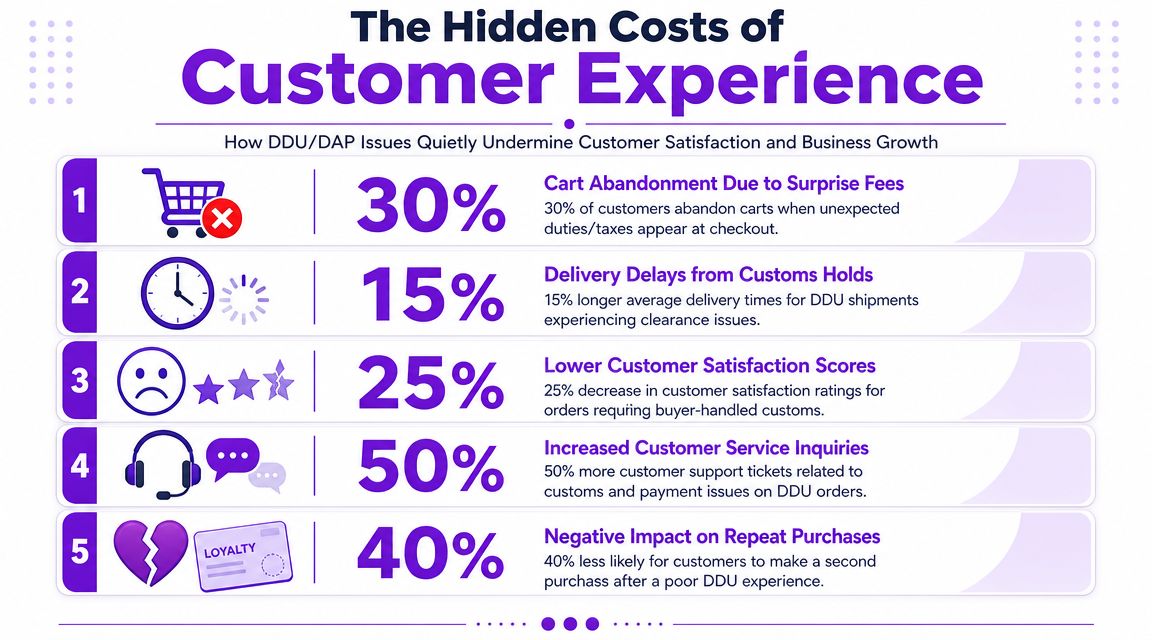
DDU can shift costs off the checkout page and onto your team
For firearms dealers, that shift creates practical problems fast.
Buyers of regulated products already expect friction. They may be checking import rules, carrier limits, age requirements, or documentation before they buy. If pricing is still unclear at checkout, confidence drops. Some abandon the cart. Others place the order, then contact support to ask questions your store should have answered before payment.
The bigger cost shows up after dispatch. Once customs or the carrier asks the customer to pay, your staff often ends up explaining duty collection, clearance timing, and release procedures. That work does not produce revenue. It ties up the same people who should be reviewing orders, checking destination rules, and preventing shipments that should never leave the warehouse in the first place.
For regulated goods, those service headaches often sit next to compliance mistakes. A closer look at the hidden costs of non-compliance in regulated product shipping shows how quickly a “lower upfront cost” decision turns into returns, manual intervention, and blocked deliveries.
Why DDP usually creates fewer customer disputes
In consumer sales, DDP generally produces fewer arguments after the sale because the buyer sees a fuller cost picture before checkout. That matters even more on expensive orders. Customers are far less tolerant of surprise import charges when the product is already high-value, controlled, or time-sensitive.
I have seen the same pattern repeatedly. If the customer has to learn the actual price from a carrier message after the parcel has shipped, the merchant absorbs the fallout. Chargebacks increase. Refusals increase. Support tickets increase. None of that is fixed by pointing to the Incoterm after the fact.
DDP still has a cost. You have to classify products correctly, calculate charges accurately, and set customer expectations before shipment. But for many firearms retailers, that is a better trade than dealing with refused parcels, angry buyers, and preventable complaints from customers who thought checkout showed the accurate total.
One more point matters here. A cleaner customer experience does not make a shipment lawful. You can prepay duties and still send a non-deliverable order if the destination restricts the product. For regulated commerce, the question is not only who pays at the border. It is whether the order should be stopped before shipment at all.
The Critical Compliance Layer for Regulated Goods
Most DDP vs. DDU articles stop at payment responsibility. That's useful, but it misses the part that matters most for firearms dealers. Shipping terms don't determine whether a regulated order is legal.
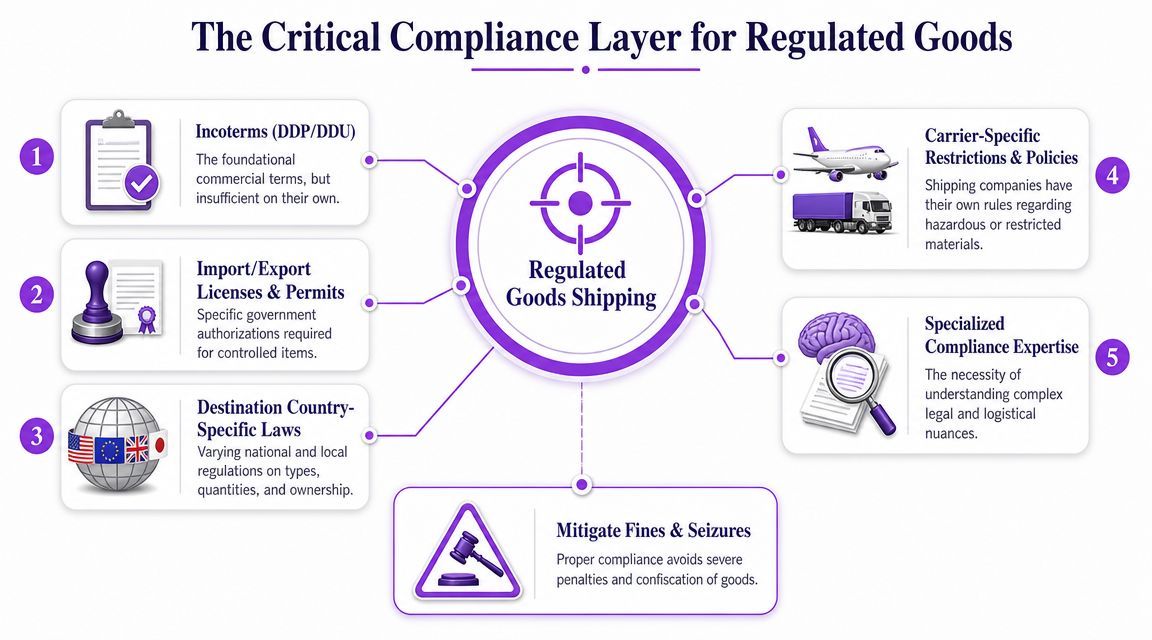
A shipment can be set up perfectly under DDP. Duties can be prepaid. Customs paperwork can be assembled. The buyer can be ready. The carrier can have the parcel in motion. And the order can still be non-deliverable because the destination jurisdiction restricts the product.
Payment terms don't solve legality
Passport Global makes the gap clear. For regulated products, the primary issue isn't just who pays customs. The critical question is whether the order should be blocked before checkout, because shipping terms alone don't address that compliance risk (Passport Global on the compliance gap in DDP vs DDU decisions).
That is the operational reality for firearms merchants.
A scope mount, magazine, receiver-related component, ammunition-related item, or other regulated accessory may trigger a different rule set depending on destination country, province, state, municipality, or even carrier policy. None of those issues disappear because you selected DDP. Prepaying border charges doesn't legalize the shipment.
Here's a useful way to frame it:
- DDP answers the billing question
- DDU/DAP answers the buyer-burden question
- Compliance answers whether the shipment should exist at all
The risk stack is wider than customs
This video gives useful background on the broader logistics context:
<iframe width="100%" style="aspect-ratio: 16 / 9;" src="https://www.youtube.com/embed/q_1SFqhOMXE" frameborder="0" allow="autoplay; encrypted-media" allowfullscreen></iframe>For regulated goods, your review process needs to account for more than import taxes:
- Destination restrictions that make the item unlawful or limited
- Licensing and permit requirements for import or export
- Carrier rules that are stricter than the law
- Product classification errors that create customs or enforcement trouble
- Address-level screening when local rules differ inside the same country
A merchant who gets DDP right but destination compliance wrong still ships a bad order.
That's why firearms dealers should treat Incoterms and carrier billing terms as secondary controls. The first control is order eligibility. If the jurisdiction fails the compliance screen, no shipping term will rescue the transaction.
A Decision Framework for Firearms Retailers
There isn't one universal answer to DDP vs. DDU for regulated goods. There is a sequence of decisions that separates manageable international growth from repeated shipping failures.
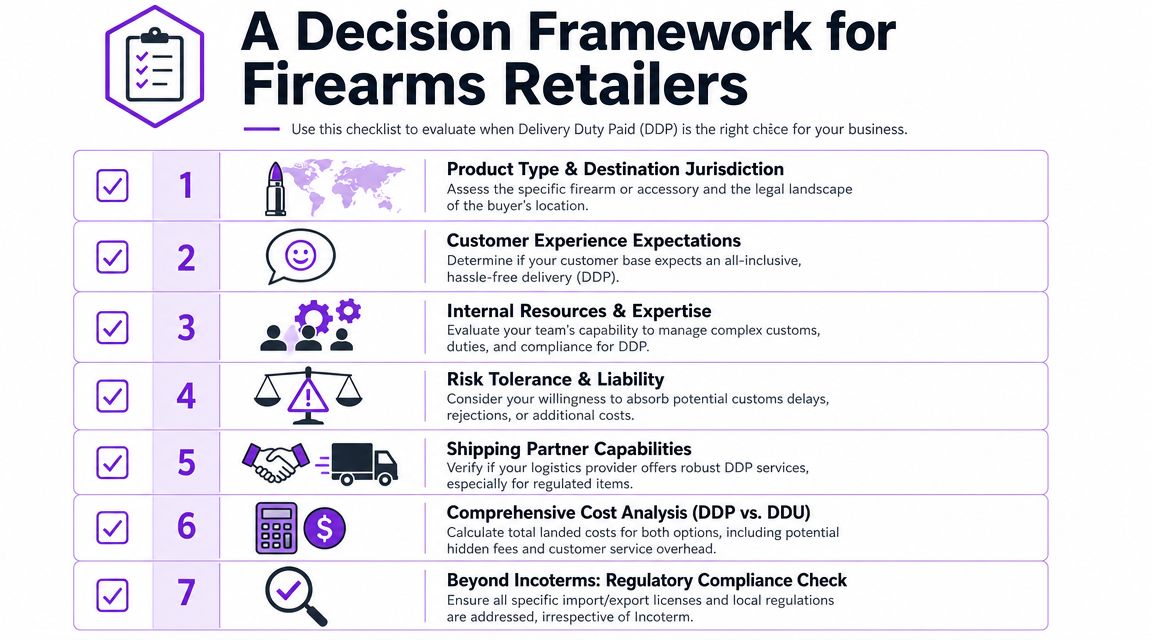
Start with the non-negotiable question
Before comparing landed cost models, ask this:
Can this product legally ship to this buyer's jurisdiction through this carrier under this documentation path?
If the answer is unclear, stop there. Don't let a shipping setting become a substitute for legal review.
Then evaluate the commercial fit
Once the shipment is compliant, use a narrower framework:
-
Product sensitivity
High-value or tightly regulated products usually benefit from a smoother delivery experience. Buyer confusion is more expensive when the item carries higher scrutiny. -
Customer expectations
In many cross-border consumer markets, buyers increasingly expect duties to be visible at checkout. GFS reports that 61% of merchants now display duties at checkout, and notes that 10% of DDU parcels are refused or returned due to unexpected charges (GFS data on duty display and DDU refusals). -
Internal capability
DDP only works when your product data, classification discipline, checkout calculation, and post-order review are strong. If your team can't support that, DDP can become margin leakage. -
Tolerance for exception handling
DDU/DAP may reduce your upfront burden, but it increases the chance that the recipient becomes the point of failure.
Practical recommendations
For most B2C firearms-related commerce, the pattern is straightforward:
- Choose DDP when you want predictable checkout, fewer surprise-fee disputes, and stronger control over the import side.
- Use DDU/DAP selectively when you have informed buyers, lower customer-experience expectations, or market-specific reasons to let the buyer handle import charges.
- Block orders before any shipping logic applies when the product, destination, or carrier combination creates a compliance concern.
The strongest operators don't ask which term is “best” in the abstract. They ask which term fits a compliant shipment and a supportable workflow.
WooCommerce Setup and Proactive Compliance
WooCommerce gives you flexibility, but that flexibility only helps if your workflow is disciplined. For firearms merchants, the setup should separate three layers: checkout presentation, shipping responsibility, and destination screening.
If you're offering DDP
Your store needs to present a landed-cost experience as cleanly as possible. That means product data has to be consistent, shipping methods have to map correctly to destination markets, and customer messaging has to make it clear that duties and tax are being collected in advance.
At the operational level, DDP setup usually includes:
- Clear tax and duty display so buyers understand the full delivered cost before they pay
- Tight SKU data management because bad product classification creates bad landed-cost calculations
- Carrier selection discipline since not every service level handles prepaid import charges the same way
- Post-order review rules for regulated products, especially when certain destinations require manual checks
If you're offering DDU or DAP
DDU/DAP can work, but only if you communicate aggressively. Don't bury the warning in a shipping policy page. Put it in checkout, order confirmation, and shipment emails.
Use plain language:
- Buyer pays import charges on arrival
- Customs may hold the shipment until payment is made
- Carrier handling steps can affect delivery timing
- Restricted goods remain subject to destination law regardless of shipping terms
If you're comparing platform workflows before building this out, this breakdown of Shopify and WooCommerce differences is useful because it highlights why many regulated-goods sellers prefer WooCommerce's control over checkout logic and extensions.
Compliance comes before shipping method
For firearms dealers, the best WooCommerce setup starts before rates are shown. You need destination-based restriction logic that can stop a bad order before payment.
A practical implementation path is:
- Define product restriction categories inside WooCommerce.
- Map destination rules at the level you need, including state, county, city, or ZIP where applicable.
- Block restricted orders before checkout completes.
- Show specific customer messages so the buyer knows why the order can't proceed.
- Only then apply DDP or DDU/DAP logic to orders that are eligible to ship.
If you need a technical walkthrough for that process, this WooCommerce setup guide for FFL dealer shipping restrictions covers the operational side well.
That order matters. First decide whether the shipment is allowed. Then decide who pays import charges.
Frequently Asked Questions About DDP and DDU
Can I offer both DDP and DDU and let the customer choose
Yes, but only if your checkout language is unmistakable and your team can support both workflows. For many firearms retailers, offering both creates more complexity than value. If you do it, keep the decision limited to destinations and products you already understand well.
Is DDP usually better for eCommerce
In many consumer markets, yes. DHL notes that DDP is more common in eCommerce because it creates a better delivery experience. DHL also states that under DDP the seller covers VAT, import duty, clearance documentation, transport, and insurance, while DDU shifts most of those responsibilities to the buyer on arrival (DHL overview of DDP and DDU responsibilities in eCommerce).
Does the carrier change the strategy
Absolutely. Some carriers handle prepaid-duty workflows more smoothly than others. Some service levels fit DDP well for standard goods but become harder to use with regulated items. Always confirm carrier rules for the exact product category, destination, and billing structure you plan to use.
What if customs reclassifies the item and my DDP amount was wrong
That's one of the key risks with DDP. If classification, tariff treatment, or destination rules change after checkout, the merchant may absorb the difference or face an adjustment. That's why landed-cost accuracy, product data governance, and destination screening matter more than the label attached to the shipping term.
Can DDP fix a compliance problem
No. DDP fixes a payment-responsibility issue. It does not fix a legal-shipment issue. If the item is restricted in the destination jurisdiction, prepaid duties won't make the shipment compliant.
If you sell regulated products on WooCommerce, you need more than a shipping policy. You need a way to stop restricted orders before they turn into seizures, returns, and customer disputes. Ship Restrict helps firearms dealers enforce shipping restrictions by state, county, city, and ZIP before checkout, so your team can prevent bad orders instead of cleaning them up later.
Automate Shipping Compliance
Stop worrying about restricted states. Ship Restrict handles it automatically.

Cody Yurk
Founder and Lead Developer of ShipRestrict, helping e-commerce businesses navigate complex shipping regulations for regulated products. Ecommerce store owner turned developer.
Automate Shipping Compliance
- Block restricted states
- No more cancellations
- Set and forget
3-day free trial · Card required