International Flat Rate Shipping Boxes: Simplify Global
Use international flat rate shipping boxes for eCommerce. Learn USPS rules, customs, costs, and automate compliance for regulated goods with Ship Restrict.
You're probably looking at an order that seems simple on paper. The parts fit in a USPS flat rate box, the customer is overseas, and the checkout total already feels tight. That's exactly where expensive mistakes happen.
For a firearms FFL or any WooCommerce store shipping regulated goods, international flat rate shipping boxes can be useful. They can also create a false sense of simplicity. The postage may be fixed, but the legal, packaging, and workflow risks are not.
What Are International Flat Rate Shipping Boxes
Domestic flat rate trains merchants to think in a shortcut. If it fits, it ships. International flat rate doesn't work that way in practice.
International flat rate shipping boxes are a specific USPS service under Priority Mail International Flat Rate. USPS is the only major carrier offering true international flat rate shipping boxes, with service to approximately 180 to 190 countries and estimated delivery of 6 to 10 business days, and the service includes tracking plus insurance up to $100 for documents and $200 for merchandise according to Quadient's overview of USPS international flat rate service.
Automate Shipping Compliance
Block orders to restricted states automatically. 3-day free trial.
Start Free TrialThat matters because many merchants assume FedEx or UPS offer a direct equivalent. They don't, at least not in the same true flat rate box model for international parcels. If your shipping workflow depends on one fixed international box price, USPS is the carrier that gives you that option.
Fixed postage doesn't mean simple shipping
The flat rate part only refers to how postage is charged. It doesn't simplify export controls, destination-country restrictions, customs review, or product classification.
For firearms retailers, that distinction is critical. A box with a fixed shipping price can still be held, rejected, repriced, or blocked if the contents, paperwork, or destination don't line up with the rules.
Here's the practical way to think about it:
- The box is a pricing tool: You know the postage framework before you weigh every ounce within the allowed cap.
- The shipment is still a compliance event: Customs data, content description, export review, and carrier rules still apply.
- The destination still controls risk: A part that's routine in one market can be restricted or prohibited in another.
Practical rule: Treat international flat rate as a narrow shipping product, not a blanket international shipping strategy.
Why FFLs use them anyway
There's a reason experienced shippers still consider them. Regulated goods often include small, dense items. Certain parts, hardware kits, mounts, or components can be compact enough to fit standardized packaging while still being heavy enough that a flat rate model may work in your favor.
That doesn't mean every order belongs in one. It means these boxes can be a smart option when the order is eligible, documented correctly, and screened before the label is purchased.
The biggest mistake I see is operational, not theoretical. Teams build checkout and fulfillment around the assumption that international flat rate shipping boxes reduce decision-making. For regulated products, they increase the need for disciplined decision-making upstream.
Navigating Critical Weight Size and Carrier Restrictions
The easiest way to lose money with international flat rate shipping boxes is to apply domestic flat rate habits to international shipments.
Free Shipping Compliance Audit
We'll review your WooCommerce store's shipping compliance for free.
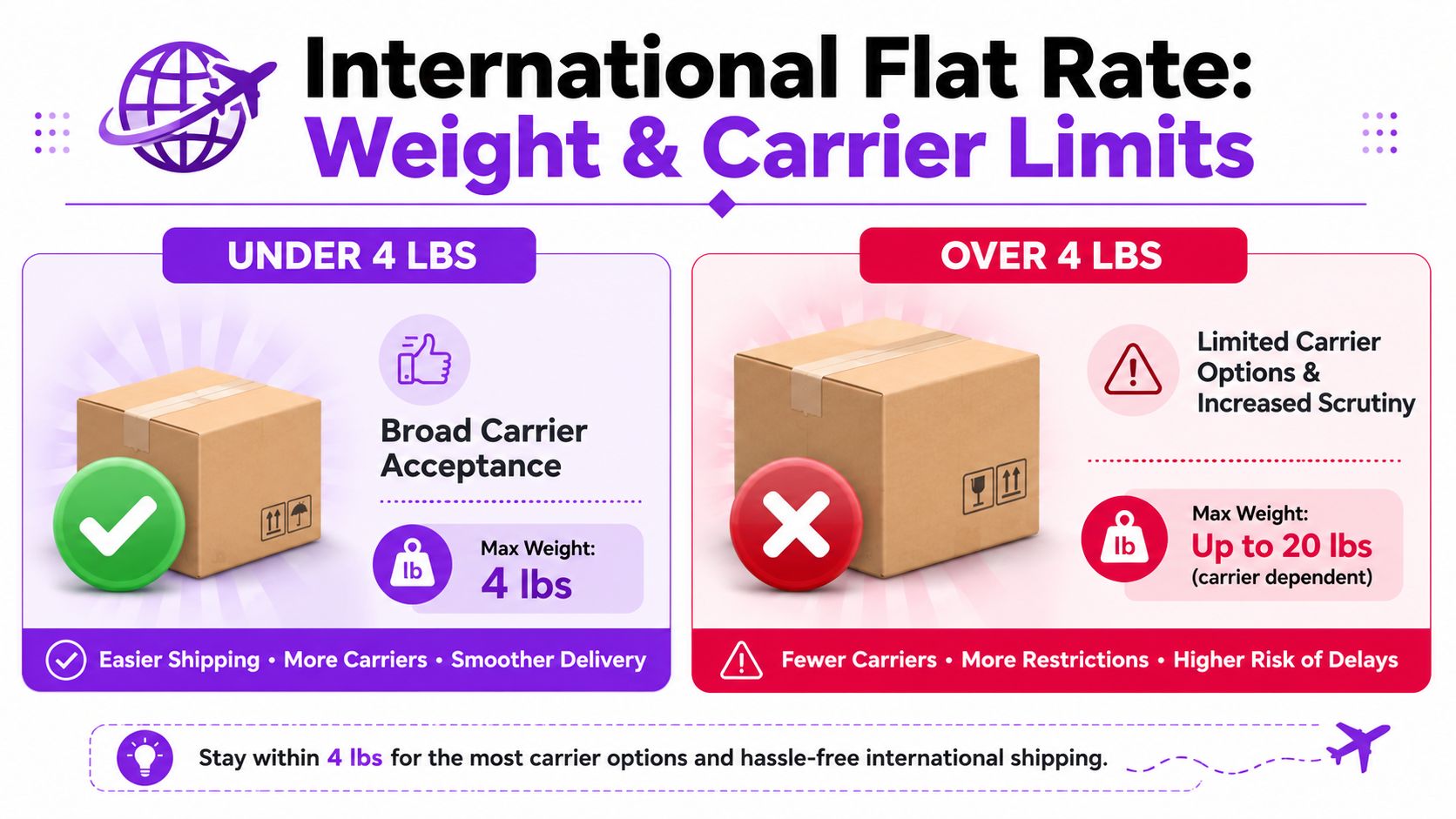
USPS now enforces a 4-pound limit for small international flat-rate boxes and envelopes, and a 20-pound limit for medium and large international flat-rate boxes. Domestic flat rate rules are different, and many guides still blur the two. That confusion creates overpacked parcels, rejected shipments, and customs delays for regulated goods, as noted in Shippo's breakdown of USPS flat rate box sizes and rules.
The weight limits that catch dense products
Firearms parts can be tricky. A compact metal component can look harmless from a packing standpoint. It may fit cleanly into a small box, but the actual weight can push you into a different package class or out of flat rate eligibility entirely.
Use this quick reference:
| Package type | International weight cap | Common risk |
|---|---|---|
| Small flat rate box or envelope | 4 lbs | Dense parts exceed limit faster than expected |
| Medium flat rate box | 20 lbs | Packing material and paperwork push order over cap |
| Large flat rate box | 20 lbs | Team assumes domestic-style headroom that doesn't exist |
For regulated shipments, ounces matter. Dense goods don't forgive sloppy packing estimates.
Official USPS packaging only
There's another restriction merchants overlook. International flat rate pricing is tied to official USPS-branded packaging. You can't use a third-party carton with similar dimensions and expect the flat rate label to hold.
That sounds obvious until a warehouse runs short on branded boxes and someone substitutes “the same size” packaging to keep orders moving. In a regulated shipping environment, that kind of improvisation creates avoidable risk. If you're building repeatable rules across carriers, routing, and order filters, teams often benefit from pairing those workflows with broader transport logistics software planning so packaging rules don't live only in one person's memory.
If your process depends on a picker or packer remembering exceptions from experience, the process is weak.
What works and what doesn't
What works:
- Pre-weighing dense SKUs: Firearms parts, hardware bundles, and metal accessories should have known packed weights in your catalog.
- Separating domestic and international packing rules: Don't let one SOP govern both.
- Holding branded box inventory: Running out of official packaging is not a minor inconvenience.
What doesn't work:
- Assuming fit equals eligibility
- Using domestic flat rate instincts for international orders
- Letting staff “make it work” with substitute cartons
If you sell regulated items, the shipping station needs hard limits, not judgment calls.
Calculating the True Cost of International Flat Rate
Flat rate can be economical. It can also be the wrong choice for the same product line, depending on how that specific order is packed and where it's going.
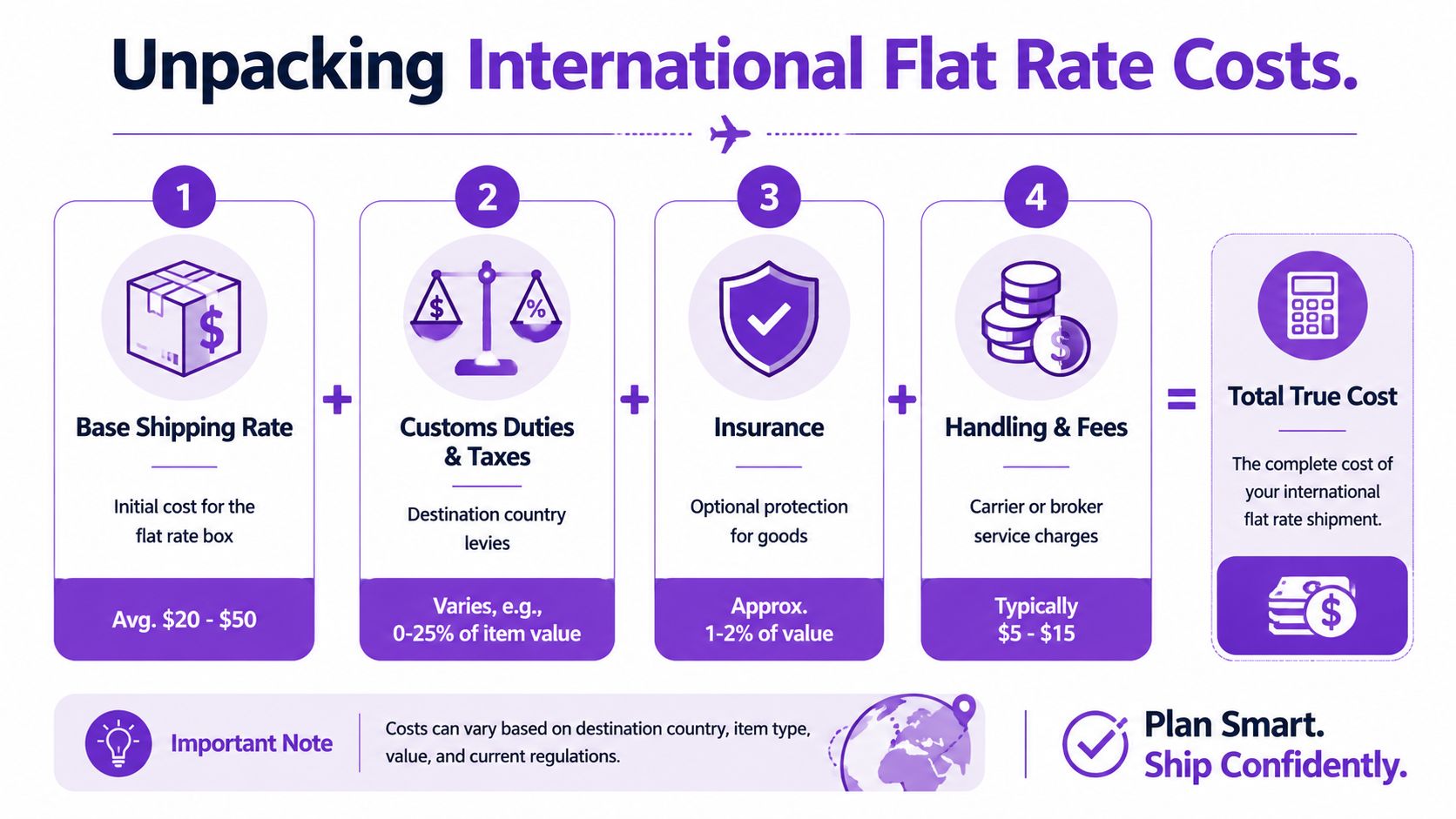
The pricing model is straightforward in one sense. The postage is based on box size and destination country group, not on the actual package weight once it stays within the allowed cap. The official packaging is free from USPS, but the postage is not. The small box measures 5-1/2″ x 8-5/8″ x 1-3/4″ and starts around $36.50, the medium box starts at $65.45, and the large box measures 12″ x 12″ x 5-1/2″ and costs about $81.00 at retail, according to Mailworld's summary of USPS international flat rate boxes.
When flat rate usually makes sense
International flat rate shipping boxes tend to work best when the product is:
- Small and dense: Metal parts, mounts, tools, and compact components are the usual candidates.
- Going to a farther destination group: Predictable postage can beat variable weight-based pricing.
- Easy to package securely within the standard box footprint: Odd shapes can erase the advantage fast.
That's why many merchants compare flat rate against alternative packaging before they commit. If you want a simple baseline on flat rate packaging costs in general, this guide on how much flat rate boxes cost is a useful reference point.
When flat rate becomes a bad buy
Flat rate loses appeal when the order is light but bulky. It also loses appeal when your packing method needs extra void fill, reinforcement, or protective structure that burns space without adding much saleable weight.
Use this decision lens:
| Order profile | Likely fit for international flat rate |
|---|---|
| Compact steel components | Often strong |
| Long or awkward parts | Often poor |
| Light accessories with bulky packaging | Usually weak |
| Mixed-item orders with uncertain final packed weight | Risky unless pre-modeled |
Cost discipline: Don't ask whether the product fits the box. Ask whether the packed order justifies the box price.
Build a per-order rule, not a blanket rule
Merchants get into trouble when they set international flat rate as the default international method for an entire category. That's too broad for regulated goods.
A better operating model is narrower:
- Approve only products that are legally eligible for the destination.
- Confirm the packed order fits the correct official USPS box.
- Check whether the flat rate price is better than your weight-based alternative.
- Release the method only if all three conditions pass.
That approach takes more setup. It saves money because it prevents the common failure mode: cheap-looking checkout options that turn into expensive back-office exceptions.
Shipping Regulated Goods and Firearms Parts
Flat rate doesn't simplify international firearms compliance. It simplifies one thing only: the postage structure.
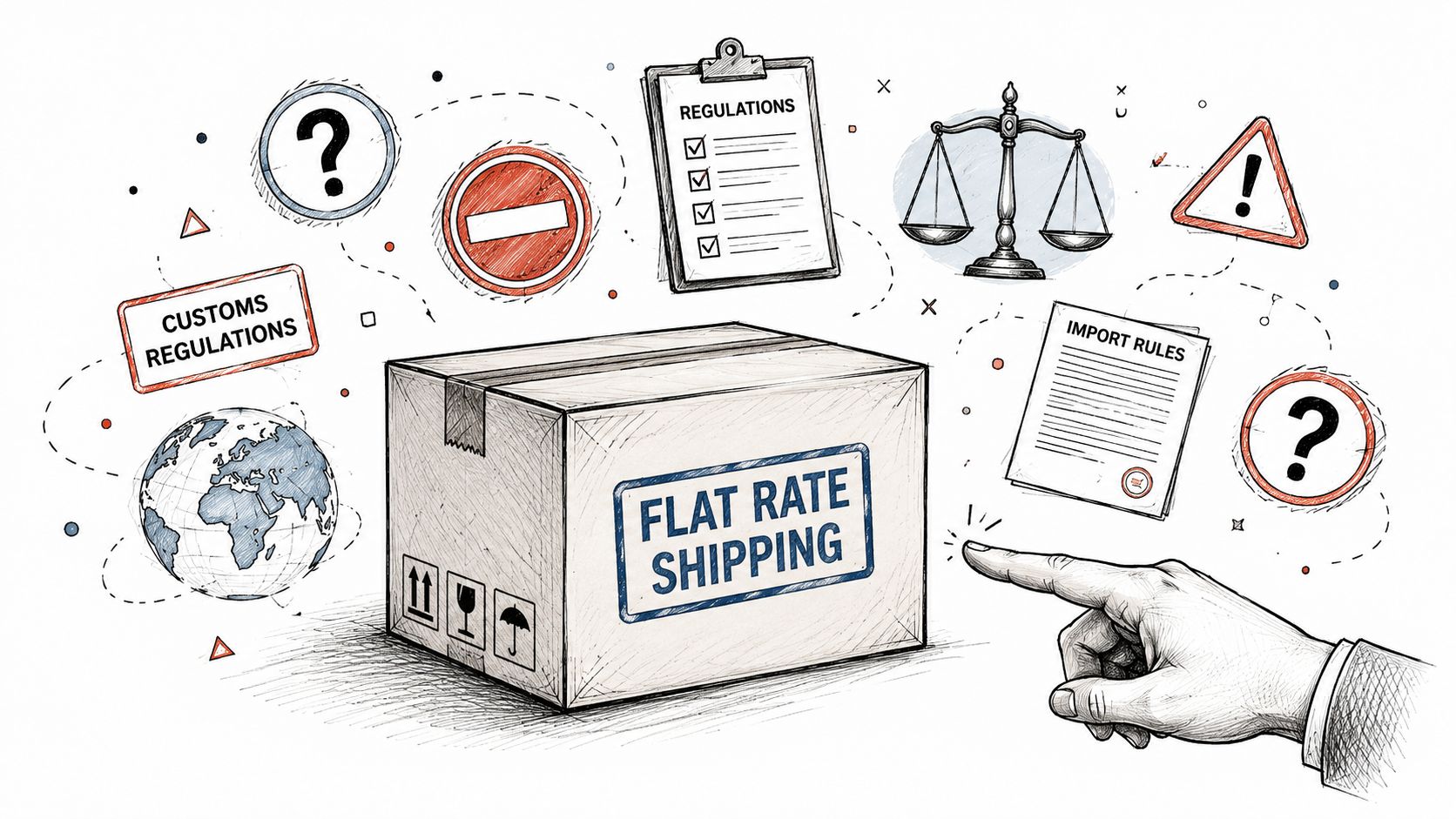
That's the assumption to challenge. Many merchants see a standardized USPS box and think the rest of the shipment gets easier. For regulated goods, the opposite is often true. Standardized postage can hide the fact that product classification, export eligibility, destination-country restrictions, and customs disclosures still determine whether the shipment should move at all.
The shipping method doesn't override the law
If you sell firearm components, accessories, or related regulated products, your first question isn't “Which box is cheapest?” It's “Can this item legally ship to this customer in this country under the applicable rules?”
That review can involve customs classification, destination import restrictions, and export control analysis. Flat rate boxes don't solve any of that. They only give you a mailing product to use after the legal and operational checks are done.
The dangerous mindset is operational convenience. Teams sometimes approve a shipment because the item seems minor, the customer sounds informed, or the order value looks low. None of those facts replaces a proper restriction review.
The weight problem is sharper for firearms parts
USPS notes a specific problem for regulated goods like firearms. You must make sure the 20-pound cap includes the item, internal protection, and documentation. If the package exceeds the limit by even one ounce, the flat rate is invalidated and the shipment is reclassified to weight-based international rates, which can raise costs by 25 to 40 percent depending on destination, according to USPS Priority Mail International guidance.
That's a real operational trap for dense products. A set of parts may look compact enough for a medium or large box, but after you add padding, reinforcement, invoices, and any internal compliance paperwork, the margin disappears.
The order that barely fits is usually the order that causes the exception.
What experienced teams check before label creation
For firearms-related international orders, the packing bench should never be the first checkpoint. The review needs to happen earlier.
A practical screening sequence looks like this:
- Product eligibility: Is the SKU allowed to leave the U.S. and enter the destination country?
- Customer location review: Is the destination acceptable for that exact product type?
- Carrier-service fit: Is USPS Priority Mail International Flat Rate even appropriate for the contents?
- Packed shipment validation: Does the final packed order stay within the permitted limits and box rules?
This walkthrough gives a useful visual on how shipping workflows and restrictions intersect in practice:
<iframe width="100%" style="aspect-ratio: 16 / 9;" src="https://www.youtube.com/embed/gRiyw0fdQAE" frameborder="0" allow="autoplay; encrypted-media" allowfullscreen></iframe>Where merchants usually make the wrong call
The usual failure isn't malicious. It's simplification.
A merchant knows the customer wants a small replacement part. The part seems harmless. The box is standard. The postage is fixed. The team pushes it through.
Then one of three things happens:
- The item was restricted for export or import.
- The customs description was too vague for a regulated product.
- The packed shipment crossed the allowed threshold and lost flat rate eligibility.
For a firearms FFL, international flat rate shipping boxes are useful only when they sit inside a stricter compliance workflow. Without that workflow, they don't reduce risk. They concentrate it.
A Practical Packaging and Documentation Checklist
Packaging discipline matters more internationally because the service rules and the customs review both depend on accuracy. When you're shipping regulated goods, small shortcuts create large problems.
USPS flat rate international packaging requires official USPS-branded boxes. If you use a third-party box with matching dimensions and apply a flat rate label, USPS can reject it or re-price it at a higher dimensional rate, as explained in Easyship's discussion of USPS flat rate packaging requirements.
Packing checklist for regulated shipments
Use a repeatable bench process:
-
Pull the right USPS box first
Don't pack into a generic carton and plan to transfer later. Build the shipment in the actual USPS-branded flat rate box that will be used. -
Verify the final product list
Match every line item in the order against what is physically going in the box. Mixed orders are where misdeclared contents start. -
Stabilize heavy components
Dense parts shift hard in transit. Use internal protection that keeps metal parts from breaking through seams, crushing smaller items, or damaging paperwork. -
Leave room for paperwork
Customs forms, invoices, and any supporting documents take physical space and add weight. Don't treat them as an afterthought.
Bench reminder: If the package only closes cleanly when someone presses down on the flaps, stop and repack.
Documentation that gets reviewed closely
Customs descriptions for regulated goods need specificity. “Parts” is weak. “Accessory” is often too vague. The description should identify the item clearly enough to support classification and review without becoming misleading.
Your checklist should include:
- Accurate content description: Be precise, not generic.
- Declared value: Match the commercial reality of the shipment.
- Consistent paperwork: Product description, invoice, and label data should align.
- Destination review notes: Keep an internal record of why the shipment was approved.
If you've ever seen how packaging design affects handling, this piece on eco-friendly food packaging design is a useful reminder that packaging choices shape both presentation and process. Different industry, same lesson. Standardized packaging works best when the design and the workflow support each other.
One more checkpoint after sealing
Before the package leaves the bench, run one last verification:
| Final check | Why it matters |
|---|---|
| USPS-branded flat rate box used | Prevents rejection or re-pricing |
| Contents match order and paperwork | Reduces customs disputes |
| Box closes normally | Avoids packaging failure and service misuse |
| Documentation complete | Lowers hold risk during review |
Customs delays aren't always avoidable, but unclear paperwork makes them more likely. If your team needs a customer-facing reference for expectations, this explainer on how long packages stay in customs helps frame the issue without overpromising timelines.
Automating International Shipping Rules in WooCommerce
Most compliance failures don't start at the post office. They start at checkout.
A customer sees an international shipping option, places the order, and assumes the purchase is valid. Your staff then becomes the enforcement layer. They review the SKU, destination, service method, and restrictions after payment has already been taken. That's backwards for regulated products.
Why manual review breaks at scale
Manual review works when order volume is low and the product catalog is simple. Firearms and related regulated goods don't stay simple for long.
You may need to account for:
- destination-specific restrictions
- product-level export sensitivity
- box eligibility
- service exclusions for certain items
- exception handling for mixed carts
If you're still evaluating store architecture or building for a regulated catalog from scratch, this resource comparing platforms can help teams compare ecommerce platforms before they lock in operational complexity.
What automated rule enforcement should do
The goal isn't just rate display. The goal is prevention.
A WooCommerce rule engine should let you block or hide international flat rate shipping boxes when:
- the order contains products that shouldn't ship internationally
- the destination country is not allowed for that SKU or category
- the cart composition creates a compliance conflict
- your internal policy requires manual review instead of automatic checkout

That's the difference between reactive compliance and controlled compliance. Instead of correcting bad orders after they enter the system, you stop them before payment and fulfillment. For teams running regulated WooCommerce stores, this approach aligns with the broader case for automated shipping compliance for WooCommerce stores.
If your store sells regulated products, shipping should never depend on staff memory or last-minute judgment calls. Ship Restrict helps WooCommerce merchants enforce shipping rules before checkout, so restricted international orders, invalid destinations, and risky flat rate selections get blocked before they turn into compliance problems.
Automate Shipping Compliance
Stop worrying about restricted states. Ship Restrict handles it automatically.

Cody Yurk
Founder and Lead Developer of ShipRestrict, helping e-commerce businesses navigate complex shipping regulations for regulated products. Ecommerce store owner turned developer.
Automate Shipping Compliance
- Block restricted states
- No more cancellations
- Set and forget
3-day free trial · Card required