International Shipping Rules for Regulated eCommerce
Master international shipping rules for regulated products. Learn customs, documentation, and compliance strategies to avoid costly delays and legal issues.
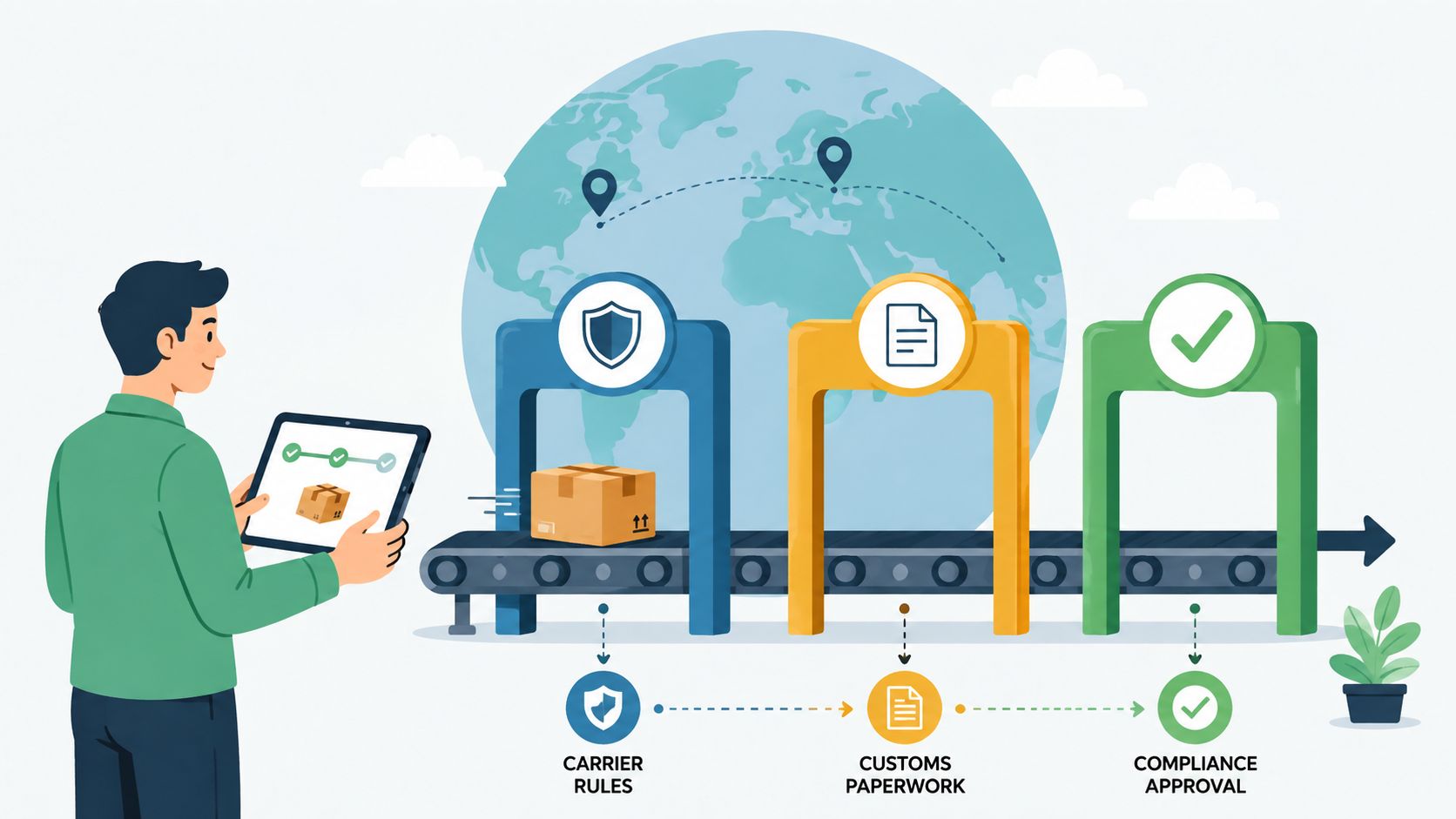
You've got a sale ready to ship, the label prints cleanly, the carrier picks it up, and then the package sits in customs with no clear explanation. The product isn't obviously banned, the customer is frustrated, and your team is left untangling whether the problem was the item, the destination, the paperwork, or the carrier rule you missed on the back end.
That's the shape of international shipping rules in regulated eCommerce. The question isn't just “can I ship this product?” It's “can I ship this product to this specific country with this carrier and these documents, without getting blocked by export controls, import rules, or a paperwork error that turns into a delay?”
The scale behind that question is enormous. More than 90% of global trade moves by sea, and UNCTAD says seaborne trade grew from 2.6 billion tonnes in 1970 to almost 11 billion tonnes in 2021 in the source data provided for this topic, which is why documentation, customs controls, and safety standards matter so much in the first place. UNCTAD also reports that developing countries' share of global maritime freight rose from 38% in 2000 to 54% in 2023, a reminder that shipping rules are shaped by a wider and more diverse trade map than many merchants assume. UNCTAD maritime trade data
Why Your “Allowed” Shipment Got Blocked at the Border
A firearms retailer can do everything “right” from the seller's point of view and still end up with a frozen shipment. The product might be legal in the origin market, the destination market might allow it under certain conditions, and the carrier might accept the parcel at intake. Then customs holds it anyway because one layer in the chain was never satisfied.
Automate Shipping Compliance
Block orders to restricted states automatically. 3-day free trial.
Start Free TrialThat's the common failure pattern. Merchants treat shipping as binary, allowed or prohibited, but border authorities don't work that way. A shipment can clear carrier screening, fail an export requirement, and then get stopped again on import because the destination country wants a permit, a correct HS code, or a different document set.
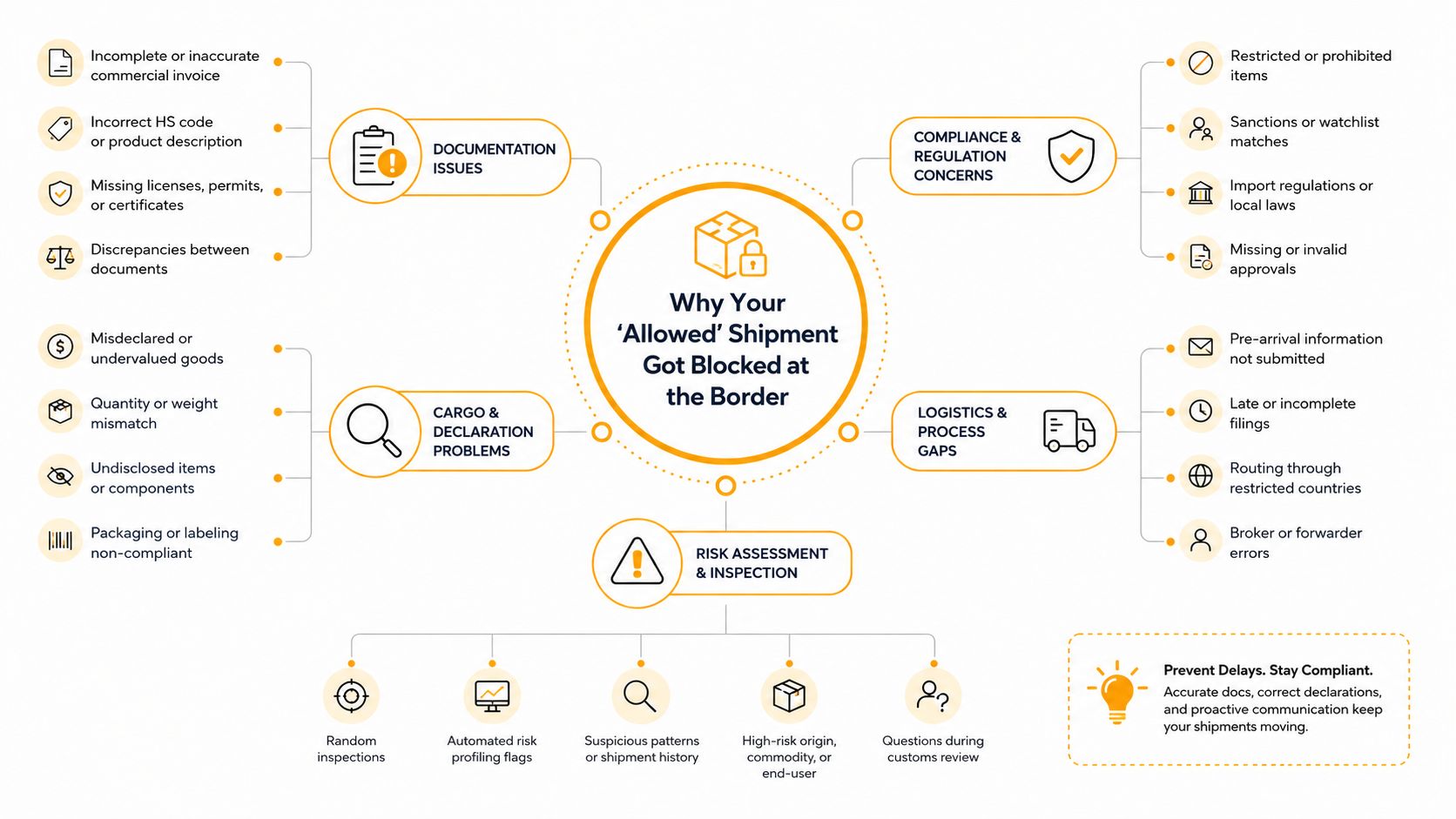
The question is really five questions
A shipment that looks “allowed” can still fail because of the carrier policy, the export rule, the import rule, sanctions screening, or a documentation mismatch. That's why a product decision made at checkout is never the final decision. It's just the first filter.
Practical rule: if you can't answer the destination, carrier, export status, import status, and document status separately, you don't actually know whether the shipment is shippable.
That operational gap is especially visible on cross-border routes where rules change by corridor. If you want a practical example of how route-specific rules affect freight movement, the Haulier.AI guide to UK cabotage is a useful reminder that legal movement on one leg of transport doesn't automatically mean the whole shipping chain is compliant.
It's also why merchants should keep a route-level view of compliance, not a product-only view. The same product can ship cleanly to one country and sit in inspection elsewhere because the customs office, carrier, or export authority sees it through a different rulebook. For a shipping compliance manager, that's the part that costs the most time, because every exception has to be traced back through multiple systems, not just one policy page.
For a broad overview of how corridor-specific restrictions can complicate a seemingly simple cross-border shipment, the USA to UK shipping restrictions overview is a helpful reference point.
The Three-Layer Compliance System You Need to Navigate
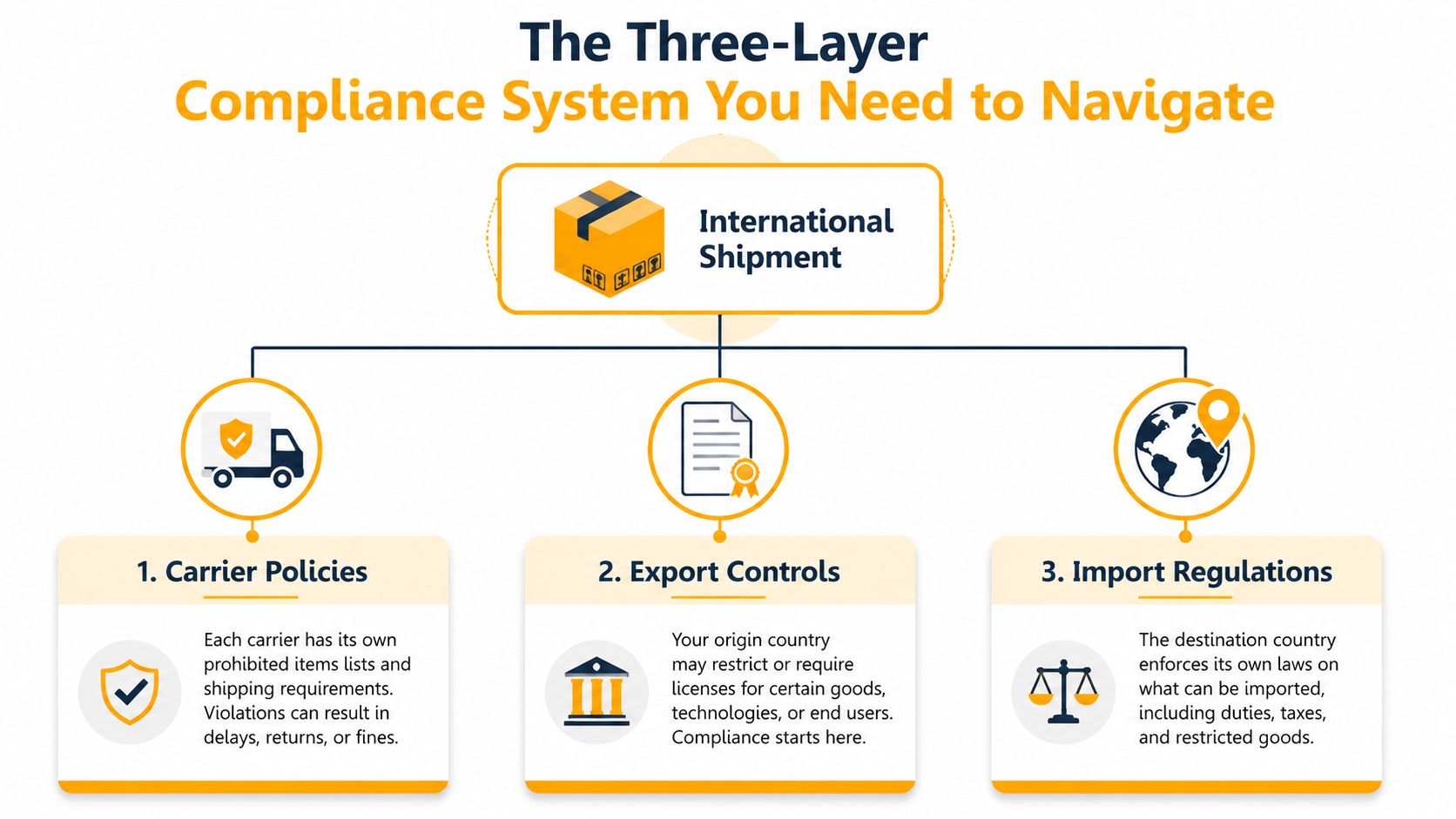
Every international parcel has to survive three different gates, and each gate can stop the shipment on its own. The first is the carrier's own policy. The second is the origin country's export control system. The third is the destination country's import regime.
Carrier policies are only the first gate
Carriers publish prohibited-items lists, packaging rules, and destination-specific service limits. That matters, because a carrier can accept a parcel at tender and still be wrong for the route if the destination country or product class wasn't screened properly. A shipment that passes carrier intake is not “compliant,” it's only carrier-acceptable.
That's where merchant mistakes begin. A product can be fine for one carrier's network but disallowed by another carrier's service rules, or fine in general but blocked on a destination-specific lane. If your checkout logic only checks the product name and ignores geography, you're building a false pass.
Free Shipping Compliance Audit
We'll review your WooCommerce store's shipping compliance for free.
Export controls add the origin-country layer
The origin country can require licensing, screening, or controlled-item review before a package leaves. The World Shipping Council notes that international shipping compliance is governed by overlapping regimes, with the IMO as the principal UN body for maritime safety and environmental regulation, while customs and trade controls are layered on by national authorities and export-control systems such as EAR, ITAR, and OFAC. World Shipping Council shipping regulation overview
That layered structure is why a product can look fine to the carrier and still be blocked by origin-country law. A firearms component or a controlled chemical may need an export license even when the carrier has no issue moving the box.
Import rules are the last, and often decisive, gate
Destination-country customs can require permits, tax IDs, country-specific forms, or product-specific approvals. In practice, many “allowed” shipments die at this stage, because the shipment was never classified correctly for that country. A regulated product can be legal in transit but still fail import because the consignee can't present the right document set.
A good automation layer helps because it validates by destination, product type, and legal status before the order leaves checkout. DigiParser's compliance automation guide is a solid adjacent read if you're thinking about how document-heavy compliance work gets reduced to repeatable checks.
Documentation Failures That Delay or Kill Your Shipments
The fastest way to lose a shipment isn't always a forbidden product. It's incomplete, inconsistent, or unverified paperwork. Customs systems are built to compare what you declared against what the goods are, and if the record is weak, the shipment gets stuck even when the item itself is lawful.
The Electronic Export Information (EEI) threshold is a good example of how technical this gets. U.S. exports generally require EEI when the commodity value exceeds $2,500, when an export license is required, for ITAR-controlled items, for self-propelled vehicles, for certain “600 series” items, for exports under the STA license exception, and for rough diamonds regardless of value. UChicago international shipping guidance That's why many shipment failures are documentation failures, not freight failures.
The invoice has to tell a complete story
A commercial invoice needs shipper and consignee identity, country of origin, quantities, weights in kilograms, and accurate product descriptions. If the invoice says “parts” or “accessories,” customs may treat the filing as incomplete. If the same order has one description in checkout and another on the invoice, that discrepancy becomes a clearance problem.
The practical test is simple. If a broker, carrier, or customs officer can't understand what the item is, where it came from, and how it's classified, the shipment is weak. Missing detail is not harmless, it can invalidate the filing record and create an audit trail that no one wants to defend later.
HS codes and country-specific forms are where errors pile up
The right commodity classification matters because customs uses it to route, tax, and inspect the shipment. A wrong HS code can make a lawful item look misdeclared, and that's a serious problem for regulated sellers because it affects duty calculation and border treatment. For EU shipments, carrier guidance also calls out the need for tax IDs such as EORI and an accurate goods description.
The distinction between a clean filing and a risky one is usually tiny. One invoice says “sports accessory,” another says “rifle scope.” One has kilograms and country of origin, the other doesn't. Customs doesn't guess in your favor.
| Shipment Type | Required Documents | Threshold/Trigger | Common Mistakes |
|---|---|---|---|
| U.S. export | EEI, commercial invoice | Value over $2,500 or license-controlled goods | Missing EEI, vague descriptions, wrong commodity details |
| EU-bound shipment | Invoice, EORI or tax ID, item description | Destination-country entry requirements | No EORI, incomplete consignee data, wrong goods description |
| Regulated goods shipment | License or permit, invoice, classification data | Product-specific control or destination rule | Assuming carrier acceptance is enough |
| Standard commercial parcel | Invoice, customs form, origin data | Every international package | Missing weights, weak descriptions, inconsistent values |
If you're trying to tighten this process, a useful reference on paperwork sequencing is cross-border restricted goods documentation. A cleaner certificate workflow also helps when the shipping record depends on origin evidence, and the streamline certificate of origin signing resource shows how teams reduce friction around that document.
Prohibited vs Restricted vs Conditionally Allowed Items
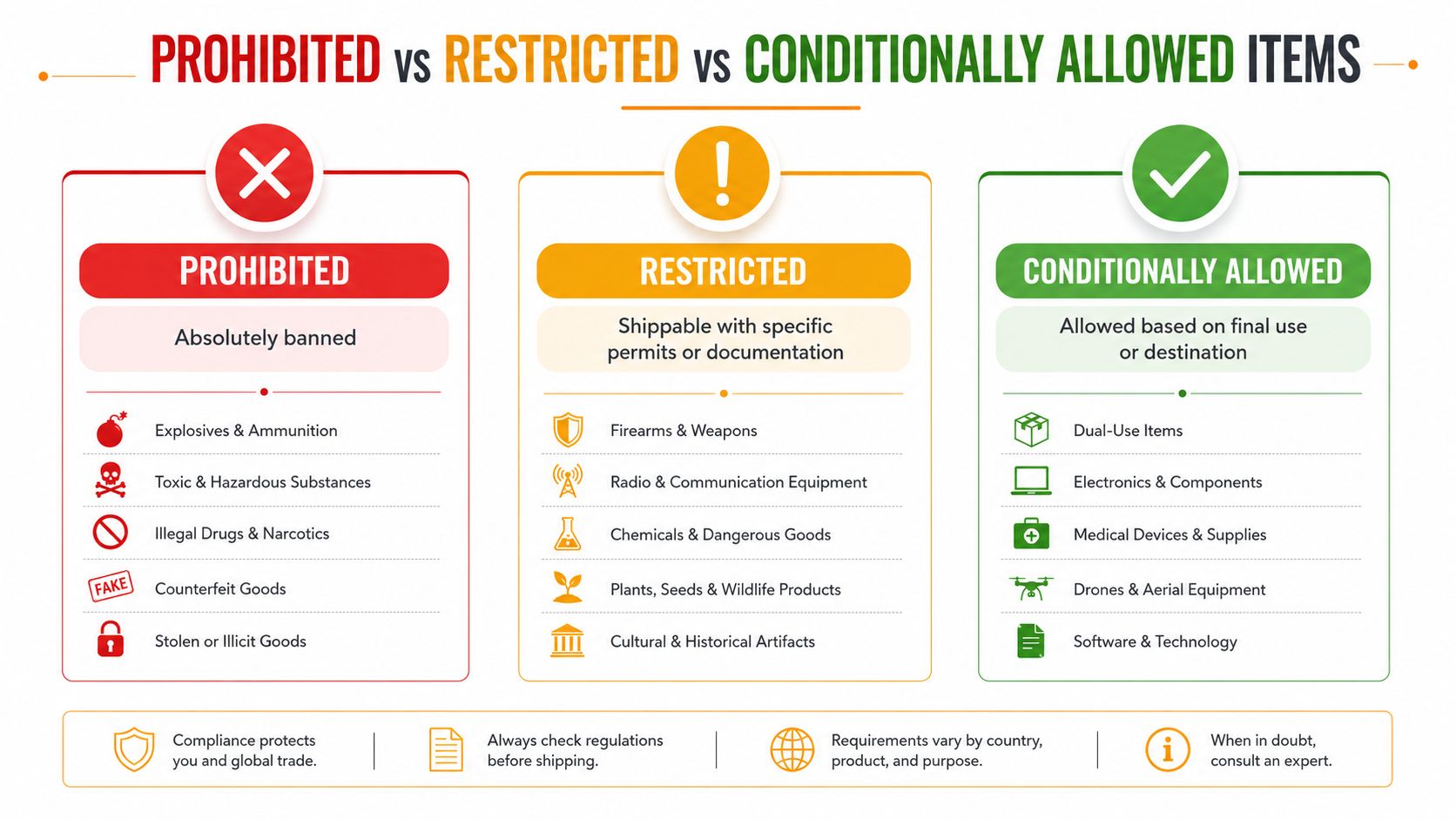
Not every hard-to-ship product belongs in the same bucket. The useful distinction is between prohibited, restricted, and conditionally allowed items, because each one requires a different decision at checkout and a different level of scrutiny in fulfillment.
Prohibited means the answer is no
USPS lists hemp-based products including CBD, marijuana, lithium batteries, perfumes containing alcohol, and flammable paint-related items as internationally nonmailable from the U.S. USPS shipping restrictions That doesn't mean those items are always banned everywhere in every context, but it does mean a U.S. shipper can't treat the parcel as a normal international order.
The important operational point is that “prohibited” is carrier and route specific, not just product specific. A merchant who ignores that distinction usually learns it after the shipment has already left the building.
Restricted means the shipment might work, if every condition is met
Lithium batteries are the classic example. They're not a universal no, they're a “yes, if the packaging, labeling, and route rules are correct.” That's why restricted items belong in a documented workflow, not in a generic checkout path that only says “allowed” or “blocked.”
Practical rule: restricted doesn't mean soft approval. It means the shipment is conditional on the right packaging, paperwork, destination, and carrier lane.
Conditionally allowed depends on destination, use, and paperwork
Firearms are the clearest example of a conditionally allowed product. The origin country may allow export only with the right license, the destination may require an import permit, and the carrier may impose additional restrictions. The same item can therefore be shippable in one transaction and non-shippable in the next, purely because the destination or end use changed.
UPS guidance also emphasizes that shipments to the EU need an EORI or tax ID, a 6-digit HS code for every item, and an accurate goods description. UPS international shipping guidance That's why “can I ship this?” is the wrong first question. The key question is, “Can I ship this to this specific place, with this carrier, under these documents, for this use case?”
<iframe width="100%" style="aspect-ratio: 16 / 9;" src="https://www.youtube.com/embed/NnFWGtepTUE" frameborder="0" allow="autoplay; encrypted-media" allowfullscreen></iframe>Building a Pre-Shipment Compliance Checklist
A reliable checklist has to stop bad orders before anyone prints a label. If you wait until the package is already staged for pickup, you've waited too long, because most of the expensive mistakes are visible much earlier.
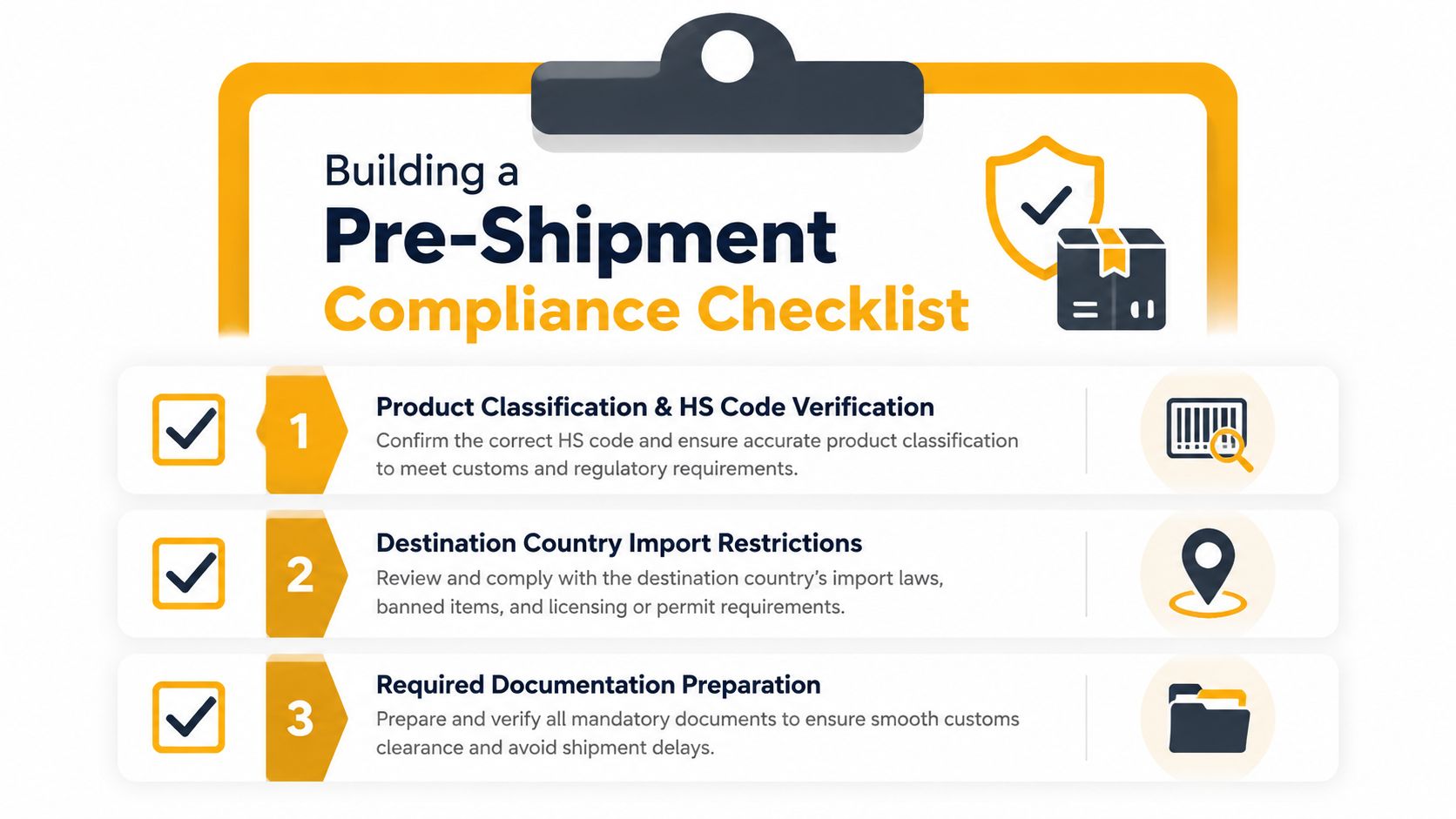
Start with product and destination
First, classify the product and confirm the HS code. Then check the destination country's import rules for permits, bans, and service restrictions. If the item's classification is fuzzy, or if the country's list is unclear, that's a stop sign, not a maybe.
The point isn't to memorize every rule. It's to create a repeatable review path that flags the product before fulfillment. A regulated seller should be able to answer whether the item is controlled, whether the destination allows it, and whether the carrier accepts that route.
Check origin controls and sanctions status
Next, determine whether the origin country requires an export license or special filing. Then screen the destination and end user against sanctions restrictions and other legal blocks. If the buyer, consignee, or destination creates a legal problem, the shipment doesn't move.
Checkout logic and back-office review should connect. Manual review tends to happen too late, after the customer has already completed the order and expects movement. That's a bad place to discover a legal issue.
Finish with documents and declaration triggers
Prepare the commercial invoice, customs form, country-specific IDs, and any permit or license reference before handoff. Confirm whether the shipment crosses the EEI threshold, because that changes what must be filed and when. If the paperwork isn't complete, the shipment shouldn't leave the warehouse.
A simple rule set works well here:
- Product classification: Verify the HS code against the actual item, not the marketing description.
- Destination research: Confirm the country accepts the item, quantity, and use case.
- Export review: Check whether the origin country requires a license or filing.
- Sanctions screening: Validate the destination and end-user details.
- Carrier fit: Confirm packaging and route rules with the carrier's prohibited-items list.
- Document package: Gather invoice, customs forms, IDs, permits, and origin evidence.
- Declaration trigger: Check whether EEI or another filing is required.
If one of those checks fails, the shipment should pause. That's not a workflow delay, it's how you keep a bad parcel from becoming a border problem.
Automating Compliance at Checkout vs Manual Review
Manual review looks cheaper until you measure the labor, the misses, and the support fallout. Regulated orders often need someone to check geography, product type, carrier rules, and documentation before the shipment moves, which makes the review process slow and inconsistent when volume rises.
Automation shifts that work into checkout. Systems that validate by destination, product, and rule set can block bad orders before payment, which is exactly where compliance belongs for regulated goods. Ship Restrict is one option in that category, because it applies configurable shipping restrictions by state, city, and ZIP in WooCommerce and Shopify stores, so non-compliant orders don't enter the fulfillment queue in the first place.
Manual review also creates a quality problem. Humans miss edge cases, especially when the same customer places similar orders to different destinations or when product rules vary by variant. Rule-based automation is stronger because it doesn't get tired, and it applies the same decision logic every time.
The trade-off is setup work. Someone has to define the rule structure, maintain it when laws change, and keep product data clean. But that work is still easier than rechecking every order by hand, then explaining to a customer why a completed purchase can't ship.
Practical rule: manual review works for exceptions, automation works for the standard path.
For teams that are still deciding how to allocate responsibility for duties and taxes, the DDP vs DDU breakdown is useful because payment responsibility and compliance responsibility are often confused. Once those roles are separated, checkout logic gets much easier to maintain.
Turning Compliance from Cost Center to Competitive Advantage
Clean international shipping rules do more than keep you out of trouble. They make delivery more predictable, reduce refusal and seizure risk, and cut the number of customer support tickets that start with “where's my order?” after a customs hold.
That matters because the customer doesn't separate logistics from trust. If your competitor ships the same product more cleanly, the customer remembers the smoother experience, not the reason your shipment got held. In regulated eCommerce, reliability becomes a brand feature.
Compliance also helps your team keep fewer orders on the wrong path in the first place. Fewer bad shipments mean fewer returns, fewer chargebacks, and less time spent rebuilding paper trails after the fact. It also makes your carrier and customs relationships healthier, because clean records are easier to process than messy ones.
The smartest rollout is narrow. Start with your highest-volume destinations and the products that trigger the most exceptions, then widen the rule set in controlled steps. That gives you faster gains without turning the whole catalog into a compliance project at once.
If you need a practical way to enforce those rules at checkout, start by mapping your riskiest products and destinations in Ship Restrict. Then build the rule set around the checks that stop shipments, not the ones that just sound important.
Automate Shipping Compliance
Stop worrying about restricted states. Ship Restrict handles it automatically.

Cody Yurk
Founder and Lead Developer of ShipRestrict, helping e-commerce businesses navigate complex shipping regulations for regulated products. Ecommerce store owner turned developer.
Automate Shipping Compliance
- Block restricted states
- No more cancellations
- Set and forget
3-day free trial · Card required