USA UK Shipping: A Regulated Goods Guide for 2026
Navigating USA UK shipping for regulated goods? Our 2026 guide covers customs, carrier policies, pitfalls, and how WooCommerce stores can automate compliance.
You get the UK order. The cart value looks good. The customer is legitimate. Your WooCommerce store is already shipping across the US, and you've probably handled enough domestic restrictions to think, “International can't be that different.”
Then the friction starts.
The product description that works fine for a US carrier suddenly isn't enough. The carrier's terms get vague around parts, components, accessories, and anything that might fall under weapons policy review. Customs wants clean product classification, the importer needs the right identifiers, and your usual manual review process starts to feel flimsy. If you sell firearm parts or anything adjacent to regulated goods, USA UK shipping isn't just a label-printing problem. It's a layered compliance problem where the wrong order can get blocked, held, returned, or worse.
That's why generic cross-border advice fails this niche. General eCommerce guides assume your catalog is ordinary. They assume a carrier that accepts international parcels will also accept your specific items. They assume a human can spot exceptions before fulfillment. For regulated products, those assumptions break fast.
Automate Shipping Compliance
Block orders to restricted states automatically. 3-day free trial.
Start Free TrialThe UK is too important to ignore. In 2024, U.S. exports to the UK totaled over $75 billion, with ocean freight moving the majority of containerized cargo in that corridor, according to trade and shipping data summarized here. But opportunity only matters if you can operationalize it safely. For firearms retailers and parts sellers, the winning approach isn't “ship carefully.” It's build a system that prevents bad orders before payment, before label creation, and before inventory leaves the shelf.
The Promise and Peril of UK eCommerce Shipping
A UK order often looks like straightforward expansion. Same language. Strong consumer market. Familiar online buying behavior. On the surface, it feels like a natural next step for a US firearms retailer that already has product-market fit at home.
The upside is real. The UK remains closely tied to global shipping flows, and efficient port infrastructure keeps freight moving at scale. But regulated sellers don't operate in the same world as a general apparel store or gadget brand. The moment your catalog includes firearm parts, magazines, components, or products that can trigger policy review, every layer of the shipment gets harder. Customs classification gets harder. Carrier acceptance gets harder. Customer communication gets harder.
Why ordinary cross-border playbooks fail
Most merchants start with the wrong question. They ask, “Can I ship to the UK?” The better question is, “Which exact SKUs can I ship, under which conditions, through which carrier, with which documents, to which destination?”
That difference matters.
A basic international shipping setup usually relies on three weak controls:
- Manual product review: Someone on your team checks the order after it's placed.
- Generic shipping zones: WooCommerce offers a UK rate to anyone with a UK address.
- Carrier assumption: If the platform lets you buy a label, the shipment must be acceptable.
Those controls break down on regulated goods. Manual review is inconsistent under volume. Generic shipping zones don't understand product restrictions. Carrier systems often catch policy conflicts late, after the order has already become a customer service issue.
Practical rule: If your compliance decision happens after checkout, you're already too late.
What works in practice
The stores that handle USA to UK shipping well for regulated goods do two things early. First, they separate “internationally eligible” from “domestically saleable.” Second, they treat shipping compliance as part of checkout logic, not warehouse cleanup.
Free Shipping Compliance Audit
We'll review your WooCommerce store's shipping compliance for free.
That means your UK strategy should begin with a narrow lane. Approve only the products you know you can classify, document, and route cleanly. Everything else stays blocked until you've validated the legal path and the carrier path.
That's less exciting than turning on worldwide shipping. It's also how you avoid teaching customers to distrust your store.
Decoding UK Customs Controls for US Merchants
A UK order looks fine until the parcel hits customs with a weak description, the wrong importer details, or no clear tax treatment. Then the shipment stops, the customer asks where it is, and your team starts fixing data that should have been locked before checkout. For regulated goods, that failure point is expensive.
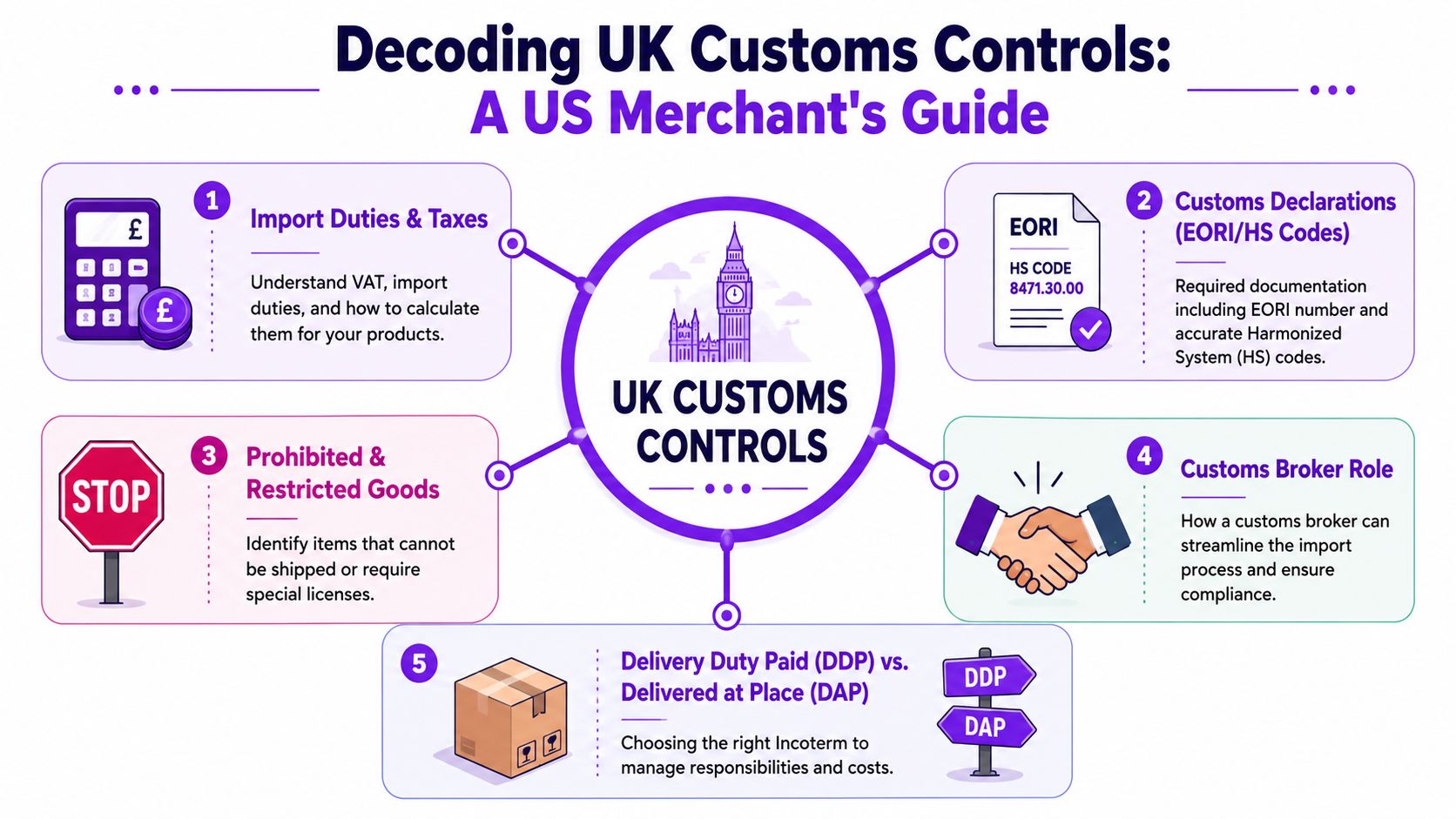
GB EORI has to be settled before fulfillment
If a shipment into Great Britain requires an importer identifier, treat the GB EORI as a pre-dispatch requirement. Do not let it become a warehouse-side exception.
Store owners often assume they can collect missing customs data after the order is paid. That approach creates avoidable holds. It also creates a second problem for firearm parts and other controlled-adjacent products. Once a shipment falls out of the normal electronic flow and into manual review, the odds of extra scrutiny go up.
The practical rule is simple. If the importer of record is not clear, the UK order is not ready to ship.
HS codes and product descriptions must agree at the SKU level
Customs systems do not evaluate your intent. They evaluate the data you submit. The HS code, commercial description, declared value, and importer details need to describe the same product in the same way.
Regulated-goods merchants often get into trouble. A vague description such as “metal accessory” may feel safer internally, but it gives customs brokers and border officers less to work with. An overly broad description can also pull a harmless part into the wrong review path. For firearms eCommerce, ambiguity is not a protective strategy. It is a delay strategy.
A working standard looks like this:
| Item field | What good looks like |
|---|---|
| Product name | Clear commercial name that matches the invoice and packing data |
| HS code | Assigned consistently at the SKU level, not guessed at order time |
| Description | Specific function and product type, without marketing fluff |
| Importer details | Complete and verified before the label is purchased |
If your catalog cannot produce those fields cleanly, fix that first. Automation matters here because manual classification shortcuts are exactly how restricted items get misdeclared.
CIF, duty, and VAT decide whether the order is still profitable
UK import charges are tied to the declared value structure, including freight and insurance where applicable. If those figures are inconsistent across the invoice, checkout total, and customs declaration, you create both compliance risk and margin drift.
That matters more now that low-value assumptions are less forgiving and more merchants are being forced to treat cross-border tax and duty as an operational control, not a post-sale accounting task. For a regulated-goods seller, a bad declaration is not just a math error. It can trigger reassessment, customer disputes, and a shipment you cannot easily reship.
The stores that handle this well do not rely on staff to remember special cases. They use checkout rules, SKU-level metadata, and document templates to keep the declared product, importer, and value data aligned every time.
For a tighter process on invoices, declarations, and restricted-item paperwork, review this guide to cross-border documentation for restricted goods.
Navigating Carrier Policies and Prohibited Items
A UK customer places an order for a small firearm accessory. Your checkout accepts it, your customs data looks clean, and the label prints. Then the carrier rejects the parcel at handoff because its internal weapons policy is stricter than the law. That is a common failure point in USA UK shipping, and it hits regulated sellers harder because one bad assumption can leave you with a blocked shipment, refund pressure, and an account review.
Carrier acceptance is a separate control layer from customs. Government rules decide whether the goods may be imported. The carrier decides whether it will carry that SKU, on that service, under that account, with that wording on the paperwork.
That distinction gets missed because the route is busy and familiar. According to the previously mentioned trade summary, the USA UK corridor handles heavy commercial volume, which makes many merchants assume standard parcel logic applies. It does not apply to regulated or adjacent-to-regulated goods.
Carrier policy is account-specific, service-specific, and SKU-specific
Two merchants can present the same item and get different answers from the same carrier. One account may be approved for review-only movement through a brokered service. Another may be blocked outright on parcel services. Final-mile partners can add another filter, especially when the product description suggests a weapons component.
This is where stores get exposed:
- Descriptions trigger unnecessary flags: "Tactical," "AR," or overly broad accessory language can push a harmless item into manual review.
- Descriptions are too thin: If the carrier cannot identify the item clearly, staff will default to reject or hold.
- Carrier approval lives in email, not in workflow: A rep says a product is acceptable, but that approval never gets translated into checkout logic.
- Operations learn by failure: The first real test happens after a paid order is packed.
For regulated catalogs, that is sloppy risk management.
Build a carrier acceptance matrix before you sell
Do not ask whether a carrier ships from the US to the UK. Verify whether that carrier will move each controlled, restricted, or lookalike item in your catalog under your exact setup.
A working matrix should include:
| Decision area | What to verify |
|---|---|
| SKU or product family | Whether the carrier classifies it as prohibited, restricted, or subject to manual approval |
| Service level | Whether express, standard parcel, freight, or brokered movement changes acceptance |
| Account status | Whether your specific shipper account is approved for that item class |
| Description rules | What product wording the carrier will accept on labels, invoices, and customs data |
| Supporting documents | Whether end-use, consignee, or product-spec records are required before dispatch |
| Exception owner | Who makes the call when an item sits near a policy boundary |
If the policy team still needs to review the item after checkout, the item should not be available for UK delivery yet.
The gray zone causes more damage than the obvious bans
The hardest shipping failures are rarely the clearly prohibited items. They are the products that are conditionally accepted, accepted only on one service, or accepted only when the product data is written in a very specific way. Firearm parts sellers run into this constantly with accessories, mounts, components, and items that are legal to sell but easy for a carrier to misclassify.
That is why broad labels like "weapons accessories" are useless in operations. They do not tell your warehouse team what can ship, your support team what to promise, or your checkout what to block.
The practical fix is automation. Store carrier rules at the product or category level, tie them to destination and service, and stop disallowed orders before payment or label creation. This guide to automated shipping compliance for WooCommerce stores shows how to turn carrier policy into enforceable checkout logic. If you also need to automate your shipping operations, make sure the automation includes restricted-item decisioning, not just label generation.
Manual review does not scale here. It creates inconsistent decisions, missed restrictions, and preventable holds at the depot.
The Regulated Goods Minefield for Firearms and Parts
If you sell ordinary consumer goods, cross-border shipping problems usually come down to cost, transit time, and customs paperwork. If you sell firearm parts or closely related products, the problem is structurally different. You're navigating overlapping control systems where US export issues, UK import controls, carrier policy, and platform workflow all interact.
That's why generic USA UK shipping advice is risky for this category.
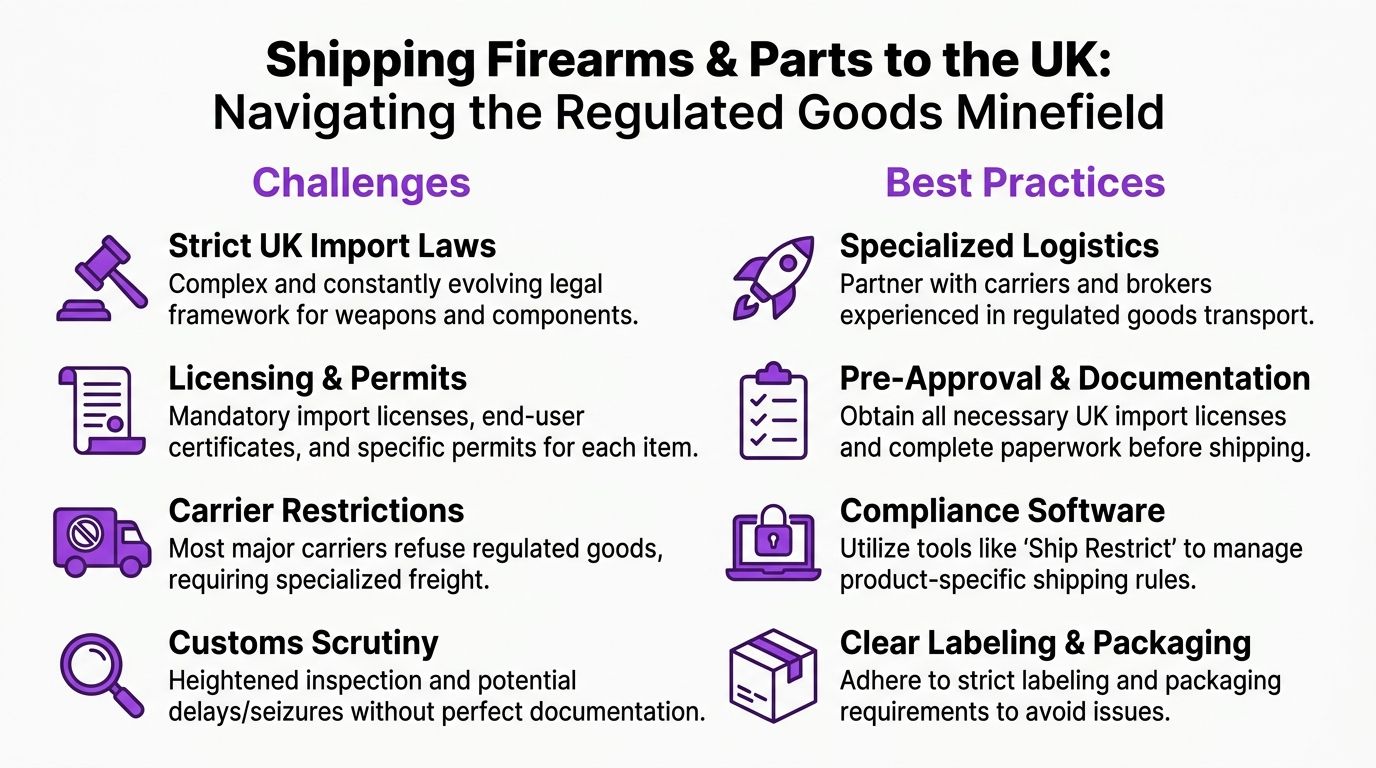
The de minimis collapse changed the operating model
A critical gap in cross-border guidance is what happens to regulated goods after the collapse of the $800 de minimis exemption. According to Landmark Global's overview of UK-to-US shipping changes, that shift has caused major carriers like DHL and UK national carriers to temporarily suspend shipments to the USA due to unfinished customs processes, creating a compliance vacuum for regulated merchants.
Even though much public discussion focuses on general eCommerce, regulated sellers feel the impact more sharply because they already operate close to the line. Once every shipment falls into more formal customs handling, weak processes stop being inconvenient and start becoming unworkable.
Why regulated goods break manual workflows
A manual review system usually depends on one employee noticing a risky address, a problematic SKU, or a carrier mismatch before fulfillment. That might work for a handful of domestic exceptions. It does not scale once cross-border formalities tighten.
Regulated-goods merchants have to answer multiple questions at once:
- Export side: Does the US side impose any licensing or control issue for this item?
- Import side: Can the UK consignee lawfully receive it?
- Carrier side: Will the selected transport network accept it at all?
- Storefront side: Should the customer have been allowed to place the order in the first place?
That fourth question is the one most stores neglect.
A compliant warehouse team can still inherit a non-compliant order if the storefront accepts it without enforcing destination rules.
Firearm parts are not standard eCommerce inventory
Store owners sometimes try to solve this by adding a warning banner, requiring a customer checkbox, or telling support staff to review international orders manually. None of that is strong enough for regulated items.
What works is narrower and more disciplined:
- Treat UK shipping eligibility as a product rule, not a shipping-method preference.
- Separate border-ready SKUs from domestic-only SKUs.
- Block uncertain combinations by default.
- Allow exceptions only after documentation, carrier acceptance, and import logic are settled.
The old “we'll review it after purchase” model creates customer frustration and legal exposure at the same time. You take payment for an order that may never have been shippable. Then you rely on staff to unwind the mistake politely.
For firearms retailers, that's not just inefficient. It's operationally brittle.
Automating Compliance for WooCommerce Merchants
Manual compliance fails for the same reason manual inventory counts fail. It depends on memory, timing, and a person catching edge cases under pressure. For a regulated WooCommerce store, that's a bad foundation for international shipping.
The smarter approach is to move the decision forward. Don't let the order enter your pipeline unless it already satisfies your destination rules.
Automation changes where the mistake happens
Without automation, the failure happens after checkout. Support emails the customer. Ops voids the label. Finance processes the refund. The warehouse has already touched the order, and your customer now thinks your store doesn't know its own rules.
With automation, the failure happens before payment or before shipping selection. That's where you want it.
A durable setup usually includes these controls:
- Destination-based rules: Country-level logic for whether the UK is open at all.
- Product-based rules: SKU or category blocks for parts that should never leave the US.
- Conditional messaging: Clear checkout notices that explain why a product can't ship.
- Order prevention: No manual override unless a documented exception exists.
That structure is more than convenience. It's risk containment.
Why WooCommerce stores need rule-based enforcement
WooCommerce is flexible, which is useful until flexibility becomes ambiguity. If your store can sell restricted products into multiple regions, you need the platform to enforce policy consistently. Staff training alone won't carry that load.
For merchants looking at broader operational process design, this practical overview on how to automate your shipping operations from Routelink is a helpful complement to compliance-specific planning.
For regulated goods, the key insight is this: shipping automation and compliance automation are not the same thing. A label workflow makes dispatch faster. A compliance rule engine decides whether dispatch should happen at all.
If you run WooCommerce in a restricted category, that distinction matters every day.
What to codify first
Start with the rules that humans misapply most often:
| Priority rule | Why it belongs in automation |
|---|---|
| UK country block for restricted categories | Stops bad orders at the top level |
| SKU-specific export restrictions | Prevents false assumptions based on broad categories |
| Customer-facing explanations | Reduces abandonment confusion and support volume |
| Exception paths | Keeps approved products moving without opening the whole catalog |
For a deeper compliance workflow model specific to this platform, review this guide to automated shipping compliance for WooCommerce stores.
Implementing Ship Restrict for UK Shipments
If you're selling regulated goods, the best rule set is usually conservative. Block first. Allow later. That sounds restrictive, but it's how you stop your storefront from promising shipments your operation can't complete.
A recurring merchant concern is how costs and timelines change for regulated shipments once de minimis loopholes close. According to Sendcloud's discussion of UK-US shipping changes, merchants ask how to avoid costly mistakes under formal entry requirements, and the post-change environment means they face a 100% failure rate if they do not implement automated, state/county/ZIP-level restriction rules before checkout. The geographic examples in that source focus on the US side, but the operational lesson carries over cleanly: granular rule enforcement has to happen before the order is accepted.
Start with a deny-by-default UK rule
For firearm parts stores, don't begin by allowing the UK and then plugging holes one by one. Start with a country rule that blocks all UK shipments. That gives you a clean baseline.
Then create narrow exceptions for products you've already vetted for:
- carrier acceptance
- customs classification
- import eligibility
- internal documentation readiness
That sequence prevents the common failure mode where a merchant opens an entire destination because one subset of products is probably fine.
Here's the practical logic:
- Block all orders with destination country set to the United Kingdom.
- Identify low-risk, clearly classifiable SKUs that you intend to permit.
- Create exception rules for only those SKUs or categories.
- Keep all firearm-part families blocked unless you have a documented route.
Use customer messaging to protect the brand
A hard block without explanation looks broken. A clear restriction message looks controlled.
Good checkout copy should do three things:
- identify that the restriction is destination-based
- avoid legal overstatement
- tell the customer what to do next
Examples that work better than a generic error:
- “This item isn't available for shipment to the United Kingdom.”
- “Your cart contains products that can't be shipped to this destination.”
- “Please remove restricted items or contact support about eligible products.”
That language lowers support friction because the customer understands the problem immediately.
Here's what the setup looks like in practice:
Build layered rules, not one giant rule
A lot of stores try to encode everything into a single condition. That becomes hard to audit and easy to break. Use layered logic instead.
A practical UK configuration often looks like this:
| Rule layer | Purpose |
|---|---|
| Country block | Stops all UK orders by default |
| Product exception | Reopens approved non-regulated SKUs |
| Category restriction | Keeps firearm-part groups blocked |
| Message rule | Shows the right explanation to the customer |
That structure is easier to maintain when product lines change.
Operator note: If a staff member can't explain why a rule exists, that rule will eventually be bypassed or deleted.
Keep documentation and storefront logic connected
Store owners often separate compliance policy from store configuration. Legal keeps a spreadsheet. Ops has carrier notes. Ecommerce has categories. Nobody has one enforceable rule set.
That's where mistakes survive.
Your store should reflect your actual shipping policy. If a product requires extra review for UK shipment, don't rely on team memory. Restrict the SKU. If a category is never eligible, encode that once and apply it consistently. If a product becomes approved later, add it back intentionally.
For implementation basics and setup flow, the Ship Restrict getting started documentation gives a clear foundation for turning those policies into enforceable checkout rules.
Your USA to UK Shipping Operational Checklist
A UK order for a harmless-looking part gets packed on Friday, flagged by the carrier on Monday, and refunded after support has already promised delivery. That is how cross-border expansion turns into margin loss. For firearms, parts, and adjacent regulated catalogs, the problem usually starts long before the parcel reaches customs. It starts with a store that accepts orders it should have blocked.
The operational fix is simple in principle and strict in practice. Give legal, ecommerce, support, and fulfillment one checklist, then enforce it with store logic instead of staff memory.
The broader shipping sector behind this route carries real economic weight. The UK shipping industry supports major employment and output across the economy, with productivity levels above the national average, according to a summary of UK shipping industry data. For a merchant, the practical point is straightforward. Strong shipping operations reduce friction, contain exception handling, and make expansion into the UK easier to manage.
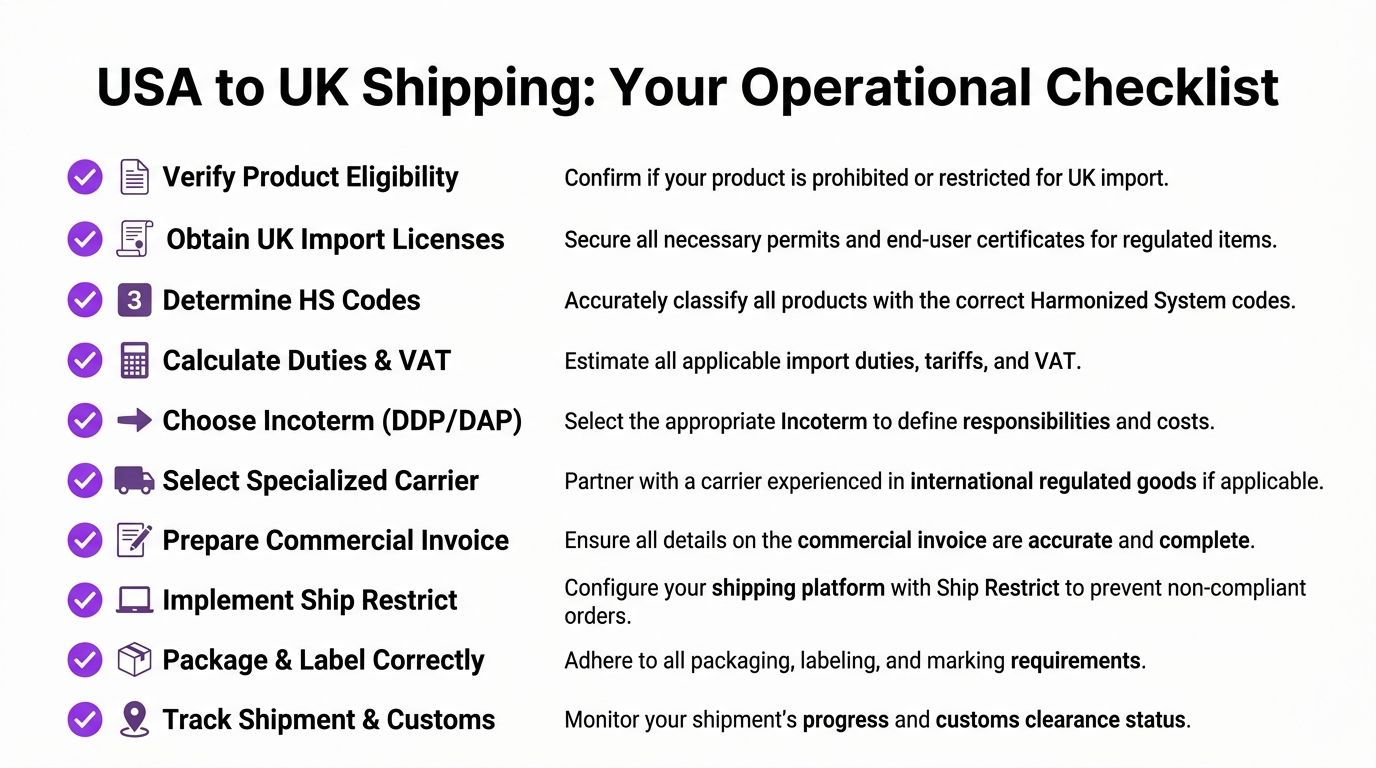
The checklist to keep beside your shipping desk
- Verify product eligibility: Confirm exactly which SKUs can ship to the UK, and separate approved accessories from controlled parts at the product level.
- Confirm importer readiness: Make sure the required importer identifiers, consignee details, and commercial information are available before the order reaches fulfillment.
- Classify products correctly: Maintain SKU-level HS codes and invoice descriptions that match the item a customs officer or carrier reviewer will see.
- Validate landed-cost inputs: Keep invoice value, freight value, and declared value aligned so the shipment does not create avoidable duty, VAT, or clearance problems.
- Vet the carrier by item type: A carrier that serves the UK does not automatically accept firearm parts, magazines, or other restricted product classes.
- Choose a narrow launch catalog: Start with the products you can defend operationally, not the full catalog.
- Block the UK by default for restricted categories: Approve exceptions deliberately. Do not leave eligibility open because a category map is incomplete.
- Show clear checkout messages: Tell the customer why the item cannot ship and what to do next, if any alternative exists.
- Review commercial documents before label creation: Catch description, value, and consignee errors before the parcel enters the carrier network.
- Audit rules regularly: Carrier policy changes, UK import treatment changes, and catalog changes all need a rule review. The end of easy low-value assumptions raised the cost of getting this wrong.
Stores that stay out of trouble build systems that prevent bad orders from reaching the warehouse.
If you sell regulated goods on WooCommerce, the safer path into the UK is controlled expansion with automated enforcement. Limit the lane. Approve only the SKUs you can support. Let automation stop non-compliant orders before your team has to unwind them by hand.
If you need to enforce destination, SKU, and restriction logic before checkout, Ship Restrict gives WooCommerce merchants a practical way to block non-compliant orders automatically. For firearms and other regulated catalogs, that means fewer manual reviews, fewer avoidable refunds, and a cleaner path into cross-border sales.
Automate Shipping Compliance
Stop worrying about restricted states. Ship Restrict handles it automatically.

Cody Yurk
Founder and Lead Developer of ShipRestrict, helping e-commerce businesses navigate complex shipping regulations for regulated products. Ecommerce store owner turned developer.
Automate Shipping Compliance
- Block restricted states
- No more cancellations
- Set and forget
3-day free trial · Card required