Dangerous Goods Shipments: eCommerce Compliance 2026
Master dangerous goods shipments for eCommerce. Our guide covers 2026 compliance, packaging, carrier rules, and WooCommerce automation to ship safely.
You're often only one support ticket away from finding out you've been shipping a regulated product without treating it like one.
It usually starts small. A customer asks why a lithium battery item can't go by air. A carrier rejects a parcel with perfume, aerosol, dry ice, or a cleaning chemical. Someone on your team realizes the product page says “flammable,” but your shipping rules treat it like a coffee mug. That's when dangerous goods stop being a compliance topic and become an operations problem.
The good news is that dangerous goods shipments aren't a niche edge case. They're a normal part of commerce. Dangerous goods make up about 10% of all containerized shipments worldwide, which is why serious merchants build process around them instead of improvising order by order, according to Port Technology's summary of dangerous shipping statistics. If your catalog includes batteries, solvents, aerosols, adhesives, medical items, cleaners, or temperature-control materials, this is part of your shipping department whether you planned for it or not.
The Hidden Risks in Your Shipping Department
A merchant adds a new personal care line. One item is a fragrance mist. Another is hand sanitizer. Sales come in fast, fulfillment moves on autopilot, and nobody slows down until the first rejection email lands from the carrier. The shipment was prepared like ordinary merchandise. It wasn't ordinary merchandise.
Automate Shipping Compliance
Block orders to restricted states automatically. 3-day free trial.
Start Free TrialThat's how most dangerous goods problems appear. Not through dramatic warehouse incidents, but through everyday catalog drift. Product teams add SKUs. Marketplace sellers upload vague descriptions. Customer service changes copy. Operations inherits the risk after the order has already been paid for.
Where stores usually get caught
The trouble spots are predictable:
- Consumer products with hidden transport risk: Perfume, aerosols, cleaning chemicals, battery-powered devices, and anything temperature-controlled can trigger dangerous goods handling rules.
- Catalog language that masks the hazard: “Accessory,” “kit,” “refill,” or “sample” tells your warehouse almost nothing about transport classification.
- Shipping workflows built for general merchandise: Standard pick-pack-ship routines don't catch products that need special packaging, labels, declarations, or service restrictions.
A dangerous goods failure rarely starts at packing. It usually starts upstream with bad product data.
That matters because the consequences stack quickly. A carrier can reject the package. A customer can miss a delivery window. Your team can spend hours reworking one order that should never have reached label printing in the first place. If the mismatch is serious, the issue moves beyond inconvenience into enforcement risk.
What works instead
The stores that handle dangerous goods shipments well do three things early.
First, they decide classification before launch, not after the first carrier refusal. Second, they build shipping methods around product reality rather than customer preference. Third, they treat regulated products as a repeatable workflow, not an exception someone “just checks manually.”
That's the practical shift. Don't ask, “Can we get this one package out?” Ask, “What process prevents this exact mistake on the next hundred orders?”
First Principles Product Classification
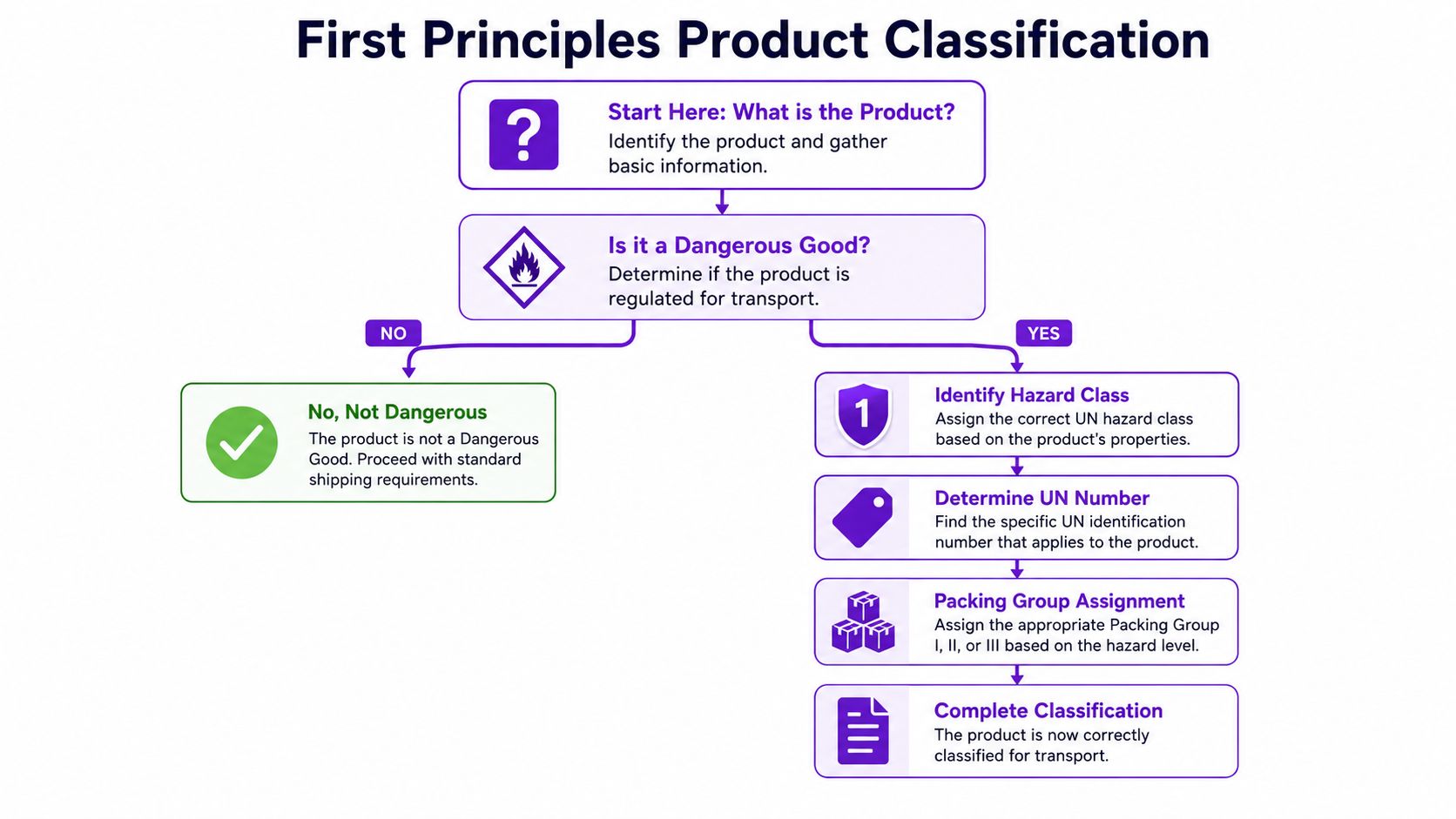
Classification is the step you can't skip. If you get this wrong, every downstream action gets shaky. Packaging, labels, documentation, service selection, and retention records all depend on knowing exactly what the product is in transport terms.
In the United States, the Hazardous Materials Regulations require businesses shipping these materials to classify them into one of nine hazard classes, and the FAA notes that roughly 6,500 businesses reported shipping at least one hazardous material commodity in the 2021–2022 dataset. The same framework also ties into a two-year shipping declaration retention requirement, as outlined in FAA hazardous materials shipping guidance.
Free Shipping Compliance Audit
We'll review your WooCommerce store's shipping compliance for free.
Start with the SDS, not your product title
The product title in WooCommerce is for selling. The Safety Data Sheet, or SDS, is for transport decisions.
If you're classifying a product for the first time, pull the current SDS from the manufacturer and go straight to the transport information. If the supplier can't provide it, that's already a warning sign. A vague PDF, outdated sheet, or marketing brochure isn't enough for a defensible shipping process.
Look for these fields first:
- UN or NA number: This is the identifier that drives marking and documentation.
- Proper shipping name: This must match the regulated description, not your storefront name.
- Hazard class: The transport risk category.
- Packing group: Where applicable, this affects the packaging standard you need.
For a more detailed regulatory orientation, hazmat shipping regulations for online sellers are worth reviewing before you operationalize the product in your store.
Use plain-English product examples
The nine hazard classes sound abstract until you connect them to familiar merchandise. In eCommerce terms, think this way:
| Hazard class | Typical store example |
|---|---|
| Explosives | Fireworks or certain ammunition-related products |
| Gases | Aerosol cans or compressed gas products |
| Flammable liquids | Perfume, solvent-based products, hand sanitizer |
| Flammable solids | Certain reactive consumer or industrial items |
| Oxidizers and organic peroxides | Some chemical treatment products |
| Toxic and infectious substances | Certain pesticides or medical materials |
| Radioactive materials | Specialized industrial or medical products |
| Corrosives | Drain cleaners, acids, battery-related fluids |
| Miscellaneous | Dry ice, some battery shipments, airbags |
The point isn't to memorize examples. The point is to stop guessing based on product category. “Beauty,” “electronics,” and “automotive” are retail categories. They are not transport classifications.
A quick visual helps teams document the logic consistently:
<iframe width="100%" style="aspect-ratio: 16 / 9;" src="https://www.youtube.com/embed/08Lqiz4K2JE" frameborder="0" allow="autoplay; encrypted-media" allowfullscreen></iframe>Packing group decides how tough the packaging must be
Once you identify the material and hazard class, check whether a Packing Group applies. In practice, this determines the required performance level of the packaging.
A common mistake is treating the box as a generic purchasing decision. It isn't. If the product's classification points to packaging standards that your current mailer or bottle insert doesn't meet, the shipment isn't compliant no matter how carefully the warehouse tapes it.
Practical rule: If your team can't point to the SDS, UN or NA number, hazard class, and packing group from a central product record, the product isn't ready to ship.
That central record matters even more in high-SKU catalogs. Once classification lives in a spreadsheet on one manager's desktop, errors multiply. Build a product master that operations, customer service, and fulfillment can all use.
A Guide to Packaging Labeling and Documentation
Once classification is settled, the next job is turning that classified product into a package a carrier can legally accept. Most operational failures happen during this stage. Not because the rules are unknowable, but because teams rush and let small mismatches slip through.
The basic compliant workflow is straightforward: classify the item, choose packaging based on hazard class, apply the UN number and proper shipping name, affix labels, and include signed shipping papers, as summarized in Easyship's dangerous goods shipping workflow guide.
Packaging has to match the transport risk
Start with the outer packaging. Don't pick a box because it's already on your warehouse shelf. Pick it because it suits the product's classification and handling needs.
If the product is fragile, pressure-sensitive, leak-prone, or reactive with common packing materials, solve that before it ever reaches the pack bench. Internal cushioning, liners, absorbent materials, separators, and closure methods matter because the package must survive real handling, not ideal handling.
Here's the sequence I'd use on the floor:
- Pull the product record: Confirm the proper shipping name, identification number, and any packing instructions attached to that SKU.
- Match the packaging to the hazard profile: Don't let packers improvise with “close enough” cartons or filler.
- Check compatibility of inner and outer materials: Some products need more than impact protection. They need resistance to leakage, abrasion, or chemical exposure.
- Standardize the pack-out: If one SKU can ship compliantly, document that exact pack method so every shift repeats it the same way.
If your team applies labels in environments where chemicals, condensation, abrasion, or rough handling are common, it helps to review practical guidance on understanding chemical resistant labeling. Label failure isn't cosmetic. If critical marks become unreadable in transit, the package can become noncompliant even if it started out correctly.
Markings and labels have to agree with the paperwork
A large share of rejections comes from inconsistency. The carton says one thing. The declaration says another. The internal product packing slip uses a sales name that doesn't match the transport name. Carriers notice those mismatches quickly.
Your package preparation checklist should include:
- Proper shipping name: Use the regulated name, not your merchandising phrase.
- UN or NA number: Apply the exact identifier tied to the classified product.
- Hazard labels: Use the correct labels and place them so handlers can see them.
- Emergency information: Include the required details in the shipping paperwork.
- Durability check: Make sure labels and markings remain visible and intact through handling.
If the label, shipping paper, and SKU master don't match word for word on the critical fields, stop the shipment and fix the record before it leaves the building.
That stop-the-line discipline saves time. Reworking one held package at the dock is cheaper than chasing a rejected load, refund request, or internal blame cycle later.
Documentation is where manual processes fall apart
Shipping papers aren't filler. They're part of the package's compliance identity.
A signed declaration, shipping papers, and retained records aren't optional administrative extras. They're how you prove what the shipment is, how it was prepared, and why it was accepted into transport. If your team creates those documents by copying old templates and editing them manually, errors will creep in.
Common breakdowns include:
| Failure point | What it looks like in practice |
|---|---|
| Wrong shipping name | The store name or customer-facing product title appears instead of the regulated name |
| Identifier mismatch | The package mark and document don't show the same UN or NA number |
| Incomplete declaration | Required fields are missing or unsigned |
| Packaging mismatch | The declared product and the actual package configuration don't align |
Dry ice is one of the fastest ways to expose a weak documentation process because stores often add it to preserve service levels without updating the transport workflow around it. If that's relevant to your business, this operational primer on how to ship using dry ice is useful because it forces the packaging and paperwork conversation at the same time.
The best documentation system is boring. It pulls from a controlled product record, limits free-text editing, and gives packers a packet they can trust.
Navigating Carrier Rules and Shipping Costs
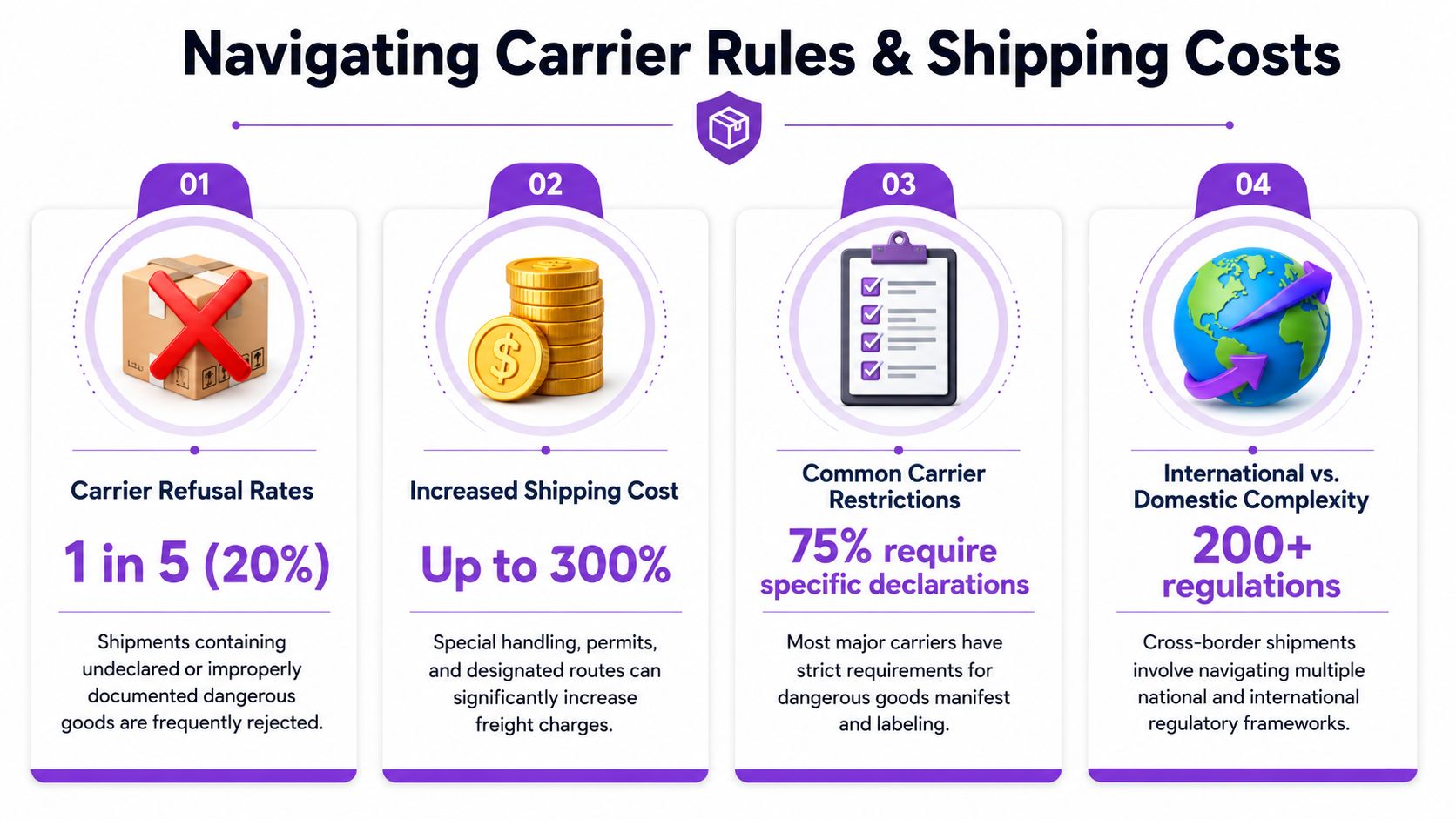
A compliant package still has to pass the carrier's own acceptance rules. That's where many merchants discover that dangerous goods shipments are not just a compliance issue but a margin issue.
Some products can move by multiple services. Others are effectively pushed into narrower channels because air restrictions, carrier acceptance policies, packaging demands, and destination rules cut down your options fast.
Speed usually loses to acceptance
When merchants first price dangerous goods shipping, they often focus on delivery speed. That's understandable, but it's often the wrong starting point. The first question is whether the service will take the shipment at all.
Air transport is especially strict. IATA notes that dangerous goods packages must withstand pallet and ULD handling as well as pressure and temperature changes, and it also notes that the air-freight market is projected to grow at 4.9% annually over the next five years, which implies a growing compliance workload for teams using that mode. The same IATA guidance also stresses that the Shipper's Declaration for Dangerous Goods, Air Waybill details, labels, and documentation fields must be exact, with IATA's air transport guidance on dangerous goods identifying labels and documentation as common failure points.
That's why ground service often becomes the practical choice for regulated consumer products. It may be slower, but “allowed and predictable” beats “fast in theory, rejected in practice.”
The surcharge changes the economics
Handling fees can erase the margin on an order you thought was profitable. One logistics source notes that dangerous goods handling can add meaningful surcharges, including about $160 per accessible package on some domestic express shipments, along with other carrier fees, in DCL's breakdown of dangerous goods shipping costs.
That should change how you evaluate fulfillment promises.
- Low-margin items: A dangerous goods surcharge can turn a normal order into a loss.
- Free shipping promotions: These become risky if your catalog contains regulated products and your checkout doesn't separate them.
- Express upgrades: Customers may pay for speed that the product can't legally or economically use.
Carrier choice needs decision rules
Most stores don't need more carrier options. They need better carrier logic.
Build a decision matrix that answers these questions before the order is rated:
| Decision area | Question to answer |
|---|---|
| Product acceptance | Will this carrier accept this class of dangerous goods at all? |
| Mode restrictions | Can it go by air, or is ground the only realistic path? |
| Packaging readiness | Does your current pack method meet that carrier's standards? |
| Documentation burden | Can your team generate the exact paperwork without manual edits? |
| Margin fit | Does the fee structure still make the order worth shipping? |
If you don't formalize these checks, your team starts negotiating with reality at the last minute. That's expensive.
Automating Compliance in Your WooCommerce Store
Manual review feels safer than it is. Someone checks the SKU, scans the address, remembers that one state has a rule, and changes the shipping method by hand. That process works until a weekend order spike, staff turnover, or a new product launch breaks it.
Dangerous goods shipments need rule-based enforcement inside the store, not memory-based enforcement after checkout.
What to automate first
The best starting point is not “automate everything.” It's “automate the mistakes that happen repeatedly.”
Focus on these controls first:
- Block incompatible shipping methods: If a product can't move by a certain service, remove that option before the customer pays.
- Restrict destination coverage: Prevent checkout when the order contains products that can't go to specific states, counties, cities, or ZIP codes.
- Flag mixed carts: Some combinations create handling problems even when each item is manageable on its own.
- Trigger manual review for weak product data: Marketplace and imported catalog feeds often contain vague descriptions that should never flow straight into fulfillment.
Federal aviation guidance on undeclared hazmat is useful here because it addresses the intake problem, not just the label-on-the-box problem. It defines undeclared dangerous goods as shipments with no visible indication of hazardous contents and points to warning signs such as vague descriptions like “parts” or “samples,” odd odors, packaging discrepancies, and content-to-weight mismatches in FAA guidance on undeclared hazardous materials.
That's exactly the kind of issue software should catch early.
Build rules around product metadata
A WooCommerce store can only enforce what it knows. If your dangerous goods logic lives outside the product data, automation will be weak.
Your product records should include transport-relevant fields such as regulated status, compatible services, destination constraints, and any requirement for manual approval. Once those fields exist, rule engines can make checkout decisions without forcing warehouse staff to reverse-engineer every order.
A practical setup often looks like this:
- Tag or classify the SKU as regulated based on your internal product master.
- Map allowed services to that product or product group.
- Block prohibited destinations before payment succeeds.
- Show a clear checkout message so the customer understands why the restriction exists.
- Route uncertain orders to review instead of letting them print like normal shipments.
Operational advice: Every dangerous goods order should either pass a predefined rule or stop automatically. There shouldn't be a third path called “someone will probably notice.”
Use automation to reduce support tickets too
Compliance automation isn't only about prevention. It also improves communication.
If checkout fails without context, customers open tickets. If the storefront explains that a product can't use a selected shipping method or can't ship to a destination because of transport restrictions, customers adjust faster and your staff spends less time explaining avoidable denials.
For stores that want to tighten declaration workflows as part of the same process, this guide to DHL dangerous goods declaration automation is a useful operational reference because it frames documentation as a system problem, not a typing problem.
Building a Long-Term Risk Mitigation Plan
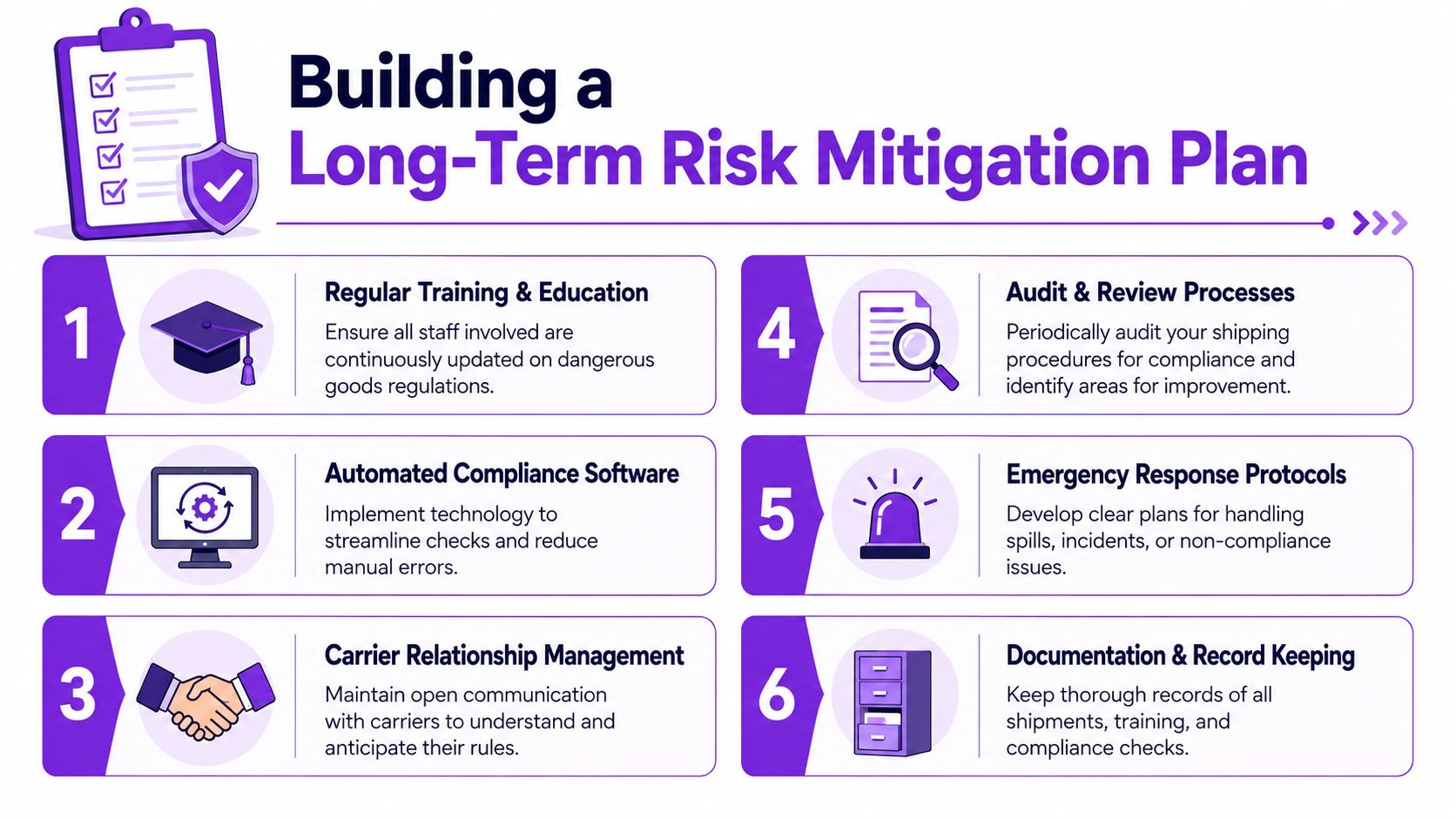
One compliant shipment doesn't mean the program is sound. A durable dangerous goods operation depends on habits, records, and recurring checks that survive team changes and product expansion.
The strongest programs treat dangerous goods like a managed capability. Product onboarding, warehouse execution, customer communication, and record retention all connect. If one piece drifts, the rest eventually follows.
Build the operating system, not just the shipment
The practical components are simple, but they need discipline.
- Train by job function: FAA guidance says employees performing hazmat functions should be trained based on a needs assessment, with recurrent training obligations under the applicable rules. Don't train everyone the same way. Train catalog staff on classification inputs, packers on execution, and support teams on what they can and can't promise.
- Retain records consistently: Shipping declarations and related records need to be kept for the required retention period. That record trail protects you in audits, investigations, and internal reviews.
- Audit your own workflow: Pull recent dangerous goods orders and compare the product record, package preparation, selected service, and retained paperwork. You're looking for drift, not perfection.
- Update the product master: New suppliers, reformulations, packaging changes, and seasonal items can all invalidate old assumptions.
Watch for the quiet failures
The biggest risks usually aren't dramatic. They're quiet.
A supplier updates an SDS and nobody changes the SKU notes. A warehouse lead creates a workaround to keep orders moving. A customer service rep manually overrides a method because the customer is angry. Those are management failures, not technical failures.
Good dangerous goods programs remove guesswork before a person has the chance to improvise.
Review incident patterns, carrier feedback, held orders, and manual overrides together. If the same type of exception happens more than once, treat it as a process design flaw and fix the rule, training, or product data behind it.
A store that ships regulated products safely isn't the one with the most paperwork. It's the one where classification is controlled, packaging is standardized, carrier choices are realistic, and the software blocks mistakes before the warehouse has to clean them up.
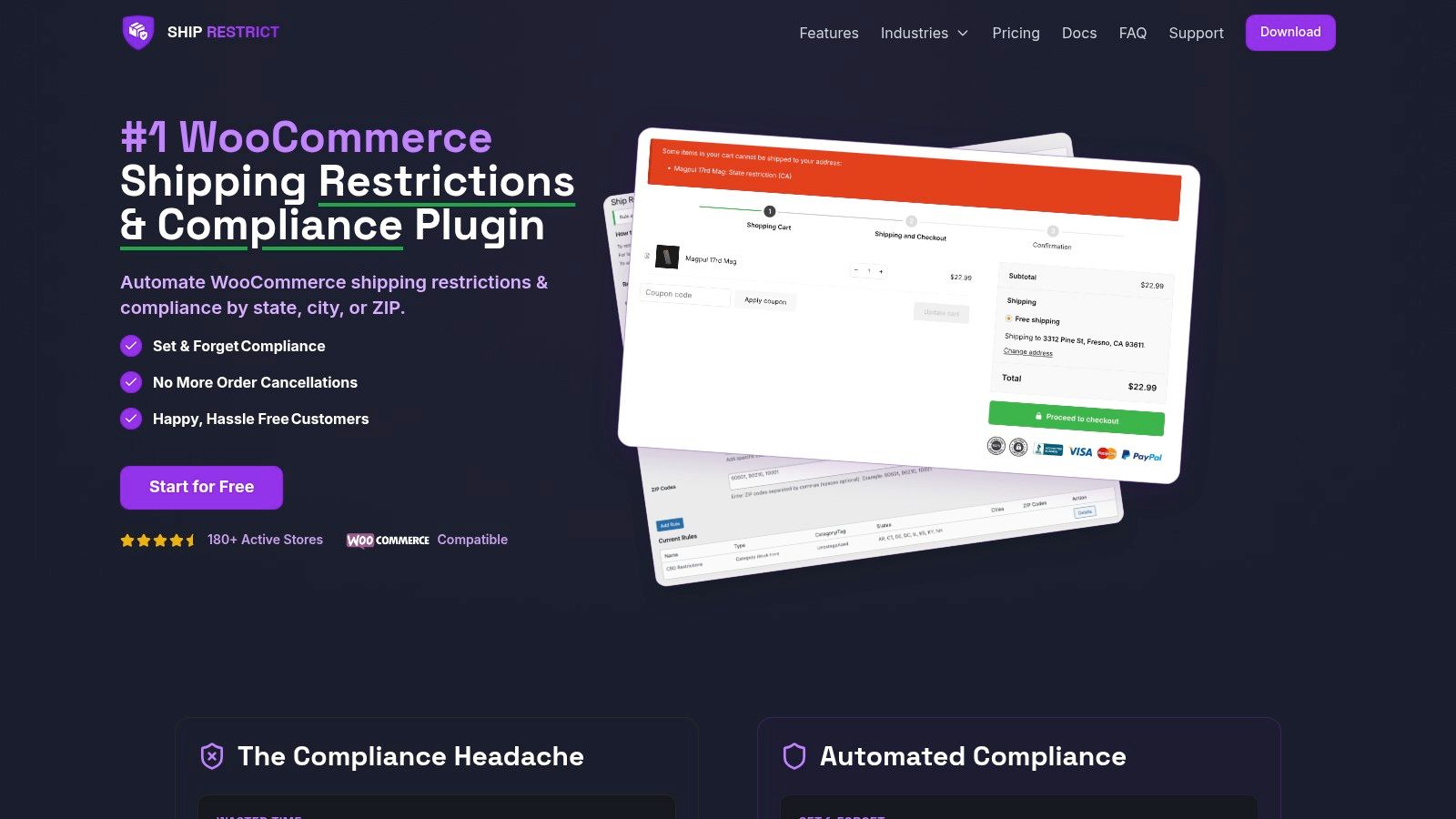
If your WooCommerce store handles regulated products, Ship Restrict gives you a practical way to enforce shipping rules before an order becomes a compliance problem. You can block incompatible shipping methods, restrict destinations by state, county, city, or ZIP code, and show customers clear messages at checkout instead of relying on manual review after payment. For merchants who want fewer preventable errors and tighter control over dangerous goods workflows, it's a strong way to turn policy into enforceable store logic.
Automate Shipping Compliance
Stop worrying about restricted states. Ship Restrict handles it automatically.

Cody Yurk
Founder and Lead Developer of ShipRestrict, helping e-commerce businesses navigate complex shipping regulations for regulated products. Ecommerce store owner turned developer.
Automate Shipping Compliance
- Block restricted states
- No more cancellations
- Set and forget
3-day free trial · Card required