DHL Dangerous Goods Declaration Automation Guide
A practical guide to DHL dangerous goods declaration automation. Learn to integrate systems, streamline compliance, and reduce costly shipping errors.
If you're still handling DHL dangerous goods declarations by hand, you're playing a high-stakes game of operational roulette. It's a process loaded with compliance risks and expensive errors, adding serious friction to your supply chain. A single typo on a form can get a shipment rejected, trigger fines, and cause delays that ripple through your entire operation.
This is where DHL dangerous goods declaration automation comes in. It’s about turning a major liability into a real competitive advantage by locking in speed, accuracy, and safety.
Why Manual Dangerous Goods Declarations Are a Thing of the Past
The old-school way of prepping DG declarations—manual data entry, flipping through paper charts, and double-checking everything by eye—isn't just slow. It's a minefield. A warehouse team member might misread a UN number, pick the wrong packing group, or just hit the wrong key. It happens.
Think about a real-world scenario we've seen before: a pallet of lithium batteries needs to go out by air freight. An operator manually types in the quantity but accidentally exceeds the per-package limit for passenger aircraft. Nobody catches it. The shipment gets all the way to a DHL sorting facility, where it’s immediately flagged and rejected.
Automate Shipping Compliance
Block orders to restricted states automatically. 3-day free trial.
Start Free TrialWhat's the fallout? A seriously delayed shipment, an unhappy customer, and the extra cost of pulling the order back and redoing everything. That one small mistake just ate into your profit margin and dinged your brand’s reputation for getting things done right.
The True Cost of Manual Errors
Beyond the obvious financial hit from a rejected shipment, the hidden costs of manual processing pile up fast. Every minute your team spends filling out forms and checking data is a minute they aren't spending on picking, packing, or customer service.
The total impact is much bigger than one bad shipping label. When you look into the true cost of manual order screening vs automated restrictions, you see how these little operational drags compound over time, holding back growth and ratcheting up your legal exposure.
Before we get into the nuts and bolts of DHL's requirements, it’s worth taking a step back and understanding workflow automation in general. It’s all about swapping out these traditional, error-prone manual tasks for efficient, predictable systems.
Automation isn't about replacing your team. It’s about getting rid of the high-risk, repetitive tasks that are magnets for human error. This frees up your people to focus on the exceptions and the big picture, turning a compliance headache into a smooth operational asset.
The Shift to Proactive Compliance
Relying on manual declarations is a fundamentally reactive strategy. You ship the package, cross your fingers, and only find out there’s a problem after it’s already causing one. DHL dangerous goods declaration automation flips that script entirely.
Instead, you create a proactive compliance framework where all the validation happens instantly, before a shipping label is even printed.
This automated approach gives you a few massive advantages:
- Reduced Human Error: Data is pulled straight from your product database or ERP, killing manual entry mistakes.
- Increased Speed: Declarations are generated in seconds, not minutes, which dramatically speeds up your fulfillment time.
- Enhanced Consistency: Every single declaration is built using the same validated business rules, so you get uniform compliance across every shipment.
By moving on from outdated manual methods, you're not just buying a piece of software. You're investing in a more resilient and efficient supply chain.
Getting a Handle on Dangerous Goods Shipping Regulations
Before you can even think about automating DHL dangerous goods declarations, you need a solid grasp of the rules. This isn't just about what DHL requires; it's a complex global framework built to keep the entire supply chain safe. Trying to automate this process without understanding the regulations is like building a house without a blueprint—it's just not going to work.
Free Shipping Compliance Audit
We'll review your WooCommerce store's shipping compliance for free.
The two names you absolutely must know in air freight are the International Air Transport Association (IATA) and the International Civil Aviation Organization (ICAO). These organizations set the global standards that every carrier, including DHL, lives by. Their rules dictate everything, from the exact label that goes on a box to the specific data points required on a declaration.
For decades, the standard was the paper-based Shipper's Declaration for Dangerous Goods (DGD). Anyone who’s been in logistics for a while knows this document well and the headaches that came with filling it out by hand. A single mistake—a wrong UN number, an incorrect packing group, or even a simple typo—was a recipe for disaster, leading to immediate shipment rejections, fines, and painful delays. That manual process was the number one source of non-compliance and a massive operational bottleneck.
The Critical Shift to Electronic Declarations
The logistics world has been pushing away from paper for years, and dangerous goods are no different. The real game-changer was the introduction of the electronic Dangerous Goods Declaration, or e-DGD. This digital standard finally allows shippers, freight forwarders, and airlines to exchange declaration data electronically, creating a single, reliable source of truth for every shipment.
This isn't just about convenience. It’s a direct answer to the ridiculously high error rates of the old paper forms. Digital data can be validated automatically, checked against regulatory databases in real-time, and sent instantly. For a carrier like DHL, this means packages move faster, require fewer manual checks, and carry a much lower risk of a non-compliant shipment ever entering their network.
The move from paper DGDs to electronic e-DGDs is the single most important driver for automation. Your automated system must be built to generate and transmit data that meets these modern digital standards, not just replicate an old paper form.
This shift toward automation in air freight isn't happening in a vacuum; it’s part of a global regulatory push for better accuracy and compliance. As far back as 2009, both ICAO and IATA officially began supporting e-DGDs. The movement gained serious momentum in March 2018 when the IATA Cargo Services Conference endorsed a data-sharing platform policy for e-DGD, cementing the industry's commitment to a paperless, faster, and more accurate process. You can discover more insights about logistics automation at DHL.
How Global Standards Impact Your Automation Setup
Understanding these regulations directly impacts every part of your automation setup. You can't just toss random product data at DHL's system and hope for the best. Everything you send must be structured to meet the precise requirements of the IATA Dangerous Goods Regulations (DGR).
Here’s what that means in practice:
- Data Mapping is Crucial: Your product database must have dedicated fields for the UN Number, Proper Shipping Name, Class, and Packing Group. Your automation software has to map these details perfectly to the corresponding fields in DHL's API or EDI message. No exceptions.
- Business Rules Must Reflect Regulations: Your system needs built-in logic to catch problems before they happen. For instance, it should automatically prevent an order for a flammable liquid from being shipped with a service that prohibits it. For a deeper look at this, check out our guide on managing hazmat shipping restrictions in WooCommerce.
- Labeling and Documentation: A good automation system doesn't stop at the e-DGD. It should also generate the correct hazard labels and markings required for the physical package itself.
By building your DHL dangerous goods declaration automation strategy on this foundation of global standards, you graduate from simply filling out a form faster to creating a truly compliant and resilient shipping operation. It's not just about dodging penalties—it's about building a system that guarantees safety and efficiency from the moment an order is placed to its final delivery.
Integrating Your Systems With The DHL Network
This is where the magic happens. Connecting your internal systems—like your ERP or e-commerce platform—directly to DHL’s network is the technical heart of automating your dangerous goods declarations. It's how you turn a manual, error-prone process into a seamless, compliant workflow.
The whole point is to establish a direct line of communication. Your system sends the necessary dangerous goods information to DHL in real-time, gets a validation response, and generates a compliant shipping label instantly. This is what permanently eliminates the risks and delays of manual data entry.
The industry is moving away from paper declarations and embracing digital standards like the electronic Dangerous Goods Declaration (e-DGD). This shift is the foundation for effective DHL dangerous goods declaration automation.
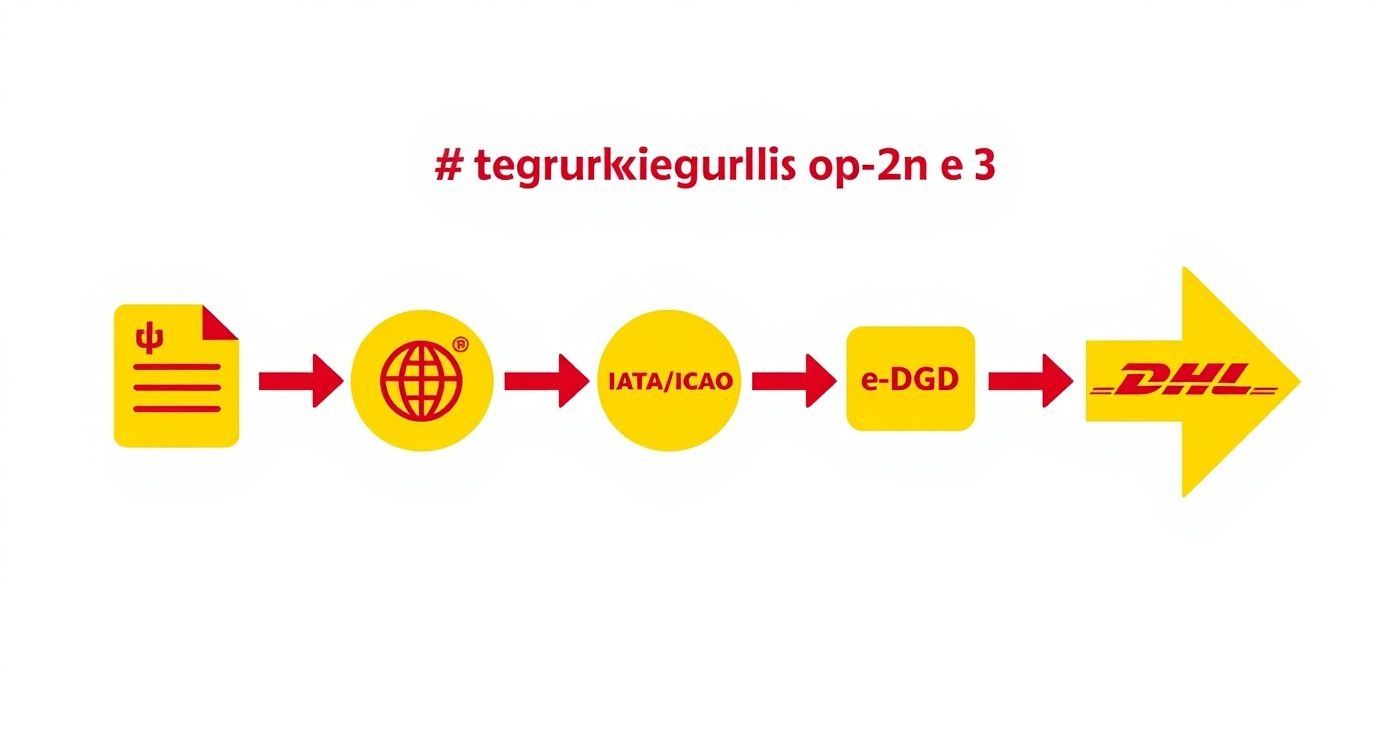
This workflow shows exactly how data flows from your system, through international regulatory checks, and into DHL’s network, creating a fully digital and auditable trail.
Choosing Your Integration Path: API vs. EDI
To build this connection, you generally have two options: an API (Application Programming Interface) or EDI (Electronic Data Interchange). They both get data from point A to point B, but they work very differently. Your choice really depends on your company's technical skills, shipping volume, and the systems you already have in place.
An API is the modern, flexible choice. It uses web-based protocols that let different software applications talk to each other directly in real-time. Think of it as a fluent translator that helps your system and DHL's system have an instant conversation.
EDI, on the other hand, is the old-school, highly standardized method. It's been the backbone of B2B communication for decades, relying on rigid, structured file formats like EDIFACT to exchange business documents in batches.
Deciding between them is a big step. This table breaks down the key differences to help you figure out which path makes the most sense for your business.
API vs EDI Integration for DHL Declarations
| Feature | API (Application Programming Interface) | EDI (Electronic Data Interchange) |
|---|---|---|
| Speed & Flexibility | Real-time, synchronous communication. Highly flexible and easy to adapt. | Batch-based, asynchronous processing. Rigid structure, making changes difficult. |
| Technical Skillset | Requires modern web development skills (JSON, REST). Common for SaaS platforms. | Requires specialized EDI knowledge and often a third-party VAN (Value-Added Network). |
| Implementation Cost | Generally lower initial setup costs, especially with in-house developers. | Can be higher due to specialized software, consultants, and ongoing VAN fees. |
| Ideal Use Case | Perfect for businesses needing immediate feedback, like e-commerce checkouts. | Suited for large enterprises with high-volume, predictable batch transactions. |
For most businesses shipping dangerous goods today, especially in e-commerce, an API integration is the more practical and agile choice. That instant feedback is critical for validating an order right at the point of fulfillment, not hours later.
Mapping Your Product Data To DHL's Requirements
Whether you pick API or EDI, the most critical part of the project is data mapping. This is where you tell your system exactly which piece of your product information corresponds to each required field in DHL's declaration. If you get this wrong, your automation will fail every single time.
Your product catalog or ERP absolutely must have accurate, dedicated fields for all the required DG info. You can't just stuff it in a generic description field.
The essential data points you'll need to map include:
- UN Number: The four-digit code identifying the substance (e.g., UN1263 for paint).
- Proper Shipping Name: The official, standardized name of the material.
- Hazard Class: The risk classification (e.g., Class 3 for flammable liquids).
- Packing Group: The degree of danger (I, II, or III).
- Quantity and Type of Packaging: Specifics like "2 x 5L steel drums."
Let's say you sell industrial coatings through WooCommerce. A product in your store should have custom fields like "UN Code" and "Packing Group." Your integration middleware then needs to be configured to pull data from those specific fields and place it into the corresponding <UNNumber> and <PackingGroup> tags in the API request you send to DHL.
Pro Tip: Never use generic fields like "description" to store critical DG data. Create dedicated, validated custom fields in your source system from day one. This discipline makes mapping cleaner and drastically cuts down the chance of sending incorrect information.
Getting your data flow right is a cornerstone of modern logistics. For those looking to connect various systems, understanding the principles of business automation SaaS integration is key to building a robust and scalable operation.
A successful integration ensures that every single dangerous goods shipment is backed by a compliant, digitally generated declaration. It transforms a complex regulatory headache into a reliable, automated part of your daily workflow.
Building Smart Validation and Error Handling Rules
A great automation system doesn't just work when everything is perfect; it shines when things go wrong.
Simply connecting your systems to DHL is only half the battle. A truly resilient DHL dangerous goods declaration automation setup is built to anticipate and gracefully handle failures. This means designing smart business rules that catch declaration errors before they ever reach DHL's network, preventing rejections and compliance headaches down the line.
Think of it as creating a digital gatekeeper. This gatekeeper validates every piece of data against a predefined set of rules, ensuring that only compliant, accurate declarations get transmitted. It’s a proactive approach that turns your automation from a simple data-pusher into an intelligent compliance engine.
This isn't just about slick technology; it's about raw operational efficiency. DHL itself has seen massive gains from this approach. Its Global Forwarding and Freight (DGFF) division deployed over 160 software robots to automate data processing for dangerous goods. This initiative resulted in a 50% immediate boost in operational efficiency. You can dig into the details of DHL's digital customs initiatives to see the impact firsthand.

Identifying Common Declaration Errors
To build effective validation, you first have to know what you’re looking for. From my experience, most shipment rejections stem from a handful of common, entirely preventable errors. Your system's logic should be laser-focused on catching these specific issues.
Here are the top offenders your validation rules must target:
- Incorrect UN Numbers: A simple typo, like entering UN1236 instead of UN1263, is an instant failure. Your system absolutely must validate UN numbers against an authoritative list.
- Quantity Mismatches: This happens all the time. The declared quantity of a hazardous material exceeds the per-package or per-aircraft limits set by IATA regulations.
- Invalid Packing Groups: Assigning Packing Group I (high danger) to a substance that only qualifies for Packing Group III (low danger) is another frequent mistake.
- Missing or Incomplete Data: A declaration gets submitted without a required field, like the Proper Shipping Name or the shipper's contact information.
By programming your system to check for these specific problems, you can filter out the vast majority of errors that would otherwise cause a shipment to be flagged and returned.
Designing an Intelligent Error Handling Protocol
When a validation rule trips an alarm, what happens next is just as important as the rule itself. A silent failure is useless. You need a clear, automated protocol that alerts the right people and gives them the information needed to fix the problem fast.
Your error handling shouldn't just tell you that an error occurred; it must tell you why it occurred. A message like "Error 500" is unhelpful. A message like "Validation Failed: UN1993 quantity exceeds 30L limit for passenger aircraft" is actionable.
A robust error handling workflow should include several key components to ensure nothing falls through the cracks.
Automated Alerts and Notifications
The moment a declaration fails validation, your system must act. Don't wait for a human to stumble upon the problem hours later.
- Instant Team Notifications: Configure your system to send an immediate alert via email, Slack, or whatever internal tool you use. This message should go directly to the logistics or fulfillment team responsible for dangerous goods.
- Clear Error Messaging: The alert must contain the order number, the specific product causing the issue, and the exact validation rule that failed. This clarity is non-negotiable for a fast resolution.
- Automatic Order Hold: The order should be automatically placed in an "On Hold" or "Requires Review" status in your ERP or e-commerce platform. This simple step prevents a well-meaning team member from accidentally shipping a non-compliant package.
Establishing a Manual Review Process
Automation handles the routine, but you still need humans for the exceptions. A failed validation should trigger a clear, documented process for manual intervention.
This process ensures that a trained team member reviews the flagged order, corrects the underlying data in your source system (like updating incorrect product information in WooCommerce), and then re-initiates the declaration process. This human-in-the-loop approach combines the speed of automation with the critical thinking of an expert.
Maintaining a Bulletproof Audit Trail
Every action, whether it's a success or a failure, must be logged. An audit trail is your best friend during an internal review or, worse, an official carrier audit. Your system absolutely needs to record:
- The initial data submitted for the declaration.
- The exact time the validation failed.
- The specific error message that was generated.
- Which user manually reviewed and corrected the issue.
- The successfully re-submitted declaration data.
This detailed log provides complete visibility into your compliance process, proving that you have a systematic approach to catching and correcting errors. It's an essential part of any mature DHL dangerous goods declaration automation strategy, minimizing your legal exposure and demonstrating due diligence.
Testing and Deploying Your Automated Workflow
<iframe width="100%" style="aspect-ratio: 16 / 9;" src="https://www.youtube.com/embed/KppHXxAUpHU" frameborder="0" allow="autoplay; encrypted-media" allowfullscreen></iframe>You’ve built the integration and hammered out the validation rules. That’s a huge win, but don’t pop the champagne just yet. Going live with DHL dangerous goods declaration automation without exhaustive testing is like flying blind into a storm—a completely avoidable risk. A single logic flaw could bring your entire shipping operation to a screeching halt, leading to a pile-up of rejected shipments and angry customers.
This is where a methodical, almost adversarial, testing plan becomes your best friend. The goal isn't just to see if it works; it's to find every possible way it could break in a controlled environment. This phase is all about earning your confidence in the system before it ever touches a real package.
Leveraging the DHL Sandbox Environment
DHL provides the perfect proving ground for this: a sandbox or testing environment. Think of it as a full-featured replica of their live system where nothing is real. You can fire off test declarations, get real-time API responses, and even generate sample shipping labels without accidentally dispatching a package or racking up charges.
Working inside this sandbox is non-negotiable. It’s your playground to safely trace the entire data flow, from the moment your system makes an API call to the final declaration landing in DHL's system. This is where you prove that the data mapping you spent so much time on actually translates perfectly into DHL’s required formats.
It’s easy to forget that not long ago, this was all done on paper, a manual process riddled with human error. The push for digitization has been a game-changer. During the pandemic, for instance, DHL fast-tracked its move to an electronic flight bag system. Pilots could suddenly access critical DG data on iPads instead of shuffling through stacks of paper, a testament to how digital workflows crush inefficiency. You can get a sense of DHL’s aviation digitization efforts and see how this mindset improves accuracy across the board.
Building a Comprehensive Test Plan
A good test plan doesn't just confirm success paths. It actively hunts for failure. You need to dream up a diverse portfolio of test cases that cover every weird, complex, and problematic scenario your product catalog can throw at it. Your mission is to expose every edge case and weakness now, not when a customer’s order is on the line.
Your test plan should feel like a stress test, including scenarios like:
- Every Hazard Class: Don't just test one product. Run declarations for every class you carry, from flammable liquids (Class 3) and corrosives (Class 8) to trickier items like lithium batteries (Class 9).
- Complex International Orders: Create test shipments to countries with notoriously strict import rules. This is how you validate that your system handles country-specific data fields correctly.
- Quantity Limit Breaches: Intentionally create orders that blow past IATA's quantity limits for both passenger and cargo-only aircraft. This is a crucial check to see if your validation rules are actually doing their job.
- Bad Data Submissions: Try to send declarations with garbage data. Use fake UN numbers, leave out the packing group, or submit an incomplete shipper address. This is how you test your error-handling and ensure it fails gracefully.
Think like a regulator. Your testing should be designed to find every possible point of failure. A declaration that works for a simple domestic shipment might fail spectacularly for a multi-item international order. Cover every angle.
For a more structured framework, you can pull ideas from our Ship Restrict testing guide to build out your specific test cases.
Executing a Phased Rollout
Once your system has survived the gauntlet of testing and you're feeling confident, resist the urge to flip the master switch. A phased rollout is infinitely safer and lets you manage the transition without chaos. You get to monitor the system's real-world performance with a limited blast radius, just in case something unexpected pops up.
Here’s a practical checklist to guide you from the sandbox to full production:
- Start Small: Begin by enabling the automation for a single, specific service, like DHL Express Worldwide.
- Keep it Internal: For the first few days, only use the new workflow for internal test shipments or orders sent to a friendly address (like your own office).
- Watch the Logs: Keep a close eye on your system's audit trail and the API response logs from DHL. Look for any errors or warnings, no matter how small.
- Expand Gradually: Once you’ve confirmed everything is running like clockwork, slowly expand the automation to other DHL services and, finally, to all eligible dangerous goods shipments.
This methodical approach minimizes risk and gives your team time to adapt to the new process. It ensures your DHL dangerous goods declaration automation launches as a stable, compliant, and genuinely useful asset to your business from day one.
Common Questions on DHL Dangerous Goods Automation
Even with a clear plan, diving into an automation project like this can bring up a lot of questions. We see the same ones pop up time and again, from basic definitions to the "what if" scenarios that keep logistics managers up at night.
Let's walk through some of the most common questions we hear about automating DHL dangerous goods declarations.
What Is the Difference Between a DGD and an e-DGD?
This is probably the most fundamental question, and the answer really gets to the heart of why this automation is so critical.
A DGD (Dangerous Goods Declaration) is the classic paper form you’ve been filling out for years. It’s the document that gets printed, signed, and physically attached to a shipment. While it’s the original source of truth, it’s also painfully slow and a magnet for human error. One typo, one forgotten signature, and the whole shipment grinds to a halt.
An e-DGD is simply the digital version of that same declaration. Instead of ink on paper, the data flows electronically from your system directly into DHL's network. The real magic here is the massive boost in speed and accuracy. An e-DGD kills manual data entry, which in turn drastically cuts down on compliance mistakes and gets your shipments accepted at the terminal that much faster.
The move from DGD to e-DGD isn't just a format change—it's a complete process overhaul. It lets your systems talk directly to DHL's, which is the entire foundation of a modern, automated workflow.
Can I Automate Declarations for All Dangerous Goods Classes?
For the most part, yes. DHL has built its automated systems to handle the vast majority of dangerous goods classes you're ever likely to encounter, from everyday flammables and corrosives to more niche materials. Their API and EDI connections are designed to process the specific data required for nearly every regulated product.
But there are always outliers. The most extreme or sensitive materials, like certain Class 1 explosives or Class 7 radioactive goods, often have special protocols that fall outside standard automation. These high-risk items typically require extra manual checks or direct handling arrangements with DHL's dangerous goods team.
A couple of pro tips here:
- Always have DHL's specific guidelines on hand for the products you ship. Don't guess.
- Talk to DHL’s integration specialists early in the project. Confirm that your entire product catalog is supported before you start building.
A little proactive communication upfront can save you from designing a system around a product that was never going to fit the standard process.
What Data Points Are Most Critical to Map Correctly?
Every field on a declaration is important, but a few are absolutely non-negotiable. Get these wrong, and you're looking at an instant rejection from DHL's system. In our experience, errors in these five fields account for the vast majority of failed automated declarations.
Make sure your data mapping and validation rules are ironclad for these five:
- UN Number: The four-digit universal ID for the substance.
- Proper Shipping Name: The official, regulated name—no abbreviations or trade names.
- Hazard Class: The risk category (e.g., Class 3, Class 8).
- Packing Group: The assigned danger level (I, II, or III).
- Quantity and Type of Packaging: The exact amount and description of the container.
A mistake in any one of these is a guaranteed red flag. If you can nail the mapping for these five fields, you’ve already eliminated 80% of your potential declaration problems.
What Happens If My Automated Declaration Fails?
This is where a good system really shows its value. A failure should never happen in a black box. When your system sends a declaration and gets an error back from DHL, a clear, automated workflow needs to kick in instantly.
A robust process doesn't just fail; it manages the exception. Here's what should happen:
- Stop the Label: The system must immediately prevent a non-compliant shipping label from being printed.
- Fire off an Alert: Your logistics team should get an instant notification with the order number and the exact error message from DHL, like "Invalid Packing Group for UN1263."
- Flag the Order: The order's status in your ERP or WMS should automatically change to something like "DG Review Needed," pulling it out of the main fulfillment queue.
This turns a failed DHL dangerous goods declaration automation attempt from a shipping disaster into a manageable task. Your team can quickly see the problem, fix the data at the source, and resubmit the declaration without causing a major bottleneck.
Managing shipping compliance for regulated goods doesn't have to be a manual struggle. With Ship Restrict, you can automate complex shipping rules directly within WooCommerce, preventing costly mistakes before they happen.
Take control of your shipping compliance with Ship Restrict today!
Automate Shipping Compliance
Stop worrying about restricted states. Ship Restrict handles it automatically.

Cody Yurk
Founder and Lead Developer of ShipRestrict, helping e-commerce businesses navigate complex shipping regulations for regulated products. Ecommerce store owner turned developer.
Automate Shipping Compliance
- Block restricted states
- No more cancellations
- Set and forget
3-day free trial · Card required