How to Ship Using Dry Ice: Guide & 2026 Regulations
Learn how to ship using dry ice safely & legally. Guide covers packaging, labeling, carrier rules, & compliance checklist for your business.
If you're preparing your first frozen shipment, you're probably juggling two worries at once. You need the product to arrive solidly frozen, and you need the carrier to accept the box without delay. Dry ice solves the temperature problem, but it also turns an ordinary parcel into a regulated shipment with real safety consequences.
That usually becomes obvious at the packing table. A food brand ships steaks for the first time. A lab sends temperature-sensitive samples. A specialty retailer adds frozen inventory to an eCommerce catalog. Everyone starts with the same assumption: put it in a cooler, add dry ice, tape the box shut. That's where expensive mistakes happen.
Learning how to ship using dry ice isn't just about printing the right label. It's about building a package that vents correctly, survives handling, holds temperature for the full transit window, and meets the carrier's acceptance rules the first time.
The High Stakes of Shipping Frozen Goods
Frozen shipping fails in predictable ways. The box sits one transfer longer than expected, the insulation isn't matched to the route, the dry ice charge is too light, or the package is sealed too tightly. Any one of those errors can leave the recipient with thawed goods, a rejected package, or a safety issue that never should've happened.
Automate Shipping Compliance
Block orders to restricted states automatically. 3-day free trial.
Start Free TrialDry ice is powerful because it keeps shipments far colder than standard refrigerated packaging. That's exactly why businesses use it for frozen food, biotech materials, and other products that can't drift upward in temperature for long. But the same property that makes it useful also means you can't treat it like gel packs or regular coolant.
Practical rule: A dry-ice shipment is a cold-chain system, not just a box with coolant added at the end.
The businesses that get this right don't think in terms of a single packing step. They think in terms of hold time, venting, insulation, labeling, carrier acceptance, and who will receive the box on delivery day.
That's the difference between a one-off experiment and a repeatable shipping process.
The First Rule of Dry Ice Do Not Seal It
A first-time dry ice shipment often fails before the label goes on. The product is packed cold, the box looks secure, and someone tapes every seam tight because that feels safer. Then the package starts producing carbon dioxide gas in transit. If that gas cannot escape, the package design itself becomes the problem.
Dry ice is solid carbon dioxide. It does not melt into liquid water. It sublimates into gas, and that gas needs a path out of the package for the entire trip.

What vented packaging means in practice
Venting is a packaging decision, not a hole-punching exercise. The package still needs to protect the contents, hold its shape, and survive handling. It also needs to release carbon dioxide gas under normal shipping conditions.
The standard approach is a foam-insulated inner container inside a corrugated outer box, closed in a way that is secure but not airtight. The University of Oregon dry ice shipping guide also notes that the dry ice marking should be placed on a vertical side so handlers can see it while the package is stacked and moved.
That requirement exists for a practical reason. Dry ice is consumed throughout transit, not just at drop-off. If the gas release path is blocked by a threaded lid, an airtight cooler, or overbuilt sealing, pressure can build while the box sits in a truck, on a belt, or in an aircraft container.
Free Shipping Compliance Audit
We'll review your WooCommerce store's shipping compliance for free.
Use a simple approval test before you pack. If the container would also be suitable for keeping air and moisture fully trapped inside, it is usually the wrong choice for dry ice.
Why this rule changes the rest of the shipment plan
Venting is tied directly to hold time, insulation, and dry ice quantity. As the same guide explains, dry ice disappears continuously during shipment, and the amount used depends on transit time, package design, and ambient conditions. That is why experienced shippers estimate the load before packing instead of adding a few pellets at the bench and hoping for the best.
A short local route and a two-day zone skip do not need the same dry ice charge. Neither does a compact insulated carton versus a large box with dead space. If you need a planning baseline before you build your packout SOP, this guide on how long dry ice lasts for shipping is useful for matching dry ice quantity to expected transit time.
This is also where new shippers make expensive mistakes. They focus on keeping the package colder for longer, then accidentally remove the venting margin that makes the design safe to transport.
Packaging choices that help, and choices that create risk
Good dry ice packaging balances three jobs at once. It holds temperature, releases gas, and stays durable through handling.
Use these rules:
- Use an insulated inner pack inside a corrugated outer box.
- Close the package so it stays shut without becoming airtight.
- Choose materials that tolerate very low temperatures without cracking or tightening into a seal.
- Place required markings where they stay visible on a side panel.
Avoid these setups:
- Airtight plastic coolers
- Threaded or screw-top lids
- Closures taped as if the goal is a watertight seal
- Household containers that become brittle or trap gas as temperatures drop
For a practical example of how experienced shippers build around insulation, stabilization, and transit stress, BlueRipple's packing process is worth reviewing. The product is different, but the operational logic is the same. Package for the actual trip, not for the moment it leaves your dock.
The costly mistake to avoid is simple. Do not treat venting as a minor compliance box to check. It is a design constraint that affects container choice, closure method, dry ice quantity, and whether the shipment can move through the carrier network safely.
How to Build a Compliant Dry Ice Package
A reliable dry-ice package is built in layers. The inner layer manages temperature. The outer layer manages handling. The space around the product affects how quickly your dry ice disappears, which is why packing technique matters as much as the amount of ice you buy.
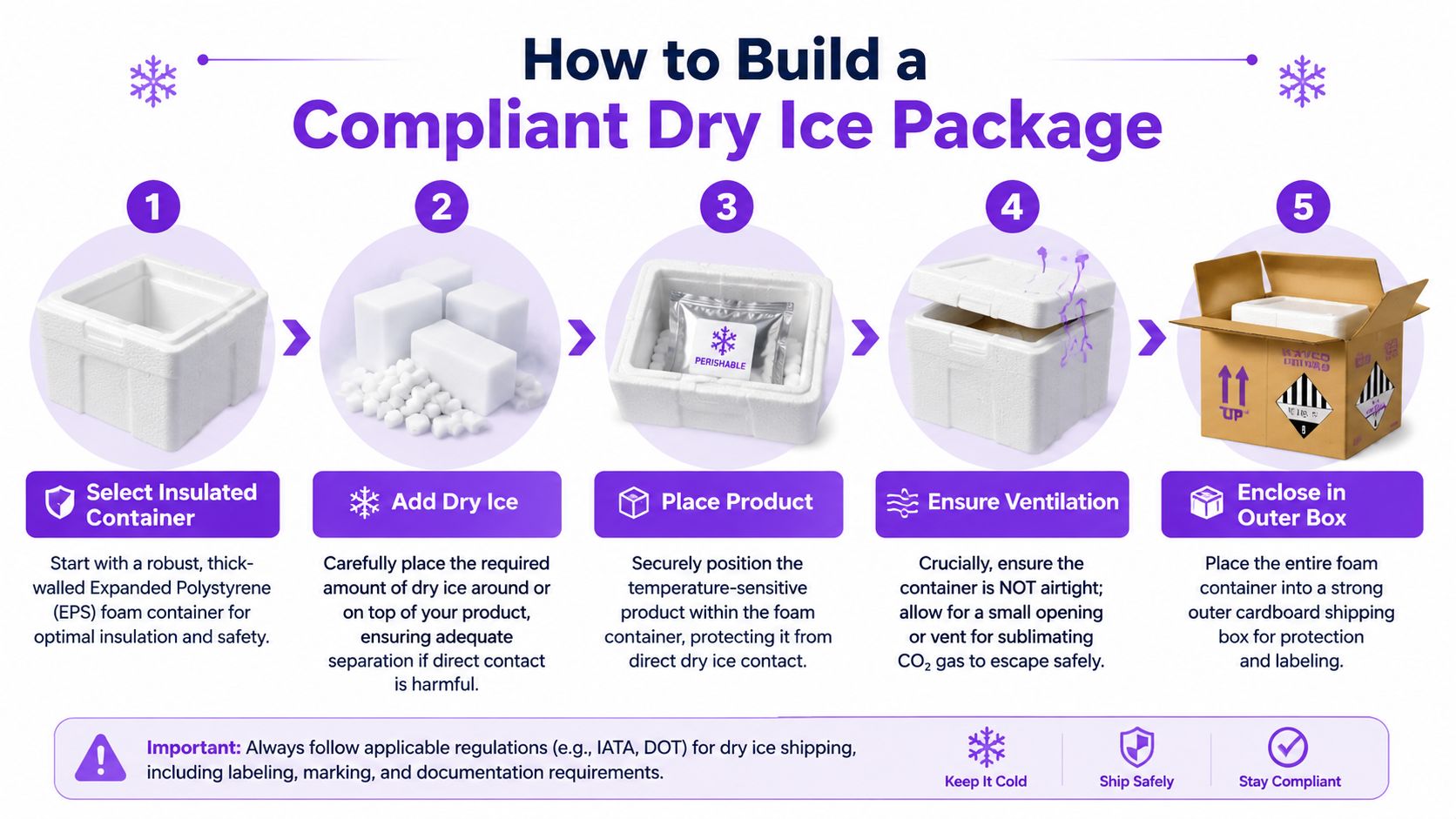
Start with the right container system
The standard build is simple and effective:
- Inner insulation: Use a foam-insulated container.
- Outer protection: Place that insulated pack inside a corrugated shipping box.
- Cold-ready materials: Avoid plastics that can become brittle at dry-ice temperatures.
- Stable fit: The contents shouldn't shift as the dry ice sublimates and the interior changes.
This is the same general logic you'll see in niche cold-chain businesses. For a useful real-world packing example, BlueRipple's packing process is worth reviewing because it shows how experienced shippers think about insulation, stabilization, and transit stress, even though the product type is different.
Estimate the dry ice load from transit time
One of the few quantified planning baselines available from major carriers is that dry ice sublimates at roughly 5 to 10 pounds per 24 hours, and UPS notes that the exact rate depends on the EPS foam container's density, according to the UPS dry ice shipping guidance.
That gives you a practical framework:
- Shorter transit and stronger insulation: Plan near the lower end of the range.
- Longer transit, warmer weather, or weaker insulation: Plan toward the higher end.
- Large void space or frequent handling: Expect faster loss.
Don't turn that baseline into false precision. Dry ice planning is not a spreadsheet exercise where one formula guarantees success. It's a controlled estimate, then a packing standard, then repeated validation over actual shipments.
The right question isn't "How much dry ice fits?" It's "How much dry ice will still be there when the box reaches the customer?"
If you need a supplemental explainer on hold time assumptions, this guide on how long dry ice lasts for shipping is a useful companion when you're setting your internal packing SOP.
A hard carrier cap also matters here. FedEx caps dry ice at 200 kg per package, as noted in the UPS summary of carrier requirements in the linked guidance above.
Later in the packing process, this walkthrough is worth watching because seeing the sequence helps teams standardize the bench routine:
<iframe width="100%" style="aspect-ratio: 16 / 9;" src="https://www.youtube.com/embed/EOJT3chzz2s" frameborder="0" allow="autoplay; encrypted-media" allowfullscreen></iframe>Pack in the correct order
The most dependable bench workflow looks like this:
- Pre-cool the product so you aren't asking the dry ice to remove avoidable heat from room-temperature contents.
- Pre-cool the package when possible. A warm box burns through cold capacity early.
- Position dry ice around the contents and on top while protecting the product from any direct contact that could cause damage.
- Fill empty space so air gaps don't accelerate sublimation.
- Secure the contents so they won't shift as the dry ice load shrinks in transit.
- Close the package securely but not airtight.
A frequent mistake in first shipments occurs when teams focus on "enough ice" and ignore pre-conditioning. If the contents go into the box warmer than they should be, the dry ice gets consumed doing catch-up work instead of preserving temperature.
Build around the transit promise, not the ideal route
The safest workflow is to choose a service level with a delivery commitment that is at least 12 hours shorter than the maximum thaw window you can tolerate, based on FedEx operational guidance for dry ice shipments. That buffer matters because cold-chain planning should absorb normal transport variation, not collapse the moment a shipment runs less than perfectly.
In practice, the best dry-ice shippers don't ask whether the package can survive the best-case transit lane. They ask whether it can survive a realistic one.
Mastering the Required Labels and Documentation
Packing keeps the shipment cold. Labeling tells every handler what they're dealing with. If the markings are missing, incomplete, or hidden, the package can be delayed or refused even if the insulation job is perfect.
For dry ice, the outer package has to communicate a regulated refrigerant, not just a frozen product.

The non-negotiable markings
FedEx's dry ice guidance requires parcels to be marked with UN1845 / Dry Ice / Carbon dioxide, solid, along with the net weight in kilograms. For air transport, the package may also require a Class 9 hazardous-materials label, and FedEx states a 200 kg per package cap in that same guidance, which you can review in the FedEx dry ice shipping requirements.
That breaks down into a simple acceptance checklist:
- Proper identification: The package must say UN1845.
- Recognizable substance name: Use Dry Ice or Carbon dioxide, solid as required by the carrier workflow.
- Weight declaration: State the net weight in kilograms.
- Air shipments: Add the Class 9 label when required.
- Readable placement: Put labels where handlers can still see them during normal stacking and movement.
Why these details matter on the dock
These aren't bureaucratic extras. Dry ice creates carbon dioxide gas as it sublimates, so every transfer point needs to know what's in the package and how much refrigerant is inside. The weight declaration isn't just paperwork. It helps carriers assess handling and compliance for regulated transport.
A frequent mistake is printing the right wording but placing it poorly. If the box is palletized, stacked, or turned during handling, a top-only mark can disappear from view. That's why side-panel visibility matters so much in real operations.
A compliant label hidden on the wrong panel is operationally close to no label at all.
Documentation mistakes that trigger avoidable problems
The most common failures are boring, which is why they keep happening:
- Missing kilogram weight: Teams know the pounds loaded at the bench but never convert and print the declared kilogram amount.
- Obscured marks: Over-taping, shrink wrap, or paperwork pouches cover required information.
- Mismatch between package and paperwork: The declared refrigerant details don't match what the carrier sees on the box.
- International assumptions: Shippers focus on domestic hazmat rules and forget the customs side.
When a shipment crosses a border, customs paperwork becomes its own risk point. If your team is still building that process, this resource on avoiding costly customs errors is a practical reference because many shipping failures start with inaccurate declarations, not just bad packaging.
For broader internal process design, it also helps to keep a standing checklist against your hazmat SOP. This overview of hazmat shipping regulations is a useful benchmark when you're documenting what your staff must verify before release.
A simple pre-tender review
Before you hand off the package, stop and verify these points in order:
- Can a handler see the dry-ice mark on a vertical side?
- Does the package show UN1845?
- Is the dry ice named correctly?
- Is the net dry ice weight shown in kilograms?
- If moving by air, is the Class 9 label applied where required?
- Do the package details and shipment record match?
That final check takes less time than rebuilding a rejected box at the counter.
Carrier Rules for USPS UPS and FedEx
Carrier selection isn't a minor detail. It decides what services you can use, what labels apply, how much dry ice is allowed, and whether your team can tender the shipment at all.
Many first-time shippers compare only price and delivery speed. That's backwards. Start with service allowance and acceptance rules, then compare operational fit.
What changes by carrier
FedEx and UPS both publish dry ice procedures and allow dry ice under defined conditions. FedEx clearly states a 200 kg per package cap in its dry ice requirements, while the verified guidance here doesn't provide a matching USPS quantity figure, so any USPS decision should be confirmed directly against current postal rules before shipment tender.
That leaves a practical comparison like this:
| Carrier | Service Allowance | Max Quantity (Domestic Air) | International Allowed? |
|---|---|---|---|
| USPS | Limited and rule-dependent. Confirm current postal acceptance rules before shipping. | Not specified in the verified data provided here | Rule-dependent. Confirm directly with USPS before tender |
| UPS | Allowed under carrier dry ice procedures | Not specified in the verified data provided here | Rule-dependent based on service and destination |
| FedEx | Allowed under carrier dry ice procedures | 200 kg per package | Rule-dependent based on service and destination |
How to choose the right carrier for the shipment
A small frozen parcel and a sensitive regulated shipment shouldn't be treated the same way. Use these decision criteria instead of guessing:
- If acceptance certainty matters most: Review the carrier's dry ice workflow before you print the label, not after the box is packed.
- If you're shipping by air: Pay extra attention to hazard labeling and weight declaration requirements.
- If the destination is international: Confirm both carrier acceptance and destination-country import rules before order release.
- If the product has a narrow thaw tolerance: Pick the service around hold time risk, not just the advertised transit speed.
Common carrier mistakes
The biggest operational failures aren't exotic. They're routine process errors:
- A team selects a service that doesn't match the package setup.
- The shipment is packed correctly but tendered with incomplete marks.
- Someone assumes international dry ice shipping works like domestic.
- The shipping desk doesn't know whether the parcel is moving through an air network, so the Class 9 requirement gets missed.
Carrier compliance starts before pickup. Once the carton is sealed, your options narrow fast.
For businesses sending frozen goods through UPS, this guide on shipping frozen food via UPS is useful because it helps translate general carrier rules into product-specific shipping decisions.
A practical way to think about carriers
Don't ask which carrier is best in general. Ask which carrier is workable for this shipment.
That means matching four things:
- Product requirement
- Packaging design
- Service level
- Destination rules
If one of those doesn't line up, the shipment is wrong before it leaves your facility.
Automating Compliance and Advanced Cold Chain Strategy
A lot of businesses reach for dry ice too early. That's understandable. It feels like the safest answer. But the right cold-chain decision starts with the product temperature requirement, not the coldest tool available.
According to the verified operational guidance from Shipfare, gel packs are often sufficient for products that only need to stay at 32–40°F, while dry ice is reserved for shipments that must remain at or below 0°F, as outlined in this dry ice versus gel pack guidance.
When dry ice is the wrong answer
If the product only needs refrigeration, dry ice can create unnecessary complexity:
- It changes the package into a regulated shipment.
- It adds venting and marking requirements.
- It can create a rougher customer experience when recipients aren't prepared to handle leftover dry ice.
- It may increase handling burden without adding useful protection.
For mixed catalogs, that decision shouldn't be left to warehouse intuition. A store selling frozen products, chilled products, and ambient accessories needs rules that determine packaging before the order ever reaches the bench.

Build rules before the customer checks out
At this stage, cold-chain operations start to overlap with shipping compliance systems. Once a business scales past occasional manual shipments, the expensive mistakes usually happen upstream:
- The customer chooses an address you don't want to serve with frozen delivery.
- A mixed-temperature cart creates packaging conflicts.
- The selected service isn't appropriate for the product class.
- The recipient won't be available on the intended delivery day.
Those aren't box-packing problems. They're order-control problems.
One way to handle that in WooCommerce is to automate shipping restrictions before checkout. Ship Restrict is a plugin that lets merchants apply location-based shipping restriction rules by state, county, city, or ZIP code, which can help prevent non-shippable orders from being placed in the first place. In a cold-chain context, that kind of rule engine can support operational policies such as blocking certain destinations, limiting methods for specific products, or requiring tighter controls for sensitive items.
Standardize decisions, then standardize packing
The mature approach looks like this:
- Classify products by temperature need
- Assign the right packaging type
- Limit shipping methods by product class
- Block destinations that don't fit the cold-chain model
- Train the bench team to execute a narrow set of approved packouts
That matters because a cold chain is only as reliable as the number of exceptions your staff is expected to remember. If every order requires a judgment call, errors become routine.
The best compliance process is the one your team doesn't have to improvise.
When businesses ask how to ship using dry ice reliably, the deeper answer is this: reduce the number of times people need to make fresh decisions under pressure. Decide early, automate what you can, and leave the packing bench with a short list of approved configurations.
Ship with Confidence Not Confusion
Dry ice shipping gets easier when you stop treating it as a mystery and start treating it as a controlled process.
The essentials are straightforward. Vent the package. Build the box in layers. Match the dry ice load to a realistic transit window. Mark the shipment correctly. Confirm the carrier's rules before tender. Most failures come from skipping one of those basics, not from some obscure hazmat edge case.
If you're building this process for the first time, don't aim for clever. Aim for repeatable. Use approved packaging, train your team on one bench routine, and document the acceptance checklist so nobody relies on memory at the counter.
That's how frozen shipments arrive in usable condition and how regulated parcels move without avoidable rejection.
A good dry-ice program isn't just compliant. It's predictable.
If you sell products with location-based shipping constraints, mixed compliance rules, or checkout scenarios that can create non-shippable orders, Ship Restrict can help you enforce those restrictions before payment is completed. That reduces manual review and gives your team a cleaner order queue to ship correctly.
Automate Shipping Compliance
Stop worrying about restricted states. Ship Restrict handles it automatically.

Cody Yurk
Founder and Lead Developer of ShipRestrict, helping e-commerce businesses navigate complex shipping regulations for regulated products. Ecommerce store owner turned developer.
Automate Shipping Compliance
- Block restricted states
- No more cancellations
- Set and forget
3-day free trial · Card required