USPS Mail Drop Guide for Regulated Goods
Master USPS mail drop for regulated goods: blue box rules, retail counter tips, and WooCommerce compliance workflows.
You're in the last ten minutes before cutoff, the labels are printed, the parcels are boxed, and somebody says, “Just toss them in the nearest USPS mail drop.” That shortcut feels harmless until one package disappears into an anonymous blue box with no receipt, no clerk handoff, and no clean proof that the Postal Service ever took custody. For a firearms retailer, that's not a minor inconvenience. It's exactly how a routine shipment turns into a customer dispute, a missing-mail headache, and a compliance problem you'll have to document after the fact.
USPS mail volume is still massive even after years of decline, which is part of why the system is easy to underestimate. The Postal Regulatory Commission says total volume peaked at 213 billion pieces in FY 2006 and fell to 108.7 billion pieces in FY 2025, a drop of about 49% (PRC state of the postal service). That scale matters because it explains why some drop points are built for speed, not traceability. If you move regulated goods, speed alone is a weak standard.
The Hidden Risk in Your Daily Mail Drop Routine
A firearms retailer can do everything right inside the box and still create risk at the drop point. The package may be packed correctly, labeled correctly, and addressed to the right recipient, but if it disappears into a collection box after the final pickup, the business loses the clean handoff record that often protects it later. That's where a convenience-first routine starts to break down.
A routine that looks efficient until something goes missing
A common scenario is simple. The shipping team finishes a late order, prints the label, and sends someone to the nearest blue box because it's on the way home. If the item is later delayed or unscanned, nobody can easily prove when USPS accepted it or which location received it, and the missing-mail process itself doesn't allow a search request until 7 days after mailing (USPS missing mail basics). That waiting period is not just annoying, it stretches uncertainty exactly when a customer is already asking for answers.
Automate Shipping Compliance
Block orders to restricted states automatically. 3-day free trial.
Start Free TrialPractical rule: If the shipment could affect an FFL, treat the drop point as part of compliance, not just logistics.
The operational mistake is assuming all drop points create the same evidence. They don't. A staffed counter can give you a documented handoff, and in some cases a receipt or acceptance scan, while an unattended box gives you little more than hope. When the package is sensitive, that difference becomes the whole story.
Why proof of acceptance matters more than convenience
For regulated goods, the sender usually needs more than “we dropped it somewhere.” They need a trail that shows the package entered USPS custody in a defensible way. That is why a drop routine built around evidence, not speed, tends to age better when a customer challenges a shipment or a regulator asks for records.
A better workflow starts before the driver leaves the warehouse. Pack the item, verify the address, decide whether the shipment needs a staffed acceptance point, and send staff with a clear instruction about which location to use. That sounds basic, but basic is what keeps a normal shipping day from becoming a compliance scramble.
Understanding USPS Mail Drop Options and Their Rules
USPS doesn't run on a single universal mail drop rule. The acceptance point changes what the Postal Service will take, what evidence you get back, and how much ambiguity you're accepting when the package leaves your hands. The USPS locations tool separates collection boxes, post office counters, self-service kiosks, and other retail acceptance points, and the practical rules depend on item type, label format, and package size rather than one blanket policy (USPS locations tool). That distinction is exactly what many generic shipping guides skip.
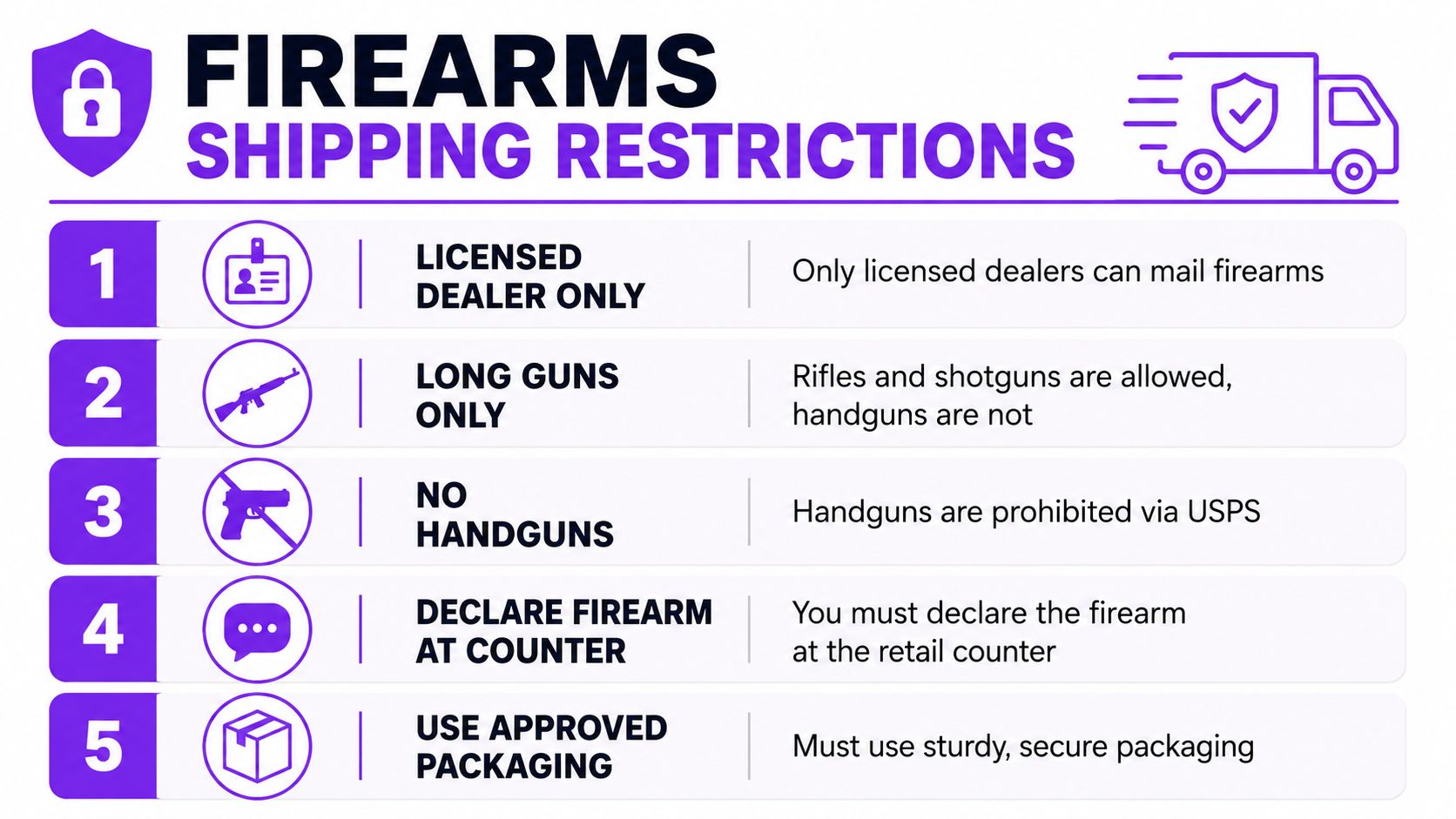
Blue collection boxes are built for simple mail, not judgment calls
Blue boxes are the easiest option to abuse because they look like a drop-off solution for everything. They're not. They're best understood as unattended acceptance points for ordinary mail, not a place to resolve edge cases, restricted content questions, or shipments where proof matters. If your package needs a clerk's review, a receipt, or any special handling, the box is the wrong tool.
Retail counters are the safer default for regulated shipments
A staffed counter is the place to use when the item requires handoff visibility or when your team needs help confirming the right mailing method. USPS's retail acceptance environment is designed for that kind of interaction, and that's why it matters for anything that sits outside routine letter mail. The counter gives you a person, a timestamped transaction, and the chance to catch an error before it disappears into the network.
If your shipment is prepaid, that doesn't automatically mean it belongs in a blue box. Prepaid labels solve postage, not eligibility. The question is still whether the item and the destination can be accepted at that exact location.
Self-service kiosks are convenient, but convenience has limits
Kiosks can help with postage and some deposit workflows, but they're not a substitute for a clerk when you need judgment, restricted handling, or documented acceptance. They work best for low-risk mail that doesn't need a human to say yes before it enters the system. If there's any question about the shipment category, use the counter.
Free Shipping Compliance Audit
We'll review your WooCommerce store's shipping compliance for free.
For regulated packages, the correct question isn't “Where is the nearest drop?” It's “Which acceptance point gives me the right proof?”
If you want a broader policy reference on carrier restrictions, the comparison in USPS restricted-mail permit requirements is a useful companion to the USPS location rules. And for merchants weighing carrier choices on regulated merchandise, UPS, FedEx, and USPS ammunition shipping differences helps frame why the last mile of acceptance matters so much.
The other practical layer is packaging visibility. Good warning labels, clear handling cues, and obvious outer packaging can reduce mistakes at the counter and in transit, which is why resources like warning labels from Storage & Removal Boxes can be useful when you're standardizing outbound carton marking. The label doesn't replace compliance, but it does help the handoff go smoothly.
Firearms and Ammunition Shipping Restrictions You Cannot Ignore
Firearms shipping is one of those subjects where generic advice does real damage. A retailer can't just ask, “Can USPS take this package?” and call it done. The core question is whether the item, the shipper, the recipient, and the acceptance point all satisfy the rules at the same time. If one of those pieces is off, the shipment becomes a compliance problem, not a shipping problem.
Long guns and handguns do not sit in the same bucket
Federal firearms compliance depends heavily on the type of firearm and who is sending it. Handguns are treated much more strictly than rifles and shotguns, and the sender has to know which category the item falls into before it ever gets near a USPS counter. For a firearms business, that means the inbound order review and the outbound mail drop decision are part of the same control system.
Practical rule: If you can't explain why the item is eligible for USPS handling, don't hand it over.
Documentation matters because shipping mistakes aren't just clerical. They can trigger disputes with the recipient, internal audits, or worse. A clean record starts with correct product classification and continues through the exact acceptance method used.
The counter is where restricted shipments get handled correctly
A counter transaction gives staff a chance to identify a problem before the item enters the stream. That's especially important for regulated items where the outer package, the shipment method, and the acceptance process all need to line up. If the package should never have gone into a collection box, the counter is the last practical checkpoint.
A useful mental model is simple. Collection boxes are for low-friction mail. The counter is for mail that needs a human decision. Regulated goods belong in the second category.
Ammunition deserves its own policy, not a shrug
Ammunition shipping is often misunderstood because people lump it together with firearms. That's a mistake. Merchants need separate handling rules, separate staff training, and separate carrier logic for ammo than they do for the firearm itself. If your team treats all regulated merchandise as interchangeable, the process will eventually fail.
The compliance angle also affects how you document the shipment internally. A clear record should show what was shipped, who approved it, and where it was accepted. That kind of recordkeeping is easier to defend than a memory of “we dropped it at the post office sometime Tuesday.”
One more useful operational tool is to borrow discipline from non-shipping compliance work. Merchants who use security compliance advantages as a framework tend to think better about controls, evidence, and audit trails. The same mindset applies here. You want a process that proves the shipment was handled correctly, not just a process that moves quickly.
Convenience Versus Compliance in Mail Drop Decisions
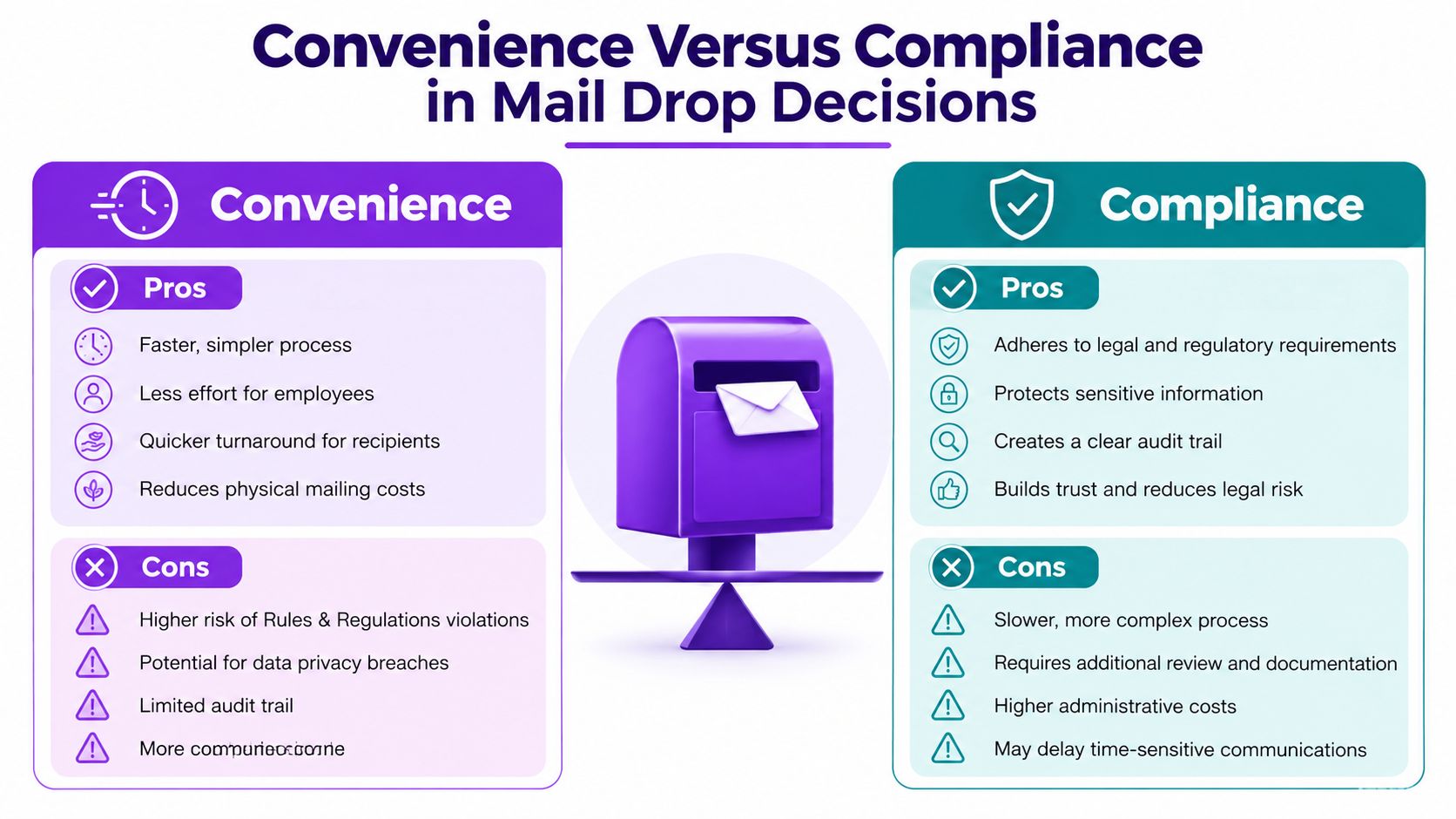
The convenience gap is easy to feel and hard to fix. A blue box is always there, always open, and always tempting when a route is already overloaded. A staffed counter takes more time, but it gives you a person, a receipt opportunity, and a cleaner compliance story when the shipment matters.
Convenience reduces friction, not risk
Anonymous drop points work best when the consequence of a delay is low. That's why ordinary correspondence can tolerate more ambiguity than regulated outbound shipments. When the package is sensitive, ambiguity becomes expensive because nobody can tell you whether the mail was received, accepted, or merely deposited somewhere outside the chain of custody.
The USPS missing-mail process makes that risk more visible because the wait to start a search is built into the system. If a package disappears after a box drop, the business is stuck in a quiet period before it can even escalate the issue (USPS missing mail basics). That delay is exactly why staff acceptance often feels slower but performs better in practice.
Proof beats assumption when the shipment is time-sensitive
The right standard for compliance-sensitive shipments is not “Was it mailed?” It is “Can we prove handoff and timing?” That's where a counter wins. The clerk interaction can produce evidence that a package entered USPS custody on that day, while a box drop leaves you dependent on later scans and location practices you don't control.
For merchants who want a broader view of process discipline, the discussion in how AY Automate handles logistics shows why repeatable workflows matter when operations scale. The principle is the same here. A process with clear checkpoints is easier to defend than one built on convenience and guesswork.
If the shipment could draw a question from a regulator, assume you'll need more than a memory and a tracking number.
Staffed acceptance is slower only until you need the record
The trade-off is straightforward. Blue boxes save time on the front end. Counters save time after something goes wrong. For regulated goods, that second kind of time usually matters more because it protects the customer relationship, the shipment record, and the business's ability to answer hard questions later.
Building a Compliant Fulfillment Workflow with Ship Restrict
The smartest mail drop routine starts before the parcel is packed. If the order can be blocked, redirected, or flagged earlier, the team never has to solve a problem at the counter. That's the value of automation in regulated fulfillment. It shifts the question from “Can we mail this today?” to “Should this order have reached shipping at all?”
Put the restriction decision at checkout
A WooCommerce store can use shipping restriction logic to stop bad orders before they enter the fulfillment queue. That is where a tool like Ship Restrict fits naturally, because it creates granular rules by state, county, city, or ZIP code and blocks restricted orders before checkout completion. You can read more about that kind of workflow in order fulfillment automation.
The practical benefit is simple. Staff spends less time on manual review, and compliance decisions happen while the customer is still on-site. That means fewer cancellations, fewer exceptions, and less temptation to “figure it out at the drop point.”
Use a workflow that reduces human judgment at the last mile
A disciplined process usually looks like this:
- Order comes in. The checkout layer checks the destination against your shipping rules before the order reaches fulfillment.
- The system flags exceptions. Restricted locations, products, or combinations are stopped early instead of being discovered during pack-out.
- Shipping staff reviews only edge cases. That keeps manual work focused on the shipments that need a person.
- Acceptance happens at the right USPS point. If the shipment needs proof or a clerk review, it goes to a staffed counter instead of a box.
- The business retains records. Each exception and approval is easier to explain later.
This workflow works because it separates policy enforcement from package movement. Too many merchants reverse that order and hope the shipping team can rescue a bad checkout decision ultimately.
Make the customer-facing message do part of the work
When customers understand restrictions during checkout, they're less likely to abandon carts out of confusion. Clear messaging also cuts down on support tickets asking why a location was blocked or why a product can't ship to a certain area. That's not just a better customer experience, it's a cleaner compliance environment.
If you need to explain why an order can't move forward, do it in plain language. Avoid legal clutter and focus on what the customer can do next. The best system is the one that prevents a bad shipment without turning every purchase into a paperwork fight.
Your Firearms Shipping Compliance Checklist
A strong compliance program is mostly about doing the same few things the same way every day. The error rate rises when someone improvises at pack-out or chooses a drop point based on convenience instead of evidence. A good checklist keeps those decisions from drifting.
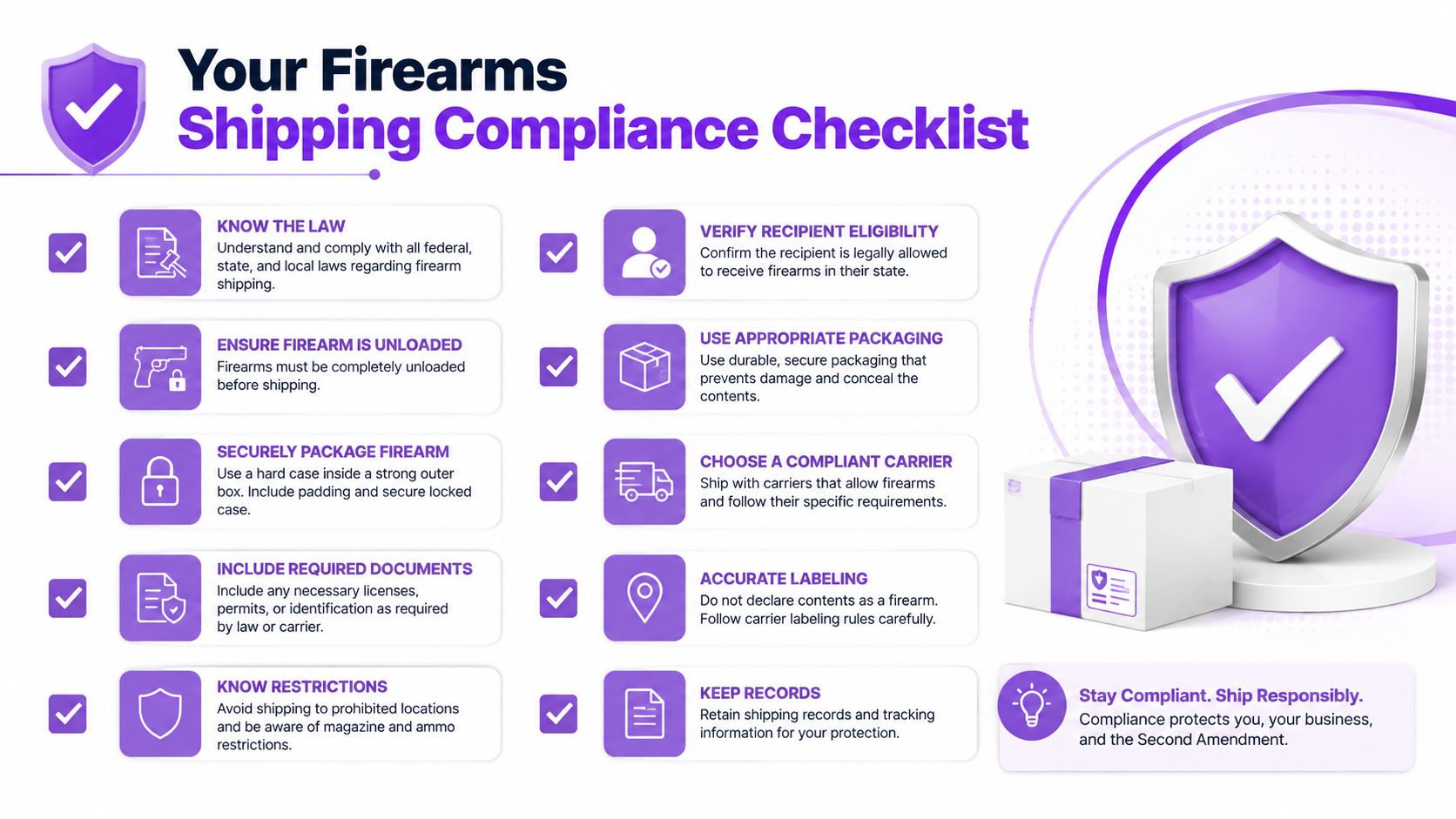
Daily checks that protect the shipment
- Verify the recipient and destination before label printing. That prevents a blocked order from reaching the shipping table.
- Confirm the item category. You want the firearm type, ammo status, and shipping method aligned before the package leaves the bench.
- Choose the acceptance point based on proof needs. If the shipment needs handoff evidence, use a staffed counter.
- Retain the transaction record. Keep the receipt, scan, or acceptance proof with the order file.
- Escalate anything uncertain. If staff can't explain why the shipment is eligible, it waits.
Weekly and monthly habits that keep the system honest
Once a week, review the exceptions. Look for patterns where staff keeps encountering the same destination conflicts or the same package-type confusion. Those repeated issues usually point to weak rules, not bad luck.
Once a month, audit the workflow from checkout to drop-off. Check whether the order was blocked early, whether the accepted shipment used the right USPS point, and whether the handoff record is still easy to retrieve. That review matters because good compliance degrades when the team gets busy.
Operational reminder: The fastest shipping day is the one where the wrong order never made it to the box stage.
If you want a broader automation lens, how AY Automate handles logistics is a useful reference for thinking about repeatable processes and exception handling. The same principle applies here. The less your team relies on memory, the fewer surprises show up at the drop point.
Scaling Compliance as Your Firearms Business Grows
A process that works for a handful of parcels can collapse when volume rises. More orders mean more exceptions, more destinations, and more opportunities for someone to use the wrong USPS drop method because the line was long and the clock was running. That's why manual compliance doesn't scale well in regulated commerce.
What usually breaks first is judgment. Staff start making fast calls under pressure, and those calls aren't consistent across shifts. Automation fixes that by moving the rule set out of the person and into the system, so the same blocked destination stays blocked whether the shipment is processed at noon or near closing.
The second failure point is documentation. The more packages you move, the easier it is for acceptance proof to get separated from the order record. A scalable workflow keeps the evidence attached to the shipment as a matter of routine, not as a special project when something goes wrong.
For a growing firearms eCommerce business, the answer isn't more manual review. It's tighter rules, earlier enforcement, and a USPS drop routine that assumes you'll eventually need to defend the handoff. That's the only model that stays sane as volume rises.
Ship Restrict helps WooCommerce merchants enforce shipping rules before an order reaches the fulfillment queue, which is exactly where most USPS mail drop mistakes start. If you're shipping regulated goods and want fewer exceptions, cleaner handoffs, and better proof around restricted destinations, visit Ship Restrict and see how automated compliance can fit your workflow.
Automate Shipping Compliance
Stop worrying about restricted states. Ship Restrict handles it automatically.

Cody Yurk
Founder and Lead Developer of ShipRestrict, helping e-commerce businesses navigate complex shipping regulations for regulated products. Ecommerce store owner turned developer.
Automate Shipping Compliance
- Block restricted states
- No more cancellations
- Set and forget
3-day free trial · Card required