Implementation Timeline: A Phased Rollout Plan For
Plan a realistic implementation timeline for shipping compliance in regulated eCommerce, including tasks, roles, and blockers.
You're staring at a shipping rule problem that already cost you a near-miss, or it's about to. The order almost went through to a restricted address, the customer service inbox is getting messy, and someone on the team says they can “just keep an eye on it manually.” That's the moment an implementation timeline stops being a project artifact and becomes a control system.
A good rollout for a WooCommerce firearms store doesn't start with dates. It starts with who owns the rule set, how restricted jurisdictions are validated, when testing happens, and what has to be true before the first real order is allowed through. The difference matters because implementation timelines in enterprise systems are often not linear, they're phase-gated, and schedule slippage usually comes from execution complexity, not optimism on a calendar. For context, small and midsize businesses commonly finish enterprise-system implementations in 3 to 9 months, while large businesses usually need 6 to 18 months according to NetSuite.
If you've been trying to run shipping compliance on tribal knowledge, you already know the weakness. One rep remembers a county rule, another remembers a ZIP-code exception, and nobody wants to be the person who says a customer's order has to be cancelled after checkout. That's why the timeline itself becomes the audit trail your business doesn't have yet, and why a structured website delivery model like a structured website development approach can be useful as a reference point when you're building dependencies, approvals, and release gates.
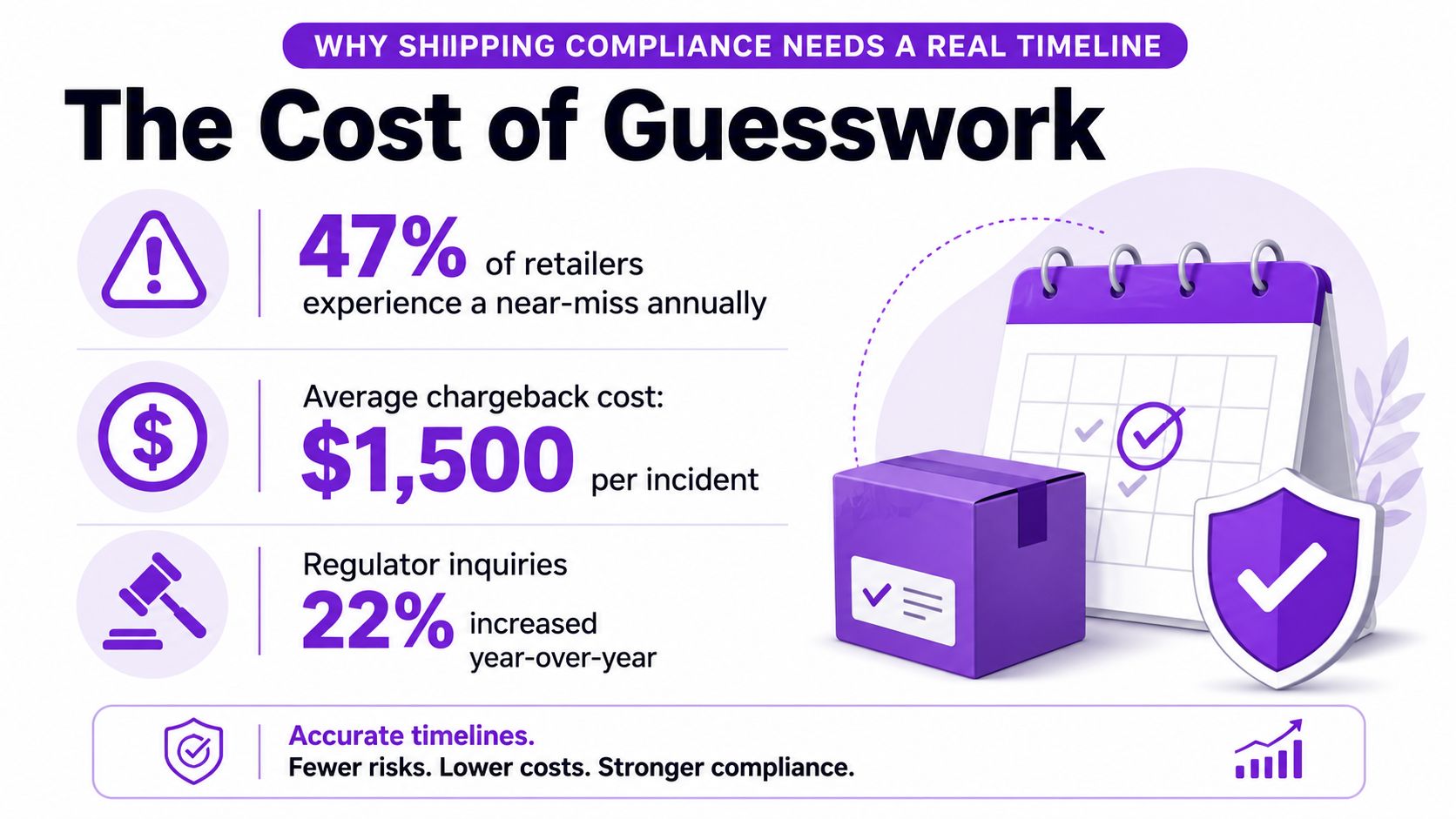
Why Shipping Compliance Needs a Real Timeline
The first sign that a firearms store needs a real implementation timeline is usually a bad almost-order. A restricted jurisdiction sneaks through the cart, a staff member catches it after checkout, and the order gets cancelled before fulfillment. That might feel like a save, but it's also proof that the business is running on memory, not controls.
Automate Shipping Compliance
Block orders to restricted states automatically. 3-day free trial.
Start Free TrialThe real issue is not speed, it's traceability
Shipping compliance failures rarely begin with bad intent. They start when the store grows faster than the rule set, or when a temporary exception turns into a permanent habit. Once that happens, nobody can show when a restriction was added, who approved it, or whether the current rule set matches current policy.
That's why the rollout should be treated like an operational control rather than a calendar exercise. A strong timeline gives you a record of validation, build decisions, testing outcomes, and launch approvals. In regulated categories, that record matters as much as the software itself.
Practical rule: if the team can't say who approved a rule, when it was tested, and what changed before go-live, the timeline isn't finished.
A generic project plan says, “launch in six weeks.” A control-oriented timeline says, “validate the jurisdictions first, then build rules, then test edge cases, then roll out in stages, then stabilize with assigned ownership.” That sequencing is much closer to how enterprise implementations succeed. Independent market analysis shows 80% of companies complete the planning-to-initial-rollout phase within 1 to 12 months, and best-in-class teams do it even faster, with 96% finishing in under a year according to BARC.
The business consequence is blunt. A staged rollout is slower than guesswork, but it avoids the much higher cost of one bad order, one compliance complaint, or one regulator inquiry that forces a post-hoc cleanup. For a firearms store, the timeline is the thing that proves the business knew what it was doing before the first restricted shipment ever reached a checkout page.
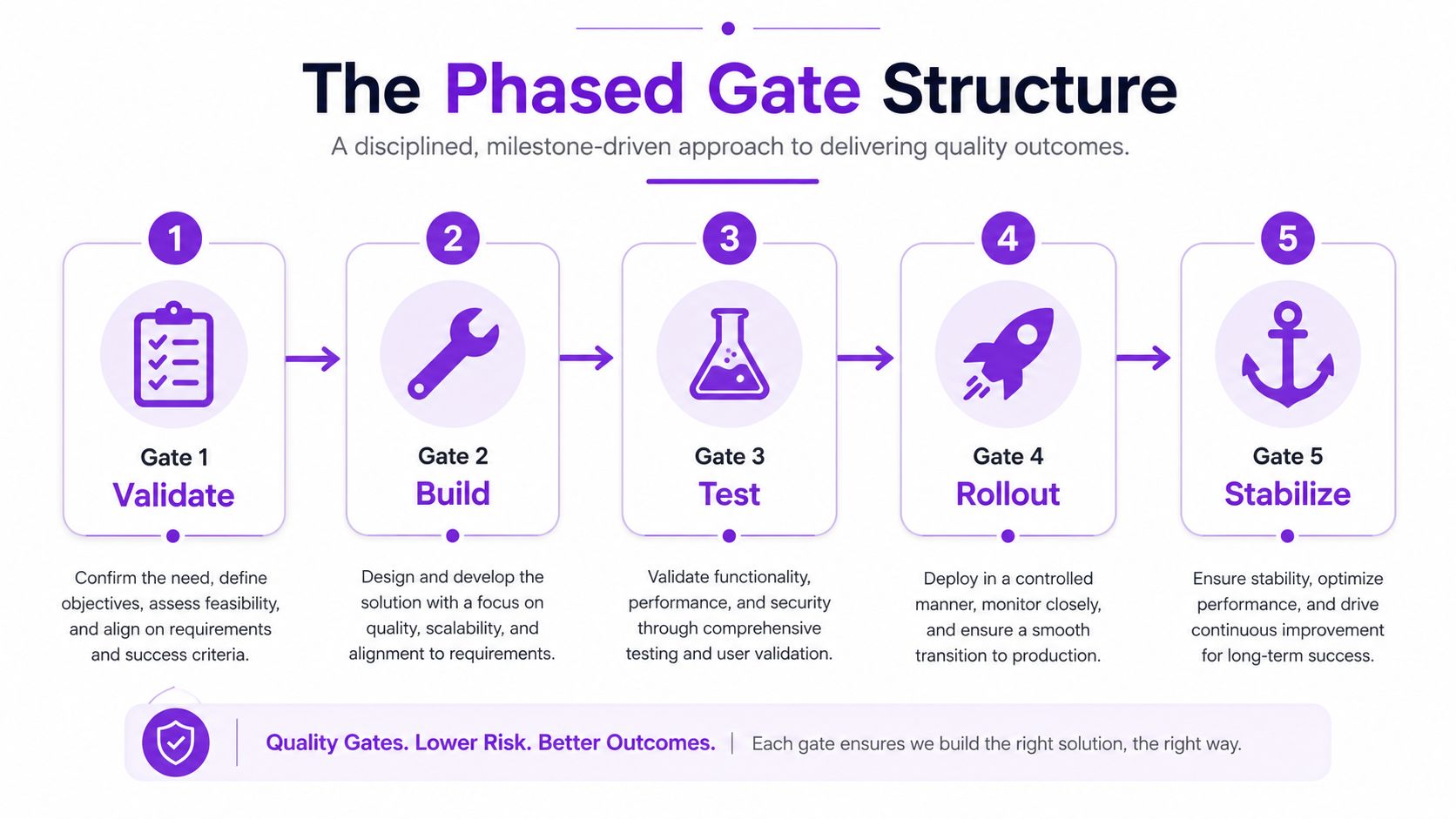
The Phased Gate Structure Behind a Strong Timeline
A useful implementation timeline is built like a gate system, not a list of hopeful due dates. The five phases that hold up in regulated shipping are validate, build, test, rollout, and stabilize. Each gate needs a written exit criterion, or the team will slide forward with unresolved risk.
Validate before anything else touches production
Validation is where the store decides what the rule set must cover. That means mapping the jurisdictions in scope, identifying the product categories that trigger restriction logic, and confirming which exceptions are real versus assumed. If the team skips this gate, the rest of the project turns into cleanup.
The schedule should also use a RACI matrix here, because regulated workflows fail when ownership is fuzzy. The compliance lead owns rule definitions, the store owner owns the business decision, the eCommerce manager owns the customer-facing behavior, and the WooCommerce developer owns technical implementation. If any of those roles are unclear, the build phase inherits ambiguity.
Build and test only after the dependency map is clear
Build work should follow dependencies, not calendar optimism. That means configuring the rule engine, setting up decline messages, and preparing data structures only after the validation checklist is signed off. Then testing can start with clean expectations instead of with assumptions.
Free Shipping Compliance Audit
We'll review your WooCommerce store's shipping compliance for free.
Dates come after dependencies. If the dependencies are wrong, every date on the calendar is fake.
The broader software market backs that logic. A benchmark cited in the enterprise implementation analysis recommends a 3 to 12 month target window depending on company size, spread, and scope according to BARC. For a focused WooCommerce compliance rollout, the window can be much shorter, but only if the gates are narrow and the owner list is explicit.
Phase-by-Phase Work Breakdown for a Regulated Store
The work in a firearms shipping rollout changes by gate, and each gate should end with an artifact that proves it's done. That's the only way to keep the timeline auditable and the responsibilities clean. If a phase produces no document, no approval, and no test result, it probably wasn't completed.
Validate and build the rule structure
The validation phase should start with a jurisdiction map. For a WooCommerce firearms store, that usually means prioritizing state rules first, then layering county, city, and ZIP exceptions where they matter operationally. The output is a rule spreadsheet that shows the logic path, the exception owner, and the approval status.
Once validation is locked, the build phase can translate that map into the plugin configuration. If the store uses Ship Restrict, the technical work is usually straightforward because the core job is to automate restricted-address enforcement before checkout, but the logic still needs human review before it goes live. During build, the team should also draft customer-facing decline messages so shoppers understand why an order won't proceed.
Test and rollout with evidence, not hope
Testing needs real edge cases, not just one clean sandbox order. The team should create test orders for every restricted jurisdiction in scope, including ZIPs that sit on boundary lines or fall into odd municipal pockets. UAT scripts should prove that the decline message is readable, the restriction fires at the right point, and the fallback path is understood.
The internal standard for this phase should include one rollback plan. If a rule misfires, the team needs a documented way to disable or adjust it without guessing. The implementation guidance on shipping restriction implementation best practices is a useful reference point for this kind of sequencing and ownership discipline.
A rollout is done only when the team can explain what changed, who checked it, and what would happen if it had to be reversed.
Stabilize with measurable ownership
Stabilization is where the timeline stops being a project and starts being an operating rhythm. The compliance lead reviews exceptions, the eCommerce manager watches customer friction, and the developer resolves any rule anomalies that show up after launch. This phase should end with the store's steady-state support process, not with silence.
A practical deliverable set looks like this:
- Rule spreadsheet, validated by jurisdiction and product type.
- Test order log, showing restricted and non-restricted scenarios.
- UAT script set, signed off by business and technical owners.
- Rollback plan, written before go-live.
- Decline message copy, approved for customer clarity.
- Stabilization checklist, assigned to named owners.
Sample 8-to-12 Week Rollout Schedule With Owners
A realistic implementation timeline for a WooCommerce firearms store usually fits inside an accelerated 8-week path or a steadier 12-week path, depending on how many jurisdictions and exception types are in scope. The point isn't to compress everything. The point is to make ownership and dependencies visible enough that the schedule can survive contact with reality.
A schedule you can actually run
| Phase | 8-Week Plan | 12-Week Plan | Owning Role |
|---|---|---|---|
| Discovery | Week 1, confirm scope, inventory restricted jurisdictions, collect current shipping rules | Weeks 1-2, same work plus exception review | Store owner, compliance lead |
| Rule Mapping | Week 1-2, map state, county, city, and ZIP rules | Weeks 2-3, same work with more review cycles | Compliance lead |
| Configuration | Week 2-3, build rules in WooCommerce and draft messages | Weeks 3-5, build in staged batches | WooCommerce developer |
| Sandbox Testing | Week 3-4, run test orders for restricted and edge-case addresses | Weeks 5-6, expand test matrix and retest fixes | eCommerce manager, developer |
| UAT | Week 4-5, sign off on customer flow and decline behavior | Weeks 6-8, business sign-off and exception review | Store owner, compliance lead |
| Training | Week 5-6, train staff on escalations and declines | Weeks 8-9, staff training plus support handoff | eCommerce manager |
| Staged Rollout | Week 6-7, launch by jurisdiction group | Weeks 9-10, staged launch with tighter monitoring | Store owner, developer |
| Stabilization | Week 8, watch issues and finalize handoff | Weeks 11-12, monitor exceptions and refresh rules | Compliance lead |
The 8-week path only works if scope is narrow and stakeholders respond quickly. The 12-week path gives you room for review, which is usually where regulated rollouts need breathing space. That breathing space is not waste. It's protection against the kind of drift that turns a launch into a cleanup project.
The planning guidance on implementation playbooks recommends buffers of 10 to 20% for coordination-heavy milestones and keeping milestone variance within roughly 10 to 15% of the original target according to Moxo. That's a useful control threshold for compliance work, because the issue is rarely raw development effort. It's usually approvals, rule validation, stakeholder response, and edge-case cleanup.
If a store wants the faster path, the owner has to remove friction early. If not, the 12-week plan is the safer baseline because it gives the team enough time to test, review, and correct without forcing a launch on unresolved assumptions.
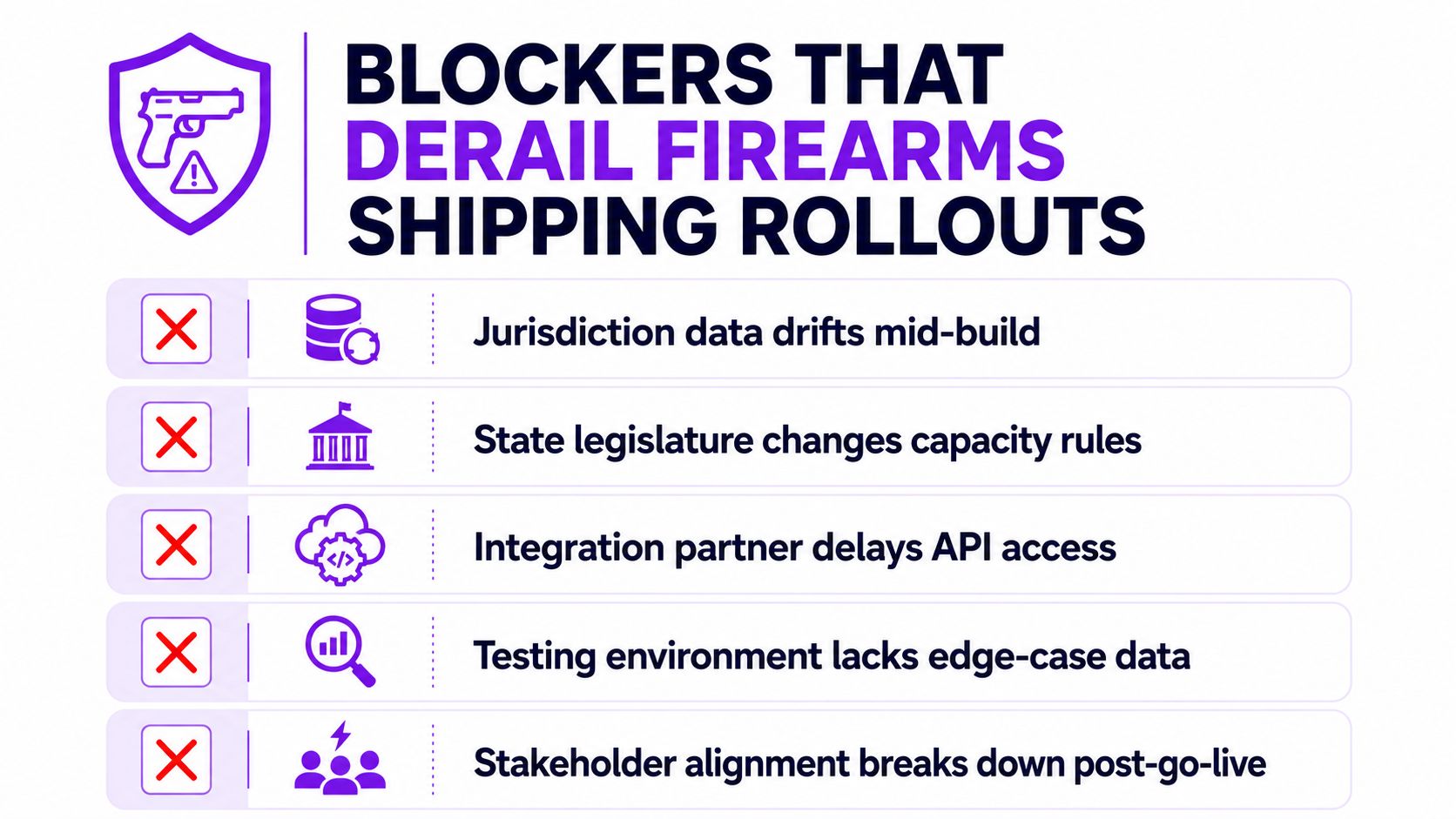
Blockers That Derail Firearms Shipping Rollouts
The blockers that break a firearms shipping rollout are usually predictable. The problem is that teams ignore them until the schedule is already slipping. A strong implementation timeline names the failure modes early, then builds review points around them.
The usual ways schedules collapse
Jurisdiction data drifts during the build, and the team keeps configuring against old assumptions. State legislation changes a capacity rule close to go-live, and the rule set needs a fast update. Carrier-specific restrictions sit on top of state law, which means a technically valid order still can't ship the way the store expected.
There are also more annoying edge cases. ZIP codes can straddle municipal pockets, so a simple address lookup doesn't always tell the whole story. Then there's scope expansion, the classic “just one more product category” request in week six, which usually means retesting everything the team thought was done.
How to de-risk the rollout before launch
The best defensive move is a data audit 4 to 6 weeks before migration or cutover, followed by cleansing before the final build freeze. That lines up with broader implementation guidance on data migration and quality problems, which affect 40 to 50% of implementations according to Reach International. The same guidance also points to regular executive review points, typically bi-weekly, which are associated with 40% higher success rates in meeting target completion dates when leadership is actively involved according to Reach International.
A practical risk-assessment reference like the one at compliance risk assessment is worth using before launch because it forces the team to name legal, operational, and technical exposures in one place.
If the risk review doesn't change the plan, it was just a meeting.
The launch decision should be tied to go/no-go criteria, not enthusiasm. Weekly risk reviews should check for open rule mismatches, pending approvals, unresolved edge cases, and any support pattern that suggests the decline logic isn't matching the business policy. That's how a 12-week plan stays a 12-week plan instead of becoming a nine-month rewrite.
Testing Plan and Go-Live Checklist
A timeline without a testing plan is just a guess. For a firearms shipping rollout, testing has to prove that the rule engine blocks the right orders, explains the block clearly, and doesn't break normal checkout for everything else.
The minimum test set before launch
Start with sandbox orders for every restricted jurisdiction in scope. Then test edge-case ZIPs that sit on county or municipal boundaries, because those are the addresses most likely to expose sloppy rule logic. The decline message should be checked for clarity as well, since customer confusion often shows up as avoidable support tickets.
Performance matters too, especially if the store has a large catalog or many rules. Validation queries should be tested under normal and heavy use so the store doesn't discover latency during a live launch window. Finally, build a rollback path that lets the team undo a bad rule without waiting for a developer to improvise.
The testing guide is the right place to anchor your UAT checklist because it keeps the validation process tied to real shipping logic rather than generic website QA.
The 30-60-90 structure works well here if it stays practical. The first 30 days focus on requirements, project plan, baseline metrics, and initial configuration. Days 30 to 60 cover migration, validation, UAT, and training. Days 60 to 90 move into full training, adoption metrics, and steady-state support according to Moxo.
Go-live checklist
- Restricted-jurisdiction orders pass or fail correctly in sandbox.
- Boundary ZIPs are tested and documented.
- Customer-facing decline copy is approved by the business owner.
- Rollback steps are written and reachable during launch.
- Support staff know escalation paths before the first live order.
- No open critical defects remain at the final go/no-go review.
Keeping the Timeline Honest After Launch
Launch doesn't end the timeline, it exposes whether the timeline was real. The store should refresh the rule dataset on a defined cadence, use scheduled rule expiry where temporary restrictions make sense, and watch the admin notifications from the compliance plugin so exceptions don't sit unnoticed.
The most useful post-launch metrics are the ones tied to operational friction. Track cancellations on restricted carts, support tickets about shipping, audit findings, and the time saved versus manual checks. Those numbers tell you whether the rollout reduced risk and work, or whether the team just moved the problem into a new system.
A good timeline stays honest because it has owners, change management, blocker tracking, and clear success criteria. Without those controls, even a clean go-live drifts back into tribal knowledge. With them, the rollout becomes a live operating process instead of a one-time project.
If you're ready to replace manual shipping checks with a rule-based workflow that fits WooCommerce and regulated product handling, review what Ship Restrict does for jurisdiction-level blocking, customer messaging, and compliance logging. Use it to build a rollout that your team can defend at day 14, day 60, and after the first audit question comes in.
Automate Shipping Compliance
Stop worrying about restricted states. Ship Restrict handles it automatically.

Cody Yurk
Founder and Lead Developer of ShipRestrict, helping e-commerce businesses navigate complex shipping regulations for regulated products. Ecommerce store owner turned developer.
Automate Shipping Compliance
- Block restricted states
- No more cancellations
- Set and forget
3-day free trial · Card required