Franchise Compliance Guide: Rules, Duties and Controls
Learn franchise compliance from federal and state duties to audits, recordkeeping and shipping checks for regulated products in one practical guide.

You're three weeks out from opening your second location, and a binder of franchise paperwork sits on the corner of your desk. The franchise agreement is signed, the lease is active, and your staff are learning the point-of-sale system. Then an email lands from corporate asking for proof of local compliance, while a municipal inspector calls asking why a required filing never reached their desk.
Most operators treat franchise compliance as a legal project handled once a year by attorneys in another city. In practice, compliance happens at the counter, in the stockroom, and inside the checkout flow of every single unit. Every federal disclosure, state rule, local permit, and brand standard only works when someone at a specific location can prove they followed it on a specific day.
Franchise Compliance in Plain Terms
Say a franchisee prepares to open a new food-service unit on Monday morning. On Friday afternoon, a city inspector issues a stop-work notice because a required local permit is missing. Head office assumed the franchisee filed it during build-out, and the franchisee assumed corporate's onboarding team handled every government form. Both sides had policies on paper, yet the doors stayed locked.
That breakdown captures what franchise compliance means. It's the complete set of legal, contractual, and operational obligations that both a franchisor and its franchisees must satisfy, starting before a franchise is ever sold and continuing through every daily transaction. Think of a franchise system like a restaurant chain sharing one master recipe book. The recipe book only protects customers if every kitchen measures the ingredients accurately, and every kitchen still answers to its own county health inspector when the doors open.
Automate Shipping Compliance
Block orders to restricted states automatically. 3-day free trial.
Start Free TrialWhy Scale Breaks Manual Oversight
Keeping rules consistent across independent operators isn't a small administrative chore. According to the International Franchise Association's 2024 economic outlook, the United States was projected to reach approximately 821,000 franchise establishments, adding more than 15,000 units (a 1.9% increase) during the year. That same outlook forecast roughly 221,000 additional franchise jobs and $893.9 billion in total franchise-business output in 2024, up 4.1% from $858.5 billion in 2023.
Those numbers show why spreadsheets and email reminders fail once a brand grows beyond a handful of stores. A single brand can run hundreds or thousands of independently owned outlets, each with its own staff, local vendors, customer transactions, and municipal rules. Meanwhile, small operators feel the weight of those rules disproportionately. In 2024, most U.S. small businesses reported spending more per employee complying with regulations than larger competitors, according to the U.S. Chamber of Commerce and MetLife Small Business Index.
Working rule: Franchise compliance is an information-management problem as much as a legal one. When a control fails at one location, customers, franchisees, regulators, and the brand all absorb the fallout at the same time.
Use a simple working definition when reviewing your own operations: compliance means knowing which rule applies to a given location, assigning one person to execute it, and keeping proof that it happened. Getting there starts with separating your obligations by the level of government or contract that created them.
Federal, State and Local Obligations at a Glance
Confusion usually starts when operators lump every legal requirement into one giant bucket. A federal disclosure deadline has nothing in common with a municipal fire inspection, and neither looks like a carrier restriction on shipping regulated inventory. Separating your obligations into four layers clarifies who files what and where records belong.
| Level | Typical obligations | Usually owned by | Example |
|---|---|---|---|
| Federal | FTC Franchise Rule disclosure (FDD) delivered at least 14 calendar days before sale | Franchisor | Pre-sale FDD with audited financial statements |
| State | Franchise registration in registration states; relationship laws on termination, renewal and transfer | Franchisor | Registering the FDD before offering franchises in a registration state |
| Local | Business licenses, zoning, health and fire permits, sales tax registration | Franchisee | Health permit for a food unit before opening |
| Product-specific | Age verification, hazardous-materials and carrier rules, state bans on shipping regulated goods | Shared, set by the franchise agreement | Blocking shipments of a restricted product to a state that bans it |
Federal and State Frameworks
At the federal level, U.S. franchise law focuses on transparency before money changes hands. After finding widespread deceptive practices in franchise sales, the Federal Trade Commission introduced its original Franchise Rule on October 21, 1979, codified at 16 C.F.R. Part 436, as documented in the FTC Franchise Rule archive. The agency approved major amendments on January 22, 2007, and the amended rule became mandatory for all franchisors on July 1, 2008. Under the rule, a franchisor must deliver a standardized disclosure document at least 14 calendar days before a prospective buyer signs an agreement or pays any fee.
The FTC Franchise Rule specifies 23 information categories inside the Franchise Disclosure Document (FDD). Those categories span corporate history, litigation and bankruptcy records, initial and ongoing fees, contractual obligations, outlet counts in Item 20, and audited financial statements in Item 21. Treat FDD production like a controlled software release rather than a static Word file. Freeze source data at a cutoff date, reconcile outlet counts across legal and operations teams, capture sign-offs, and lock immutable copies of every delivered document and signed receipt.
State obligations sit directly beneath that federal baseline. A group of U.S. states require franchisors to register their FDD with a state regulator before offering or selling a franchise within their borders, and many states also enforce relationship statutes governing termination, non-renewal, and franchise transfers. State examiner expectations shift frequently during annual renewal cycles, so franchisors should verify the current state registration list with counsel before marketing in any new jurisdiction.
Local Permits and Product Rules
Local obligations are where location-level reality kicks in. Municipal business licenses, zoning approvals, health and fire permits, and local sales tax registrations almost always fall on the franchisee operating the physical address. A single project often straddles two rows of the table at once. For a food unit, the franchisor discloses estimated build-out and licensing costs inside the federal FDD, while the franchisee is strictly responsible for pulling the local health permit before serving the first customer.
Free Shipping Compliance Audit
We'll review your WooCommerce store's shipping compliance for free.
Product-specific rules create the trickiest overlap, especially for retail, food, or eCommerce franchises handling regulated inventory. Age verification, hazardous-materials handling, carrier prohibitions, and geographic shipping bans are usually split between brand headquarters and individual stores through the franchise agreement. Relying solely on state-level checklists often leaves gaps, because municipalities and counties enforce narrower rules of their own, as outlined in this guide to county-level shipping restrictions.
Before you assign any task to a staff member, run a two-part ownership test on the requirement:
- Identify the authority: Confirm whether a federal agency, state statute, municipal office, or product regulation created the obligation.
- Name the proof holder: Decide who must produce the evidence if an auditor or inspector asks for it tomorrow.
Build this four-row map for your own franchise system and attach one named person, not a department, to every row.
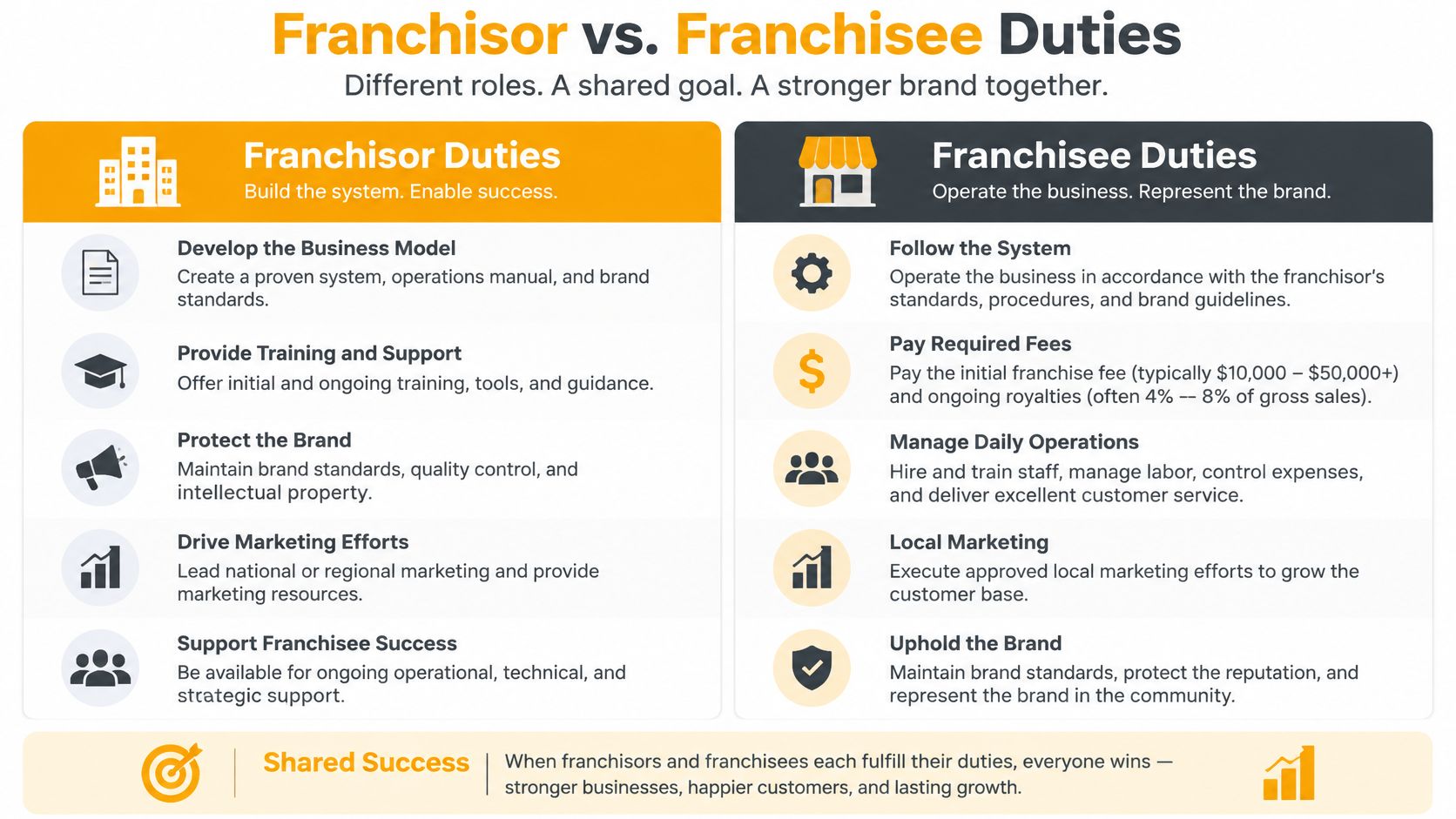
Franchisor and Franchisee Duties Side by Side
Reading a franchise agreement can give both sides a false sense of security. The contract and operating manual draw a neat dividing line between corporate responsibilities and store-level tasks, which looks straightforward in a table.
| Area | Franchisor usually owns | Franchisee usually owns |
|---|---|---|
| Disclosure documents | Preparing and delivering the FDD on time | Reviewing it and keeping the signed receipt |
| Operating standards | Writing and updating the operating manual | Applying the standards at each location |
| Training | Designing the curriculum and approving trainers | Completing training and keeping staff records |
| Local licenses and permits | Publishing requirements by region | Obtaining and renewing them |
| Sales reporting | Defining the reporting method and audit rights | Reporting accurate gross sales |
| Customer data and marketing | Setting privacy and advertising rules | Following them in local campaigns |
| Approved vendors | Approving suppliers and technology platforms | Buying only from approved vendors |
Here is a visual summary of how those distinct responsibilities connect to shared brand goals across a franchise system.
Where the Clean Split Breaks Down
Paper boundaries rarely hold up when a real operational failure hits. Even when the operating manual pushes day-to-day execution onto the franchisee, regulators and courts can still scrutinize the franchisor for what it promised in pre-sale disclosures and for the brand standards it mandated. Meanwhile, most practical compliance breakdowns don't begin inside a franchisor's legal binder. They happen when local managers improvise or when third-party technology tools behave unexpectedly.
According to Greenberg Traurig's 2026 franchise and distribution market watch, privacy rules, biometric data, digital surveillance, data-sharing arrangements, and technology fees have become active compliance layers across modern franchise networks, alongside closer scrutiny of mandatory vendor programs and hidden margins. Decentralized execution across franchisees and outside providers creates significant real-world exposure. Three vendor categories cause the most friction:
- Software platforms: Point-of-sale tools, scheduling apps, and loyalty programs often collect customer or employee data without matching the brand's written privacy notice.
- Payment processors: Misconfigured terminals, surcharge settings, or unapproved checkout gateways can trigger card-network penalties or state consumer-protection claims.
- Marketing platforms: Local agencies or ad tools running geo-targeted campaigns regularly publish unapproved claims, missing disclosures, or restricted product ads.
Say a franchisee signs up for an unapproved local delivery app to boost weekend orders. The app collects customer phone numbers and home addresses. The franchisor's national privacy policy governs customer data collected under the brand name, the franchisee's counter staff operate the tablet, and the third-party delivery company stores the database. When a customer files a data-deletion request or a breach occurs, nobody can show who owned the obligation because no written workflow covered unapproved tools.
Three Questions to Put in Writing
For a clear walkthrough of how franchisors and franchisees divide operational control without blurring legal lines, watch the breakdown below.
<iframe width="100%" style="aspect-ratio: 16 / 9;" src="https://www.youtube.com/embed/MMfTiYNH6JI" frameborder="0" allow="autoplay; encrypted-media" allowfullscreen></iframe>To close the gap between legal agreements and store-level reality, document written answers to three specific questions before a dispute arises:
- Who owns remediation and regulatory reporting when a franchisee, SaaS vendor, payment processor, or marketing platform causes a violation?
- What exact record proves that each individual location followed the rule on a given date?
- Which routine checks detect drift between corporate policy and local execution before an inspector or customer flags it?
Document your answers across four decision areas right away: vendor approval exceptions, customer-data incident response, local marketing sign-offs, and technology-fee disclosures. Clear written ownership stops finger-pointing when an urgent notice arrives.
Building a Compliance Program That Holds Up
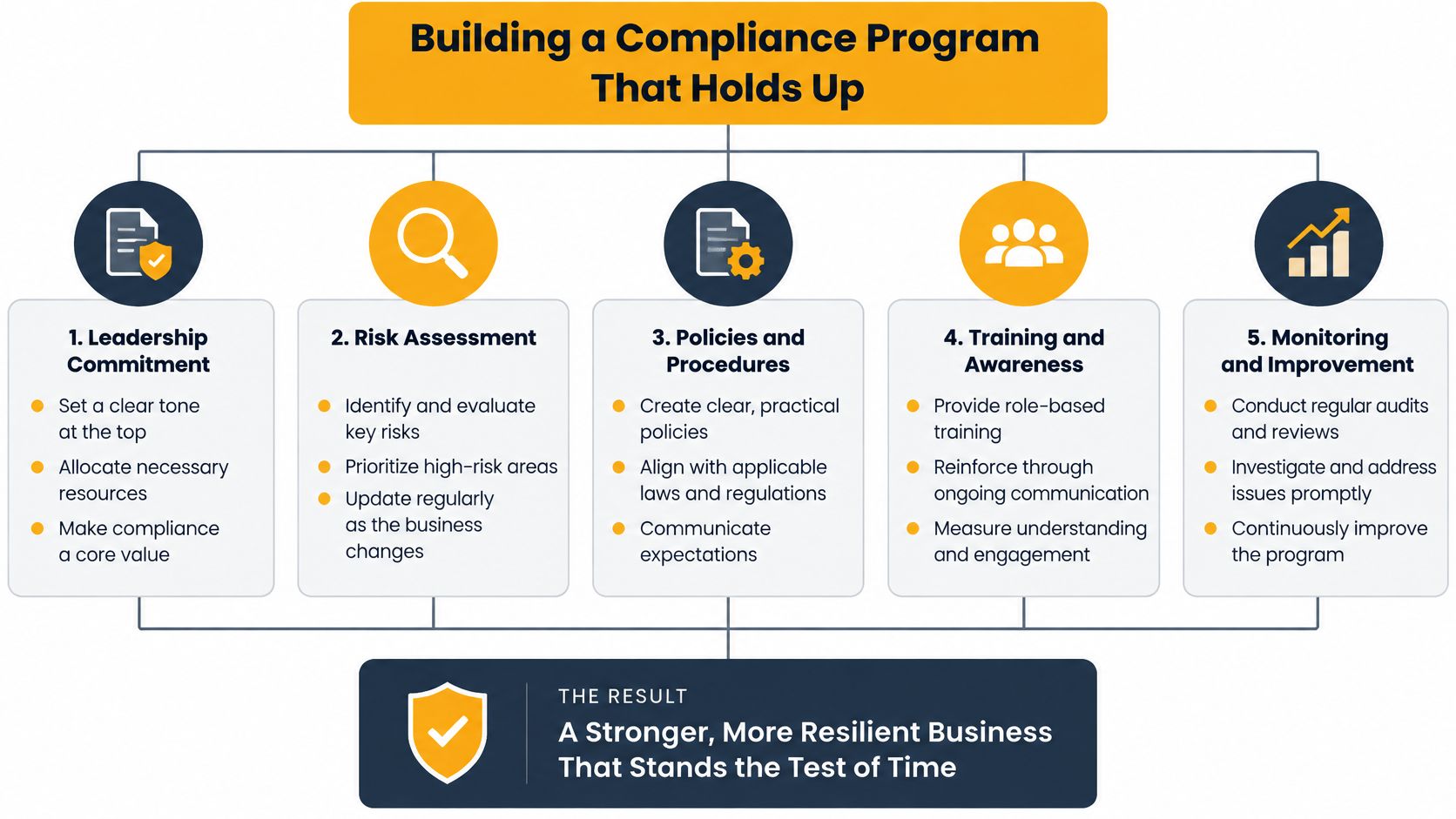
Writing rules down is the easy part. Keeping hundreds of independently managed counters, warehouses, and checkout pages aligned with those rules requires a repeatable control structure. Every working program rests on six core components, each tied to concrete proof and a set review rhythm.
| Component | What it covers | Evidence to keep | Typical check interval |
|---|---|---|---|
| Policies | Written rules mapped to each obligation | Version history and approval dates | Review yearly and whenever the law changes |
| Training | Role-based courses and sign-offs | Completion logs and assessment scores | At onboarding and after each policy change |
| Audits | Site reviews and sales reconciliation | Audit records with assessor, timestamp and photos | Quarterly for high-risk units, yearly for others |
| Recordkeeping | Reports, receipts, permits and disclosure records | Retention schedule and secure storage | Continuous, with retention periods set by counsel |
| Vendor controls | Approved supplier and platform list | Contracts, approvals and data terms | At approval and at each renewal |
| Corrective action | Tracking each exception to closure | Owner, deadline and retest result | Closed by the agreed deadline |
The diagram below shows how those pieces fit together into a five-step cycle that keeps day-to-day execution tied to measurable outcomes.
Turning Standards Into Pass or Fail Controls
Post-sale verification matters just as much as pre-sale disclosure. The FTC Franchise Rule Compliance Guide points to the operating manual, system procedures, training responsibilities, outlet statistics, and record maintenance as material areas of ongoing compliance, noting that franchise agreements may authorize audits and financial remedies when units understate gross sales.
The breakdown follows a predictable chain: decentralized execution creates measurement variance across stores, variance hides noncompliance from headquarters, and late detection drives up remediation costs across the entire brand.
Stop writing vague audit questions like "Does the store follow safety standards?" Convert every operating rule into an observable pass/fail check that any trained assessor would score the same way:
- Training verification: Every active shift manager holds a current completion certificate dated after the latest manual update, reinforced by clear staff training and shipping compliance SOPs.
- Supplier checks: Invoices from the past quarter match the approved vendor list with zero undocumented substitutions.
- Safety inspections: Current local fire and health certificates are posted on-site and uploaded to the central folder.
- Sales reconciliation: Point-of-sale gross receipts match monthly royalty reports and bank settlement summaries.
- Remediation closure: Open corrective items close with photo or document proof before their assigned due dates.
Structuring Audit Records and Escalation
An audit note scribbled on a clipboard doesn't hold up in a franchise dispute or regulatory inquiry. Every audit entry in your tracking sheet or compliance dashboard should capture nine fields: the requirement tested, the unit ID, the timestamp, the assessor, the evidence file, the severity rating, the assigned owner, the remediation deadline, and the retest result. Standardizing those fields lets you compare locations side by side and spot patterns early.
A compliance program without escalation thresholds is just a filing cabinet. If repeated failures never change how closely a unit gets monitored, the same violations will keep showing up every quarter.
Because compliance teams rarely have enough staff to inspect every unit every month, apply risk-based sampling. Put new units, locations with repeat failures, high-revenue stores, and controls tied directly to physical safety or financial reporting at the top of your quarterly review queue. Set objective triggers that escalate a unit automatically: repeated exceptions on the same control, overdue corrective actions, or sudden divergence from network sales benchmarks.
Say a mid-volume franchise unit fails monthly sales reconciliation twice across two consecutive quarters, reporting lower gross sales than its point-of-sale terminal totals. Under a clear escalation rule, that second failure automatically moves the store off an annual check cycle and into a targeted financial audit with a strict closure deadline and mandatory retest.
Shipping Controls for Regulated Products and Where Automation Fits
When a franchise brand sells physical goods online, compliance isn't decided in the franchise agreement. It's decided one order at a time inside the online store. A single non-compliant shipment can trigger state enforcement notices, carrier account suspensions, and costly chargebacks, and the merchant of record usually absorbs that exposure even when a local franchisee packs and ships the box.
| Checkpoint | Typical failure | Control |
|---|---|---|
| Product listing | Restricted item shown without any state notice | Flag restricted products and show a clear message |
| Checkout address | Order ships to a banned state, city or ZIP | Validate state, city and ZIP before payment |
| Shipping method | Carrier refuses a prohibited or restricted item | Apply carrier-specific rules and keep documentation |
| Returns and refunds | Refund issued after an illegal shipment with no record | Log the reason and block future orders to that address |
Navigating the Geographic Patchwork
Regulated products sit inside an overlapping web of federal rules, state bans, local ordinances, and carrier terms. An item that's completely legal to ship into one state can be prohibited across the border, and individual cities or counties often enforce stricter bans than their state capitals. Relying only on broad state-level shipping zones leaves blind spots that cost real money.
Operators run into three recurring edge cases once online order volume picks up:
- Mismatched age thresholds: An age-restricted product ships cleanly into a state with a lower age requirement, but violates state law when ordered by a buyer in a state enforcing a higher minimum age.
- Municipal bans inside legal states: A product remains legal statewide, yet a single city prohibits delivery, requiring a precise ZIP-code rule rather than a blanket state block.
- Carrier rejections after checkout: A sale is legal under state law, yet the chosen parcel carrier prohibits that item class or requires special hazmat documentation, forcing staff to cancel the order days after payment cleared.
To close those gaps, put six controls in place in strict sequence:
- Map every regulated SKU, category, or product variant to the exact rules governing it.
- Configure geographic restrictions down to the state, city, and ZIP level rather than stopping at state lines.
- Block prohibited orders inside the checkout flow before payment is captured.
- Display clear, plain-language restriction messages on both the product page and checkout screen so buyers know why an order can't ship.
- Log every compliance-related cancellation or refund with its specific reason code so patterns show up in audits.
- Review and update your configured rule sets every time a statute, ordinance, or carrier policy changes.
Where Software Fits Inside the Program
Manual order checking breaks down quickly when daily order counts climb. Staff get tired, spreadsheets fall out of date, and late cancellation emails frustrate buyers. That's where checkout automation earns its keep, provided you stay realistic about what software can and can't do. Software enforces the rules you configure at the point of sale. It doesn't write company policy, interpret statutes, or replace qualified legal advice. Merchants should confirm current requirements for their products with their legal counsel and review their rules when laws change.
For franchise systems running online storefronts on WooCommerce or Shopify, Ship Restrict applies shipping rules by state, city, and ZIP code and targets items by product, category, tag, or variant. On Shopify, restrictions are evaluated by a Shopify Function inside Shopify's own infrastructure, blocking restricted orders before payment while storing only your rules and never your customers' addresses or personal data. You can also schedule rules to activate or expire around statutory effective dates and export rule sets as portable JSON files. Rules should be exported as a backup and reviewed when regulations change.
Keep the division of labor crystal clear across your team: software enforces approved checkout rules consistently on every order, operations staff own exceptions and audit logs, and legal counsel owns statutory interpretation.
Run a Compliance Gap Check This Week
You don't need a six-month consulting engagement to find your biggest compliance blind spots. Block off a few focused hours over the next five days and walk through these six steps with your operations lead and legal contact.
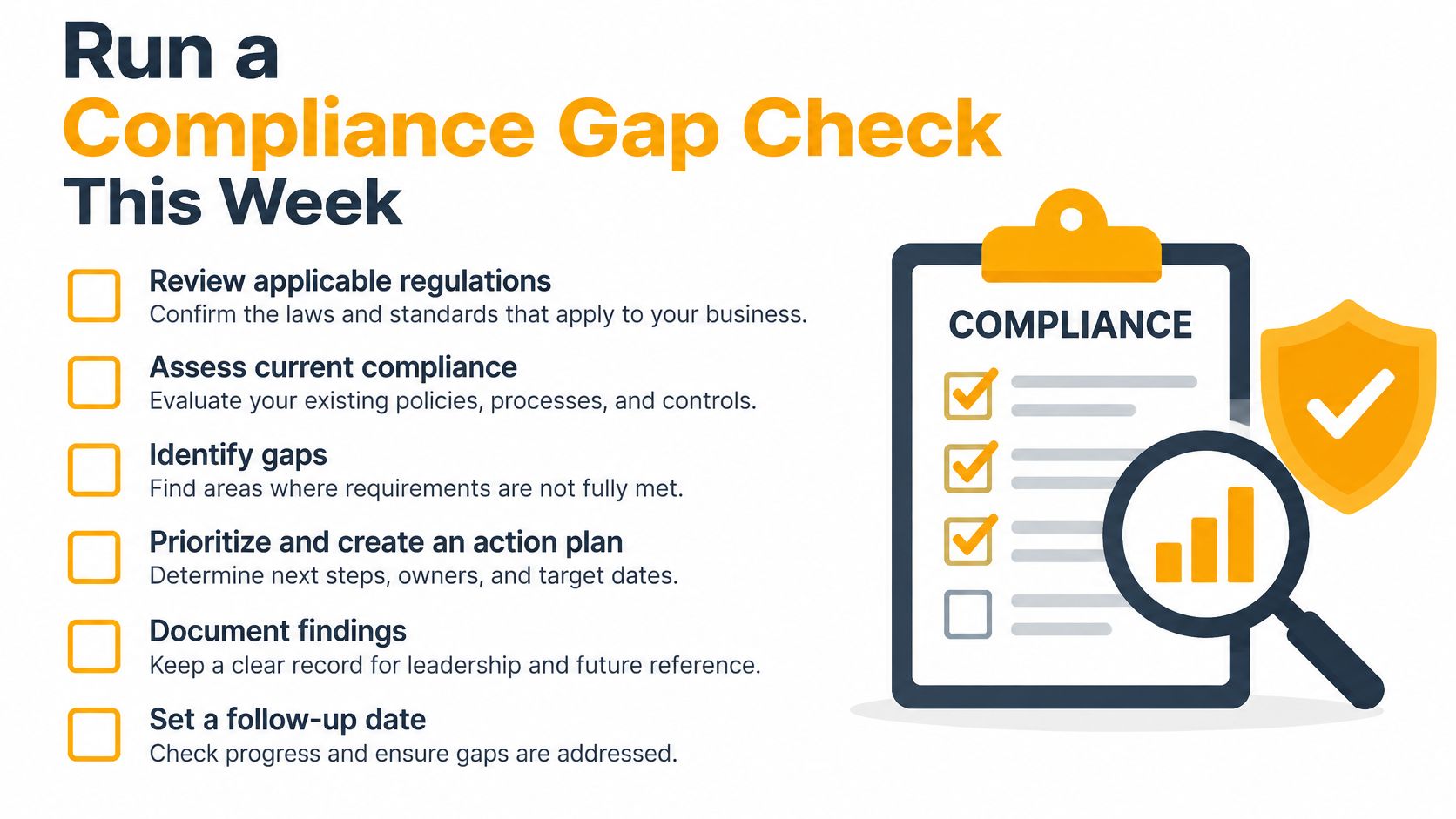
- List every obligation by level. Build a clean inventory covering your federal disclosure requirements, active state registration and relationship rules, local unit permits, and product-specific restrictions. Keep every rule tied to the physical or online locations where it applies.
- Assign one named owner per obligation. Walk through each line and attach one individual's name. If an obligation currently reads "operations" or "franchisee team," narrow it down until a single person knows they own the evidence.
- Trace regulated products across the order flow. Pull your top restricted SKUs and check four touchpoints: the product page notice, checkout address validation, carrier shipping method rules, and refund logging. Fix any step that still depends on someone remembering to check a spreadsheet.
- Pull twelve months of compliance evidence. Gather signed FDD receipts, current local permits, staff training logs, vendor approvals, and past site audit reports. Pair your location review with structured FDD and royalty reconciliation checks from Franchise Foundry so disclosure records and store-level financial reporting stay aligned.
- Set risk-based audit schedules. Stop auditing every store on the exact same calendar. Prioritize new units, locations with repeat violations, and high-revenue stores using a formal compliance risk assessment so your limited review hours go where exposure is highest.
- Back up rules and lock your next review date. Export your active checkout and operational rule sets into a dated backup folder, and put a recurring calendar hold on the books tied to state renewal deadlines and regulatory effective dates.
One decision to settle before Friday: If your franchise sells regulated products online, decide whether checkout rules will be enforced automatically in software or vetted manually by staff, and get your legal counsel's sign-off on that approach before launching or expanding.
Remember that software can only enforce rules you've already approved; it can't decide which laws apply to your catalog. Hundreds of businesses use Ship Restrict to handle their shipping compliance, where Ship Restrict checks every order against current federal, state, and local regulations automatically. Before committing to any platform, test your highest-risk products and trickiest ZIP-code edge cases against your shortlist, including Ship Restrict, so you know the checkout blocks hold up under real orders.
If your franchise network sells regulated goods through WooCommerce or Shopify stores, Ship Restrict enforces state, city, and ZIP-level shipping rules right at checkout before payment clears, cutting manual order review and helping keep every location aligned with your approved policies. Visit Ship Restrict to see how automated checkout restrictions, scheduled rule updates, and portable JSON backups fit into your location-level compliance program.
Automate Shipping Compliance
Stop worrying about restricted states. Ship Restrict handles it automatically.

Cody Yurk
Founder and Lead Developer of ShipRestrict, helping e-commerce businesses navigate complex shipping regulations for regulated products. Ecommerce store owner turned developer.
Automate Shipping Compliance
- Block restricted states
- No more cancellations
- Set and forget
3-day free trial · Card required