Staff Training Shipping Compliance SOPs That Protect Your Store
A guide to building staff training shipping compliance SOPs. Learn to create, implement, and audit procedures to protect your firearms eCommerce business.
When you're shipping regulated products like firearms, a packing slip and a shipping label just aren't enough. You need a bulletproof system of staff training and shipping compliance SOPs to sidestep catastrophic legal and financial risks. Think of these procedures not as bureaucratic hurdles, but as essential armor that protects your Federal Firearms License (FFL) and ensures every single package leaves your facility legally and safely.
The High Stakes of Shipping Compliance
In regular eCommerce, a shipping mistake might lead to a lost package or a grumpy customer. For a firearms retailer, that same mistake could literally mean the end of your business. The consequences of non-compliance aren't just abstract warnings; they are real-world penalties that have crippled unprepared companies. Relying on manual checks and "tribal knowledge" is a high-stakes gamble in an industry governed by a complex web of federal, state, and local laws.
Picture this: a new team member, just trying to be efficient, ships an order to a customer in a city that recently passed a strict local ordinance banning that exact product. Without a clear, documented SOP and proper training, they're just going off an outdated mental checklist. The package goes out, the violation gets flagged, and suddenly your business is facing an ATF audit, crippling fines, and the potential revocation of your FFL. This isn’t a far-fetched hypothetical; it's a preventable error that robust SOPs are designed to eliminate.
The Financial and Reputational Fallout
The financial penalties for compliance failures can be absolutely staggering—and they aren't just minor slaps on the wrist. Just look at the broader world of regulated shipping: a Thailand-based company was hit with a $20 million fine by the U.S. Office of Foreign Assets Control (OFAC) for hundreds of Iran-related violations. It's a stark reminder of how simple manual process failures can lead to catastrophic errors. You can read a full analysis of how compliance missteps impact businesses and see how these lessons apply across any regulated industry.
Automate Shipping Compliance
Block orders to restricted states automatically. 3-day free trial.
Start Free TrialBeyond the direct financial hit, the reputational damage can be even worse. A single compliance violation can instantly vaporize customer trust and attract unwanted scrutiny from regulators and the public. In the firearms industry, your reputation for safety and strict adherence to the law is your single most valuable asset.
A single compliance failure can undo years of hard work. Your staff training and shipping compliance SOPs aren't just about following rules; they're about building a resilient business that can operate with confidence and integrity.
Moving from Reactive to Proactive
Ultimately, effective staff training and shipping compliance SOPs shift your entire business from a reactive to a proactive stance. Instead of just hoping mistakes don't happen, you build a system that actively prevents them from ever occurring.
This framework empowers every person on your team, from the warehouse floor to the customer service desk, to become a guardian of your compliance. They understand not just what to do, but why it's so critical. This cultural shift transforms compliance from a burden into a competitive advantage, letting you navigate the complex regulatory landscape and grow your business with peace of mind.
Building Your Shipping Compliance Playbook
It's time to turn abstract risks into a concrete action plan. This means creating a clear, actionable playbook for your store's core Standard Operating Procedures (SOPs). This isn't about writing some dense legal document no one will ever read. It's about crafting a practical, day-to-day guide for your team.
A well-designed playbook transforms compliance from a source of anxiety into a manageable, repeatable process. And the foundation of any strong SOP is absolute clarity on roles and responsibilities.
Defining Roles and Responsibilities
Ambiguity is the enemy of compliance. Before you write a single checklist, you need to decide who owns each critical step of the shipping process.
When an order for a regulated item comes in, who is your first line of defense? Is it the customer service rep who sees it first? An order processor? Someone in the warehouse? Without a crystal-clear answer, critical checks get missed because team members assume someone else is handling it.
Assign specific, documented ownership for these key compliance tasks:
Free Shipping Compliance Audit
We'll review your WooCommerce store's shipping compliance for free.
- Order Verification: Who is on the hook for that initial check to confirm the customer's age, shipping address, and the legality of the product in their specific location?
- Exception Handling: Who investigates and resolves orders flagged by your system as potentially non-compliant? This person needs the authority to put orders on hold, no questions asked.
- Pre-Shipment Audit: Who performs the final sanity check before a label is printed to ensure all documentation is correct and the order is 100% cleared for shipping?
- SOP Updates: Who is tasked with monitoring regulatory changes and updating the playbook accordingly? This can't be an afterthought.
This clear delegation of duties creates accountability. When everyone knows their specific role in the compliance chain, the entire system becomes more robust and far less prone to human error. It only takes one small mistake to trigger a cascade of negative outcomes, from initial penalties to severe, long-term consequences for your business.
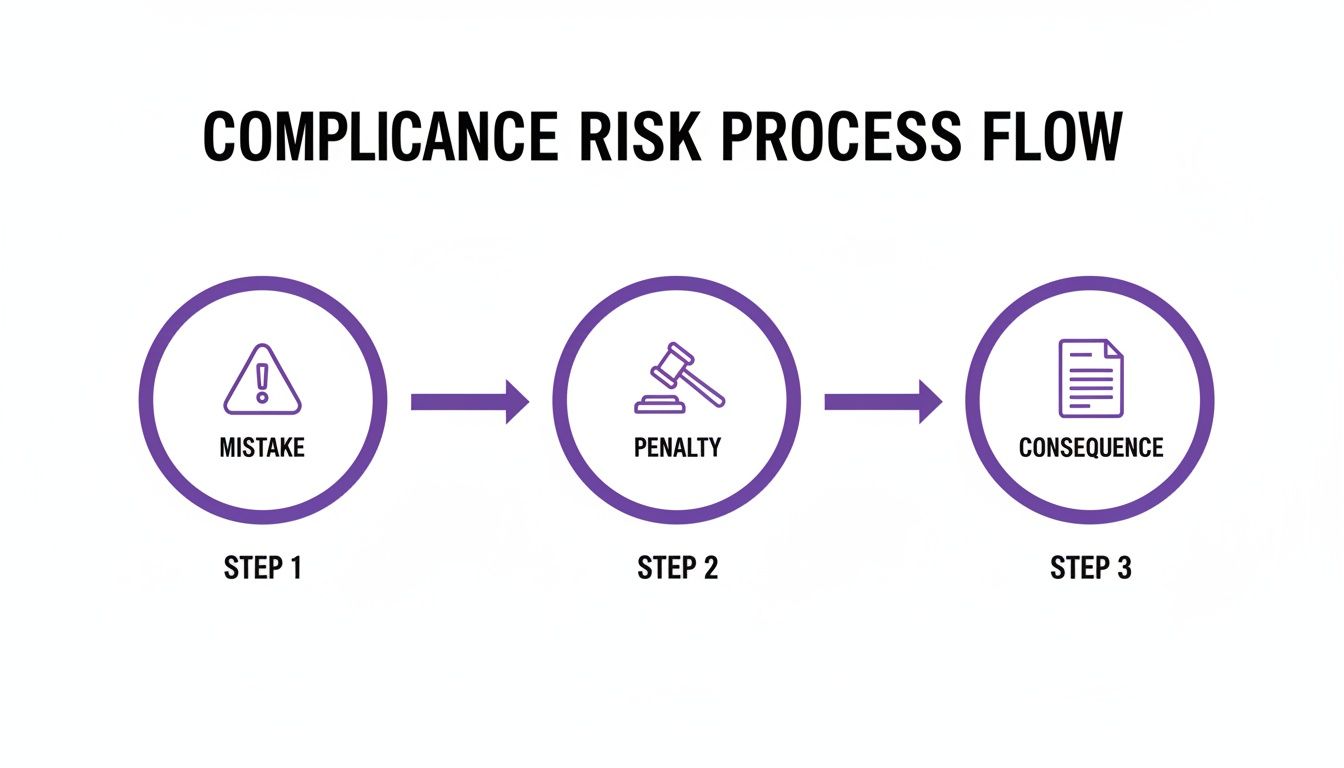
As you can see, a simple mistake quickly blows up into significant penalties and lasting repercussions. This is why having a documented, repeatable process is non-negotiable.
Core Components of a Firearm Shipping SOP
With roles clearly defined, you can start building the SOPs themselves. These documents need to be simple, direct, and focused on action. Use checklists, flowcharts, and plain English. Avoid legal jargon wherever possible—the goal here is usability, not complexity.
A comprehensive staff training shipping compliance SOPs playbook should include several key components. Here's a look at the non-negotiable elements that form the backbone of any effective compliance documentation.
| SOP Component | Key Objective | Example Action Item |
|---|---|---|
| Order Intake & Initial Screening | Catch obvious compliance issues at the very beginning of the order lifecycle. | Verify the shipping address against a master list of known restricted states, counties, or cities immediately upon order creation. |
| Address Validation Protocol | Ensure the specific shipping address is eligible to receive the ordered product(s). | Use a tool like Ship Restrict to automatically check the customer's ZIP code against granular, up-to-date restriction rules. |
| Final Pre-Shipment Check | Provide a final, manual safeguard before the package leaves the facility. | The assigned team member must initial a physical or digital checklist confirming the address, product, and documentation are all correct. |
| Exception Handling Procedure | Provide a clear, step-by-step process for resolving flagged or uncertain orders. | If an order is flagged, move it to an "On Hold" status, notify the designated compliance manager, and document the reason for the hold. |
| Record Keeping Requirements | Maintain a clear audit trail that proves due diligence in case of an inquiry. | All compliance checks, communications, and final decisions for each order must be logged and attached to the customer's order record. |
These components create a layered defense, making it incredibly difficult for a non-compliant order to slip through the cracks.
Real-World SOP Example
Let’s walk through a tricky but common scenario: an order for a specific firearm accessory is placed with a shipping address in Illinois.
Now, while the state might generally allow the item, Cook County has its own, much stricter set of restrictions. A generic SOP might just say, "Check Illinois laws." That’s not helpful. A truly effective SOP provides a much more detailed, actionable workflow.
SOP for Illinois Accessory Shipments:
- Upon order intake, confirm the shipping address is in Illinois.
- Use the address validation tool to check the specific county and ZIP code against the "Cook County Prohibited Items" rule set.
- If Flagged: The order is automatically placed on hold. The Compliance Manager is notified to review the specific item against the county ordinance. The order cannot proceed without their explicit digital approval.
- If Clear: The order proceeds to the standard pre-shipment audit.
This level of detail removes all the guesswork. It gives your team a precise map to follow, ensuring that even complex, multi-layered regulations are handled correctly every single time. This is what it means to build a compliance playbook that actually protects your business.
Creating a Training Program That Sticks
Your carefully crafted shipping compliance playbook is a fantastic start, but let's be honest—it’s just a document until your team puts it into practice. This is where your training program becomes the linchpin. A one-and-done session during onboarding isn’t going to cut it; you need to build a continuous learning program that embeds compliance deep into your company culture.
It all starts the moment a new employee walks through the door. Their initial training needs to be more than just handing them a manual. It has to give them the "why" behind every rule—the real-world consequences like a revoked license, crippling fines, and a damaged reputation.
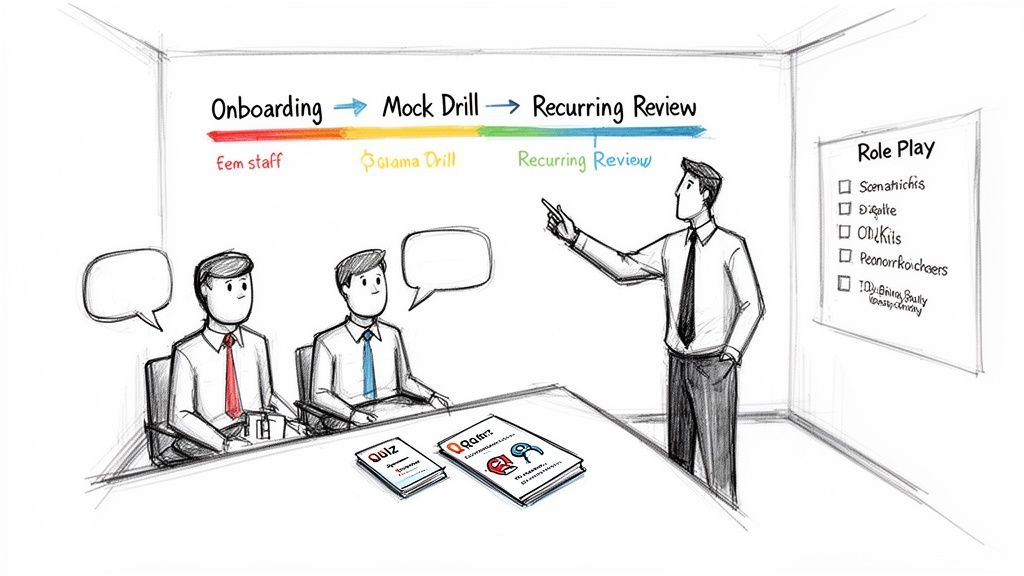
From Onboarding to Ongoing Education
Onboarding sets the foundation, but the regulatory landscape for firearms shifts constantly. A state law that was perfectly fine last quarter might be obsolete today. This reality means you have to commit to recurring training to keep your team sharp and your operations protected.
A good ongoing training schedule doesn't have to be a massive, time-sucking affair. Think consistent, bite-sized learning opportunities.
- Quarterly Compliance Huddles: Get everyone together for 30 minutes to go over any recent changes in state or federal laws. This is also the perfect time to review any "close calls" or flagged orders and turn them into learning moments for the whole team.
- Annual SOP Deep Dive: Once a year, block out time for the team to review the entire compliance playbook, cover to cover. This reinforces the core principles and helps you spot procedures that might need an update based on day-to-day experience.
- Immediate Alerts: When a major law changes, don't wait. Send out an immediate, mandatory-read email or Slack message to all relevant staff. This gets critical updates out instantly, not weeks later at the next scheduled meeting.
This rhythm of reinforcement ensures compliance stays top-of-mind, turning it from a distant onboarding memory into an active part of everyone's job. It’s a crucial part of any solid staff training shipping compliance SOPs strategy.
Making Training Practical and Engaging
The best training goes way beyond slideshows and lectures. To make lessons stick, you have to get practical, hands-on, and engaging. People learn by doing, especially when it comes to complex, procedural work.
The goal isn't just to teach your team the rules. It's to build their confidence so they feel empowered to pause an order and ask a question, knowing they're protecting the business, not slowing things down.
Try incorporating interactive exercises that simulate the real-world challenges your team will actually face.
- Mock Order Drills: Create a few "fake" orders loaded with compliance traps. Think mismatched billing and shipping addresses in a high-risk area, or an order for a product that's legal in the state but banned in a specific city. See if your team can spot the red flags based on your SOPs.
- Role-Playing Scenarios: Your customer service reps are often the first line of defense. Run role-playing exercises where one person acts as a customer pushing to get an item shipped to a restricted zone. This prepares your team to handle these tough conversations professionally and firmly. Our guide on customer service scripts for explaining shipping restrictions can give your team a head start.
- Knowledge-Check Quizzes: After a training huddle, send out a short, simple quiz to check for understanding. It’s not about getting a grade; it's about spotting any areas where the information wasn't clear and needs to be reviewed.
By making training a dynamic and interactive process, you ensure your team doesn't just know the SOPs—they understand how to apply them under pressure. That’s how you build a resilient culture of compliance that truly protects your business from costly, preventable mistakes.
Using Automation to Reinforce Your SOPs
Relying on manual checks to manage firearms compliance is like trying to catch rain in a bucket. It's exhausting, inefficient, and you're guaranteed to miss something. Your meticulously crafted Standard Operating Procedures (SOPs) and training programs are vital, but they are only as good as the human consistency behind them.
This is where technology steps in—not to replace your SOPs, but to enforce them tirelessly.
Automation acts as your digital compliance officer, ensuring the rules you've documented are followed 24/7 without fail. It drastically cuts down on human error, which is the single greatest threat to your FFL. By embedding your compliance logic directly into your eCommerce platform, you transform your SOPs from a static document into an active, automated defense system.
This approach is becoming less of a luxury and more of a necessity as manual processes buckle under pressure. In fact, a staggering 92% of companies still rely on error-prone spreadsheets and emails for compliance, while only 8% use dedicated software. That's a huge gap, especially when you consider the complexity of shipping regulations today.
A Real-World Automation Scenario
Let's walk through a common, high-stakes situation. A customer in Chicago, Illinois, tries to purchase a regulated product from your website. If you're running on manual checks, this kicks off a messy, multi-step process for your team.
First, an employee has to recognize that Chicago has its own specific restrictions that are different from Illinois state law. Then, they have to hunt down the correct, up-to-date spreadsheet listing all the restricted ZIP codes. Finally, they need to manually cross-reference the customer's shipping address against that list.
This process is slow and full of potential failure points. What if the employee is new? What if the spreadsheet is outdated? One little oversight can lead to a non-compliant shipment slipping right through the cracks.
Now, let's look at the same scenario with an automated system. The moment the customer enters their address at checkout, the system instantly validates it against a pre-set rule blocking sales to their specific ZIP code. The sale is blocked before it can even be completed. Your employee never even has to touch it.
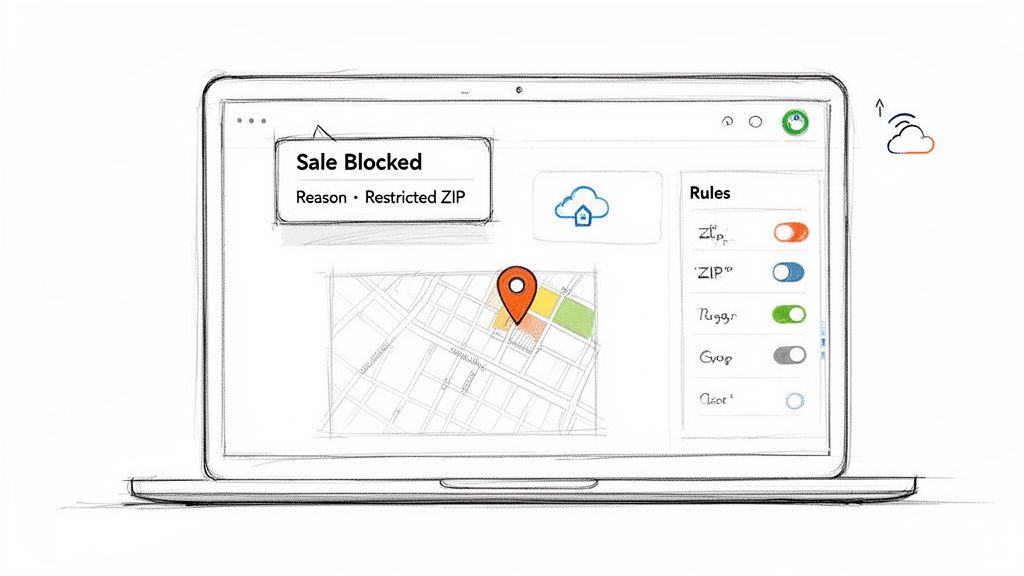
This screenshot shows exactly how a tool like Ship Restrict provides a clear, immediate block based on your defined rules. It prevents a compliance failure before it ever has a chance to happen. This isn't just about convenience; it's about systematically eliminating risk.
Key Automation Features That Supercharge Your SOPs
Modern compliance tools offer powerful features that directly reinforce your staff training shipping compliance SOPs. Instead of just trusting your team to remember every single rule, you give them a system that makes it impossible to forget.
Here’s what to look for:
- Real-Time Address Validation: The system checks every address against your restriction rules while the customer is checking out—not after the order is placed and paid for. This stops compliance issues from ever entering your order queue in the first place.
- Bulk Rule Management: The legal landscape is always changing. Instead of manually updating a dozen different documents, you can update a state- or county-wide restriction in a single action, and the change is instantly enforced across your entire store.
- Customizable Customer Messaging: When a sale is blocked, the system can display a clear, professional message explaining why. This supports your SOP for customer communication, reduces frustration, and cuts down on support tickets.
Automation doesn't make your team's training obsolete. It empowers them by removing the tedious, error-prone tasks, freeing them to focus on complex exceptions and genuine customer service challenges.
For those running on WooCommerce, understanding the specifics of implementation is key. You can discover more about how these systems work by reading our deep dive into https://shiprestrict.com/blog/shipping-restrictions/automated-shipping-compliance-for-woo-commerce-stores, which breaks down the setup process.
Ultimately, integrating automation transforms your compliance program from a reactive checklist into a proactive, preventative machine. It codifies the best practices from your training sessions and SOPs, ensuring they are executed perfectly on every single order.
And it doesn't just have to be software. You can also leverage human support to maintain adherence. For instance, using virtual assistants specializing in logistics support to manage documentation and tracking according to your SOPs can be a game-changer. This combination of smart automation and targeted human oversight creates the most resilient compliance framework possible.
Auditing and Maintaining Your Compliance Program
<iframe width="100%" style="aspect-ratio: 16 / 9;" src="https://www.youtube.com/embed/yDL8fi0z7tQ" frameborder="0" allow="autoplay; encrypted-media" allowfullscreen></iframe>Getting your Standard Operating Procedures written and your team trained is a huge win. But don't mistake the starting line for the finish line. Compliance isn't a one-and-done project you can shelve and forget. It's a living, breathing part of your day-to-day operations that needs constant attention.
Let's be blunt: a dusty SOP manual on a shelf offers zero protection when an ATF agent is standing in your warehouse.
To keep your compliance program healthy, you need to give it a regular check-up. This means setting a firm schedule for audits and reviews. Think of it like routine maintenance on your most critical piece of machinery—it's what prevents catastrophic failures down the road.
Establishing a Practical Review Cadence
Regulations in the firearms industry change fast, and a reactive approach is a losing game. While an annual review is the absolute bare minimum, a more frequent schedule is much smarter and safer. You need a rhythm that keeps your procedures sharp and relevant.
Here's a practical schedule to start with:
- Quarterly SOP Audits: Every three months, do a quick, focused check. Pull out your documented procedures and compare them to what's actually happening on the floor. Has the team started taking shortcuts or developing informal "workarounds"?
- Immediate Trigger Reviews: This one is non-negotiable. The moment a federal, state, or local law changes, you update the relevant SOPs. Immediately. Waiting for the next quarterly review is a gamble you just can't afford.
- Post-Incident Debriefs: If a shipping mistake happens (or even a near-miss), you need to huddle up and conduct a review within 48 hours. The goal is to figure out exactly what went wrong and how to strengthen the SOP to make sure it never happens again.
This cycle ensures your staff training shipping compliance SOPs don't get stale. They'll evolve right alongside the legal landscape and your own operational lessons.
Conducting a Simple Internal Audit
An internal audit doesn't have to be some big, intimidating affair. The whole point is to spot small cracks before they turn into major fissures. It's a straightforward process: compare what your SOPs say you should be doing with what your records show you are actually doing.
Your audit isn’t about pointing fingers; it’s about finding opportunities to get better. The goal is to reinforce good habits and correct any procedural drift before it becomes a real compliance headache.
Start by pulling a random sample of 10-15 recent orders for regulated products. Grab a simple checklist and walk through each one. For a great template to get you started, check out our comprehensive WooCommerce Shipping Compliance Audit Checklist to build your own.
For each order in your sample, ask some pointed questions:
- Was the initial address validation check documented like it was supposed to be?
- If the order got flagged, was the exception-handling SOP followed to the letter?
- Does the order history show that the final pre-shipment verification step actually happened?
- Are all the required notes, approvals, and documents attached to the order record?
This simple exercise is the fastest way to find any gaps between your documented process and your team's daily execution. A key part of this also involves navigating data security and compliance complexities, particularly when you're handling sensitive customer data with outside partners.
Your Incident Response Blueprint
Look, even with the best SOPs on the planet, mistakes can still happen. The real difference between a resilient business and a fragile one is having a clear, pre-defined plan for when they do. A solid incident response plan takes the panic out of the equation and replaces it with a calm, methodical process.
Your plan should spell out the immediate actions to take:
- Containment: How do you stop a shipment that's already in transit? Who is responsible for contacting the carrier, and how?
- Documentation: Immediately record every single detail of the incident—who, what, when, where, and why. Create a clear timeline.
- Correction: What are the immediate steps to fix the error? This could involve recalling a package or contacting a customer.
- Refinement: Based on the debrief, how will the SOP be updated to prevent this specific failure from ever happening again?
Having a structured response like this is the mark of a truly mature compliance program. We're in an environment where record penalties have companies scrambling to invest in compliance. A recent study shows that 82% of firms are now planning tech investments specifically for training and monitoring. It's a clear signal that the industry is pivoting from manual checklists to more automated SOPs. Keeping ahead of these trends is how you build a business that can withstand scrutiny and adapt over time.
Got Questions About Compliance? We’ve Got Answers.
Even with the best-laid plans, questions always pop up when you’re rolling out new compliance procedures. Getting ahead of these common concerns can make the transition smoother and give your team the confidence they need to handle things correctly. Here are a few questions we hear all the time.
How Often Should We Update Our Shipping Compliance SOPs?
Your SOPs should be treated like living documents, not a dusty old rulebook you wrote once and forgot about. You need to conduct a full, comprehensive review at least once a year, no exceptions.
But in reality, the regulatory world sets the real pace. You must update your procedures immediately any time a federal, state, or local firearms law changes. It’s also a smart move to review and tighten them up after any shipping error or even a "close call." That's your chance to find the weak spot and fix it before it becomes a real problem. Automation tools are great for keeping rule sets current, but your internal team documents have to be updated to match.
What’s the Biggest Mistake Stores Make with Compliance Training?
The most dangerous mistake is treating training as a one-and-done event during onboarding. That "set it and forget it" mindset is a fast track to a major compliance violation.
The legal landscape for firearms is constantly shifting; what was perfectly legal last year might be a serious offense today. Effective staff training has to be an ongoing commitment.
An SOP manual gathering dust on a shelf is a liability, not an asset. Active, continuous engagement with your training materials is the only way to stay protected and ensure procedures are followed correctly.
This means scheduling regular refreshers, sending out immediate alerts about new laws, and running practical drills to keep everyone’s skills sharp.
Can a Small Business Realistically Implement All This?
Absolutely. In fact, for a small business, it’s arguably even more critical. A single massive fine or license revocation can shut you down for good, whereas a bigger company might be able to weather the storm. The great thing is that these principles scale perfectly to your size.
Your compliance playbook doesn’t need to be a 50-page legal tome. It can be a simple two-page checklist that covers the core functions. Your "training program" can be a recurring 30-minute team huddle, not some formal, all-day seminar.
The key is to formalize and document your process, no matter how simple it is. For smaller teams, automation is a game-changer. It acts as a force multiplier, handling all the tedious, time-sucking verification tasks that would otherwise eat up your day. By automating the checks, you free up your team to focus on growing the business, knowing that compliance is being handled right, every single time.
Ready to stop worrying about shipping rules and start automating your compliance? Ship Restrict acts as your 24/7 digital compliance officer, enforcing your rules before an order can even be placed. Learn how Ship Restrict can protect your business today.
Automate Shipping Compliance
Stop worrying about restricted states. Ship Restrict handles it automatically.

Cody Yurk
Founder and Lead Developer of ShipRestrict, helping e-commerce businesses navigate complex shipping regulations for regulated products. Ecommerce store owner turned developer.
Automate Shipping Compliance
- Block restricted states
- No more cancellations
- Set and forget
3-day free trial · Card required