Federal Shipping Regulations: A Practical Guide
Master federal shipping regulations for eCommerce with this guide covering USPS, UPS, and FedEx rules, prohibited items, and compliance.
The order looked ordinary until the warehouse team checked the destination and the product class. A customer had already paid for a regulated item, the label was ready to print, and the system suddenly had to answer a blunt question, can this shipment move legally, with this carrier, to this address, under today's rules. That's the core pressure point in federal shipping regulations, not a textbook definition.
Most sellers learn this the hard way. A parcel can be legal in the abstract and still fail at checkout because the destination blocks it, the carrier refuses it, or the merchant's own promise to ship on time can't be kept. The practical problem is a decision tree, product, carrier, destination, and timing all have to line up before anyone accepts payment.
The Compliance Moment Every Regulated Seller Fears
A regulated DTC store can do everything right on the merchandising side and still end up with a dead-end order. The customer checks out, payment captures, and then the fulfillment team finds a product that can't move legally to that destination, or can only move under a different mode than the one the store promised. At that point, someone has to choose between a cancellation, a return, a chargeback dispute, or a violation.
That's why “shipping compliance” is too narrow a phrase. The failure often starts earlier, at the cart, when a product, carrier, and destination combination should have been blocked before money changed hands. If your workflow waits until the label printer starts humming, you've already moved too late.
Automate Shipping Compliance
Block orders to restricted states automatically. 3-day free trial.
Start Free TrialThe real control point is pre-commitment
The cleanest regulated-goods operation treats checkout as a legal gate, not a sales form. Product classification should tell you what kind of restriction you're dealing with, carrier policy should tell you whether the parcel can even be tendered, and destination rules should tell you whether it can move there at all.
Practical rule: if you can't explain why an order is shippable before payment, you don't have a compliance process yet, you have a cleanup process.
That's also why generic shipping advice fails. “Use a trusted carrier” doesn't help when one carrier accepts a category and another won't, or when a state or city rule overrides the federal baseline. The right model is product × carrier × destination × timing, because that's how the risk appears at the bench, in the admin panel, and in the shipping queue.
The Federal Agencies and Statutes That Shape Shipping
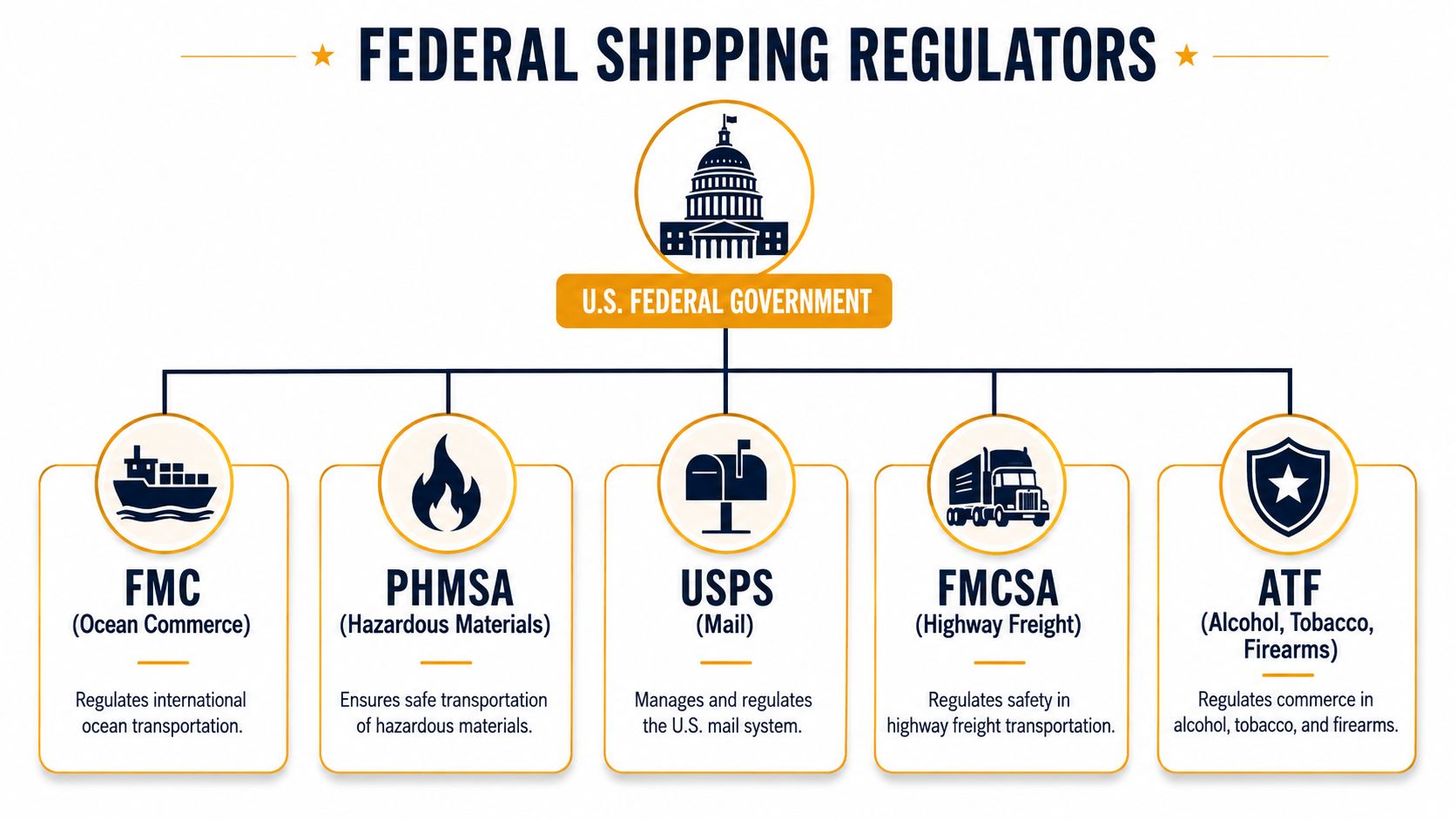
A regulated seller can have the right product, the right carrier account, and still fail at the wrong agency boundary. Federal shipping rules do not live in one tidy rulebook. They sit across agencies with different mandates, and the job is matching the shipment to the right lane before it reaches the dock.
The baseline came from long federal control over vessels
The federal role in shipping goes back to the first Congress. On September 1, 1789, Congress enacted an early statute for registering and clearing vessels and regulating the coasting trade, which created an early federal grip on domestic shipping control. That authority later expanded through the Shipping Act of 1916, which led to the U.S. Shipping Board on January 30, 1917, the first federal agency charged with promoting a merchant marine while regulating U.S. commercial shipping. The modern Federal Maritime Commission was established on August 12, 1961, when subsidy and fleet-promotion functions were separated from regulation. Those milestones matter because today's rules sit on top of a long federal structure. (Mystic Seaport statute history)
For ecommerce operators, the FMC matters when a shipment touches oceanborne transportation in U.S. foreign commerce. Its framework includes the Shipping Act of 1916, the Merchant Marine Act of 1920, the Intercoastal Shipping Act of 1933, the Merchant Marine Act of 1936, the Shipping Act of 1984, and the Ocean Shipping Reform Act of 1998. The Commission's history page notes that the Shipping Act of 1984 marked a major change in the regulatory regime for companies operating in U.S. foreign commerce, and OSRA 1998 pushed that shift further. (FMC history)
Mail, hazmat, highway freight, and firearms each sit in different lanes
USPS matters when the parcel moves through the postal system. Its restrictions page separates hazardous materials into prohibited, restricted-but-mailable, and ground-only categories, and requires segregation and a HAZMAT container marking. For a warehouse team, that means the SKU table has to answer a simple question before the label prints: can this item move by mail at all? (USPS restrictions)
PHMSA matters for hazardous materials in transit, especially where mode and packaging rules follow dangerous-goods requirements. FMCSA matters when the shipment rides on highway freight and brokered transport, because truck-side compliance is a different check from mail-side screening. ATF enters the picture for firearms-adjacent products and recordkeeping, where classification and transport restrictions cannot be handled like standard parcel work.
If you are trying to keep customs and shipment records aligned across modes, a structured documentation process is usually more useful than a loose shipping checklist. A practical starting point is to streamline customs documentation with Matil, especially if compliance, operations, and brokerage keep handing the same order back and forth.
Free Shipping Compliance Audit
We'll review your WooCommerce store's shipping compliance for free.
The decision tree is the point. Product type tells you which statute or agency can touch the shipment, the carrier tells you whether it will accept the parcel under that service, and the destination tells you whether the move is allowed there at all. Regulated DTC stores miss that sequence when they treat shipping as a warehouse task instead of a controlled approval step.
How USPS, UPS, and FedEx Policies Diverge
Carrier policy is where a lot of otherwise compliant teams get surprised. A product can be legal under federal law and still be refused by one carrier, accepted by another under conditions, or limited to a specific service level. That's why the carrier choice itself is a compliance decision, not just a shipping-rate decision.
The best way to think about this is simple. Agency law tells you whether a product can move in principle. Carrier policy tells you whether that carrier will touch it, and under what terms. If your SOP treats those as the same question, you'll keep seeing avoidable cancellations.
Compare the carriers before the order is tendered
| Product Category | USPS | UPS | FedEx |
|---|---|---|---|
| Hazardous materials | Has distinct mailability categories and packaging rules | Policy-driven acceptance varies by class and service | Policy-driven acceptance varies by class and service |
| Firearms-adjacent products | Special restrictions apply | Service and account rules may apply | Service and account rules may apply |
| Lithium batteries | May be restricted by service and packaging | May be restricted by service and packaging | May be restricted by service and packaging |
| Aerosols | Often subject to mailability limits | Often subject to service limits | Often subject to service limits |
| Alcohol | Requires carrier-specific controls | Requires carrier-specific controls | Requires carrier-specific controls |
| Hemp-derived CBD | Depends on federal and state legality plus carrier policy | Depends on federal and state legality plus carrier policy | Depends on federal and state legality plus carrier policy |
The table above is intentionally high-level, because the exact acceptable-goods list changes by account, lane, packaging, and service. For a deeper carrier-by-carrier comparison on one regulated category, this internal guide on UPS vs FedEx vs USPS restrictions for ammunition shipping is the right next stop.
The operational mistake is assuming federal legality means universal acceptance
USPS has the most visibly codified hazmat shipping structure, especially for mail handling and label controls. Private carriers often overlay their own acceptance standards on top of federal law, which means a store can't infer “legal to ship” from a statute alone.
A carrier refusal is not always a legal problem. Sometimes it's a packaging problem, sometimes it's a service-level problem, and sometimes it's just a mismatch between the SKU and the carrier's published acceptable-goods list.
The practical habit that works is to vet the carrier at the same time you vet the product. If a SKU is tied to a special service, age check, or packaging rule, record that relationship in your order rules before the item reaches the shipping cart. That's cheaper than training the warehouse to improvise after the fact.
Prohibited Items and Special Handling Rules
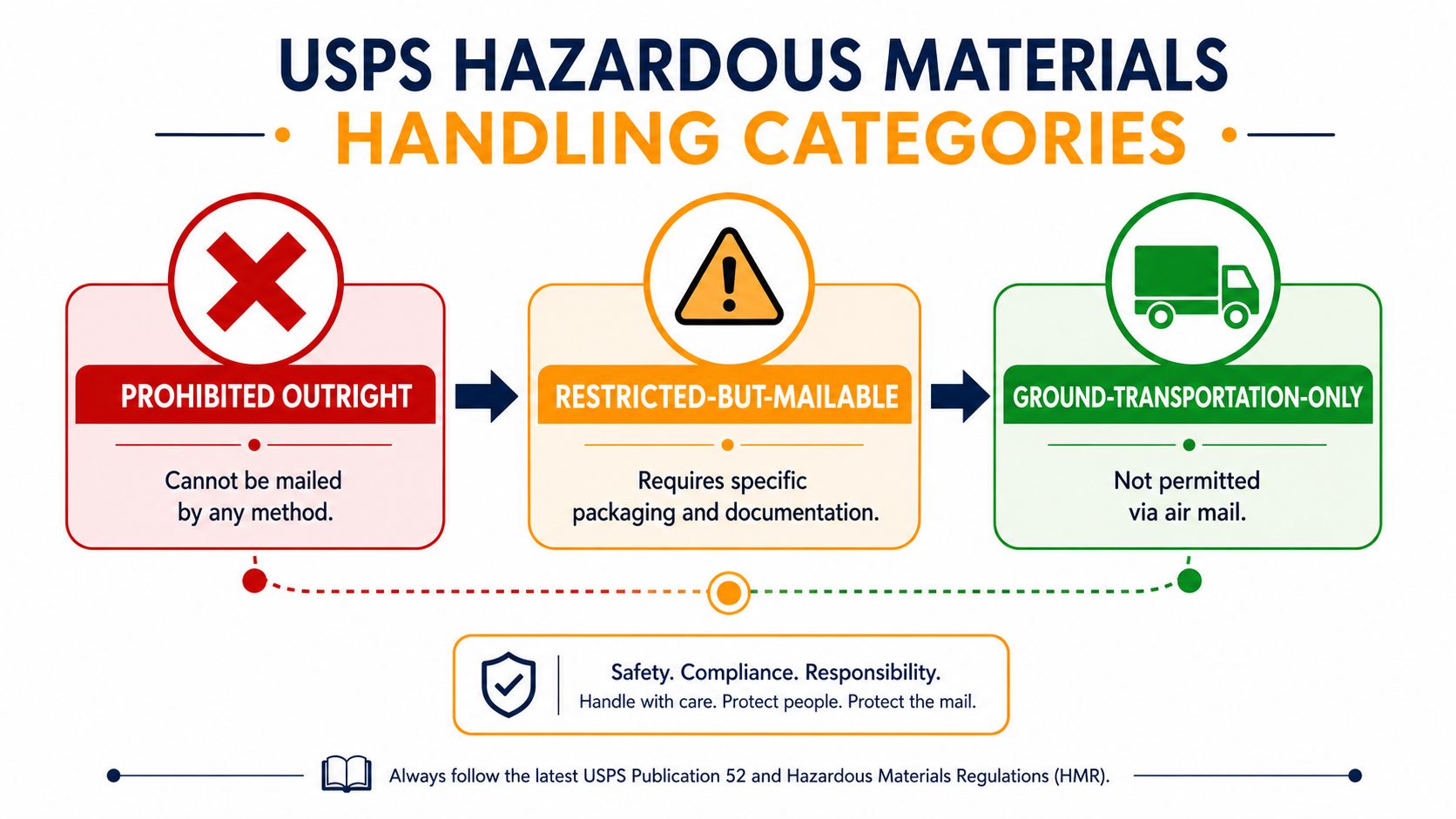
A compliance miss usually starts with the wrong question. The warehouse should not ask, “Can this ship?” first. It should ask, “What is the product, which carrier will take it, and where is it going?” Federal shipping regulations work like that. The product class, carrier policy, and destination rules form the decision tree, and USPS breaks hazmat handling into three useful buckets, prohibited outright, restricted but mailable if requirements are met, and ground-transportation-only. An infographic showing three USPS hazardous material handling categories: Prohibited Outright, Restricted-But-Mailable, and Ground-Transportation-Only.

Start with the product's legal class, not the marketing category
An airgun is not the same as a firearm in most federal frameworks, but that does not make it easy to ship. CBD can be lawful in one context and blocked in another once state law, destination policy, or product composition is part of the review. Knives carry their own overlay through the Federal Switchblade Act and a patchwork of state restrictions. Lithium batteries raise a different question, because the issue is often not whether the item exists in commerce, but whether the selected transport mode will accept it.
Those distinctions set the rule path, not the product page copy. A merchant who tags everything as “age restricted” misses the operational point. Age verification is one layer, not the whole control.
Build the handling decision around the transport mode
Ground-only products need separate handling because the restriction is about movement, not ownership. If a team prints labels before checking air versus ground, it can create a bad tender even when the destination is fine. That failure shows up often when warehouse automation assumes every parcel can move by the fastest service at checkout.
The safer method is to assign each regulated SKU a shipping class and a required handling path. If the item can be mailed only under conditions, those conditions should travel with the order into the label and packing step. If the item is prohibited, it should never reach payment without a block or a clear warning.
A carrier refusal is not always a legal problem. Sometimes it is a packaging problem, sometimes it is a service-level problem, and sometimes it is a mismatch between the SKU and the carrier's acceptable-goods list.
The practical habit that works is simple. Vet the carrier at the same time you vet the product. If a SKU needs a special service, age check, or packaging rule, record that relationship in your order rules before the item reaches the shipping cart. That is cheaper than training the warehouse to improvise after the fact.
Documentation, Labels, and Recordkeeping in Practice
The paperwork side of federal shipping regulations is where theory turns into audit evidence. If a shipment is questioned later, the label, the packaging choice, and the order record become the proof trail. A compliant product that lacks the right identifiers can still become a bad shipment.
USPS hazmat shipping now depends on specific label mechanics
USPS requires mailers to use unique Service Type Codes for domestic outbound and return hazardous-material packages, along with Extra Service Code 857. Since January 21, 2024, USPS has also required two supplemental GS1-DataMatrix IMpb labels, one in the address block and one in the lower-right corner of the label. Then, effective January 27, 2025, USPS added a rigid-outer-packaging requirement for most HAZMAT and dangerous goods mail. Those cartons must meet 32 ECT or 200-lb burst for packages at or under 20 lb, and 44 ECT or 275-lb burst for packages over 20 lb. (USPS Postal Bulletin update)
Those are the kinds of details that stop a bad shipment at the source. They also give you measurable controls, which is what auditors and carriers look for. A label generator that can't distinguish a regular parcel from a hazmat parcel isn't just incomplete, it's exposing the warehouse to avoidable rework.
Recordkeeping has to travel with the parcel
The best teams keep their compliance evidence inside the order record, not in someone's memory. That means product class, required label type, packaging type, and carrier service need to be captured before fulfillment starts. It also means the shipping station should not allow a staff member to “fix it later” by hand.
For physical labeling and carton-control workflows, having the right supplies matters more than many realize. Material Handling USA's page on wholesale labels and tags is a practical reference if your operation still prints labels in a mixed environment and needs a cleaner supply chain for regulated orders.
If you want a tightly scoped USPS-specific checklist for restricted mail handling, this internal guide on USPS restricted mail permit requirements is worth keeping beside your SOP.
What actually holds up during review
- Service code accuracy: The ship record needs the right hazmat code, not a generic label template.
- Packaging traceability: Carton strength should be chosen before the box is sealed, not guessed after a claim.
- Label placement: The supplemental labels have to be where USPS requires them, not “close enough.”
- Order history: If a parcel is challenged, the record needs to show why it was allowed to ship.
The point isn't compliance theater. It's proving that the team applied the rule, not just the printer.
The Overlooked FTC Shipment-Promise Rule
A lot of regulated sellers obsess over whether a parcel can ship and miss the more dangerous question, whether the store promised a delivery window it could legally and operationally support. The FTC's Mail, Internet, or Telephone Order Merchandise Rule still requires a seller to have a reasonable basis to expect shipment within the stated timeframe or, if no timeframe is advertised, within 30 days. (FTC order merchandise rule)
That rule bites harder in regulated catalogs than in ordinary ecommerce. If a destination check, age gate, hazmat condition, or carrier exception might stop fulfillment, the merchant can't safely advertise a normal delivery promise and hope operations will catch up later. The legal exposure starts with the promise.
Checkout blocking beats apology emails
The cleanest fix is pre-payment blocking or explicit limitation messaging at checkout. If the rule engine knows that a product can't legally go to certain ZIP codes, states, or service lanes, the site should prevent the sale or force the customer into a compliant path before payment captures. That's a customer-experience issue, but it's also a legal one.
The highest-risk failure is often not a carrier refusal. It's selling an order you already know may not ship on time or at all.
That's where compliance and marketing collide. Banner copy, shipping estimates, and cart promises all become part of the evidence if a merchant can't deliver. A cautious checkout is usually better than a clever one.
The practical takeaway is simple. If regulated inventory creates uncertain ship times, the promise has to move from a generic delivery estimate to a rule-aware experience that reflects destination legality. The FTC rule doesn't care that the carrier was the one who rejected the parcel. It cares whether the seller had a reasonable basis for the promise in the first place.
Where State and Local Rules Rewrite the Federal Baseline
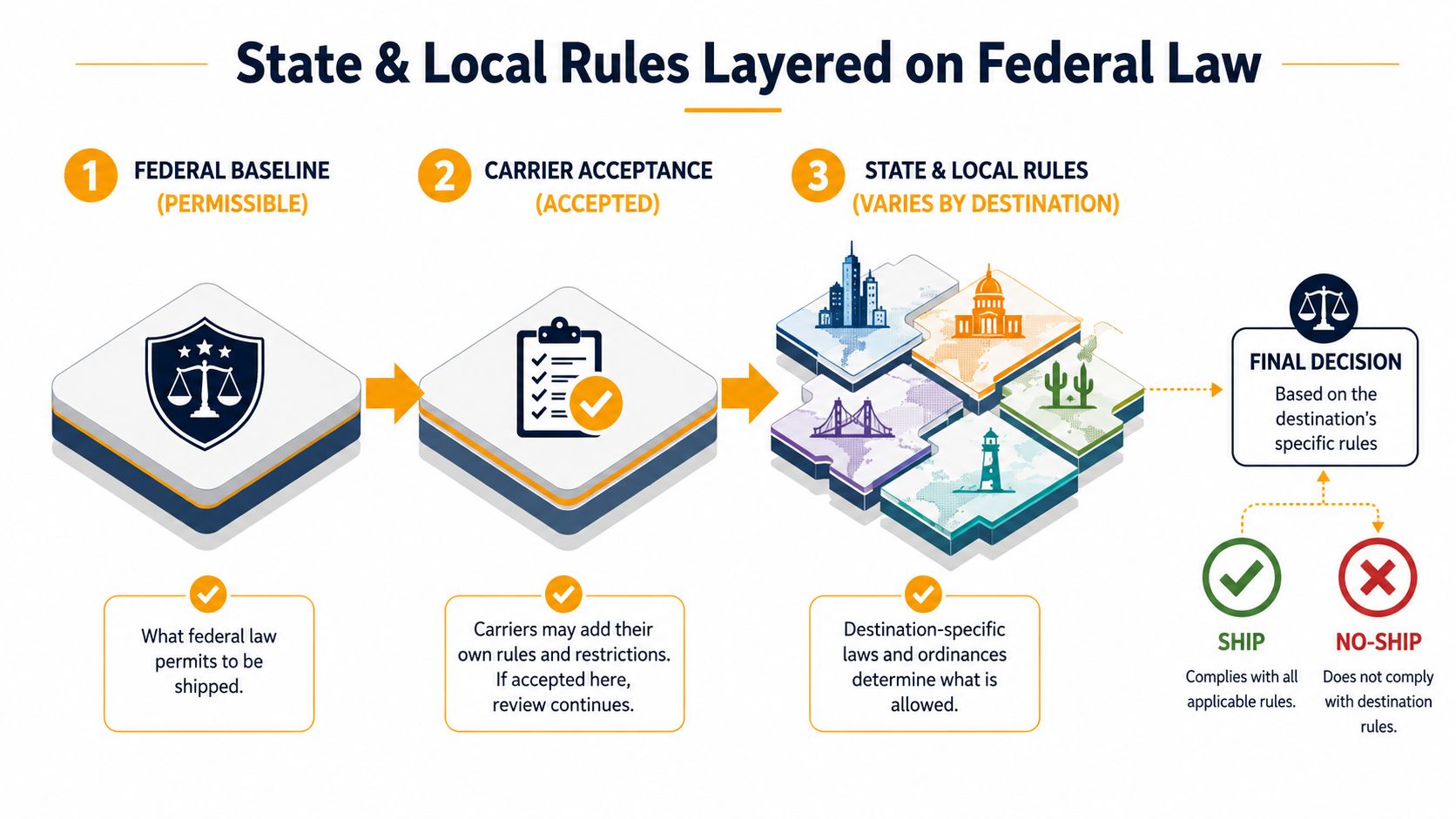
Federal permission is not the end of the analysis. State and local rules can still make a shipment illegal at the destination, even when the product is federally permissible and the carrier is willing to take it. That's the part many ecommerce teams miss because they stop at the federal layer and call the file complete.
The right mental model is destination filtering. A product should pass the federal screen first, then the carrier screen, and then a state or city screen before anyone prints a label.
Treat local law like a shipping lane, not a legal footnote
Airgun delivery bans, hemp and CBD lists, knife blade-length restrictions, and age-verification rules often live at the destination level. That means the same SKU can be fine in one ZIP code and blocked in the next. If your team only checks the federal baseline, you'll miss those destination-specific failures.
A useful internal guide on that layered problem is what federal preemption means in shipping restrictions, because it helps separate what federal law controls from what state law still gets to decide.
Build the block before label generation
The operational rule is straightforward. Destination rules need to run before label generation, not after. If the order is already in the fulfillment queue when the geographic restriction appears, the team is forced into manual review and customer service recovery.
That's the place where patchwork law becomes a workflow problem. Sellers don't need a perfect theory of federalism to stay safe. They need a hard decision gate that says ship, don't ship, or review, based on the address entered at checkout.
Building a Compliance Workflow That Actually Holds
A workable workflow doesn't start with software. It starts with a decision chain that every order passes through in the same order, every time. First, classify the product. Then check the destination. Then check carrier eligibility. Then generate the correct label, packaging, and record trail. If any step fails, the order should stop before payment or at least before fulfillment moves.
The checklist that keeps the process honest
- Classify the SKU: Identify whether the item is prohibited, restricted, or ground-only under the relevant federal rule.
- Check the destination: Block states, cities, or ZIP codes where the shipment isn't allowed.
- Select the carrier: Confirm that the chosen carrier accepts the product category and service level.
- Generate the right artifacts: Apply the right codes, labels, carton specs, and documentation.
- Log the decision: Save the reason the order shipped or was blocked.
- Refresh rules on schedule: Update the rule set when law changes or temporary restrictions expire.
That checklist does one job well. It turns scattered legal requirements into a repeatable process instead of a tribal-knowledge exercise. When a warehouse supervisor, CX lead, and compliance manager all use the same logic, fewer orders need manual rescue.
For teams that need automation instead of spreadsheets, Ship Restrict applies shipping restrictions and checkout compliance in WooCommerce and Shopify by state, city, and ZIP, with product, variant, and category targeting, scheduled rule activation, JSON import and export, and audit logging. If you're also building training content for staff, these AI compliance training examples are useful for turning a policy into a repeatable internal workflow.
The point isn't to eliminate judgment. It's to force the judgment to happen before the order becomes a liability. If your store sells regulated goods, the right move is to make the rule tree visible at checkout and enforce it in the store, not in the shipping cage.
If your store is still relying on manual review for regulated orders, it's time to replace that with a rule tree that blocks bad shipments before they start. Ship Restrict helps WooCommerce and Shopify stores enforce product, state, city, and ZIP restrictions at checkout, so you can stop non-compliant orders before payment, reduce cleanup work, and keep your shipping process tied to the rules that apply.
Automate Shipping Compliance
Stop worrying about restricted states. Ship Restrict handles it automatically.

Cody Yurk
Founder and Lead Developer of ShipRestrict, helping e-commerce businesses navigate complex shipping regulations for regulated products. Ecommerce store owner turned developer.
Automate Shipping Compliance
- Block restricted states
- No more cancellations
- Set and forget
3-day free trial · Card required