What Is Federal Preemption? a Guide for FFL Retailers
Understand what is federal preemption and how it impacts your firearms business. Learn the legal basics and how to stay compliant with complex state laws.
You're staring at a checkout page, an order is ready to move, and the rules don't line up. The state allows the sale, the city may have its own ordinance, and your shipping team needs a clean answer before the label prints. That's the everyday problem federal preemption is supposed to solve, and for a WooCommerce firearms retailer, it can also be the difference between a compliant shipment and a costly mistake.
At a high level, federal preemption is the rule that valid federal law can override conflicting state or local law under the Constitution's Supremacy Clause. In firearms retail, though, that simple sentence doesn't remove the hard part, because the primary task is deciding which rule controls when federal, state, county, and city requirements overlap. If you run an FFL business online, this isn't a law school abstraction, it's a shipping and checkout issue.
The Compliance Dilemma Facing Every FFL Retailer
A customer places an order for a standard firearm accessory, the address looks legitimate, and the sale seems routine. Then someone on your team notices that the destination is inside a city with a local rule layered on top of state law, and the question becomes immediate, which rule governs the shipment? That's the kind of moment where merchants feel the pressure of overlapping authority in real time.
The mistake many retailers make is treating state law as the final answer. It often isn't. In firearms commerce, you can have a federal baseline, a state overlay, and then another local layer that may or may not be enforceable depending on preemption rules, which is why manual review so often turns into second-guessing.
Automate Shipping Compliance
Block orders to restricted states automatically. 3-day free trial.
Start Free TrialThat uncertainty isn't just annoying, it creates operational risk. A label printed too soon can become a compliance problem, while an unnecessary cancellation can frustrate the customer and slow down cash flow. For a practical overview of the business consequences, see the true cost of shipping compliance violations.
Practical rule: if your team cannot explain why a destination is allowed, it's too early to ship.
The challenge lies in the fact that firearms compliance is rarely handled by one rulebook. It's a patchwork, and the retailer who assumes one layer of law automatically resolves the rest usually finds out too late that it doesn't. That's why understanding what federal preemption is matters at the checkout stage, not just in a legal memo.
What Federal Preemption Actually Means
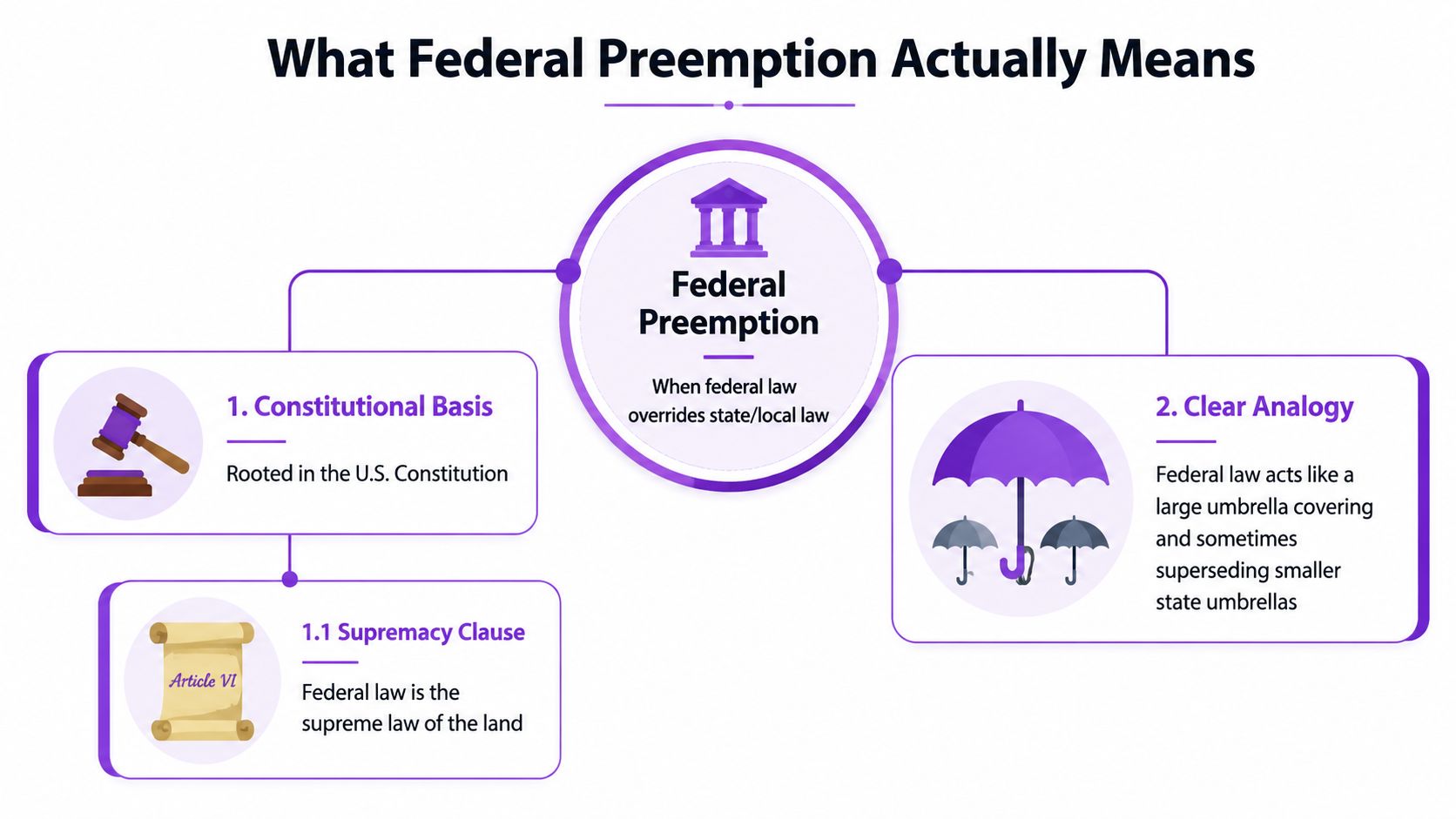
Federal preemption starts with the Supremacy Clause of Article VI, which makes “the Laws of the United States ... the supreme Law of the Land” (Congressional Research Service overview of federal preemption). In practice, that means when Congress validly enacts a law and a state law conflicts with it, the federal law takes precedence and the state law is preempted. For a retailer, the operational takeaway is simple, if a lower-level rule would make compliance with federal law impossible or would frustrate a federal objective, you have a conflict problem.
Federal preemption operates similarly to a relationship between headquarters and branch offices. The federal rule is the company-wide directive, and state or local rules are branch policies. A branch can add detail, but it can't tell employees to do the opposite of what headquarters requires.
Why the constitutional basis matters
The constitutional source matters because preemption isn't a policy preference, it's a hierarchy of authority. Courts don't just ask whether a local rule seems inconvenient, they ask whether Congress had the power to displace the lower-level rule and whether the federal law does so in the circumstances. That's why a retailer can't rely on intuition alone when an order crosses multiple jurisdictions.
Federal preemption also covers valid federal agency regulations issued under congressional delegation, not just statutes, so the compliance question is broader than one line in the U.S. Code (Cornell Legal Information Institute on preemption). In real terms, your workflow has to account for the federal framework as a whole, including rules that shape how shipments, transfers, and restricted persons are handled.
What it means for a WooCommerce retailer
For an online firearm seller, federal preemption is less about courtroom theory and more about setting the correct decision tree. A good system answers three questions quickly. Does a federal rule apply, does a state or local rule add a restriction, and can both rules operate together without conflict?
The safest shipping logic is the one that assumes overlap until the software proves otherwise.
A practical compliance stack should therefore treat federal law as the floor, not always the ceiling. The ceiling depends on whether state or local law has been displaced, and in firearms retail that question often turns on narrow preemption language rather than broad federal takeover.
Free Shipping Compliance Audit
We'll review your WooCommerce store's shipping compliance for free.
Here's a useful reference point for local compliance disputes, county-level shipping restrictions. County and city layers are often where manual processes break down first.
The Two Main Types of Preemption Explained
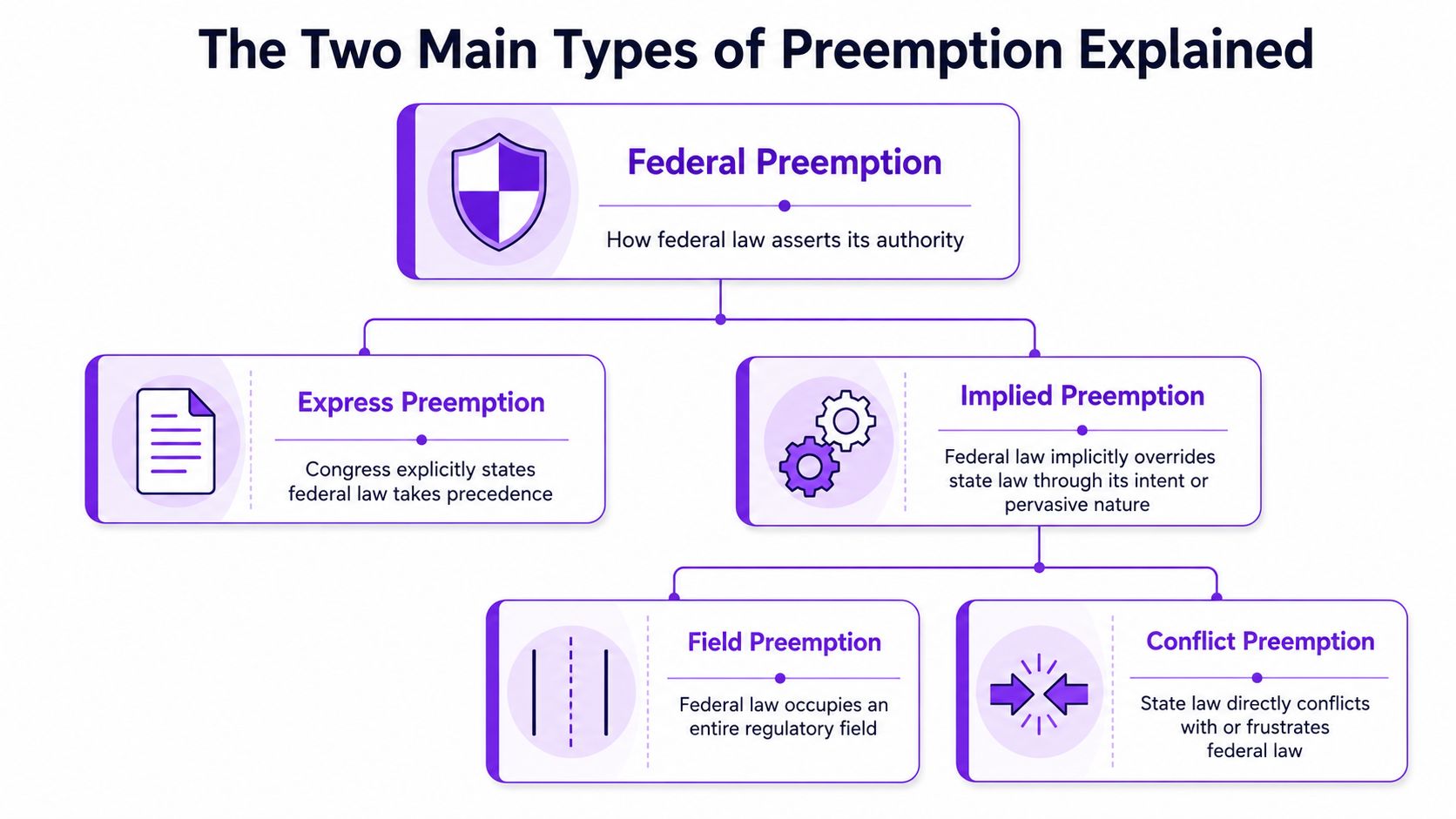
Courts generally work with two main buckets, express preemption and implied preemption (Duke Sanford preemption overview). Express preemption is the easy one to spot, because Congress says directly that state law is displaced. Implied preemption is subtler, and it appears when Congress does not use the word “preempt” but the structure of the federal scheme still leaves no room for lower-level rules.
Express preemption
Express preemption happens when the statute says it plainly. For a retailer, that means the first place to look is the text of the federal law itself. If Congress has clearly said a category of state rules is displaced, there's less room for argument.
A simple non-firearms example is a federal product rule that says states may not require a different warning label for the same item. That kind of statute removes guessing from the analysis because the federal law tells you the scope of displacement.
Implied preemption
Implied preemption comes in two forms, field preemption and conflict preemption. Field preemption exists when the federal regulatory scheme fully occupies the whole field. Conflict preemption exists when you can't comply with both rules at once, or when the state rule stands as an obstacle to the federal purpose.
A practical example is a federal safety standard that controls every aspect of a device's design, testing, and labeling. If a state then tries to impose an incompatible design requirement, the issue isn't whether Congress wrote “preempt,” it's whether the state rule can coexist with the federal one.
Why this distinction matters operationally
For a WooCommerce retailer, the distinction affects how you build your compliance logic. Express preemption can often be coded as a direct exclusion rule. Implied preemption requires more judgment because it depends on the interaction between two legal systems, not just one sentence in a statute.
That's why a compliance workflow should flag both text-based overrides and conflict-based risks. If your team only screens for explicit federal bans, you'll miss the messier situations where a state or local rule looks valid on its face but still can't operate alongside federal law.
How Federal Preemption Works in Firearms Regulation
Firearms law is a textbook example of layered authority, but it's also where overconfidence causes the most trouble. With very narrow exceptions, Congress has not expressly preempted state or local firearms and ammunition laws, and courts generally presume against preemption unless there's an irreconcilable conflict (Giffords on preemption of local firearms laws). That means the federal rule is not a universal shield for a retailer who wants to ignore local restrictions.
In practical terms, federal firearms law still matters because it sets important national constraints. But in many retail decisions, state and local law can be stricter. That's why the answer to “is it legal federally” is often only the first question, not the final one.
Why the patchwork exists
The reason the patchwork persists is that Congress has usually left broad room for state and local regulation in this area. Many local governments are limited by their own state's preemption statutes, and in the states that do expressly preempt most local firearm regulation, the state law becomes the key layer merchants watch first. For a retailer, that means you need jurisdiction-aware shipping logic, not a one-size-fits-all federal checklist.
The daily workflow consequence is straightforward. A destination can be fine under federal law and still fail a state or local rule. If your team only checks against a federal standard, you're leaving a blind spot in the process.
What a compliant retail workflow looks like
A strong workflow checks location before checkout, not after the order ships. It should also distinguish between product types, buyer status, and destination layers, because firearms retail doesn't fail in one big obvious way, it fails in small overlooked ones. A customer-facing block at checkout is far safer than a manual catch in the warehouse.
For a more detailed look at how online retailers handle federal transfer paperwork alongside ecommerce operations, review ATF Form 4473 and e-commerce.
If your policy says “we'll sort it out later,” your policy is really a liability plan.
The practical lesson is that federal preemption does not eliminate the need for local screening in firearms commerce. It only tells you how to resolve a direct conflict when one exists, and in this industry those conflicts are frequent enough that the screening process has to be built into the store itself.
Common Misconceptions and Emerging Compliance Traps
One dangerous myth says that an FFL automatically overrides local law. It doesn't. Another says federal preemption is broad enough to simplify the entire firearms compliance picture. It isn't, especially when state and local restrictions continue to sit on top of the federal baseline.
The newest trap is not static law, it's shifting federal interpretation. In January 2026, the DOJ's Office of Legal Counsel concluded that the federal ban on mailing concealable firearms under 18 U.S.C. § 1715 is unconstitutional as applied to protected firearms (Cornell CFR text on 18 U.S.C. § 1715 context). That's a major development because many general explainers assume federal mailing restrictions are settled in the same way year after year.
Why changing federal limits can raise risk
When one federal restriction weakens, the compliance burden doesn't disappear. It shifts. Retailers still have to deal with interstate shipment limits, transfer restrictions for prohibited persons, and the continuing stack of state and local rules that sit beside federal law.
That creates a trap for businesses that only update their process after a headline changes. If the federal rule narrows but your local restrictions stay the same, your shipping policy can become inconsistent overnight. The risk isn't just noncompliance, it's using yesterday's assumptions to make today's shipping decision.
What to watch in practice
A firearms retailer should treat shipping rules as living controls, not static policy text. That means any address-based rule set needs review whenever the federal framework changes, but also whenever a state or local jurisdiction updates its own restrictions. Manual spreadsheets won't keep up for long.
A more reliable approach is to separate legal interpretation from enforcement. Let counsel decide how a federal change affects your business policy, then let automation apply the current rule set consistently at checkout. That keeps staff from making ad hoc decisions under pressure.
Outdated habits prove most damaging. Teams that rely on memory, old SOPs, or tribal knowledge tend to miss the places where rules are layered, narrowed, or reinterpreted. In firearms ecommerce, “we've always done it this way” is not a compliance strategy.
How to Automate Compliance and Reduce Legal Exposure
Manual address review doesn't scale well when the legal map changes by state, county, city, and ZIP code. A WooCommerce retailer can't realistically expect staff to verify every shipment against every local rule in real time, especially when the legal issue is not just federal legality but whether a destination is blocked by a narrower subnational rule. The practical answer is to automate the decision before checkout.
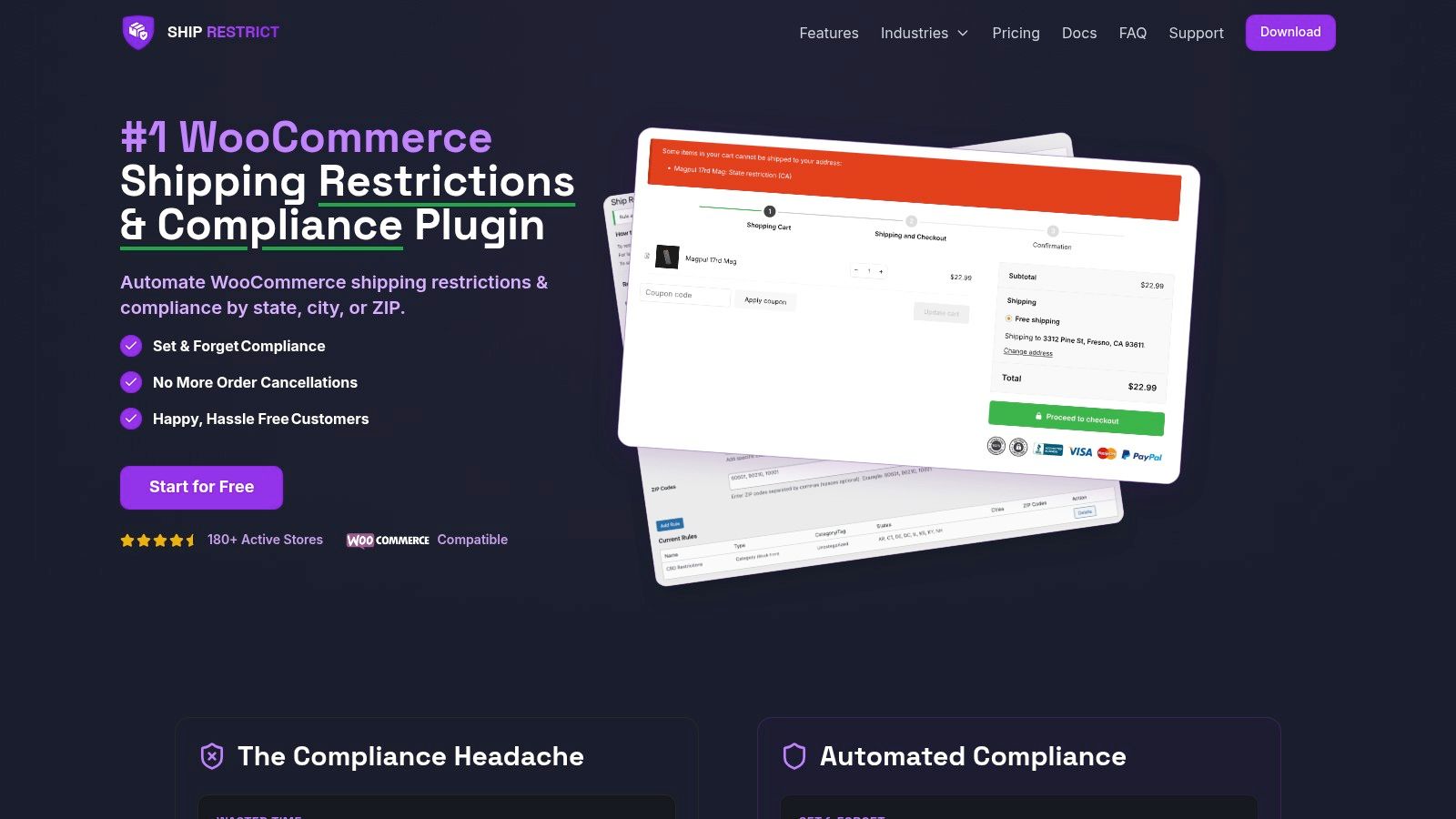
That's where a tool like Ship Restrict for WooCommerce fits. It lets merchants apply granular location-based shipping rules, so restricted products can be blocked by state, county, city, or ZIP code before the order completes. For a regulated firearms store, that matters because the order never reaches packing if the destination fails the rule check.
What automation does better than spreadsheets
Automation reduces the two failures that hurt retailers most, missed restrictions and inconsistent manual judgment. A spreadsheet can tell a staff member what the rule was when someone last updated it. It can't reliably stop a checkout on its own.
A rules engine built into WooCommerce can. It applies the same logic every time, which is exactly what regulated commerce needs. That consistency is especially valuable when the legal layer beneath you changes faster than your internal team can manually review every order.
A practical setup for a firearms merchant
Start with your highest-risk destinations, then build outward to broader geographic restrictions. Keep the rules simple enough that staff can explain them, and specific enough that the checkout flow blocks questionable orders early. If the business serves multiple jurisdictions, use location restrictions as a front-line control instead of an after-the-fact filter.
Compliance works best when the software makes the safe choice before a person has to improvise.
If you want a scalable control layer that fits a WooCommerce workflow, Ship Restrict is one option built for granular location rules in regulated commerce. The point isn't to remove legal review, it's to keep human review focused on the hard calls instead of the obvious ones.
If your store is still checking restricted destinations by hand, tighten the process now. Map your shipping rules, review the jurisdictions that matter most to your business, and put automated blocks in front of checkout so your staff isn't guessing under pressure.
Automate Shipping Compliance
Stop worrying about restricted states. Ship Restrict handles it automatically.

Cody Yurk
Founder and Lead Developer of ShipRestrict, helping e-commerce businesses navigate complex shipping regulations for regulated products. Ecommerce store owner turned developer.
Automate Shipping Compliance
- Block restricted states
- No more cancellations
- Set and forget
3-day free trial · Card required