Firearms Export Compliance: Master Essentials for 2026
Master export compliance for firearms eCommerce. Learn sanctions, denied parties, and licensing. Automate to reduce legal exposure in 2026.
The order looks domestic until it doesn't. A customer checks out on a WooCommerce firearms store with a U.S. billing address, a shipping name that looks normal, and a cart that clears every basic fraud rule. Then the fulfillment team notices a forwarding-style address, a mismatch in buyer details, or a destination that shouldn't have passed first review, and the whole order has to stop before it turns into an export problem.
That's the part most firearms sellers underestimate. Export compliance doesn't begin at the border, and it doesn't end with a shipping label. It starts the moment a regulated product enters the transaction flow, where product data, customer data, destination data, and document handling all need to line up before the package moves.
The practical failure is usually small. A store approves the order because the item is lawful to sell, but no one checked whether the buyer, end user, or destination created a separate export issue. By the time someone spots it, the business is already dealing with a held shipment, a canceled order, or an audit trail that's too thin to defend.
When a Single Order Becomes an Export Problem
A firearms merchant can lose control of an order long before the box leaves the shelf. The trigger is often mundane, a normal-looking checkout with details that don't fit the rest of the file. A buyer may look domestic on paper, but the shipping path, contact data, or requested handling tells a different story.
Automate Shipping Compliance
Block orders to restricted states automatically. 3-day free trial.
Start Free TrialThat's why export compliance has to live inside the store's order flow, not in a separate binder that only gets opened after something goes wrong. The fastest way to get burned is to let checkout approve a regulated order before anyone has checked the destination, the end user, and the transaction pattern together. When that happens, the merchant has already created a problem that shipping can only expose, not fix.
Practical rule: if the order only looks clean after someone manually explains away three warning signs, it wasn't clean enough to release.
The best way to think about it is chain logic. One weak link, like a miss on the address, a bad classification, or a skipped screening step, can turn an otherwise lawful sale into a compliance failure. For regulated goods, the right question is never just “Can we sell this item?” It's “Can we move this specific item to this specific buyer, in this specific place, under this specific set of controls?”
For that reason, cross-border documentation matters early. A useful primer on the shipping side is the guide to cross-border restricted goods documentation, because the paperwork risk usually shows up at the same moment the order starts looking unusual.
What Export Compliance Actually Means for a Firearms Store
Think of export compliance as a set of locked doors. A regulated order has to pass each door in sequence, and if one door doesn't open, the shipment shouldn't move. For a firearms store, those doors are product classification, party screening, destination review, and license logic.
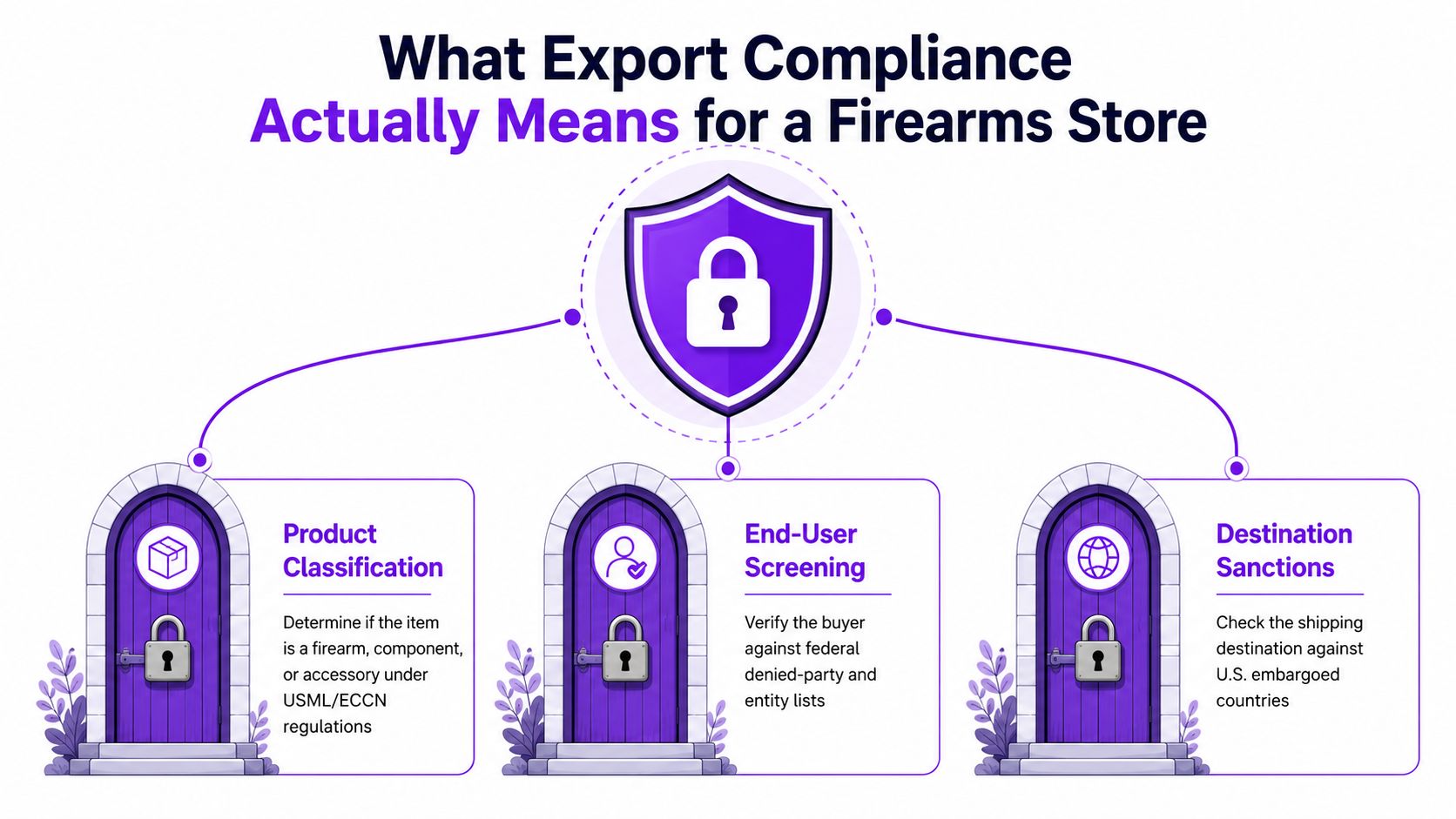
Domestic shipping is not the same thing as export compliance
A lot of merchants mix up ordinary firearms shipping rules with true export controls. Domestic shipment rules, FFL checks, carrier policies, and state restrictions matter, but they're not the same as cross-border transfer rules. The export side kicks in when the item, the buyer, the destination, or the later movement of the goods crosses into controlled territory.
That distinction matters because a store can do everything right on a domestic label and still fail export compliance. A forwarding address, an overseas end user, or a re-export request can make an order subject to a different rule set. The store that treats every checkout as “domestic unless proven otherwise” is running blind.
The clean working definition is simple. Every regulated order has to be screened, classified, documented, and approved before shipment. If one of those pieces is missing, the order may still be saleable, but it isn't defensible.
For merchants who also handle broader compliance questions around data and customer handling, the operational mindset is similar to the one discussed in Florida startup data privacy compliance, where the control problem is less about writing policy and more about proving that the right check happened at the right time.
Free Shipping Compliance Audit
We'll review your WooCommerce store's shipping compliance for free.
The Legal Stack Behind Export Compliance
Firearms merchants sit in a multi-agency framework, not a single-law environment. ITAR governs defense articles and the U.S. Munitions List under the State Department's Directorate of Defense Trade Controls. EAR covers many dual-use items under the Commerce Control List, with BIS driving licensing and compliance expectations. OFAC sanctions rules, including denied-party screening, come from Treasury. For some exports, ATF rules also matter, especially around permanent exports and related documentation.
The result is a decision tree, not a slogan. First, classify the product. Then decide whether it falls under EAR or ITAR jurisdiction. Then map the item to an ECCN or USML category, and then check the buyer, destination, and end use against the applicable restrictions. A store that gets the first step wrong often poisons every step after it.
The first question is jurisdiction
The practical question isn't “Do we have a policy?” It's “Which legal regime controls this SKU?” That answer affects licensing, screening, and recordkeeping. If the item is treated as a defense article, the rules are much tighter than a simple commercial shipping workflow.
The second question is who else is in the transaction
A regulated item can't move just because the product itself is lawful. The buyer, consignee, forwarder, and end user all matter, because sanctions or denied-party issues can block a shipment even when the SKU is correctly classified. A commercial invoice and checkout record that look fine on their face still need to match the legal path of the transfer.
For a concise overview of the overlap between product control and export law in a regulated catalog, the guide on ITAR compliance for military equipment in e-commerce is useful context. The main point is consistent across regimes, compliance lives in classification, screening, and proof.
Four Risk Zones Inside Every Firearms Order
A firearms order usually breaks in one of four places. The first is international shipping, where address patterns, freight forwarders, APO/FPO misuse, and obvious destination issues should trigger a hold before fulfillment. The second is denied-party screening, where the customer, consignee, or related party needs to be checked against the relevant restricted lists.
The third is documentation. That includes commercial invoices, license references when required, and export records that can be recovered later. The fourth is licensing itself, where the business has to decide whether the shipment can move at all without prior approval.
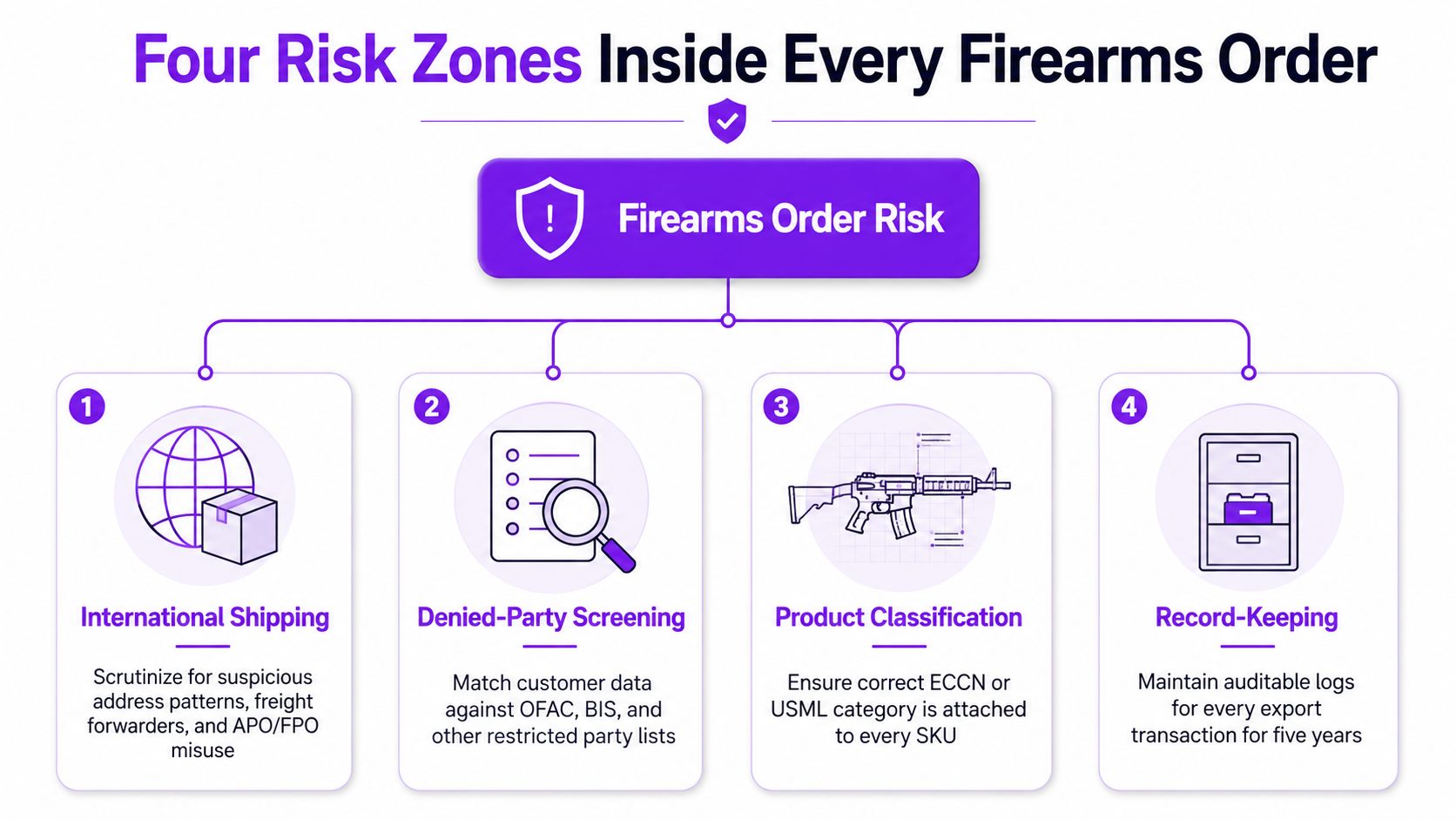
Where stores usually fail first
International shipping failures are often obvious in hindsight. Someone spots a suspicious address pattern only after the label is printed. Screening failures are quieter, because a business may check the name once and assume the file is done. Documentation failures are the nastiest, because they can survive the shipment and show up later as a recordkeeping problem.
The recordkeeping side is not optional cleanup. U.S. companies must generally retain export records for five years after the later of the export date or any known re-export or in-country transfer for transactions subject to the EAR, and those records should be retrievable within 48 hours on request (Reuters Practical Law). That makes record control a living obligation, not an archive task.
The file has to survive the shipment. If you can't rebuild the decision later, you didn't really control it.
A quick ranking helps. First harden screening and destination review, because those stop the worst mistakes before shipment. Then tighten documentation, because it carries the proof burden. Licensing comes next, since it's usually the most visible gate but not the only one that matters.
If you track trade and cross-border policy around your broader operation, the commentary on how tariffs affect Australian businesses is a useful reminder that international movement problems rarely stay in one lane. Compliance issues tend to stack.
A Step-by-Step Compliance Workflow for WooCommerce Stores
The safest WooCommerce workflow starts before checkout and ends only after the record is stored. First, classify the SKU and attach the export-control data to the product record. That means the order system should know whether the item sits under an ECCN, a USML category, or another control path before a customer ever clicks buy.
Next, screen the buyer and the ship-to data against the relevant restricted-party logic. Then validate destination and end use, because a clean name doesn't rescue a bad route. After that, generate the documents and send only the approved order to fulfillment.
What should block, what should wait, and what should just log
A clean rule set is easier to defend than a human memory. Auto-block orders when the destination is prohibited, the party match is strong, or the product lacks required control data. Send to manual review when the signals conflict, the end use is unclear, or the address is valid but the transaction behavior looks strange.
Manual review belongs at the edge cases, not in the center of the workflow.
Log-only events are the lowest-risk class, the ones that don't change the approval decision but still belong in the audit trail. That includes successful screens, routine approvals, and normal order handling. The merchant who documents every action and every exception is in a far better position than the merchant who “knows how things usually go.”
For reporting structure, the practical guide on export compliance reports for WooCommerce stores is worth using as a model. The broader systems question is the same one merchants face when choosing between WooCommerce versus Shopify, how much control you need at the transaction layer.
Manual Checks Versus Automated Enforcement
Manual compliance looks cheap until the volume rises. A spreadsheet can work for a tiny catalog and a patient team, but it depends on someone remembering to check each order, using the right list, at the right time, with the right version of the data. That's fragile.
Automated enforcement changes the shape of the work. The screen runs at checkout or order management, the rules apply consistently, and the store can hold, warn, or block without waiting for someone to open a spreadsheet. Coverage improves because every order gets the same baseline treatment.
| Mode | What actually happens | Where it breaks |
|---|---|---|
| Manual | Staff look up names, destinations, and restrictions by hand | Missed checks, inconsistent judgments, slower releases |
| Automated | Rules run in the transaction flow and trigger holds or blocks | Needs good data and sensible escalation rules |
The legal benefit is consistency. If one order was blocked for a particular destination last week, the same destination should be handled the same way this week. That's much easier to prove when the system enforces the rule instead of a person trying to remember the precedent.
Automation doesn't remove human judgment. It removes routine repetition so a manager can focus on the ambiguous files, the ones with mixed signals or unusual routes. That's the right trade-off in a regulated store.
How Ship Restrict Reduces Legal Exposure
A firearms merchant I'd trust more than most had the same problem I see in many WooCommerce stores. The team knew which locations should be restricted, but the checks lived in email threads and manual reviews. They moved to automated address-level controls, built rules by state, county, city, and ZIP code, and set start and expiry dates for time-bound restrictions so stale rules wouldn't keep blocking clean orders.
That changed the order flow immediately. A shipment headed to a restricted jurisdiction was stopped before fulfillment, and customer-facing messages explained why the order couldn't proceed. Bulk rule creation helped the catalog stay manageable, and performance-optimized validation kept checkout from feeling slow.
Where the operational value shows up
A tool like Ship Restrict fits at the enforcement layer, not the policy layer. It can't decide whether a SKU belongs under ITAR or EAR, but it can enforce the location rules the store already knows it needs. That's the useful part in WooCommerce, because the store stops relying on someone to catch every bad address by hand.
The upcoming features matter for the same reason. Real-time rule feeds, rule import and export, and admin notifications reduce the chance that a stale restriction or missed update leaves a hole in the workflow. For regulated catalogs, that kind of upkeep is the difference between a system that ages well and one that gradually falls behind.
Turning Compliance Into an Operating Standard
Treat export compliance like a live operating standard, not a policy file. Classify every regulated SKU. Screen every order. Document every decision. Review the rules on a regular cadence. Keep records retrievable for at least five years.
That list sounds simple because the hard part isn't the policy language. The hard part is making the store behave the same way every time, even when the team is busy and the order queue is full. Merchants who move toward real-time screening and behavioral red-flag detection are building for the way regulators already expect compliance to work.
The stores that get this right stop asking whether compliance is “done.” They ask whether the controls still match the transaction flow, the catalog, and the current risk profile. That's the standard worth running.
If you want to stop catching export problems after checkout and start blocking them inside the WooCommerce flow, take a look at Ship Restrict. It gives firearms sellers address-level enforcement, structured rules, and order-level control that fit the way regulated shipments fail in practice.
Automate Shipping Compliance
Stop worrying about restricted states. Ship Restrict handles it automatically.

Cody Yurk
Founder and Lead Developer of ShipRestrict, helping e-commerce businesses navigate complex shipping regulations for regulated products. Ecommerce store owner turned developer.
Automate Shipping Compliance
- Block restricted states
- No more cancellations
- Set and forget
3-day free trial · Card required