ITAR compliance military equipment e-commerce: Guide to Export Controls
ITAR compliance military equipment e-commerce: A practical guide to DDTC registration, export controls, licensing basics, and secure online storefronts.

Selling military equipment online isn't just another e-commerce niche—it's a heavily regulated industry governed by the International Traffic in Arms Regulations (ITAR). For WooCommerce merchants, this means your checkout process effectively becomes a national security checkpoint. You're responsible for adhering to strict rules about who can buy your products and where they're going.
Get it wrong, and you're facing severe penalties. Nailing down your ITAR obligations from day one is absolutely essential.
Understanding Your ITAR E-Commerce Obligations
Jumping into e-commerce with military or defense-related gear demands a complete shift in mindset. Unlike selling t-shirts, every single transaction is scrutinized through the lens of U.S. national security. ITAR is the set of U.S. government regulations at the heart of it all, controlling the export and import of defense articles and services.
And it's not just about physical hardware like firearms or tactical vests. ITAR's reach extends to "technical data"—think blueprints, CAD files, software, or even detailed instruction manuals. A violation could be as simple as letting a non-U.S. person access those files on your server.
Automate Shipping Compliance
Block orders to restricted states automatically. 3-day free trial.
Start Free TrialThe Central Role of the U.S. Munitions List
The bedrock of ITAR is the United States Munitions List (USML). It's a detailed catalog broken down into 21 categories of defense articles. If anything you sell—or even a small component within a product—appears on the USML, you're in ITAR's world.
This list is incredibly specific, covering everything from firearms and ammunition to military-grade electronics and protective equipment.
Your first, most critical job is to determine if any of your inventory falls under these categories. This isn't a suggestion; it's a legal mandate. A misclassification here can cascade into a catastrophic compliance failure down the line.
The core principle of ITAR is straightforward but absolute: Access to USML-listed items and their technical data is restricted to U.S. persons unless you have explicit authorization from the U.S. Department of State. This applies online just as it does offline.
Why Compliance Is a Business Imperative
Ignoring ITAR isn't an option. The consequences are brutal. Violations can trigger civil fines exceeding $1 million per violation, criminal penalties, and even jail time. For an e-commerce store, it could also mean being blacklisted from future exports and suffering irreparable damage to your brand.
But don't just see ITAR compliance as a burden. To give you some context, the International Traffic in Arms Regulations (ITAR) is a U.S. regulatory regime run by the Department of State’s Directorate of Defense Trade Controls (DDTC), which manages all defense-related articles on the USML. As of 2025, over 13,000 organizations are registered with the DDTC.
Getting this right provides real business advantages. A National Defense Industrial Association survey found that ITAR-compliant manufacturers consistently outperform their peers in areas like documentation, security, and even product quality. You can learn more about how national security intersects with business opportunity.
Embracing robust compliance measures does three key things for your store:
- Protects National Security: You become a vital partner in preventing sensitive technology from falling into the wrong hands.
- Builds Government Trust: A solid compliance record can open doors to lucrative government contracts and partnerships.
- Enhances Business Reputation: Customers, suppliers, and partners will see you as a reliable, professional operator in a high-stakes industry.
To get started, you need to internalize a few core concepts that are foundational to everything else you'll do.
Core ITAR Concepts for Online Sellers
This table breaks down the foundational ITAR components every online seller of military equipment needs to know. Think of this as your cheat sheet for the big-picture ideas.
Free Shipping Compliance Audit
We'll review your WooCommerce store's shipping compliance for free.
| Concept | What It Means for Your Online Store | Action Required |
|---|---|---|
| U.S. Person | You can only sell or grant access to ITAR-controlled items to U.S. citizens, permanent residents, or protected individuals. | Implement a system to verify customer nationality at checkout. |
| Export | An "export" isn't just shipping a box overseas. It includes sharing technical data with a foreign person, even if they're in the U.S. | Restrict access to technical files and secure your servers. |
| Technical Data | Blueprints, photos, software, and manuals related to USML items are controlled just like the physical products themselves. | Audit all digital assets and control who can view or download them. |
| Defense Service | Providing assistance (like training or maintenance) to a foreign person on a defense article is a controlled activity. | Scrutinize any service offerings and ensure they are only provided to U.S. persons. |
Internalizing these concepts is the first step. It shifts your perspective from being just a retailer to being a gatekeeper of sensitive U.S. technology. With this foundation, you can start building the practical, step-by-step compliance framework your store needs to operate legally and successfully.
Classifying Products and Registering with the DDTC
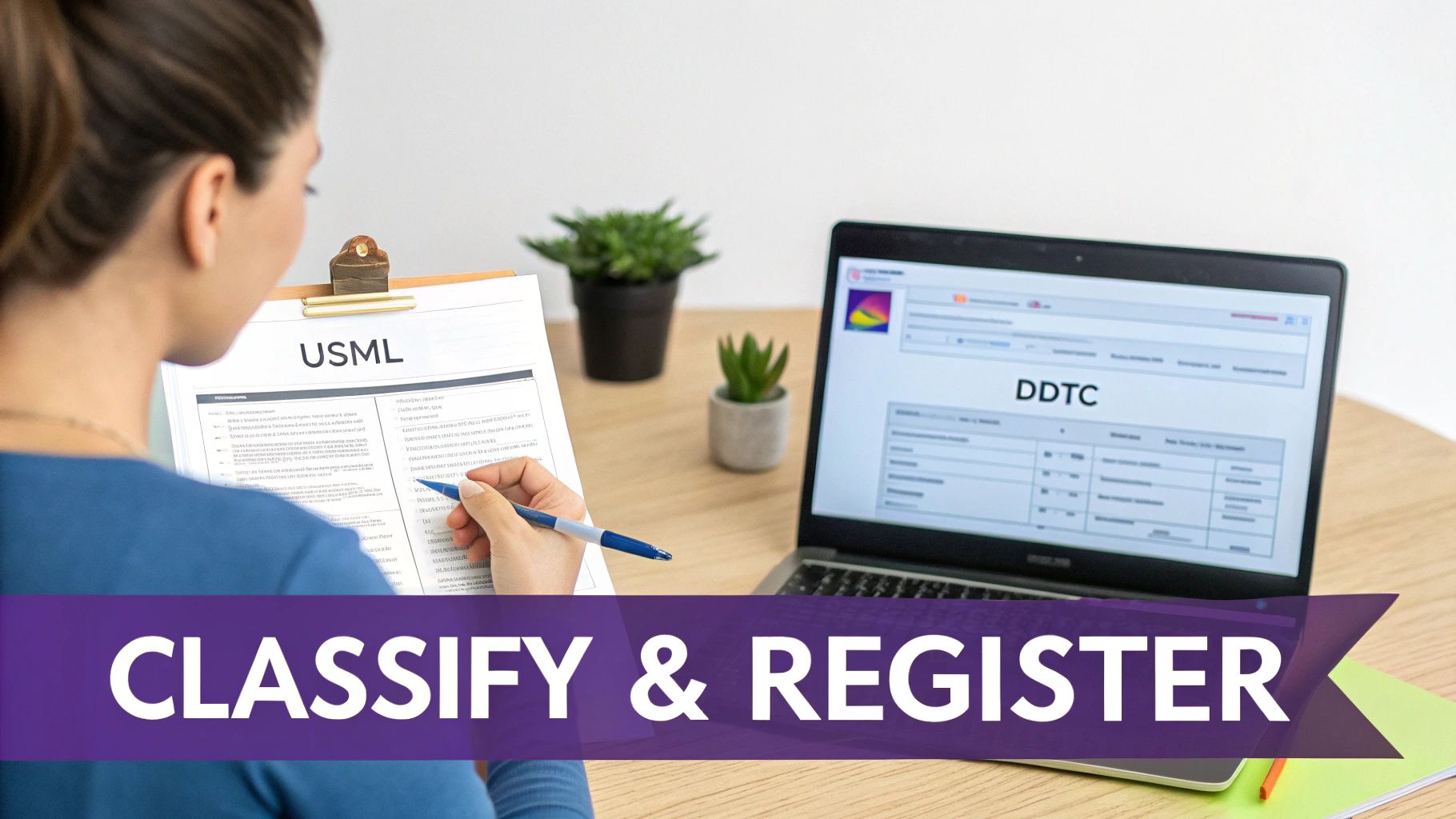
Before a single product goes live on your WooCommerce store, you have to answer one fundamental question: is it controlled by ITAR? This first step, known as commodity jurisdiction, isn't a quick glance. It's a meticulous review of your entire inventory against the 21 categories of the U.S. Munitions List (USML).
Getting this classification wrong is like building a house on a shaky foundation—everything that follows is at risk. Any company that manufactures, sells, or even just distributes items on the USML must be ITAR compliant. This isn't just for major defense contractors; it applies to any online store in the supply chain.
Navigating the U.S. Munitions List
The USML is incredibly specific. It doesn't just list tanks and missiles. It drills down to components, accessories, and even technical data. For an e-commerce store, this means a specialized scope, a firearm chassis, or military-grade night vision goggles all fall under its purview.
Your job is to take each product and cross-reference it with the USML categories. Let’s say you sell high-performance firearm components. You'd need to comb through:
- Category I: Firearms, Close Assault Weapons and Combat Shotguns
- Category II: Guns and Armament
- Category III: Ammunition/Ordnance
A common pitfall is overlooking the small stuff. A simple-looking part could be specifically designed for a military-grade weapon, pulling your entire operation into ITAR's orbit. It’s a detail-oriented process that demands absolute precision.
Key Takeaway: Product classification is not a one-and-done task. Every time you add new products, you have to repeat this diligence. A wrong assumption can lead to a severe violation without you even realizing an export occurred.
Some of your products might not be on the USML but could still be controlled. These are often "dual-use" items, which have both commercial and potential military applications, and typically fall under the Export Administration Regulations (EAR). If you're struggling to classify an item, you may need to learn more about the complexities of dual-use goods and shipping restrictions to stay compliant.
The DDTC Registration Mandate
Once you’ve confirmed that you handle USML-listed items, your next step is non-negotiable: register with the Directorate of Defense Trade Controls (DDTC). This is the arm of the State Department that administers ITAR, and registration is a prerequisite for legally engaging in any ITAR-related business.
Think of it as your license to operate in the defense trade space. Without a current DDTC registration, any sale or distribution of ITAR-controlled military equipment is a violation, plain and simple.
The process involves submitting a Statement of Registration (Form DS-2032) and paying the fees. These fees are tiered, starting around $3,000 for new registrants, and must be renewed annually. Letting your registration lapse while you continue to operate can bring on significant penalties.
A Practical Registration Scenario
Let's walk through a real-world example. You run a successful WooCommerce store selling custom firearm accessories. After a thorough review, you determine that several of your proprietary rifle chassis systems and sound suppressors are listed under USML Category I.
Here’s your path forward:
- Gather Your Paperwork: You’ll need your business's legal documentation, articles of incorporation, and information on key company officials.
- Complete the DS-2032 Form: This form requires detailed information about your business activities, corporate structure, and the specific USML categories relevant to your products. Be thorough.
- Submit and Pay: You'll submit the completed form and payment to the DDTC. The review process can take several weeks, so plan for that delay. Don't even think about listing your ITAR-controlled products until your registration is officially approved.
- Receive Your Registrant Code: Upon approval, the DDTC will issue you a unique registrant code. This code is your proof of registration and will be required for any future licensing applications you might need.
Successfully completing this process is a huge milestone in your ITAR compliance military equipment e-commerce journey. It officially establishes your business as a legitimate participant in the U.S. defense trade and sets the stage for building out the rest of your compliance program.
Building a Robust E-Commerce Compliance Program
Let's get one thing straight: ITAR compliance isn't a box you check once and then forget about. It's a living, breathing part of your e-commerce operations. Simply registering with the DDTC is just the first step on a much longer journey. To build a program that actually works—and holds up under scrutiny—you need to weave compliance checks into the very fabric of your business, from how you hire to how you manage digital files.
This ongoing commitment ensures your ITAR compliance military equipment e-commerce strategy is more than just a dusty binder on a shelf. It becomes an active defense against violations that can cost you dearly. A strong program turns abstract regulations into concrete, daily actions that protect both your business and U.S. national security.
Appointing Your Compliance Officer
Your first practical move is to put someone in charge. Designate a dedicated compliance officer who will be the go-to person for everything ITAR-related. This doesn't mean you have to hire a new C-suite executive. For most small e-commerce businesses, this role can be handled by a trusted owner or manager willing to become the in-house expert.
This person’s job is to:
- Oversee all ITAR policies and procedures.
- Serve as the main point of contact for the DDTC.
- Manage and document all employee training.
- Run internal audits to find and fix compliance gaps before they become problems.
Having a single point of accountability is non-negotiable. It prevents compliance from falling through the cracks when your team is swamped with processing orders and managing inventory.
Crafting a Technology Control Plan
Next up is creating your Technology Control Plan (TCP). This is a formal, written document that lays out exactly how your company will stop foreign persons from getting unauthorized access to ITAR-controlled technical data. Think of it as the playbook your team will follow to safeguard sensitive information.
A solid TCP for an e-commerce store has to cover both digital and physical security. A crucial part of this is taking steps to secure your digital footprint for your business, making sure every part of your online operation is locked down.
A Technology Control Plan isn't optional for any e-commerce store handling ITAR technical data. It’s your documented proof to the DDTC that you have clear, enforceable procedures in place to prevent deemed exports and protect controlled information.
Your TCP needs to detail specific internal policies, including:
- Access Controls: How are you restricting access to sensitive files on your servers or cloud storage? This means using role-based permissions so only authorized U.S. persons can view or download things like schematics, CAD files, or technical manuals.
- Employee Screening: What's your process for verifying the citizenship or permanent resident status of employees who will handle ITAR-controlled items or data? This involves background checks and keeping meticulous records.
- Data Marking: All ITAR-controlled technical data must be clearly labeled with a notice like "ITAR-Controlled" to prevent someone from sharing it by accident.
- Visitor and Network Security: How will you manage physical visitors to your facility and secure your network against digital intruders?
Integrating Compliance into Daily Workflows
The best compliance programs don't feel like an extra chore. They are woven directly into the daily e-commerce workflow, making them automatic and routine. This is where your TCP stops being a document and starts being how you do business.
For example, your product listing process should have a mandatory ITAR classification check before any new item ever goes live on your WooCommerce store. Your customer service protocols must train staff to recognize—and flag—inquiries from foreign persons fishing for technical data.
Effective training is the glue that holds all this together. Every single employee, from the person packing boxes in the warehouse to the marketing specialist running ads, needs to understand their role in maintaining ITAR compliance. Regular training sessions keep your team sharp on the regulations and ensure they know exactly what to do when a potential compliance issue pops up. This transforms your staff from a potential liability into your first line of defense.
Automating Checkout Restrictions and Customer Screening
Trying to manually vet every single order against ITAR requirements is a recipe for disaster. It's incredibly slow, wide open to human error, and simply won't scale as your business grows. The only sustainable path forward is automation.
When you build these compliance checks directly into your checkout process, you’re not just making a sale—you're operating a security gate. This isn't just about being efficient; it’s about creating a bulletproof, auditable trail of due diligence for every transaction you process. It’s your first and best line of defense against accidentally shipping a controlled item to the wrong person or place.
Integrating Denied Party Screening
A core piece of this automated puzzle is Denied Party Screening (DPS). This is where you automatically check customer and shipping details against a long list of government watchlists. These lists, run by agencies like the Departments of State, Commerce, and Treasury, flag individuals, companies, and organizations that are flat-out barred from receiving U.S. exports.
You could never do this by hand. These lists are constantly changing. An automated DPS tool plugs right into your WooCommerce store and runs these checks in real-time when an order is placed. If it gets a hit, the system can instantly put the order on hold for a manual review, stopping a potentially catastrophic violation before it even has a chance to happen.
Putting an automated screening tool in place is non-negotiable. It gives you a clean, documented record that you did your homework on every single transaction, which is priceless if you ever face an audit.
The regulatory landscape is always in motion. For example, the Directorate of Defense Trade Controls (DDTC) pushed through major ITAR amendments in 2025 that significantly expanded the U.S. Munitions List (USML) and broadened licensing rules. This move reversed a decade-long trend and signaled a renewed focus on controlling new technologies, making automated tools more critical than ever to keep up. You can get more details on recent ITAR amendments on info.redstonegci.com.
Enforcing Shipping Restrictions at Checkout
Screening customers is only half the battle. You also have to control where your products can actually be shipped. ITAR completely prohibits exports to certain countries, and it's your job to block these sales at the source. This is where automated shipping restriction tools become absolutely essential.
For anyone running on WooCommerce, a plugin like Ship Restrict lets you create incredibly specific rules that block sales based on geography. You can set it up to prevent your ITAR-controlled items from ever being shipped to:
- Embargoed Nations: Instantly block all shipments to countries listed under § 126.1 of ITAR.
- Known Freight Forwarders: Stop orders from going to addresses tied to shady international reshipping services.
- APO/FPO/DPO Addresses: While these are for U.S. military personnel, they can pose export risks without the right license, so many merchants choose to restrict them.
By automating these tedious but crucial checks, you free up your compliance officer to focus on the complex issues that actually require human expertise. For a deeper look at this, check out our guide on automated shipping compliance for WooCommerce stores.

This kind of visualization really drives home that a solid compliance program leans on interconnected parts: a Technology Control Plan (TCP), a dedicated officer, and solid training—all things that are massively supported by good automation.
Ultimately, this automated approach shifts your store from a reactive to a proactive compliance posture. Instead of catching mistakes after they’ve already happened, you prevent them from occurring in the first place. That’s how you build a secure, defensible, and successful e-commerce operation in this space.
6. Manage Licenses and Prepare for Audits
Long-term success in this space comes down to two things: obsessive license management and constant audit readiness. A strong compliance program isn't just about blocking bad sales; it’s about having an ironclad paper trail that proves your diligence to regulators.
This is where the day-to-day discipline of your operation really gets tested.
Simply registering with the DDTC doesn't give you a free pass to ship controlled items anywhere. For most international sales of USML-listed products, you're going to need a specific export license—a formal thumbs-up from the DDTC for a particular transaction.
Applying for a license, like a DSP-5 for permanent exports, is a painstaking process. You have to provide exhaustive details about the end-user, the destination, and exactly what the equipment will be used for. It’s a high-stakes application where absolute accuracy is the only option.
The Non-Negotiable World of Recordkeeping
ITAR is brutally clear about one thing: you must keep detailed records of all your defense-related activities. This isn't a friendly suggestion; it's a legal command with a strict timeline. Failing to produce the right documents during an audit is treated just as seriously as making an illegal export.
Under the regulations, you have to hold onto these records for a minimum of five years from the date the transaction is complete or the license expires. That "look-back" period means regulators can scrutinize years of your business history at any moment.
Think of your recordkeeping system as the complete, chronological story of your compliance journey. For every single order involving an ITAR-controlled item, you need to be able to instantly pull up:
- Transaction Details: Purchase orders, invoices, and shipping documents (like airway bills).
- Customer Screening Proof: A timestamped log showing you screened the buyer and all related parties against denied party lists.
- Export Authorizations: Copies of any export licenses (e.g., DSP-5) or clear documentation justifying why you used a license exemption.
- Shipping and Freight Info: Records from any freight forwarders or logistics partners who touched the shipment.
A good rule of thumb for ITAR recordkeeping is simple: If you didn't document it, it didn't happen. Your ability to produce clean, organized records on demand is your single best defense when regulators come knocking.
This level of documentation is critical, especially when you consider the sheer volume of controlled commerce. In just the first quarter of the U.S. fiscal year 2025, proposed direct commercial sales of defense articles hit at least $982 million. That volume alone shows why the government is so invested in making sure every transaction is properly licensed and documented.
To help you get your documentation in order, here's a checklist of the essential records you absolutely must maintain.
Essential ITAR Recordkeeping Checklist
This table outlines the critical documents and data points every merchant needs to maintain for ITAR compliance and to be ready for an audit at a moment's notice.
| Record Type | Key Information to Retain | Minimum Retention Period |
|---|---|---|
| Transaction Records | Invoices, purchase orders, packing slips, payment records. | 5 years from transaction completion. |
| Shipping Documents | Airway bills, bills of lading, freight forwarder communications. | 5 years from shipment date. |
| Denied Party Screening | Timestamped logs of screenings for all parties (buyer, consignee, etc.). | 5 years from screening date. |
| Export Licenses | Copies of all approved licenses (e.g., DSP-5) and associated correspondence. | 5 years from license expiration. |
| License Exemptions | Documentation justifying the use of any ITAR license exemption. | 5 years from transaction completion. |
| Employee Training | Records of who was trained on ITAR compliance, when, and on what topics. | 5 years from training date. |
| Internal Audits | Reports from self-audits, including findings and corrective actions. | 5 years from audit completion. |
Having a system to manage these records isn't just good practice—it's your lifeline.
Proactively Preparing for Audits
The DDTC doesn't always give you a heads-up before an audit. The only winning strategy is to operate as if an audit could happen tomorrow. This means shifting from simple record storage to a state of perpetual readiness, and the best way to do that is by running your own internal self-audits.
A self-audit is just a systematic review of your own processes against ITAR requirements. Grab a sample of recent international orders and trace them from checkout to delivery. Can you quickly find all the required documents? Were the screening procedures followed to the letter? Was the correct license applied?
This proactive approach helps you find and fix compliance gaps before a regulator does. Documenting these self-audits—your findings and the corrective actions you took—is incredibly valuable, as it shows regulators you have a mature, self-correcting compliance program. While you're focusing on ITAR, it doesn't hurt to brush up on general audit preparation strategies as well.
To pull all this data together efficiently, you should explore how to generate comprehensive export compliance reports for your WooCommerce store.
Ultimately, managing licenses and preparing for audits aren't two separate jobs. They are two sides of the same coin, building a culture of diligence that is non-negotiable for any e-commerce business in the high-stakes world of defense equipment.
Your Top ITAR E-Commerce Questions Answered
When you're running an online store that sells defense-related gear, ITAR compliance isn't just a checklist—it's a constant reality. Even with a solid playbook, you'll inevitably run into weird situations at checkout that don't have a clear, easy answer. A single wrong click can spiral into a serious violation, which makes those gray areas incredibly stressful.
Let's cut through the noise. Here are straight, practical answers to the most common (and trickiest) questions we see from merchants dealing with ITAR compliance military equipment e-commerce.
Can I Sell ITAR-Controlled Items to US Citizens Living Abroad?
This is one of the most dangerous myths out there. A customer's U.S. citizenship is completely irrelevant once they are outside the country. The moment that item crosses the border, it's an export. Full stop.
Selling to a U.S. citizen overseas is treated exactly the same as selling to a foreign national. You absolutely must get an export license from the DDTC before anything ships. The destination country's relationship with the U.S. and its own laws will play a huge role in whether that license is even approved. And yes, you still have to run them through all your denied party screenings.
For almost every WooCommerce store, the smart move is simple: block all international shipping for ITAR-controlled products. The hassle and expense of managing individual export licenses for consumer sales just isn't worth it unless you have a dedicated compliance department.
What Is the Difference Between ITAR and EAR Compliance?
It's easy to get these two mixed up, but they operate in completely separate lanes. The key difference is who's in charge and what kind of product you're selling.
-
ITAR: This is the State Department's territory. ITAR strictly governs items on the U.S. Munitions List (USML)—things specifically designed or modified for military use. Think rifle scopes, body armor, and specialized components.
-
EAR: This is run by the Commerce Department. The Export Administration Regulations (EAR) cover "dual-use" items on the Commerce Control List (CCL). These are commercial products that could have a military application, like a high-performance GPS or advanced encryption software.
Here’s the critical takeaway: a product is either ITAR or EAR. It’s never both. Figuring out which list your gear falls under is the first, most fundamental step of your entire compliance strategy.
How Do I Handle Returns for ITAR-Controlled Products?
You can’t just tell a customer to ship an ITAR item back to you from another country. That return is considered a temporary import, and it’s just as heavily regulated as the original export.
Before that product even thinks about crossing back into the U.S., you need specific authorization from the DDTC. This might mean using a license exemption for repairs or applying for a temporary import license. If you don't have this paperwork squared away before the item arrives, you've just committed a major violation.
Your store's return policy needs to be crystal clear about this. State explicitly that international customers cannot send ITAR products back without first working with your compliance officer to get the proper approvals.
Are Digital Products Like Schematics Covered by ITAR?
One hundred percent, yes. ITAR's authority goes way beyond physical gear. It aggressively controls what's called "technical data," which includes everything from blueprints and CAD files to software and detailed assembly manuals for anything on the USML.
Giving a foreign person access to this data is a regulated export. This even applies if they are standing right next to you on U.S. soil—that's called a "deemed export" and it requires a license.
If your WooCommerce store hosts, sells, or even gives away technical data for controlled items, you need bulletproof digital security. That means rock-solid access controls, user verification to confirm U.S. person status, and maybe even digital rights management (DRM) to prevent unauthorized downloads.
Trying to manage these rules with a spreadsheet is a recipe for disaster. Ship Restrict gives you the power to automate your checkout, enforce complex shipping rules, and block risky sales before they happen. Protect your business and make compliance manageable.
Automate Shipping Compliance
Stop worrying about restricted states. Ship Restrict handles it automatically.

Cody Yurk
Founder and Lead Developer of ShipRestrict, helping e-commerce businesses navigate complex shipping regulations for regulated products. Ecommerce store owner turned developer.
Automate Shipping Compliance
- Block restricted states
- No more cancellations
- Set and forget
3-day free trial · Card required