Does Mail Travel on Weekends? the 2026 Shipper's Guide
Does mail travel on weekends? Find out USPS, FedEx, and UPS weekend delivery and transit schedules for 2026. Essential guide for regulated eCommerce shippers.
A late Friday order hits your WooCommerce store. It's a regulated item, the customer paid for speed, and your team is already watching the clock. The question isn't whether you can print the label. The question is whether that package will move through the network before Monday, or sit still while the customer refreshes tracking and starts emailing support.
For firearms retailers, that question matters more than it does for a general eCommerce store. You're balancing customer expectations, carrier service windows, adult-signature realities, and the fact that some shipments can't be treated like ordinary consumer parcels. If your weekend policy is vague, Friday afternoon becomes expensive fast.
The Friday Afternoon Shipping Dilemma
At around 4 p.m. on Friday, the mistakes usually start with assumptions.
A customer sees “expedited” at checkout and assumes the order is basically on the truck. Your warehouse sees a paid order and assumes getting it out the door is enough. Then Monday arrives, tracking still looks thin, and support gets pulled into a conversation that should have been prevented at checkout.
Automate Shipping Compliance
Block orders to restricted states automatically. 3-day free trial.
Start Free TrialFor a firearms dealer, the problem has a few layers:
- The product is regulated. You can't rely on loose delivery expectations or casual handoff assumptions.
- The customer is watching closely. High-value orders generate more anxiety, not less.
- Your carrier options aren't equal. Weekend movement, weekend delivery, and guaranteed weekend delivery are three different things.
The practical issue is simple. If an order lands late Friday, you need to know whether the package will enter the carrier network, whether it will continue moving over the weekend, and whether the final delivery window lines up with the receiving party's availability.
Practical rule: Don't promise speed based on label creation. Promise speed based on when the carrier will actually accept, move, and attempt delivery for that service level.
That distinction changes how you set cutoffs. It also changes how you write shipping messages on product pages and during checkout.
A Friday order isn't automatically a problem. But it becomes a problem when your store treats every late-week order the same way. A small accessory order and a regulated shipment don't carry the same operational risk. One can tolerate ambiguity. The other can't.
The stores that handle this well don't guess. They define a hard Friday cutoff, map each shipping option to actual carrier behavior, and make sure the customer sees that policy before payment. That removes most of the confusion before the order ever reaches your pick queue.
Understanding Mail Movement vs Mail Delivery
Most confusion around whether mail travels on weekends comes from treating movement and delivery as the same thing. They aren't.
A package can move through sorting equipment, linehaul trucks, and regional hubs even when your local retail counter is closed and nobody is delivering to a doorstep. That difference matters because customers often read a quiet tracking page as “nothing is happening,” when the package may still be working its way across the network.

What movement actually means
Think of the carrier network like an airport cargo system. Passenger-facing activity might slow down at odd hours, but freight is still being scanned, loaded, routed, and transferred between hubs. Mail works the same way.
Free Shipping Compliance Audit
We'll review your WooCommerce store's shipping compliance for free.
That's why a package can show an overnight or early-morning facility event even though no recipient could have received it at that time. The network is operating behind the scenes.
One overlooked point is that USPS delivery is not the same as retail access or processing. Weekend delivery exists for many mail classes, but post office counter hours are often shorter on Saturdays and Sunday service is limited to select parcels, so an item can still be in motion even when customers can't drop off or pick it up locally, as noted in this operator guide to USPS weekend logistics.
What delivery means for your store
Delivery is the final handoff. That's the part customers care about most, but it's only one stage of the shipment.
For a firearms retailer, this distinction affects how you answer common support questions:
| Customer question | What they usually mean | What you should verify |
|---|---|---|
| “Will it go out today?” | Will the carrier accept it? | Pickup cutoff and manifest timing |
| “Will it move this weekend?” | Will tracking update? | Hub movement and scan likelihood |
| “Will it arrive Saturday?” | Will it be delivered? | Service-level promise, not general movement |
If you treat all three questions as one, you'll overpromise.
A package can be in transit while the storefront, post office counter, or receiving FFL is effectively unavailable. That gap is where most weekend confusion starts.
The operational takeaway
Your shipping policy should separate these ideas in plain language:
- Accepted by carrier
- In transit through the network
- Out for delivery or delivered
That wording helps your team, your customers, and your automated emails say the same thing. It also cuts down on avoidable “where is my order” tickets that appear when weekend scans don't line up with customer expectations.
Carrier Weekend Schedules A Detailed Breakdown
If you're comparing carriers for weekend shipping, stop looking for one universal answer. Each carrier handles Saturday and Sunday differently, and the gap between “available” and “guaranteed” matters.
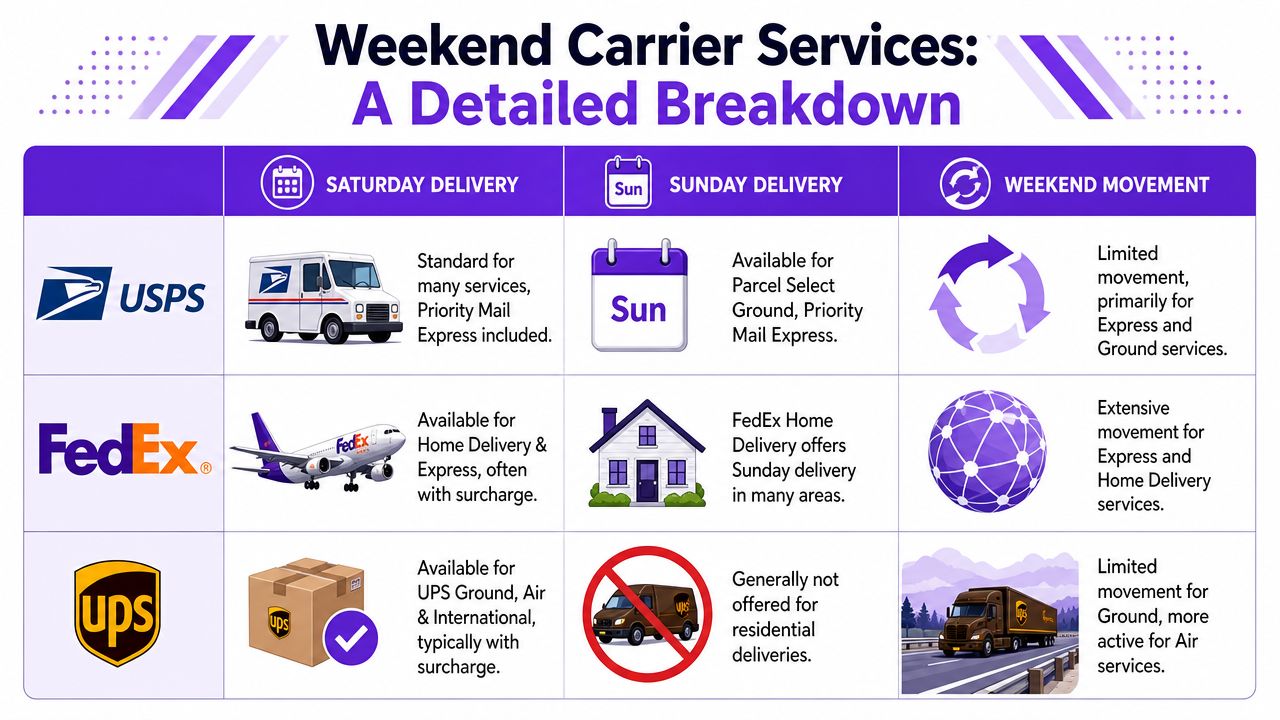
USPS
USPS is the clearest place to start because Saturday is a normal business day for many mail classes. USPS says it delivers several major services on Saturdays, including First-Class Mail, Priority Mail, Priority Mail Express, and USPS Ground Advantage, and deliveries generally run until about 5 p.m. local time, according to this USPS weekend delivery guide.
That has two practical consequences.
First, a package entered late in the week may still advance before Monday. Second, you should not treat Saturday as a dead zone when estimating customer-facing delivery windows.
What USPS does not do is treat every weekend service the same. Standard weekend movement and Saturday delivery are broader. Guaranteed Saturday delivery is narrower. If you need the stronger service commitment, that usually points you toward Priority Mail Express rather than assuming another service will behave the same way.
Sunday is more limited. USPS treats Saturday as regular delivery for many classes, but Sunday delivery is restricted. Standard mail generally isn't delivered, while Priority Mail Express and some Amazon parcels may move on Sunday in select areas, as described in this overview of USPS Saturday and Sunday delivery.
FedEx
FedEx is usually more service-dependent and geography-dependent than small retailers expect. In practice, weekend capability often depends on whether you're using a residential service lane, an express product, or a route where FedEx has active weekend coverage.
For firearms retailers, the useful way to think about FedEx is not “does FedEx run on weekends?” It's “which specific FedEx service covers my destination, and what kind of final delivery attempt should I expect?”
That means your team should verify:
- Service type selected at checkout
- Destination type, especially residential versus business or FFL
- Receiving availability, since a technically possible delivery attempt still fails if the consignee can't receive it
UPS
UPS also varies by service. Some UPS services support Saturday handling or delivery, but that doesn't mean every shipment automatically gets Saturday treatment. If your team uses UPS for regulated products, you need to confirm the specific service behavior rather than assuming “2-day” or “air” means weekend completion.
If you're evaluating one common expedited option, this breakdown of whether UPS Second Day Air delivers on Saturday is worth reviewing before you expose that promise at checkout.
What works and what does not
What works:
- Map weekend promises by exact service name. Don't group “USPS,” “UPS,” or “FedEx” into one rule.
- Use Saturday as an active planning day for USPS. That's a real operating day for many services.
- Treat Sunday as a special case. If Sunday completion matters, verify it service by service.
What does not:
- Using carrier brand names as shorthand for delivery guarantees
- Assuming movement equals final delivery
- Offering “expedited” without defining the actual fulfillment cutoff
For regulated shipments, the best shipping option isn't the fastest label. It's the service that matches the recipient's ability to receive the package without creating a compliance headache.
Why Your Tracking Stalls Over the Weekend
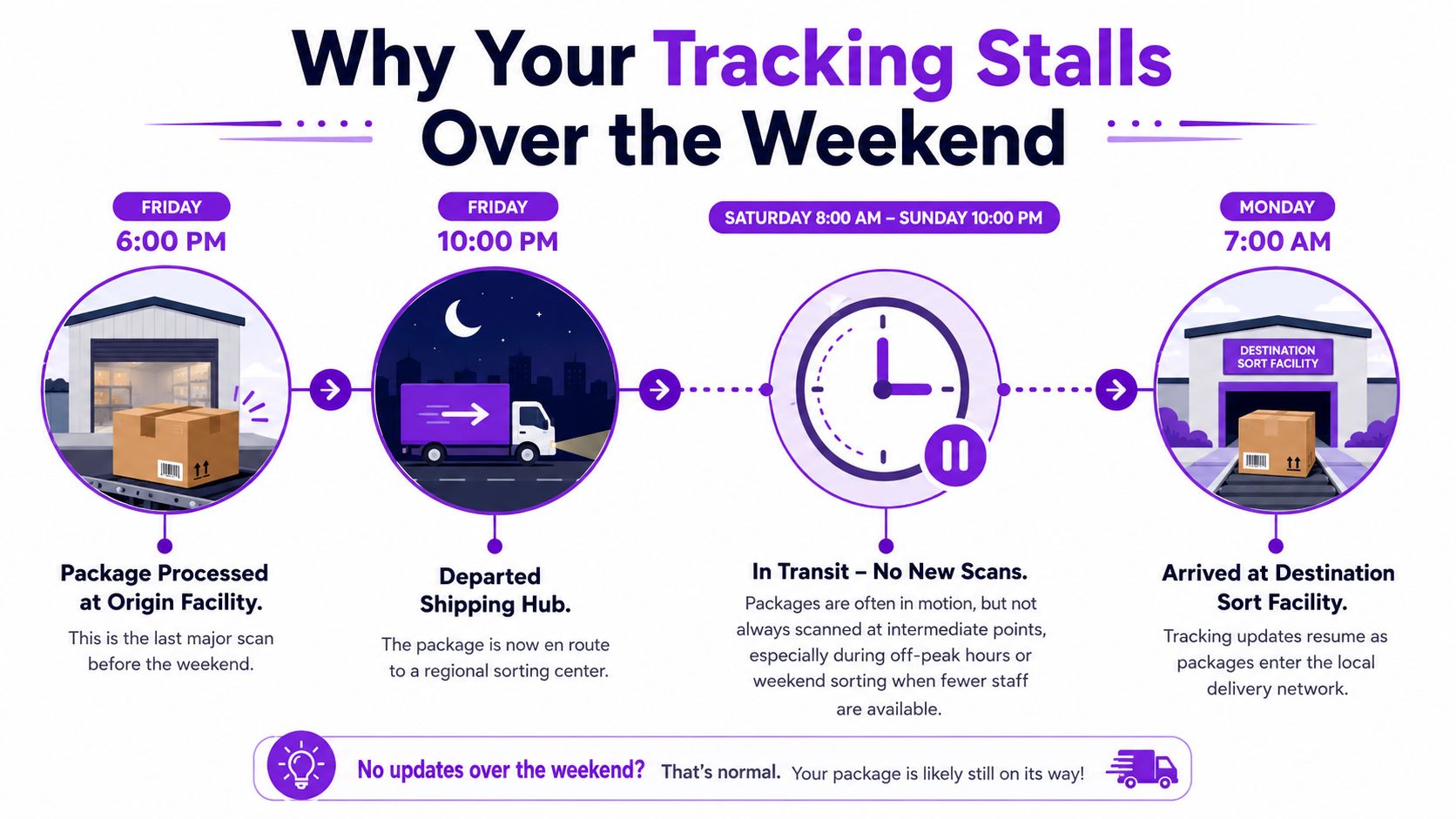
A tracking number can look dead over the weekend and still be completely normal.
That's because carriers don't scan every package at every point in the trip, and service standards don't always count weekend days the way customers assume they do. The result is a predictable pattern: a package leaves origin, enters linehaul or a sort network, then appears quiet until it reaches the next meaningful scan point.
Sunday is the key blind spot
For USPS multi-day services, Sunday is excluded from transit-day counting. USPS gives a clear example: a 3-day service mailed on Saturday is expected to arrive on Wednesday because Sunday is not included, according to the official USPS service standards page.
That one rule explains a lot of “stalled” tracking complaints.
A customer sees a shipment accepted late in the week and starts counting calendar days. The carrier is counting transit days differently. Nothing is necessarily delayed. The customer is just using the wrong clock.
How to read a quiet tracking page
When a customer sends you a screenshot on Sunday night, read the event sequence before you assume there's a problem.
A normal pattern often looks like this:
- Origin acceptance or processing on Friday or Saturday
- Departure scan from an origin facility
- No new visible event for a stretch of time
- Arrival scan at a regional or destination facility when the next major handoff occurs
That gap is often ordinary network behavior, not a lost parcel.
If your team fields these questions often, it helps to standardize internal definitions. This explainer on what dispatched means in shipping is useful because many customers read “dispatched,” “accepted,” and “in transit” as if they all mean “arriving tomorrow.”
A missing weekend scan is not the same as a delay. The real issue is whether the package missed a required handoff, not whether the tracking page stayed quiet for a day.
What to tell customers before they ask
The strongest fix is proactive messaging, not reactive support.
Use checkout copy and post-purchase email language that says:
- Transit estimates follow carrier business-day rules
- Weekend scans may be limited even when packages remain in transit
- Delivery timing for regulated items also depends on the receiving party's availability
That last point matters for firearms orders. Even if network transit is on track, the final handoff may still depend on weekday business operations at the receiving end.
A quiet tracking page creates anxiety when the customer expected constant visibility. It creates much less anxiety when you warned them in advance what a normal weekend cycle looks like.
A Weekend Shipping Strategy for Firearms Retailers
For a firearms retailer, weekend shipping policy is not just a customer service issue. It's an operational control.
The stores that handle this well don't try to make the weekend disappear. They build rules around it. That gives buyers realistic expectations and gives staff a repeatable process when orders land outside ideal fulfillment windows.
Set a hard cutoff and publish it
If your Friday cutoff is internal only, it will fail. Customers need to see it before they pay.
Put the message in three places:
- Product pages for regulated items
- Cart or checkout near shipping method selection
- Order confirmation email so the buyer sees the same policy again
Keep the language plain. For example:
Orders for regulated items placed after our Friday shipping cutoff may enter carrier processing later than non-regulated orders. Delivery timing depends on carrier service, weekend handling, and receiving-party availability.
That message is better than a generic “ships fast” promise because it sets boundaries without sounding evasive.
Configure WooCommerce around reality
A lot of stores create support problems in their own checkout settings. They expose service options that look fast on paper but don't match actual weekend handling for the item type.
Your WooCommerce setup should account for:
| Checkout issue | Better configuration |
|---|---|
| Expedited options shown late Friday with no caveat | Add cutoff messaging tied to shipping methods |
| Weekend ETA displayed as if all shipments are standard consumer parcels | Buffer estimates for regulated products |
| Same shipping choices for accessories and firearms | Split methods by product class or shipping class |
If you ship firearms with UPS, review the practical constraints in this guide to shipping firearms with UPS before you mirror those options in checkout labels.
Build customer messaging that prevents tickets
Automated email does more work here than most retailers realize. Your post-purchase flow should answer the questions the customer is about to ask.
Use short, direct messages such as:
- Order received email: confirm that regulated shipments may follow different fulfillment timing than standard merchandise.
- Label created email: explain that carrier acceptance and delivery timing are separate events.
- In-transit email: remind the customer that weekend tracking visibility may be limited.
- Delivery prep email: note that the receiving party must be available and able to accept the package under the applicable delivery requirements.
This isn't overcommunication. It's replacing uncertainty with predictable checkpoints.
Your best defense against weekend confusion is a shipping policy the customer can read without opening a support ticket.
Protect inventory and workflow over the weekend
Weekend operations also affect inventory control.
If your store continues taking orders while your shipping team is out, make sure stock is adjusted immediately at order capture. A firearm sold on Saturday should not remain exposed to oversell risk because the warehouse won't physically touch it until Monday.
A few process rules help:
- Separate pick status from payment status. Paid does not mean ready to ship.
- Queue regulated orders for manual review if needed. That's better than rushing a flawed handoff.
- Flag Monday backlog early. Don't let weekend volume hide inside the order list until staff returns.
Treat the weekend as a planning window
Some retailers view weekend orders as operational clutter. That's the wrong frame.
Handled correctly, the weekend gives you time to validate destination details, confirm fulfillment sequencing, and prevent Monday morning chaos. If your store captures clean data, shows accurate promises, and routes orders correctly, you start the week with fewer exceptions.
That becomes a competitive advantage because buyers notice when a regulated seller sounds organized. They also notice when tracking, delivery expectations, and policy messages line up cleanly from checkout to final handoff.
Turning Weekend Logistics into a Competitive Advantage
So, does mail travel on weekends? Yes. But the useful answer is narrower. Some shipments move, some deliver, some pause visibly, and some only look stalled because the customer is counting time differently than the carrier.
For a WooCommerce firearms retailer, the win comes from process discipline. Publish your cutoff times. Match each checkout option to the actual carrier service behind it. Explain the difference between acceptance, transit, and delivery. Write automated emails that reduce uncertainty before support gets involved.
Do that consistently and weekend logistics stop being a recurring mess. They become part of a reliable operating system.
Customers buying regulated products don't expect magic. They expect precision. If your store gives them clear promises and follows them, you'll reduce avoidable friction, protect your workflow, and look more trustworthy than competitors who still treat weekend shipping like a guessing game.
If you run a WooCommerce store that sells regulated products, Ship Restrict helps you enforce shipping rules before checkout instead of catching problems after the order is placed. It's built for firearms retailers that need tighter control over destination restrictions, cleaner customer messaging, and fewer compliance-driven shipping mistakes.
Automate Shipping Compliance
Stop worrying about restricted states. Ship Restrict handles it automatically.

Cody Yurk
Founder and Lead Developer of ShipRestrict, helping e-commerce businesses navigate complex shipping regulations for regulated products. Ecommerce store owner turned developer.
Automate Shipping Compliance
- Block restricted states
- No more cancellations
- Set and forget
3-day free trial · Card required