Difference Between Delivery and Shipping: A Guide for FFLs
Learn the critical difference between delivery and shipping for eCommerce. Our guide covers legal risks, compliance for firearms, and how to automate rules.
A customer calls because the tracking page says shipped, but the order hasn't arrived. On a normal store, that's a routine support question. In an FFL operation, it can be the start of a compliance problem, a carrier dispute, or a refund fight, depending on what left the building, where it was headed, and whether it should have gone out at all.
That's why the difference between delivery and shipping matters more than most articles admit. Consumer explainers usually treat the terms like simple milestones on the same timeline. In regulated commerce, they mark the line between what you still control and what you no longer do.
If you sell firearms, ammunition, magazines, parts, or other restricted goods, that line is operational and legal. Once an order is packed, labeled, and tendered correctly, you've entered shipping. Once the carrier completes the final handoff, you've entered delivery. Confusing those stages leads to bad customer communication, weak SOPs, and costly mistakes that should have been blocked before a label was ever printed.
Why Shipping and Delivery Are Not the Same
A common failure point in regulated retail starts with a basic misunderstanding. The warehouse team sees a label printed, the order status flips to completed, and everyone acts like the hard part is over. It isn't. For controlled goods, the riskiest moment is often the handoff itself, because that's the last point where the merchant can stop a bad shipment.
Automate Shipping Compliance
Block orders to restricted states automatically. 3-day free trial.
Start Free TrialI've seen this show up in ordinary language inside teams. Customer support says an order is “on delivery” when it really means the package was manifested and picked up. Operations says a package was “delivered” when the carrier only issued an origin scan. Those sound like small wording issues until a customer disputes a timeline or a restricted order leaves for an address that should have been blocked.
Checkout language makes the confusion worse
Part of the confusion comes from how retailers label fulfillment options. Some stores use “shipping” as a broad term for any outbound movement. Others separate local courier service, store fulfillment, and carrier transit as different workflows.
Target's help center makes that distinction clearly. It separates same-day delivery from shipping by explaining that same-day delivery uses a personal shopper and happens within hours, while shipping uses carriers like UPS or FedEx and usually takes 2+ days according to Target's same-day delivery and shipping explanation. That matters because the difference between delivery and shipping isn't only about timing. It can reflect entirely different fulfillment chains, different custody points, and different compliance controls.
Practical rule: If your team can't say exactly when an order became shipped, they can't say when your internal control ended.
The real distinction is control
For an FFL merchant, shipping is the last controllable checkpoint. You can still verify the destination, confirm the receiving FFL if applicable, review product restrictions, validate paperwork, and stop release. After carrier handoff, the workflow changes. You're now managing exceptions, status visibility, customer communication, and carrier performance.
Delivery is where the order is finally realized for the customer. It's also where you discover whether the last mile matched the promise made at checkout.
That's why this topic shouldn't be treated as semantics. In regulated commerce, “shipped” is your release event. “Delivered” is the carrier's completion event. Those are not the same thing, and your policies shouldn't treat them as if they are.
Shipping vs Delivery Core Concepts Explained
In logistics terms, shipping starts when the parcel is prepared for transit and handed to the carrier. Delivery ends when the parcel is physically handed to the recipient. Those are different operational events, which is why tracking statuses like “shipped” and “delivered” don't mean the same thing, as explained in Airpals' breakdown of shipping vs delivery.
For merchants, this is more than vocabulary. Shipping covers the outbound work your team performs or initiates. Delivery covers the last-mile completion your carrier performs.
Free Shipping Compliance Audit
We'll review your WooCommerce store's shipping compliance for free.
Shipping vs. Delivery: A Head-to-Head Comparison
| Criterion | Shipping | Delivery |
|---|---|---|
| Start point | Begins after the order is picked, packed, labeled, and tendered | Begins in the final local handoff phase toward the recipient |
| End point | Ends when the carrier takes possession for transit | Ends when the package is physically handed to the recipient |
| Key activities | Packing, labeling, documentation, carrier handoff | Route execution, last-mile stop, drop-off or handoff confirmation |
| Primary operator | Merchant and warehouse team, then carrier intake | Carrier, local courier, or final-mile service |
| Typical tracking meaning | “Label created,” “accepted,” “shipped,” “in transit” | “Out for delivery,” “delivered,” handoff confirmation |
| Main merchant concern | Accuracy, compliance, packaging, release authorization | Proof of handoff, customer availability, exception handling |
What shipping includes inside an FFL workflow
In a regulated environment, shipping is where most internal controls live. That usually includes:
- Order review: Product-to-destination checks, receiving FFL validation when required, and hold logic for suspect addresses.
- Physical prep: Correct packing method, labeling, and any handling instructions needed for the parcel.
- Documentation: Carrier records, internal compliance notes, and fulfillment records that show why the order was cleared.
- Release: The point where the package leaves your possession and enters carrier custody.
If a team treats shipping as “the label got printed,” it will miss half the work.
What delivery actually means
Delivery is narrower, but it's less predictable. It covers the final route segment and the handoff outcome. That can include doorstep drop-off for ordinary merchandise, staffed receipt at a business, adult-signature style workflows where applicable, or failed delivery attempts that send the parcel into an exception queue.
Shipping is a process you design. Delivery is an outcome you monitor.
That distinction matters because merchants often overestimate how much control they have after dispatch. The warehouse can standardize packing and release rules. It can't control route congestion, address-access issues, missed handoffs, or a recipient who isn't available when the driver arrives.
Those looking for the difference between delivery and shipping usually want a simple definition. For a merchant, the useful answer is this: shipping is the outbound release phase, and delivery is the final completion phase. They touch the same order, but they require different systems, different accountability, and different customer messaging.
Legal and Operational Responsibilities in the Chain
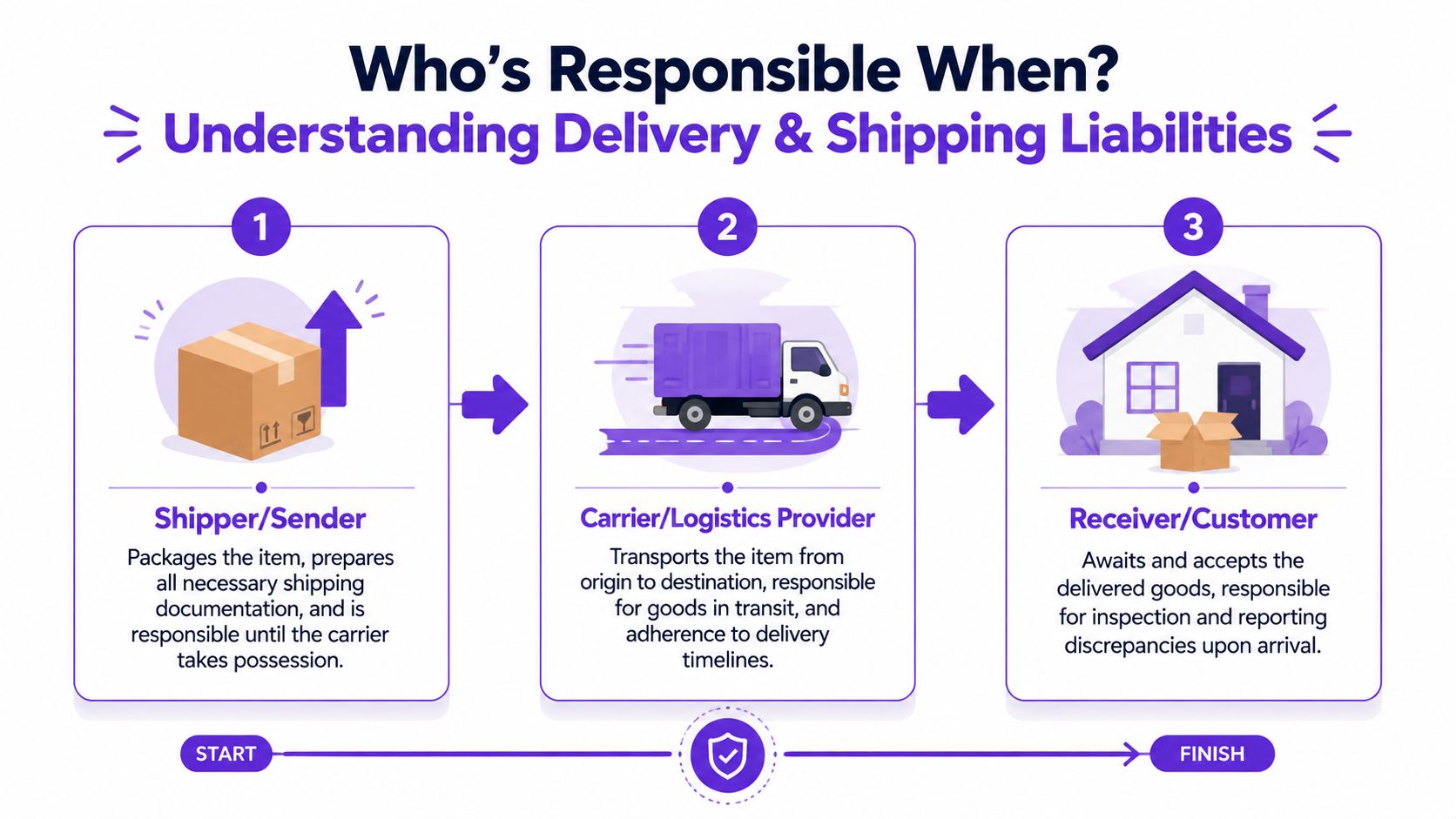
The cleanest way to manage risk is to map the chain of custody. In practice, three parties matter most: the shipper, the carrier, and the receiver. Each has a different role, and the handoff between them is where confusion usually starts.
What stays with the shipper
Before tender, the merchant owns the process. In ecommerce operations, shipping is usually the point where the SLA is defined and tracked from warehouse dispatch, while delivery is where performance is realized or missed at the customer's address, as outlined in Merchize's explanation of shipping and delivery in ecommerce.
That means the shipper is responsible for getting core details right:
- Packaging standards: The parcel has to be packed to survive normal handling and route movement.
- Label accuracy: The name, address, service type, and any internal references have to match the approved order.
- Paperwork readiness: Shipping records and required internal documentation need to be complete before release.
- Compliance approval: In a regulated business, the shipment must be lawful before it leaves the warehouse.
Small details matter here. If a parcel needs clearer handling cues, teams often add visible identifiers such as professional fragile packaging labels so warehouse staff and carriers can spot special handling requirements quickly. That won't fix a bad address decision, but it does reduce preventable packaging and handling mistakes.
For FFL retailers using UPS workflows, policy interpretation also needs to be documented clearly; a practical reference like Ship Restrict's article on shipping firearms with UPS can help operations teams align fulfillment steps with carrier expectations.
What shifts to the carrier
Once the carrier scans or accepts the parcel, the job changes. The carrier now controls movement through the network, sorting, linehaul, local routing, and the final stop sequence.
That doesn't erase the merchant's accountability to the customer. It does mean the merchant no longer controls the mechanics of transit. If weather, route backlog, missed sortation, or local access issues affect the parcel, those are delivery-phase disruptions, not shipping-phase failures.
A late truck and a bad release decision are different problems. Teams should investigate them differently.
What falls on the receiver
The receiver's role is usually treated as passive, but it isn't. The recipient has to be available when the delivery method requires presence, verify receipt when needed, and report issues promptly if the package arrives damaged, incomplete, or misdirected.
For regulated and high-value goods, the receiver side becomes more sensitive. A failed handoff, refusal, address mismatch, or inability to complete final verification can turn delivery into an exception event instead of a successful completion.
Where liability gets blurry
Most disputes happen in the seam between stages. A merchant says, “We shipped it on time.” A customer says, “I didn't receive it.” Both statements can be true. The operational answer depends on whether the problem happened before handoff, during transit, or at the last mile.
That's why mature teams don't use one generic “fulfillment status.” They separate release, transit, out-for-delivery, delivered, return-in-process, and exception statuses. The more regulated the catalog, the less room you have for vague status language.
How to Interpret Tracking Timelines for Customers
Most support tickets aren't caused by true package loss. They start because the customer reads a status one way, while the merchant means something else. If your storefront, CRM, and support macros blur shipped and delivered together, customers fill in the gap themselves.
That's a problem at scale. One 2026 projection says the average American receives 66 package deliveries per year, totaling about 22.4 billion packages in the U.S. annually, according to Capital One Shopping's package delivery statistics. With that volume, ecommerce teams have to manage outbound shipping and final delivery as separate phases or support queues become messy fast.
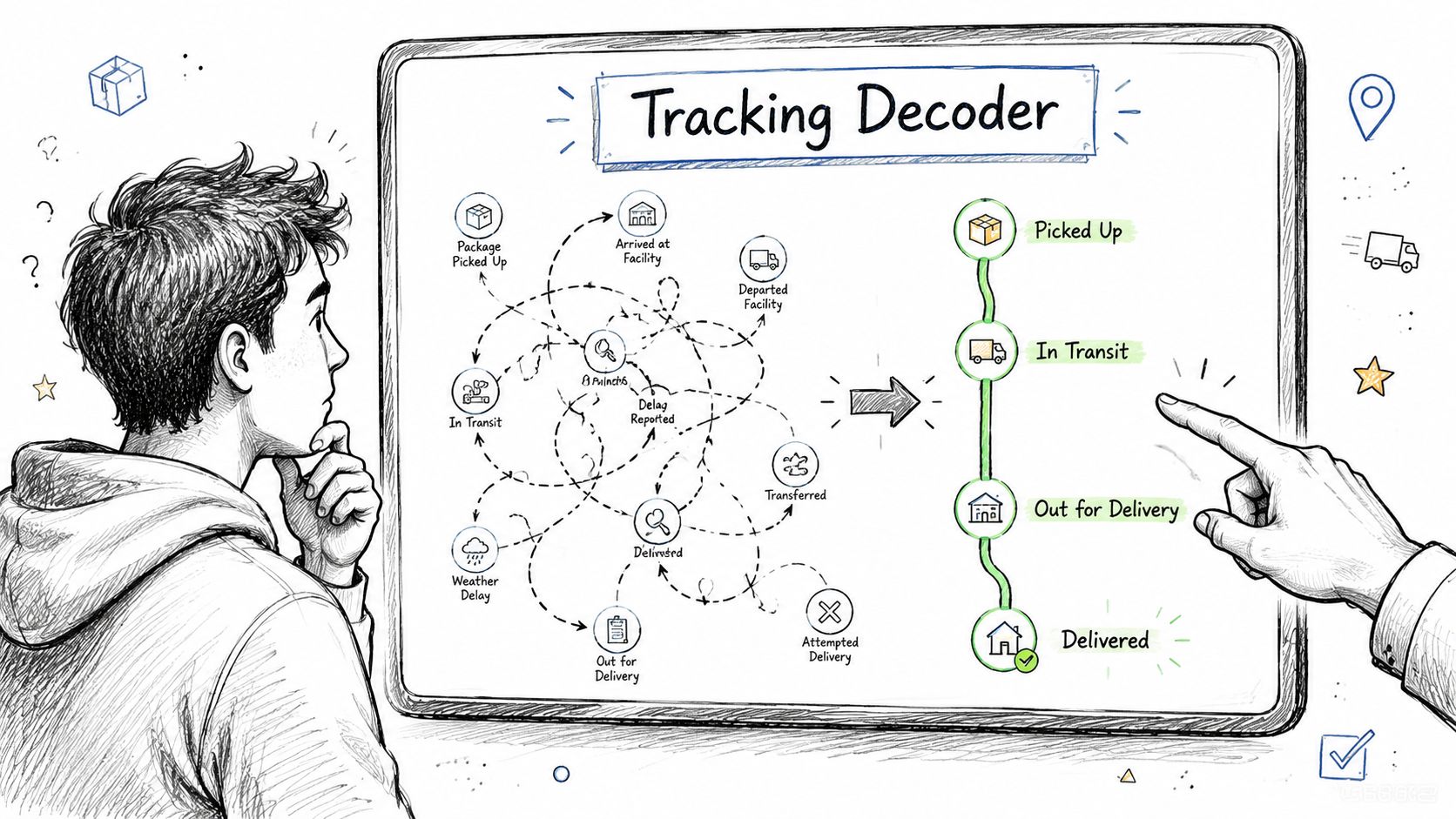
What the main statuses usually mean
Customers don't need carrier jargon. They need plain-English explanations tied to what happens next.
- Label created: Your team has generated the shipping record, but the carrier may not have the parcel yet.
- Shipped: The parcel has left your operational control and entered the carrier network.
- In transit: The package is moving through the carrier system between facilities or toward the destination region.
- Out for delivery: The parcel is on the final local route for attempted handoff.
- Delivered: The carrier has marked the final handoff as completed.
The phrase “shipping date” causes its own confusion. If your team needs a cleaner way to explain that event to customers, use a resource like Ship Restrict's guide to what shipping date means and then adapt that language into your own help center.
What to tell customers at each stage
Different statuses call for different support responses.
| Tracking status | What to tell the customer |
|---|---|
| Label created | “Your order is being prepared for carrier pickup.” |
| Shipped | “Your package has left our facility and is in the carrier network.” |
| In transit | “The carrier is moving your order between hubs.” |
| Out for delivery | “Your package is on the final route today.” |
| Delivered | “The carrier marked the package as handed off.” |
Where merchants often get this wrong
The biggest communication mistake is telling customers that shipped means arriving soon. It doesn't. It means the order has started transit.
The second mistake is treating delivered as the end of every inquiry. In reality, delivered may still require proof review, recipient confirmation, or investigation if the customer reports a problem. That's especially true for high-value and regulated orders, where handoff details matter more than they do for commodity goods.
If support answers “it shipped” when the customer is really asking “when will it arrive,” the ticket will reopen.
Strong support teams build templates around operational meaning, not carrier buzzwords. They also separate three questions that often get mixed together: Has it left us? Is it moving? Was it handed off? Once your staff answers those cleanly, the difference between delivery and shipping becomes much easier for customers to understand.
Compliance Risks for Regulated and High-Value Goods
Generic retail advice breaks down fast when the product itself carries restrictions. In that environment, the difference between delivery and shipping becomes a control issue. Shipping is the point where an item leaves your custody. Delivery is the point where the final verification, exception, or failure becomes visible.
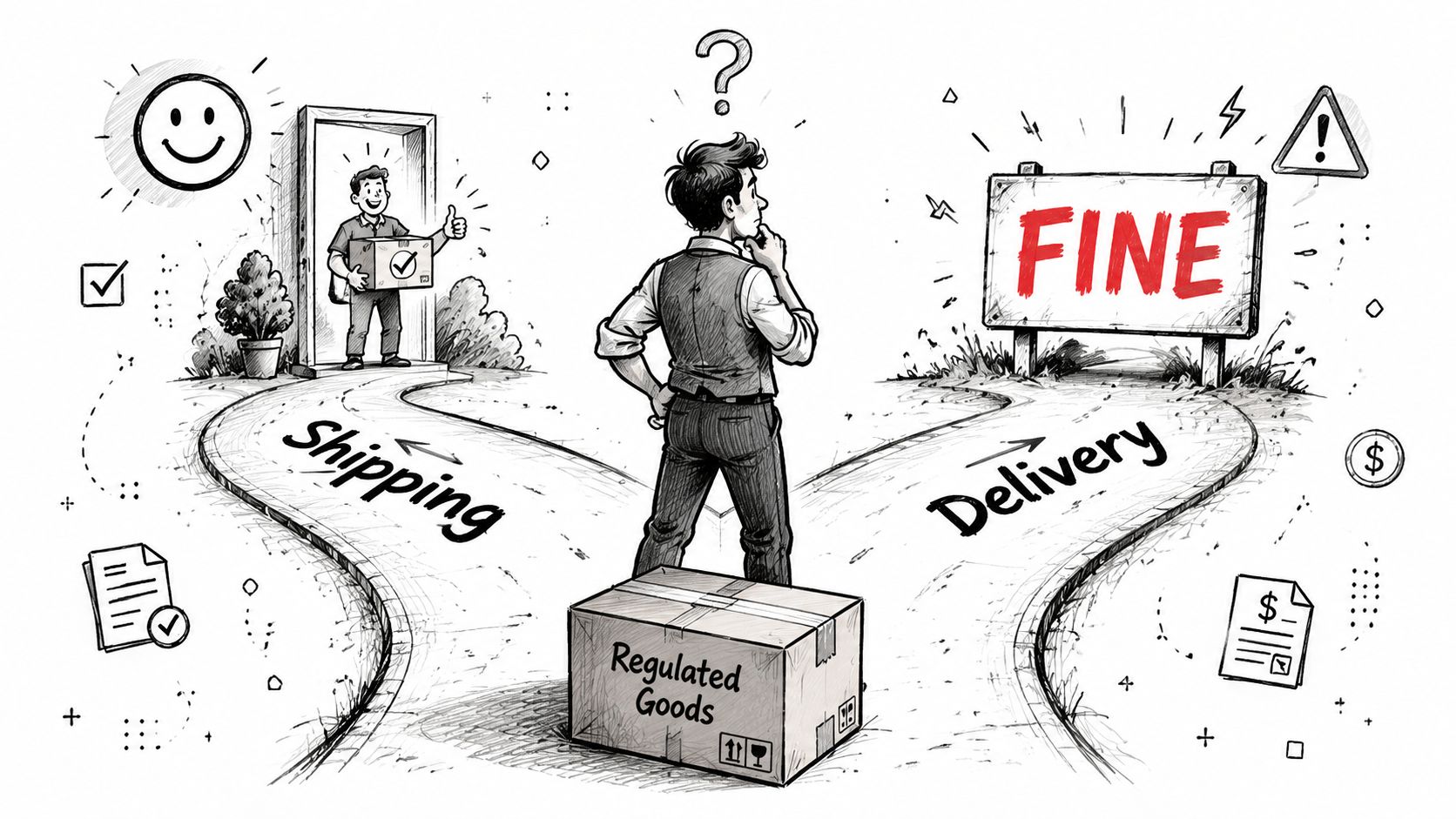
Most articles ignore that nuance. They reduce the topic to ordinary parcel movement, even though regulated goods require a very different operational view. As noted in APS Fulfillment's discussion of shipping and delivery for special-handling items, delivery is increasingly a verification and exception-management step, not just a physical handoff. That's the useful frame for FFLs.
Where the real compliance exposure sits
The dangerous assumption is that you can sort out a problem later because the package isn't delivered yet. That's backwards. For regulated goods, the key decision usually happens before shipping.
Consider the types of issues that surface in real operations:
- Destination restrictions: The product may be lawful in one jurisdiction and restricted in another.
- Catalog mismatches: A product might look similar to another SKU but fall under a different rule set.
- Address edge cases: City and ZIP restrictions can create failures that a state-only review misses.
- Receiver problems: The delivery point may not support the required handoff conditions.
Once the parcel is out the door, your options shrink. You may be left trying to intercept, return, or explain an order that should have been blocked before packing.
Delivery is where exceptions become visible
In regulated commerce, last-mile delivery often acts like a final filter. The carrier reaches the address, but then something goes wrong. The receiver isn't available. The location doesn't match expectations. The handoff requirements can't be completed. The parcel goes into a hold or return channel.
That doesn't mean the failure started there. In many cases, delivery exposes a screening gap from the shipping stage.
Compliance teams should treat delivery exceptions as feedback on upstream controls, not only as last-mile problems.
High-value goods raise the stakes even when regulations are clear
Even when the destination is lawful, expensive and sensitive goods need tighter handling discipline. Packaging quality, access control inside the warehouse, and chain-of-custody procedures all matter because the loss profile is different from low-cost general merchandise.
Warehouse operators reviewing physical security practices can borrow ideas from broader logistics environments. A resource like ABCO Security's guide for warehouses is useful for thinking through surveillance coverage, access control, and incident response around high-value stock before parcels ever reach the carrier cage.
Common failure patterns in FFL fulfillment
These are the patterns that tend to create avoidable trouble:
-
The team checks legality too late
If compliance review starts after pick-pack, the process is already moving in the wrong direction. -
Customer support uses loose status language
Calling a parcel “delivered” because it hit a local terminal invites disputes and weakens internal accountability. -
Rules live in tribal knowledge
One experienced employee remembers what can't go where. Everyone else guesses. -
Exception handling isn't connected to root cause
Returned, refused, and failed-delivery orders should trigger review of release logic, not just reship requests.
For regulated and high-value goods, the difference between delivery and shipping isn't academic. Shipping is the gate. Delivery is the proof point. If the gate is weak, the proof point gets ugly.
Automating Compliance Before an Order Ships
Manual review breaks first at the exact moment you need reliability. A spreadsheet, a sticky-note rule, or one experienced employee who “knows the restricted states” might work for a handful of orders. It won't hold up once the catalog grows, rules get more granular, or staff changes.
That's why the best fix isn't better reaction after shipping. It's prevention before shipping starts.
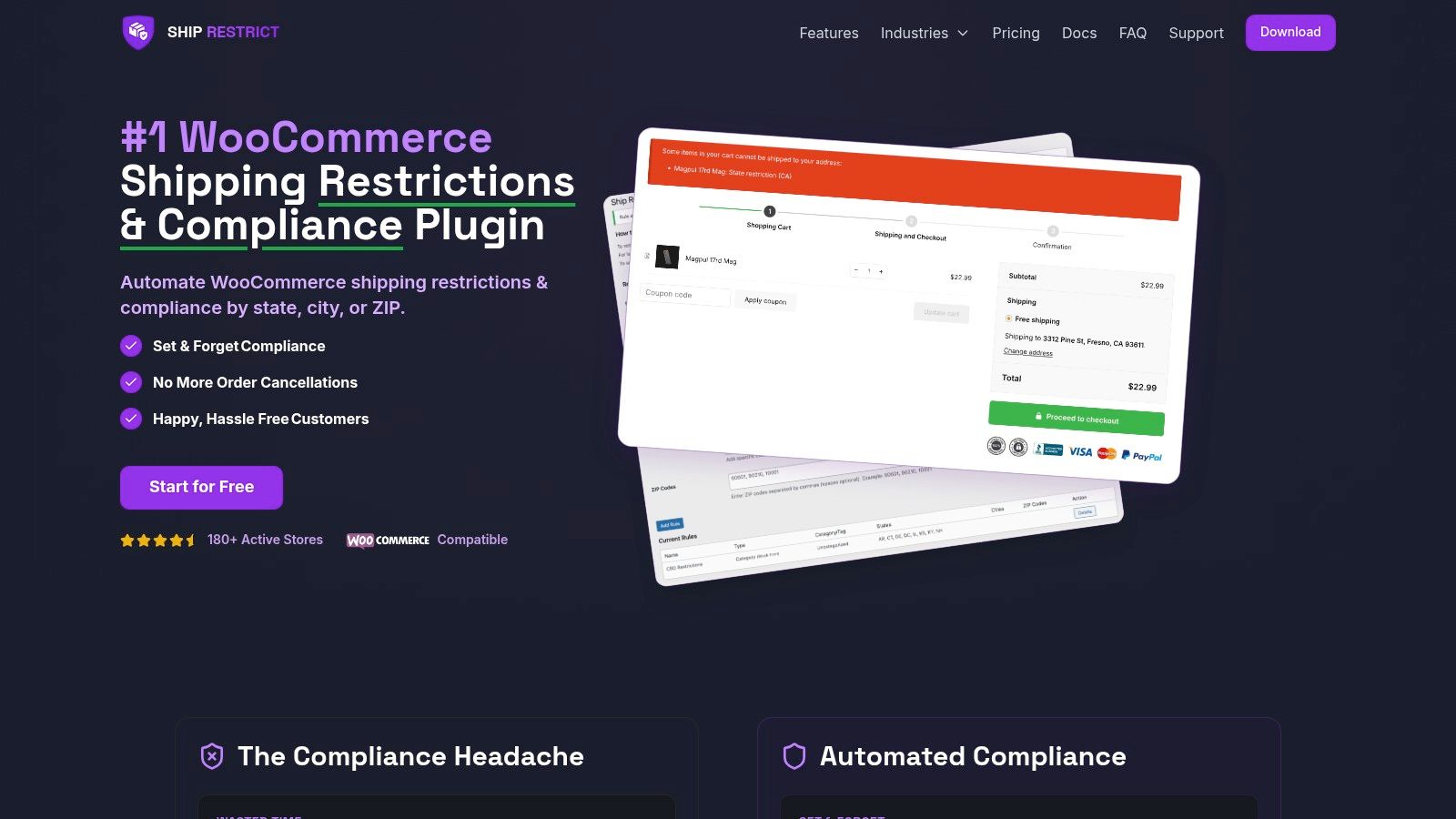
Move compliance to checkout
The strongest workflow blocks bad orders before the warehouse ever sees them. Instead of asking fulfillment staff to catch destination issues during pick-pack, the store validates the cart and destination earlier.
That changes the job of operations in a useful way:
- Less manual interpretation: Staff isn't forced to remember location rules from memory.
- Fewer wasted touches: Teams don't pick, pack, and relabel orders that should never have cleared checkout.
- Cleaner customer communication: The buyer gets a restriction message early instead of a cancellation after payment and processing.
- Better auditability: You can tie the restriction to a rule, not to a verbal instruction.
If you're mapping this process inside WooCommerce, Ship Restrict is one option that applies granular restriction rules by state, county, city, or ZIP code before checkout. That kind of workflow pairs well with broader order fulfillment automation guidance, because it pushes compliance upstream instead of burying it in fulfillment.
What works and what doesn't
What works is simple. Put the rule engine as close to the point of sale as possible. Let the order enter fulfillment only after destination checks pass.
What doesn't work is relying on a final manual glance before the label prints. By then, the order already exists in your system, the customer expects shipment, and the warehouse is under pressure to move fast. That's the wrong moment to introduce legal judgment calls.
The safest shipment is the one your system never allowed when the address was restricted.
For an FFL merchant, that's the practical answer to the difference between delivery and shipping. Shipping is where you release risk. So your controls need to fire before that moment, not after it.
If your WooCommerce store sells regulated products, Ship Restrict helps you enforce shipping restrictions before an order reaches fulfillment. It lets merchants apply rules by product and destination so restricted orders can be blocked at checkout instead of discovered after packing, labeling, or carrier handoff.
Automate Shipping Compliance
Stop worrying about restricted states. Ship Restrict handles it automatically.

Cody Yurk
Founder and Lead Developer of ShipRestrict, helping e-commerce businesses navigate complex shipping regulations for regulated products. Ecommerce store owner turned developer.
Automate Shipping Compliance
- Block restricted states
- No more cancellations
- Set and forget
3-day free trial · Card required