Shipping Date Meaning: A Guide for E-commerce Merchants
Understand the shipping date meaning for your e-commerce store. This guide defines shipping vs. delivery dates and explains compliance for regulated goods.
You've probably seen this happen in your store. A customer places an order, sees a shipping date, and assumes that means the box will arrive that day. Your team means one thing. The customer hears another. Then the email comes in asking why the package “hasn't shipped” when your warehouse is still waiting on a compliance review, an FFL confirmation, or a backordered item.
For a firearms dealer, that confusion isn't a small customer-service issue. It can become a compliance problem fast. In a regulated business, the shipping date isn't just a status field in WooCommerce. It's the point where your order leaves internal control and enters the carrier network. If your workflows are sloppy before that moment, you don't just risk angry customers. You risk shipping mistakes that are harder to unwind.
The Complete Order to Delivery Timeline
Most confusion around shipping date meaning comes from people using one term to describe an entire fulfillment process. That process has several distinct handoffs. If you don't separate them internally, your customer-facing dates will drift, and your staff will make bad assumptions under pressure.
Think of an order like a relay race. One stage hands the baton to the next. The shipping date is only one baton pass in that sequence. It matters a lot, but it is not the whole race.
Automate Shipping Compliance
Block orders to restricted states automatically. 3-day free trial.
Start Free Trial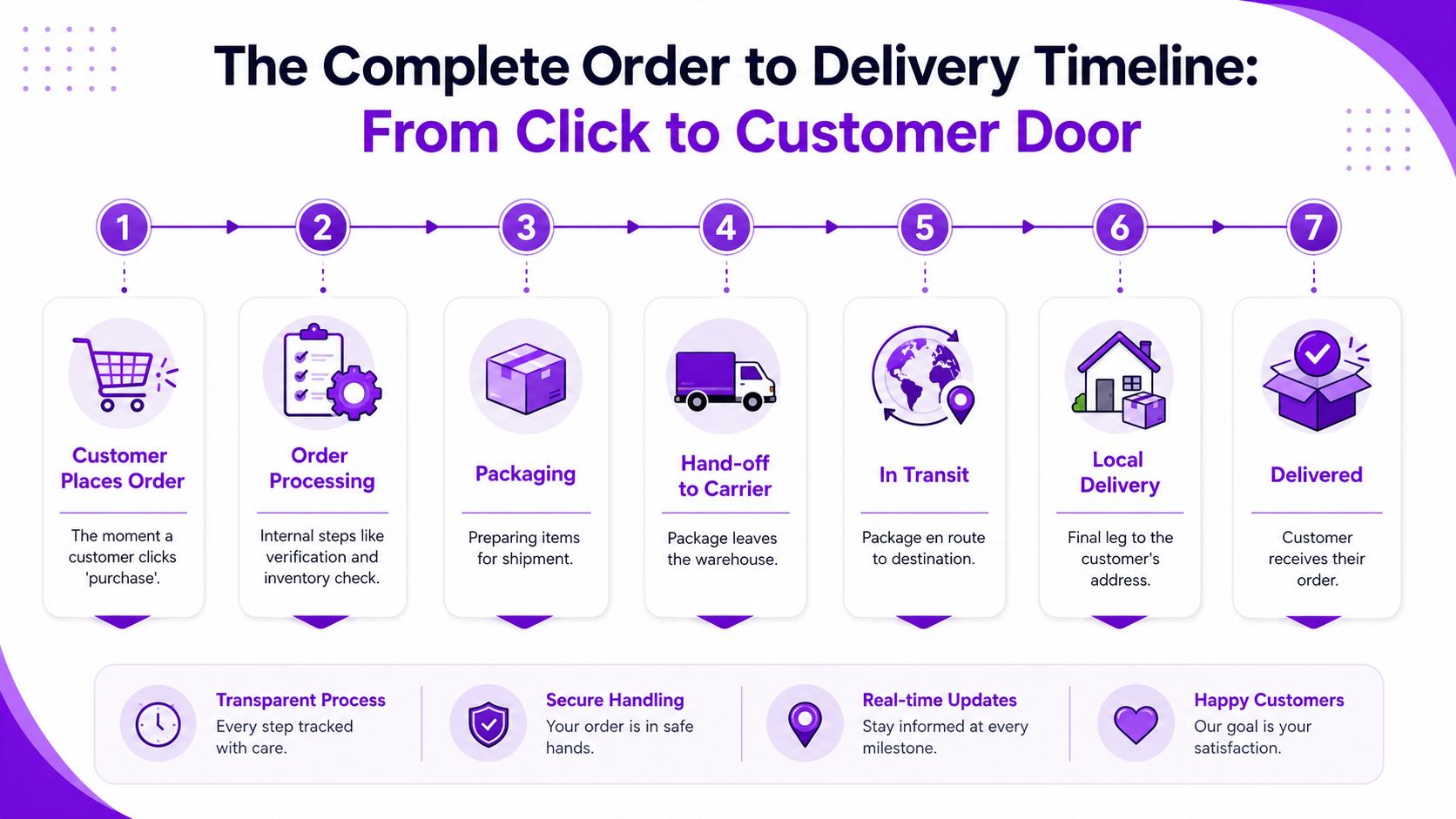
The seven handoffs that matter
-
Customer places order
This is the transaction date. Money is captured or authorized, the cart becomes an order, and your internal obligations begin. -
Order processing
Your staff checks payment, fraud signals, inventory, destination restrictions, and any workflow that must happen before fulfillment can continue. -
Packaging
The item is picked, packed, labeled, and staged. For regulated products, this stage often includes an extra review because the label may be the last practical checkpoint before handoff. -
Hand-off to carrier
This is the shipping date in the operational sense. A package is physically handed over to the carrier. Shopify explains that a shipping date is the date a package is physically handed over to the carrier, and many systems calculate estimated shipping date = order date + processing time and estimated delivery date = estimated shipping date + transit time in its explanation of shipping date meaning. -
In transit
The carrier controls the parcel. Your team can still communicate and intervene in limited ways, but the package is no longer sitting in your warehouse waiting for correction. -
Local delivery
The parcel moves through the final-mile network. -
Delivered
The order reaches the customer or receiving FFL, depending on the product and workflow.
Practical rule: If your team uses “shipped” to mean “packed,” “labeled,” and “carrier accepted,” you'll create avoidable confusion. Pick one definition and train everyone on it.
Where merchants usually get this wrong
The biggest mistake is treating the shipping date as a vague estimate disconnected from warehouse reality. It isn't. It should reflect your actual cutoffs, actual pick-pack capacity, and actual carrier pickup schedule. If your last carrier pickup is already gone, that order's realistic ship date has changed, whether your storefront admits it or not.
Free Shipping Compliance Audit
We'll review your WooCommerce store's shipping compliance for free.
Weekend timing also trips up merchants. Customer expectations often collapse because they assume carrier movement and warehouse processing happen continuously. If you need a quick reference for that customer-facing question, this guide on whether mail travels on weekends is useful for setting expectations clearly.
Some teams benefit from mapping their internal workflow visually before touching checkout messaging. If you want a simple reference for sequencing work and handoffs, view our company timeline as an example of how timeline-based communication can make operational stages easier to understand.
Estimated vs Guaranteed Dates and Why They Matter
Merchants get into trouble when they use precise language casually. “Estimated” and “guaranteed” are not interchangeable. One gives the customer a forecast. The other sounds like a promise.
That distinction matters even more when you sell products that can be delayed by inventory issues, carrier constraints, destination restrictions, or manual verification. If your operation has variables you don't fully control, promising a guaranteed date too early is asking for disputes.
The real difference in customer expectation
An estimated date tells the buyer, “This is our best current forecast based on what we know right now.” A guaranteed date tells the buyer, “We are committing to this outcome.” Those statements create very different expectations, even if the calendar date displayed is the same.
Backorders make this even more obvious. For items on backorder, estimated ship dates can change due to manufacturer updates, holidays, production delays, or severe weather, and the recommended approach is to use dynamic updates and date ranges rather than a single fixed date, as explained in this guide to estimated ship dates for backordered items.
| Aspect | Estimated Date | Guaranteed Date |
|---|---|---|
| Meaning | A forecast based on current processing and transit assumptions | A firm commitment made to the customer |
| Best use | Standard ecommerce checkouts, variable inventory, regulated reviews | Only when your workflow and carrier commitment support it |
| Customer interpretation | “Likely, but subject to change” | “This will happen as stated” |
| Backorder fit | Appropriate, especially with ranges and updates | Usually a poor fit unless stock and fulfillment are fully controlled |
| Operational risk | Lower, if wording is clear | Higher, because your wording invites claims if the date slips |
| Recommended display | Range-based messaging and updates | Limited use, reserved for narrow scenarios |
What works in practice
If a product is in stock but still needs internal review, use estimated language. If inventory is uncertain, use broader date ranges. If a manufacturer's date has already moved once, don't display a single hard date unless you're comfortable defending it.
A lot of merchants create their own problems by showing one rigid date on the product page and then softening it later in email. Customers read the first promise and ignore the later correction.
If the date can move, say that upfront. Customers usually tolerate uncertainty better than contradiction.
For expedited services, be equally careful. A shipping method can create the illusion of certainty when your own warehouse cutoff already makes that timeline unrealistic. That's especially important when buyers ask about premium services on weekends, and a practical reference like whether UPS Second Day Air delivers on Saturday can help your team answer accurately instead of improvising.
Configuring Shipping Dates in WooCommerce
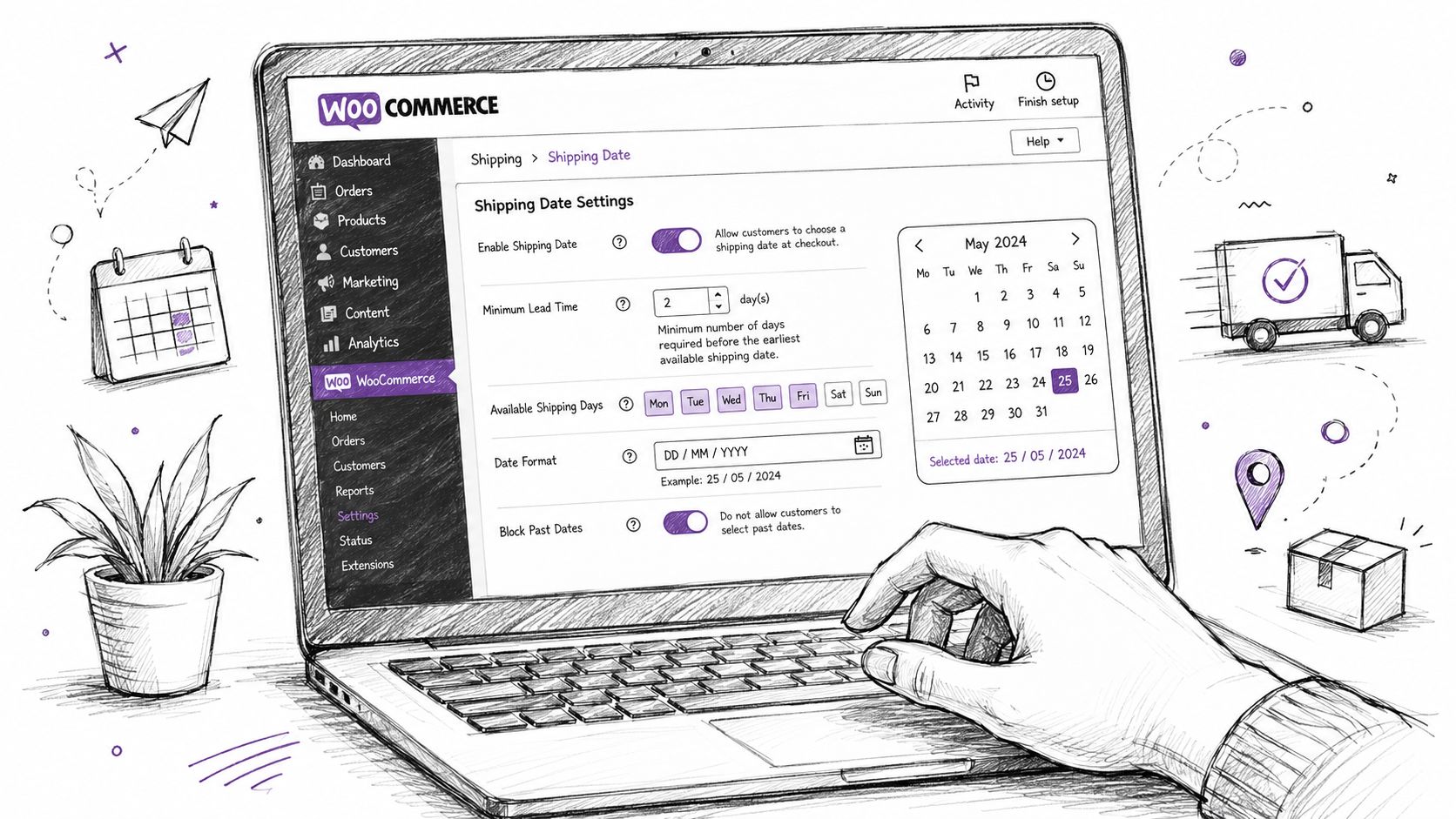
WooCommerce doesn't magically know your real-world fulfillment process. It knows what you configure. If those settings don't reflect how your warehouse operates, the dates shown to customers will be wrong before a label is ever printed.
That's why shipping date meaning becomes a setup issue, not just a terminology issue. In WooCommerce, your displayed dates are only as good as your product availability rules, processing assumptions, and shipping extensions.
Start with native WooCommerce reality
Out of the box, WooCommerce can support basic shipping logic, but not a robust promise engine. You can define shipping zones, methods, product stock status, and order statuses. That's useful, but it doesn't automatically produce accurate ship-date messaging for a firearms dealer with multi-step reviews.
For most stores, the practical setup starts here:
- Set honest stock states: Don't leave products purchasable if your team can't fulfill them without manual exception handling.
- Align order status rules: Make sure “processing,” “on hold,” and “completed” reflect actual warehouse stages, not just accounting events.
- Account for lead time: If some items require extra handling, don't bury that detail in a policy page.
If you're still deciding on store architecture or rebuilding a regulated catalog from scratch, this breakdown of choosing the right ecommerce platform is helpful because platform limitations often show up first in shipping and compliance workflows.
Where plugins become necessary
Most merchants need extensions once they try to display estimated shipping or delivery dates on product pages, cart pages, or checkout. Native WooCommerce doesn't cover all the logic around cutoff times, excluded days, lead times, and dynamic messaging.
You also need a practical onboarding path before adding more moving parts. If your team is still setting up workflows, the getting started documentation is a good model for documenting store rules so operations and development stay aligned.
A video walkthrough helps if you're configuring workflows with a developer or agency partner:
<iframe width="100%" style="aspect-ratio: 16 / 9;" src="https://www.youtube.com/embed/9grxkwNm-zQ" frameborder="0" allow="autoplay; encrypted-media" allowfullscreen></iframe>What to configure before you show any date
Don't publish date messaging until you've answered these questions internally:
- What is the daily fulfillment cutoff? Morning and late-night orders don't belong in the same promise bucket.
- Which SKUs need manual review? Firearms, serialized components, and restricted accessories often don't follow the same timeline as general merchandise.
- What happens on non-shipping days? Your storefront needs the same calendar logic your warehouse uses.
- Who owns exception handling? If a date slips, someone needs a defined process for updating the customer before they ask.
The stores that get this right usually keep the display simple and the backend logic strict. The stores that get it wrong tend to show polished date promises on the front end while relying on tribal knowledge in the warehouse.
Shipping Dates and Firearms Compliance
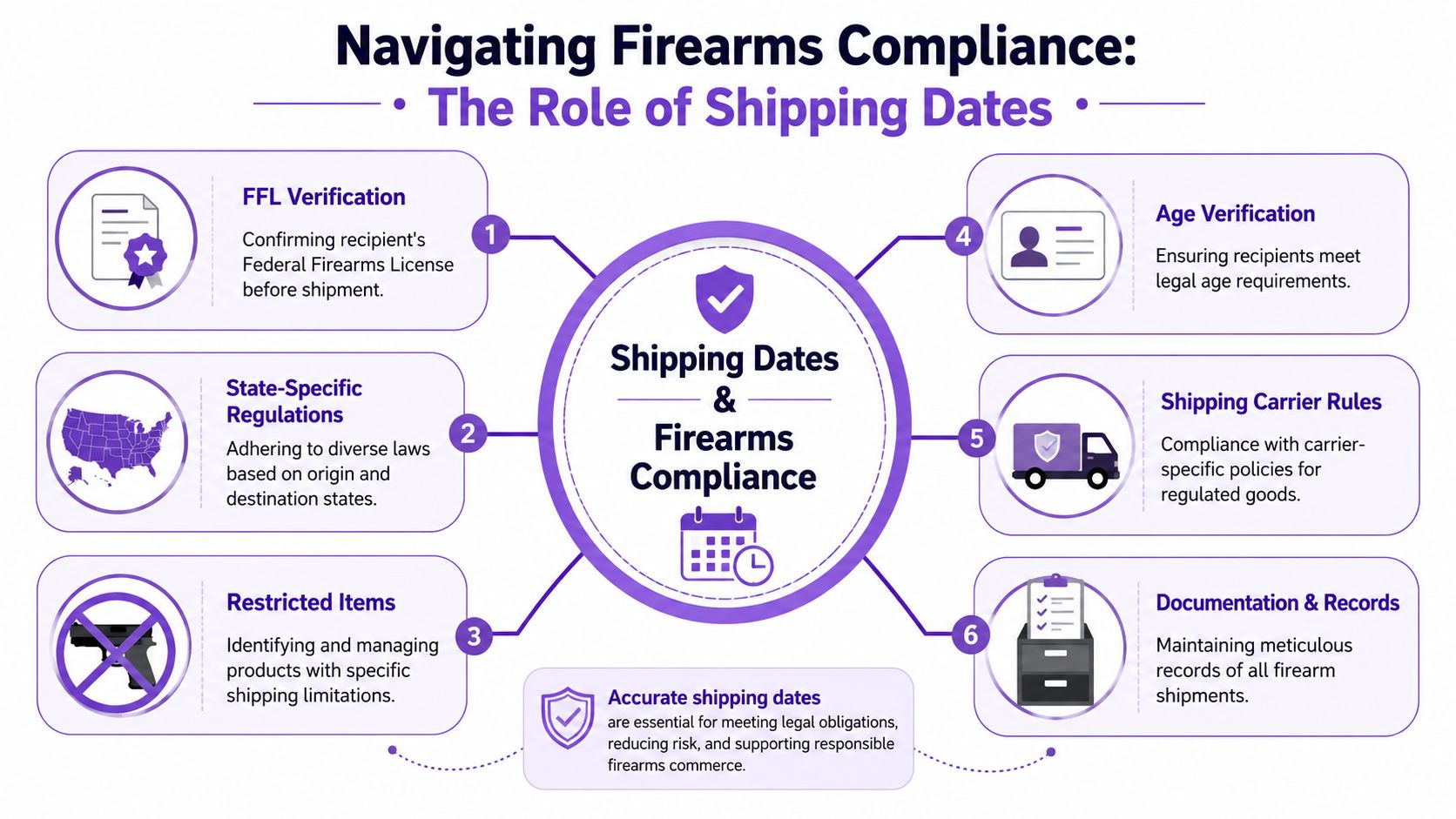
For a firearms dealer, the shipping date is the line between an internal order review and a regulated physical movement. Before that handoff, your team can still stop, correct, escalate, or cancel. After that handoff, you're dealing with a shipment already in motion.
That's why generic ecommerce advice isn't enough here. In regulated goods workflows, compliance checks should occur before the shipping date is committed, because once the parcel is handed to the carrier the transaction has moved from order management into physical transport, as noted in this explanation of shipping dates in regulated fulfillment.
Why the shipping date is the point of no return
A lot of merchants think of the ship date as a warehouse milestone. For firearms, it's more serious than that. It's the moment your internal controls stop being theoretical and start being tested in practice.
If the receiving FFL hasn't been verified, if the destination rule was interpreted incorrectly, or if a restricted product slipped through the wrong checkout path, the time to catch that was before handoff. Once the carrier has the parcel, your options narrow fast.
A compliance mistake before shipment is an order-management problem. A compliance mistake after shipment is a legal and operational problem.
Checks that must happen before carrier handoff
Every firearms dealer's workflow differs, but the sequence should be disciplined. At minimum, review these categories before you allow an order to reach its shipping date:
- Recipient validation: Confirm the receiving party and the required documentation path.
- Destination review: State, local, and product-specific restrictions need to be checked against the exact ship-to location.
- Product classification: Don't assume every item in a category follows the same rules.
- Carrier policy fit: The shipment has to satisfy your internal rules and the carrier's handling requirements.
- Recordkeeping readiness: If the order is questioned later, your file should show what was reviewed and when.
The operational mistake that causes most pain
The biggest failure isn't usually bad intent. It's bad sequencing. A merchant lets the warehouse move too early because operations and compliance live in separate systems or separate people's heads. The box gets packed, the label gets printed, and everyone starts acting as if shipment is inevitable.
That's backward. For regulated goods, the warehouse should treat the shipping date as permission granted, not as a target that forces permission to catch up later.
Some dealers also overlook changing local rules because they rely on static notes, outdated spreadsheets, or memory. That approach works until it doesn't. And when it fails, it tends to fail on a live order that already consumed labor and customer attention.
Mastering Shipping Communication and Automation
Customers don't search for shipping date meaning because they love logistics terminology. They search because they want to know one thing: when will my order move, and can I trust that answer?
That's why communication and operations have to match. InsureShield notes that many searches on this topic are really about delivery promises, and ecommerce sites should calculate the actual handoff time based on fulfillment cutoffs and processing lead time in its guide to understanding shipping and estimated delivery dates.
Manual practices that still matter
Even if you plan to automate more of your workflow, the underlying discipline still matters. Teams that communicate well usually do a few unglamorous things consistently.
- Use real cutoff logic: Your storefront should reflect the time your operation can pick, pack, review, and hand off.
- Separate internal and customer-facing dates: Your warehouse may track several milestones, but customers should see clear, plain-language status updates.
- Update estimates when conditions change: Backorders, weather, and supplier movement should trigger revised messaging, not silence.
- Write delay messages before you need them: Angry customer emails often get worse because the first response is improvised.
Where automation changes the game
Manual date communication can improve customer trust. Manual compliance review, at scale, is where merchants burn time and create risk.
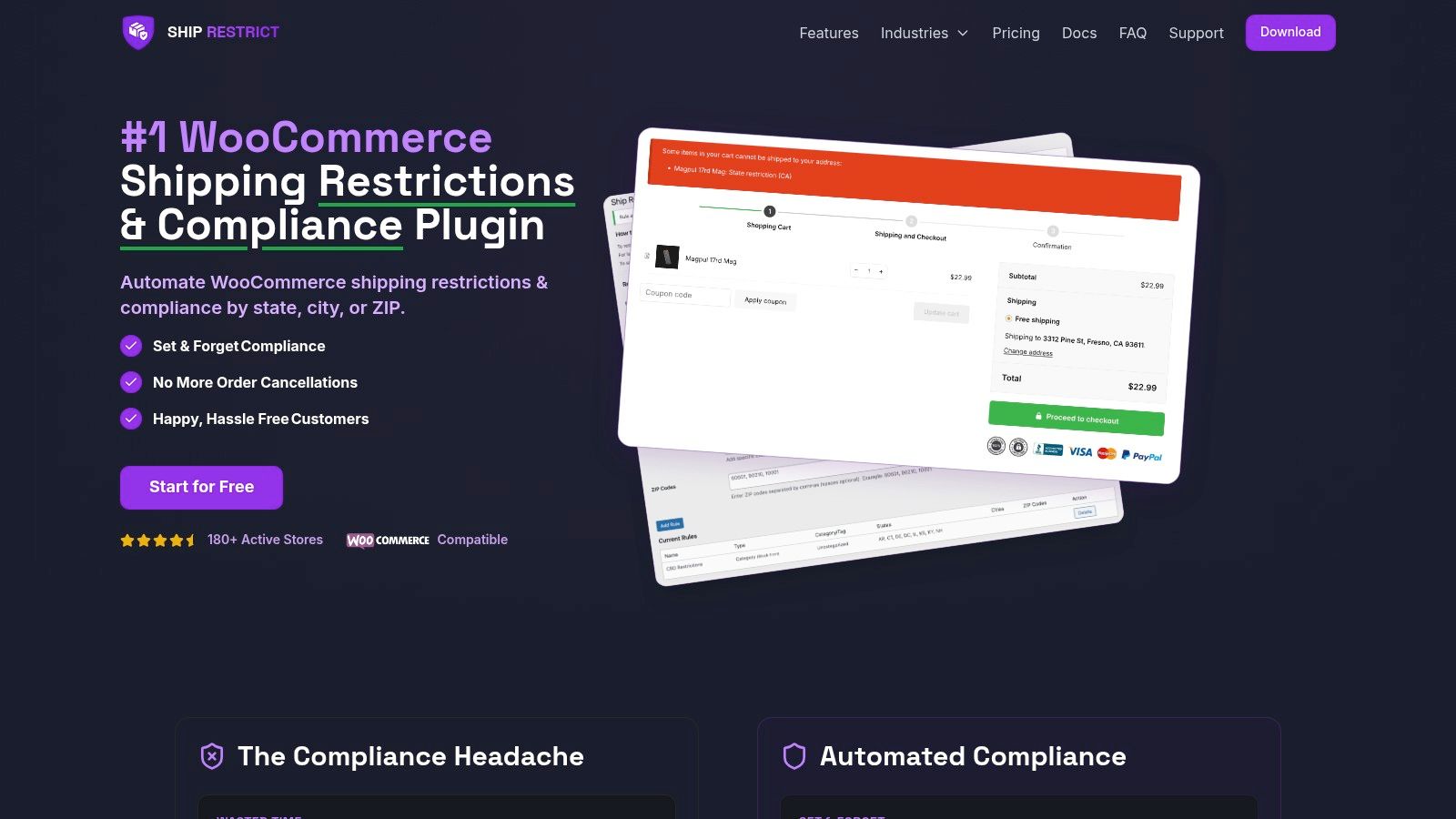
The better model is to automate the decision points that should happen before a shipping date is ever considered. If a destination is restricted, the order shouldn't drift into a fulfillment queue and wait for a human to catch it later. If a product can't lawfully ship to a location, your system should stop that transaction early.
This is also where customer service strategy matters. Good support doesn't rescue a broken workflow. It communicates the output of a disciplined one. If your team is reworking these customer touchpoints, this piece on 2026 Shopify customer service strategies has useful ideas around automation and message consistency that apply beyond Shopify.
Strong communication starts upstream. The cleanest “where is my order?” email is the one you prevent by setting the right date and blocking the wrong order before checkout.
A practical operating model
For regulated ecommerce, the most reliable pattern looks like this:
- Block orders that can't ship
- Calculate dates only for valid orders
- Show date ranges when variables remain
- Trigger updates when status changes
- Keep warehouse actions behind compliance clearance
Merchants often reverse that order. They publish dates first, then hope compliance and inventory can support them. That creates friction for customers and stress for staff. It also trains your team to treat exception handling as normal.
Shipping Date FAQs
How does the shipping date work for international orders
The core meaning stays the same. The shipping date is still the handoff to the carrier. What changes is everything that happens after that, especially customs clearance and country-specific import handling.
For customer communication, don't present the shipping date as if it predicts final arrival with precision. International orders need wider delivery windows and clearer language about post-handoff delays that aren't controlled by your warehouse.
Do USPS, UPS, and FedEx define shipping date the same way
In practical ecommerce use, yes. Merchants and logistics systems generally use shipping date to mean the point when the package enters the carrier network. The exact scan event names may differ, and your storefront may say ship date, shipment date, or dispatch date, but the operational idea is the same.
What matters more than wording is consistency. Your product pages, checkout, support scripts, and order emails should all use the term the same way. If one system says “shipped” at label creation and another says “shipped” at carrier acceptance, customers will spot the contradiction immediately.
What's the best way to explain a shipping delay to an angry customer
Be direct, specific, and brief. Don't hide behind generic language like “unexpected issues” unless you cannot say more. Customers usually calm down faster when they get a plain answer and a next step.
A good response usually includes:
- What changed: Say whether the issue is processing, inventory, carrier pickup, or supplier delay.
- What it means: Clarify whether the shipping date moved, not just the delivery expectation.
- What happens next: Give the customer the next update point or available options.
- What you're not claiming: Don't invent certainty you don't have.
“Your order has not been handed to the carrier yet. The expected ship date moved while we completed review on the order. We'll send the updated shipment confirmation as soon as carrier acceptance occurs.”
That kind of message works better than polished corporate language because it answers the core question. Customers want to know whether the order is still in your control or already moving.
Should you show a single date or a date range
If your operation includes variables you don't fully control, a date range is safer and usually more honest. Single-date promises can work when inventory, staffing, and carrier schedules are tightly controlled. In most regulated ecommerce environments, ranges reduce avoidable disappointment.
Is the shipping date the same as the order date
No. The order date is when the customer places the order. The shipping date is when the package is physically handed over to the carrier. Confusing those two dates causes most of the misunderstandings merchants see in support tickets.
If you sell regulated products on WooCommerce, you can't afford to treat shipping dates as a simple checkout label. Ship Restrict helps firearms dealers prevent restricted orders before checkout with location-based rule enforcement built for compliance-heavy stores. That means fewer manual checks, fewer avoidable shipping mistakes, and a cleaner path from valid order to lawful shipment.
Automate Shipping Compliance
Stop worrying about restricted states. Ship Restrict handles it automatically.

Cody Yurk
Founder and Lead Developer of ShipRestrict, helping e-commerce businesses navigate complex shipping regulations for regulated products. Ecommerce store owner turned developer.
Automate Shipping Compliance
- Block restricted states
- No more cancellations
- Set and forget
3-day free trial · Card required