Delivery Duty Unpaid Incoterms Explained for eCommerce
Learn what delivery duty unpaid Incoterms means, how DDU compares to DAP and DDP, and how to handle duties, customs, and compliance in your shipping workflow.
You're probably looking at a checkout, invoice, or freight quote that still says DDU, and the customer is already asking why a package landed with a customs bill attached. That's the classic cross-border surprise, the seller thought the price covered delivery, the buyer thought it covered the whole landed move, and the paperwork used a term that no longer sits in the current Incoterms framework. In regulated-product eCommerce, that confusion gets expensive fast, because the shipment has to survive both customs rules and product-specific shipping rules before anyone can call it complete.
Where the DDU Label Still Trips Up Cross-Border Sellers
A firearms merchant can handle the outbound side correctly, pack the order, confirm the export documents, and hand it to a carrier, then still face an angry overseas buyer when the parcel stops at import. The invoice may say Delivered Duty Unpaid, but the customer often reads “delivered” as finished, not delivered to the border with import costs still waiting to be paid. That mismatch is where service tickets, chargebacks, and failed handoffs start to stack up.
The label keeps showing up because legacy paperwork lasts. DDU was removed from Incoterms 2010, and many businesses later shifted to DAP for the same basic delivery structure, but older contracts, invoices, and shipping instructions still use the retired term (Time Matters glossary on DDU). That is more than a terminology problem. It creates cost-allocation confusion when teams assume the old label still works like a current rule.
Why the old label keeps surviving
Old templates outlast policy updates in day-to-day operations. A warehouse team copies a previous commercial invoice, a sales rep pastes terms from an earlier deal, or an ERP field still says DDU because nobody rebuilt the shipping logic after the contract language changed. The result is a document that sounds official but does little to help the buyer understand who is paying import charges.
Automate Shipping Compliance
Block orders to restricted states automatically. 3-day free trial.
Start Free TrialPractical rule: if the customer has to clear customs and pay duties, the document needs to say that plainly, not hide it behind a retired label.
For eCommerce merchants, the biggest problem is expectation management. A DDU-style quote can look competitive because it includes transport to destination but excludes import charges, so the buyer does not see the actual cost until the carrier or broker requests payment. That is why the term still creates trouble, even though the official rule set has moved on.
What DDU Actually Means Under Incoterms
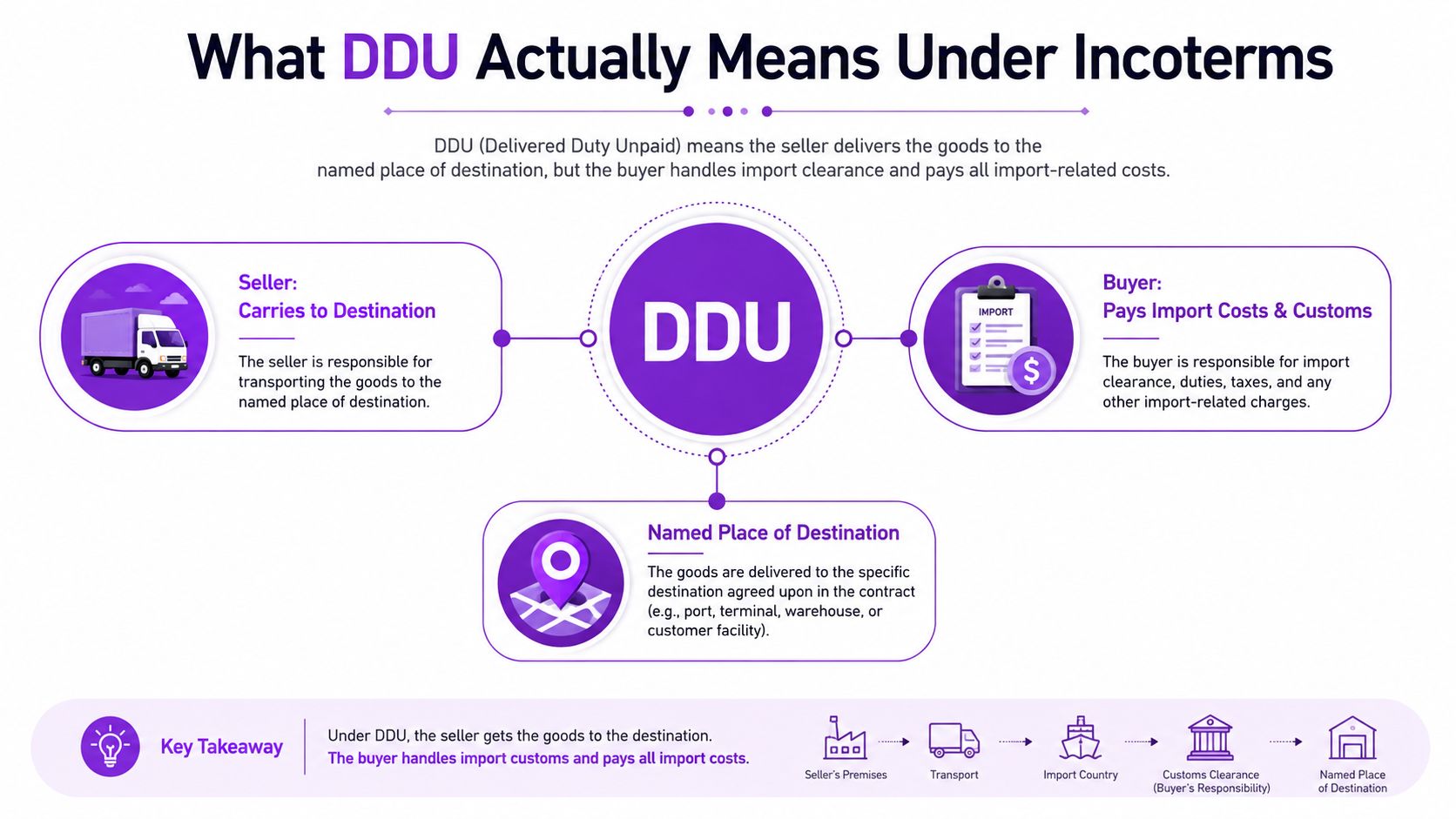
A cross-border checkout can look clean on the front end and still fail at customs. DDU, Delivered Duty Unpaid, was the legacy Incoterms rule used when the seller paid to move the goods to a named destination, while the buyer handled import clearance, duties, and taxes (Incoterms 2000 DDU guidance). In practical terms, the seller got the parcel to the buyer's country, but the buyer still had to clear it through the border.
The simple mechanics
A courier can deliver a box to the door and still leave the import side unresolved. DDU worked the same way. The seller carried the transport burden to the named place, while the buyer took over the customs step, which is where regulated-product eCommerce often gets exposed. If a merchant is shipping items that face state-by-state restrictions, the delivery line and the compliance line are not the same thing.
DDU was later replaced by DAP in Incoterms 2010 and 2020, which removed some of the ambiguity around delivery to a named place and unloading. The old term still shows up in invoices and shipping notes, especially where teams have not updated contract language to match current workflows. That replacement matters because DDU was about getting goods to a place before customs formalities were finished.
Where risk changes hands
The risk transfer point is where many shipping teams still get tripped up. Under DDU, the seller bears the cost and risk of transport until the goods are placed at the buyer's disposal at the named destination, before unloading. After that point, the buyer carries the import-side burden, including customs formalities and the related charges.
That setup is why DDU never described duty-paid delivery. The seller promised transport to destination, then the buyer took the handoff for the border side of the shipment. In operational language, DDU splits transport responsibility from fiscal responsibility, and that split is still the source of confusion when legacy terms appear in modern eCommerce contracts.
Seller and Buyer Obligations Under DDU
A DDU shipment only works cleanly when both sides know where their obligations change hands. The seller handles movement to the named place and the origin-side paperwork, while the buyer handles import clearance, the duty bill, and the physical handoff at destination. On paper that sounds straightforward. In practice, cost responsibility and risk transfer are not always felt in the same way once a shipment is moving through customs, a carrier terminal, or a regulated checkout flow.
Obligation split at a glance
| Step in the Shipment | Seller Responsibility | Buyer Responsibility |
|---|---|---|
| Export documentation | Provide commercial documents and export paperwork | None |
| Export clearance | Handle origin-side export formalities | None |
| Transport to named destination | Pay for and arrange carriage to destination | None |
| Import clearance | None | File or arrange import clearance |
| Duties and taxes | None | Pay import duties, VAT, GST, and related charges |
| Unloading | None, unless the contract says otherwise | Arrange and pay for unloading |
| Risk before unloading | Bears risk until goods are placed at buyer's disposal | None |
| Risk after delivery point | None | Bears risk after handoff |
The seller's job is to get the goods to the agreed place in the buyer's country and make sure the transport documents are in order. The buyer's job begins when the shipment reaches that destination and the import side has to be completed. If the buyer does not have a broker, license, permit, or customs process ready, the handoff can stall even when the truck or aircraft has done its part.
Free Shipping Compliance Audit
We'll review your WooCommerce store's shipping compliance for free.
Shipping and compliance teams often miss that the import step can fail even after delivery is otherwise on schedule. In regulated-product eCommerce, that gap matters because the checkout promise, the customs paperwork, and the state-by-state shipping rule may all be different problems. Tools such as Ship Restrict's DDP vs DDU guidance help teams decide whether the contract should leave import charges with the buyer or shift more of the burden to the seller.
Why the risk point matters
Risk shifting before unloading is not a technical footnote. It decides who owns the problem if something goes wrong at the delivery point. A pallet can sit on a dock, a parcel can wait for release, or a broker can hold the entry because paperwork is incomplete, and under DDU the buyer is already on the hook once the goods are available at destination. That is why shipping teams need to separate who paid the freight from who absorbed the import exposure.
How DDU Compares to DAP and DDP Today
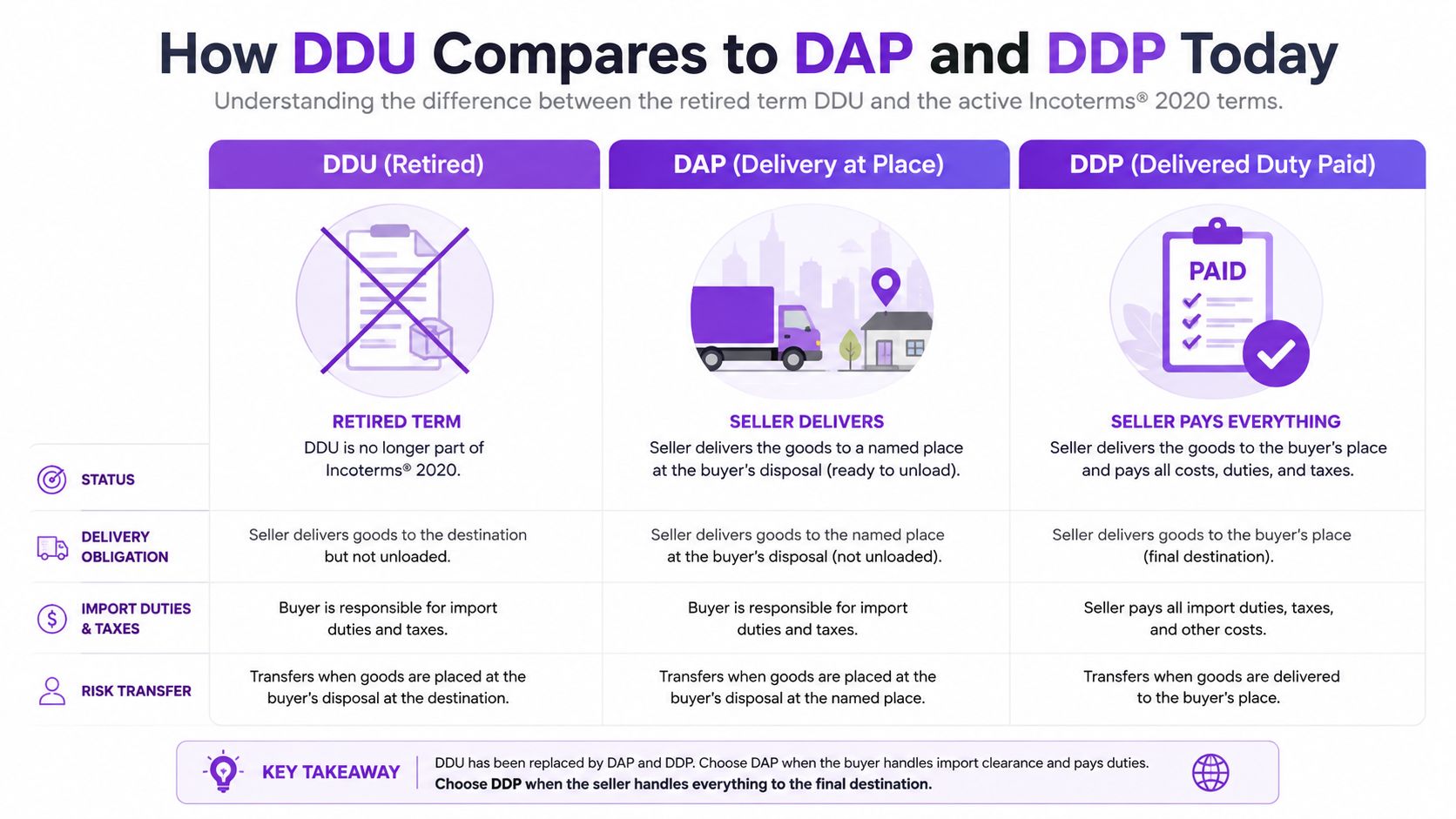
A cross-border checkout can look complete until the shipment reaches the border. At that point, the contract language decides who clears import formalities, who pays duties, and who absorbs delay when a regulated item is held for review. DDU and DAP both place delivery at a named place and leave import clearance and import charges with the buyer, while DDP pushes those import-side costs and responsibilities back to the seller.
What changed when DDU was retired
The practical change is mostly in the wording. DDU was retired, and DAP is the current term that covers delivery to a named place without assigning import duty and tax payment to the seller. The old label still shows up in contracts, checkout copy, and freight quotes, but it often hides the actual intent. If the seller is not paying import charges, DAP is the cleaner way to write the deal.
That distinction matters for regulated-product eCommerce, where the shipping promise, customs process, and state-level restrictions can each fail for different reasons. A seller can promise delivery to the destination and still miss the mark if the buyer cannot receive the item under local rules. For teams deciding whether the buyer or seller should carry the import burden, this DDP versus DDU shipping breakdown is a useful practical reference.
One way to separate the terms is by pricing behavior. A DDU-style quote usually leaves duties and taxes outside the headline price, while DDP folds those import-side charges into the seller's responsibility. That can make the customer experience feel cleaner, but it also demands tighter landed-cost control and better customs planning.
For operators who want a broader trade context, the supply chain guide for South African exporters is a helpful companion piece.
Where each term fits
| Term | Who pays transport to destination | Who handles import clearance | Who pays duties and taxes |
|---|---|---|---|
| DDU | Seller | Buyer | Buyer |
| DAP | Seller | Buyer | Buyer |
| DDP | Seller | Seller | Seller |
The most useful takeaway is simple. If a current quote says DDU, it is usually describing a DAP-style shipment in legacy language. If the seller wants to remove import surprise from the buyer's side, DDP is the closer fit, but only when the seller is ready to own the border-side compliance work and the landed-cost exposure.
<iframe width="100%" style="aspect-ratio: 16 / 9;" src="https://www.youtube.com/embed/Kcmg4faS6Hw" frameborder="0" allow="autoplay; encrypted-media" allowfullscreen></iframe>Customs Duties and Documentation in a DDU Shipment
Under a DDU-style shipment, the paperwork doesn't stop when the export truck leaves the warehouse. The seller usually hands over the commercial invoice, packing list, and the transport document, such as a bill of lading or air waybill, then the buyer or buyer's broker uses those documents to clear import formalities. If the destination country wants additional permits or approvals, the buyer has to have those in place before release.
What the buyer must actually do
The import side is a sequence, not a single event.
- Confirm the entry details: The buyer or broker checks the shipment description, quantities, and declared values against the commercial invoice.
- File or arrange customs clearance: The buyer handles the import entry, either directly or through a customs broker.
- Pay the charges: Import duties, VAT, GST, customs processing fees, and any other assessed charges have to be settled before release.
- Release and unload: Once customs clears the shipment, the buyer arranges unloading at the named destination.
DDU is where a lot of customer disputes begin, because the buyer often expects the carrier to finish the job without any extra cost. That expectation is wrong if the shipment is duty unpaid. It is also why seasoned freight teams insist on writing down the import responsibilities clearly, especially when the destination has strict documentation rules or unstable clearance timing.
For merchants dealing with regulated or cross-border documentation complexity, the cross-border restricted goods documentation guide is a useful companion piece. It fits neatly with the import side because the same shipment can fail on missing papers long before anyone argues about freight charges.
Where shipments get stuck
The most common failure point is a held parcel waiting on missing paperwork or unpaid charges. That can lead to storage fees, delayed delivery, or a package being returned if the buyer won't or can't complete the import process. In practice, the seller gets blamed even when the terms placed the import burden on the buyer, which is why DDU needs plain language in the sales contract.
If you're building a global shipping process from the ground up, the supply chain guide for South African exporters is a strong reference for understanding how documentation discipline and trade coordination affect border movement.
Clear terms don't eliminate customs friction, but they do stop a shipment from failing for the wrong reason.
Why DDU-Style Terms Add Risk for Firearms eCommerce
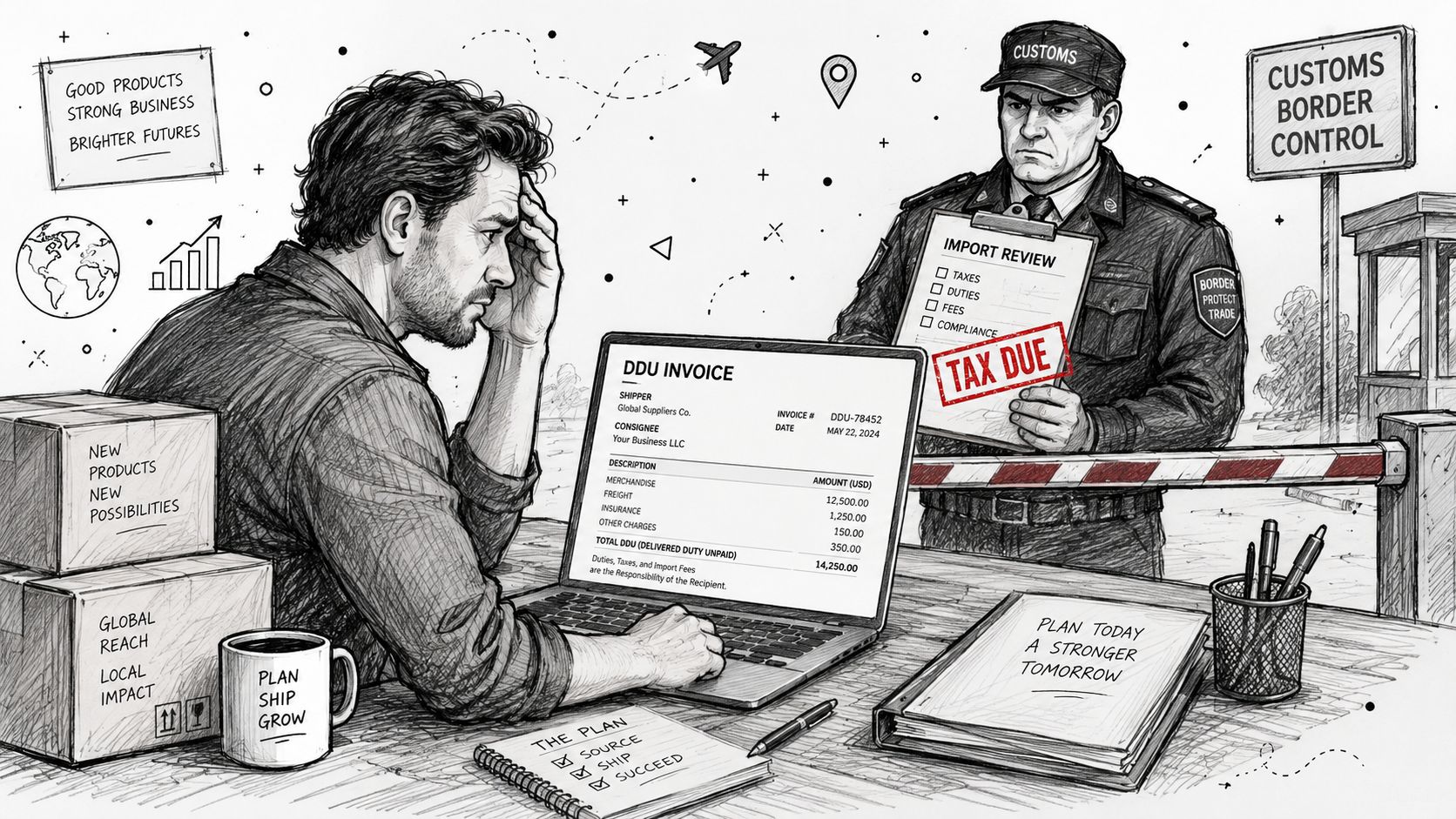
Firearms eCommerce already lives inside a tight compliance frame. Add a DDU-style international quote, and the buyer may now be responsible for clearing a product that could face import barriers in the destination country, even if the seller did everything correctly on export. That's a bad combination, because the customer experience depends on a border process the buyer may not be able to complete.
The customs problem gets bigger with regulated goods
A regulated-product shipment is not just a freight move, it is a compliance event. If the buyer cannot lawfully import the goods, a DDU structure can turn into a dead end because the shipment is already in motion while the import step remains unresolved. That creates more than a delivery delay, it creates a likely customer dispute over who should have known what before the order shipped.
The same pre-shipment discipline that matters for state-by-state domestic restrictions matters here too. Before any order leaves the warehouse, the merchant needs to know whether the destination permits the product, whether the paperwork is complete, and whether the buyer can receive it. For a practical domestic analogue, the firearms and ammunition shipping compliance guide for WooCommerce stores shows how restriction checks belong before fulfillment, not after a label prints.
Why DDP or DAP is usually a better fit
For regulated goods, quoting DDU often feels like outsourcing the hardest part to the customer. That works only when the buyer already has the import capability, the local broker setup, and a legal path to receive the product. If any one of those is missing, the shipment stalls, and the seller still has to manage the fallout.
Practical rule: if the customer can't reliably complete import clearance, don't build the order flow around a duty-unpaid assumption.
That doesn't mean every regulated shipment should be DDP. It means the term has to match the compliance reality. For firearms eCommerce, the safest default is to align the Incoterm with the buyer's actual import capacity, not with whatever sounds easiest at checkout.
Best Practices for Reflecting Incoterms in Your Shipping Workflow
The cleanest fix is to stop using DDU as shorthand in live customer-facing copy. If the buyer is responsible for import clearance and duties, call the term DAP if you're following current Incoterms language, and use DDP only when you want to absorb the import side. That single edit removes a lot of ambiguity from invoices, quotes, and checkout messaging.
What to change in the workflow
- Update contract language: Replace legacy DDU references with modern DAP or DDP language where appropriate.
- Spell out import responsibility: Tell customers who pays duties, taxes, and clearance fees before the order is placed.
- Match checkout copy to operations: Don't promise a landed experience if your process still expects the buyer to clear customs.
- Check the product type first: Regulated goods need stricter pre-shipment validation than ordinary merchandise.
- Keep documents aligned: Invoices, packing slips, and shipping instructions should all tell the same story.
A useful operational rule is to align Incoterms with the same logic you already use for shipping restriction enforcement. If a product is blocked by geography, you stop it before checkout. If a shipment is duty unpaid, you say so before payment. Both controls are about preventing a bad handoff after the order is already in motion.
If your store runs on WooCommerce and you need an automated layer for restriction enforcement, the same discipline behind Ship Restrict belongs in the broader checkout stack, because the right rule at the right point prevents expensive fixes later.
If you're standardizing international shipping for regulated goods, Ship Restrict can help you enforce the right shipping rules before the order reaches fulfillment. Visit Ship Restrict to see how checkout-level restriction controls support cleaner compliance, fewer customs disputes, and more reliable customer expectations.
Automate Shipping Compliance
Stop worrying about restricted states. Ship Restrict handles it automatically.

Cody Yurk
Founder and Lead Developer of ShipRestrict, helping e-commerce businesses navigate complex shipping regulations for regulated products. Ecommerce store owner turned developer.
Automate Shipping Compliance
- Block restricted states
- No more cancellations
- Set and forget
3-day free trial · Card required