Firearms Compliance Gap Analysis Guide for 2026
Our 2026 guide shows how to conduct a firearms compliance gap analysis. Identify risks, create a remediation plan, and automate checks with tools like Ship
You're staring at a shipping order that looks ordinary until you open the address, the product mix, and the destination rules all at once. A customer wants a regulated item, your team has a spreadsheet with county and ZIP restrictions, and someone in fulfillment is asking whether the order can go out today. That is the point where compliance gap analysis stops being a corporate phrase and becomes a daily survival tool for a firearms retailer.
For a WooCommerce store selling regulated products, the danger usually isn't one dramatic mistake. It is the small ones that pile up, a manual ZIP check that gets skipped, a policy update that never makes it into checkout logic, or a carrier rule that is still sitting in someone's inbox. A disciplined gap analysis shows you where those weak spots are before they turn into returned shipments, frustrated customers, or a larger regulatory problem.
If you already feel buried in manual checks, the practical value is straightforward. A gap analysis helps you locate the places where your current shipping process, product restrictions, and documentation do not fully match the requirements you have promised to follow. For the cost side of those failures, the true cost of shipping compliance violations is hard to ignore, and an audit readiness guide can help frame the documentation work that has to support every decision.
Why a Compliance Gap Analysis Is Non-Negotiable
A firearms retailer does not get to treat compliance like a cleanup task that happens later. One missed destination rule can stop an order, trigger a customer dispute, or let a shipment leave the warehouse when it should have been held. In WooCommerce, the risk gets sharper because checkout moves faster than a person can reliably inspect every address by hand.
Automate Shipping Compliance
Block orders to restricted states automatically. 3-day free trial.
Start Free TrialA compliance gap analysis compares what the business is doing today with the requirements it needs to meet. The practical question is simple, where are we acting as if we are compliant without proving it? That distinction matters because a policy sitting in a folder does not stop a bad shipment, and a spreadsheet check understood by only one employee does not hold up when order volume increases.
The cost of getting it wrong is not abstract. IBM's breach cost figures point to the scale of loss that control failures can create, and the same discussion notes that compliance teams spend a large share of their time on manual, repetitive work state of GRC compliance automation 2026. That is the trap for firearms sellers, too. If address rules, product restrictions, and exception handling live in human memory instead of system logic, the process breaks as soon as someone is busy, absent, or rushed.
Practical rule: if the restriction only exists in a spreadsheet, it does not exist at checkout.
For a retailer, the point is to find the blind spots between legal text and actual shipping behavior before a regulator, a carrier, or an unhappy customer finds them first. That means checking more than one layer, destination rules, internal procedures, product mappings, customer messaging, and the evidence that proves the process really works. It also means understanding the downstream cost of a mistake, which is why the true cost of shipping compliance violations belongs in the same conversation as your shipping rules. The documentation side matters too, and the audit readiness guide is where the recordkeeping piece starts to make sense.
Laying the Groundwork for Your Analysis

A common initial mistake is jumping straight into the checklist. That usually produces a shallow review, one that catches obvious issues but misses the conflict between a federal rule, a carrier policy, and the way your fulfillment team operates. For a firearms eCommerce operation, the scope has to be specific enough to be useful, but broad enough to identify the actual risk surface.
Start by deciding what's in scope. If you only review shipping restrictions, you may miss customer notices, data handling, or marketing language that creates a separate compliance issue. If you expand too far without a boundary, the project turns into a never-ending audit exercise, so the scope needs a written line around products, states, counties, cities, ZIP codes, and any internal processes that influence fulfillment.
The hard part is choosing the right benchmark. Many guides don't address how to compare legal requirements, industry standards, and internal policies when they conflict, and that creates false confidence. Recent guidance emphasizes pinning specific framework versions and documenting evidence rather than using a one-size-fits-all checklist, which is the safer mindset when your controls have to match real-world shipping rules, not generic GRC language compliance gap analysis.
Build a source of truth
Once the scope is clear, collect every rule set into one place. That means applicable laws, carrier restrictions, internal SOPs, shipping-zone logic, and customer-facing messaging. The point is not to create a giant binder, it's to create a master reference that shows what the business says it does and what systems enforce.
A good benchmark is specific, versioned, and defensible. A vague checklist is none of those things.
From there, inventory your current controls. Write down what's manual, what's automated, and what depends on tribal knowledge. If your team still checks certain destinations by looking at a spreadsheet before printing labels, that belongs in the baseline, because the analysis starts with reality, not intent.
Free Shipping Compliance Audit
We'll review your WooCommerce store's shipping compliance for free.
A Repeatable Workflow for Finding Gaps
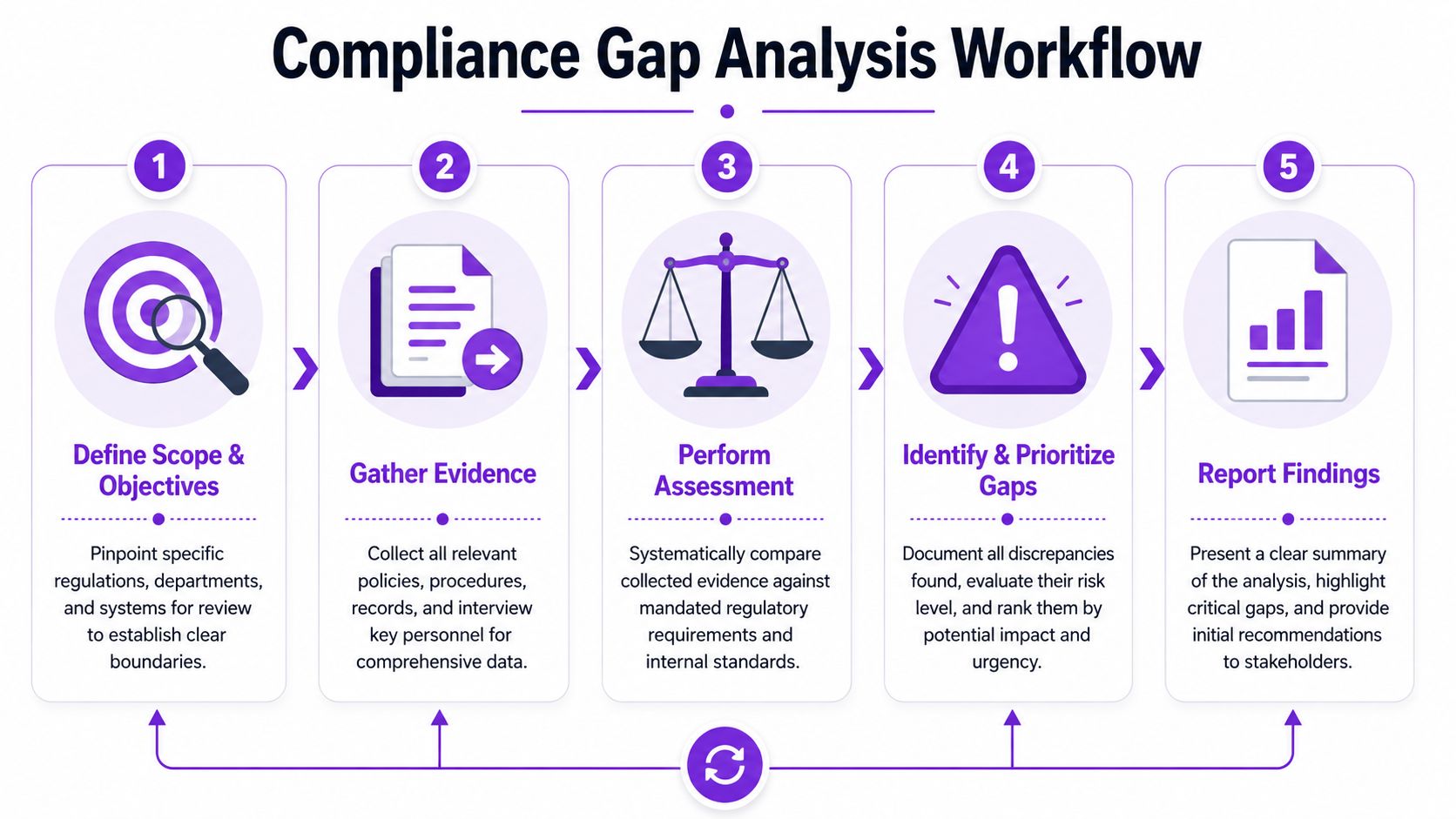
A solid compliance review has to produce the same result every time, or it will fall apart under audits, staff turnover, or growth. For an FFL retailer, the safest approach is a repeatable workflow, define the benchmark and scope, inventory current-state evidence, map requirements to existing controls, classify gaps by risk, assign remediation owners, then validate closure through retesting compliance gap analysis workflow. That structure matters because it turns legal text into a control matrix you can manage in WooCommerce, fulfillment, and customer service.
Start with a real shipping example
A state changes its magazine-capacity rules and your catalog still allows the item to ship everywhere unless a staff member catches the destination. The benchmark is the updated rule set, the scope is the affected product line, and the evidence includes your WooCommerce shipping zones, product tags, carrier settings, checkout messages, and warehouse instructions. If the order path does not block the sale before checkout, that is not a paperwork issue, it is a control gap.
The best discovery worksheet is simple and ugly on purpose. Use columns for requirement, current control, evidence reviewed, gap description, risk level, owner, due date, and retest status. If a requirement is satisfied by more than one control, note each one separately so you can tell whether the control is redundant or just duplicated in documentation.
Gather evidence that can survive scrutiny
Do not rely on policy language alone. A defensible analysis should triangulate written procedures, system configuration records, training logs, audit trails, interviews, and direct testing so each requirement can be marked compliant, partially compliant, non-compliant, or not applicable. That means checking what the site does when a restricted address is entered, not just reading what the policy says should happen.
If the evidence never leaves the page and touches the system, it is not enough.
For eCommerce teams, hidden risk often shows up in plain sight. Marketing may promise fast shipping, fulfillment may rely on a manual exception, and the checkout page may still present a blocked product as available. Those mismatches are exactly what the workflow is designed to uncover, because they are hard to spot when everyone only looks at their own piece of the process.
Keep the output operational
One common weakness in compliance content is that it stops at identification. The useful version ends with a traceable list of gaps, the control that failed, and the person responsible for fixing it operationalizing compliance analysis. That is the difference between an assessment and a working remediation program.
If you need a quick companion to this stage, a compliance risk assessment helps separate the issue itself from the damage it could cause. The gap analysis tells you what is missing, the risk assessment helps you decide what to fix first.
From Findings to Priorities How to Score Your Risks
Once the gaps are on paper, attention turns to the order of operations. A long list of findings is useless if the team treats a minor wording issue the same way it treats a control failure that can block a prohibited shipment. That's why risk scoring matters, it forces discipline when everything feels urgent.
A basic matrix works well for most retailers because it keeps the conversation concrete. Rate each gap by likelihood and impact, then sort the list by the combination of the two. High likelihood means the failure is likely to recur in normal operations, and high impact means the business consequence could be severe, such as a major legal action or a serious loss of license confidence.
| Sample Risk Scoring Matrix | Low Impact, minor customer inconvenience | Medium Impact, returned shipment, moderate fine | High Impact, FFL revocation, major legal action |
|---|---|---|---|
| Low Likelihood | Low priority | Low to moderate priority | Moderate priority |
| Medium Likelihood | Low to moderate priority | Moderate priority | High priority |
| High Likelihood | Moderate priority | High priority | Highest priority |
Use the matrix to separate noise from exposure. A slightly outdated customer notification message might be annoying, but if the blocked checkout logic still works, it belongs below a control that lets a restricted item pass through because a ZIP restriction wasn't mapped correctly. The matrix is useful because it keeps the team from wasting hours polishing a low-risk message while a serious restriction remains manual.
A practical scoring rule is to ask two questions for each finding. First, how often could this fail in normal operations? Second, what happens if it does? If the answer to the second question includes shipment rework, regulatory exposure, or a license-level consequence, that issue belongs near the top no matter how uncomfortable it is to admit.
Score the control failure, not the effort it would take to fix it.
For a firearms retailer, this usually means the most urgent issues are the ones tied to destination filtering, product eligibility, and order placement. Lower on the list are presentation problems that don't affect enforcement, even though they still matter for customer trust and audit clarity. The discipline comes from keeping the scoring tied to business harm, not internal politics.
Closing Gaps with Remediation and Automation
A finding only matters if someone owns the fix. That means every gap needs a remediation record with a named owner, a deadline, the exact control change required, and a clear test for closure. Without that structure, issues drift, and the team keeps reporting the same weakness quarter after quarter.
The most common mistake is treating remediation like a to-do list instead of a workflow. Good remediation plans tell you who changes the rule, who verifies it, what evidence proves the change worked, and when the control gets retested. That last part matters because a fix that isn't verified can look complete in a meeting and still fail in production.
For shipping-related gaps, automation usually closes the widest holes. If the analysis shows that a manual ZIP check is error-prone, the remediation is not “remind staff to be careful,” it's to move the rule into checkout enforcement so the block happens before the order is submitted. A WooCommerce restriction layer can enforce destination-based rules, which is exactly where a control belongs when the risk is tied to address and product combinations.
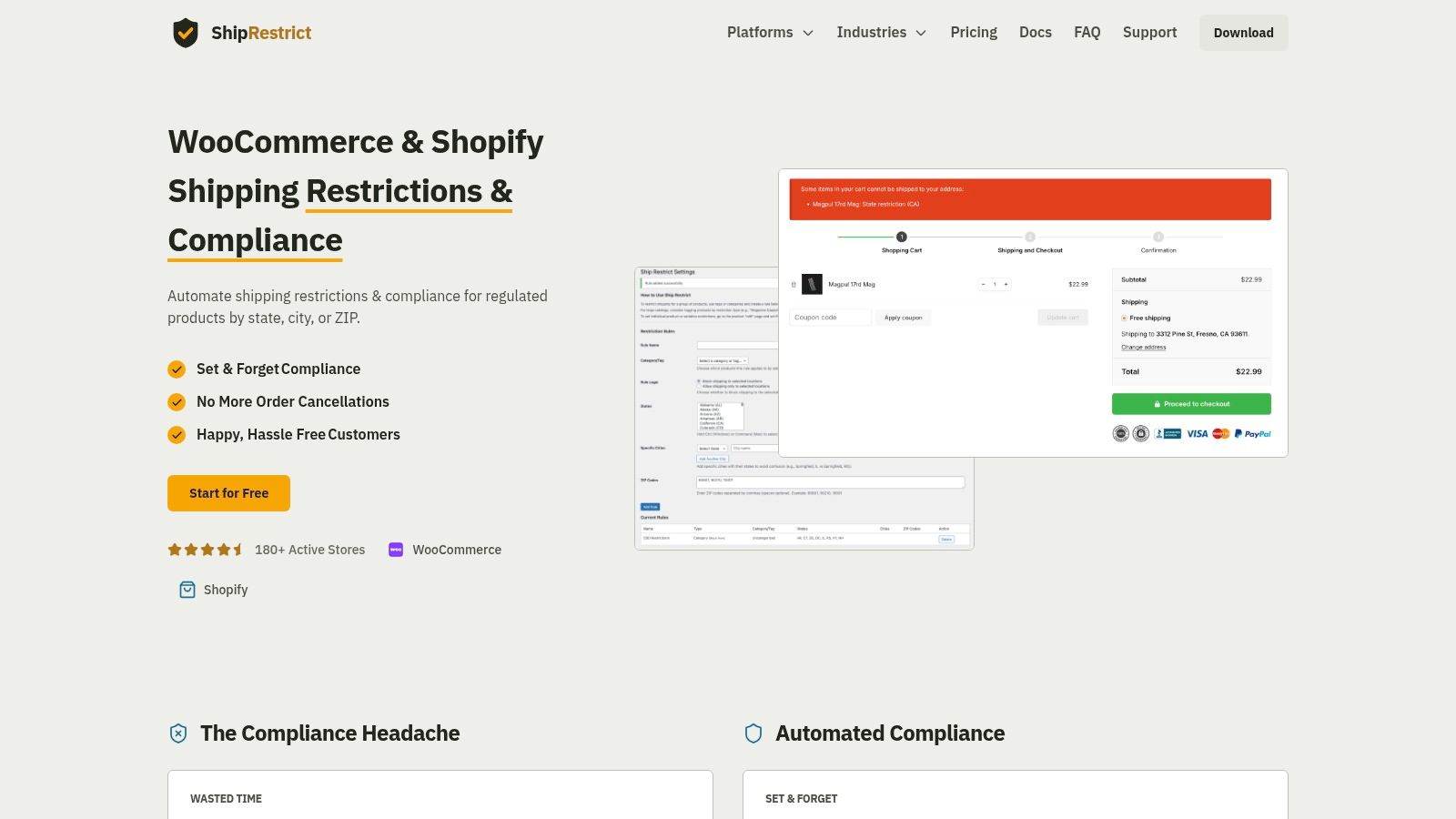
Ship Restrict fits naturally into that kind of remediation because it automates shipping restrictions by state, county, city, or ZIP code inside WooCommerce. In practice, that means you can turn a finding like “manual review for Cook County is inconsistent” into a specific rule that blocks restricted checkout paths before fulfillment ever touches the order. It replaces a human memory problem with an enforceable system rule, which is the right shape for a regulated catalog.
The documentation still matters after automation goes live. Keep the original finding, the remediation owner, the implementation date, the test result, and the retest evidence together so an auditor can follow the trail without hunting through inboxes. That's the part many teams skip, even though it's what proves the control wasn't just changed, but closed.
Fix the process, then prove the fix.
Making Continuous Compliance a Reality
Compliance gets expensive when it becomes episodic. The better posture is to treat gap analysis as a standing operational habit, because regulations change, carrier policies shift, and product assortments evolve faster than annual review cycles can keep up. That's especially true for regulated commerce, where a new destination rule or catalog change can create a gap even if last quarter's analysis was clean.
The broader market is already moving in that direction. In 2025 to 2026, 85% of organizations said compliance requirements had become more complex, and 92% now conduct at least two audits or assessments annually compliance statistics. That shows gap analysis is no longer just an internal risk exercise, it's tied to audit preparedness and market access.
Make the process repeatable. Set a review cadence, keep a change log for new products and destination rules, and re-run the analysis whenever the business changes something material in shipping logic or supplier relationships. A continuous monitoring tool can help keep that rhythm from falling apart between reviews, especially when the team is stretched thin compliance monitoring tool.
The payoff is practical. You get fewer last-minute shipment reversals, cleaner audits, and a fulfillment process that doesn't depend on one person remembering every exception. More important, you build a control environment that can grow without creating hidden compliance debt.
If you're ready to replace manual ZIP checks and brittle spreadsheets with rules your WooCommerce store can enforce, visit Ship Restrict and evaluate how it can support your shipping compliance workflow. A tighter control process starts with the right gap analysis, and the right automation helps you keep those gaps closed as your catalog and regulations change.
Automate Shipping Compliance
Stop worrying about restricted states. Ship Restrict handles it automatically.

Cody Yurk
Founder and Lead Developer of ShipRestrict, helping e-commerce businesses navigate complex shipping regulations for regulated products. Ecommerce store owner turned developer.
Automate Shipping Compliance
- Block restricted states
- No more cancellations
- Set and forget
3-day free trial · Card required