Compliance Monitoring Tool for Firearms eCommerce
Learn what a compliance monitoring tool is and why firearms eCommerce stores on WooCommerce need one. This guide covers features, ROI, and integration.
A lot of firearms store owners end the day the same way. Orders are still coming in, someone on the team is second-guessing a shipping destination, and a simple checkout turns into a legal research project.
That's the key problem with choosing a compliance monitoring tool for firearms eCommerce. Most software in this category was built for IT teams chasing SOC 2, HIPAA, or internal access controls. Your problem is different. You're trying to stop a restricted item from reaching the wrong county, city, or ZIP code before it creates a compliance issue, a chargeback headache, or a regulator's interest.
If you run WooCommerce in this space, you don't need another vague “GRC platform” pitch. You need a system that watches orders, applies shipping rules accurately, and keeps your team out of spreadsheet hell.
The High Cost of Manual Shipping Compliance
At 10 PM, the order itself looks harmless. A magazine. Common product. Repeat customer name. Then your gut tells you to check the destination one more time.
Automate Shipping Compliance
Block orders to restricted states automatically. 3-day free trial.
Start Free TrialSo you open the spreadsheet. Then a bookmarked state site. Then maybe a county page that looks like it hasn't been updated in years. Then a forum thread because sometimes the forum is clearer than the law. Meanwhile, more orders are waiting.
That routine is expensive even before a mistake happens.
Where manual checks break down
Manual shipping compliance fails in three ways at once:
- It slows fulfillment: Every questionable order pulls someone out of packing, customer service, or inventory work.
- It creates inconsistency: One staff member interprets a rule one way. Another reads it differently the next day.
- It leaves no clean audit trail: When someone asks why an order was allowed or blocked, the answer often lives in memory, notes, or scattered screenshots.
For firearms retailers, that's a bad operating model. You're dealing with product-specific restrictions, local variations, and rules that can change faster than a team can update a spreadsheet.
The stores that struggle most with compliance usually don't have one giant failure. They have hundreds of small manual decisions that nobody can scale safely.
The operational side matters as much as the legal side. A team that spends part of every evening checking addresses by hand is burning labor on work software should handle automatically. If you're looking at broader ways of automating transport operations, the same logic applies here. Remove repeatable admin work first, because that's where error and delay usually start.
The risk isn't just a bad shipment
The hidden cost of manual review is uncertainty. Staff hesitate. Orders sit. Customers get delayed responses. Someone overrides a concern just to keep the queue moving.
That's why the pertinent comparison isn't “manual is free, software costs money.” Rather, the comparison is ongoing staff time and avoidable shipping risk versus automated rule enforcement at checkout.
A useful breakdown of that trade-off appears in this analysis of the true cost of manual order screening versus automated restrictions. The short version is simple. Manual review feels cheaper until your order volume grows or a rule change slips past the team.
Free Shipping Compliance Audit
We'll review your WooCommerce store's shipping compliance for free.
Why this gets worse as you grow
Growth makes manual compliance more dangerous, not less. More SKUs mean more edge cases. More traffic means more rushed decisions. More staff means more variation in how rules are applied.
What worked when the owner reviewed every order personally stops working once checkout volume becomes routine. At that point, a compliance process that depends on memory and late-night research isn't a process. It's a bottleneck.
What Is a Compliance Monitoring Tool
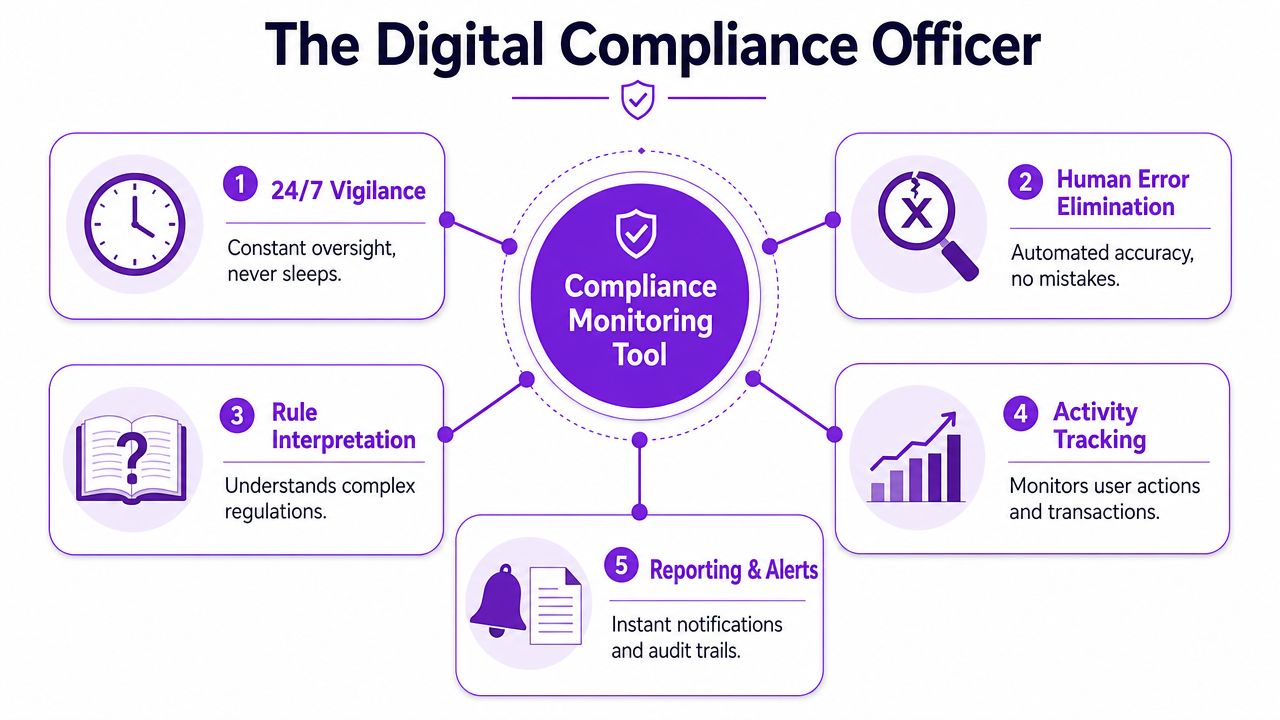
A compliance monitoring tool is software that watches activity against defined rules and flags problems when something falls outside those rules. In plain terms, it acts like a digital compliance officer that doesn't clock out, doesn't skip steps, and doesn't rely on memory.
For most businesses, that means moving away from periodic review and toward continuous oversight. According to Diligent, automated compliance monitoring systems conduct continuous analysis of 100% of enterprise transactions, instead of relying on periodic audits that only review historical samples, which allows organizations to identify anomalies as they occur (Diligent on automated compliance monitoring).
The difference between checking and monitoring
Most store owners already “check” compliance in some form. They review destinations, keep notes on restricted areas, and rely on staff judgment. That's not the same as monitoring.
Checking is occasional. Monitoring is continuous.
A useful analogy is traffic enforcement. Manual review is like pulling over a few cars and hoping that sample tells you what happened on the highway all day. A compliance monitoring tool is closer to putting a camera on every lane and evaluating every vehicle against the same rule set.
For a regulated WooCommerce store, that matters because orders don't become risky only during a quarterly review. They become risky at the exact moment a restricted product is paired with a restricted destination.
What a real tool actually does
A practical compliance monitoring tool usually handles several jobs at once:
| Function | What it means in daily operations |
|---|---|
| Rule matching | Compares each transaction against your restriction logic |
| Continuous oversight | Applies rules every time an order event occurs |
| Alerting | Flags exceptions before they become shipment problems |
| Documentation | Preserves a record of what happened and why |
| Workflow support | Routes issues to the right person for review or resolution |
Practical rule: If a tool only helps you prepare for an audit, it's not enough for firearms shipping. You need it to control the order before fulfillment, not just document the problem later.
Why busy store owners should care
This isn't about buying “more compliance.” It's about replacing weak manual checkpoints with repeatable logic.
The best tools in the broader market are moving toward cloud-based, AI-native compliance management with real-time checks, API integrations, custom workflows, and reporting, according to Atlas Systems' overview of top platforms in 2026 projections (Atlas Systems on compliance tracking software). But for firearms eCommerce, the basic lesson matters more than the branding. The right system watches every relevant order event, applies current rules, and gives your team a clear path when something fails.
That's what store owners should expect when they hear the phrase compliance monitoring tool. Not a policy binder. Not a dashboard nobody checks. A live system that reduces bad decisions at checkout and during fulfillment.
Why Generic Tools Fail Firearms eCommerce
A generic compliance platform can be excellent at proving your company has policy documents, access reviews, and audit evidence. That doesn't mean it can stop a restricted item from being sold to the wrong address.
That's the gap many firearms retailers miss when they shop for a compliance monitoring tool. They see familiar terms like “continuous compliance,” “automated controls,” and “real-time alerts,” then assume the tool can handle shipping restrictions. Usually, it can't.
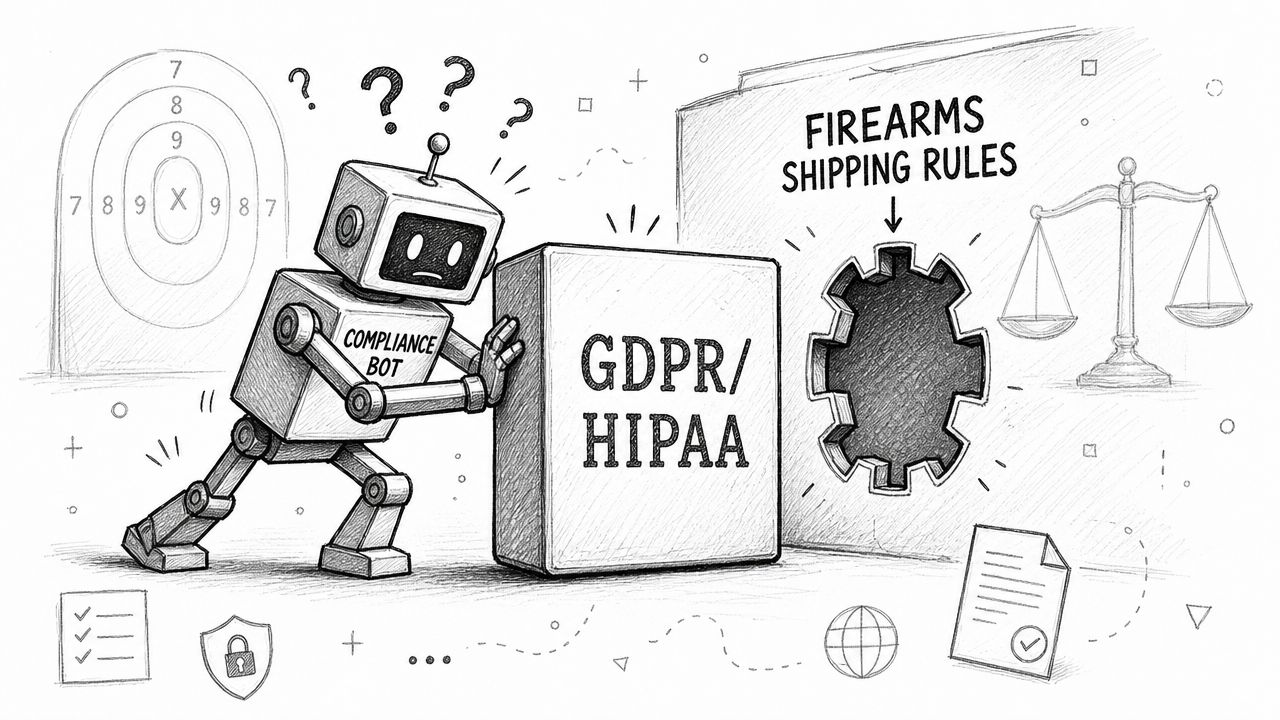
Generic compliance software solves the wrong problem
Most well-known compliance products were built for digital environments. They monitor cloud settings, employee access, evidence collection, vendor reviews, or framework mapping across standards like SOC 2 and ISO 27001.
Your shipping problem is narrower and harder. It depends on:
- Physical destination data
- Product-specific restrictions
- Local legal variation
- Checkout timing
- Order blocking before fulfillment
That's a different architecture.
A cybersecurity tool can tell you if multi-factor authentication drifted. It usually cannot tell you whether a specific product can ship to a specific ZIP code tonight. Those are different data models, different workflows, and different consequences.
Firearms rules are too local for generic logic
SentinelOne's coverage gap is useful here because it points to the underlying issue. Existing content on compliance monitoring tools heavily focuses on cloud security and financial regulations, while physical goods shipping gets far less attention. It also notes that the U.S. Department of Justice indicates there are over 15,000 state and local laws governing firearm transfers, which generic digital compliance tooling does not resolve (SentinelOne on compliance monitoring software).
That number explains why broad “policy compliance” software falls short. Firearms compliance is not a single national rule set. It's a stack of state and local restrictions, plus product details, plus order context.
A store can be compliant in one county and non-compliant a few miles away. Software that only understands high-level frameworks will miss that entirely.
Why customization matters
Some retailers try to force-fit these gaps with internal notes, custom fields, and manual overrides. That approach works poorly because the software was never designed for location-aware shipping enforcement.
If your operation requires custom logic, checkout validation, and product-location matching, it helps to understand the broader guide to custom software solutions mindset. The lesson isn't that every store needs a giant bespoke build. It's that regulated commerce often needs software designed around the workflow, not software retrofitted after the fact.
A more direct explanation of the mismatch is in this article on why generic shipping plugins fail regulated industries. The core issue is simple. Generic tools treat shipping like logistics. Regulated stores have to treat shipping like compliance enforcement.
The practical test
When evaluating any generic platform, ask one question:
Can this tool evaluate a WooCommerce order using product type plus state, county, city, or ZIP-specific restrictions before the order moves forward?
If the answer is vague, that tool isn't built for firearms eCommerce. It may be useful elsewhere in your business. It's just not your shipping compliance system.
Feature Checklist for Your Compliance Tool
A firearms store doesn't need a feature list full of audit buzzwords. It needs a compliance monitoring tool that handles location-sensitive shipping rules without slowing down checkout or burying staff in admin work.
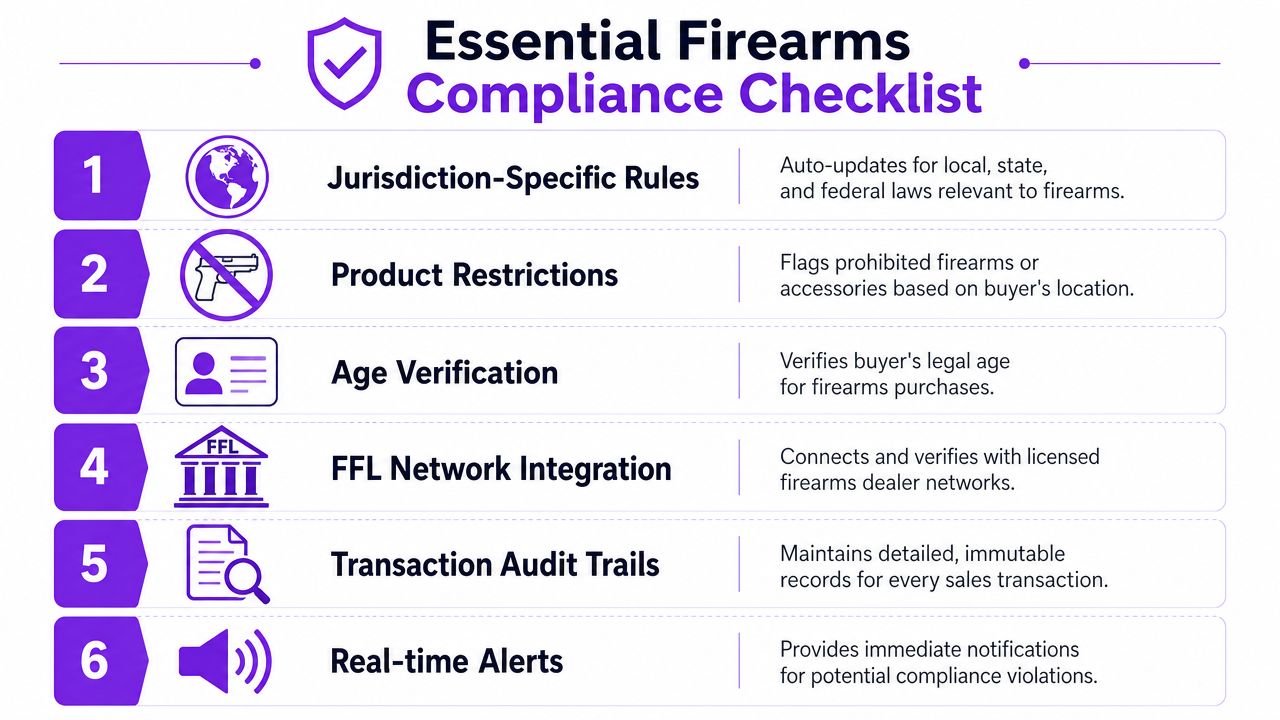
The simplest way to evaluate a tool is to ask whether it supports a real control process. Scrut describes a modern compliance model as five connected steps: identify requirements, define controls, implement monitoring, track deviations, and report issues so compliance becomes continuous rather than periodic (Scrut on compliance monitoring). For a firearms retailer, every feature should support one of those steps.
The features that actually matter
Here's the checklist I'd use for any WooCommerce firearms store.
-
Granular jurisdiction logic
The tool should support rules at more than the state level. County, city, and ZIP-based restrictions are where many stores get into trouble. -
Product-level restriction handling
“Firearms” is too broad. You need rule logic that can treat a magazine, ammunition, accessory, or firearm category differently. -
Real-time checkout enforcement
A rule that only triggers after the order is placed is weak. The tool should stop or redirect the transaction during checkout. -
Clear exception workflows
When an order fails a rule, the system should make next steps obvious. Review, block, modify, or route to staff. -
Searchable audit records
Staff should be able to see which rule fired, when it fired, and what was done next. -
Bulk rule management
If a rule change affects multiple jurisdictions, you need to update them without editing one by one.
What improves the customer experience
Store owners often focus on the block itself and forget the customer message. That's a mistake.
A good tool should let you customize on-screen notices so the customer understands why a product can't ship to their location. That reduces confusion and support tickets. It also keeps the interaction professional instead of making the store look broken.
This matters for conversion too. Not because the tool should “push sales” at all costs, but because compliant friction can still be cleanly handled. If you care about checkout clarity and user behavior, broader resources on top conversion rate optimization software can be useful. The lesson for regulated retail is that better messaging often saves more carts than vague hard stops.
A quick pass or fail screen
Use this short table when you review demos:
| If the tool says this | Treat it as |
|---|---|
| “We support compliance frameworks” | Too broad |
| “We monitor policy attestations” | Helpful, but not enough |
| “We can validate by exact shipping jurisdiction” | Relevant |
| “We can trigger checkout restrictions by product and destination” | Essential |
| “We store why the order was blocked” | Strong sign |
| “You can update many rules quickly” | Operationally useful |
Don't buy a platform because it has the word compliance in the category. Buy it because it can enforce the exact controls your orders require.
Integrating a Compliance Tool with WooCommerce
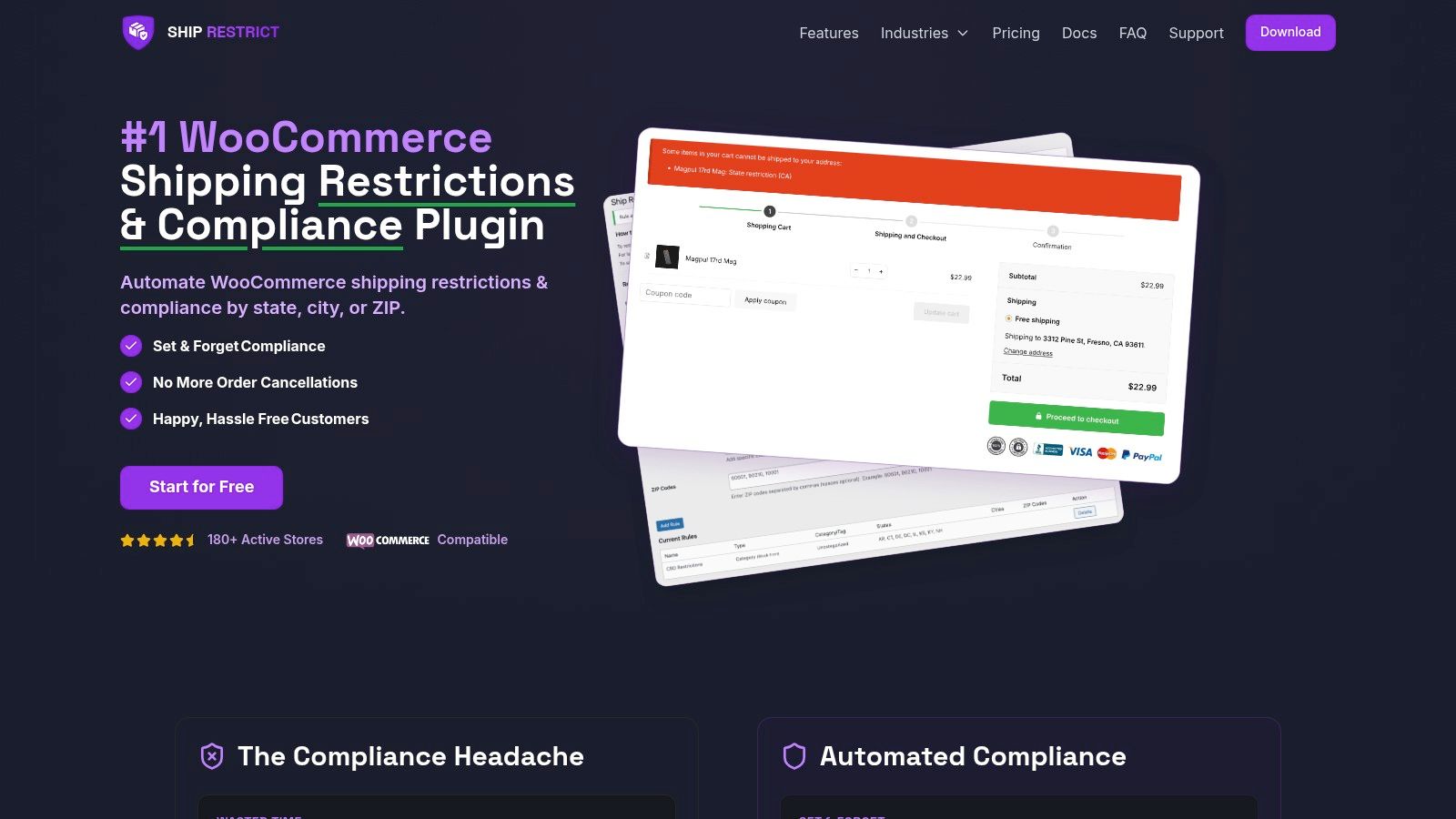
A customer in New Jersey adds ammunition to the cart, enters a shipping address, and reaches checkout. If your store catches the restriction before payment, the order stops cleanly and your team avoids a refund, a support ticket, and a compliance problem. If the rule fires late, or not at all, the mistake moves downstream into fulfillment where it costs more to fix.
That is why WooCommerce integration matters so much for regulated shipping. The tool has to work inside the actual order flow, with your product data, checkout fields, shipping methods, and other plugins. In firearms eCommerce, a compliance rule that only looks good in a dashboard is not useful.
Two paths and the trade-off behind each
Most WooCommerce stores choose between a custom API integration and a native plugin.
| Approach | What usually happens |
|---|---|
| Custom API integration | Flexible, but maintenance-heavy |
| Native WooCommerce plugin | Faster to deploy and easier to manage |
Custom work gives you control. It also gives you permanent ownership of edge cases. WooCommerce updates, checkout custom fields, tax plugins, shipping extensions, and theme overrides can all change how and when rules fire. For a firearms seller, that is not a minor technical issue. It is an ongoing compliance exposure.
A native WooCommerce plugin built for restricted shipping usually fits better because it already hooks into the cart and checkout process where the decision needs to happen. That shortens implementation time and reduces the odds that a later site change inadvertently breaks enforcement.
What a clean rollout actually looks like
The stores that get this right keep the rollout boring. That is a good thing.
-
Install in staging first
Test against a copy of your real checkout, not a stripped-down demo. -
Match products to rule logic
Firearms, ammunition, magazines, and accessories often need different handling. Your categories and SKUs should reflect that. -
Build rules at the jurisdiction level
State-level logic is often not enough. Some restrictions depend on city, county, product type, or license requirement. -
Run both normal and edge-case orders
Test approved destinations, blocked destinations, mixed carts, PO boxes, and store-specific shipping methods. -
Review the customer-facing message
A clear explanation reduces abandoned support tickets and helps staff explain what happened if the customer calls.
The risk is simple. eCommerce stores that use outdated or poorly configured shipping rules can accept orders they should have blocked, or block orders they could have shipped legally. In a regulated category, both problems create cost. One exposes you to compliance trouble. The other cuts revenue and frustrates good customers.
What to avoid during implementation
The biggest failures I see are operational.
-
Handing the whole project to a developer
Engineering can implement logic, but someone on the business side still has to define the actual shipping rules. -
Testing only the happy path
The trouble shows up in mixed carts, edge jurisdictions, and plugin interactions. -
Using generic block messages
“Shipping unavailable” does not help the customer or your support team. A specific message usually prevents confusion. -
Treating launch as the finish line
Rules need review as products, destinations, and site configuration change.
If you want a more practical setup reference, review this guide on firearms and ammunition shipping compliance for WooCommerce stores before you go live.
Later in the process, a visual walkthrough helps teams line up configuration with order flow:
<iframe width="100%" style="aspect-ratio: 16 / 9;" src="https://www.youtube.com/embed/uZH7WNYTR_w" frameborder="0" allow="autoplay; encrypted-media" allowfullscreen></iframe>The decision most stores should make
Small and mid-sized firearms retailers usually should not build their own compliance layer unless they already have strong internal development support and a clear reason to own long-term maintenance.
For most stores, the better choice is a WooCommerce tool built specifically for regulated physical goods shipping. Generic compliance platforms are usually built for policies, audits, and internal controls. Your checkout needs product-by-destination enforcement, clear customer messaging, and rule updates that your team can manage without filing a development ticket every week.
Calculating the ROI of Automated Compliance
Most owners look at compliance software and ask one question first. What does it cost?
That's fair, but it's the wrong starting point. The better question is what manual compliance is already costing you in labor, delays, blocked staff time, and preventable mistakes.
Start with time, not software price
If a staff member reviews questionable orders every day, those hours already have a cost. If your developer gets pulled into fixing shipping rule workarounds, that has a cost too. If your customer service team keeps explaining why an order was canceled after checkout, that's another cost.
Automation changes the shape of that work. Sprinto's verified benchmark notes that platforms like Sprinto and Drata automate evidence collection and scheduled tests, route alerts to control owners, and reduce time to first monitored control in production from quarters to weeks (Sprinto on compliance monitoring tools). In a firearms store context, the principle is similar. Faster operational control means less lag between recognizing a risk and enforcing a rule.
Where the return usually shows up
The ROI usually appears in four places:
-
Labor savings
Staff stop spending so much time checking addresses and restrictions by hand. -
Fewer preventable order problems
Bad orders get blocked earlier, before they become fulfillment issues. -
Cleaner internal operations
The team handles exceptions in a repeatable process instead of ad hoc Slack messages and guesswork. -
Stronger customer trust
Customers may not love a restriction, but they trust a store more when the process is clear and consistent.
Stores often underestimate the value of consistency. A team that handles every restricted order the same way creates fewer disputes and fewer internal mistakes.
The practical ROI test
You don't need a complex finance model. Ask:
- How much team time goes to manual compliance review each week?
- How often do orders get delayed because nobody is sure about a destination?
- How much disruption comes from updating rules manually?
- What happens to your business if one restricted shipment slips through?
If the answer to those questions makes you uncomfortable, the ROI case is already there. A good compliance monitoring tool doesn't just reduce downside. It gives your team time back and makes the store easier to run.
How Ship Restrict Automates Firearms Compliance
For WooCommerce firearms stores, the value of a purpose-built tool comes down to one thing. It has to translate messy location-based restrictions into reliable checkout enforcement.
That's where Ship Restrict fits. It's built specifically to automate shipping compliance for regulated products on WooCommerce, with rule control at the state, county, city, and ZIP level. That directly addresses the core weakness discussed earlier. Generic compliance software tracks policies. A regulated shipping tool has to stop the wrong order before it moves forward.
How it maps to the real-world problems
The practical strengths line up with the operational pain points:
-
Granular rule engine
This handles hyper-local restrictions that broad plugins usually can't model well. -
Bulk rule creation and management
That matters when stores need to maintain many restriction rules without drowning in admin work. -
Performance-focused validation
Checkout enforcement only works if it doesn't create a slow, unreliable front end. -
Custom customer messaging
Blocked orders need a useful explanation, not a vague error that creates support tickets. -
Scheduled updates and upcoming real-time rule feeds
This is the right direction for stores that need less manual rule maintenance over time.
Why this is the right category of tool
The broader lesson in this article is that firearms eCommerce needs a different kind of compliance monitoring tool than a SaaS security company does.
You're not trying to prove that an employee acknowledged a policy. You're trying to prevent regulated goods from being sold into the wrong jurisdiction. That requires location logic, checkout integration, and operational simplicity for a busy WooCommerce team.
Ship Restrict is aligned with that reality because it was designed around the order decision itself. Not around a generic governance dashboard.
If your biggest compliance exposure starts when a customer enters a shipping address, your monitoring tool has to live at that point in the workflow.
For firearms merchants, that's the difference between “having compliance software” and having a system that effectively protects the store.
If you run a WooCommerce firearms store and want to replace manual address checks with automated rule enforcement, take a close look at Ship Restrict. It's built for regulated shipping, supports granular location rules, and helps stop restricted orders before they become expensive problems.
Automate Shipping Compliance
Stop worrying about restricted states. Ship Restrict handles it automatically.

Cody Yurk
Founder and Lead Developer of ShipRestrict, helping e-commerce businesses navigate complex shipping regulations for regulated products. Ecommerce store owner turned developer.
Automate Shipping Compliance
- Block restricted states
- No more cancellations
- Set and forget
3-day free trial · Card required