Blue Dart Express India: Regulated Shipping for WooCommerce
Ship regulated products via Blue Dart Express India with WooCommerce. Get 2026 compliance tips, courier evaluation, and Ship Restrict integration guidance.
A WooCommerce order looks simple until the product is regulated. A customer enters an address, your store accepts payment, and the warehouse prints a label. Then the significant risk begins. If the destination falls into a restricted area, if the carrier branch handles the shipment differently than expected, or if support becomes unreachable during a delivery exception, one order can turn into a compliance problem.
That's why many store owners look closely at Blue Dart Express India. It's a familiar name, it has strong domestic reach, and it offers multiple service levels that can fit different shipment types. But name recognition alone doesn't solve the last mile problem for regulated products. You need a workflow that checks the address before the order moves.
If you're still refining your store setup, this step-by-step guide for Divi users is a practical companion for building a WooCommerce site with a cleaner operational foundation. For the shipping side, it also helps to review broader shipping for ecommerce compliance basics, because the primary challenge isn't just delivery speed. It's preventing avoidable mistakes before checkout.
Introduction to Blue Dart Express India Shipping
Blue Dart often enters the conversation when merchants need a carrier that can cover large parts of India without stitching together multiple local couriers. For regulated goods, that matters. A wider network usually means fewer handoffs, clearer tracking, and more consistent routing.
Automate Shipping Compliance
Block orders to restricted states automatically. 3-day free trial.
Start Free TrialStill, regulated shipping has a different standard. You're not only asking, “Can this parcel reach the buyer?” You're also asking, “Should this order be accepted at all?” Those are separate decisions, and many merchants mix them together.
Practical rule: Carrier capability and legal eligibility are not the same thing. First decide whether an order may ship. Then decide which service should carry it.
That distinction becomes important with Blue Dart. The company offers structured delivery products, established infrastructure, and broad domestic coverage. But if your WooCommerce store allows a restricted destination through checkout, the carrier can't fix that mistake for you later.
A safer setup starts with a simple sequence:
- Check the destination first. Validate state, city, or ZIP-level restrictions before payment completes.
- Match the shipment to a Blue Dart service. Choose the service only after the address passes your rules.
- Prepare an exception path. If a shipment stalls, your team should know exactly who to contact and what documentation to review.
Understanding Blue Dart Express India
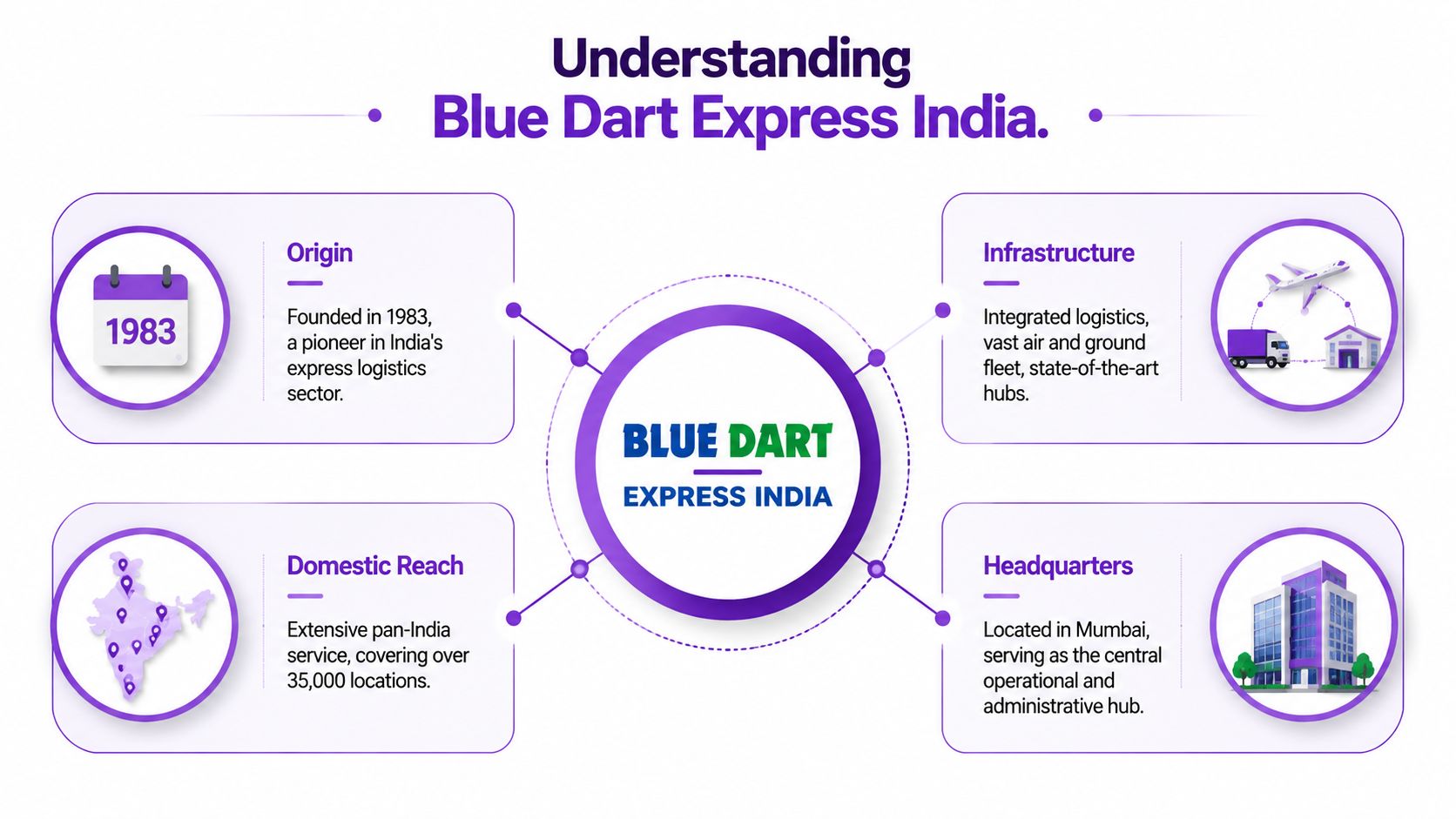
Blue Dart is not a small regional courier trying to stretch into national operations. It was founded in 1983 and incorporated in 1988, is headquartered in Mumbai, and serves over 27,000 domestic locations and more than 220 international destinations, while processing 47 million packages in a fiscal year, according to its company profile on Wikipedia.
That scale matters for e-commerce managers because network size changes how problems appear. With a local courier, the risk is limited reach. With a large integrated carrier, the risk shifts toward process consistency across many hubs and branches.
How the network works
Think of Blue Dart's system like a river network. Major hubs work like large junctions, moving shipments across regions. Local branches act like smaller channels that carry the parcel to the final destination. For standard commerce, that's efficient. For regulated products, each handoff is also a checkpoint where interpretation and execution can vary.
Three parts matter most:
- Air and ground integration: Blue Dart operates as an integrated transportation and logistics company, so merchants can plan around both urgency and destination type.
- Domestic depth: Coverage across thousands of locations makes it suitable when your customers are spread across metros and smaller cities.
- Operational centralization: A large network can standardize tracking and routing better than loosely connected local operators.
A useful companion read is this overview of regional carrier options for regulated products, especially if you're comparing national coverage with region-specific handling behavior.
Free Shipping Compliance Audit
We'll review your WooCommerce store's shipping compliance for free.
A short visual overview helps make the network easier to grasp:
<iframe width="100%" style="aspect-ratio: 16 / 9;" src="https://www.youtube.com/embed/nrg8UkslEKY" frameborder="0" allow="autoplay; encrypted-media" allowfullscreen></iframe>What e-commerce managers should notice
Scale doesn't remove friction. It changes where friction shows up.
If your store sells regulated items, focus on these questions instead of marketing language:
- Where does verification happen? At checkout, warehouse pick, handoff, or branch intake?
- Who handles exceptions? Your support team, Blue Dart branch staff, or a centralized contact point?
- What happens when a destination is borderline? A large network can move the parcel quickly, but your policy still has to decide whether it should move at all.
Key Features and Service Levels
Blue Dart's service lineup matters because regulated shipments rarely fit a one-size-fits-all rule. Some orders need faster movement. Others need broader ground reach. The wrong service choice can create avoidable delay even when the address itself is lawful.
Blue Dart reported ₹5,172 crore in revenue from operations in FY 2023 and lists services including Domestic Priority, Dart Apex, Dart Surfaceline, and Dart Plus in its FY 2023 company release. For merchants, those names aren't just labels. They signal different operational fits.
What the service names mean in practice
Domestic Priority is the service many managers associate with time-sensitive domestic deliveries. If your customer expects tighter delivery handling, this is usually the mental model.
Dart Apex often fits heavier commercial movements better than a small-parcel mindset. If your team ships business orders or consolidated loads, this category becomes more relevant.
Dart Surfaceline is the practical option when time sensitivity is lower and ground movement is acceptable. For non-urgent flows, this can align better with cost-conscious planning.
Dart Plus sits in the lineup as another structured option for shipment planning. The exact fit depends on your contract terms, shipment profile, and origin-destination pattern.
Blue Dart also offers temperature-controlled logistics and door-to-door ground distribution through the service portfolio noted in the company release. That doesn't automatically make a shipment compliance-ready, but it shows the carrier can support more specialized handling than a basic courier model.
Blue Dart Service Comparison
| Service | Delivery Window | Features |
|---|---|---|
| Domestic Priority | Time-definite domestic service | Suited to urgent shipments and tighter delivery expectations |
| Dart Apex | Day-definite service | Better aligned with larger commercial consignments |
| Dart Surfaceline | Day-definite ground service | Useful when speed is less critical and surface transport is acceptable |
| Dart Plus | Structured domestic service | Supports planned shipment movement within Blue Dart's service suite |
Tracking and operational control
Blue Dart's logistics technology is a real strength. According to an AlphaStreet profile of Blue Dart, the company uses a proprietary TMS with RFID pallet tracking, GPS telemetry updates every 15 seconds, and route optimization that cuts fuel use by 12% per kilometer, while maintaining 98% on-time delivery.
For regulated shipping, that translates into three practical advantages:
- Better visibility: Your team can follow where a parcel is moving instead of guessing.
- Cleaner escalation: When a shipment pauses, you have more context for the support conversation.
- More predictable routing: Fewer routing surprises usually mean fewer late-stage compliance headaches.
Strong tracking helps after dispatch. It does not replace pre-checkout restriction logic.
That last point matters most. A highly visible non-compliant shipment is still a non-compliant shipment.
Evaluating Blue Dart for Regulated Shipping
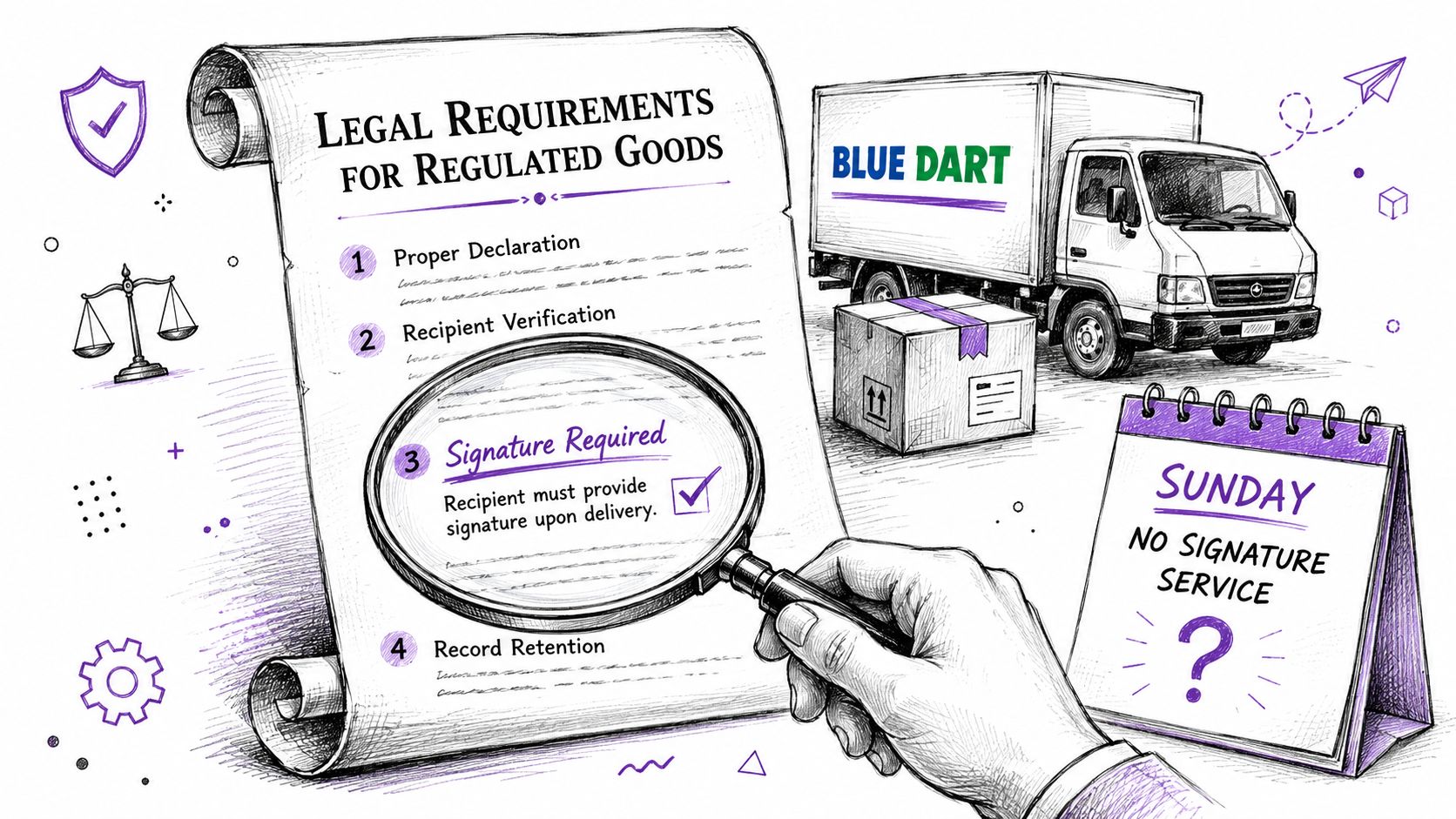
For ordinary retail, a missed delivery is mostly a customer service problem. For regulated goods, the same delay can become a documentation problem, a legal problem, or both. That's why Blue Dart should be evaluated on two tracks at once. First, can it move the shipment reliably? Second, can your business operate safely when exceptions happen?
Where Blue Dart fits well
Blue Dart is attractive when you want one recognized carrier with broad domestic reach, formal service tiers, and strong shipment visibility. For many WooCommerce managers, that simplifies operations because the team doesn't need to juggle multiple regional systems for routine orders.
It also helps when your internal process depends on consistent tracking checkpoints. If warehouse staff, support agents, and compliance reviewers all need to see the same shipment status, a structured network is easier to work with than fragmented local courier arrangements.
Where the risk appears
The weak point is support access during urgent exceptions. Customers report that the toll-free helpline 18602331234 is “always busy,” while alternatives such as 02269751234 are poorly promoted, creating a support blindspot for urgent regulated shipments, according to customer reviews compiled on Justdial.
For a standard parcel, that's frustrating. For a regulated parcel, it can leave your team without a fast resolution path when address interpretation, delivery timing, or branch handling needs clarification.
A practical comparison mindset
When choosing whether Blue Dart should carry a regulated order, compare these two models:
- Carrier-first thinking: “Blue Dart covers this destination, so we can ship.”
- Compliance-first thinking: “Our rules allow this destination, and Blue Dart is an approved method for this order.”
Only the second model is safe.
If a shipment depends on a support call to confirm whether it should have been accepted, the control happened too late.
That's why regulated merchants often need a fail-safe upstream. The carrier should move approved orders, not decide questionable ones after the label is printed.
Implementing Compliance Rules with Ship Restrict
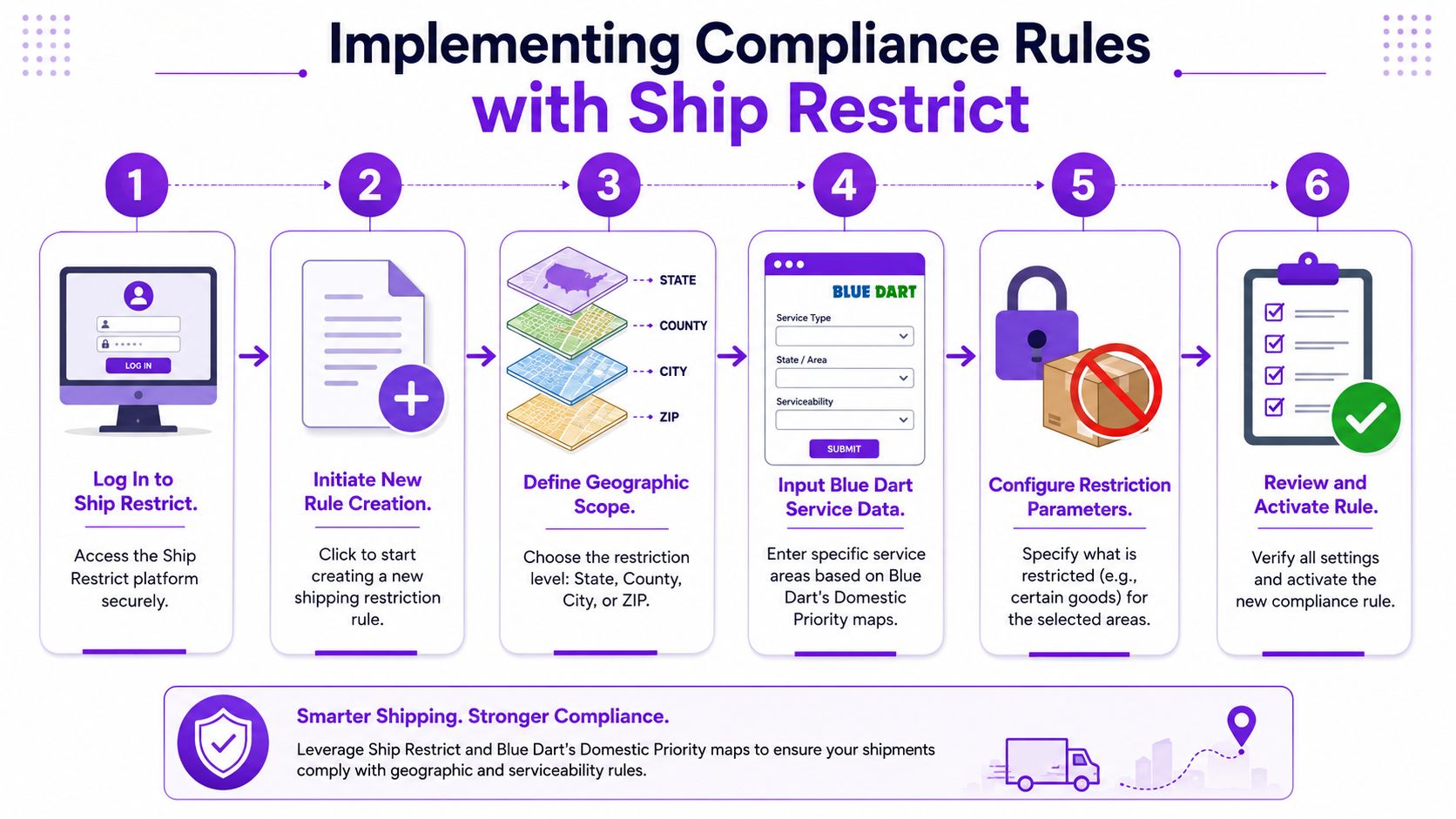
The cleanest way to reduce carrier-level surprises is to stop invalid orders before they enter your fulfillment queue. That means building rules around geography first, then mapping those rules to the shipping methods you allow at checkout.
Start with your smallest reliable rule unit
Some merchants begin with entire states. That's easy, but it's often too broad for regulated shipping. A better approach is to use the smallest rule unit your compliance policy requires.
For example:
- State rules when the regulation applies statewide.
- City rules when a local area needs separate handling.
- ZIP-based rules when the restriction is hyperlocal and broad geography would block valid buyers.
This matters with Blue Dart because carrier coverage and legal eligibility are different maps. Blue Dart may serve an area operationally, but your store may still need to reject that order.
Match shipping methods to rule outcomes
Once your geographic rules are defined, connect them to your WooCommerce shipping logic. If an address falls inside a restricted zone, the safest workflow is to hide or block the Blue Dart option entirely for that order.
A practical setup looks like this:
- Allow approved zones: The customer sees the relevant Blue Dart method.
- Block restricted zones: The carrier option disappears or the order is prevented before completion.
- Show a clear message: Tell the customer why the order can't ship to that location.
That message matters. Customers get less frustrated when the restriction is explained at checkout instead of after payment.
Build a review process your staff can follow
Rules are only useful if your team trusts them. Keep the review process simple enough that warehouse and support staff can use it without interpreting policy from scratch.
Use a short checklist:
- Check the destination class: Approved, restricted, or needs manual review.
- Confirm the product type: Different categories may need different rules.
- Approve the carrier only after the address passes.
- Document exceptions: If a branch or route creates friction, update your rules or internal notes.
For stores that are setting this up for the first time, the Ship Restrict getting started documentation gives a practical onboarding path for rule configuration.
Field note: The goal is not to make checkout stricter than necessary. The goal is to make invalid shipments impossible.
A well-built rule system also protects your support team. They won't need to explain why an order was accepted and then later cancelled due to destination issues. The store makes the decision early, clearly, and consistently.
Real World Examples and Use Cases
The hardest part of regulated shipping is that many problems look small right up until they become expensive. Blue Dart's regional handling quirks make that more important, not less. According to Blue Dart's centralized customer service page context, no existing content clearly analyzes whether regional hubs enforce state-specific restrictions for firearms, and reviews in Mumbai show frustration over unreachable service points. That creates a real compliance blindspot for merchants.
Example one
A Delhi-based merchant selling regulated outdoor equipment noticed a pattern. Orders from certain destination clusters were legal in some cases and questionable in others, depending on the exact locality. The store had been relying on staff memory plus carrier selection during fulfillment.
That process worked until a borderline order reached the packing stage. The team paused the shipment because the destination needed closer review than the checkout flow had provided. The lesson was simple. If staff need to investigate an address after payment, the store accepted the order too early.
Example two
A Chennai merchant with a larger catalog faced a different issue. The addresses were often valid, but support escalations became messy when a shipment exception occurred. The problem wasn't only transit. It was uncertainty about whether a local branch would interpret handling requirements the same way every time.
The merchant changed the process by separating decisions into two lanes:
- Eligibility lane: The store checks whether the destination can receive the product.
- Fulfillment lane: The warehouse selects the approved carrier method only for eligible orders.
That separation reduced confusion inside the team. Support no longer had to untangle compliance questions during delivery exceptions because the core approval had already happened before dispatch.
Regional inconsistency is manageable when your store acts as the first compliance gate instead of the last.
These examples aren't about dramatic rescues. They show a quieter truth. Most regulated shipping failures start as ordinary workflow shortcuts.
Conclusion and Next Steps
Blue Dart Express India is a strong operational option when you need broad domestic reach, structured service levels, and better shipment visibility. For regulated products, though, carrier strength only solves half the problem. Your store still needs to block ineligible destinations before the order enters fulfillment.
Use a simple audit. Review which products need geographic restrictions, decide how specific those rules must be, map approved orders to the right Blue Dart service, and document what your staff should do when support is hard to reach. A compliant shipping flow is usually less about speed and more about sequence.
If you want to turn those checks into automated WooCommerce rules, Ship Restrict helps you block restricted orders by state, county, city, or ZIP before checkout. It's built for regulated products, so your team can stop relying on manual address review and create a cleaner handoff between compliance, checkout, and fulfillment.
Automate Shipping Compliance
Stop worrying about restricted states. Ship Restrict handles it automatically.

Cody Yurk
Founder and Lead Developer of ShipRestrict, helping e-commerce businesses navigate complex shipping regulations for regulated products. Ecommerce store owner turned developer.
Automate Shipping Compliance
- Block restricted states
- No more cancellations
- Set and forget
3-day free trial · Card required