Shipping for Ecommerce: The Complete 2026 Guide
Master shipping for ecommerce in 2026. Our guide covers carriers, rates, fulfillment, returns, and crucial compliance for regulated goods like firearms.
You're probably in one of two situations right now. Either you're launching a store and realizing shipping for ecommerce is more operational than it looks, or you're already selling and finding out that margins disappear fast when packaging, carrier choices, address errors, and returns all hit at once.
Most advice stops at labels, boxes, and “offer free shipping if you can.” That's not enough. It's especially not enough if you sell products that trigger legal restrictions, carrier policy issues, or destination-based bans. In those stores, shipping isn't just a post-purchase task. It's a checkout control, a margin decision, and a compliance function.
The practical way to run shipping is to treat it as a system. Carrier selection, packaging, rate strategy, returns, insurance, and restriction logic all affect each other. If one part is weak, the rest gets more expensive.
The Foundations of Ecommerce Shipping
Shipping has three core building blocks. Carrier, service level, and pricing method. New store owners often mix these together, then end up troubleshooting the wrong problem.
Automate Shipping Compliance
Block orders to restricted states automatically. 3-day free trial.
Start Free TrialA carrier is the company moving the parcel. The service level is how that carrier handles speed, tracking, and delivery commitment. The pricing method is what you charge the customer at checkout.
Choosing the right carrier for the job
For most U.S. ecommerce stores, the working options are USPS, UPS, and FedEx. The right one depends less on brand preference and more on what you're shipping.
- USPS usually fits lightweight parcels, PO Box deliveries, and lower-cost residential shipments.
- UPS often works well for dependable ground movement, stronger business shipping workflows, and better handling of heavier packages.
- FedEx can be a fit when you need service variety, stronger time-definite options, or a carrier your customers already trust for certain product categories.
That doesn't mean one carrier wins across the board. It means each has lanes where it performs better for your catalog. A small accessory, a bulky part, and a high-value regulated item shouldn't automatically go through the same network.
Practical rule: Don't choose a default carrier for your whole store. Choose a default carrier by package profile.
Most stores improve faster when they compare carriers by SKU group. Put your products into buckets like lightweight, fragile, oversized, and restricted. Then test how each carrier behaves for cost, claims handling, scan quality, and delivery consistency.
If you want a broader platform-level perspective, this guide for Shopify Plus merchants is useful because it shows how shipping decisions affect checkout and operations together, not as separate tasks.
Understanding service levels without overcomplicating them
Service levels aren't just “fast” or “slow.” They define what promise you're making and what cost you're willing to absorb.
A practical way to think about them:
| Service question | What it affects | What can go wrong |
|---|---|---|
| How fast does it move? | Conversion and delivery expectations | You overpay for speed customers didn't need |
| How reliable is tracking? | Support tickets and trust | Customers think the order is lost |
| Does it need a signature? | Risk control | High-value items get left unattended |
| Is it residential-friendly? | Final-mile experience | Surcharges or failed delivery attempts |
If you sell standard consumer goods, you can often offer a mix of economy and expedited methods. If you sell regulated or high-risk products, you'll care more about scan visibility, signature workflows, and policy alignment than shaving a day off transit.
Free Shipping Compliance Audit
We'll review your WooCommerce store's shipping compliance for free.
Pricing models work like restaurant menus
Pricing gets easier when you stop treating it as abstract ecommerce jargon.
Think of checkout shipping options like restaurant menus:
- Flat-rate shipping is the prix fixe menu. One known price, simple for the customer, simple for you, but sometimes too high for nearby orders and too low for distant ones.
- Real-time calculated shipping is à la carte. The customer pays based on what is ordered and where it's going. More accurate, but less predictable and more dependent on clean product data.
- Free shipping is the all-you-can-eat offer. Customers love it, but the store is still paying for every parcel somewhere in the margin structure.
That framework matters because shipping for ecommerce is rarely about finding the “best” model. It's about choosing the one your data can support. If your product weights are inconsistent, real-time rates will frustrate customers. If your margins are tight, blanket free shipping can undermine growth.
Mastering Packaging and Fulfillment Models
Once the order is placed, theory stops mattering. The box, the packing bench, the warehouse workflow, and the handoff to the carrier determine whether the shipment is profitable.
Two stores can sell the same item at the same price and get very different results because one has disciplined packaging and the other treats fulfillment as an afterthought.
Fulfillment model choices by business stage
Most stores end up choosing between in-house fulfillment, 3PL, and dropshipping. The right answer depends on how much control you need and what kind of mistakes your business can tolerate.
| Model | Best for | Main advantage | Main drawback |
|---|---|---|---|
| In-house | Early-stage stores, specialized products, regulated goods | Maximum control | Labor-heavy and harder to scale |
| 3PL | Growing stores with steady volume | Operational scale | Less direct oversight |
| Dropshipping | Catalog expansion, low inventory risk | Low upfront inventory commitment | Weakest control over packaging and service |
In-house fulfillment gives you the tightest grip on packaging quality, order review, and exception handling. That matters for fragile products, premium branding, and anything that needs special shipment logic. If an order might require a manual compliance review, owning the pick-pack process helps.
A 3PL works when order volume starts to outrun your internal team. The trade-off is simple. You gain labor capacity and shipping throughput, but you lose some flexibility. Custom inserts, unusual pack-outs, and edge-case product handling often become slower to change.
Dropshipping is easy to start and hard to perfect. It can work for low-risk goods, but it creates distance between your storefront promise and the actual shipment. That's a dangerous setup if your products have destination restrictions, carrier limitations, or packaging requirements you need enforced consistently.
Packaging decisions that affect margin
Packaging isn't only about protection. It also controls cost.
The mistake I see most often is using a box that's convenient for the warehouse instead of correct for the order. That raises shipping costs, wastes void fill, and creates dimensional weight problems. Even when the product is light, a badly sized carton can price like a much heavier shipment.
Use a simple packaging discipline:
- Define a standard package for every core SKU. Don't let staff improvise the box size on common orders.
- Create fallback packages for multi-item orders. Bundles need their own packaging logic.
- Match dunnage to product risk. Fragile items need protection. Durable items usually don't need premium filler.
- Test the package in motion. A package that survives the packing table can still fail in carrier handling.
A good package protects the item, controls postage, and doesn't waste labor. If it only does one of those things, it isn't a good package.
Branding matters, but not before operational discipline
A memorable unboxing experience can help retention. Custom tape, inserts, printed boxes, and product education cards all have value. But none of that matters if the order arrives damaged, late, or packed in a way that inflates your shipping bill.
For stores selling regulated goods, restraint usually beats decoration. Clean packaging, correct documentation, and dependable pack-out rules matter more than theatrics. Customers remember smooth delivery and competent handling longer than they remember tissue paper.
Developing a Profitable Shipping Rate Strategy
Most store owners encounter a common dilemma. Customers want shipping to feel cheap or free. The business still has to pay the bill.
That pressure isn't theoretical. The global parcel delivery market is projected to reach $538 billion in 2026, with last-mile delivery consuming 53% of total shipping costs, and 88% of consumers choosing free shipping over fast shipping when given the choice according to 2026 ecommerce shipping data compiled by Ringly. That's the core tension in shipping for ecommerce. Buyers want lower visible shipping costs while the most expensive part of delivery keeps getting harder to absorb.
A simple visual helps frame the decision:
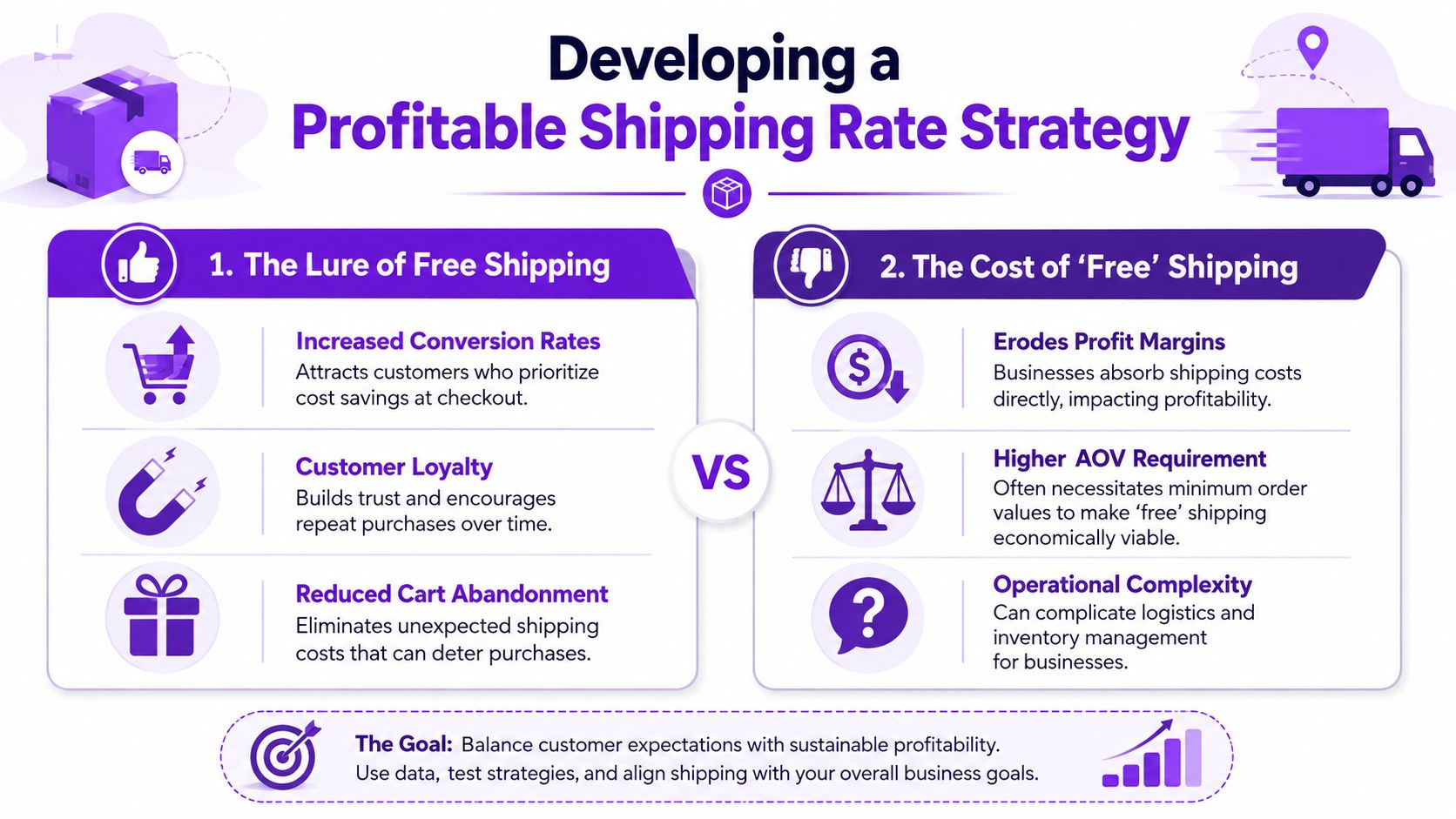
Free shipping works, but only when you define where it's paid for
“Free shipping” isn't a strategy by itself. It's a presentation layer. The actual strategy is where you recover the cost.
There are only a few honest ways to do it:
- Build it into product margin. Best when margins are healthy and package profiles are predictable.
- Set a minimum order threshold. This pushes customers toward larger carts.
- Limit it by geography or method. Offer it only where your cost exposure stays manageable.
- Restrict it to selected products. Useful when some SKUs are compact and others are expensive to move.
The weakest version is storewide free shipping with no threshold, no exclusions, and no package discipline. That usually looks customer-friendly at first and turns into a margin leak later.
Use zones and handling logic together
Shipping zones are the cleanest way to charge more fairly based on destination. They keep nearby orders from subsidizing faraway ones too aggressively, and they give you room to create sensible pricing bands.
Handling fees solve a different problem. They cover the work around the shipment, not just the postage. Box cost, tape, dunnage, labor, signature workflow, and document prep all belong in your internal shipping math even if you don't label them that way to the customer.
Here's a practical framework:
| Store condition | Better rate approach |
|---|---|
| Small catalog, similar package sizes | Flat-rate shipping |
| Wide catalog, weight differences, varied destinations | Real-time or table rate shipping |
| Strong margins, high competition | Threshold-based free shipping |
| Regulated or exception-heavy orders | Rate logic plus explicit handling coverage |
For merchants who need more control than simple flat-rate rules, table rate shipping in WooCommerce is often the middle ground between oversimplified pricing and full carrier-calculated complexity.
Video walkthroughs can also help when you're setting policy and trying to avoid common setup mistakes:
<iframe width="100%" style="aspect-ratio: 16 / 9;" src="https://www.youtube.com/embed/gkPnQngCLNA" frameborder="0" allow="autoplay; encrypted-media" allowfullscreen></iframe>What usually works in practice
The healthiest shipping policies are blended, not pure.
A store might offer free shipping above a target order value for compact items, flat-rate shipping for standard orders, and calculated or table-based pricing for oversized or regulated products. That sounds more complex than it is. Customers don't need your internal math. They just need shipping options that feel consistent and fair.
Operational note: If your rates surprise customers, check packaging data first, not just checkout settings. Bad weights and dimensions break good pricing strategies.
Managing Returns and Shipping Insurance
Returns are the part of shipping most stores tolerate instead of managing well. That's a mistake. A messy return process creates support load, refund disputes, and repeat-purchase damage.
A clear return policy does the opposite. It reduces friction before the customer buys and reduces arguments after the order arrives.
Build a return policy that operations can actually follow
Start with the operational questions, not the legal template.
- Return window: Pick a timeframe your team can administer consistently.
- Item condition: Define what counts as resellable, defective, opened, or final sale.
- Refund method: Decide when you issue the original payment back and when store credit makes more sense.
- Return shipping responsibility: Be explicit about who pays in cases of remorse, exchange, damage, or fulfillment error.
- Exceptions: Regulated, hazardous, personalized, and high-risk items often need separate return rules.
The policy should match what your warehouse and support team can do without improvising. If the rule on the site doesn't match the actual workflow, customers find the gap quickly.
Insurance is not the same as carrier liability
Many store owners assume carrier coverage fully protects every shipment. It often doesn't. What the carrier offers and what your business needs can be two different things.
If you want a clean explanation of that gap, this resource helps understand cargo insurance, especially if you're sorting out where carrier responsibility ends and broader protection begins.
A simple way to assess insurance needs is to ask four questions:
- Is the item expensive enough that one loss hurts cash flow?
- Is the item fragile or theft-prone?
- Does the shipment require signatures or extra documentation?
- Would replacing it trigger compliance work, inventory issues, or customer escalation?
If the answer is yes to several of those, supplemental coverage often makes sense. For stores shipping sensitive inventory, this guide on shipping insurance for high-risk ecommerce products is a useful next step because it looks at insurance as part of operational risk control, not just claims paperwork.
Insurance should protect the business from a bad transit event. It shouldn't be a substitute for better packaging, better carrier selection, or better order review.
Make the unhappy path feel organized
Customers can tolerate a return. They rarely tolerate confusion.
Good returns operations usually include a clear authorization process, a visible status trail, and predefined inspection rules when the package comes back. If your team decides refunds case by case with no structure, return handling becomes subjective, slow, and expensive.
Navigating Compliance for Regulated Goods
This is the part most shipping guides skip, and it's the part that causes the most expensive mistakes.
If you sell regulated goods such as firearms, shipping isn't just fulfillment. It's legal execution. The package can be physically packed correctly and still create a serious problem if the destination is restricted, the receiving party is wrong, the carrier policy isn't followed, or the product classification data is sloppy.
For new merchants, the first hard lesson is that compliance doesn't sit in one place. It's layered.
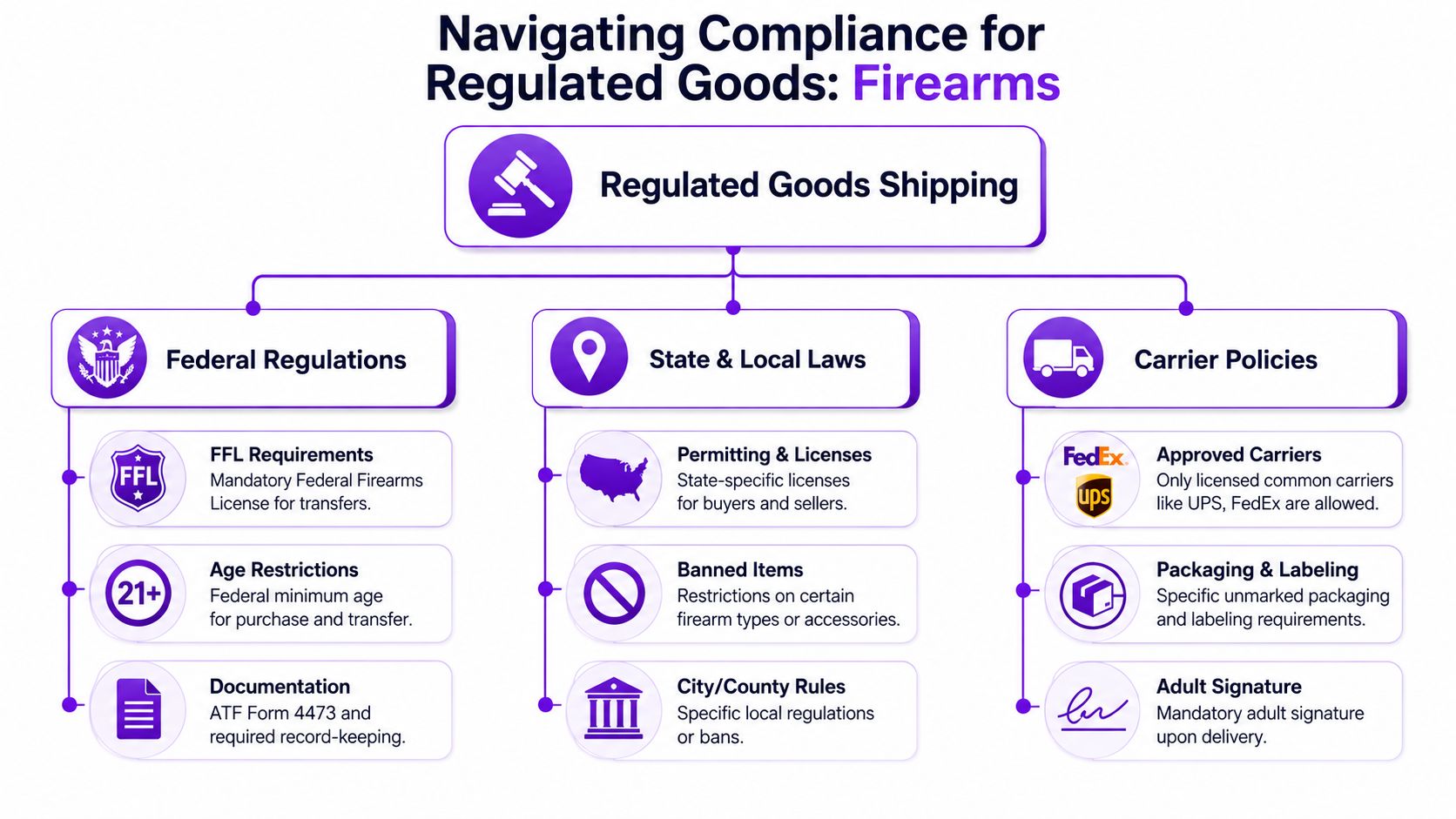
Three rule systems control the shipment
You have to satisfy all three at the same time:
| Layer | What it governs | Why merchants get caught |
|---|---|---|
| Federal rules | Licensing, transfer structure, documentation | They assume state approval is enough |
| State and local restrictions | Product legality, buyer requirements, destination limits | They check state law but miss county, city, or ZIP-level restrictions |
| Carrier policy | Acceptance standards, packaging, service conditions, signature requirements | They treat carrier rules like suggestions instead of shipment conditions |
That's why manual compliance often breaks. A staff member checks one rule set, misses another, and the order moves forward because the checkout system didn't block it.
Manual address checks don't hold up
A lot of stores still rely on spreadsheets, memory, or a final review by a staff member before label creation. That approach might feel cautious, but it fails under routine ecommerce conditions. Orders come in after hours. Staff interpret rules differently. A restricted ZIP code gets overlooked because the state itself isn't banned.
The gap is especially serious for WooCommerce merchants handling regulated products. The underserved area is state-by-state and ZIP-code-level restriction automation, and a 30% increase in penalties for non-compliant firearm shipments is tied to outdated address-check methods, according to ShipperHQ's discussion of restricted shipping compliance.
That matters because the error doesn't start at the shipping label. It starts at checkout, when the store accepts an order it should never have taken.
The safest restricted shipment is the one the store blocks before payment is completed.
Classification mistakes are not “paperwork issues”
Cross-border and regulated shipping add another risk layer. Product classification and export eligibility need to be correct before the order moves into fulfillment.
Validating HS codes and export eligibility at the moment of order creation is the most effective checkpoint because fixing classification errors after dispatch creates rework, customs delays, and potential penalties, as noted in ParcelPlanet's compliance guidance.
The practical takeaway is simple. If a product has legal shipping constraints, the store must validate destination, buyer path, and product classification before anyone prints a label. Doing those checks late turns a preventable checkout problem into a fulfillment and legal problem.
Why regulated goods need a different mindset
Standard ecommerce shipping asks, “How do we deliver this quickly and cheaply?” Regulated ecommerce adds a harder question: “Should this order proceed at all?”
That changes everything. Your product data has to be cleaner. Your checkout logic has to be stricter. Your staff can't improvise. Carrier selection becomes policy-sensitive. Customer messaging needs to explain restrictions clearly enough to reduce failed checkouts and support friction.
The merchants who get this right don't treat compliance as a final review step. They treat it as infrastructure.
Automating Shipping Rules with WooCommerce Tools
Once the rule set gets too complex for memory, automation stops being a convenience and becomes the only stable way to operate. That's especially true in WooCommerce, where many stores start with flexible checkout tools but later realize flexibility alone doesn't enforce shipping law or carrier restrictions.
The useful way to think about automation is as a rule engine. You define conditions. The system evaluates the cart, address, and product mix. Then it allows, blocks, or modifies the shipping options before the order turns into a fulfillment task.
What a shipping rule engine should handle
For regulated or high-risk catalogs, a basic rule engine should cover several layers at once:
- Destination controls: Block or allow by state, county, city, or ZIP code.
- Product-based logic: Apply different rules to firearms, accessories, components, or general merchandise.
- Method restrictions: Hide shipping methods that shouldn't appear for certain products or destinations.
- Customer messaging: Explain why a checkout option is blocked instead of creating a dead-end error.
- Admin usability: Let staff update rules without editing code or relying on memory.
Many generic plugins often fall short. They can add rates or tweak methods, but they don't always translate legal restrictions into enforceable checkout behavior.
A visual example makes the concept tangible:
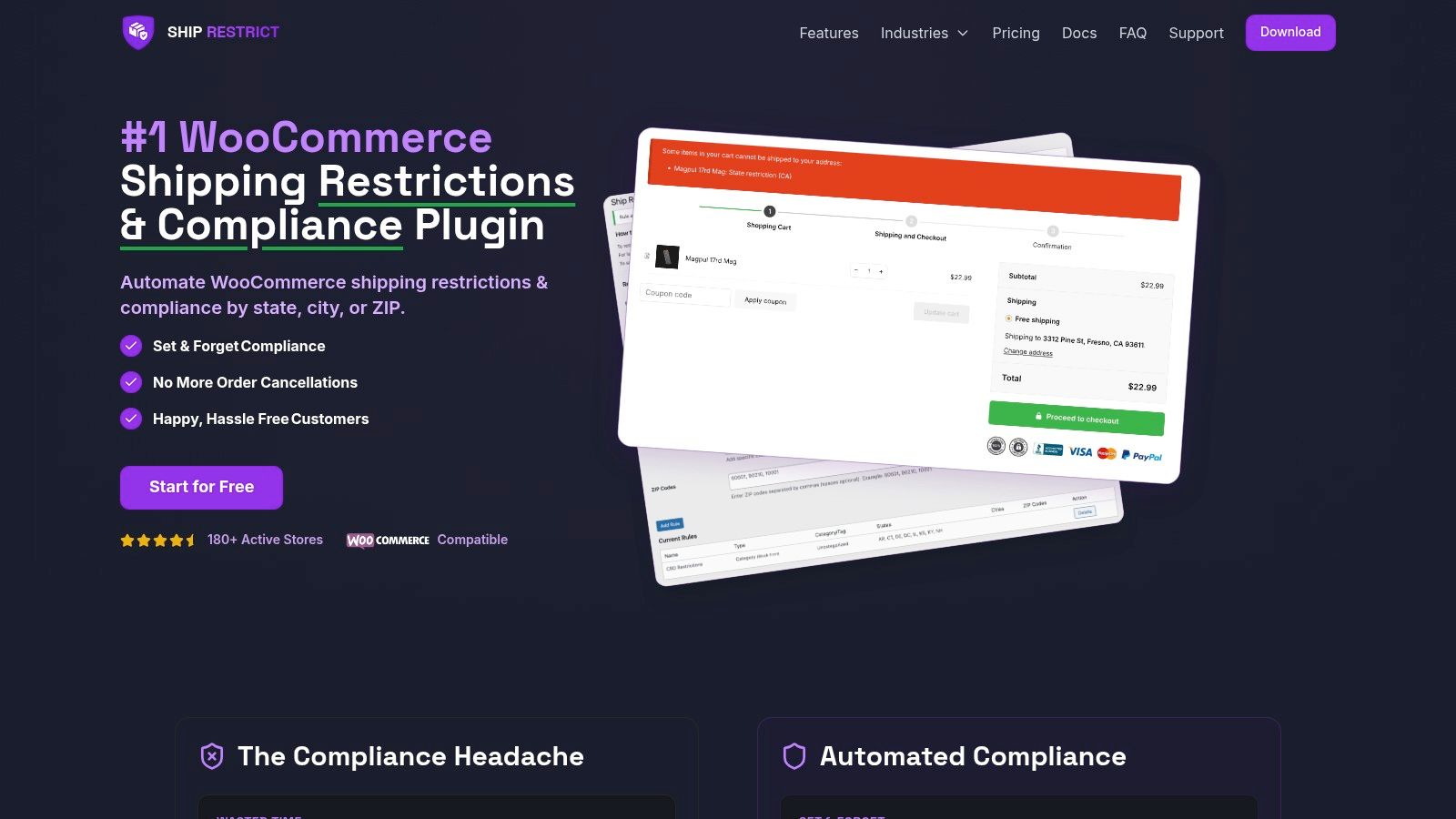
What good automation changes operationally
The biggest win isn't only speed. It's consistency.
Without automation, one employee may flag a destination and another may miss it. One product may be tagged correctly and another nearly identical item may be left out of the restriction process. That's how stores drift into uneven enforcement.
With the right setup, the workflow changes:
- A shopper adds a regulated product to cart.
- The store evaluates the delivery address against location rules.
- The system checks which shipping methods should appear.
- The customer sees only compliant options, or a clear restriction message.
- Staff no longer need to perform repetitive manual destination checks on every order.
That shift moves compliance earlier. It also reduces the ugly middle state where a customer pays, your team reviews later, and then support has to explain why the order can't ship.
For merchants researching this category, this guide to shipping software for creators is helpful as a broader comparison lens, even though regulated-goods merchants usually need more restrictive logic than the average brand.
Mobile and cross-border pressure make rule clarity more important
This isn't just a desktop checkout issue. Cross-border ecommerce is expanding at nearly twice the rate of domestic ecommerce, and mobile commerce accounts for nearly 59% of total online retail sales entering 2026, according to Mayple's cross-border ecommerce roundup. That's why shipping restriction tools need mobile-friendly behavior. If a rule works technically but creates a confusing mobile checkout experience, customers abandon the order or flood support.
That pressure is one reason merchants are moving toward more structured automation. This overview of automated shipping compliance for WooCommerce stores is useful if you're comparing manual reviews against rule-based enforcement.
Field insight: A restriction that triggers after payment creates customer service work. A restriction that triggers during checkout creates clarity.
What doesn't work
A few things consistently fail in regulated shipping operations:
- Relying on staff memory for destination restrictions
- Keeping ZIP restrictions in static documents that nobody updates cleanly
- Using generic shipping plugins that can price shipments but can't stop prohibited ones
- Writing vague error messages that leave the buyer unsure what happened
- Reviewing risky orders only after they've entered fulfillment
The stores that stay stable build shipping logic into checkout itself. That's the operational difference between “we try to catch mistakes” and “the system prevents them.”
Your Ecommerce Shipping Operations Checklist
Most shipping problems don't come from one big mistake. They come from ten small unchecked settings that stack up. The easiest way to tighten your operation is to review shipping like a pre-flight process.
Print this checklist. Use it before launch or during your next shipping audit.
Core setup checks
- Carrier accounts are active: Confirm the services you plan to offer are enabled and tested.
- Each SKU has usable shipping data: Weight, dimensions, and package assumptions need to be complete.
- Packaging rules are documented: Staff should know which box or mailer fits each standard order type.
- Labels and documents are automated: Don't rely on copying addresses or manual form creation where automation is available.
- Tracking notifications are turned on: Customers should get shipping updates without contacting support.
Commercial policy checks
Review these like a merchant, not just an operator.
| Policy area | Confirm before going live |
|---|---|
| Shipping rates | They cover your likely cost profile and don't create obvious margin loss |
| Free shipping rules | Thresholds, exclusions, and applicable products are clearly defined |
| Delivery methods | Economy, standard, and premium options reflect what you can consistently fulfill |
| Returns | The policy matches warehouse reality and customer communication |
| Insurance | High-risk products have a defined protection standard |
Compliance checks for regulated catalogs
If you sell restricted items, this part can't be informal.
- Map products to restriction groups: Don't assume every item in a category follows the same rules.
- Check destination logic: State-level rules are not enough if county, city, or ZIP restrictions apply.
- Verify product classification data: If the shipment needs codes or export review, validate that before fulfillment.
- Test blocked scenarios: Run checkout tests using restricted addresses to confirm the order is stopped.
- Review customer-facing messages: Buyers should understand why shipping isn't available.
Good compliance messaging reduces cancellations and support tickets because the customer sees the restriction before they expect delivery.
Three common shipping errors to fix first
-
Rates look wrong at checkout
Start with weight, dimensions, package settings, and zone logic. Bad product data breaks otherwise correct shipping rules. -
Orders reach fulfillment that shouldn't ship
Move checks earlier. If the system waits for human review after payment, you've already created avoidable risk. -
Customers are confused by blocked shipping options
Replace vague notices with plain language. Tell them the item can't ship to that destination or requires a different fulfillment path.
The standard worth aiming for
A strong shipping operation feels boring in the best way. Orders route correctly. Rates are defensible. Packaging is repeatable. Returns are understandable. Restricted products are controlled before they become shipment problems.
That's what good shipping for ecommerce looks like in practice. Not flashy. Just disciplined.
If your WooCommerce store sells firearms or other restricted products, Ship Restrict helps you enforce shipping rules by state, county, city, and ZIP code before checkout is completed. It's built for merchants who need to replace manual address checks with consistent automated compliance, reduce avoidable order cancellations, and keep regulated shipping manageable as the store grows.
Automate Shipping Compliance
Stop worrying about restricted states. Ship Restrict handles it automatically.

Cody Yurk
Founder and Lead Developer of ShipRestrict, helping e-commerce businesses navigate complex shipping regulations for regulated products. Ecommerce store owner turned developer.
Automate Shipping Compliance
- Block restricted states
- No more cancellations
- Set and forget
3-day free trial · Card required