A WooCommerce Guide To The Washington Assault Weapon Shipping Ban
Understand how the Washington assault weapon shipping ban (HB 1240) impacts your WooCommerce store and learn how to stay compliant with automated solutions.
When Washington passed House Bill 1240, it didn't just tweak the rules for online firearms retailers—it completely upended them overnight. This wasn't some gradual policy shift with a long runway for businesses to adapt. The Washington assault weapon shipping ban was an immediate, sweeping prohibition that became one of the most significant state-level regulations we've seen in years.
The law hit like a lightning strike. One day, business was as usual; the next, a whole category of firearms was illegal to import, distribute, or sell within the state.
What Washington HB 1240 Actually Does
At its core, HB 1240 is designed to stop the flow of newly manufactured or distributed firearms defined as "assault weapons" into Washington. For anyone running a WooCommerce store, this means your legal responsibility now extends far beyond just refusing a sale to a Washington resident. You are legally barred from shipping or importing these specific items into the state for any commercial reason.
That includes sending inventory to an FFL partner in Washington. The moment Governor Inslee signed the bill, the game changed for everyone.
Automate Shipping Compliance
Block orders to restricted states automatically. 3-day free trial.
Start Free TrialThe Immediate Fallout for Retailers
On April 25, 2023, Washington became the 10th U.S. state to enact a broad ban on the sale and shipment of many common semiautomatic rifles. The law took effect the very same day it was signed, creating an instant compliance crisis for eCommerce businesses nationwide. You can find more background on how this reshaped gun policy in the state over at InvestigateWest.org.
This zero-day effective date meant any orders for restricted firearms already in the pipeline suddenly became illegal to fulfill. It was a stark reminder of a growing regulatory trend we've seen in other states. If this sounds familiar, you might want to read our analysis on the Connecticut assault weapon parts shipping ban, which followed a similar pattern.
HB 1240 At-a-Glance Compliance Checklist
To cut through the legal jargon, here's a quick reference table breaking down what this law means for your day-to-day operations. It clarifies what's off-limits versus what's still permitted for your online store.
| Action | Status Under HB 1240 | eCommerce Implication |
|---|---|---|
| Shipping a defined "assault weapon" to WA | Prohibited | You must block all sales and shipments of these items to Washington addresses. |
| Selling a compliant firearm (e.g., bolt-action rifle) | Permissible | Your store can continue to sell and ship firearms not covered by the ban. |
| Importing banned firearms into WA for sale | Prohibited | You cannot transfer inventory of these items to an FFL partner in Washington. |
| Distributing parts to assemble an assault weapon | Prohibited | Selling "kits" from which a banned firearm can be built is also illegal. |
This checklist should help you quickly assess which parts of your product catalog are affected by these new rules and where you need to implement immediate shipping blocks.
How To Identify a Banned Firearm Under HB 1240
To safely navigate Washington's assault weapon shipping ban, you first have to understand what the state considers an "assault weapon" under House Bill 1240. This isn't as simple as checking a brand name. Instead, the law uses a feature-based definition, meaning a firearm’s legality comes down to its specific parts and characteristics.
Think of it like a recipe. A cake isn't just a cake; its identity comes from its ingredients—flour, sugar, eggs. Similarly, a semiautomatic rifle isn't banned by its model name alone but by its "ingredients" or features. If a semiautomatic rifle accepts a detachable magazine and has just one specific feature from a banned list, it’s classified as a prohibited assault weapon in Washington.
This flowchart boils the decision-making process down to its simplest form.
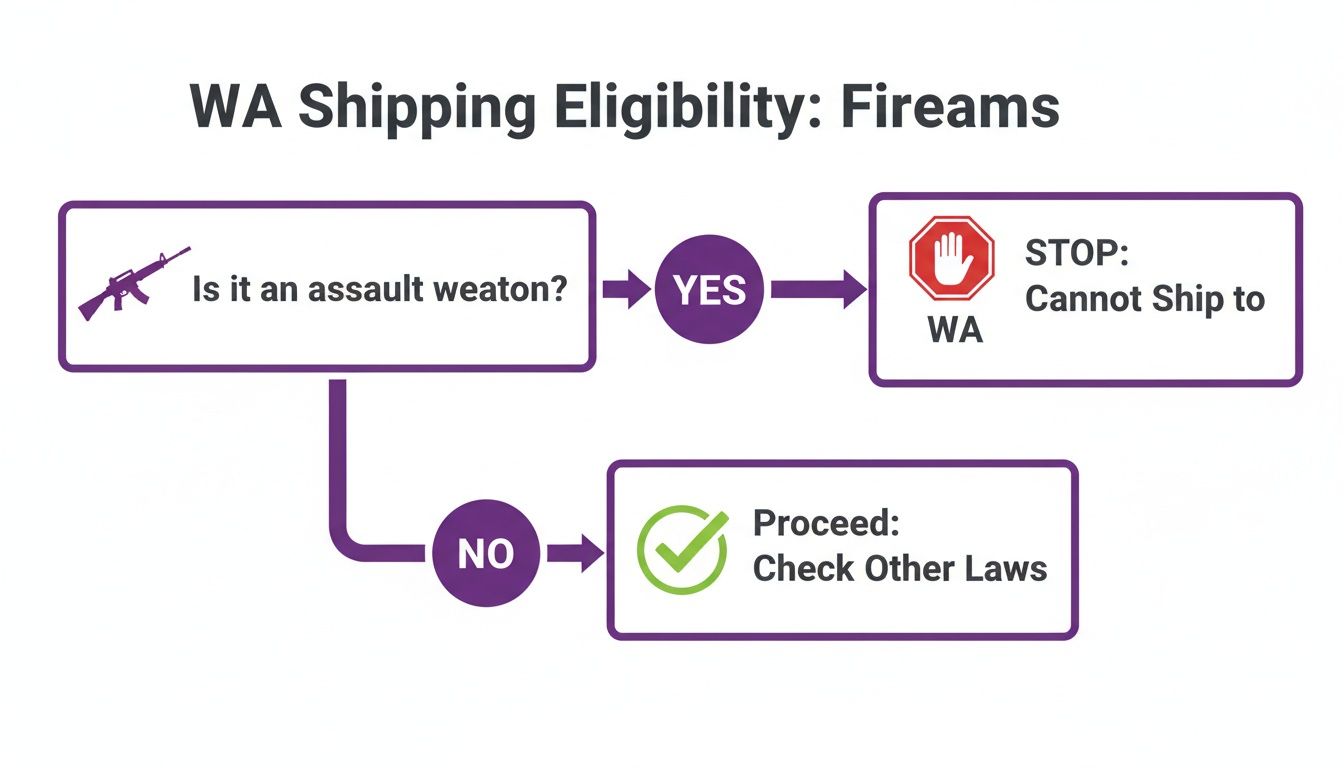
As the graphic shows, the first and most critical question you have to answer is whether the product meets the state’s definition of an "assault weapon." That single factor determines if it's eligible to ship.
Free Shipping Compliance Audit
We'll review your WooCommerce store's shipping compliance for free.
The Feature-Based Test for Semiautomatic Rifles
So, how do you know if a semiautomatic rifle is banned? You have to check it for at least one of the following characteristics. This is the practical checklist every FFL needs to run through.
- A stock that is folding or telescoping. This covers stocks that can collapse or fold, making the rifle shorter and easier to conceal.
- A pistol grip. This refers to a grip that protrudes conspicuously beneath the action of the weapon.
- A thumbhole stock. This is a stock with an opening that allows the shooter's thumb to pass through it.
- A forward grip. This includes any grip, like a vertical or angled foregrip, meant for the non-trigger hand.
- A flash suppressor or threaded barrel. Any device designed to reduce muzzle flash or a barrel threaded to accept one.
- A grenade launcher or flare launcher. Any attachment designed for launching grenades or flares.
If a semiautomatic rifle has a detachable magazine and any single feature from this list, you cannot legally ship it to Washington. This strict, one-strike approach is the foundation of the state's ban.
Beyond Rifles: What Else Is Covered?
While semiautomatic rifles get a lot of attention, the scope of HB 1240 is much broader. The law also explicitly bans over 60 specific firearm models by name, including the AK-47 and AR-15 in all their forms.
The law's reach extends beyond just rifles. It also reclassifies certain pistols and shotguns as assault weapons based on similar feature tests, making a complete inventory audit non-negotiable for compliance.
For example, a semiautomatic pistol with a detachable magazine is banned if it also has a threaded barrel, a second handgrip, or a barrel shroud. A semiautomatic shotgun is banned if it comes with features like a folding stock or a pistol grip.
This layered definition—a list of banned-by-name firearms plus a detailed feature test—creates a tricky compliance landscape. It forces retailers to look past the product title and SKU and analyze the actual physical attributes of every firearm in their catalog before even thinking about shipping to a Washington address.
How The Ban Impacts Your Shipping and Operations
Knowing the technical definitions in Washington's new law is one thing. Actually translating those legal rules into your day-to-day operations is a completely different ballgame. One mistake isn't just a simple shipping error—it's a direct violation of state law with some very real teeth.
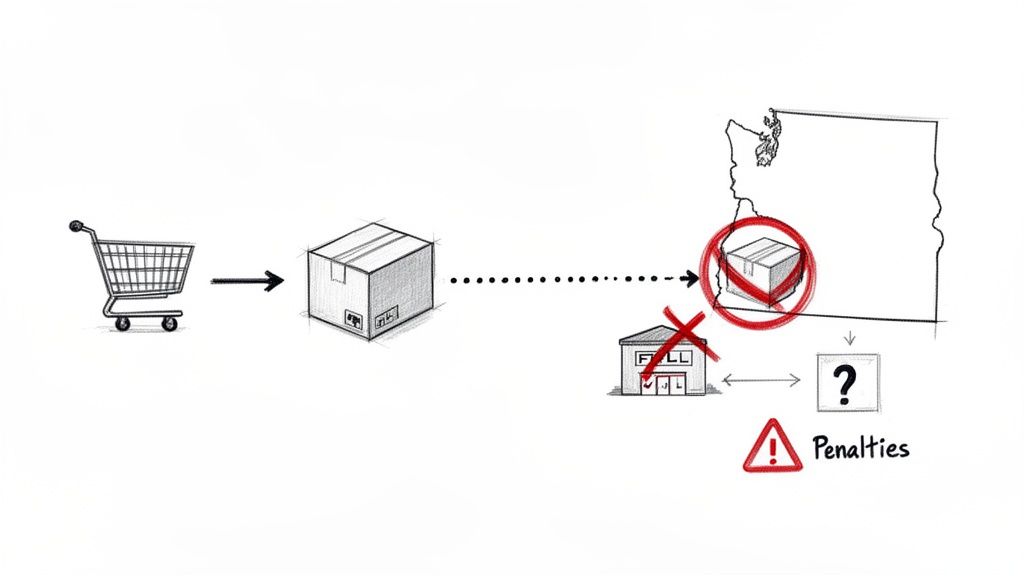
Think about your standard order process. A customer in Seattle adds a popular semi-automatic rifle to their cart. They pop in their Washington shipping address, choose their local FFL for the transfer, and hit "place order." In the past, your team would just verify the FFL's license and ship it out. Today, that entire process is dead on arrival.
Under HB 1240, you're flat-out prohibited from importing or distributing these firearms into the state for sale. That means you can't ship a newly purchased, banned firearm to a Washington-based FFL for a customer. The transaction is illegal from the moment the order is placed.
Navigating Returns and Legal Risks
And the headaches don't stop with new sales. Handling something as routine as a return or repair has become a legal minefield. While the law has some very narrow exceptions for sending a firearm back to its legal owner, the burden of proof is entirely on you. You'd need ironclad documentation proving the customer legally owned that specific firearm before the ban even started.
The penalties for getting this wrong are severe, designed to make sure the Washington assault weapon shipping ban is taken seriously.
A violation of HB 1240 is classified as a gross misdemeanor. That can mean hefty fines, potential jail time, and—most critically for your business—putting your Federal Firearms License (FFL) at risk.
The financial and legal exposure from a single slip-up is huge. It's why many national retailers have simply stopped shipping these firearms to Washington altogether, even for legacy repairs. The risk just isn't worth the reward. It's no secret where this motivation comes from. Legislators often point to statistics like those from the 1994–2004 federal ban, during which mass-shooting fatalities were 70% less likely to occur, fueling state-level action. The Giffords Law Center has more insights on the data driving these policies.
Why Manual Order Checks Fail
Relying on your team to manually check every single Washington order against a growing list of banned models and features is just not a sustainable strategy anymore. It’s slow, it’s wide open to human error, and it leaves your business dangerously exposed. All it takes is one busy afternoon or a moment of distraction for a prohibited order to slip through the cracks. For a deeper dive into the broader complexities of FFL shipping, check out our guide on FFL dealer shipping restrictions and how to set them up in WooCommerce. This new regulatory landscape demands a more reliable, automated approach to protect your operations and your FFL.
Why Manual Compliance Is No Longer An Option
<iframe width="100%" style="aspect-ratio: 16 / 9;" src="https://www.youtube.com/embed/m6RPjjuLjJA" frameborder="0" allow="autoplay; encrypted-media" allowfullscreen></iframe>Trying to manually enforce the Washington assault weapon shipping ban is like asking your best sales guy to also be a full-time constitutional lawyer. It's a recipe for disaster, and the stakes are just too high to get it wrong. In this new regulatory climate, "manual compliance" isn't a strategy—it's a liability waiting to happen.
Think about a busy Monday morning. Orders are flooding in. Your sales manager is already slammed with inventory questions and customer calls. Now, on top of all that, they have to stop and cross-reference every single order against a clunky spreadsheet of banned SKUs and a map of Washington ZIP codes.
An order pops up from Tacoma. Is that specific rifle on the restricted list? What about that lower parts kit for a customer in Spokane? Is that covered, too?
Every single check eats up precious time that should be spent growing the business. More importantly, it’s a process practically begging for human error. One simple slip-up—a misread SKU, a moment of distraction—and you've just sent an illegal shipment across state lines.
The Hidden Costs of Human Error
The direct penalty for a violation is bad enough—we're talking hefty fines and even losing your FFL. But it’s the hidden costs, the ones that slowly bleed your business dry, that can be just as damaging.
- Wasted Payroll: Every minute your team spends double-checking spreadsheets is a minute they aren't making sales, running marketing campaigns, or helping customers. That lost productivity adds up fast.
- Angry Customers: Nothing sours a customer relationship faster than accepting their order, taking their money, and then having to cancel it a day later because of a compliance mistake. That leads to chargebacks, bad reviews, and lost repeat business.
- Massive Legal Exposure: This is the big one. A single compliance failure puts you in serious legal and financial jeopardy. "Oops, it was an accident" won't hold up as a defense when regulators come knocking.
The breaking point for manual compliance is when the cost of doing it—in wasted time, immense risk, and missed opportunities—is far greater than the cost of a rock-solid automated solution. For most dealers, that day arrived the moment HB 1240 was signed.
Here's a look at how Ship Restrict gives you a simple, clean interface for setting up and managing these rules automatically.
The dashboard turns an otherwise complex and nerve-wracking manual chore into a straightforward task, letting you define exactly what products are blocked from which locations.
Automation Is Now a Necessity
Let's be blunt: manual processes are completely unsustainable when you're up against laws as complex as the Washington assault weapon shipping ban. They are inefficient, unreliable, and they expose your business to a level of risk that is simply unacceptable.
The only scalable and secure way forward is automation. By using a tool built for this exact purpose, you take human error out of the equation and guarantee every single order is automatically checked against the latest regulations. This isn't just about being more efficient. It's about protecting your FFL and ensuring your business can survive and thrive in a tough legal environment.
Automating Compliance With A Shipping Rules Plugin
Manual compliance checks are a dangerous bottleneck. They waste time and expose your FFL to massive legal risk with every single order you process. The only truly safe and scalable way to handle the Washington assault weapon shipping ban is with automation. This is where a dedicated shipping rules plugin for WooCommerce becomes less of a convenience and more of a business necessity.
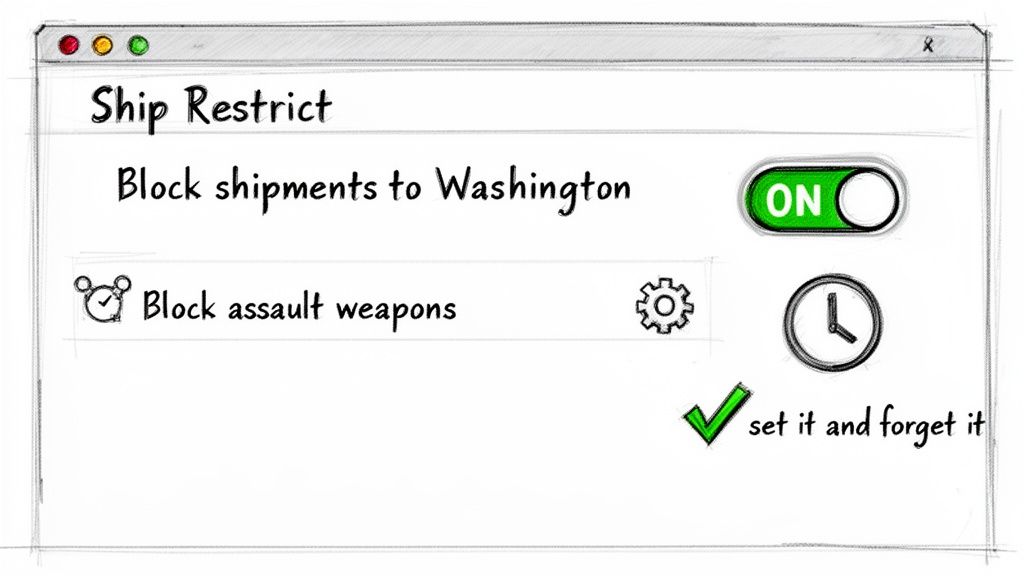
Think of a plugin like Ship Restrict as a digital compliance officer working for you 24/7. It doesn’t get tired, it doesn’t get distracted, and it doesn't make mistakes. Its only job is to enforce the specific shipping rules you set up, acting as a gatekeeper right at your checkout.
Instead of your team manually sifting through orders, the plugin does the heavy lifting in an instant. A customer from Washington tries to buy a restricted firearm, and the system automatically blocks the sale before it’s even completed. This "set it and forget it" approach turns a daily chore into a one-time setup.
Building Your Digital Defense
Creating a rule to block banned firearms is a surprisingly simple process. You can lock down a store-wide policy in just a few minutes, giving you immediate protection against accidentally violating Washington state law.
Here’s a quick breakdown of how it works:
- Create a New Restriction: First, you define a new rule specifically for Washington. You can apply it to the entire state, so no address slips through the cracks.
- Assign Products: Next, you tell the plugin which products the rule applies to. You can select individual SKUs or, far more efficiently, apply the restriction to entire product categories you’ve tagged as "Assault Weapons" or "Washington Restricted."
- Set a Custom Message: Finally, you write a clear, helpful message for customers. This note explains why their order can't be completed, citing state shipping restrictions. That kind of transparency is key for good customer relations and keeps abandoned carts from becoming frustrated support tickets.
Once saved, this rule is your instant shield. It protects your FFL, saves countless hours of manual work, and makes sure you’re fully compliant with the complex demands of HB 1240.
A purpose-built shipping plugin eliminates the single greatest point of failure in compliance—human error. It automates the decision-making process, guaranteeing that your store adheres to the law on every transaction, without exception.
This level of automation is critical for any FFL dealer selling online. For anyone wanting a deeper dive into the benefits, our guide to automated shipping compliance for WooCommerce stores has more insights. If your business needs a solution beyond off-the-shelf plugins, understanding the world of outsourcing custom software development can open up new possibilities. Ultimately, automation gives you the peace of mind to focus on what you do best: running your business.
Common Questions About The Washington Shipping Ban
Trying to understand the ins and outs of the Washington assault weapon shipping ban can feel like a headache waiting to happen. For FFLs running a WooCommerce store, the day-to-day questions are what matter most. Here are some direct, practical answers to the concerns we hear about all the time.
Does The Ban Apply To Shipping Parts And Accessories?
This is where a lot of the confusion comes in. While HB 1240 obviously targets complete firearms, its language is written broadly enough to ensnare parts and kits that could be used to assemble a banned weapon. This is a huge minefield for online sellers.
For instance, selling a standalone pistol grip is probably fine. But what about selling that exact same grip in a "lower parts kit" alongside a stripped receiver? That could easily be interpreted as distributing the components to build a prohibited firearm.
You have to look at your entire catalog, not just the firearms section. Every individual part and every combination kit needs to be evaluated for this gray area.
The only safe way forward is to restrict any part or kit specifically marketed for building or converting a firearm into a configuration that’s now illegal in Washington. A simple mistake with a parts kit carries the same legal weight as shipping a complete, banned rifle.
What If A Customer Is An Exempt Law Enforcement Officer?
The law does have carve-outs for sales to law enforcement agencies and active-duty military personnel who are purchasing for official use. The problem is, this is almost impossible to verify safely and securely through a standard eCommerce checkout.
Relying on a customer to just check a box or upload a photo of their credentials is a massive compliance risk. The potential for fraud is incredibly high, and the legal burden to verify that person's identity and active status falls squarely on you, the seller.
The most effective, risk-averse strategy is to simply block all online sales of restricted items to Washington addresses. Any legitimate agency purchases should be handled through a completely separate, manual process where you can confirm credentials directly with the department before an order is even placed.
Can I Ship A Firearm Back To Washington After Repairs?
This is one of the thorniest situations under the new law. On paper, the statute might permit returning a legally owned firearm to its owner after service. In practice, the logistical and legal hurdles are enormous.
To be compliant, you'd need indisputable proof that the customer legally possessed that exact firearm—by serial number—before the ban went into effect on April 25, 2023. This means having meticulous, pre-ban documentation that most retailers just don't have for firearms that have been in circulation for years.
Because the legal risk is so high and proving prior ownership is so difficult, many FFLs have simply adopted a blanket policy: they no longer ship any of these items to Washington, even for repairs, to avoid any possibility of a legal battle.
How Can I Quickly Update My Store To Comply With The Ban?
The fastest and most reliable way to get compliant is with an automated shipping rules plugin. You can lock down your store in just a few minutes by creating a new restriction that applies to the entire state of Washington.
From there, you just assign the specific products or categories banned under HB 1240 to that rule. Once you hit save, the plugin automatically stops any customer with a Washington shipping address from checking out with those items in their cart. It's instant compliance.
Stop losing time to manual order checks and eliminate the risk of costly shipping errors. With Ship Restrict, you can automate your store's compliance with the Washington assault weapon shipping ban in minutes. Protect your FFL and simplify your operations today.
Automate Shipping Compliance
Stop worrying about restricted states. Ship Restrict handles it automatically.

Cody Yurk
Founder and Lead Developer of ShipRestrict, helping e-commerce businesses navigate complex shipping regulations for regulated products. Ecommerce store owner turned developer.
Automate Shipping Compliance
- Block restricted states
- No more cancellations
- Set and forget
3-day free trial · Card required