Connecticut assault weapon parts shipping ban Retailer guide
Connecticut assault weapon parts shipping ban: A concise retailer guide on compliance steps, timelines, and best practices.
For any online firearms retailer, the question of shipping to Connecticut has a painfully clear answer: you are legally blocked from sending any parts defined as components of an 'assault weapon' to an address in the state. This isn't just about complete firearms. The law puts individual components under the same tight restrictions.
What is the Connecticut Assault Weapon Parts Ban?
To really get a handle on Connecticut's ban, you have to look at its history. This isn't some new rule dropped out of the blue; it’s the result of a long, deliberate legislative effort to control specific types of firearms and the parts used to build them. For an out-of-state FFL, this law reaches right across state lines and directly into your e-commerce checkout process.
The Law's Origins and What It Means for Parts
Connecticut put itself at the forefront of firearm regulation when it dramatically expanded its assault weapons ban back in April 2013. This was a direct response to the tragedy at Sandy Hook Elementary School, building on a foundation of legislation that went all the way back to 1993. The 2013 law didn't just broaden the definition of an "assault weapon"—it also banned large-capacity magazines and jacked up the penalties for trafficking. These tough rules have been tested in court and have consistently been upheld. You can explore the history of Connecticut's firearm laws to see how these regulations evolved.
This history is critical because it explains the core principle of the law: regulate not just the finished product, but also the means of creating it. The logic is simple. If a complete firearm is banned, then the key components that give it the characteristics of a banned firearm must be restricted, too.
Automate Shipping Compliance
Block orders to restricted states automatically. 3-day free trial.
Start Free TrialThink of it like this: You can't legally ship a banned chemical, and you also can't ship its core ingredients separately to the same address so someone can mix it up at home. The law treats the parts with the same seriousness as the fully assembled firearm.
To give you a quick reference, here’s a breakdown of what the ban covers.
Quick Guide to Connecticut's Shipping Ban Prohibitions
This table summarizes the core restrictions, defining what is banned and who is affected to provide a quick reference for retailers.
| Aspect of the Ban | Description | Impact on Retailers |
|---|---|---|
| Banned Items | Any part or combination of parts designed to convert a firearm into an "assault weapon" or from which one could be assembled. | You must identify and flag every product in your inventory that falls under this broad definition, from stocks and grips to trigger components. |
| Geographic Scope | All shipping addresses within the state of Connecticut. | Your e-commerce system must be able to recognize and block any order destined for Connecticut if it contains a restricted item. |
| Affected Parties | All out-of-state e-commerce retailers, regardless of their location. | The responsibility for compliance falls entirely on the seller. "I didn't know" is not a valid legal defense. |
| Core Principle | If the complete firearm is illegal, so are the essential parts used to build, convert, or repair it. | This forces retailers to look beyond just selling firearms and apply the same compliance logic to their entire parts catalog. |
This isn't a "maybe" situation. The rules are strict, and the state expects you to follow them to the letter.
The Bottom Line for E-commerce Retailers
This legal framework creates a serious set of challenges for any FFL shipping nationwide. The burden of compliance is squarely on your shoulders. A single accidental shipment can spiral into a costly legal mess, complete with fines and damage to your reputation.
Your business absolutely must have a system that can:
- Pinpoint Banned Parts: You need a rock-solid way to classify every single product in your inventory based on Connecticut's specific definitions.
- Block Prohibited Orders: Your checkout process must automatically stop any order containing a restricted part that's headed to a Connecticut address. No exceptions.
- Keep Good Records: You need to maintain a clear, defensible log of your compliance efforts. This is your proof that you’re taking the law seriously.
Trying to manage this with spreadsheets or manual checks is a recipe for disaster. The Connecticut assault weapon parts shipping ban is a perfect example of why state-level regulations have to be a central piece of your national sales strategy. A tool like Ship Restrict can automate this entire process, ensuring every order is checked against current laws before it ever reaches your fulfillment team.
Spotting a Banned Part Under Connecticut's Law
Figuring out what you can and can't ship to Connecticut comes down to one core question: what does the part do? It’s not about what the part is called or what’s printed on the box. The law is laser-focused on specific features that, when put together, create what the state considers an assault weapon.
Think of it like building a race car. A generic bolt or gasket is harmless on its own, but a high-compression piston is a key component for turning a regular engine into something much more powerful. Connecticut views certain gun parts the same way—they are the essential building blocks for a firearm configuration the state has outlawed.
Free Shipping Compliance Audit
We'll review your WooCommerce store's shipping compliance for free.
The whole issue boils down to identifying parts that add a specific, banned characteristic. If a part you sell could give a semi-automatic, centerfire rifle with a detachable magazine one of these features, you can't ship it there. Period.
Key Prohibited Characteristics
The law gets very granular, targeting the exact features that push a firearm into the "assault weapon" category in Connecticut. You have to block any shipment containing parts that could create these traits:
- Folding or Telescoping Stocks: Any stock that can be folded or adjusted for length to make the firearm more compact is a no-go.
- Conspicuous Grips: This is a big one. It includes any grip that lets the trigger hand sit below the action of the weapon when firing, like a classic pistol grip or a thumbhole stock.
- Forward Pistol Grips: Any extra grip for the non-trigger hand is banned.
- Flash Suppressors: If it attaches to the muzzle and is designed to cut down on visible muzzle flash, it’s restricted.
- Grenade or Flare Launchers: Pretty straightforward—any part made to launch grenades or flares is explicitly banned.
This decision tree shows the simple but strict logic you have to apply to every single order heading to a Connecticut address.
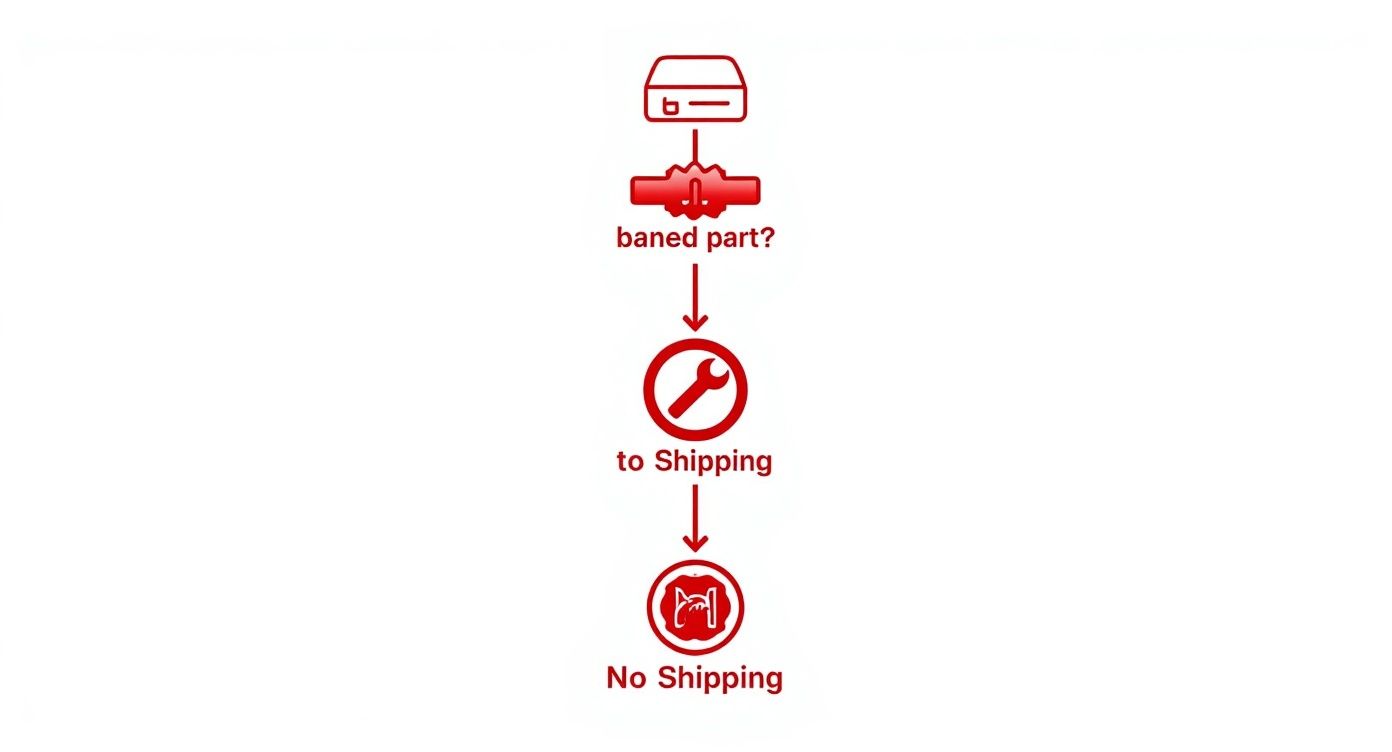
As the flowchart shows, the first question is always whether the item is a banned part. If the answer is yes, the process stops right there—no shipping.
The Problem with Dual-Use Parts
Here’s where it gets really tricky: "dual-use" parts. A certain stock might be perfectly fine for a bolt-action hunting rifle but completely illegal to ship if a customer could just as easily slap it on their semi-automatic AR-15. This is the compliance headache. The law puts the responsibility squarely on you, the seller, to figure out a part’s potential for being used in a banned setup.
The state’s focus doesn’t just stop at traditional parts, either. They’re also cracking down on newer tech. Connecticut has already banned auto sears and Glock switches, which are devices that can convert a semi-automatic firearm to fire continuously. Back in 2018, the state also explicitly banned bump stocks and any other accessory made to speed up a firearm's rate of fire. These rules all point to a broad strategy to regulate any component that could help create a banned weapon.
Connecticut statute § 53-202a lays it all out. It defines an "assault weapon" as any semi-automatic centerfire rifle that has a detachable magazine and at least one of the specific features mentioned above. This definition is the legal bedrock of the entire parts ban.
This deep focus on components is also a huge part of the regulations around self-manufactured firearms. For a closer look at that related topic, check out our guide on ghost gun parts shipping restrictions. Ultimately, your compliance system needs to be smart enough to flag and block any part based on these very specific, feature-based definitions.
The Real-World Consequences of Non-Compliance
Ignoring Connecticut's assault weapon parts shipping ban isn't a minor slip-up—it's a high-stakes gamble with devastating consequences. The penalties aren't just a slap on the wrist; they're designed to be a powerful deterrent, and the state takes this stuff very seriously.
Violating this law can trigger a total legal and financial meltdown for your business. We're not talking about a simple fine here. A single unlawful shipment can lead to felony charges for both the business and potentially you, the person who made the sale.
These criminal charges come with the very real threat of serious prison time and crippling financial penalties. But beyond the immediate legal battle, a conviction will almost certainly lead to the revocation of your Federal Firearms License (FFL). Losing your FFL is a death sentence for your business, permanently shutting you down.
A Cautionary Tale: How One Mistake Ends a Business
Picture this: "Patriot Parts," a small online retailer in another state, gets an order from a customer in Connecticut. The cart contains a telescoping stock, a flash suppressor, and a pistol grip. The order slips through their manual review process and ships out.
Weeks later, a certified letter arrives from the Connecticut Attorney General's office. The package was either intercepted or the buyer was part of a sting operation. Now, the owner is facing felony charges under Connecticut statute § 53-202e. The legal fees immediately skyrocket into the tens of thousands of dollars.
The ATF gets notified, which kicks off a full-scale federal audit of their FFL. The business grinds to a halt as the legal fight consumes every dollar and minute of the day. Even if the owner avoids prison, the felony conviction means their FFL is gone for good. Patriot Parts is finished—all because of one preventable shipping mistake.
State and Federal Agencies Are Watching
Enforcement of the Connecticut assault weapon parts shipping ban is a team effort. State authorities, like the Connecticut State Police, are actively investigating illegal shipments coming into their state. They work hand-in-hand with federal partners, including the ATF, to trace these parts back to their source—which is you, the online retailer.
The aggressive enforcement makes sense when you look at the bigger picture. After the federal assault weapons ban expired back in 2004, the criminal use of firearms with these types of features shot up dramatically. For example, one analysis found that in several major cities, the number of recovered crime guns with these features jumped by 48% to 111% in the years after the ban ended. If you want to dig into the numbers, you can read the full analysis on assault weapon ban impacts. This is exactly why states like Connecticut are so vigilant.
Building Your Compliance Framework in WooCommerce

Knowing about the Connecticut assault weapon parts ban is one thing; building a rock-solid system to enforce it inside your WooCommerce store is another. An "honor system" or trying to catch restricted orders manually is a recipe for disaster. What you really need is a reliable framework that automatically stops an illegal sale before it ever becomes a problem.
This all starts with your product catalog. Every single item you sell needs to be meticulously organized. You’ll have to create a specific product attribute or category—something simple like "CT Restricted"—and apply it to every telescoping stock, flash suppressor, pistol grip, and other banned part on your site. This data entry is the bedrock of any automated rule you build later.
Configuring Your Shipping Rules
Once your products are properly tagged, it's time to put those tags to work by creating powerful shipping restrictions. Your WooCommerce setup needs to be smart enough to see a "CT Restricted" item in a customer's cart and check their shipping address at the same time. If the package is headed to Connecticut, the system has to shut the sale down.
This means setting up conditional logic that tells your store, in plain English:
- Check the Cart: Is there anything tagged "CT Restricted" in here?
- Check the Destination: Is the shipping address in Connecticut?
- Apply the Rule: If the answer to both is "yes," then hide all shipping options and block the checkout.
This automated check runs 24/7, making sure no restricted order can slip through the cracks and land you in hot water. To get a better handle on the nuts and bolts of this process, check out our in-depth guide on firearms and ammunition shipping compliance for WooCommerce stores—it dives deep into building these critical systems.
When a sale is blocked, clear communication makes all the difference. Instead of a vague error, show a professional message explaining exactly what's happening.
Example Message: "Due to Connecticut state law (§ 53-202a), we are unable to ship one or more items in your cart to your location. Please remove the restricted item(s) to proceed with your order."
This simple message educates the customer, cuts down on frustration, and proves you're a serious business that follows the law.
Manual Checks Versus Automated Solutions
Let's be blunt: asking a human to manually review every single order for compliance is a high-risk gamble. People make mistakes, especially when order volumes spike. An automated system, on the other hand, performs these checks perfectly, every single time. It never gets tired, and it never has an off day.
Deciding between a manual process and an automated tool is a critical choice for your business. Let's break down what each approach really means for your day-to-day operations and your legal exposure.
Comparing Manual vs Automated Compliance Methods
| Compliance Method | Pros | Cons | Best For |
|---|---|---|---|
| Manual Review | No upfront software cost. Seems easy for brand-new stores with almost no orders. | Huge risk of human error. Extremely time-consuming and impossible to scale. Creates a major fulfillment bottleneck. | Honestly? Not recommended for any serious ecommerce business. The risk is just too high. |
| Automated System | Eliminates human error completely. Enforces rules 24/7 without fail. Scales with your business. Creates a clear, defensible compliance record. | Requires an initial software investment and a bit of setup time. | Any FFL holder shipping regulated products to customers across the country. |
When you look at it this way, the choice becomes pretty clear.
Ultimately, automation isn't just a nice-to-have; it's an essential layer of legal armor for your business. A dedicated plugin like Ship Restrict was built for exactly this purpose. It takes complicated state laws and turns them into simple, bulletproof rules you can manage right from your WooCommerce dashboard.
How to Automate Shipping Rules with Ship Restrict
Trying to handle compliance manually is a high-stakes bet you can't afford to lose. Automating your shipping rules with a tool like Ship Restrict takes the guesswork out of the equation. It builds a reliable, foolproof system that shields your business from the harsh consequences of violating the Connecticut assault weapon parts shipping ban.
This isn't just about making life easier; it's about turning complex legal jargon into simple, automated actions right inside your WooCommerce dashboard. You can create a specific rule that physically blocks any product you've categorized as a banned part from ever being shipped to a Connecticut address. This isn't a suggestion for your fulfillment team—it's a hard stop built directly into your checkout process.
Setting Up a Connecticut-Specific Rule
Creating your first rule is surprisingly simple. You just need to define the conditions that trigger the restriction, giving you laser-focused control over your store's shipping logic.
Here’s what that looks like in practice:
- Define the Restriction: First, you create a new rule and give it a clear name you'll recognize, like "Block CT Assault Weapon Parts."
- Select the Product Category: Next, you link this rule to the specific product category you made for all the banned parts (e.g., "CT Restricted").
- Set the Geographic Target: Finally, you tell the system this rule only applies to orders with a shipping address in the state of Connecticut.
Once you hit save, that rule works quietly in the background, checking every single cart, 24/7. Think of it as your always-on compliance officer, eliminating the kind of human error that can lead to catastrophic legal and financial penalties. For stores with massive inventories, you can even learn how to bulk import shipping restrictions from a CSV file, which makes the setup incredibly fast.
Communicating Restrictions to Customers
Solid compliance isn't just about blocking sales; it's also about clear communication. When Ship Restrict stops an order, it doesn't just throw up a generic error message. You can write a custom message that explains why the sale can't go through, turning a potentially frustrating moment into an informative one.
Example Message: "Due to Connecticut state law (§ 53-202e), we are unable to ship one or more items in your cart to your location. Please remove the restricted item(s) to proceed with your order."
This professional touch builds trust and shows your customers that you’re a responsible, law-abiding retailer.
By putting this system in place, you create a defensible record of your compliance efforts. This kind of automation isn't just about saving time—it's about building a legal firewall around your business. If you're curious about the broader impact, it's worth reading up on the general benefits of automation in business. Ultimately, it ensures your operations stay protected so you can focus on growing your company.
Common Questions About the Connecticut Parts Ban

Even when you think you have a handle on the rules, the Connecticut assault weapon parts shipping ban has plenty of tricky nuances that can trip up even experienced retailers. It's one of the toughest sets of firearm regulations in the country, and specific situations often lead to confusion.
Let's clear the air and tackle some of the most common questions we hear from store owners. Getting these edge cases right will help you build a much stronger, more confident compliance strategy.
Does the Ban Apply to Parts for Non-Assault Weapons?
This is a big one, and it’s where a lot of retailers get into trouble. The short answer is that the law cares about the part's characteristics, not its intended use or how you market it. The state is focused on components that could be used to build a firearm with banned features.
For example, a standard trigger for a hunting rifle is probably fine. But a telescoping stock? That's a restricted item, period. It doesn't matter if the customer says it's for their granddad's old deer rifle. Because that stock is a defining feature of a banned weapon, it's off-limits.
You have to ask one core question: could this part be used to give a semi-automatic rifle a prohibited feature? If the answer is yes, you can’t ship it to Connecticut.
What if My Customer Is a Licensed Gunsmith in Connecticut?
Unfortunately, the law makes no special exceptions for licensed gunsmiths or FFL holders in Connecticut. The restrictions are on the parts themselves being shipped into the state, not on who is receiving them.
There are some very narrow exemptions for direct sales to law enforcement or military agencies, but a private gunsmith is treated just like any other resident. Before you even think about shipping to someone claiming they're exempt, you need to get official documentation and have your lawyer verify its validity. The burden of proof is 100% on you, the seller.
How Can I Stay Updated on Changes to Connecticut’s Laws?
Firearm laws are never set in stone. They're constantly changing, and staying current is a non-negotiable part of compliance.
- Go to the Source: Regularly check the official website for the Connecticut State Department of Emergency Services and Public Protection (DESPP). This is where you'll find the actual legal statutes.
- Lean on Industry Groups: Subscribe to newsletters from reputable firearm legal organizations. They provide timely analysis and plain-English updates on new laws and court cases.
- Get a Pro: Keep an attorney who specializes in firearms law on speed dial. This is the only truly reliable way to get definitive answers and protect your business from devastating mistakes.
Trying to navigate these complex regulations with a spreadsheet and a prayer is a huge risk. Ship Restrict automates your entire compliance framework, letting you create specific rules that block prohibited sales to Connecticut before they can become a liability. Protect your business and streamline your shipping by visiting https://shiprestrict.com.
Automate Shipping Compliance
Stop worrying about restricted states. Ship Restrict handles it automatically.

Cody Yurk
Founder and Lead Developer of ShipRestrict, helping e-commerce businesses navigate complex shipping regulations for regulated products. Ecommerce store owner turned developer.
Automate Shipping Compliance
- Block restricted states
- No more cancellations
- Set and forget
3-day free trial · Card required