Taxidermy Wildlife Shipping Lacey Act Compliance A Practical Guide
Navigate taxidermy wildlife shipping Lacey Act compliance with this guide. Learn documentation, rules, and how to use WooCommerce to avoid costly penalties.
Shipping taxidermy and other wildlife products isn't like shipping a t-shirt. It's an arena governed by the Lacey Act, a century-old federal law with serious teeth. For any WooCommerce store in this niche, understanding this law isn't optional—it's the bedrock of your business. It makes transporting, selling, or buying wildlife taken in violation of any U.S. or foreign law a federal crime.
That means every single shipment must be legally sourced, perfectly labeled, and properly documented. The penalties for getting it wrong are severe.
The High Stakes of Shipping Taxidermy Under the Lacey Act
Putting a taxidermy mount in a box might seem simple, but you're operating under one of the most powerful wildlife protection laws in the country. The Lacey Act of 1900 is far from a historical relic; it’s an active enforcement tool, and for online merchants, ignorance is no defense.

At its core, the law targets two things that can easily trip up an online seller: trafficking illegally sourced wildlife and submitting false information about a shipment. Think about it this way: if a deer mount was harvested without the proper state tag, shipping it across state lines suddenly becomes a federal offense. It’s that serious.
Automate Shipping Compliance
Block orders to restricted states automatically. 3-day free trial.
Start Free TrialKey Lacey Act Provisions Affecting Your Store
The law's impact on your day-to-day operations really boils down to a few critical areas. Each one is a potential landmine if you don't have solid procedures in place.
- Illegal Trafficking: This is the big one. It covers the transport or sale of any wildlife—or products made from it—that was poached, possessed, or sold in violation of an underlying federal, state, tribal, or foreign law.
- False Labeling: Every package containing wildlife must be clearly and accurately marked with the species and quantity inside. Mislabeling a shipment, even by accident, is a direct violation.
- Import/Export Declarations: All wildlife shipments coming into or leaving the U.S. require a declaration filed with the U.S. Fish and Wildlife Service (FWS). Skipping this paperwork is a fast track to getting your shipment seized.
The consequences aren't just a slap on the wrist. A simple labeling mistake or failing to verify a supplier's harvest tags can lead to seized inventory, fines that can climb into the hundreds of thousands of dollars, and even felony charges for knowing violations.
While the Lacey Act is vital for wildlife shipping, it's also just one piece of the broader legal framework for online businesses every merchant should be familiar with. This isn't just about protecting animals; it’s about protecting your entire business from catastrophic legal and financial fallout. Your compliance strategy starts right here.
Understanding the Agencies That Enforce the Lacey Act
When you ship a taxidermy product, it’s not just one set of eyes on your package. Full taxidermy wildlife shipping Lacey Act compliance means knowing that multiple federal agencies have a stake in your shipment, each with its own authority and focus. It’s a complex regulatory web where a single oversight can cause major headaches.
Think of it as a team of specialists. The two big players you'll run into are the U.S. Fish and Wildlife Service (FWS) and the Animal and Plant Health Inspection Service (APHIS). Their jobs are distinct but often overlap, especially with taxidermy that uses multiple materials.
The Role of the US Fish and Wildlife Service
The FWS is the lead agency for enforcing the wildlife side of the Lacey Act. Their jurisdiction covers any product made from an animal—from a full-sized bear mount to a small keychain featuring feathers or bone.
FWS agents are stationed at ports of entry across the country, inspecting both international and domestic shipments for proper paperwork and legal sourcing. They’re the ones who will be scrutinizing your import/export declarations (FWS Form 3-177). They have full authority to seize any shipment they suspect violates federal or state wildlife laws. For a WooCommerce merchant, this means your documentation has to be flawless. An inspection can be triggered by something as simple as an inaccurate species name or missing permit info.
The APHIS Connection to Plant Materials
While the FWS is all about the animal, the USDA's Animal and Plant Health Inspection Service (APHIS) handles the plant side of things. This is absolutely critical for taxidermy mounted on wooden plaques, bases, or dioramas that use natural plant materials.
APHIS enforces the plant provisions of the Lacey Act, requiring declarations for certain imported wood products to fight illegal logging. This multi-agency setup means a single shipment can easily fall under dual jurisdiction. For example, a duck mount on a piece of driftwood is subject to review by both FWS (for the bird) and APHIS (for the wood). You can find more details about this complex dynamic from The Sustainability Alliance's breakdown on Lacey Act enforcement. This overlap is precisely why automated, detailed compliance checks are so vital.
Free Shipping Compliance Audit
We'll review your WooCommerce store's shipping compliance for free.
The key takeaway is that you can't just focus on the animal. Every component of your product, right down to the wooden base, must be part of your compliance checklist. Missing an APHIS requirement is just as serious as an FWS violation.
Juggling these overlapping jurisdictions gets complicated, especially with international orders. The paperwork needed for one agency might not satisfy the other, making a deep understanding of cross-border restricted goods documentation non-negotiable for any seller looking to expand their market.
Creating Your Essential Lacey Act Shipping Checklist
Trying to handle compliance reactively is a fast track to serious problems. The only way to protect your business is to build an ironclad, repeatable process for every single shipment. Think of it as a pre-flight checklist that turns a tangled web of legal requirements into a simple, day-to-day operational task for shipping taxidermy and wildlife.
This whole process starts way before you even think about listing an item on your WooCommerce store. It’s all about building a solid foundation of proof for every single piece in your inventory.
Pre-Listing Documentation and Sourcing
Before any product goes live, you have to have its entire legal history locked down and documented. Simply taking a supplier's word for it isn't nearly enough to demonstrate the "due care" required by the Lacey Act. You need cold, hard proof that every specimen was sourced legally.
Your pre-listing checklist should feel second nature and include:
- Sourcing Records: Keep meticulous records of where and when the animal was harvested. This means getting copies of hunting licenses, tags, or trapping permits. No exceptions.
- Supplier Agreements: Get it in writing. Have formal agreements with all your suppliers that explicitly state they are providing legally obtained specimens and will hand over all the necessary documentation to prove it.
- Accurate Species Identification: Make sure every item is identified by its correct scientific and common name. Mislabeling a species, even by accident, is a clear violation of the Act.
This quick decision tree helps visualize which agency—the U.S. Fish and Wildlife Service (FWS) or the Animal and Plant Health Inspection Service (APHIS)—you need to focus on based on what your product is made of.
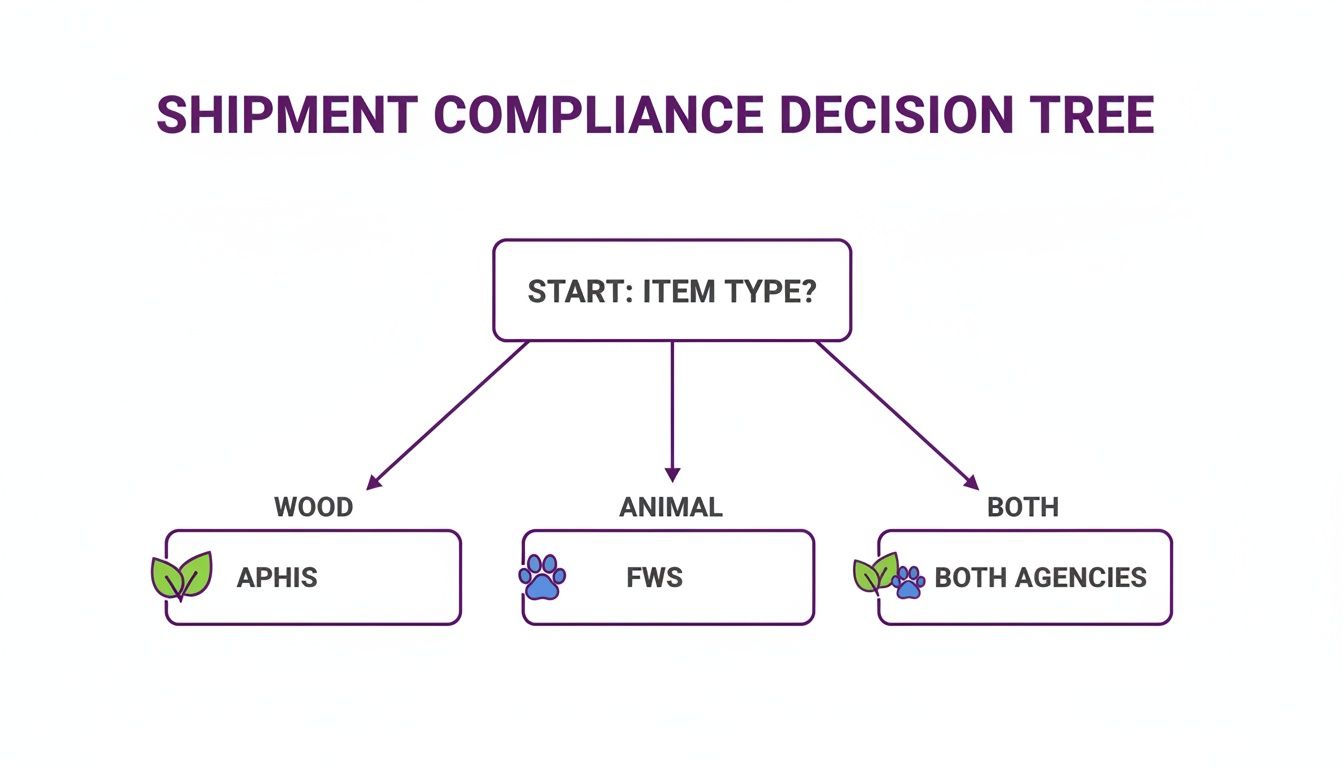
As you can see, if you're selling something with both animal and plant parts, you're on the hook for compliance with both the FWS and APHIS. That means more layers and more paperwork.
Shipping Declarations and Packaging Protocols
Once an order comes in, your focus shifts to getting the shipment itself right. This is where a lot of businesses stumble and make critical mistakes. The single most important document for many of your shipments will be the U.S. Fish and Wildlife Service Declaration for Importation or Exportation of Fish or Wildlife (Form 3-177).
This form is mandatory for all commercial wildlife shipments that are imported, exported, or moved in interstate commerce to or from a U.S. territory, Alaska, or Hawaii. While it's often not required for shipments within the mainland U.S., keeping the underlying data on hand is still a smart move.
Your shipping checklist also has to cover packaging. The Lacey Act’s marking requirement is non-negotiable and strictly enforced. Every single package containing wildlife must be plainly marked on the outside with the names and addresses of both the shipper and the recipient, along with a totally accurate list of its contents by species and number of specimens.
Here’s a quick-reference table to help you keep the essential documentation straight for different shipping scenarios.
Table: Essential Lacey Act Shipping Documentation
| Shipment Type | Required Documentation | Key Considerations |
|---|---|---|
| Domestic (Mainland US) | Sourcing records (licenses, tags), species list, shipper/consignee info on package. | While FWS Form 3-177 is not typically required, having the data ready is best practice. |
| To/From AK, HI, Territories | FWS Form 3-177, sourcing records, external package markings. | These are considered interstate commerce under the Act and have stricter declaration rules. |
| International Export | FWS Form 3-177, CITES permits (if applicable), sourcing records, customs forms. | CITES is a separate, complex layer of regulation for protected species. Ignorance is no excuse. |
| Containing Plant Material | APHIS PPQ Form 505 (for certain wood products), FWS documentation (if animal parts present). | If it has both wood and wildlife, you must satisfy requirements from both agencies. |
Having this documentation organized and ready to go for every shipment is the key to staying compliant.
Maintaining Impeccable Records
You can't prove you exercised "due care" if you don't have meticulous records. Your documentation is your shield—it's the evidence that you took every reasonable step to follow the law. This archive needs to be organized and easily accessible, just in case an agent comes knocking.
For every single order you ship, you need to save:
- A copy of the original customer order from WooCommerce.
- All sourcing documents for the specific item that was sold.
- Copies of any required permits (like CITES for international sales).
- A copy of the completed FWS Form 3-177, if it was required.
- Photos of the package clearly showing the required external markings before it shipped.
This isn't optional. This level of detail is the cost of doing business in this industry. Building a robust system for this is essential, and you can learn more about creating an audit-proof archive by reviewing the best practices for shipping restriction record-keeping requirements. This kind of proactive documentation creates a powerful defense against any compliance questions that might come your way.
Automating Compliance in Your WooCommerce Store
Manually checking every single order against a sprawling matrix of state and federal wildlife laws isn't just a time sink—it's a recipe for expensive mistakes. For any serious WooCommerce merchant in the taxidermy and wildlife space, automation is the only sustainable way to handle taxidermy wildlife shipping Lacey Act compliance. It turns your store from a simple sales platform into an active compliance machine.
Instead of burning hours cross-referencing regulations or risking a violation from simple human error, you can put a system in place to do the heavy lifting. Think of it as a digital safety net that works for you 24/7. For anyone looking to get a handle on regulatory headaches, good compliance automation software is a total game-changer.
Setting Up Proactive Shipping Rules
The heart of this automation is building smart shipping rules that stop illegal orders before they’re even placed. Using a tool like Ship Restrict for WooCommerce, you can create granular restrictions based on the specific product and the customer's shipping address.
Let's say you sell a taxidermy piece that includes parts from a species you can't sell in California. You can create a rule that blocks that specific product from being shipped to any California address. When a customer from CA tries to check out, the system automatically stops the transaction and shows them a clear, custom message explaining why.
Here’s how you can tackle different scenarios with these rules:
- Species-Specific State Bans: Block sales of items like migratory birds or certain mammals to states where they are flat-out illegal to trade.
- Material Restrictions: Set up rules for products with materials like ivory or certain types of bone, locking down sales to states with tough regulations like New York or New Jersey.
- International Blocks: A smart default rule is to block all international shipping on wildlife products. This helps you avoid the tangled mess of CITES and FWS export declarations, which almost always require manual work.
This is what it looks like in practice—automated rules checking products against their destination and blocking illegal shipments before they ever get a shipping label.
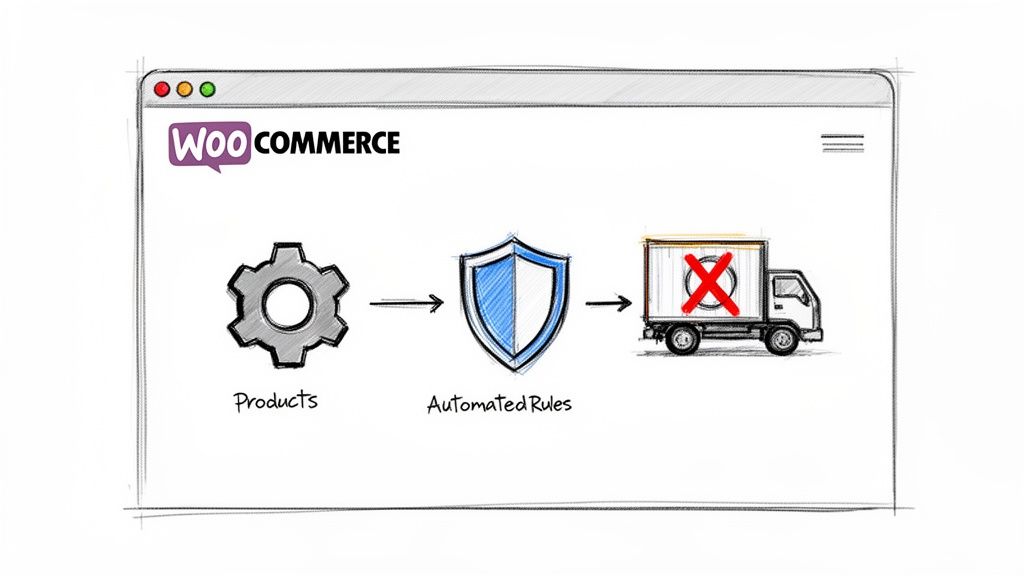
This kind of proactive validation is critical. It moves compliance from a post-order headache to a pre-checkout solution, protecting your business on autopilot.
Improving Customer Experience and Accuracy
Automation also helps you sidestep a huge Lacey Act risk: false labeling. It’s a bigger problem than you might think. A recent analysis found that an incredible 55% of wildlife products from U.S. retailers had incorrect species claims. Mislabeling an item is a direct violation, and an automated system forces you to have accurate, categorized data for every product—which is exactly what you need for correct shipping declarations.
By automating these checks, you also give your customers a much better experience. Instead of dealing with a cancelled order and a frustrated buyer, your system gives them instant, honest feedback right at checkout. That clarity cuts down on abandoned carts and builds trust, showing customers you're a responsible, law-abiding seller.
For merchants ready to put these powerful safeguards in place, our guide on automated shipping compliance for WooCommerce stores gives you a detailed walkthrough of the entire setup. This proactive system is your best defense against the steep penalties of a Lacey Act violation.
The True Cost of a Lacey Act Violation
<iframe width="100%" style="aspect-ratio: 16 / 9;" src="https://www.youtube.com/embed/W4ZxjWXrVQM" frameborder="0" allow="autoplay; encrypted-media" allowfullscreen></iframe>Ignoring the Lacey Act isn't a simple compliance slip-up. It's a high-stakes gamble that can bring devastating consequences down on your business. The penalties aren't just minor slaps on the wrist; they are severe, tiered punishments designed to make illegal wildlife trafficking unprofitable and extremely risky for everyone in the supply chain—and that includes online retailers.
The financial and legal fallout from a single violation can dismantle a business almost overnight. These violations are broken down by your level of knowledge and intent, which draws a very clear line between an honest mistake and a deliberate crime. This is where the legal concept of "due care" becomes your single most important defense. Failing to exercise it can elevate a manageable penalty into a far more serious charge.
Misdemeanors Versus Felonies
The law draws a hard line between those who should have known better and those who knowingly broke the law.
For the knowing offenders—those fully aware they're trafficking in illegal wildlife—the penalties are severe. Import and export violations are felony offenses, punishable by up to five years in prison and fines hitting $250,000. Even for a domestic sale, a felony charge kicks in if the illegally sourced wildlife is valued at more than $350.
But even if you weren't fully aware, you're not off the hook. If investigators decide you should have known about the violation by exercising reasonable due care, you could still be looking at misdemeanor convictions. These can carry up to one year in prison and fines of up to $100,000. You can dig into the full penalty structure in this detailed report on the Lacey Act.
Beyond the Fines: Seizures and Forfeiture
The direct financial penalties are only one piece of the puzzle. The Lacey Act also gives enforcement agencies sweeping power to seize and forfeit any wildlife, equipment, and even vehicles used in a violation.
- Product Seizure: The most immediate hit is the loss of your inventory. If a shipment is flagged as non-compliant, it can be seized on the spot.
- Forfeiture of Assets: In more serious cases, the government can seize assets used to commit the crime. For an online business, this could theoretically include anything from company vehicles to your computer equipment.
The crucial point here is that the cost of a single violation—in fines, legal fees, and lost inventory—can easily dwarf the entire investment in a solid, automated compliance system. It’s a clear-cut case where a proactive defense is infinitely cheaper than a reactive one. Proper taxidermy wildlife shipping Lacey Act compliance isn't an expense; it's an insurance policy.
Your Lacey Act Compliance Questions Answered
When you're dealing with the nitty-gritty of taxidermy shipping, a few common questions always seem to pop up. Let's get them answered so you can handle these complex compliance scenarios with a bit more confidence.
Does the Lacey Act Apply to Antique Taxidermy?
Yes, in most cases, it absolutely does. A common misconception is that age provides a blanket exemption, but that's not how the Lacey Act works. The law applies to wildlife products regardless of how old they are.
If that antique duck mount was made from a species that was illegally harvested at any point in time, selling or shipping it across state lines today is still a violation. This is especially true for species protected under other overlapping laws, like the Migratory Bird Treaty Act.
The burden of proof is squarely on you, the seller, to prove the item's legal origin. This is why having bulletproof records and clear provenance for any antique pieces isn't just nice—it's essential.
Setting up automated shipping rules to flag or block species commonly found in antique mounts is a simple, powerful safeguard for your business.
What Does "Due Care" Mean and How Do I Prove It?
In the eyes of the law, "due care" simply means you took all the reasonable steps you could to prevent an illegal sale from happening. "I didn't know" is not a defense that will get you very far. Proving due care requires showing a proactive, documented effort to stay compliant.
What does that look like in the real world?
- You're demanding (and keeping) sourcing documents from every single one of your suppliers.
- You're doing your own homework to independently verify species whenever possible.
- You're maintaining meticulous transaction and shipping records for every single order.
- You're using a system to actively block potentially illegal shipments before they even get a shipping label.
Your best defense is a well-documented compliance program. It's tangible proof that you aren't just crossing your fingers but are actively working to follow the law. That's the heart of due care.
Can I Ship Taxidermy Internationally from My WooCommerce Store?
The short answer is yes, but it's a whole different ballgame. Shipping taxidermy internationally is vastly more complex than domestic shipping and requires an extreme level of diligence.
Once a package crosses the border, it falls under a complicated web of regulations. You're not just dealing with the Lacey Act anymore; you've got CITES (Convention on International Trade in Endangered Species) and the specific import laws of the destination country to worry about.
You’ll be filling out FWS Form 3-177, potentially securing CITES permits, and making sure your shipment goes through a designated FWS port. For the vast majority of WooCommerce stores, the smartest and safest strategy is to simply block international shipping for all wildlife products by default.
If a special case comes up, you can handle it manually, taking the time to verify every single legal requirement for that specific order and destination. This approach dramatically minimizes your risk.
Automating these complex checks is the key to protecting your business. Ship Restrict provides the tools to create granular shipping rules, blocking prohibited items by state and helping you demonstrate the "due care" essential for Lacey Act compliance. Take control of your shipping compliance with Ship Restrict today.
Automate Shipping Compliance
Stop worrying about restricted states. Ship Restrict handles it automatically.

Cody Yurk
Founder and Lead Developer of ShipRestrict, helping e-commerce businesses navigate complex shipping regulations for regulated products. Ecommerce store owner turned developer.
Automate Shipping Compliance
- Block restricted states
- No more cancellations
- Set and forget
3-day free trial · Card required