Firearms Shipping Cost Reduction Playbook
Firearms retailers: Use our playbook for shipping cost reduction. Optimize carriers, packaging, & compliance to cut expenses and eliminate errors.
Most shipping cost reduction advice starts in the wrong place.
It tells you to negotiate harder, use flat-rate packaging, or squeeze a few cents out of void fill. Those things matter, but they don't address the part that hurts firearms retailers most. In a regulated catalog, the expensive mistakes often happen before a label is even printed.
A generic eCommerce store can treat shipping as a pricing problem. An FFL selling through WooCommerce has to treat it as a pricing problem and a compliance problem at the same time. If you ignore that second part, you can tighten packaging, shop rates, and still bleed margin through blocked destinations, manual order review, customer service cleanup, and returned packages that never should have moved.
Beyond the Basics of Shipping Cost Reduction
The standard playbook for shipping cost reduction is incomplete for regulated products.
Automate Shipping Compliance
Block orders to restricted states automatically. 3-day free trial.
Start Free TrialMost articles focus on packaging, carrier discounts, and warehouse placement. That's useful as far as it goes. The problem is that guidance for compliance-heavy industries barely addresses the hidden costs created by legal restrictions, manual verification, and shipment rejections, as noted in Pallite Group's discussion of shipping cost reduction gaps.
Where generic advice breaks down
For a firearms retailer, shipping cost isn't just what the carrier invoices. It's also the labor tied up in reviewing orders, checking destination rules, fixing address issues, answering customers after a blocked order, and unwinding transactions that should never have entered fulfillment.
A lot of stores don't notice this because the expense is spread across departments. Ops spends time reviewing. Support handles the complaint. Accounting deals with the refund. Inventory gets stuck in limbo. None of that shows up neatly under a single carrier line item, but it absolutely belongs in your shipping cost reduction plan.
Generic eCommerce advice treats compliance as a side note. In firearms operations, compliance changes the economics of every shipment.
That changes how you prioritize improvements. Rate shopping matters, but if your team is still using spreadsheets, memory, and tribal knowledge to screen destinations, you're attacking the wrong leak first.
The operational reality inside WooCommerce
This gets worse as order volume rises. A store can survive manual review for a while, then hit a point where every new sales bump creates more friction at checkout and in fulfillment. That's why the technical side of the store matters. Teams that are serious about scale usually need both policy automation and a stronger store foundation, especially when optimizing WooCommerce for enterprise scale becomes part of the conversation.
Here's the practical takeaway:
- Visible costs are only half the story. Carrier rates, packaging, and surcharges are easy to see.
- Invisible costs often come from compliance work. Manual checks, rejected orders, and exception handling consume real labor.
- The cheapest bad shipment is still expensive. Even if you got a decent carrier rate, you still lose when the order was never shippable in the first place.
What actually works
The retailers that get shipping costs under control don't treat compliance as a final review step. They push it upstream. They reduce avoidable decision-making at the bench. They build repeatable rules instead of relying on staff judgment order by order.
That's the difference between a store that is always reacting and a store that can improve margins month after month.
Free Shipping Compliance Audit
We'll review your WooCommerce store's shipping compliance for free.
Master Your Carrier Mix and Negotiate Like a Pro
If you're still running most orders through one carrier because it's familiar, you're paying for convenience.
A single-carrier setup is simple to manage, but it usually limits options and flexibility. Multi-carrier automation and intelligent rate selection can reduce shipping costs by 15-25% versus single-carrier operations, with 12-18% savings possible from better rate selection alone, according to Ecom Auto Prep's shipping cost reduction analysis.
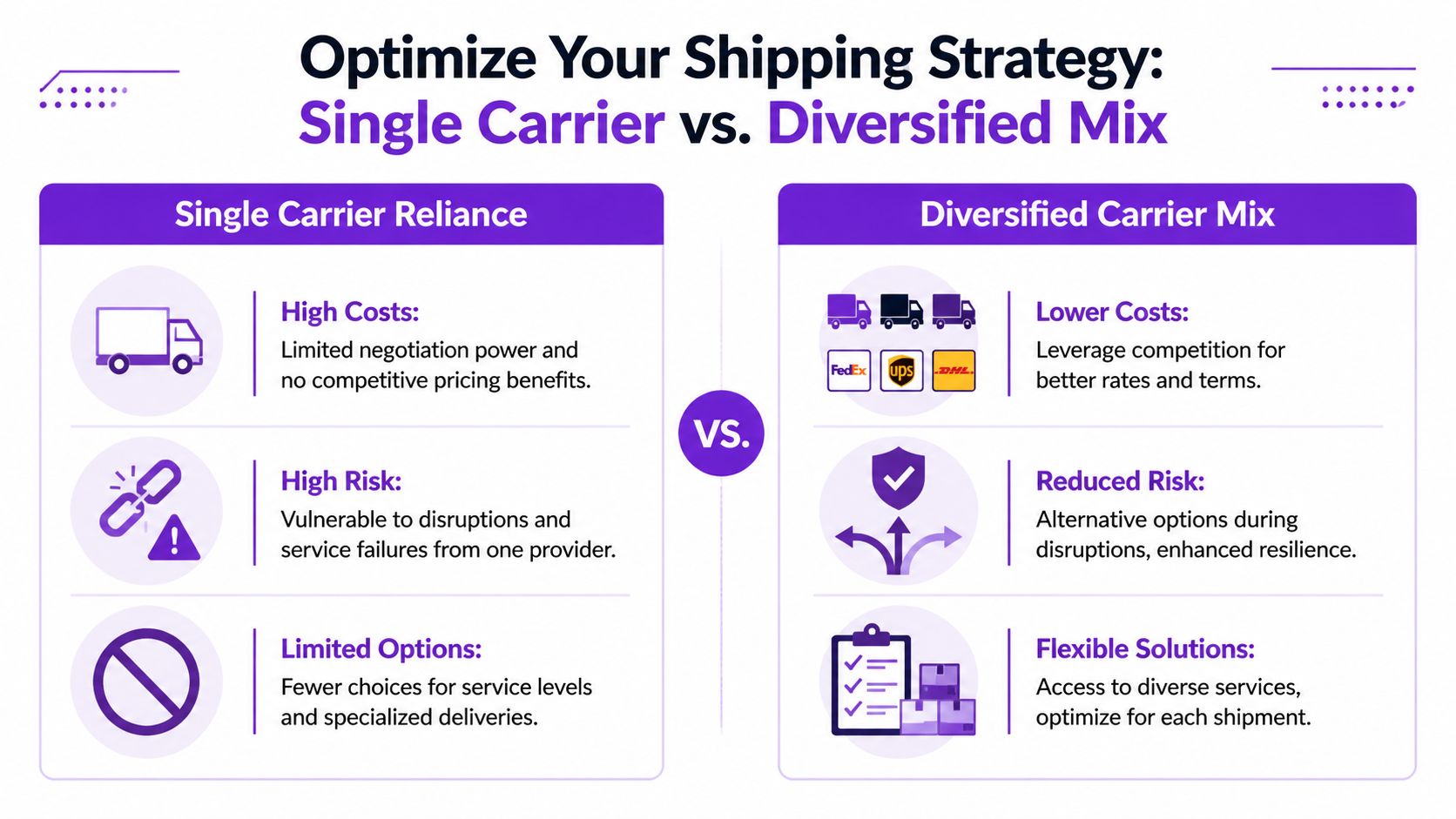
Price is only one part of the carrier decision
In firearms operations, the cheapest quoted rate isn't automatically the best option. You need to judge carriers on three things at once:
| Decision factor | What to look for | Why it matters |
|---|---|---|
| Policy fit | Whether the carrier's rules align with the products you're shipping | A low rate is useless if the package type or destination triggers friction later |
| Service consistency | Claims handling, scan reliability, pickup quality, exception response | Operational reliability saves labor, not just postage |
| Rate position | Zone-by-zone and package-by-package competitiveness | Different carriers win on different order profiles |
That means you shouldn't ask, "Who's our carrier?" Ask, "Which carrier wins for this order type?"
A workable carrier mix for smaller FFL teams
You don't need a giant shipping department to diversify. You need clean order data, clear routing logic, and discipline.
Start with these rules:
- Use a primary carrier, not an exclusive carrier. Let one carrier handle the majority of standard shipments, but keep alternatives live and tested.
- Separate by order profile. Long packages, heavy ammunition orders, accessory-only orders, and destination-sensitive shipments shouldn't all flow through the same rule.
- Review restrictions alongside rates. A carrier that looks competitive on paper can create headaches if its handling of regulated goods is inconsistent.
- Keep regional options in the mix. For some stores, regional networks improve both price and service coverage. This guide to regional carrier options for regulated products is a useful place to compare where they fit.
Practical rule: Negotiate after you've segmented your shipment types. Carriers respond better when you can show what you actually tender, not when you ask for a blanket discount on everything.
How to negotiate when your volume isn't massive
Small and mid-sized stores often assume they have no bargaining power. That's wrong. You may not have enterprise volume, but you still have routing discretion. Carriers know that.
Bring a short list of facts into the conversation:
- Your shipment mix. Show the package types and lanes you can route.
- Your consistency. Predictable weekly volume is more useful than inflated annual claims.
- Your alternatives. Negotiation changes when the rep knows you can move freight elsewhere.
Don't chase a complicated agreement you won't monitor. A slightly better structure that your team can enforce is more valuable than a contract full of discounts nobody checks in practice.
Let software do the comparison work
Manual rate shopping breaks as soon as the order queue gets busy. The better approach is shipping software that compares carriers automatically, applies your business rules, and pushes the best service option to the label step.
That's where a diversified strategy starts paying off operationally. Your team stops debating carriers at the packing bench and starts following pre-set logic. Less hesitation. Fewer one-off decisions. Better shipping cost reduction without slowing fulfillment.
Stop Paying for Air with Smart Packaging
A surprising amount of shipping waste starts with the box, not the carrier.
Firearms retailers often overpack for understandable reasons. They want protection, fewer damage claims, and cleaner presentation. But oversized packaging creates dead space, invites dimensional charges, and turns ordinary orders into expensive ones for no real gain.
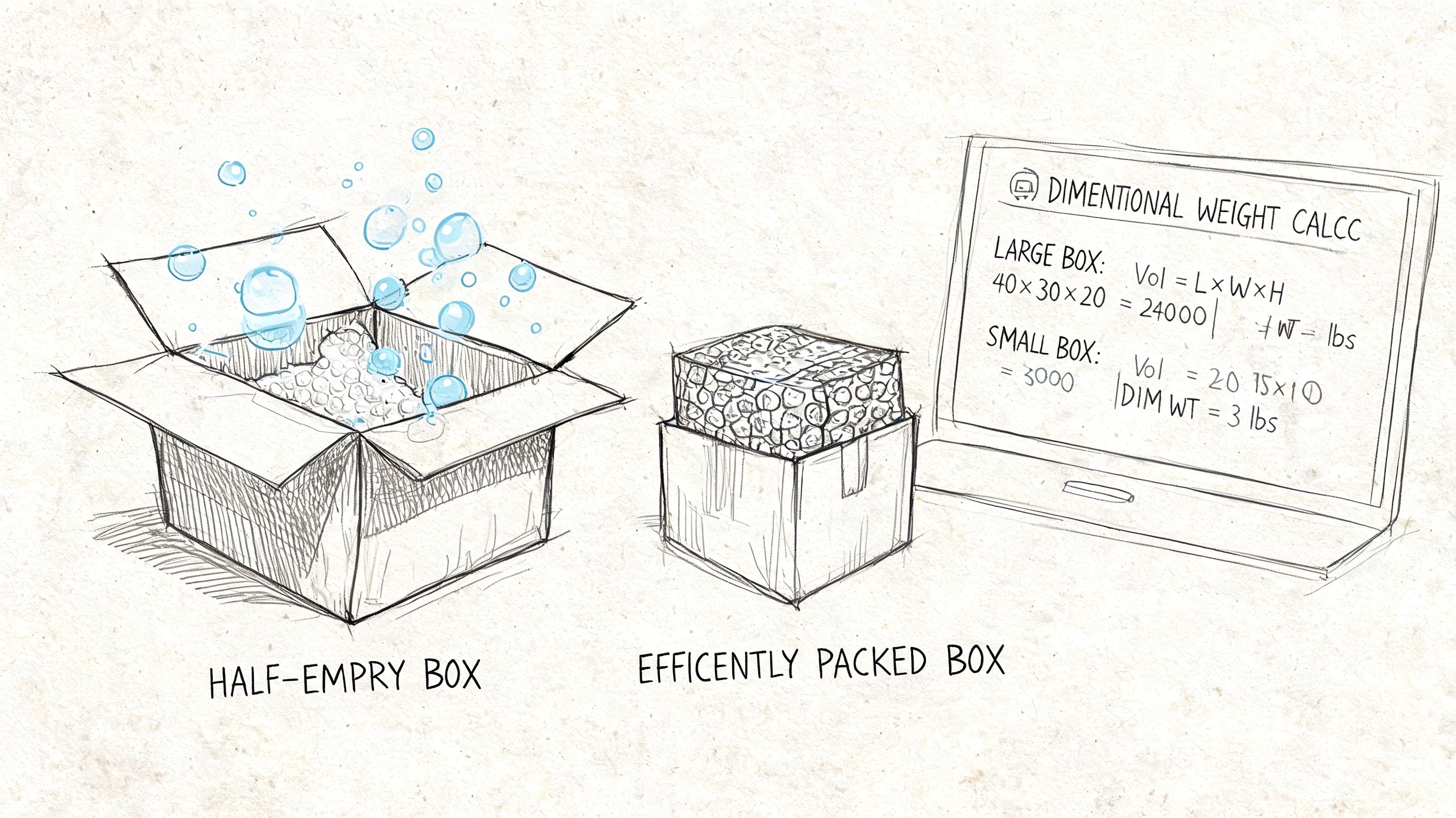
Start with the products that create the most waste
Some SKUs almost beg teams to use whatever carton is nearby. That's where cost creeps in.
A better bench routine looks like this:
- Handguns in hard cases. Measure the actual case and build a small set of cartons around it. Don't drop a compact case into a box sized for a larger platform.
- Long guns. Use carton lengths that match common product ranges, then standardize inserts so staff aren't improvising with filler.
- Ammunition. Weight matters, but box shape matters too. Dense products in oversized cartons create avoidable movement and wasted cube.
- Accessories and mixed carts. Don't let a single fulfillment rule treat optics, parts, magazines, and soft goods the same.
If your team grabs packaging by habit, audit those habits first. The fastest savings usually come from the cartons used most often, not the oddball shipments.
Build a packaging library instead of improvising
The stores that pack efficiently don't give every shipper unlimited choice. They narrow the decision. A practical packaging library usually includes a short list of approved cartons, inserts, tape standards, and fill rules by product category.
That also makes sourcing easier. When you're comparing vendors or looking at packaging companies, you can buy to a defined packaging system instead of ordering random sizes that looked useful at the time.
The goal isn't minimal packaging. It's enough packaging to protect the order without paying to ship empty space.
A solid packaging SOP should answer four questions quickly:
| Packaging question | Good standard |
|---|---|
| Does the product move inside the box? | No, or only minimally |
| Is the carton much larger than the item needs? | It shouldn't be |
| Does the packout rely on excessive void fill? | Avoid it when a better box exists |
| Could staff repeat this packout consistently? | Yes, without guesswork |
Audit your bench before buying more supplies
Walk the packing area and look at a sample of completed orders. Don't start with carrier invoices. Start with what people are physically doing.
Watch for these patterns:
- The universal box problem. One carton size becomes the default for everything.
- Presentation over efficiency. Nice unboxing doesn't help if the carton is wildly oversized.
- Filler replacing fit. If paper or bubble is doing all the work, the box is probably wrong.
- No SKU-to-box map. Staff are making packaging decisions from memory.
For a visual walkthrough of where that waste shows up, this packing video is worth a look before you rewrite your SOPs.
<iframe width="100%" style="aspect-ratio: 16 / 9;" src="https://www.youtube.com/embed/inJYyGPCClM" frameborder="0" allow="autoplay; encrypted-media" allowfullscreen></iframe>Packaging isn't glamorous, but it's one of the cleanest forms of shipping cost reduction because you control it directly.
Outsmart Shipping Zones to Cut Long-Haul Costs
Published rates get too much attention. Zone exposure is often the main margin leak, especially for firearms retailers shipping from one node while also dealing with destination restrictions, adult signature requirements, and carrier rule differences that generic ecommerce guides skip.
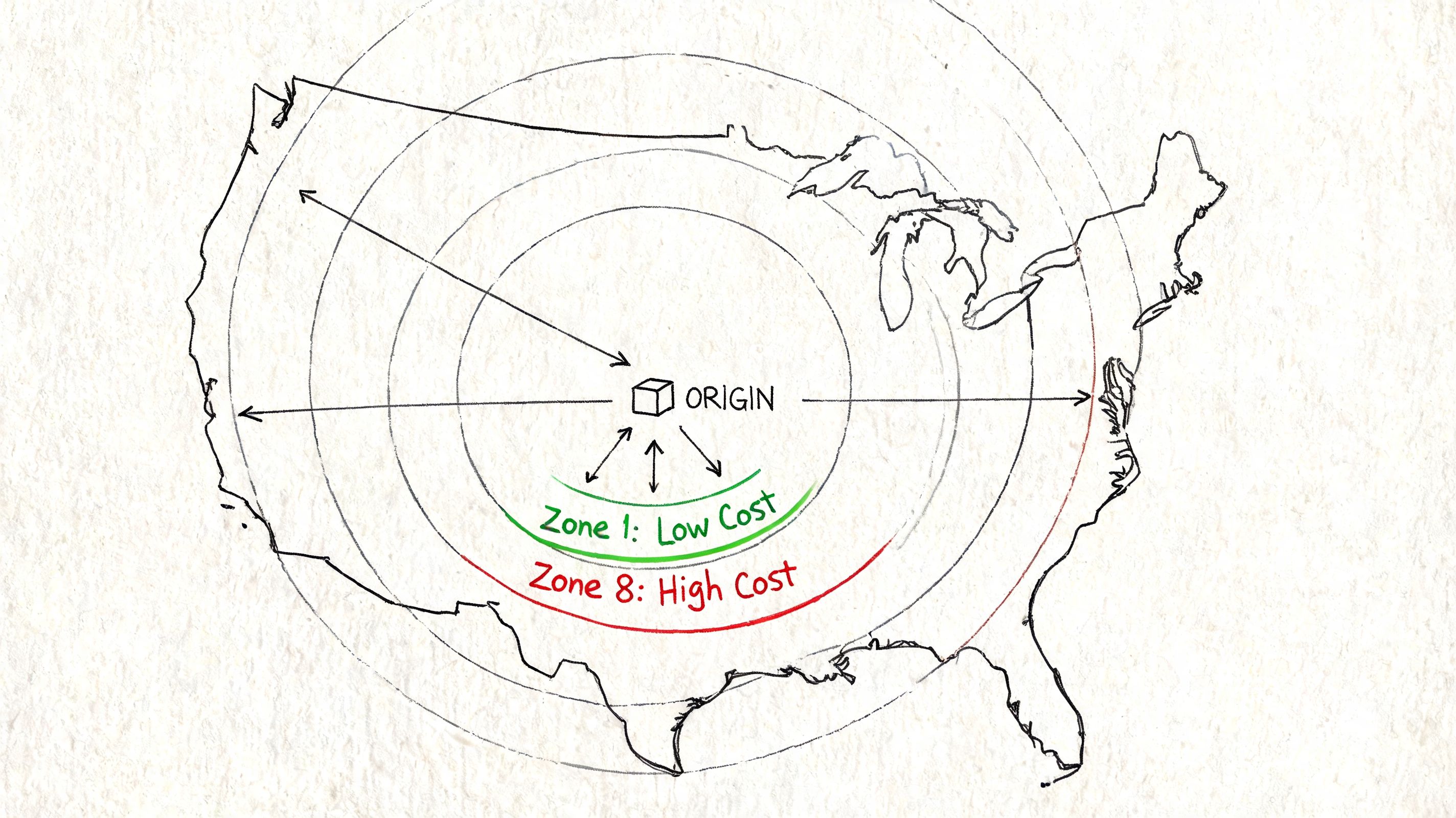
A long-haul shipment does more than raise postage. It raises the cost of every mistake around it. If an order going to a distant state gets held for a compliance check, rerouted, or canceled after labeling, the wasted labor and carrier spend hurt more than the same failure on a nearby order. That is why I look at zone strategy and compliance rules together, not as separate projects.
Read your order map before changing operations
Start with the last few months of orders and map them by destination state, zone, and product type. Then layer in the exceptions that create work for your team.
The useful patterns are usually these:
- Dense nearby demand where you can be aggressive on shipping offers without giving away margin
- Far-zone repeat orders that stay profitable only if pick, pack, and compliance review stay tight
- Restricted destinations that create extra touches, higher cancellation risk, or narrower carrier options
- Specific SKUs that break down at distance because fees and handling stack up faster than the selling price supports
That review usually exposes a network problem, not a simple rate problem.
When regional fulfillment earns its keep
Regional fulfillment can reduce zone exposure, but the math has to survive inventory reality. A second node can shorten delivery distance and lower transportation cost for a share of orders. It can also create split inventory, more transfers, and stockouts on the products that matter most.
Shopify’s guide to distributed inventory management explains the operational trade-offs well. Shorter delivery distances help, but only if order volume is consistent enough to justify putting the right inventory in more than one location.
For firearms retailers, there is another filter. If a product category needs tighter destination screening or different fulfillment handling, adding nodes without rule-based order routing can increase error rates. Saving a few dollars on postage is not a win if the wrong location processes an order that should have been blocked or reviewed first.
Regional fulfillment makes sense after volume, SKU mix, and compliance logic are stable enough to support it.
A lower-commitment option for smaller stores
A second warehouse is not the first move for every operation. Often the faster fix is charging more accurately by destination and keeping long-haul lanes from draining margin.
A location-based pricing model lets you protect margin in expensive zones without overcharging nearby buyers. This guide on creating location-based pricing strategies for restricted shipping zones is a practical reference for stores that need tighter control over restricted and high-cost destinations.
You can also use automation to make those zone decisions earlier. Tools built around rule execution, including newer AI agents for ecommerce, point toward a better workflow: evaluate destination, product, and shipping policy before the order reaches the packing queue. That matters more in firearms retail than in general ecommerce because the expensive part is often the exception handling, not the label itself.
| Approach | Best fit | Main trade-off |
|---|---|---|
| Single-node fulfillment | Smaller operations with concentrated demand | Higher exposure to long-haul and restricted-lane costs |
| Regional fulfillment | Stores with broad national demand and repeat order density | More inventory planning and routing complexity |
| Tiered shipping by zone | Stores that need margin protection without adding nodes | More customer pushback in expensive destinations |
Stop averaging away the problem
Flat shipping offers hide bad lanes. If reporting only shows one blended shipping number, the business keeps subsidizing distant and complicated destinations without seeing which orders specifically make money.
Break performance out by local, regional, and long-haul orders. Then separate standard shipments from orders that triggered extra review or destination restrictions. That is where the complete picture shows up.
Automate Compliance to Prevent Costly Returns and Blocked Shipments
Rate shopping helps, but firearms retailers usually lose more money in exception handling than in label pricing.
A manual compliance workflow can look fine at low volume. One person checks the destination, compares the item against state or local restrictions, asks a supervisor about an edge case, and releases the order. Costs build in quieter ways. Orders sit in review. Customer service waits for answers. Pickers touch orders that should have been blocked at checkout. Refunds and return handling eat labor that never shows up cleanly in a carrier report.
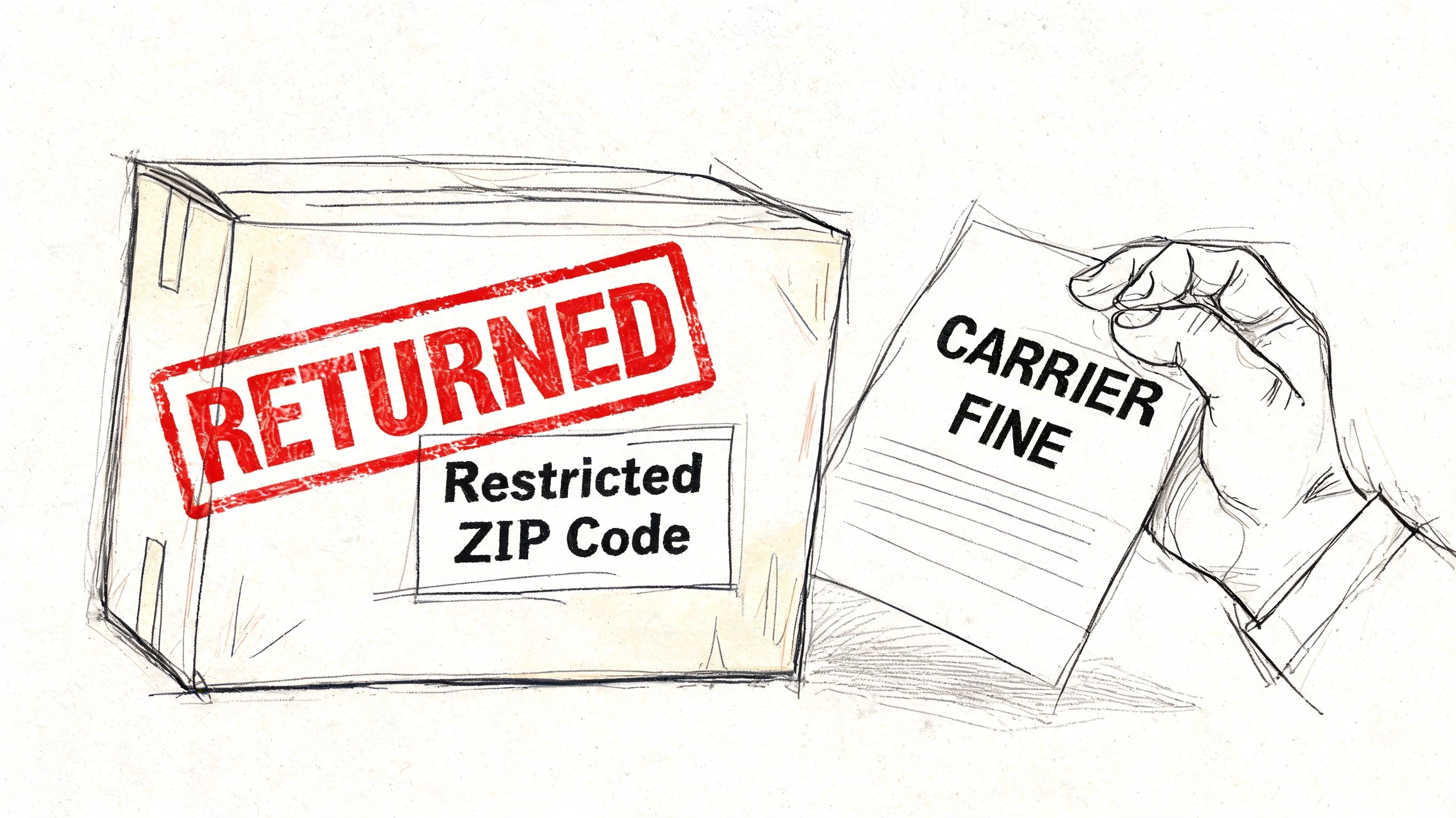
Manual review is expensive even when nobody gets fined
In firearms operations, compliance mistakes create shipping costs before a box leaves the building. A restricted order can trigger a support exchange, manager review, payment reversal, inventory put-back, and wasted pick-pack time. Generic ecommerce shipping advice rarely prices that in.
I have seen stores obsess over shaving a dollar off postage while staff spend far more than that resolving one bad order after payment. The expensive part is not always the returned package. It is the labor pileup around the exception.
Prevention beats cleanup
If your team is still checking restrictions after the order reaches fulfillment, the workflow is already too late.
The better approach is to stop bad orders before they enter the queue. That means screening destination, product type, and shipping rule compatibility during checkout, not after label creation and not after a warehouse handoff. For firearms retailers, that shift cuts rework, lowers refund friction, and keeps fulfillment focused on orders that can ship.
What good automation actually does
A useful compliance system in WooCommerce applies rules at checkout with enough geographic detail to match how restrictions are enforced in practice. State-level logic is often too broad. County, city, and ZIP-level controls are where many stores either prevent expensive mistakes or create unnecessary false blocks.
A workable setup should:
- Block restricted orders before payment turns into fulfillment work.
- Match rules to actual jurisdictions instead of broad statewide assumptions.
- Show the customer a clear reason for the block or limitation.
- Let staff update rules without depending on one person who knows the whole policy map.
- Create an audit trail so managers can explain why an order was allowed, held, or denied.
If you want a practical example of that setup, this guide to automated shipping compliance for WooCommerce stores explains the enforcement layer in more detail.
Consistency is where the savings show up
Teams often look for one dramatic number and miss the operating gain that matters more. The strongest return from compliance automation is consistency. Orders get screened the same way every time. New staff are less likely to improvise. Supervisors stop acting as the fallback rule engine. Fulfillment receives a cleaner queue with fewer manual holds.
That is also why the discussion around AI agents for ecommerce matters here. The useful idea is earlier decision-making. In a regulated store, systems should evaluate restrictions before warehouse labor, customer support time, and carrier spend get involved.
A clean process looks like this:
- Customer enters destination details at checkout.
- The store validates the order against product and location rules.
- Restricted combinations are blocked immediately or routed to a defined review path.
- Only eligible orders reach the packing queue.
- Staff spend time shipping orders, not investigating them.
That is where shipping cost reduction gets real for firearms retailers. Margin leaks often come from preventable compliance handling, not from the base rate on the label.
Track These KPIs for Continuous Shipping Savings
Cheap labels can hide an expensive operation.
I have seen stores celebrate a lower average rate while margin kept leaking through avoidable reviews, bad routing, and orders that should never have reached the packing bench. If you sell firearms or related products, the KPI set has to expose compliance friction, not just postage spend.
A useful dashboard is small, blunt, and reviewed every week. If the team cannot tie a metric to an action, cut it.
The KPI dashboard that matters
Track the numbers that show whether your shipping process is staying disciplined:
- Cost per shipment. Watch this by service level, package type, and destination band. A single blended number hides bad habits.
- Shipping cost as a share of revenue. This keeps rate wins honest. If order values dip, your shipping program can look stable while profit gets squeezed.
- Delivery exception rate. Use this instead of a broad failed-delivery bucket. It catches address problems, adult-signature misses, carrier access issues, and orders that should have been held before release.
- Carrier mix by order type. If ground-friendly orders keep moving on premium services, routing rules are not being followed.
- Manual exception count. This is the compliance KPI many generic guides miss. Every manual review adds labor, slows release, and increases the odds of inconsistent decisions.
- Return-to-sender rate. For regulated products, this is often where hidden shipping waste shows up first.
Measure the work your team should not be doing
For firearms retailers, I care as much about exception volume as pure freight cost.
If staff are touching too many orders, one of three things is usually wrong. Checkout is collecting weak address data. Restriction rules are too loose and forcing human review later. Or the warehouse is acting as the final compliance checkpoint, which is the most expensive place to catch a bad order.
That is why manual exceptions deserve their own line on the dashboard. They are not administrative noise. They are a direct cost driver.
Pitney Bowes found that 40% of consumers have experienced a shipping issue in the past year, with delivery delays, lost packages, and damaged shipments among the most common problems, according to the Pitney Bowes BOXpoll consumer shipping survey. For a firearms retailer, every exception tied to a regulated order carries extra support time and a higher risk of refund friction, reshipment cost, or compliance review.
Review exceptions by cause. Address quality, restriction mismatch, signature failure, customer no-show, and carrier handling each need a different fix.
How to use the numbers
Review the dashboard on a fixed cadence and force a decision from each KPI.
| KPI | What to ask |
|---|---|
| Cost per shipment | Which cartons, services, or lanes increased cost this week? |
| Shipping cost as share of revenue | Are freight costs rising faster than average order value? |
| Delivery exception rate | Which issues started at checkout, and which started with the carrier? |
| Carrier mix | Where are staff overriding the intended service selection? |
| Manual exceptions | Which rule can we automate so this order never needs human review? |
| Return-to-sender rate | What percentage came from preventable compliance or address problems? |
Do not rely on carrier reports alone. Store data, support tickets, payment holds, and fulfillment notes usually expose the problem sooner.
Teams that keep shipping costs down treat these KPIs as operating controls. They do not just watch the numbers. They remove the repeatable causes behind them.
If you're running a WooCommerce firearms store and still handling destination checks manually, that's the first leak to close. Ship Restrict helps retailers block restricted orders before checkout with granular rules by state, county, city, and ZIP code, so fulfillment teams spend less time on exception handling and more time shipping clean, compliant orders.
Automate Shipping Compliance
Stop worrying about restricted states. Ship Restrict handles it automatically.

Cody Yurk
Founder and Lead Developer of ShipRestrict, helping e-commerce businesses navigate complex shipping regulations for regulated products. Ecommerce store owner turned developer.
Automate Shipping Compliance
- Block restricted states
- No more cancellations
- Set and forget
3-day free trial · Card required