Shipping Cost Canada: Master 2026 Rates & Customs
Master the shipping cost canada. Our guide covers carrier rates, customs, dimensional weight, and how to automate compliance for your WooCommerce store.
A Canadian order comes through. The cart value looks good. Then the questions start.
Can you ship that item legally? Will the buyer get hit with duties at delivery? Is the quoted rate even close to the final landed cost once dimensional weight, remote surcharges, and customs handling are added? For a WooCommerce firearms retailer, shipping cost canada isn't just a freight question. It's a margin question, a customer experience question, and sometimes a compliance question.
A lot of stores get into trouble because they treat Canada like a simple extension of the U.S. market. It isn't. The border changes paperwork. Provincial and local realities change delivery economics. Regulated goods add another layer of review, especially when the shipment contains parts, accessories, or items that invite closer inspection. The order may look profitable on the product page and turn into a headache after label creation.
That volatility is real. General freight rates in Canada saw the four-month moving average rise 26.8% from 1,251 to 1,587 Canadian dollars between July 2021 and August 2022, and by early 2025 rates had softened but still remained a meaningful variable for eCommerce profitability. If you're setting flat shipping rules once and forgetting them, you're probably underestimating your cost exposure.
Automate Shipping Compliance
Block orders to restricted states automatically. 3-day free trial.
Start Free TrialMerchants that handle this well usually stop thinking in terms of "What's the cheapest label?" and start thinking in terms of "What's the safest profitable shipment?" That means pricing with enough discipline to absorb variability, choosing carriers by shipment profile instead of habit, and tightening documentation before parcels ever reach the border. If your supply chain also includes imported inventory, it helps to understand the upstream side too. This guide on reliable import from China to Canada is useful context because inbound freight decisions often shape downstream fulfillment costs and customer pricing.
The True Cost of Shipping to Canada for Your Store
For most U.S. stores, the first mistake is quoting Canada with the same logic used for domestic orders. That usually means a base carrier rate plus a little padding. With regulated products, that approach breaks fast.
A Canadian shipment often carries four separate cost layers. The transport charge is only the first one. Then come packaging-driven billing changes, cross-border fees, taxes and duties, and operational friction from documentation checks or address-level restrictions.
What eats your margin first
The expensive part isn't always the obvious line item. It can be the order that clears checkout with a reasonable rate, then picks up extra cost because the destination is remote, the box dimensions push the billed weight higher, or the shipment gets delayed over paperwork.
For firearms parts and adjacent regulated categories, the hidden cost often comes from avoidable process failures:
- Bad classification: Product descriptions that are too vague create customs friction.
- Weak packaging choices: Protective packaging can make a low-weight parcel bill like a much heavier one.
- Overly broad shipping zones: A store may allow checkout to locations it shouldn't serve profitably or compliantly.
- Customer surprise at delivery: Postal and courier thresholds work differently, so the buyer's final cost isn't always obvious unless you model it in advance.
Practical rule: If your team only checks legality after the order is paid, your shipping process is too late in the workflow.
Why this matters more for regulated goods
A normal apparel store can survive an occasional shipping misquote. A regulated-goods merchant has less room for error. Returns are harder. Rejected shipments are more expensive. Customer support conversations take longer because the issue isn't just speed. It's whether the shipment should have been accepted in the first place.
That changes how you should think about fulfillment. The best operators build shipping rules around three filters before they ever compare label rates:
- Can this product ship to that address?
- Can we document it cleanly for cross-border movement?
- Can we ship it profitably after all non-base costs are included?
If you answer those in that order, Canada becomes manageable. If you answer only the third one, you'll keep paying for mistakes that didn't need to happen.
Free Shipping Compliance Audit
We'll review your WooCommerce store's shipping compliance for free.
Why Canadian Shipping Rates Are So High

Canadian shipping is expensive for structural reasons, not because carriers feel like charging more. If you don't understand those structural reasons, you'll keep rate shopping around symptoms instead of designing around the problem.
Canada's population density is 4 people per square kilometer, compared with 33 in the U.S. That single fact explains a lot. Carriers have longer routes, fewer delivery concentrations, and less opportunity to spread network cost across dense order volume. For a merchant, that means two orders with similar weights can behave very differently depending on destination.
Distance is only part of the story
Most merchants think in miles. Carriers think in route economics.
A dense urban corridor gives a carrier repeated stops, shorter final-mile inefficiency, and more predictable capacity use. A sparse delivery network doesn't. When your package heads toward a lower-density region, you're not just paying for distance. You're paying for lower route efficiency.
That matters for firearms retailers because customer demand often isn't concentrated only in major metros. Hunters, sport shooters, and rural buyers can sit in locations that are harder and more expensive to serve. If you offer a flat nationwide Canadian shipping rate, those orders can erode margins.
Universal coverage changes the economics
Canada Post also operates under a universal service obligation, which means service must reach every address, including rural and remote areas, without variable pricing by address in the way a pure profit-maximizing model would prefer. That broad service obligation supports access, but it also contributes to higher overall cost structures across the network.
From a merchant perspective, that creates a common trap. A postal option can look simpler, but simplicity at checkout doesn't remove the cost reality behind the network.
Cheap-looking service menus often hide expensive geography.
Here's the practical takeaway:
- Urban destinations usually behave more predictably. Transit, handoff, and pricing tend to be easier to estimate.
- Remote destinations create more cost volatility. Even when the base quote looks acceptable, accessorials and service limitations can stack up.
- Fuel sensitivity matters more on long-haul networks. When a country is this large, linehaul cost pressure doesn't stay isolated for long.
- Regulated goods add friction on top of hard geography. A parcel that's already expensive to route becomes worse if documentation or eligibility is off.
A short explainer on transport economics helps put that into perspective:
<iframe width="100%" style="aspect-ratio: 16 / 9;" src="https://www.youtube.com/embed/W4r9Q1poGrA" frameborder="0" allow="autoplay; encrypted-media" allowfullscreen></iframe>What works and what doesn't
What works is designing your shipping policy around the shape of Canada, not around hope. Break out remote destinations. Use destination-aware pricing. Build extra margin into categories that need heavier packaging or extra review.
What doesn't work is copying your U.S. shipping setup and adding "Canada" as one more zone.
Decoding Your Canadian Shipping Invoice Components
Most Canadian shipping invoices look manageable at first glance, then ugly after the add-ons appear. The cure is simple. Read the invoice in layers.
Start with billed weight, not product weight
The first number to verify is the billing weight. Carriers in Canada charge by the greater of actual weight or volumetric weight. Canada Post explains that a 1 kg package measuring 40 x 30 x 20 cm has a volumetric weight of 4.8 kg because 24,000 cm³ / 5,000 = 4.8 kg. In practice, that means a light package can be charged like a much heavier one.
For firearms parts retailers, this comes up all the time. The item may be compact, but the packaging often isn't. Foam, rigid outer cartons, void fill, and separation between components can push the box into a dimensional penalty.
The invoice layers that matter
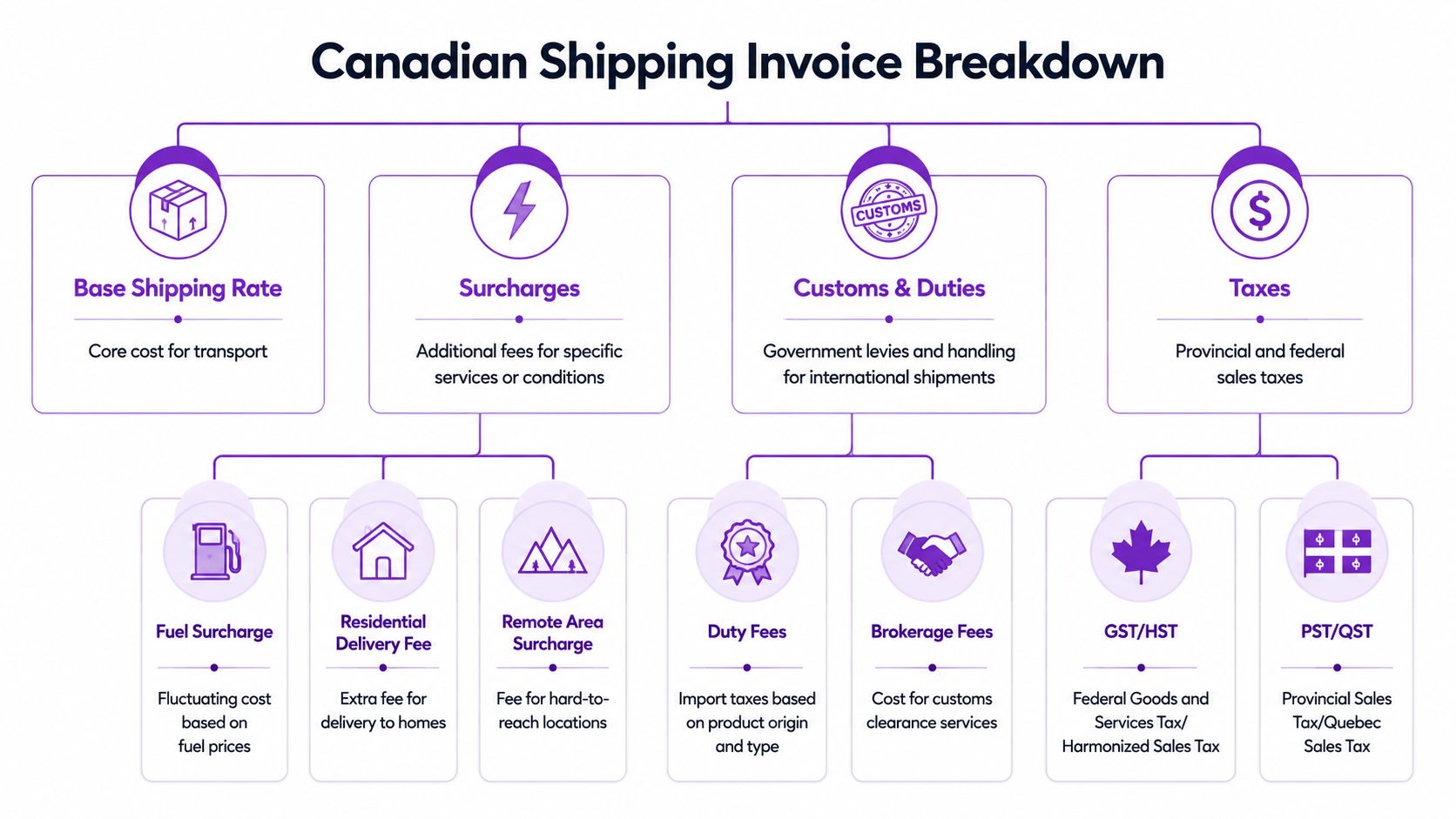
Think of the invoice as four buckets.
| Invoice component | What it means for your store |
|---|---|
| Base shipping rate | The transport charge based on service, route, and billed weight |
| Surcharges | Extra fees tied to fuel, residential delivery, remote areas, and handling conditions |
| Customs and duties | Border-related charges based on shipment type, value, and classification |
| Taxes | Federal and provincial tax treatment applied at import or sale, depending on setup |
The biggest operational mistake is treating the base rate as the actual rate. It rarely is.
Where surcharges usually appear
Some surcharges are predictable. Others show up only after the carrier audits dimensions, address type, or destination profile. That makes post-shipment billing review important, especially if your store ships a mix of accessories, parts, and compliance-sensitive items.
Watch these line items closely:
- Fuel surcharge: This fluctuates and can materially change the all-in cost of a route.
- Residential delivery fee: Direct-to-consumer shipments can trigger extra cost compared with commercial delivery points.
- Remote area surcharge: Hard-to-reach destinations can add significant expense quickly.
- Additional handling: Packaging shape, irregular dimensions, or packing quality can trigger extra review and cost.
If your packaging team doesn't know dimensional rules, your finance team will learn them from carrier invoices.
A simple way to audit your own labels
Use this quick check before you publish rates in WooCommerce:
- Measure the final packed box, not the product spec.
- Calculate dimensional exposure before choosing a service.
- Review destination type for residential or remote risk.
- Flag regulated SKUs that need stronger packaging or closer paperwork review.
- Compare posted customer charge to expected carrier invoice, not just checkout estimate.
A lot of merchants focus on negotiating better rates. That's useful, but better packaging discipline often solves the easier problem first. If your store is overboxing low-weight items, the cheapest label on the screen won't save you.
Choosing the Right Carrier for Canadian Shipments
Carrier choice for Canada shouldn't be based on habit. It should be based on package profile, destination, customer expectation, and how much risk you're willing to carry when the shipment contains regulated goods.
The common lineup is USPS handing off to Canada Post, plus UPS and FedEx. Each can be the right answer. Each can also be the wrong answer if used by default.
USPS and Canada Post
USPS is often the first option merchants test because it feels familiar and can work well for lighter parcels. The problem is that many stores treat it as the automatic low-cost winner.
That assumption doesn't always hold. According to Shippo's Canada shipping comparison, FedEx International Connect Plus was $19.18 for 4 days, while USPS Priority Mail was $42 for 6 to 10 days for a 1 lb shipment from NYC to Toronto in April 2026. For that lane and package, the courier option was both cheaper and faster.
USPS still has a place. It can be workable for certain lighter shipments, especially when delivery urgency is lower and the parcel profile is simple. But regulated-goods merchants should be careful with any service path that creates less control over tracking visibility, handoff quality, or customer communication at the border.
UPS and FedEx
UPS and FedEx usually make more sense when you need tighter tracking, better operational consistency, and more deliberate management of cross-border flow. That's especially relevant for products that may prompt questions during customs review.
Here's the trade-off in plain terms:
- FedEx: Strong option when aggregator pricing is available and you need a good speed-to-cost balance.
- UPS: Often useful for merchants that already have negotiated terms or operational familiarity with UPS workflows.
- USPS to Canada Post: Can still fit the right lightweight shipment, but don't assume it's cheapest or easiest for every order.
How I'd choose by shipment type
| Shipment profile | Better starting point | Why |
|---|---|---|
| Light parcel to major city | FedEx or USPS | Compare both live. Assumptions break often on these lanes. |
| Higher-value regulated item | FedEx or UPS | Better tracking and tighter carrier control usually matter more than saving a small amount on base postage. |
| Remote destination | UPS or FedEx with full rate review | You need a clearer picture of total charges before checkout. |
| Customer expects detailed updates | Courier services | Handoffs tend to be easier to manage operationally. |
What usually works in WooCommerce
The best setup is not "pick one carrier." It's "pick rules for when each carrier is allowed to win."
That means:
- compare rates at label time,
- separate lightweight urban shipments from compliance-sensitive orders,
- and avoid presenting all services to all customers.
For merchants building a more specialized shipping stack for regulated categories, this guide to regional carrier options for regulated products is a useful companion. The point isn't to add more carriers for the sake of it. The point is to match the carrier to the legal and economic profile of the shipment.
The cheapest service on paper becomes the most expensive service if it creates a preventable customer dispute or a border delay.
Navigating Canadian Customs Duties and Paperwork
Most failed Canada shipments don't fail because the merchant couldn't buy a label. They fail because the paperwork and fee logic weren't handled with the same discipline as the carrier selection.
The threshold problem merchants miss
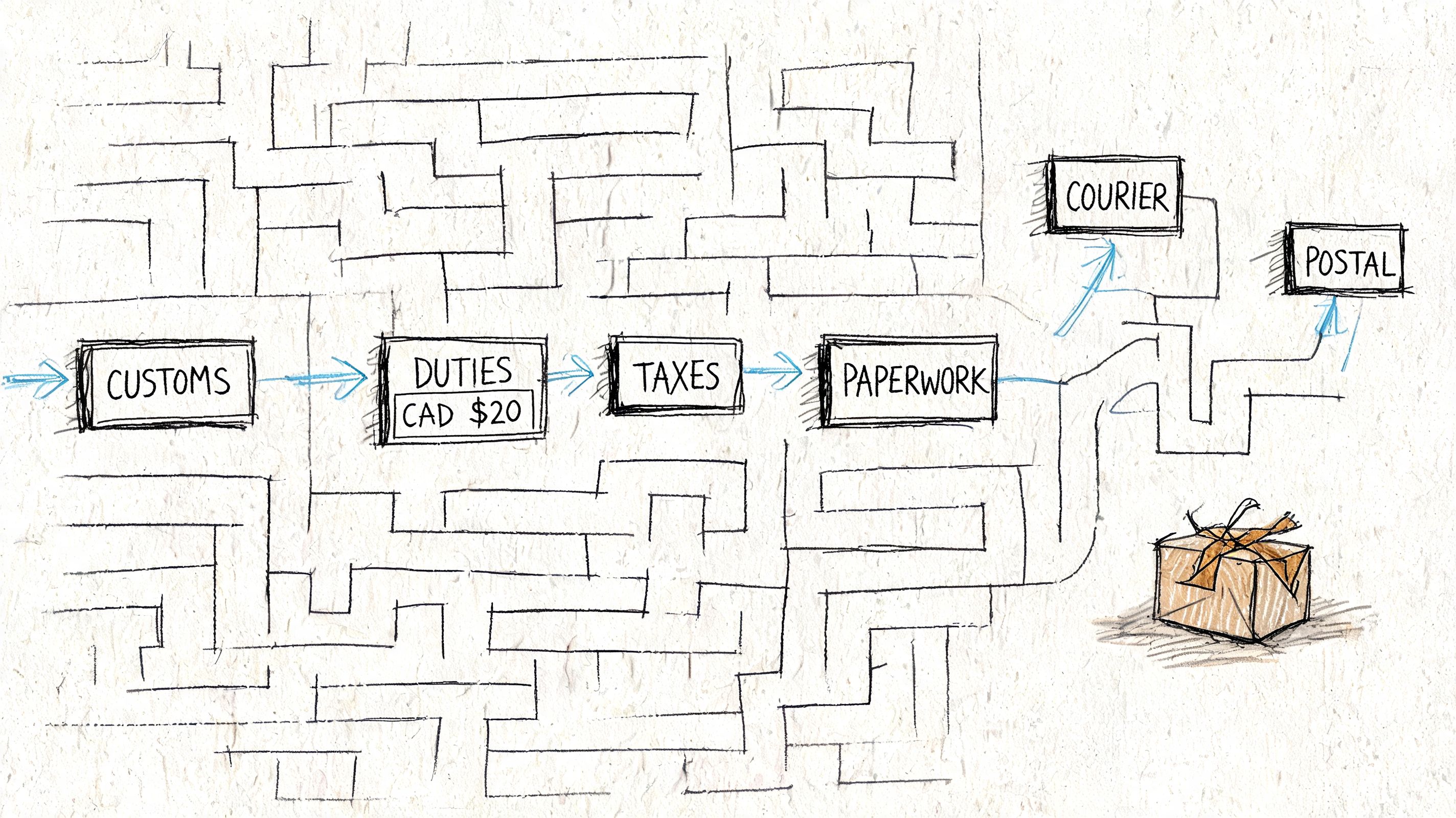
Postal and courier shipments don't play by the same threshold rules. That's where many customer surprises begin.
According to Shippo's guide to shipping from the U.S. to Canada, postal shipments are subject to duties and taxes over CAD $20, while courier shipments have a higher threshold of CAD $150. The same source notes that dutiable items sent via Canada Post incur a CAD $9.95 handling fee per item.
That difference changes your checkout strategy. A shipment that looks affordable through the postal channel can become annoying for the buyer if the parcel crosses that lower threshold and picks up extra charges on arrival.
Paperwork quality matters more for regulated goods
When the shipment includes firearms parts, accessories, or anything likely to invite closer inspection, vague paperwork is expensive. Product descriptions like "metal parts" or "sporting accessory" are asking for delay. The border officer or broker needs enough specificity to understand what the item is without guessing.
Your commercial invoice should be accurate, plain, and consistent with the cart contents, packing slip, and product classification. If your staff needs a refresher on transport documents more broadly, this article on understanding the bill of lading is a good operational primer. It helps teams separate document roles instead of treating every shipping paper as interchangeable.
A cleaner customs workflow
For WooCommerce merchants, a workable process usually looks like this:
- Classify the item correctly. Internal catalog discipline matters here. If your SKU data is sloppy, customs documents will be sloppy.
- Write precise product descriptions. Enough detail to identify the item, not marketing copy.
- Match declared value to the transaction. Underdeclaring creates bigger problems than it solves.
- Choose the service with the threshold and customer experience in mind. Cheap postage and expensive surprise fees are a bad combination.
- Review restricted-item documentation before label purchase. Don't wait until after payment capture.
If your team handles cross-border restricted shipments regularly, this resource on cross-border documentation for restricted goods is worth keeping in your workflow docs.
The customer communication piece
A technically correct shipment can still create a bad buying experience if the customer isn't warned about what happens at the border. The buyer needs to know whether your store charges duties upfront, leaves them to be collected on delivery, or restricts service types based on product category.
Use plain language in checkout and post-purchase emails. Tell them what you'll ship, what you won't, and what fees may still sit outside the base shipping quote.
Border friction gets expensive fastest when the customer says, "No one told me I would owe that."
For regulated goods, that sentence often leads to support time, refused delivery, return costs, and inventory headaches you didn't need.
Practical Strategies to Lower Your Canada Shipping Costs
You don't control Canada's geography. You do control how often you let bad packaging, weak zoning, and lazy carrier defaults drain margin.
The most effective cost reductions usually come from operational discipline, not from chasing a miracle carrier.
Fix packaging before negotiating harder
Canada's shipping economics punish wasted space. InterFulfillment's overview of Canadian shipping complexity notes that Canada's 44-zone system can increase rates by 50-200% for remote areas, and that a 5 lb package to a remote zone can incur over $15 in additional handling and volumetric fees. The same source says those costs can be mitigated by optimizing package dimensions by 10-20%.
That gives you a very practical lever. Before you spend time trying to squeeze your carrier rep, tighten your carton library.
Sample Cost Savings via Packaging Optimization
| Scenario | Dimensions (L x W x H inches) | Dimensional Weight (lbs) | Estimated Cost (UPS Standard) |
|---|---|---|---|
| Original bulky pack | 18 x 14 x 8 | Higher billed weight | Higher quoted cost |
| Reduced void fill | 16 x 12 x 8 | Lower billed weight | Lower quoted cost |
| Reworked insert and carton | 14 x 12 x 7 | Lower billed weight again | Lower all-in cost potential |
The exact savings depend on service and lane, but the pattern is consistent. Smaller, tighter, more deliberate packaging lowers exposure.
Use zone-aware pricing
A single Canada shipping rule is convenient for the merchant and often wrong for the business.
Instead:
- Separate major metro destinations from remote regions. They don't behave the same.
- Build premium shipping logic for hard-to-serve areas. That doesn't always mean charging more visibly. Sometimes it means embedding some cost into product pricing for specific assortments.
- Limit oversized products by destination. If a product category is margin-safe in urban corridors and margin-poor in remote areas, your store should reflect that.
Present fewer, better options
More choices don't always improve conversion. In regulated categories, too many shipping methods can confuse customers and create internal errors.
What tends to work better is a smaller menu:
- one economical option for eligible parcels,
- one tracked courier option for customers who value reliability,
- and no option at all where the combination of regulation and destination creates too much risk.
Rate shop, but don't worship rate shopping
Aggregator platforms are useful. They can surface better courier pricing than many merchants expect, especially on cross-border parcels. But a better rate screen doesn't fix poor package data, weak SKU classification, or broad checkout eligibility.
So use live rate shopping as the final step, not the first one.
Key takeaway: The fastest way to lower shipping cost canada isn't always a new carrier. It's fewer avoidable billing mistakes.
If your store reviews packaging, destination logic, and documentation together, you'll usually find cost control opportunities that were hidden in plain sight.
Automating Shipping Compliance for Canada with WooCommerce
Manual review works when order volume is low and the catalog is simple. It breaks when your store carries regulated items, ships across borders, and needs to decide at checkout whether a destination is eligible.
For Canada, the challenge isn't one rule. It's an accumulation of rules. Product-level restrictions, address-level restrictions, packaging realities, customer-facing rate logic, and customs readiness all intersect before the order should be accepted. If your team is still checking those conditions manually after payment, your process is fragile.
What automation should actually do
Good automation doesn't just hide shipping methods. It enforces policy before an invalid order moves downstream.
For a WooCommerce firearms retailer, that means your system should be able to:
- Block non-eligible destinations before checkout completes.
- Restrict certain product categories to approved regions only.
- Show clear customer messaging when a shipment can't proceed.
- Support rule maintenance without requiring staff to inspect every order by hand.
- Reduce edge-case mistakes caused by staff turnover or inconsistent review habits.
The strongest implementations combine shipping logic with compliance logic. A store shouldn't ask, "Can we get a label?" until it has already answered, "Should we even permit this order?"
Why this matters operationally
Automation protects margin as much as it protects compliance. Every blocked bad order saves more than legal risk. It also saves customer support time, label voids, manual address research, and inventory disruption from failed fulfillment attempts.
That's especially true when the order sits in a gray area. The product might be acceptable in one region and not another. The carrier may serve the destination, but the shipment still may not fit your internal policy for regulated items. Humans miss those distinctions under pressure.
For teams building this into WooCommerce, this guide on automated shipping compliance for WooCommerce stores lays out the operational model clearly.
Stores that automate restriction logic early don't just avoid bad shipments. They create a cleaner checkout experience for good ones.
At that point, shipping cost canada becomes easier to manage because you're no longer trying to price and process orders that should never have entered the pipeline in the first place.
If you're running WooCommerce and need to control destination rules for regulated products, Ship Restrict is built for exactly that problem. It lets you automate granular shipping restrictions by location, prevent non-compliant orders before checkout, and replace manual address review with enforceable rules that scale. For firearms retailers shipping into complex markets like Canada, that's the difference between reacting to shipping mistakes and preventing them.
Automate Shipping Compliance
Stop worrying about restricted states. Ship Restrict handles it automatically.

Cody Yurk
Founder and Lead Developer of ShipRestrict, helping e-commerce businesses navigate complex shipping regulations for regulated products. Ecommerce store owner turned developer.
Automate Shipping Compliance
- Block restricted states
- No more cancellations
- Set and forget
3-day free trial · Card required