Firearms Same Day Service: WooCommerce FFL Compliance
Offer same day service for firearms on WooCommerce. Our playbook helps FFLs ensure safe policy, operations, Ship Restrict setup, and legal compliance.
You're looking at the checkout page, watching customers ask for faster fulfillment, and wondering whether you can offer same day service without turning your FFL into a compliance experiment.
That pressure is real. Big retail has trained buyers to expect speed, and firearm buyers don't stop being eCommerce customers just because the product is regulated. But for an FFL, “faster delivery” isn't a simple operations upgrade. It changes who handles inventory, when legal checks happen, how address restrictions are enforced, what your staff documents, and how you respond when a handoff fails.
The stores that get into trouble usually make the same mistake. They treat same day service like a shipping option. It isn't. For firearms, it's a controlled transfer workflow with legal consequences attached to every shortcut.
The Same Day Service Dilemma for FFLs
A lot of dealers start in the same place. They see national brands normalizing fast fulfillment, then they look at their own local footprint and think, “We already have inventory nearby. Why not offer same day service inside our metro area?”
Automate Shipping Compliance
Block orders to restricted states automatically. 3-day free trial.
Start Free TrialThe business logic is understandable. Same-day delivery still represents a small share of parcel activity, but consumer demand is there. Capital One Shopping says same-day delivery accounts for about 2% to 3% of the U.S. parcel market, and 41% of American consumers are willing to pay more for same-day delivery according to its same-day delivery market data. That's enough to get any retailer's attention.
For an FFL, though, the market opportunity is the easy part. The hard part is building a service that doesn't create preventable violations.
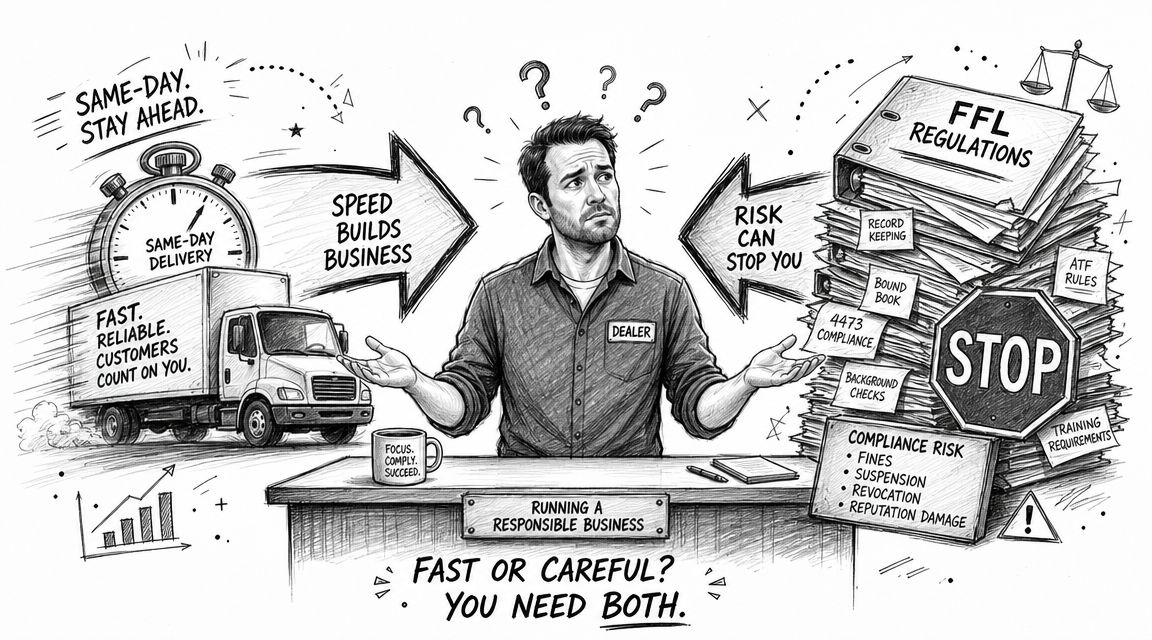
Speed is not the product
What customers think they're buying is convenience. What you're selling is a tightly limited operational promise.
A defensible firearms same day service model usually depends on a few constraints:
- Defined geography: Not “within driving distance.” Specific ZIP codes or other exact boundaries.
- Inventory proximity: The item must already be in the location that will lawfully process and release it.
- Controlled timing: Orders must come in before a hard internal cutoff.
- Qualified handoff: The final transfer can't rely on guesswork, casual staffing, or vague ID checks.
That's why generic same-day advice fails firearm dealers. Most ecommerce content talks about route density and customer experience. Your bigger exposure sits in transfer legality, documentation, address eligibility, and what happens when a customer expects one thing but your rules require another.
Practical rule: If your staff can't explain exactly when an order stops qualifying for same day service, you don't have a service. You have a liability gap.
Why operational discipline matters more than marketing
McKinsey noted that same-day delivery was once projected to reach a much larger share by 2025, but by the end of 2023 it remained far smaller because of capacity constraints and slower funding for new models. It also estimated that same-day delivery accounts for less than 5% of the courier, express, and parcel market in most countries, according to McKinsey's analysis of same-day delivery economics and constraints.
That matters because it confirms something experienced operators already know. Same day service works best when it's narrow, disciplined, and built around density. For firearm retailers, that limitation is a strength. You should want a narrow operating box.
If you're evaluating whether your category and store setup can even support this safely, start with the compliance realities specific to firearms shipping restrictions for online retailers. The stores that last in this space don't promise speed broadly. They promise it selectively, and only where they can prove control.
Free Shipping Compliance Audit
We'll review your WooCommerce store's shipping compliance for free.
Crafting Your Bulletproof Service Policy
Before you assign a driver, configure WooCommerce, or advertise anything, write the policy. This document is your operating constitution. If it's vague, your staff will improvise. If your staff improvises, your records will become inconsistent. In a regulated business, inconsistent records become expensive.
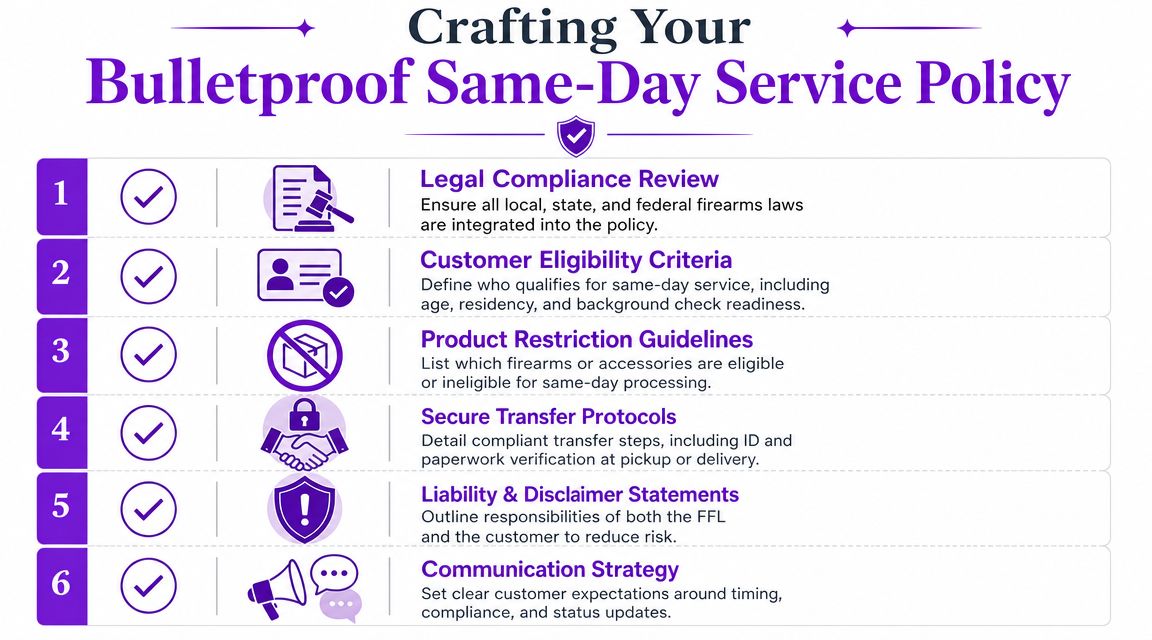
Define where same day service exists
Don't define coverage by radius alone. Use exact serviceable ZIP codes, and if your local legal or practical realities require it, tighten further by city or county. Radius sounds simple in a meeting and causes edge-case problems in production.
That matters because one of the biggest failure points in same-day operations is the gap between what customers expect and what the system can support. The public access analysis published in PMC emphasizes the importance of knowing under what conditions service stops being same day. For regulated goods, that question isn't academic. It's where compliance risk shows up.
A good service-area policy answers all of these:
- Which ZIP codes qualify
- Which store or inventory node fulfills them
- What happens if an address sits near a boundary
- Whether commercial addresses, residential addresses, or both are eligible
- Whether the service applies every day or only on selected operating days
Decide what is eligible and what is not
Don't let “same day” apply to your entire catalog by default. Build a product eligibility list.
Use a simple decision table:
| Product category | Same day eligible | Reason for caution |
|---|---|---|
| Firearms already staged in the correct licensed location | Possibly | Only if the transfer workflow is fully controlled |
| Ammunition or accessories | Depends | State and local restrictions still apply |
| Items requiring extra review | Usually no | Manual review breaks the timeline |
| Backordered or distributor-sourced items | No | You can't promise what you don't physically control |
If a product requires special handling, extra paperwork review, delayed approval, or manual legal interpretation, remove it from same day service. Customers may dislike a narrower offer. Regulators dislike inconsistent treatment much more.
Lock in non-negotiable transaction rules
Your policy should spell out the hard edges in plain language:
- Order cutoff: The exact daily time after which the promise no longer applies.
- Verification standard: What ID, matching details, and transaction records are required before release.
- Delivery refusal conditions: Mismatched identity, unavailable recipient, unsafe conditions, bad address data, or any other failed verification.
- Return-to-inventory process: How the item is logged, secured, and documented when the handoff doesn't happen.
- Customer communication: What messages go out when the order is accepted, under review, delayed, refused, or rescheduled.
Same day service fails most often where policy leaves room for staff interpretation.
That's why many dealers benefit from drafting the policy language carefully before launch. If you need a structured starting point for the legal text, a tool like AI-powered contract creation can help organize clauses and internal language, though it should never replace counsel familiar with firearms and state-level transfer law.
Write the refusal clause like you expect to use it
Most store owners spend time on the promise and almost none on the refusal. That's backwards.
Your refusal-of-service clause should make clear that the store may suspend, delay, or deny same day service whenever address verification, legal eligibility, staffing, safety, or documentation conditions aren't met. If the clause sounds too soft, your team won't enforce it when pressure rises.
The stores that stay compliant build policy around the failed handoff, not just the successful one.
Designing Your Operational Workflow
Once the policy exists, turn it into a repeatable workflow. A same day firearm order should move through controlled checkpoints, not through a loose “someone will handle it” process. Every handoff needs an owner. Every owner needs a documented responsibility.
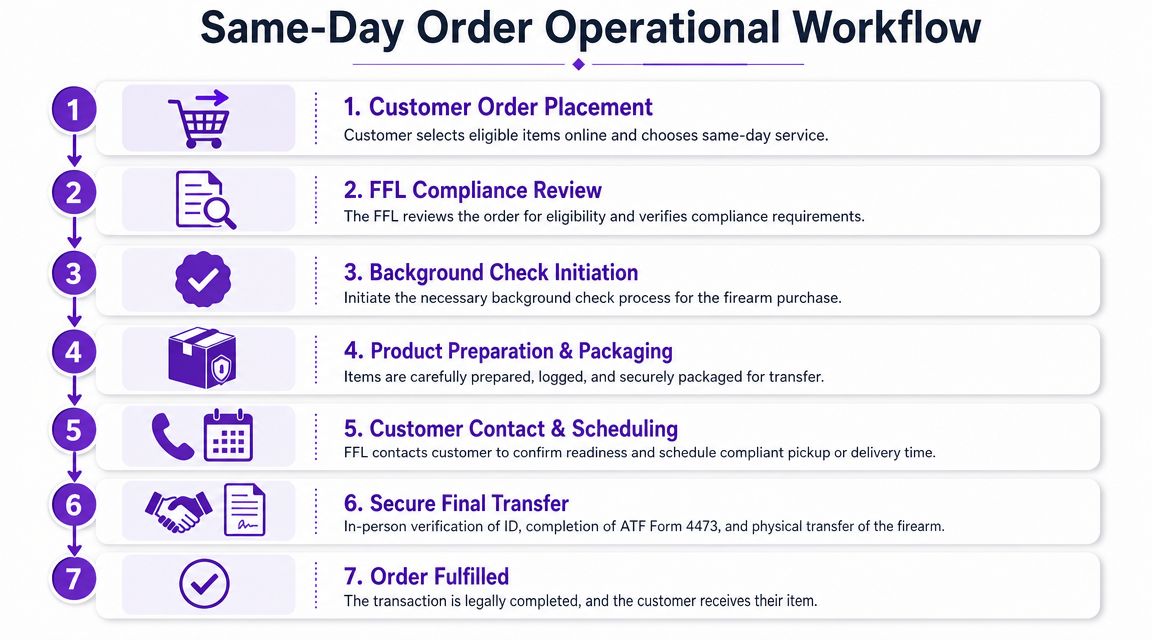
Build the workflow around four checkpoints
Shipium's operational guidance is useful here because it focuses on execution, not marketing. It identifies four critical checkpoints for same-day operations: a hard order cut-off time, rapid pick/pack speed, an efficient carrier handoff, and diligent exception monitoring. It also notes that on-time rate and first-attempt delivery success should be core metrics, according to Shipium's same-day delivery technology guidance.
For firearm retailers, those checkpoints should look like this:
-
Order intake and qualification
The order enters the system only if the address, product, and service window qualify. -
Compliance review before physical movement
Staff confirms the order is eligible for the same-day path before inventory leaves controlled storage. -
Secure pick, package, and dispatch prep
The item is pulled, logged under your internal workflow, packaged securely, and assigned to an authorized delivery process. -
Exception monitoring until final disposition
Staff doesn't assume success once the item leaves the counter. Someone tracks the delivery status through completion, refusal, or return.
A workable same day chain of custody
Think in terms of custody changes. If you can't map them on paper, don't launch the service.
A clean operational sequence often looks like this:
- Checkout approval: The system accepts same day service only for eligible orders.
- Manual review queue: A trained employee validates the order against store policy.
- Inventory pull: Backroom staff retrieves the item from the correct location.
- Packaging and documentation: The order is sealed, labeled internally, and logged for movement.
- Dispatch release: The item moves to the approved driver or internal delivery staff under a recorded handoff.
- Delivery attempt: The recipient is verified according to your policy before any release.
- Closeout or exception: The transaction is either completed or moved into the return-and-reschedule path.
The backroom is where same day service is won or lost. If pick, review, and dispatch are sloppy, the customer sees it later as a “delivery problem,” but the real failure started inside the store.
Track reliability like an auditor will read it
Don't collect vanity metrics. Track what proves control.
Use a short scorecard:
| Metric | Why it matters |
|---|---|
| On-time rate | Shows whether your published promise is realistic |
| First-attempt delivery success | Reveals whether your verification and scheduling process is working |
| Orders removed from same-day path | Shows whether your rules are too loose at checkout |
| Exception category by cause | Helps separate address issues from staffing or inventory problems |
| Return-to-inventory completion | Confirms failed handoffs are being closed properly |
You'll learn more from ten failed deliveries with clean notes than from a hundred “successful” orders with poor records. Same day service for firearms isn't judged only by speed. It's judged by whether every movement was controlled and explainable after the fact.
Navigating Carrier and Legal Constraints
Most of the operational work happens inside your store. Most of the catastrophic risk appears at the boundary where your process meets another person, another company, or another interpretation of the law.
That's why the delivery-agent question matters so much. Who is physically moving the item, under whose authority, with what training, and with what documentation standard?
In-house staff versus third-party courier
This isn't only a cost decision. It's a control decision.
Here's the practical comparison:
| Model | Main advantage | Main risk |
|---|---|---|
| In-house employee | Better training control and clearer accountability | Higher internal staffing burden |
| Dedicated contracted courier with tight procedures | Possible operational efficiency | Requires unusually strong documentation and supervision |
| Gig driver or ad hoc courier network | Fast capacity on paper | Weak control, inconsistent training, and serious liability questions |
For firearms, the weakest option is usually the one that looks easiest in a generic eCommerce playbook. A gig-style delivery model depends on interchangeable labor. Firearms compliance depends on controlled personnel and consistent procedure. Those don't fit together well.
You also need to document local legal assumptions carefully. Federal rules aren't the only issue. State and local constraints can affect whether a transaction is lawful, how transfer conditions are handled, and which addresses should never qualify in the first place. If your team wants a useful non-firearms reminder of how quickly administrative oversights can turn into bigger business problems, this primer on how to prevent business compliance issues makes the broader point well.
Carrier policy is not the same as legal permission
A common mistake is assuming that if a carrier arrangement exists, the transaction must be compliant. It doesn't work that way.
Your legal review should separate three questions:
- Is this transfer lawful in the destination jurisdiction
- Does the delivery model fit your licensing and operational controls
- Does the selected carrier or courier arrangement allow the movement under its own policy
Those are separate gates. Passing one doesn't satisfy the others.
If your team is still sorting out baseline transportation constraints, review practical issues around shipping firearms with UPS and related restrictions. Even if your same day program is local, carrier rules and firearms handling policies still shape what's workable.
Insurance and logs need to match reality
Don't rely on your ordinary retail assumptions. If an employee or courier is transporting regulated inventory locally, your insurance, internal delivery log, custody documentation, and incident reporting process should all reflect that activity. The delivery log should complement your existing records, not operate as an informal side system.
If a transfer fails, your documentation should answer four questions immediately: who had the item, where the attempt occurred, why release did not happen, and when the item returned to controlled inventory.
Configuring WooCommerce with Ship Restrict
Your policy only works if the checkout enforces it. If customers can still select same day service from an ineligible ZIP code, or if restricted products slip into the wrong shipping method, your staff ends up cleaning up errors that software should have blocked.
That's where configuration matters. Same day service should be treated as a narrowly available method, not as a general shipping upgrade.
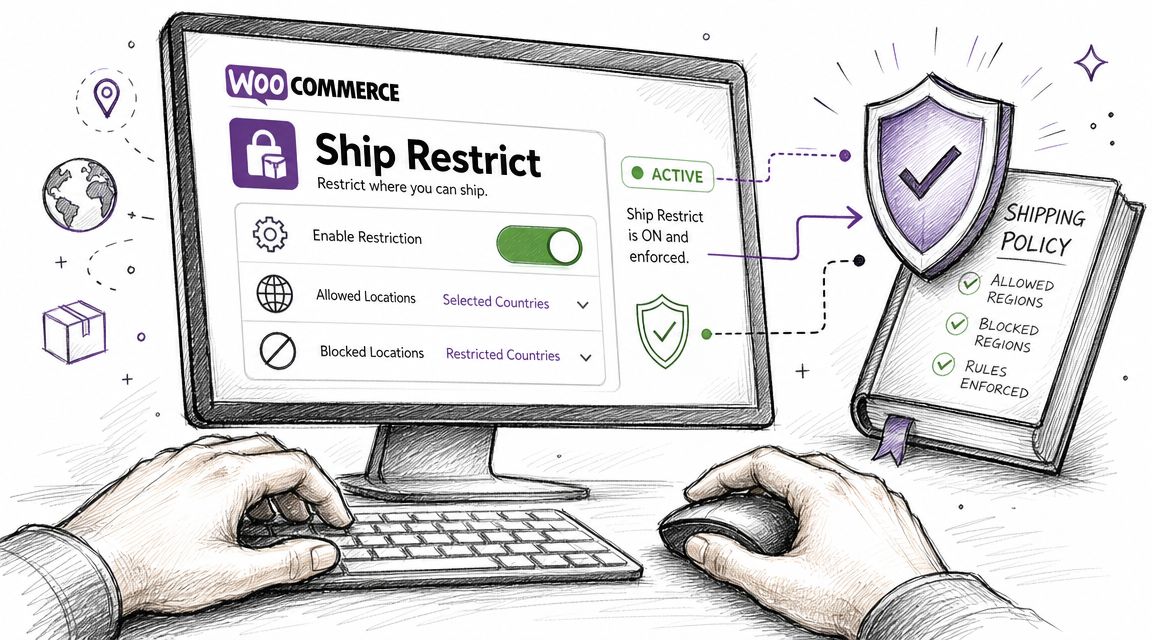
Start with a dedicated shipping method
Create a separate WooCommerce shipping method specifically for same day service. Don't bury the logic inside a generic local delivery option if you plan to treat firearms orders differently.
Keep the method narrow:
- Name it clearly: “Same Day Service” or similar.
- Assign it only where intended: Approved service zones, approved products, approved customer scenarios.
- Write customer-facing copy carefully: Explain that availability depends on eligibility, address, timing, and compliance review.
This is also where strong store architecture helps. If your checkout and rule logic have become messy over time, it's worth reviewing how teams build scalable WooCommerce stores so the compliance layer isn't fighting a brittle storefront underneath it.
Restrict by ZIP code and product conditions
For firearms, ZIP-based enforcement is usually the right starting point because it's defensible and auditable. You can show exactly which areas qualify and exactly where the method is blocked.
A practical implementation sequence looks like this:
- List every approved ZIP code from your written policy.
- Create rule groups that map those ZIP codes to the same day shipping method.
- Exclude product classes or categories that should never use same day service.
- Apply customer messages for blocked orders so users know why the option isn't available.
- Test borderline addresses near service boundaries and mixed carts with eligible and ineligible items.
What you're trying to prevent is manual exception handling at checkout. If the system forces staff to interpret every edge case, the store becomes slower and less compliant at the same time.
Keep customer messaging honest
Most support tickets start with confusion, not hostility. If a customer enters a non-qualifying address and sees the option disappear, they may assume the site is broken. Tell them what happened in plain language.
Useful message patterns include:
- Address outside service area: Same day service isn't available for this ZIP code.
- Ineligible product in cart: One or more items in this order can't use same day service.
- Missed cutoff: The order no longer qualifies for today's service window.
- Compliance review required: Availability depends on order verification.
The message should explain the restriction without inviting your staff to negotiate store policy one email at a time.
A walkthrough can help if your developer or operations manager is implementing this inside an existing firearms store. This guide to an FFL dealer shipping restrictions WooCommerce setup is a useful reference point when translating policy into enforceable checkout rules.
Later in the build, use a visual walkthrough to verify that the configuration behaves the way the policy reads:
<iframe width="100%" style="aspect-ratio: 16 / 9;" src="https://www.youtube.com/embed/7VYyDzJPdow" frameborder="0" allow="autoplay; encrypted-media" allowfullscreen></iframe>Test the rule logic before launch
Don't assume a valid rule set is a complete rule set. Run sample orders across:
- approved ZIP codes
- blocked ZIP codes
- mixed carts
- cutoff edge times
- manually edited customer addresses
If the store can produce a result your policy wouldn't allow, the launch isn't ready.
Testing and Fallback Procedures
A same day service program isn't ready when the happy path works. It's ready when the failure path is controlled.
That distinction matters because failed delivery attempts are normal in logistics. One logistics source says next-day consignments should be expected to achieve about 98.5% first-time delivery success, leaving a 1.5% failure baseline that operators should plan around, according to Diamond Logistics' analysis of courier first-time delivery success. For firearms, that baseline isn't just a customer service issue. It's a custody and compliance event.
Test the system like a hostile user would
Before launch, run internal test orders that try to break the workflow.
Use scenarios such as:
- Correct ZIP, correct product, before cutoff
- Correct ZIP, ineligible product
- Blocked ZIP with same day selected
- Address with incomplete data
- Mixed cart where one item should disqualify the method
- Order placed just before and just after cutoff
- Customer name and recipient details that don't align with policy
Your staff should document what the site displayed, what entered the order queue, what was blocked automatically, and where any manual review was required. If too many exceptions require a person to “just know what to do,” the system isn't mature enough.
Write the failed handoff playbook in advance
When the delivery attempt fails, the driver or employee should not invent the next step. The procedure should already exist in writing.
A strong fallback process includes:
-
No release under uncertainty
If identity, address, or transaction conditions don't match policy, the item is not handed over. -
Immediate status update
The failed attempt is recorded in the delivery log and internal order notes. -
Secure return path
The item goes back to controlled inventory using the same documented custody discipline as the outbound trip. -
Customer communication
The customer receives a clear explanation that the order wasn't completed and what must happen next. -
Management review for repeats
Repeated failed attempts should trigger review, not endless rescheduling.
If your fallback procedure starts with “call the customer and see what they want to do,” it's too loose for firearms.
Decide which failures are reschedulable
Not every failed handoff should get another same day attempt. Some should move to in-store pickup, some should require manual review, and some should be canceled outright based on your policy.
Create categories such as:
| Failure type | Typical response |
|---|---|
| Customer absent | Return to inventory, reschedule only if policy allows |
| ID mismatch | No release, management review |
| Address discrepancy | No release until address issue is resolved |
| Unsafe delivery conditions | Abort attempt, document and review |
| Internal packing or dispatch error | Correct internally before any new attempt |
The point isn't to eliminate all delivery failures. You won't. The point is to make every failure controlled, documented, and reversible without exposing the license.
Move Forward with Same Day Service Confidently
FFLs can offer same day service, but only when they stop treating it like ordinary shipping. The stores that do this well build the program on four pillars: policy, operations, checkout enforcement, and fallback control.
Policy gives your team hard boundaries. Operations create a repeatable chain of custody. Checkout enforcement keeps bad orders from reaching staff in the first place. Fallback procedures protect the business when conditions don't follow the ideal workflow.
That combination gives you something better than speed alone. It gives you a premium local service that is narrow enough to manage, clear enough to explain, and controlled enough to defend.
If you can't explain who qualifies, what qualifies, when the promise ends, how the handoff is verified, and what happens when delivery fails, you're not ready yet.
If you can explain all of that, document it, and enforce it consistently, same day service becomes a competitive advantage instead of a compliance trap.
If you run a WooCommerce firearms store and need to enforce ZIP-based shipping rules before an order reaches your team, Ship Restrict helps automate those restrictions so same day service only appears where your policy allows it. That means fewer manual checks, fewer avoidable mistakes, and a safer path to offering regulated local delivery.
Automate Shipping Compliance
Stop worrying about restricted states. Ship Restrict handles it automatically.

Cody Yurk
Founder and Lead Developer of ShipRestrict, helping e-commerce businesses navigate complex shipping regulations for regulated products. Ecommerce store owner turned developer.
Automate Shipping Compliance
- Block restricted states
- No more cancellations
- Set and forget
3-day free trial · Card required