Returns Refunds Policy Regulated Products: A Practical Guide to Compliance
Master a returns refunds policy regulated products with a practical guide to legal compliance, WooCommerce setup, and risk mitigation for ecommerce.
A standard returns refunds policy for regulated products like firearms isn’t just a bad idea—it’s a massive legal and financial risk. Unlike selling t-shirts, mishandling a firearm return can spiral into ATF compliance violations, hefty fines, and logistical nightmares that bleed cash. You absolutely need a specialized, proactive policy to protect your FFL.
Why Standard Return Policies Fail for Regulated Products
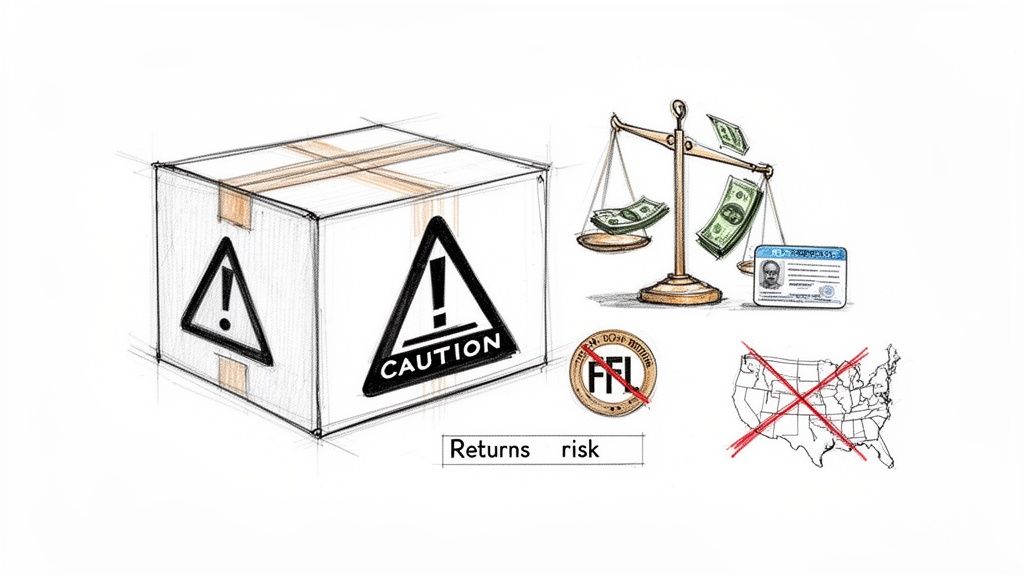
If you're in the business of selling regulated products, especially firearms, grabbing a generic returns policy from a standard eCommerce site is a recipe for disaster. The stakes are exponentially higher. A simple case of "buyer's remorse" can quickly become a complex legal puzzle.
The fundamental problem is that regulated returns are dictated by strict laws, not just customer service norms. Where a standard policy fails is in its inability to handle the complex demands of contract compliance, which for firearms, involves navigating a minefield of federal, state, and local regulations.
The Unique Challenges of Regulated Returns
Think about this common scenario: a customer in another state buys a handgun from you. You ship it to their local Federal Firearms License (FFL) dealer, but then the customer fails the background check. Now what?
Automate Shipping Compliance
Block orders to restricted states automatically. 3-day free trial.
Start Free TrialThis isn't a simple return-to-sender. It's a complicated transfer that legally requires another FFL dealer to ship the firearm back to you. Who pays for the return shipping? What about the FFL transfer fees on both ends? Without an ironclad policy, those costs almost always fall squarely on your shoulders.
That's just one of many potential pitfalls. Other frequent headaches include:
- Conflicting State and Local Laws: A firearm that is perfectly legal in your state might be banned in the customer's city or state. A return initiated for this reason is a compliance nightmare you should have prevented before shipping.
- Failed Background Checks: A denial at the FFL instantly kicks off a complex return process that a generic policy can't even begin to address.
- Inspection and Restocking Hassles: You can't just slap a "new" sticker on a returned firearm. It needs a thorough inspection by a qualified gunsmith to verify it's unfired and safe. That's a real labor cost.
- Irreversible Transfers: Here's the big one. Once the 4473 is complete and the transfer is done, that firearm is legally "used." Accepting a return at this stage is usually impossible and always financially crippling.
The differences between standard retail returns and the high-stakes world of regulated goods are stark. Here's a quick breakdown to put it in perspective:
Standard Retail Returns vs Regulated Product Returns
| Challenge Area | Standard eCommerce | Regulated Products (e.g., Firearms) |
|---|---|---|
| Legal Framework | Consumer protection laws | Federal (ATF), state, and local firearms laws |
| Logistics | Simple return label | FFL-to-FFL transfers, carrier restrictions |
| Financial Risk | Lost shipping cost, minor restocking | FFL fees (both ends), return shipping, gunsmith inspection |
| Compliance Risk | Minimal | Severe: Fines, license revocation, criminal charges |
| Product Condition | Can be resold if unopened | Legally "used" after transfer, requires expert inspection |
| Trigger Event | Buyer's remorse, wrong size | Failed background check, state law conflict, shipping damage |
This table makes it clear: you're playing a completely different game. The focus can't be on making returns easy; it has to be on preventing illegal or complicated sales in the first place.
A proactive approach that stops non-compliant orders before they ever ship is the only sustainable strategy. Preventing a problem order is infinitely cheaper and safer than trying to manage a problem return.
The scale of eCommerce returns is already mind-boggling, with global returns soaring past $640 billion each year. While typical online stores see return rates around 17–18%, the financial and legal fallout from just one mishandled firearm return can be devastating. Understanding the hidden costs of non-compliance in regulated shipping is critical for survival in this industry.
Ultimately, a generic returns policy leaves your business dangerously exposed. It doesn't account for the legal checkpoints, logistical hurdles, and financial drains unique to regulated goods. The only real defense is a meticulously crafted returns and refunds policy that educates the customer upfront and protects your business from the start.
Building Your Bulletproof Returns and Refunds Policy
Alright, let's move from theory to action. Crafting a returns and refunds policy for regulated products is your single most important line of defense. A generic template you pull off the internet just won't cut it here; your policy has to be a precise, legally-informed document that anticipates the unique headaches that come with selling firearms.
This isn't about making customers angry or being difficult. It's about educating them and setting crystal-clear expectations right from the start. A solid policy protects you from liability, stops the financial bleeding from botched transfers, and gives your team the confidence to handle tricky situations the same way, every time.
Free Shipping Compliance Audit
We'll review your WooCommerce store's shipping compliance for free.
Defining Your Non-Negotiable Conditions
The real strength of your policy is in the details. Any gray area is a potential problem waiting to happen. You have to clearly spell out the conditions for when returns are—and are not—accepted, leaving zero room for interpretation.
You need to think through every possible scenario. What happens when a customer just changes their mind after you've already shipped a firearm to their FFL? What if they flat-out fail the NICS background check? These situations demand a predefined, non-negotiable response that's already baked right into your policy.
Your core conditions need to cover these key areas:
- Final Sale Items: Be explicit about what is considered a final sale. For firearms, this should always include any gun that has been transferred to the customer via a Form 4473. Once that paperwork is complete, the sale is absolutely final. Period.
- Failed Background Checks: This is a common and expensive problem. Your policy must state that if a customer fails their background check, they are on the hook for all associated costs. That means return shipping and a hefty restocking fee.
- Factory Defects vs. Buyer's Remorse: Make a sharp distinction between a legitimate manufacturer's defect and someone just having second thoughts. A defect should be handled through the manufacturer's warranty process, not as a standard return to your shop.
The whole point is to shift the responsibility for eligibility and compliance onto the buyer before they click "purchase." Your policy should make it obvious that it's their job to know their local laws and be sure they can legally own the firearm they're ordering.
Structuring Your Restocking Fee Clause
Let's be clear: restocking fees aren't a penalty. They're a business necessity to recoup the very real costs tied to a failed or refused transfer. A returned firearm isn't like a returned t-shirt. It requires careful inspection, lots of administrative work, and takes up inventory space that could have been sold to a legitimate customer.
Your policy has to detail this fee structure without apology. A common and legally defensible practice is to charge a restocking fee of 15-25% of the purchase price, plus the actual cost of round-trip shipping.
Here’s a good example of how to word it: "All refused transfers or returns resulting from a failed background check are subject to a 20% restocking fee, which will be deducted from the refund amount. The customer is also responsible for the full cost of initial and return shipping, as well as any FFL transfer fees our business incurred."
That language is direct, fair, and legally sound. It communicates that while you’ll process the return, the financial fallout from the customer's failure to complete the transfer is their problem, not yours. Understanding specific legal protection strategies for non-compliant orders is crucial when you're writing these clauses.
Sample Clauses for Critical Scenarios
To make your policy truly bulletproof, you need specific language that tackles the most common pain points. Ditch the legalese and use plain English that anyone can understand.
On Order Cancellation: "You can cancel an order for a full refund before it ships. However, once an order containing a firearm has shipped to your designated FFL, it cannot be canceled. If you refuse the transfer for any reason, the order will be treated as a return and is subject to our full restocking fee policy."
On Customer Responsibility: "It is the customer’s sole responsibility to verify that any product you order is legal for you to own in your state, county, and city. We do not provide refunds for items that have been shipped to a customer who is not legally able to receive them."
Return rates tell an interesting story. While something like clothing can see return rates as high as 50%, heavily regulated products like beauty and personal care items see rates of just 1–5%. This gap shows that a bit of friction and clear rules in the return process naturally cuts down on abuse. For firearms retailers, it proves the value of a strong, unambiguous policy that sets the right expectations from the get-go.
Integrating Your Policy into WooCommerce
<iframe width="100%" style="aspect-ratio: 16 / 9;" src="https://www.youtube.com/embed/mBhu-ULO3BU" frameborder="0" allow="autoplay; encrypted-media" allowfullscreen></iframe>Having a rock-solid returns refunds policy for regulated products is one thing, but it’s just a document until you bake it into your sales process. If your policy is buried on some forgotten page, it won’t do you any good when a dispute arises. The key is to make it an active, unavoidable part of every single transaction on your WooCommerce store.
Your goal is simple: make it impossible for a customer to ever say, "I didn't know." By strategically placing your terms at critical points, you create an undeniable record that they saw, understood, and agreed to your rules before clicking "buy."
Making Your Policy Unmissable
First things first, your policy needs a home. Head over to your WordPress dashboard and navigate to Pages > Add New. Give it a straightforward title that leaves no room for confusion, like "Firearms Return and Refund Policy."
Now, format that page for clarity, not just to fill space. Think like a customer who’s scanning for the most important details.
- Use Clear Headings: Break the text up with headers for key sections like "Failed Background Checks," "Restocking Fees," and "Final Sale Items."
- Lean on Bullet Points: Lists are your best friend. They make complex conditions easy to digest.
- Emphasize with Bold Text: Make critical details pop. If you have a 20% restocking fee or transferred firearms are final sale, make that text bold so it can't be missed.
Once that page is published, stick a link to it in your website’s footer. That's standard practice and where people expect to find the "fine print." But we can't stop there—a footer link is passive. We need active consent.
Requiring Agreement at Checkout
This is the most important step. You absolutely must get customers to actively agree to your terms before they can hand over their money. This simple action transforms your policy from a suggestion into a binding agreement.
Thankfully, WooCommerce has this built-in. Just go to Appearance > Customize > WooCommerce > Checkout. You'll see an option to set a "Terms and conditions" page. Go ahead and select the policy page you just created.
This will add a checkbox to your checkout page, usually with generic text like "I have read and agree to the website terms and conditions." We can do better. That language is too vague for regulated products. Using a free plugin like "Checkout Field Editor for WooCommerce," you can change that label to something much more specific:
I have read, understand, and agree to the Firearms Return and Refund Policy, and I confirm I am legally allowed to purchase this item in my location.
That phrasing is direct and powerful. The customer isn't just mindlessly checking a box; they are making a specific declaration about your firearms policy and their legal status. There’s no ambiguity.
Reinforcing the Policy Post-Purchase
Don't let the conversation end at checkout. Use your post-purchase emails to gently reinforce the terms and manage customer expectations from the get-go.
You can easily edit your WooCommerce email templates to include a link back to your policy. Just navigate to WooCommerce > Settings > Emails and choose the "Processing order" or "Completed order" template. Add a simple line to the footer:
"Please Note: All regulated items are subject to our Returns and Refunds Policy. You can review the full policy here: [Link to Your Policy Page]"
This little addition serves as another reminder of the terms they agreed to. If a customer tries to initiate a return later, you can point to the fact that the policy was presented before and after the sale was finalized.
By creating a dedicated page, forcing an explicit agreement at checkout, and reinforcing it in your emails, you build a multi-layered defense. This turns your returns refunds policy for regulated products from a simple document into an enforceable part of every sale. From here, you can take the next step and learn how to block non-compliant orders before checkout in WooCommerce to stop problems before they even start.
How to Proactively Prevent Problematic Returns
A well-drafted returns and refunds policy for regulated products is your shield, but proactive prevention is your sword. The best way to handle a problematic return is to stop the non-compliant order before it's even placed. This is where your policy and your tech stack work together to build a powerful, automated defense for your business.
Instead of just reacting to costly return requests, you can use tools to automatically enforce your shipping rules at the moment of sale. This simple shift saves you from the logistical nightmares, financial hits, and legal risks that come with shipping an illegal order only to have it sent right back.
Shifting from Reactive to Proactive Compliance
Relying on a customer to read and understand your policy is a huge gamble. People are in a hurry, they skim text, and many assume the rules don't apply to them. A proactive system takes human error—on both your side and the customer's—out of the equation.
Think about it. A customer in Chicago tries to buy a firearm banned by a local city ordinance. Without an automated check, that order could easily slip through, get shipped to their FFL, and only then get flagged as illegal. The result? A forced return, a frustrated customer, and wasted money on shipping and FFL fees.
Automated tools like the Ship Restrict plugin for WooCommerce completely change this dynamic. They act as a digital gatekeeper, checking the customer's shipping address against your rules before they can finish checking out. It stops a non-compliant order dead in its tracks.
This screenshot shows how simple it is to set up restriction rules, letting you define specific conditions for different locations.
By setting up a system like this, you turn compliance from a manual, error-prone chore into an automatic, reliable part of your sales workflow.
Real-World Scenarios for Automated Blocking
The real power here is the ability to handle the tangled web of local, state, and federal regulations with precision. You can create granular rules that solve the exact compliance headaches that so often lead to returns.
Here are a few practical examples of rules you can set up in minutes:
- State-Level Magazine Capacity: Block the sale of magazines holding more than 10 rounds to customers with shipping addresses in California, New York, or Massachusetts.
- City-Specific Firearm Bans: Prevent the sale of certain firearm categories, like specific semi-automatic rifles, to addresses within cities like Chicago or Boulder that have their own strict ordinances.
- Ammunition Shipping Rules: Restrict ammo shipments to states like New York that require it to be sent to an FFL or licensed seller, not a residential address.
- Product-Specific State Blocks: Block a specific handgun model from being sold to any California address if it isn't on the state's Roster of Handguns Certified for Sale.
By implementing these rules, you're not just preventing a return; you're preventing a potential compliance violation. This shift is crucial for long-term business health and risk management in the firearms industry.
Crafting User-Friendly Blocking Messages
Just blocking a sale isn’t enough. The key to keeping customers happy is explaining why their order was blocked. A generic "this item cannot be shipped to your location" message is frustrating and unhelpful. But a clear, educational message can turn a bad experience into a good one.
Your custom messages should be helpful, not confrontational. Explain the specific regulation that prevents the sale.
Here’s an example for a magazine restriction:
"We're sorry, but due to state regulations in your area, we cannot ship magazines with a capacity greater than 10 rounds to your address. This restriction helps us both stay compliant with local laws. Please remove the item to proceed with your order."
This approach does two important things: it educates the customer about laws they might not know about, and it positions your business as a responsible, law-abiding retailer. That builds trust and cuts down on angry emails and support calls.
For firearms retailers, this kind of geographic compliance is everything. For context, Europe sees the highest return rates globally—Germany is approaching 44%, thanks to strong consumer protection laws. While the regulations are different, it shows how legal frameworks directly shape customer behavior. An automated tool like Ship Restrict is your best defense against the expensive scenario where an order ships out, only to be immediately returned due to a local rule you missed. Check out the NRF's report on the impact of returns on retail for more on the broader costs.
By being proactive, you can pretty much eliminate an entire category of forced returns, protecting both your revenue and your FFL.
Managing the Inevitable Return Workflow
No matter how dialed-in your prevention strategy is, some returns are just unavoidable. A manufacturer's defect will eventually pop up, or a rifle gets damaged in transit. When that happens, you absolutely need a clear, repeatable workflow to manage the process without introducing new legal risks or financial losses. A "wing-it" approach to a returns refunds policy for regulated products is a surefire way to create compliance headaches.
Having a standardized process means every person on your team handles returns the exact same way, every single time. This consistency is your best defense against a costly mistake. The entire workflow—from that first email from a customer to the final refund hitting their card—has to be documented and followed to the letter, especially when a firearm is involved.
To keep everyone on the same page, consider using a tool like company knowledge base software. This lets you build a central playbook for your returns process. Your team gets instant access to the right procedures, communication templates, and compliance checklists, ensuring nothing falls through the cracks.
Kicking Off the Return with an RMA
The first real step in any legitimate return is issuing a Return Merchandise Authorization (RMA). This isn't just bureaucratic paperwork; it's your control valve for the entire process. An RMA number officially logs the return, ties it back to the original order, and gives you a concrete way to track that item's journey back to your shop.
A hard and fast rule: never accept a return shipment that doesn't have a pre-approved RMA. This simple policy prevents random, unauthorized packages from showing up at your door. It also lets you prepare for the incoming item, which is critical if you need to coordinate with your FFL for a firearm.
Your RMA process should nail down a few key things:
- Customer Verification: Pull up the original order and confirm exactly why they need to send it back.
- Clear Instructions: Give the customer step-by-step shipping instructions. Make it clear the RMA number must be visible on the outside of the package.
- FFL Coordination (for Firearms): This is non-negotiable. If a firearm is coming back, you have to coordinate directly with the customer’s FFL dealer to handle the transfer back to your FFL. The firearm must ship from their FFL to your FFL. No exceptions.
This flowchart maps out a decision-making process that focuses on catching non-compliant orders before they ever need a return.
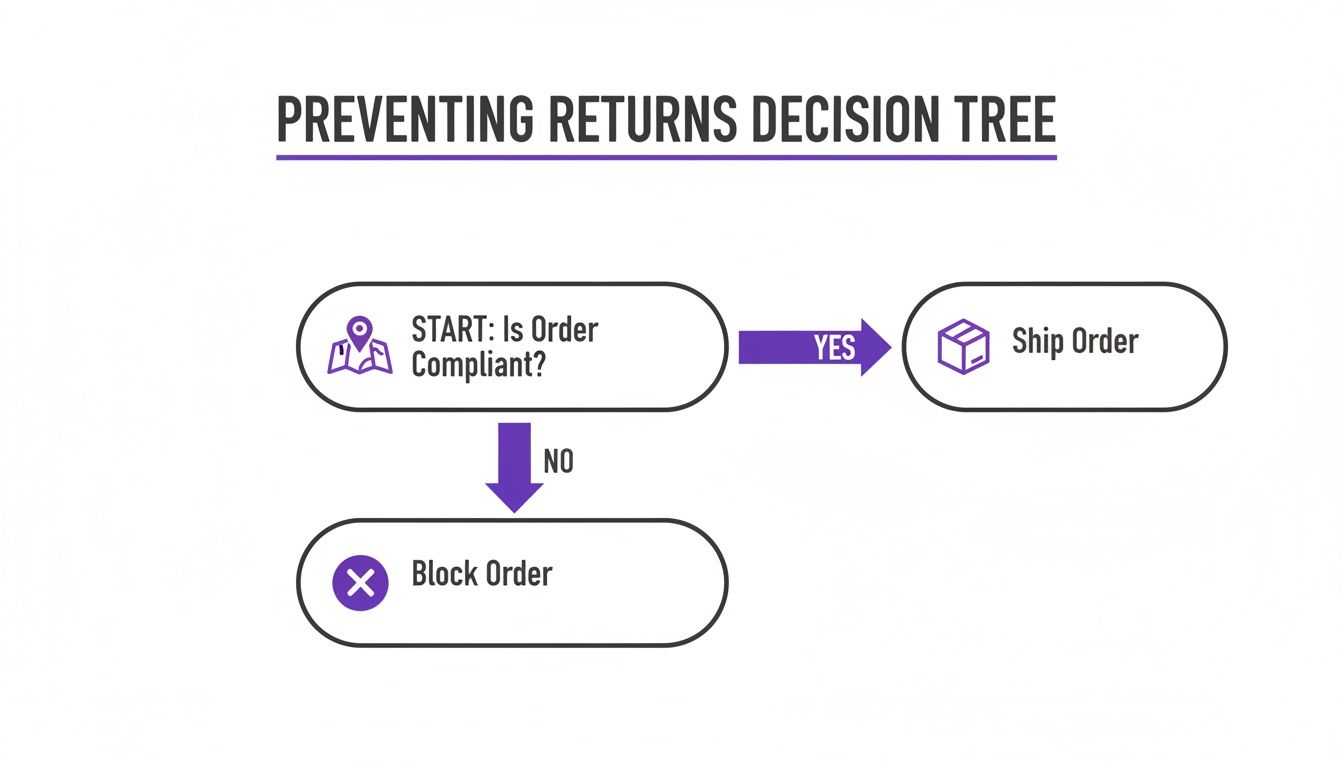
As you can see, a solid compliance check upfront is the single most effective way to minimize returns down the road.
The Inspection and Refund Process
Once the product arrives back at your facility, the job is only half done. A thorough inspection is the next critical phase, as it determines the final outcome of the refund request. This needs to be handled by someone who knows what they're looking at—like a qualified gunsmith for firearms—who can accurately assess the item's condition.
The inspection checklist must verify:
- Condition: Is the item truly in new, unfired condition as the customer claimed? You're looking for any scuffs, signs of use, or damage the customer might have caused.
- Completeness: Are all the original accessories, manuals, and packaging components in the box?
- Serial Number Match: For firearms, triple-check that the serial number on the gun matches what's on the RMA and in your original sales record.
The outcome of this inspection dictates the refund. If the item passes, you process the refund according to your policy. If it fails, you communicate the rejection professionally, explaining exactly why the return conditions were not met.
If the return is valid, it's time to process the refund. Just be sure to deduct any restocking fees that apply, as spelled out in your policy. This is especially important for returns caused by a failed background check or a refused transfer, as opposed to a product defect.
While no federal law dictates your return policy, states like Florida, New York, and California require you to conspicuously post your policy if it's anything other than "full refund, no questions asked." Having a clear, visible policy is essential if you want to enforce your restocking fees without a fight.
Common Questions About Regulated Product Returns
Let's be honest, navigating a returns and refunds policy for regulated products can feel like a minefield of "what-ifs." Even with a solid policy written down, weird situations are going to pop up, leaving you to sort through the legal and logistical gray areas.
This section is all about tackling the most frequent and tricky questions firearms dealers run into. My goal is to give you direct, no-nonsense answers so you can manage your policy with confidence.
What Happens When a Customer Fails a Background Check?
This is, without a doubt, the most common and costly headache you'll face. If a customer fails the NICS background check at their FFL, the firearm cannot be transferred to them. Period. The gun now has to be shipped back to you, from their FFL to your FFL.
So, who pays for all this? Your policy must make it crystal clear: the customer does. They are on the hook for the original shipping cost, the full cost of the return FFL-to-FFL shipping, and a significant restocking fee—I usually see this between 15-25%. This isn't a penalty; it's you recouping your real costs for a failed transaction that was completely out of your hands. You did your part by shipping the item in good faith.
Who Is Responsible for Return Shipping Costs?
This really depends on why the item is coming back. I always recommend structuring your policy to cover two main scenarios:
- Customer-Fault Returns: This bucket includes failed background checks, refused transfers (classic buyer's remorse), or someone ordering an item that isn't even legal in their state. In these cases, the customer is 100% responsible for all shipping costs, both ways.
- Seller-Fault Returns: It's rare, but it happens. Maybe you shipped the wrong item, or it arrived with obvious shipping damage. In these specific instances, it's just good business to cover the return shipping. A manufacturer's defect, however, is a different story—that should be handled through the manufacturer’s warranty process, not as a standard return on your dime.
Can We Refuse a Return if the Packaging Is Damaged?
Absolutely, and you should. Your policy needs to state that all returned merchandise must be in its original, unopened, and undamaged factory packaging. For a firearm, this is non-negotiable.
If an item comes back with the seal broken or the box torn up, you have every right to refuse the return. At a minimum, you should charge a much higher restocking fee to account for the diminished value. That product is no longer "new," and your ability to resell it as such has been compromised.
Key Takeaway: You are not legally obligated to accept returns unless the product is defective. State laws, like those in New York and Florida, mostly just require that if you have a restrictive policy (like "no refunds" or "restocking fees apply"), it must be clearly and conspicuously posted. If you do that, the terms of your policy are generally enforceable.
What if a State Law Changes After an Order Is Placed?
This is a tough one and really highlights why fast shipping and proactive compliance are so critical. If a law changes between the time an order is placed and when it ships, the safest play is to cancel the order for a full refund. Shipping something you know has become illegal is a massive compliance risk you don't want to take.
Now, if the item has already shipped and the law changes while it's in transit, it becomes a forced return. This is a true gray area. A fair approach is to refund the customer minus your actual shipping costs, since neither of you was at fault.
Managing these complex rules automatically is the best way to protect your business. Ship Restrict empowers you to build a powerful, automated defense by blocking non-compliant orders before they ever become a problem. Stop worrying about state laws and shipping mistakes, and start focusing on growing your business. Find out how at https://shiprestrict.com.
Automate Shipping Compliance
Stop worrying about restricted states. Ship Restrict handles it automatically.

Cody Yurk
Founder and Lead Developer of ShipRestrict, helping e-commerce businesses navigate complex shipping regulations for regulated products. Ecommerce store owner turned developer.
Automate Shipping Compliance
- Block restricted states
- No more cancellations
- Set and forget
3-day free trial · Card required