Legal protection strategies non-compliant orders: Key steps to secure compliance
Legal protection strategies non-compliant orders: Learn practical steps to enforce compliance, protect rights, and document actions with clear policies.

If you’re not actively protecting your business against non-compliant orders, you’re exposing yourself to massive risks. We’re talking about more than just a cancelled sale—think heavy fines and even losing your license. A solid defense isn't about reacting to problems; it's about building a multi-layered system that stops illegal sales before they ever happen.
This means combining smart automation, crystal-clear policies, and meticulous record-keeping to prove you’ve done your due diligence.
Defining Your Legal Groundwork for Non-Compliant Orders

Before we get into the nitty-gritty tactics, let’s be clear about what we’re up against. A "non-compliant order" isn't a customer service issue; it's a direct threat to your business. It’s absolutely critical to have a proactive legal framework in place.
These orders come in all shapes and sizes. It could be a blatant attempt to ship a restricted rifle to California or something subtler, like a customer who can’t pass a simple identity check. Every single one is a potential legal landmine.
Automate Shipping Compliance
Block orders to restricted states automatically. 3-day free trial.
Start Free TrialThe Real-World Consequences of Non-Compliance
Let's not sugarcoat it: ignoring this stuff can have catastrophic results. The financial and legal fallout is staggering. Globally, the average fine for regulatory violations hit around $145.33 million USD back in 2019. That number just shows how seriously authorities take compliance.
For an FFL holder, the stakes are even higher. A single slip-up can lead to:
- Severe Fines: The ATF and state agencies won't hesitate to levy penalties that can run into thousands of dollars per violation.
- FFL Revocation: A pattern of non-compliance is a fast track to losing your Federal Firearms License, which means game over for your business.
- Criminal Liability: In the worst-case scenarios, owners and even employees can face personal criminal charges.
- Forced Operational Shutdowns: Regulators can order you to shut your doors completely while they conduct an investigation.
A strong defense is built on proactive prevention, not reactive damage control. Your goal is to create a system so robust that non-compliant orders are stopped automatically, creating an airtight audit trail that proves your commitment to lawful operations.
Establishing Your Foundational Strategy
Your legal groundwork is the system of policies and procedures you design to prevent, detect, and correctly handle any order that breaks a federal, state, or local law. This framework is your first and most important line of defense.
A rock-solid strategy is a mix of technology, clear documentation, and consistent staff training. For a deep dive into creating effective Standard Operating Procedures, that link is a great resource for building consistency.
You need well-defined protocols for every step, from the moment a customer adds an item to their cart to the final shipment. To see exactly how this applies to your store, check out our guide on how to document shipping restrictions for legal compliance: https://shiprestrict.com/blog/shipping-restrictions/how-to-document-shipping-restrictions-for-legal-compliance. It lays out the actionable steps that form the bedrock of the strategies we're about to cover.
Building an Automated First Line of Defense

Relying on manual order review to catch every illegal sale is a recipe for disaster. It’s not just inefficient; it’s a massive legal gamble. Your team is human, but technology is your most reliable gatekeeper, working 24/7 to enforce the tangled web of firearm regulations.
Setting up an automated system in WooCommerce is the single most powerful step you can take to protect your business. Think of it as a digital checkpoint that stops prohibited sales before they ever land in your order queue. It’s how you turn complex legal jargon into an automated shield for your FFL.
Setting Granular Rules for Real-World Scenarios
The secret to a rock-solid automated defense is specificity. Generic, store-wide rules just don’t cut it in this industry. You need the power to create precise restrictions based on a customer’s location and the exact products in their cart. This is where a tool like Ship Restrict becomes essential.
Instead of a blunt "no sales to California" rule, you can get much smarter. For example, you can build a rule that blocks the sale of an AR-15 platform rifle to a California address while still allowing a customer there to purchase a compliant hunting shotgun. That level of detail is critical for maximizing sales while locking down your risk.
Free Shipping Compliance Audit
We'll review your WooCommerce store's shipping compliance for free.
Here are a few practical rules you could build right now:
- State-Level Firearm Bans: Create a rule blocking all products in your "Firearms" category from shipping to states with sweeping restrictions, like California, Massachusetts, or New York.
- Magazine Capacity Limits: Set up rules to block magazines over 10 rounds from going to states like Colorado or Connecticut. You can even create a separate rule for New Jersey’s 15-round handgun magazine limit.
- Local Ordinance Blocks: Target specific cities or counties with their own unique laws. You could block all firearm sales to Chicago, IL (Cook County), or Boulder, CO, by creating rules based on their zip codes.
- Ammunition Restrictions: Prevent certain ammo types from shipping to states that require them to be sent to an FFL or have other specific handling requirements.
This proactive approach stops a non-compliant order from ever being placed, which is far better than canceling it after the fact. The customer gets an immediate, clear message explaining why the sale can't proceed, which cuts down on support tickets and eliminates the chance of a prohibited item slipping through.
For a deeper dive, check out our guide on how to block non-compliant orders before checkout in Woo-Commerce.
From Configuration to Automated Enforcement
So, how does this work in the real world? Imagine a customer from a restricted zip code in Illinois adds a firearm to their cart. The moment they enter their shipping address at checkout, your automated system checks their location and cart contents against your pre-set rules.
The system instantly flags the order as non-compliant and stops the checkout process cold. It’s a clean, automated block that requires zero action from your team.
This process creates an immediate and impartial enforcement of your policies. It’s not an employee making a judgment call; it’s a system enforcing the law. This not only protects your business but also proves you have a consistent and serious compliance program—something that’s invaluable during a potential ATF audit.
Your automated system is your documented proof of due diligence. Every time it blocks a non-compliant order, it creates a record that you are actively and systematically preventing illegal sales. That's the cornerstone of a defensible compliance strategy.
To really tighten your defenses, especially against fraudulent or suspicious orders, consider layering in AI fraud detection. These systems analyze order patterns and customer data to flag transactions that might look legitimate on the surface but carry hidden risks, adding another intelligent layer to your protective measures.
Crafting Ironclad Policies and Customer Communication
Your automated rules are the first line of defense, but your next layer is just as crucial: clear, direct communication. Think of your store policies as more than just legal boilerplate—they are an active part of your legal protection strategy against non-compliant orders. When you spell things out in plain English, you educate customers, discourage anyone trying to bend the rules, and give yourself a solid foundation to stand on if you have to cancel an order.
Your policies are a contract. Leave zero room for interpretation. Vague language is an open invitation for arguments and headaches down the road. Precise wording, on the other hand, sets crystal-clear expectations from the moment a visitor lands on your site.
Fortifying Your Terms and Conditions
The Terms and Conditions (T&C) page is the legal backbone of your entire operation. It needs to state, without a doubt, that the customer is 100% responsible for knowing and following all federal, state, and local laws for every single item they purchase.
This is where you get granular. Don't just say you follow the law; explain how you enforce it. Make sure you include specific clauses covering:
- Customer Affirmation: A direct statement where the customer confirms they are legally allowed to purchase and possess everything in their cart.
- Shipping Restrictions: A detailed section explaining that you will not ship to prohibited areas. It's smart to list specific, high-profile examples (e.g., "We do not ship firearms to California or magazines over 10 rounds to New York.").
- Order Cancellation Rights: A clause that explicitly reserves your right to cancel any order, at any time and for any reason, especially if you suspect it's non-compliant.
- Restocking Fees: Clearly state that a restocking fee will be charged if an order is cancelled because the customer failed to comply with the law or your policies. This is a powerful deterrent against careless or intentionally illegal orders.
Key Takeaway: Your T&C is your legal shield. By forcing customers to agree to these terms before they can click "buy," you create a paper trail proving they were fully aware of their legal duties and your strict compliance standards.
Weaving Policy into the Customer Journey
Burying your rules deep in a T&C page and hoping for the best is a recipe for disaster. You have to reinforce your compliance stance at every critical step of the shopping experience. This kind of proactive communication nips potential problems in the bud.
Place short, impossible-to-miss notices in high-visibility spots.
- On Product Pages: Right below the "Add to Cart" button for a restricted item, like a 30-round magazine, add a bolded notice: "NOTICE: This item is restricted in several states. Please check your local laws before ordering. We will not ship to prohibited areas."
- During Checkout: Use a mandatory checkbox that customers must tick before their payment can go through. The text should be simple and direct: "I have read the Terms and Conditions and affirm I am legally permitted to purchase and receive all items in this order."
This isn't just for show. This repetition is a core part of your due diligence. It makes it nearly impossible for a customer to argue "I didn't know," which strengthens your hand immensely if a dispute ever arises.
Clear policy language is non-negotiable. The table below breaks down why certain clauses are essential and the risks they help you avoid.
Key Policy Clauses vs Potential Legal Pitfalls
| Recommended Policy Clause | Legal Risk Addressed | Example Wording Snippet |
|---|---|---|
| Customer Legal Affirmation | Negligent entrustment claims; "straw purchase" liability. | "By checking this box, you affirm that you are of legal age and are not prohibited by any law from purchasing or possessing the items in this order." |
| State & Local Law Compliance | Shipping to prohibited jurisdictions, leading to fines or license revocation. | "You are responsible for knowing your state and local laws. Orders placed for restricted items will be cancelled." |
| Right to Cancel Orders | Disputes from customers whose non-compliant orders are cancelled. | "We reserve the right to cancel any order, at our sole discretion, if we suspect it violates any federal, state, or local law." |
| Restocking Fee for Non-Compliance | Financial loss from payment processing fees and inventory handling on cancelled orders. | "A 15% restocking fee will be applied to any order cancelled due to customer error or non-compliance with our terms." |
As you can see, each clause directly counters a specific, real-world risk. Integrating this language throughout your site isn't just good practice—it's essential self-preservation in a highly regulated industry.
Standardizing Your Cancellation Communications
When an order gets flagged and cancelled—either by your automated system or a manual review—your response needs to be swift, professional, and firm. Don't get drawn into debates or long-winded explanations. That just opens the door for arguments. Instead, have a standardized, pre-approved email template ready to go.
Keep the template brief and to the point. State the facts without emotion or apology.
Example Cancellation Email Snippet:
"Hello [Customer Name],
Your recent order, #[Order Number], has been cancelled and refunded in full. This action was taken because the order does not comply with firearms regulations in your shipping jurisdiction.
This decision is final and is in accordance with our store policies, which you agreed to at checkout. You can review our Shipping Restrictions and Terms of Service here: [Link to Policies]
Thank you for your understanding."
This approach does a few things perfectly: it enforces your rules consistently, creates a documented reason for the cancellation, and points the customer right back to the terms they already accepted. It closes the loop cleanly, protecting your team from pointless arguments while keeping your operation looking professional.
Implementing a Robust Manual Order Review Workflow
Automation is your tireless front-line soldier, but a sharp manual review process is the irreplaceable special forces unit that handles the tricky stuff—the complex, suspicious, and edge-case orders your system flags. This manual workflow is a cornerstone of your legal protection strategies for non-compliant orders. It’s where human judgment comes in, creating a defensible paper trail that proves you go above and beyond to stay compliant.
A well-structured manual review isn't just about double-checking an address. It's a systematic investigation designed to confirm an order's legitimacy and document every single verification step. Without a consistent process, you're opening the door to inconsistent decisions, human error, and a much weaker legal standing if an order ever gets scrutinized. The goal is to give your team a clear, repeatable checklist that kills the guesswork and solidifies your due diligence.
The Essential Manual Review Checklist
When an order gets flagged for manual review, the first thing your team should do is move it to a dedicated "On Hold" status. Then, the real work begins. This part of the process isn't about speed; it's about meticulous accuracy. Every action taken—every call made, every database checked—must be logged in the order notes to create a permanent record of your compliance efforts.
Your checklist should nail down several key verification points:
- Customer Information Verification: Cross-reference the customer’s name, billing address, and shipping address. Do they all line up? Does the IP address location make sense with the shipping address? Any mismatches here are a huge red flag.
- Address Cross-Referencing: Use official databases to check the shipping address against known restrictions. This means pulling up state law summaries and ATF publications to confirm the specific items ordered are legal in that exact jurisdiction.
- FFL Verification (if applicable): If an order is shipping to another dealer, use the ATF’s FFL EZ Check system to confirm their license is valid and active. You should never ship without this verification.
- Direct Customer Contact: Sometimes, a minor issue like a typo in an address can be cleared up with a quick phone call. If you reach out, document the time, date, and exactly what was discussed.
This flowchart maps out the core decision-making path your team should follow for every single order.
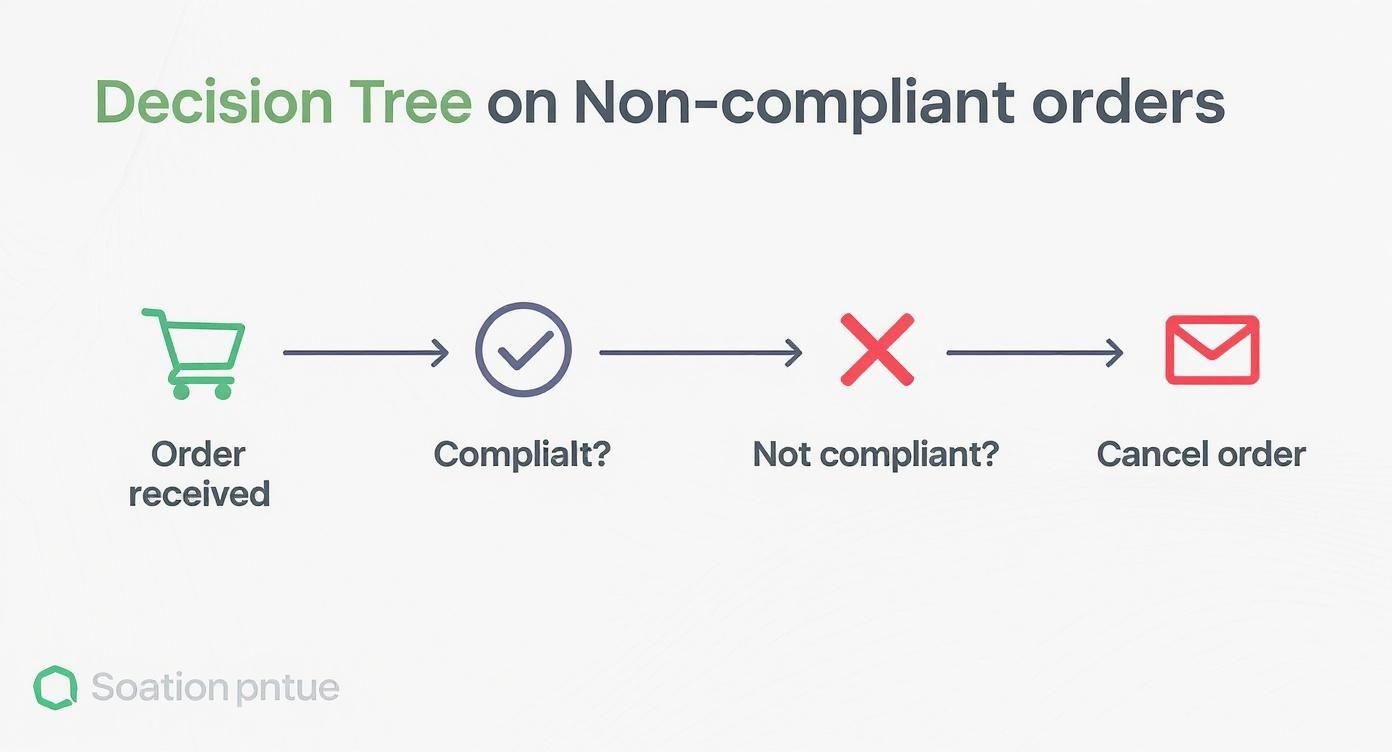
This visual guide reinforces a simple but powerful rule: when an order's compliance is in doubt, the only safe and legal move is to cancel it.
Yes, this process is more hands-on than automation, but its value is immense. For more context, you can learn about the true cost of manual order screening vs automated restrictions in our detailed guide.
Establishing a Clear Escalation Path
Not every flagged order can be resolved by your front-line staff. You need a documented escalation path to make sure complex or high-risk situations get handled by the right people. This structure prevents paralysis by analysis and ensures a consistent, defensible response every time.
Your escalation path should have clearly defined triggers.
- Team Member to Manager: An order needs to be kicked up to a manager if there are major, unresolvable discrepancies in the customer's info, if the customer becomes unresponsive or hostile, or if the order involves a tricky local ordinance that needs a more experienced eye.
- Manager to Legal Counsel: The trigger for looping in your lawyer needs to be absolute. This step becomes necessary if you suspect a straw purchase, receive threats from a customer after an order is cancelled, or are contacted by any law enforcement or regulatory agency about an order.
Critical Insight: The moment you suspect intentional illegal activity, like a potential straw purchase, the review process stops cold. The order is cancelled, and you immediately escalate the situation to your legal counsel. Do not try to investigate further on your own.
This structured approach transforms your manual review from a simple task into a sophisticated layer of your legal defense. It’s a vital shield in today's regulatory environment, where a patchwork of state and local laws demands careful navigation. A detailed, defensible review process isn’t just a good idea—it’s essential for survival.
Creating a Culture of Compliance Through Training and Recordkeeping
<iframe width="100%" style="aspect-ratio: 16 / 9;" src="https://www.youtube.com/embed/xenVi37PRR0" frameborder="0" allow="autoplay; encrypted-media" allowfullscreen></iframe>Your automated systems and manual workflows are powerful, but they’re only as good as the people running them. The final, and arguably most important, layer of your defense is a deeply ingrained culture of compliance. This isn't just about rules; it's a mindset built on two pillars: comprehensive team training and obsessive, meticulous recordkeeping.
An effective training program turns every single team member into a vigilant part of your compliance engine. This isn't a one-and-done onboarding task. It's an ongoing commitment to make sure everyone, from customer service to the shipping department, understands the why behind every single rule you’ve put in place.
Designing an Effective Training Program
A well-trained team is your best defense against the kind of human error that can land you in serious trouble. Your training needs to cover the full spectrum of your legal protection strategies for non-compliant orders, from the tech you use to the nuanced judgment calls your team will have to make during manual reviews.
A solid training agenda should always include:
- The Legal Landscape: Start with a high-level overview of ATF regulations and the confusing patchwork of state and local laws. Use real-world examples to hammer home the severe consequences of a single mistake.
- Your Automated Tools: Walk through how your Ship Restrict rules actually work. Show them the front-end customer experience when a purchase is blocked so they can answer questions confidently and accurately.
- The Manual Review Workflow: Go step-by-step through your checklist. Role-play different scenarios where an order needs to be flagged, reviewed, and potentially escalated to a manager.
- Communication Protocols: Train everyone on your standardized email templates for cancellations. Emphasize the importance of maintaining a firm, professional, and non-argumentative tone, no matter what.
Critically, this training can't just happen once. A quick 30-minute refresher every quarter, plus an immediate update whenever a law changes, will keep compliance top-of-mind and prevent outdated knowledge from creating new risks.
The Critical Role of Meticulous Recordkeeping
If training is your proactive defense, then your recordkeeping is your reactive shield. In the event of an audit or legal inquiry, your records are the undeniable proof of your due diligence. Vague or incomplete notes are almost as bad as having no notes at all.
Every single time an order is flagged, reviewed, or cancelled, a detailed log must be created and permanently attached to that order. This log becomes the official story of that transaction, showing every single action you took to ensure compliance.
Your documentation for each flagged order should include:
- Reason for the Flag: Was it an automated rule (e.g., "CA Magazine Capacity Block") or a manual flag (e.g., "Mismatched Billing/Shipping")? Be specific.
- Date and Time of Review: Note exactly when the manual review process began.
- Reviewer's Name/Initials: Accountability is absolutely key.
- Steps Taken: Detail every database you checked (e.g., "Verified FFL via ATF EZ Check"), every customer contact you attempted, and the outcome of each step.
- Final Decision: Clearly state the final action—"Order Cancelled" or "Order Approved"—and the specific reason why that decision was made.
This documentation isn't just internal bookkeeping; it's your primary legal exhibit. An ATF investigator will see a clear, chronological record of your rigorous compliance efforts, leaving no doubt about your commitment to operating lawfully.
Think of it like the cure period seen in other regulatory areas. For instance, under the California Consumer Privacy Act (CCPA), companies get a 30-day window to fix violations after being notified. This process demands effective, documented corrective action. You can learn more about this structured enforcement process on oag.ca.gov. Adopting a similar mindset of thorough, documented correction for every flagged order builds a powerful, defensible history for your business.
These records must be stored securely and kept for a period that aligns with or exceeds ATF requirements—often for many years. Using your eCommerce platform’s order notes is a great start, but you should also consider a secure, backed-up digital archive. This meticulous approach to recordkeeping transforms a simple cancelled order into a strong data point proving your compliance culture is active and effective.
Your Top Firearms Compliance Questions, Answered
Running an FFL business online means you're constantly thinking about compliance. Here are some of the most common questions we get from dealers who are shoring up their legal protection strategies for non-compliant orders. The answers cut straight to the point, giving you practical advice for situations you'll almost certainly face.
What’s the Single Most Important First Step I Can Take?
Before you write a single policy or train a single employee, set up a robust, automated shipping restriction system. It’s the only truly non-negotiable first step.
While manual order reviews and clear terms and conditions are vital, they're reactive. An automated system is your proactive, 24/7 gatekeeper that stops the overwhelming majority of non-compliant orders before they ever hit your dashboard. This is the foundation of your entire compliance program.
Setting up granular rules based on state, county, and even specific zip codes for different products—like certain firearms or high-capacity magazines—is how you do it. This isn't just about reducing human error; it's about actively demonstrating your intent to comply from the very first click.
An automated block is more than just a cancelled sale; it's a documented instance of successful compliance. Every time your system stops a prohibited order, it creates a digital record proving your due diligence. That paper trail is invaluable if an auditor ever comes knocking.
This setup doesn't just protect your FFL. It sets a clear standard for your customers and filters out the problem orders before they can drain your team's time and energy. It's the most powerful preventative move you can make.
How Should I Handle an Argumentative Customer?
When a customer gets angry about a cancelled order, your response needs to be professional, firm, and completely unwavering. The biggest mistake you can make is getting dragged into a debate over the law or your policies. That back-and-forth only creates openings for them to argue more.
Stick to your script. Your communication should be polite but final, always pointing back to your store's clearly stated policies.
- Use a template: Have a standardized email ready to go. It leaves zero room for misinterpretation.
- State the facts simply: "We are unable to complete this order as it does not comply with regulations in your shipping jurisdiction."
- Point to your policy: "This decision is final and aligns with our store policies, which you can review here [link to your T&C page]."
Once you send that final message, your job is done. Document the entire exchange by saving copies of all emails or chat logs. If their behavior crosses a line into threats or genuine harassment, stop all communication immediately, preserve the records, and talk to your lawyer about what to do next.
How Often Should I Update My Compliance Policies?
Compliance is never a "set it and forget it" task. To stay effective, your strategy needs constant attention. As a good rule of thumb, plan on a full review of your automated rules, store policies, manual review checklists, and staff training materials at least twice a year.
But the real trigger for an update isn't the calendar—it's legislative change. You have to be actively monitoring firearms laws at the federal, state, and local levels. The moment a new law passes or a regulation changes, you need to act.
This isn't something you can put off. Update your systems immediately and hold a quick, mandatory training session with your staff. Everyone on the team needs to understand the new rules and how to enforce them. In this industry, continuous adaptation is the only way to stay protected.
Is an Automated Tool a Substitute for a Lawyer?
Absolutely not. Let’s be perfectly clear: an automated tool is an essential part of your compliance strategy, but it is in no way a replacement for professional legal advice.
You need to work with an attorney who specializes in firearms law (FFL law) to help draft your store policies and to periodically review your entire compliance framework.
Think of it this way:
- Your lawyer is the architect. They understand the complex legal blueprints and design the rules that keep your business safe.
- Your automated tool is the enforcer. It takes the architect's rules and enforces them flawlessly, 24/7, without getting tired or making mistakes.
Your attorney provides the legal strategy; the automation executes that strategy perfectly. It's this one-two punch that gives you the confidence to operate in such a highly regulated market.
Ready to build your automated first line of defense? Ship Restrict for WooCommerce gives you the power to create granular, location-based shipping rules that stop non-compliant orders before they start. Protect your FFL and streamline your operations by visiting https://shiprestrict.com.
Automate Shipping Compliance
Stop worrying about restricted states. Ship Restrict handles it automatically.

Cody Yurk
Founder and Lead Developer of ShipRestrict, helping e-commerce businesses navigate complex shipping regulations for regulated products. Ecommerce store owner turned developer.
Automate Shipping Compliance
- Block restricted states
- No more cancellations
- Set and forget
3-day free trial · Card required