How to document shipping restrictions for legal compliance
How to document shipping restrictions for legal compliance: a practical guide with steps, templates, and tips to stay compliant.
When people talk about documenting shipping restrictions, what they really mean is creating a verifiable, audit-ready paper trail that proves you’re following the law. This isn't just about writing down rules; it's about building a living system. That includes your internal policies, meticulous records of every compliance check, and clear workflows your team can actually follow.
Think of it less like paperwork and more like your primary shield against crippling fines and operational chaos.
Why Your Documentation Is Your First Line of Defense
Let's cut right to it: documenting your shipping compliance isn't just a "best practice." In a world of constantly shifting regulations, it's the only real protection you have. It’s the tangible proof that shows you’re doing your due diligence.
Frankly, this documentation is what stands between you and a logistical nightmare of seized shipments, angry customers, and expensive penalties.
Automate Shipping Compliance
Block orders to restricted states automatically. 3-day free trial.
Start Free TrialWithout a rock-solid process, you're just operating on trust and assumptions. Neither of those holds up when a regulator comes knocking. A well-maintained system, on the other hand, turns a compliance headache into a strategic advantage, making your business more resilient and always ready for an audit.
The Rising Stakes of Non-Compliance
Forgetting to document your compliance efforts has never been more dangerous. Regulators are cracking down—customs, environmental, and security rules are all getting tighter. For instance, new U.S. customs rules now demand detailed documentation for every single package from certain regions, throwing out an old exemption. That one change alone caused massive e-commerce delays. It’s a perfect example of why precise recordkeeping is non-negotiable.
A violation is rarely a one-time fine. It can trigger deeper audits, crater your brand’s reputation, and even get your shipping privileges suspended. Your documentation is your evidence that you have a proactive, enforceable system in place to stop that from happening.
Key Pillars of a Compliant Documentation System
A robust documentation strategy isn't just one thing; it's a combination of several core components working together. Each one plays a critical role in building a comprehensive and defensible compliance posture. These pillars ensure your process is clear, consistent, and—most importantly—verifiable.
I've broken down the essential components here to give you a quick framework for what you need to build.
Key Pillars of a Compliant Documentation System
| Component | What It Achieves | Examples of What to Document |
|---|---|---|
| Clear Internal Policy | Establishes the "source of truth" for what is and isn't allowed. | Specific product bans, restricted states/cities, carrier rules, age verification steps. |
| Audit-Ready Recordkeeping | Creates a verifiable log of every compliance decision. | Timestamps of automated checks, blocked order logs, justifications for manual overrides. |
| Defined Team Workflows | Ensures consistent application of the policy by every employee. | Customer service scripts for blocked orders, warehouse procedures for flagged packages. |
Each pillar supports the others, creating a system that’s much stronger than its individual parts.
Understanding how these elements fit into the broader concept of compliance management is a game-changer. It’s not just about avoiding fines; it’s about running a smarter, more protected business. If you need a reminder of what's at stake, check out our guide on the true cost of shipping compliance violations. The numbers might surprise you.
Crafting a Clear Internal Shipping Policy
Your internal shipping policy is the single source of truth for your entire compliance operation. Think of it as the playbook for your business. A vague or outdated policy isn't just confusing—it’s a liability waiting to happen, inviting mistakes and offering zero defense if an auditor comes knocking.
This document isn’t just for executives to sign off on. It's a practical, day-to-day guide for your warehouse crew, your customer service staff, and even your marketing team. Everyone needs to understand and apply it, every single day. To make it work, you have to move beyond generic statements like "we follow all laws." It needs explicit, unambiguous instructions on what you sell, where you sell it, and how you verify every single order.
Free Shipping Compliance Audit
We'll review your WooCommerce store's shipping compliance for free.
Defining Your Prohibited and Restricted Items
First things first: your policy has to draw a crystal-clear line between what you absolutely will not ship and what you’ll ship only under certain conditions. This clarity is your first line of defense against accidental violations. Create distinct lists that leave zero room for interpretation.
For a firearms retailer, that might look something like this:
-
Prohibited Items (No Exceptions):
- Fully automatic firearms
- Armor-piercing ammunition
- Any products classified as destructive devices by the ATF
-
Restricted Items (Subject to State/Local Laws):
- Standard capacity magazines (prohibited in CA, CO, CT, etc.)
- Certain semi-automatic rifles (subject to "assault weapon" bans in specific states)
- Ammunition sales (may require FFL transfer in states like NY or CA)
This level of detail empowers your team. They can make quick, accurate calls without having to flag down a manager every time an order comes in from a regulated state.
Outlining Geographic Restrictions
Next, your policy needs to be a detailed map of where you can't ship certain products. This isn't just about big-picture international sanctions. You have to drill down into the messy, complicated world of state, county, and even city-level rules—a notorious headache in the firearms industry.
Your policy should be so clear that a new hire could see an order for a 30-round magazine shipping to Boulder, Colorado, and immediately know it’s a no-go. That’s the standard you’re aiming for. No questions asked.
A simple table is one of the best ways to make this information accessible and easy for your team to use on the fly:
| Location Type | Restriction Example | Policy Language |
|---|---|---|
| State | California | "No ammunition will be shipped directly to residential addresses in California. All ammunition must be sent to a licensed FFL dealer for transfer." |
| City | Chicago, IL | "The sale and shipment of all firearms, ammunition, and assault weapon attachments to addresses within the city limits of Chicago, IL, is prohibited." |
| U.S. Territory | Puerto Rico | "Due to local regulations, we do not ship any firearms or firearm parts to Puerto Rico." |
When you structure your rules like this, they become searchable and actionable. This is a core part of building a defensible, audit-ready compliance system.
Incorporating Carrier-Specific Rules
Legal compliance doesn't stop with government regulations. Your shipping carriers—like UPS and FedEx—have their own rulebooks, and breaking them can get your account shut down overnight. Your internal policy has to account for their requirements, too.
Both UPS and FedEx have specific, and often changing, policies for shipping firearms and ammo. Your policy needs sections that spell these out clearly:
- Required Labeling: What markings are mandatory, like ORM-D for ammunition packages.
- Packaging Mandates: Details on using sturdy, unmarked outer boxes for firearms.
- Service Level Restrictions: Which services must be used (e.g., "All handguns must ship via Next Day Air").
This keeps your fulfillment team aligned not just with the law, but with the partners who actually get your products to the customer.
Establishing Version Control and a Review Cadence
Finally, remember that a shipping policy is a living document. Laws change, carriers update their terms, and you add new products. An outdated policy is a dangerous one.
Implement a simple version control system right in the document's header or footer. Something like Shipping Compliance Policy v2.3 - Last Updated: October 26, 2024 is perfect. This tiny detail is incredibly valuable for creating an audit trail.
Then, put a process in place. Schedule a formal review of the entire policy at least twice a year. Assign a specific person to be the point person for monitoring legal updates between those scheduled reviews. This proactive approach ensures your documentation is always current, accurate, and ready for scrutiny.
Building Your Audit-Ready Recordkeeping System
Your internal policy sets the rules, but your recordkeeping system is what proves you follow them. An auditor's visit shouldn't send your team scrambling; it should be a routine event where you confidently present a clear, organized, and verifiable log of your compliance activities. This is where the abstract concept of "due diligence" becomes a tangible, defensible asset.
Building this system is all about meticulously logging every compliance check, every flagged shipment, and every decision made along the way. Without this evidence, your policy is just words on a page. With it, you have an unshakeable defense that proves your commitment to legal compliance.
What to Capture for Every Single Order
Every order that passes through your checkout generates a trail of critical compliance data. Your job is to capture this information consistently, creating a detailed story for each shipment. Sure, a simple spreadsheet can work when you're starting out, but the risk of human error is high. Automated tools are built to log these details flawlessly, every single time.
Regardless of the method, your compliance log needs specific data points to be considered audit-ready.
- Order and Customer Details: Always capture the order ID, date, customer name, and full shipping address.
- Product Information: Log the specific SKUs and product names in the shipment. This is non-negotiable for item-specific restrictions.
- Compliance Check Results: Record the outcome of every check, whether it was automated or manual. Think: "Denied Party Screening: Passed" or "State Restriction: Blocked."
- Timestamp: Every single action needs a precise date and timestamp. This creates an undeniable timeline of events.
- User/System ID: Note who—or what—performed the check. For instance, "Automated Check by Ship Restrict" or "Manual Override by J. Smith."
This meticulous approach shows you have a systematic process, which is exactly what regulators want to see. It demonstrates that you have a consistent, enforceable method for applying your rules.
The flowchart below shows how a clear policy—the foundation of your recordkeeping—breaks down into key decision points.
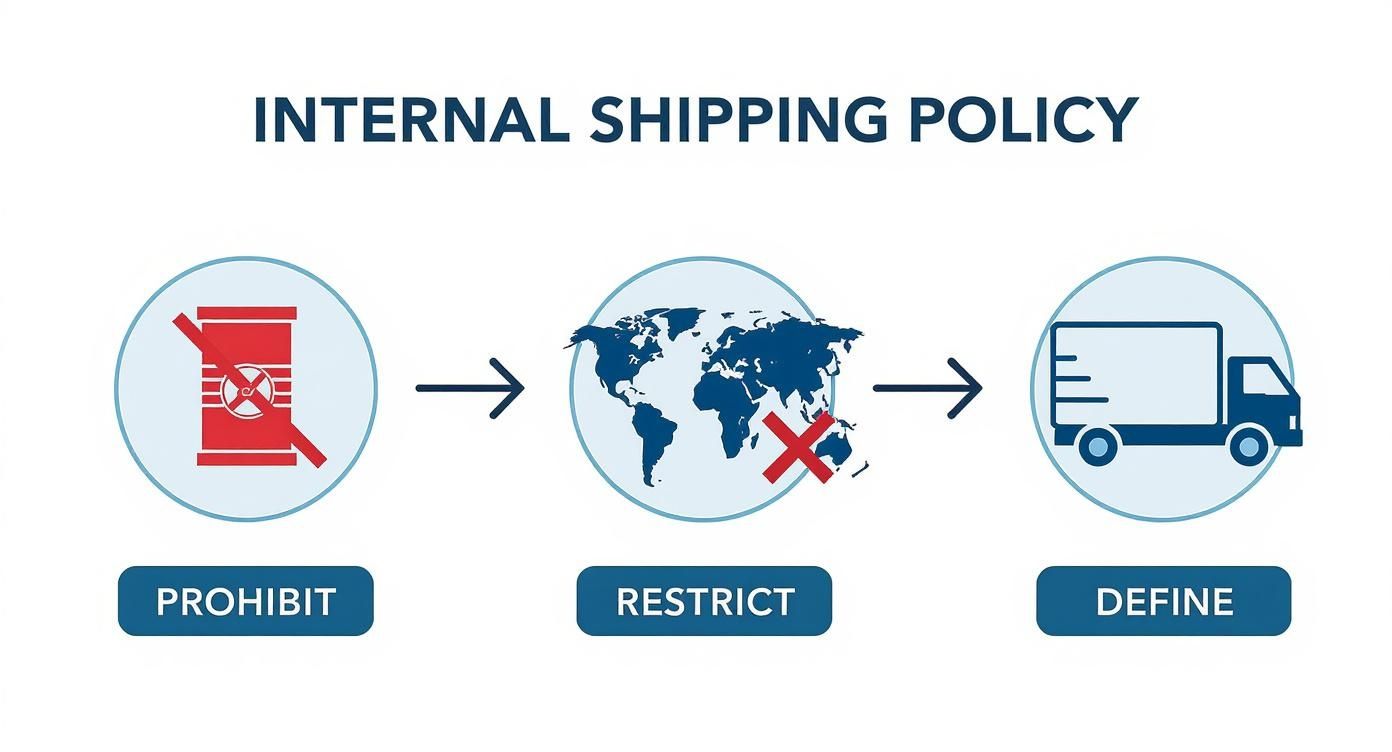
This flow, from prohibiting dangerous goods to restricting specific destinations, forms the logic your recordkeeping system must mirror. Every step needs a corresponding log entry.
Essential Fields for Your Compliance Log
Use this breakdown to create a robust shipment log. Capturing these details is fundamental for proving due diligence during an audit.
| Field Name | Why It's Important | Sample Entry |
|---|---|---|
| Order ID | Uniquely identifies the transaction being audited. | ORD-2024-98765 |
| Timestamp | Creates a chronological record of every compliance action. | 2024-10-26 14:15:03 UTC |
| Customer Info | Links the order to a specific person and shipping destination. | John Doe, 123 Main St, Anytown, USA |
| SKU(s) | Pinpoints the exact products being checked for restrictions. | ABC-101, XYZ-202 |
| Check Performed | Describes the specific compliance rule being evaluated. | CA State Magazine Capacity Check |
| Result | Shows the outcome of the compliance check (pass/fail/flagged). | Blocked - Exceeds 10-round limit |
| Action Taken | Details what happened next (e.g., order cancelled, item removed). | Order cancelled, customer notified. |
| System/User ID | Attributes the action to an automated system or a specific team member. | System: Ship Restrict |
Having a log this detailed leaves no room for ambiguity. It’s a clear, factual account of your compliance process in action.
Documenting Decisions on Flagged Shipments
The most scrutinized part of your audit trail will always be the exceptions. How do you handle an order that an automated system blocks? This is where your documentation must be flawless, detailing the justification for every manual action.
For example, say an order is flagged for a potential address mismatch but is manually approved after your team verifies the details. Your log needs to tell that whole story.
Example Log Entry: "Order #54321 flagged for ZIP code mismatch. Customer contacted via phone on 10/26/2024 at 2:15 PM by A. Miller. Customer confirmed correct ZIP is 90211; a typo was made during entry. Order manually approved for shipment."
This level of detail is non-negotiable. It proves that a human reviewed the situation and made a reasoned decision based on your internal policy, rather than just carelessly overriding a safety check. For a deeper dive into what auditors look for, check out our WooCommerce shipping compliance audit checklist.
Data Retention: How Long to Keep Records
Knowing what to log is only half the battle; you also need to know how long to keep it. Retention policies aren't arbitrary—they are often dictated by federal and state regulations. For many industries, a retention period of five to seven years is the standard for transactional and compliance records.
Failing to keep records for the required duration is a compliance violation in itself. Define a clear retention schedule in your policy and make sure your system—whether it's a series of spreadsheets or a cloud-based platform—can securely store those archives for the full timeframe.
It’s also helpful to look at broader industry standards to shape your strategy. External guidelines on the minimum documented information required for compliance can offer valuable perspective.
This whole process is magnified by global pressures. Documenting shipping restrictions is critical as maritime trade, which carries over 80% of world trade by volume, faces increasing regulatory complexity. Failure to produce the right paperwork can lead to seized shipments and steep costs—a risk no business can afford. It's a global context that highlights why having a bulletproof, audit-ready system is essential for every e-commerce business.
Turning Policy Into Daily Team Workflows
A bulletproof shipping policy is only as good as the team that follows it. If your rules live in a forgotten Google Doc, they aren’t protecting you. The real work is turning that static document into the daily, muscle-memory actions of your team.
<iframe width="100%" style="aspect-ratio: 16 / 9;" src="https://www.youtube.com/embed/iAC4-9SSc8fw" frameborder="0" allow="autoplay; encrypted-media" allowfullscreen></iframe>Your goal is to build a system where compliance just happens. It should be a natural part of every single operation, from the moment an order is picked in the warehouse to the final click of a customer service chat. When everyone knows exactly what to do and has the right tools, you create a powerful human firewall against expensive compliance mistakes.
Train Your Frontline Teams
Your warehouse and customer service staff are your first line of defense. They are the ones who see every order and talk to every customer, making their knowledge of your shipping policy absolutely critical. But just handing them a 20-page document and hoping for the best is a recipe for disaster.
Training has to be role-specific and scenario-based. A warehouse packer doesn't need to memorize the fine print of international sanctions, but they absolutely must know how to spot a prohibited item heading to a restricted state.
- For Warehouse Staff: Keep it simple and visual. Put up posters or checklists at packing stations that highlight restricted products and "no-ship" states or cities. Run hands-on drills where they have to physically pull non-compliant packages off the line.
- For Customer Service: Give them a quick-reference guide or an internal knowledge base that boils down the restrictions. This lets them answer customer questions with confidence instead of escalating every single query.
The point is to make compliance tangible. Give your teams the specific tools they need to make the right call in seconds.
Script Clear Customer Communication
How you tell a customer "no" is a make-or-break moment. A blunt, poorly worded message leads to frustrated shoppers, bad reviews, and a flood of support tickets. But with a little finesse, you can turn a potential negative into a neutral, understandable interaction.
Your documentation needs pre-approved scripts for different restriction scenarios. This creates consistency and stops well-meaning reps from going off-script and accidentally creating legal exposure.
Pro Tip: Your messaging should be helpful, not accusatory. Instead of saying, "We cannot ship this to you," try something like, "Due to state regulations in California, this item is unavailable for shipment to your address. We've removed it from your cart." That subtle shift in tone changes the entire conversation.
Even better, build these messages right into your website. A tool like Ship Restrict can automatically display a custom message on the product or cart page the moment a customer enters a restricted address. This stops a non-compliant order before it's even placed, which is the best possible outcome for everyone.
Establish an Exception Handling Process
Let's be realistic: no system is perfect. Whether you're using automated tools or manual checks, some orders will get flagged for review and need a human to make the final call. Your workflow documentation must have a crystal-clear process for handling these exceptions. Every manual override needs an auditable trail.
This process must define three key things:
- Who is authorized to review flagged orders? Keep this circle small. Limiting this responsibility to a few well-trained people ensures consistent decision-making.
- What criteria are used for approval or denial? Don't leave it to guesswork. The criteria should point directly back to specific rules in your master shipping policy.
- How is the decision documented? This is non-negotiable. Every manual action must be logged with the order ID, the reason it was flagged, the reviewer's name, the date, and a short justification for the final decision.
For example, if an order is flagged for a possible address typo, the workflow should tell the reviewer to contact the customer for verification. The log should then show that the contact was made and what the outcome was. This meticulous record-keeping turns a potential weak spot into a strength, showing any auditor that you’re diligent and have a solid process in place.
Using Automation to Fortify Your Documentation
 Let's be honest: manually chasing compliance is a losing battle. The sheer volume of regulations, coupled with the constant threat of human error, makes a manual approach not just inefficient but dangerously risky. This is where you stop chasing compliance and start automating it, letting technology handle the heavy lifting of documentation.
By shifting from spreadsheets and checklists to an automated system, you’re building a compliance engine that works 24/7. It doesn’t forget rules, make typos, or get overwhelmed during a holiday sales rush. Instead, it systematically enforces your policies and—just as importantly—creates the perfect digital paper trail you need for any audit. This is how you build a compliance strategy that is both accurate and scalable.
From Manual Checks to Automated Enforcement
The real power of automation is its ability to perform thousands of complex checks in milliseconds, right at the point of purchase. Imagine a customer in a restricted ZIP code trying to buy a regulated item. A manual system relies on a team member catching this before it ships—a process filled with potential failure points.
An automated tool, however, makes this check instantly. It can run real-time address validation, enforce product-specific rules, and even screen against denied party lists before the order is ever finalized. Every check is a data point, and every action is a log entry.
For example, a robust system will automatically:
- Validate Addresses: Check state, county, city, and ZIP code rules against the items in the cart.
- Enforce Product Rules: Block specific SKUs from being shipped to prohibited locations.
- Screen for Denied Parties: Compare customer information against government watchlists.
This preventative approach is the foundation of modern compliance documentation. It stops violations before they happen, and the logs are there to prove your diligence.
The Automatic Creation of an Audit Trail
This is where automation truly shores up your process for documenting shipping restrictions. A great compliance tool doesn’t just block bad orders; it meticulously records why each decision was made. This creates an unchangeable, time-stamped log that becomes the bedrock of your defense in an audit.
Every single compliance check gets recorded. Every blocked order is logged with a specific reason. And comprehensive reports can be generated on demand.
Think of it this way: instead of manually building a case file for each flagged order, the system builds it for you in real-time. An auditor can see a complete, chronological history of every rule enforcement, proving your process is systematic and not arbitrary.
This digital paper trail is your greatest asset. It shows not just that you have a policy, but that you have an active, consistent system for enforcing it on every single transaction. For WooCommerce store owners, understanding how this works is key. You can explore a detailed breakdown of automated shipping compliance for WooCommerce stores to see these principles in action.
Scaling Your Compliance Efforts
As your business grows, so does your compliance risk. More orders mean more potential for error, and a manual documentation process simply cannot keep up. Automation, however, is built to scale. It can handle one hundred orders or one hundred thousand orders with the same level of accuracy and diligence.
This scalability is especially critical in today's volatile shipping environment. A recent report from A.P. Moller-Maersk revealed that over 76% of European shippers faced supply chain disruptions in 2024, with nearly a quarter experiencing more than 20 separate incidents. This volatility demands a nimble and precise approach to compliance, which only automation can provide.
By investing in an automated solution like Ship Restrict, you’re not just buying software; you’re investing in a scalable documentation system. You ensure that as your business succeeds, your compliance framework doesn't just keep pace—it gets stronger. This frees up your team to focus on growth, confident that your compliance documentation is being handled perfectly in the background.
Common Questions on Documenting Shipping Restrictions
Once you start building out your compliance framework, the theoretical stuff quickly gives way to practical, real-world questions. It’s one thing to write a policy, but it’s another thing entirely to live with it day-to-day. Let’s tackle some of the most common questions we hear from business owners trying to get their documentation right.
How Often Should I Review My Documentation?
Your shipping restriction documentation isn’t a file you create once and then bury in a folder. Think of it as a living system that needs regular attention to stay effective.
As a baseline, you should schedule a comprehensive review of your entire policy and recordkeeping process at least once a year. This is your formal check-in to make sure your procedures are still working and align with how your business actually operates.
But some events can’t wait for an annual review. You need a process for making immediate updates when certain things happen:
- New Government Sanctions: When an agency like the Office of Foreign Assets Control (OFAC) announces a new trade embargo, your destination rules have to be updated that day.
- Carrier Policy Changes: Carriers like FedEx or UPS tweak their rules for regulated items from time to time. When they do, your internal policy needs to reflect that change.
- New Product Lines: Launching a new category of products means you have to run them through your entire compliance checklist and document any new restrictions that apply.
Geopolitical shifts can happen overnight. The best approach is to assign a specific person or team the responsibility of monitoring official sources for these changes. While a tool like Ship Restrict is fantastic for keeping your active rule sets current, your internal policy document must also be officially updated to show you’ve acknowledged and adopted the new reality.
The Single Most Critical Piece of Information to Log
Every data point in your audit trail matters, but if you have to focus on one thing, make it the justification behind each decision. This is especially true for any shipment that was blocked or flagged for manual review by your team. Your records need to tell a clear, concise story.
For any order that gets stopped, your log must show:
- Which specific rule was triggered: Was it a state law? A city ordinance? A carrier policy? Be specific.
- Who reviewed the order (if applicable): Note the name or user ID of the team member who made the final call.
- Why the final decision was made: A good log entry is unambiguous. For instance: "Order blocked due to OFAC country sanction for Cuba," or "Item removed from cart; violates CA magazine capacity law."
This level of detail proves you have a systematic, enforceable process. It shows an auditor that you're making consistent, rule-based decisions, not just arbitrary calls on the fly.
An auditor's primary goal isn't to catch you in a "gotcha" moment. It's to verify that you have a consistent and defensible system. A detailed log of justifications is the strongest evidence you can offer that your compliance program is both active and effective.
Can a Small Business Just Use Spreadsheets?
Absolutely. A small business can definitely start with spreadsheets. In fact, a well-organized spreadsheet is a thousand times better than having no documentation at all. You can use it to outline your policies, log manual compliance checks, and keep a simple record of employee training. It's a perfectly viable entry point.
But you have to be honest about the limitations. A manual approach is incredibly vulnerable to human error and becomes a nightmare to manage as your order volume picks up. The risk of one simple typo in an address or overlooking one obscure local ordinance is huge. And one small mistake can lead to a very expensive violation.
This is exactly why specialized software becomes such a smart investment, even for smaller operations. It automates the logging, ensuring every single check is accurately time-stamped and recorded without anyone having to lift a finger. This creates a far more reliable and defensible audit trail. When you weigh the cost of an automated tool against the potential fines and business chaos from a single compliance failure, the math becomes pretty clear. It’s about moving from a reactive, manual process to a proactive, automated one.
Ready to build a truly audit-ready documentation system without all the manual work? Ship Restrict automates rule enforcement and creates the perfect digital paper trail for every order, ensuring your business stays compliant as it grows. Learn more and see how it works at https://shiprestrict.com.
Automate Shipping Compliance
Stop worrying about restricted states. Ship Restrict handles it automatically.

Cody Yurk
Founder and Lead Developer of ShipRestrict, helping e-commerce businesses navigate complex shipping regulations for regulated products. Ecommerce store owner turned developer.
Automate Shipping Compliance
- Block restricted states
- No more cancellations
- Set and forget
3-day free trial · Card required