Quarterly compliance review guide regulated e-commerce: Audit readiness roadmap
Quarterly compliance review guide regulated e-commerce: A practical checklist to manage risk, prep for audits, and keep compliant records.

For anyone running a regulated e-commerce store, a quarterly compliance review isn't just another task on the to-do list—it's an essential rhythm for the business. Think of it as a systematic check-up that ensures everything from your shipping restrictions to your data privacy practices is still aligned with the law. This isn't about bureaucracy; it's a critical defense against fines, operational shutdowns, and a damaged reputation.
Why Quarterly Compliance Reviews Are Essential for Survival
Ignoring compliance in a regulated industry is like navigating a minefield blindfolded. The risks are huge and often pop up when it's already too late. A disciplined quarterly review isn't just about ticking boxes. It's a core business strategy that protects your revenue, your brand, and your fundamental ability to operate.
The fallout from non-compliance can be brutal, and it's much more than a simple slap on the wrist. A single package shipped to a restricted state by mistake can ignite a firestorm of thousands of dollars in fines and legal bills. Even worse, it could lead to your payment processor pulling the plug on your account. The damage to your brand can be even more painful, wiping out the customer trust you've worked so hard to build.
The Shifting Regulatory Landscape
The rules of e-commerce are anything but static. Governments around the world are constantly tightening their grip on online sales, and new regulations can appear practically overnight. If you're not staying ahead of these shifts, you're falling behind.
Automate Shipping Compliance
Block orders to restricted states automatically. 3-day free trial.
Start Free TrialJust look at the explosive growth in the market. Between 2014 and 2024, global retail e-commerce sales skyrocketed from around USD 1.3 trillion to nearly USD 7 trillion—a massive five-fold jump. That kind of growth puts a huge target on the industry for regulators. A perfect example is how the U.S. eliminated its de minimis import tax exemption, suddenly subjecting countless e-commerce shipments to duties and taxes. This single change dramatically increased the compliance workload for international sellers. You can get more insights on e-commerce at this turning point to see the full picture.
"In the world of regulated e-commerce, compliance isn't an expense; it's an investment in your business's future. A proactive review process transforms regulatory requirements from a threat into a competitive advantage."
Before we dive into the "how-to," it's helpful to see the big picture. The table below outlines the core domains every compliance review should cover, the main goal for each, and the common mistakes that can trip up even experienced store owners.
Core Focus Areas for Your Quarterly E-commerce Compliance Review
A summary of the critical domains every regulated e-commerce business must assess each quarter to maintain compliance and mitigate risk.
| Compliance Area | Key Objective | Common Pitfalls to Avoid |
|---|---|---|
| Shipping & Product Rules | Ensure product and shipping restrictions are current and accurately enforced at checkout. | Using outdated rule sets, failing to account for local/municipal laws, not testing rule logic after updates. |
| Data Privacy & Security | Verify that customer data handling, storage, and consent mechanisms meet regulations like GDPR & CCPA. | Vague privacy policies, not having a clear data breach response plan, using non-compliant third-party apps. |
| Tax Nexus & Collection | Confirm sales tax is correctly calculated and remitted based on current economic nexus thresholds. | Ignoring state-by-state nexus changes, misclassifying products, failing to remit collected taxes on time. |
| Marketing & Advertising | Audit all marketing claims, email campaigns, and ad copy for compliance with FTC and industry-specific rules. | Making unsubstantiated product claims, failing to include required disclaimers, not honoring opt-out requests promptly. |
Getting these four areas right each quarter forms the bedrock of a resilient, legally sound operation. It's the difference between constantly reacting to problems and confidently steering your business forward.
From Burden to Business Advantage
If you're still looking at compliance as just a cost center, you're missing the bigger picture. A solid quarterly review process does more than just keep you out of trouble; it makes your business stronger from the inside out.
Here's how a consistent review cycle pays off:
- Builds Customer Trust: When you show a real commitment to compliance, you're telling customers their data is safe and they're buying from a business that plays by the rules. That's a powerful differentiator.
- Improves Operational Efficiency: These audits almost always shine a light on broken workflows—like outdated shipping rules or manual tasks that could easily be automated. Fixing them saves you time and money.
- Unlocks New Markets: Having a deep and current understanding of regulations is your passport to expansion. It gives you the confidence to move into new states or countries without worrying about getting blindsided by a local law.
By following this quarterly compliance review guide for regulated e-commerce, you move from a defensive, reactive crouch to a proactive, strategic stance. This framework will help your WooCommerce store not just survive, but actually thrive in an increasingly complex legal world.
Building Your Actionable Audit Checklist
A solid review process lives and dies by its checklist. But a generic template just won't cut it when you're selling regulated goods. You need a detailed, practical list that gets into the weeds of the specific risks your WooCommerce store faces every day. Think of it less as a chore and more as a proactive tool for improvement.
This checklist shouldn't be a static document you dust off every three months. It needs to be a living, breathing guide that evolves with each review. It must cover the nuts and bolts of your entire operation, from the specific shipping rules that govern every single sale to the security protocols protecting your customers' data. A systematic approach here is your best defense against missing something critical.
Free Shipping Compliance Audit
We'll review your WooCommerce store's shipping compliance for free.
Scrutinizing Shipping Rules and Zones
The heart of your compliance audit is your shipping logic. This is where the rubber meets the road. I've seen firsthand how misconfigured rules can lead directly to compliance violations, chargebacks, and lost revenue. Your quarterly check-in needs to be a deep dive, not just a quick once-over.
Start by auditing your shipping zones against current laws. A rule that was perfectly fine last quarter might be a liability today. For instance, a state could pass new legislation overnight that restricts a product category you've been selling there for years.
Your audit absolutely must confirm:
- Geographic Accuracy: Are your state, county, and even ZIP code-based restrictions perfectly aligned with the latest legal boundaries? It's not unheard of for a small town to enact a local ordinance that requires an immediate update on your end.
- Product-Specific Rules: Do your rules correctly block specific product SKUs from shipping to prohibited areas? This is non-negotiable for items with nuanced restrictions, like different types of ammunition or firearm accessories that might be legal in one county but not the next.
- Rule Logic: Test the logic itself. What happens when a customer puts both a restricted and an unrestricted item in their cart? Your system needs to behave exactly as intended, whether that's blocking the entire sale or splitting the shipment (if your workflow even allows for that).
Following this process turns a simple checklist into an ongoing quarterly compliance review guide for regulated e-commerce, keeping your store—and your business—protected. For a more detailed breakdown, our comprehensive WooCommerce shipping compliance audit checklist is a great place to start.
This whole flow, from spotting risks to actively auditing and ultimately growing your business, is a continuous cycle.
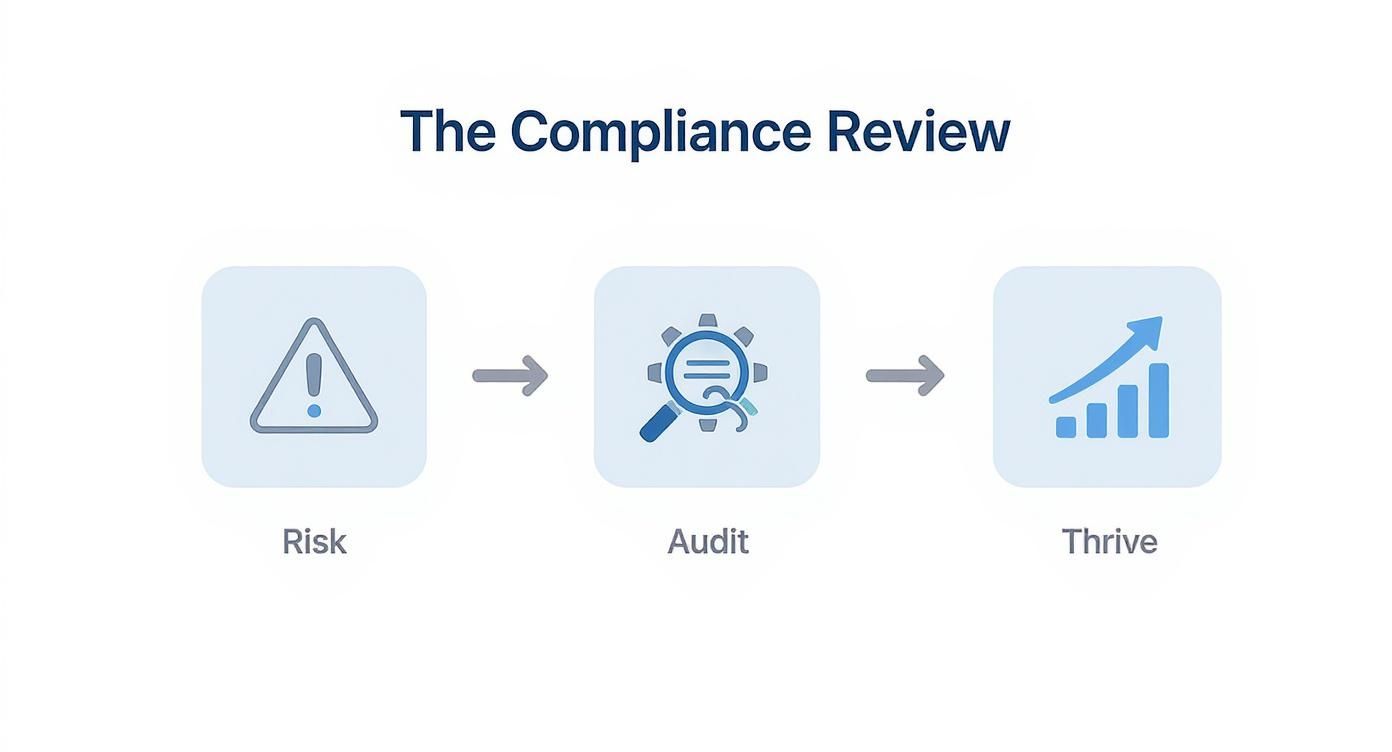
This visual really drives home the point: auditing is the essential bridge between seeing potential compliance threats and achieving sustainable, compliant growth.
Analyzing Rule Performance and Friction
It's not enough to just confirm your rules are correct. You have to analyze how they're performing in the wild. A rule that fires constantly might signal a deeper issue, like an unclear product description or a confusing checkout process that baits customers into trying to make a prohibited purchase.
Dive into your analytics. Which restriction rules get triggered most often? Are you seeing a spike in abandoned carts from specific regions? This data is a goldmine for revealing points of customer friction.
A compliance rule should be a silent guardian, not a frustrating roadblock. If a rule is constantly being triggered, investigate the 'why.' You might discover an opportunity to improve the customer experience by providing clearer information upfront, long before they reach checkout.
For example, if you see repeated attempts to ship a restricted item to California, why not add a prominent notice directly on that product’s page? It's a simple step that can slash cart abandonment and reduce the number of support tickets you have to answer. A crucial part of your audit checklist should also involve Understanding the INFORM Act and its impact on Amazon Sellers, ensuring your business stays compliant with new legislation affecting online marketplaces.
Verifying Product Data and Security Protocols
Your checklist has to go beyond just shipping. Two other areas demand your attention every quarter: the integrity of your product data and your data security protocols. These are foundational to building trust and maintaining your operational legitimacy.
Product Information Audit
- Labeling and Descriptions: Do your product descriptions have all legally required warnings, disclaimers, and specifications?
- Categorization: Are products correctly categorized to make sure the right shipping and tax rules are applied automatically?
- Images and Media: Do your product photos accurately represent the item and comply with any relevant advertising standards?
Data Security and Privacy Verification
- PCI DSS Compliance: Your payment environment must be secure. A quarterly check ensures your practices align with current PCI DSS standards, which get updated more often than you'd think. This is non-negotiable for anyone handling credit card info.
- Privacy Policy Review: Does your privacy policy actually reflect how you collect, store, and use data today? Make sure it's current with regulations like GDPR or CCPA if you sell to customers in those areas.
- Third-Party App Security: Audit the permissions and data access of every single third-party plugin connected to your WooCommerce store. A vulnerability in one of them can compromise your entire system.
By methodically working through these points each quarter, you shift your audit from a reactive chore into a proactive strategy for making your business stronger and more resilient.
Conducting a Practical Risk Assessment for Your Store
While an audit tells you where you stand today, a risk assessment is all about looking ahead to see where things could go wrong. This isn't just some abstract corporate exercise; it's a brass-tacks process for spotting the real-world threats that could sideswipe your regulated e-commerce business. The goal is to get out of a simple "check the box" mindset and start proactively shielding your store from future compliance failures.
<iframe width="100%" style="aspect-ratio: 16 / 9;" src="https://www.youtube.com/embed/DKzijPaHS-Q" frameborder="0" allow="autoplay; encrypted-media" allowfullscreen></iframe>A proper assessment forces you to ask the tough questions. What’s the actual financial hit if your main shipping carrier suddenly decides they won't handle your product category anymore? How bad is the brand damage if just one non-compliant product slips through and gets sold where it shouldn't? Answering these questions gives you a clear roadmap for what to fix first.
Identifying and Categorizing Your Risks
First things first, you need to brainstorm what could realistically derail your operations. And don't just think about shipping rules. You need to look at every touchpoint of your business where compliance is a factor, from marketing emails to the third-party apps you've installed.
I’ve found it helpful to group potential problems into a few key buckets:
- Regulatory Risks: This is the big one. It's the chance of new laws popping up or old ones changing. A state could suddenly ban an item you sell, or new cross-border tax laws could make shipping a nightmare.
- Operational Risks: These are the internal fumbles. It could be anything from an employee manually overriding a shipping block to a software bug in your WooCommerce setup that lets an illegal order through.
- Third-Party Risks: Your business leans on partners, and when they mess up, it becomes your problem. This includes your payment gateways, shipping carriers, and even the marketing agency running your ads.
- Data Security Risks: This is the ever-present threat of a data breach. The penalties under regulations like GDPR and CCPA are massive, not to mention the hit your reputation will take.
The compliance world is always shifting. Recent studies show that e-commerce audits are getting more frequent and complex, with 58% of companies now running four or more audits every year. It’s no surprise that the top headaches—privacy breaches, vendor failures, and regulatory fines—were flagged by over a quarter of these businesses.
Prioritizing Risks With a Simple Framework
Once you've got a list of everything that keeps you up at night, you have to prioritize. You can't fix everything at once. A simple but incredibly effective way to do this is to score each risk on two things: likelihood and impact.
Just assign a score from 1 (low) to 5 (high) for each one.
- Likelihood: How likely is this to actually happen in the next 12 months?
- Impact: If it does happen, how bad will it be? Think money, legal trouble, and reputation.
Then, just multiply the two scores to get a Risk Priority Number (RPN). A risk with a high likelihood and high impact (like a 5 x 5 = 25) needs your immediate attention. Something with a low likelihood and low impact (say, a 1 x 2 = 2) can go on a watchlist, but you don't need to drop everything for it.
This simple scoring method cuts right through the noise. It turns a long list of worries into a clear, actionable to-do list, making sure you spend your time and money on the threats that truly matter.
For example, an accidental sale of a restricted firearm part to a prohibited state is a low-likelihood event (especially with a tool like Ship Restrict in place), but the impact is catastrophic. That incredibly high impact score justifies the ongoing cost of automated compliance tools and the time it takes to audit their settings every quarter.
Developing Practical Mitigation Strategies
With your risks ranked, the final step is to come up with concrete plans to deal with the highest-scoring threats. This is where your risk assessment goes from being a document to a game plan. Your strategies have to be specific and actionable, not just vague ideas.
Here are a few real-world examples:
- Risk: A key third-party app in your store becomes non-compliant with a new privacy law.
- Mitigation: During each quarterly review, you’ll re-evaluate the privacy policies of all your plugins. For any mission-critical app, you should also identify and pre-vet an alternative so you can swap it out quickly if you have to.
- Risk: An employee manually approves an order that violates a shipping restriction.
- Mitigation: Lock down user role permissions in WooCommerce. Create a documented policy that says any manual override needs a sign-off from two different team members. Then, make checking the override log a standard part of your quarterly review.
- Risk: Your email marketing campaigns accidentally violate CAN-SPAM or other regulations.
- Mitigation: Set up a quarterly audit of all email templates to ensure they have the required info, like a physical address and a clear unsubscribe link. Understanding the Legal Considerations for Email Marketing is a non-negotiable part of this process.
This structured approach to risk turns your compliance efforts from reactive fire-fighting into proactive fire prevention. It empowers you to tackle vulnerabilities before they become expensive emergencies, making it a cornerstone of any serious quarterly compliance review guide for regulated e-commerce.
Mastering Your Documentation and Reporting
In the world of regulated e-commerce, there's an old saying that’s painfully true: if it isn’t documented, it never happened. A rock-solid documentation and reporting system is your ultimate defense during an audit and your proof of due diligence. This isn't just about creating files to sit on a server; it's about building a living record that turns your compliance efforts into a strategic asset.
Think of it as the black box for your compliance program. Your documentation creates a clear, auditable trail of every decision, every audit finding, and every corrective action you take. This trail is invaluable for proving your commitment to regulators, payment processors, and partners. Without it, you're just relying on memory, and that simply won't stand up to scrutiny.

Building Your Compliance Repository
First things first: you need to create a centralized, secure repository for all compliance-related materials. A scattered collection of documents in various cloud drives, email inboxes, and local folders is a recipe for disaster when an auditor comes knocking. This central hub has to be organized, access-controlled, and consistently maintained.
This is your compliance command center. It needs to be the single source of truth for your entire team. For a deeper dive into the level of detail required, understanding shipping restriction record-keeping requirements provides a solid foundation.
Your repository should contain a few key elements:
- Audit Checklists: The actual checklists used during each quarterly review, complete with notes, screenshots, and findings.
- Risk Assessments: Your detailed risk assessment documents, including how you scored each risk and your plans to mitigate them.
- Remediation Logs: A running log that tracks every issue found, the steps taken to fix it, who was responsible, and the date it was resolved.
- Training Records: Proof that your team has completed all necessary compliance-related training.
Establishing a Schedule with Clear Ownership
Accountability is the engine of any successful compliance program. A vague plan with no assigned owners or deadlines is doomed to fail. You need a simple but effective schedule that clearly outlines who is responsible for what and when it needs to be done.
This schedule is what turns your quarterly compliance review guide for regulated e-commerce from a document into an actual, operational plan.
A schedule without owners is just a wish list. Assigning specific team members to each review task ensures that nothing falls through the cracks and creates a culture of personal responsibility for compliance.
Here’s a sample framework you can adapt for your own team:
| Task | Owner | Frequency | Due Date (Q3 Example) |
|---|---|---|---|
| Review Shipping Rules & Zones | Operations Manager | Quarterly | July 15th |
| Audit Third-Party Apps | IT Lead | Quarterly | July 20th |
| Update Risk Assessment | Compliance Officer | Quarterly | August 1st |
| Review Privacy Policy | Legal/Marketing | Semi-Annually | August 10th |
| Compile Quarterly Report | Compliance Officer | Quarterly | August 15th |
Crafting the Quarterly Compliance Report
The capstone of each review cycle is your quarterly compliance report. This document is more than just an internal memo; it's a formal record that summarizes the entire process. It should be clear, concise, and structured so that anyone can get a comprehensive overview at a glance.
This report serves a couple of important purposes. Internally, it keeps leadership in the loop on the company's compliance posture. Externally, it can be presented to auditors or regulatory bodies to demonstrate a proactive and systematic approach to managing your obligations.
Your report should always include these core sections:
- Executive Summary: A brief, high-level overview of the review period, key findings, and overall compliance status. Keep it short and to the point.
- Scope of Review: Clearly state what areas were audited this quarter (e.g., shipping rules, data security, marketing materials).
- Key Findings: A detailed breakdown of any identified issues, gaps, or non-compliance events discovered during the audit. No sugarcoating.
- Risk Assessment Update: Note any new risks identified or changes in the priority of existing ones. Did a new law pass? Did a new threat emerge?
- Remediation Plan: An actionable list of corrective steps. For each item found in the findings, list the fix, the person responsible, and a firm deadline.
This kind of structured reporting transforms the abstract concept of "compliance" into tangible, measurable actions. It makes your quarterly review a powerful tool for continuous improvement, not just a box-ticking exercise.
Trying to run your compliance checks manually is like playing with fire. It’s slow, wildly inconsistent, and dangerously prone to human error—a single slip-up can easily cost you thousands in fines. Bringing specialized tech into your workflow isn’t just about moving faster; it’s a fundamental upgrade that makes your entire quarterly review process stronger, more accurate, and ready to scale.
The right tools turn your review from a reactive scramble into a proactive strategy. Instead of cross-referencing shipping addresses against a messy spreadsheet of state laws, you can lean on automated systems that enforce these rules 24/7. This frees up your team to focus on what really matters, like digging into rule performance and getting ahead of new legislation.
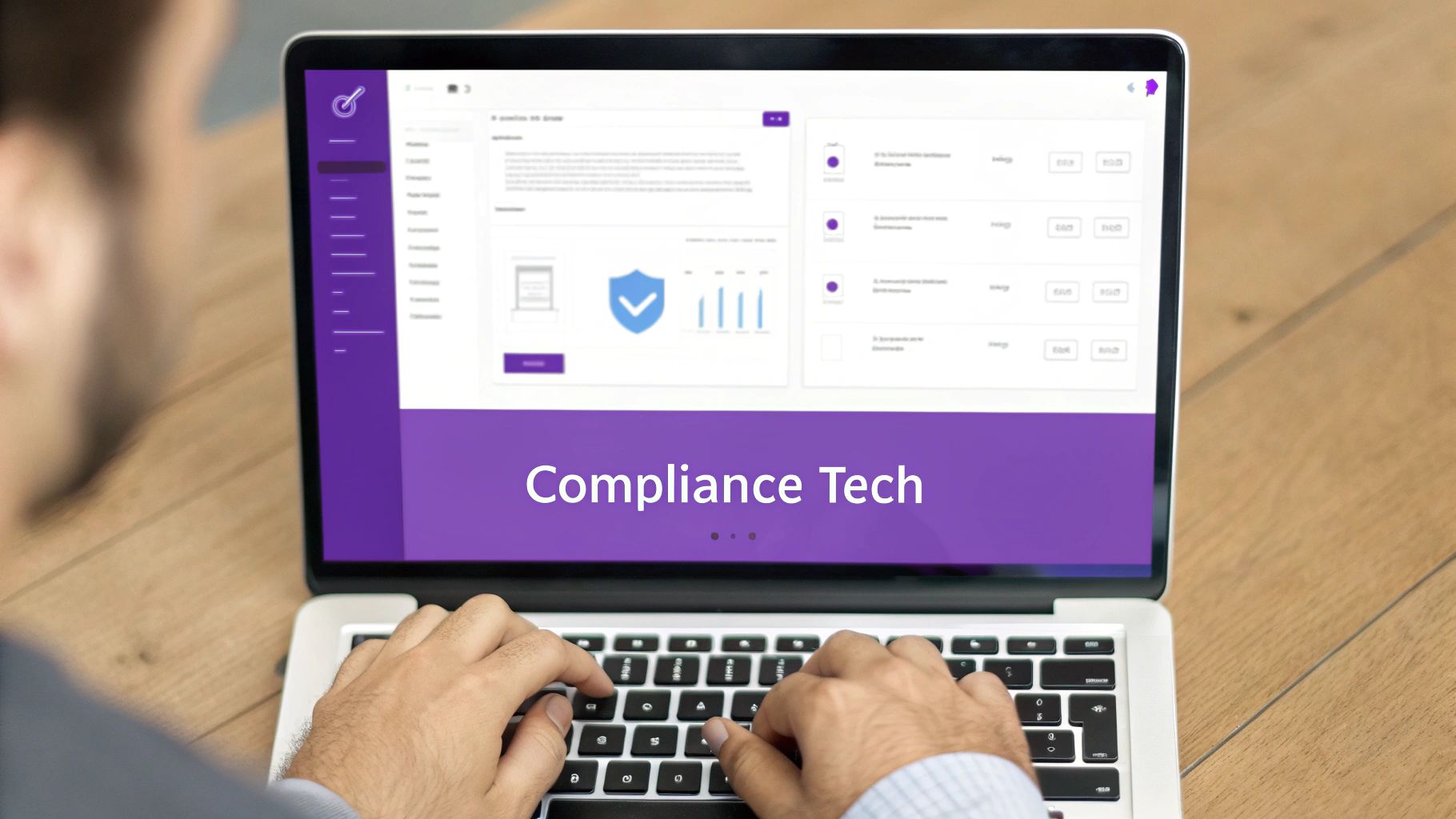
This kind of dashboard puts all your critical compliance data right where you need it, letting you perform quick audits and make adjustments on the fly. You can see at a glance where your rules are firing correctly and where you might have a problem.
Auditing Your Automated Shipping Rules
A huge piece of a tech-driven review is putting your existing rule sets under the microscope. Your quarterly check-in has to include a full validation of every single shipping restriction configured in your WooCommerce store. This is exactly where tools built for automated shipping compliance for WooCommerce stores become non-negotiable.
Let's walk through a real-world example. Say a new regulation in Colorado suddenly restricts a specific firearm accessory you sell. Here’s what your audit process should look like:
- Verification: First, log into your compliance plugin and confirm a rule exists that blocks that product’s specific SKU from shipping to any Colorado ZIP code. No guesswork.
- Testing: Next, run a live test transaction. Add that exact item to a cart with a Colorado address and try to check out. The system should block it, no exceptions.
- Message Review: Finally, look at the customer-facing message that pops up. Is it clear and helpful? Or is it a generic error that just frustrates shoppers and leads to abandoned carts?
This kind of systematic check ensures your automated defenses are actually working as intended. It turns a complex legal headache into a simple, repeatable item on your quarterly checklist.
Adapting to Regulatory Changes with Tech
The e-commerce world never sits still. Looking ahead to 2025, major regulatory shifts are hitting key markets, like the EU’s new General Product Safety Regulation (GPSR). This rule forces sellers to conduct detailed risk assessments before products are even listed—a task that's nearly impossible to manage manually if you have more than a handful of products.
Technology is a force multiplier. It gives you the power to adapt to complex regulatory changes with speed and precision. A new international tax law or a product ban can be rolled out across your entire store in minutes, not days.
Think about it. A new law requires you to start collecting a specific VAT for all sales to Spain. With a modern tech stack, it’s no big deal. You just create a new tax rule in your WooCommerce settings or tax plugin, apply it to your "Spain" shipping zone, and run a quick test order to confirm it’s working. This agility is what keeps you compliant without bringing sales to a grinding halt.
Your Top Questions About E-commerce Compliance Reviews
Even the sharpest e-commerce operators have questions when it comes to compliance reviews. Let's break down some of the most common ones we hear, moving past the jargon to give you practical answers you can actually use.
How Often Should a Small E-commerce Business Really Do a Full Compliance Review?
While this guide focuses on a quarterly schedule, the honest answer is: it depends on your risk.
If you’re in a heavily regulated space—think firearms, CBD, or vape products—a quarterly review is the bare minimum. Seriously. The rules in these industries change so fast that waiting six months is like inviting a compliance nightmare to your doorstep. Penalties are no joke.
For smaller shops selling less sensitive items, a deep dive every six months might be enough. But even then, we strongly recommend a quick quarterly check-in on your highest-risk areas, like your critical shipping rules and data privacy settings.
The real key is establishing a regular, documented rhythm. Compliance can't be a once-a-year fire drill. The more complex your products and the more states you sell into, the more you should lean into that quarterly schedule.
What Are the Most Common Compliance Failures for WooCommerce Stores?
From what we see in the trenches, the costliest mistakes almost always come down to misconfigured shipping and tax settings. One of the biggest offenders is messing up sales tax, especially with the maze of economic nexus laws that are different everywhere you look. Failing to collect the right amount is a fast track to an audit.
Another huge failure point is breaking state-specific shipping restrictions for things like alcohol, tobacco, or even certain agricultural products. These rules get incredibly specific, sometimes changing from one county to the next.
Beyond that, data privacy is a minefield. Common mistakes we see all the time include:
- Stale Privacy Policies that don't match how you actually handle data or meet current GDPR/CCPA standards.
- Shady Cookie Banners that don't give users a real choice or clear information.
- Missing Product Documentation, which is a huge deal for anyone selling internationally and can get products seized at the border.
How Can I Possibly Keep Up with All the Changing E-commerce Regulations?
Staying on top of regulatory changes is a challenge, but it’s not impossible if you build a system. You can’t just wait for the news to come to you; you have to go get it.
First, subscribe to newsletters directly from the agencies that govern your industry (like the FDA or TTB) and follow a few reputable legal blogs that focus on e-commerce law. Joining industry associations is also a game-changer; they often send out easy-to-digest summaries of new laws.
Don't forget to lean on your partners. Your payment gateways, shipping carriers, and compliance software providers all publish updates on regulatory changes that affect their services. They have a vested interest in making sure you stay compliant.
Finally, a simple but powerful trick is to set up Google Alerts. Use keywords for your industry plus terms like "e-commerce regulations" or "shipping restrictions." Make a habit of reviewing these alerts as a formal part of your quarterly review. This proactive hunt for information is what separates a good quarterly compliance review guide for regulated e-commerce from a great one.
Can't I Just Automate My E-commerce Compliance Review?
Not entirely, but you can—and absolutely should—automate the enforcement and monitoring. The goal of automation isn’t to replace the review; it’s to kill the potential for human error in your day-to-day operations.
For example, specialized tools can automate the enforcement of complicated shipping rules, stopping an illegal sale from ever happening in the first place. Tax software can handle sales tax calculations and remittances without you lifting a finger. Security scanners can be set up to automatically check your site for PCI DSS vulnerabilities.
The job of your quarterly review, then, is to audit the automated systems themselves. You need to confirm their settings still line up with current laws, test that they’re working correctly, and manually handle the things that need a human brain—like updating your privacy policy or conducting a fresh risk assessment. Technology handles the heavy lifting; your review makes sure the strategy is still sound.
Ready to eliminate the guesswork and human error from your shipping compliance? Ship Restrict for WooCommerce automates your shipping rules, blocking restricted orders before they become costly mistakes. Learn how Ship Restrict can protect your business today.
Automate Shipping Compliance
Stop worrying about restricted states. Ship Restrict handles it automatically.

Cody Yurk
Founder and Lead Developer of ShipRestrict, helping e-commerce businesses navigate complex shipping regulations for regulated products. Ecommerce store owner turned developer.
Automate Shipping Compliance
- Block restricted states
- No more cancellations
- Set and forget
3-day free trial · Card required