New York Alcohol Shipping Laws A Practical Compliance Guide
Navigate New York alcohol shipping laws with confidence. This guide covers DTC rules for wine, beer, and spirits, plus licensing, taxes, and compliance.
New York's alcohol shipping laws are notoriously complex, with rules that change depending on the type of beverage and where your business is located. To put it simply, wineries can often ship directly to consumers (DTC) with the right license, while in-state distilleries have some limited DTC rights, and beer shipping is almost entirely off-limits. This guide will cut through the noise and break down these regulations into clear, actionable steps for your eCommerce store.
Navigating New York's Alcohol Shipping Landscape
Trying to understand New York’s web of alcohol shipping laws can feel like you’ve been handed a map in a foreign language. The rules aren’t just strict; they’re incredibly specific, changing dramatically based on what you sell and where you’re selling it from. This creates a huge headache for any eCommerce business trying to tap into the massive New York market.
The central player you need to know is the New York State Liquor Authority (NYSLA). This is the agency that creates, interprets, and enforces every single regulation, from handing out licenses to penalizing sellers who step out of line. Think of the NYSLA as the ultimate gatekeeper for all alcohol sales in the state.
Who Can Ship What: A Quick Overview
To get your bearings, know that permissions boil down to three key factors: the type of alcohol (wine, spirits, or beer), whether your business is physically inside New York, and the specific license you hold. This is far from a free-for-all market; each category operates under its own distinct legal framework.
Automate Alcohol Shipping Compliance
Block orders to restricted states automatically. 3-day free trial.
Start Free TrialAn out-of-state winery, for example, has a relatively clear path to New York consumers. An out-of-state brewery, on the other hand, has virtually none. Understanding these fundamental differences is the first, most critical step toward compliance.
The core challenge for sellers is that New York's laws create an uneven playing field. A business shipping wine from California follows a completely different set of rules than a distillery shipping gin from just across the state line in New Jersey.
To give you a clearer picture right away, here’s a high-level summary of who can ship what directly to consumers in New York.
Quick Guide to NY Direct-to-Consumer (DTC) Alcohol Shipping
This table provides a snapshot to help you quickly see where your business fits into New York’s DTC shipping rules.
| Beverage Type | In-State Seller Permissions | Out-of-State Seller Permissions |
|---|---|---|
| Wine | Permitted with license | Permitted with Direct Shipper's License |
| Spirits | Permitted for licensed distilleries | Prohibited (with some exceptions) |
| Beer | Very limited local delivery only | Prohibited |
As you can see, the opportunities are highly specific. In the sections that follow, we'll dive deep into the licenses, permits, and day-to-day operational rules you'll need to follow for each of these categories.
We’ll also get into tax obligations, which are a critical piece of the puzzle. Properly calculating and remitting taxes is non-negotiable for staying in good standing with state authorities. For a closer look at that side of things, check out our detailed guide on how state excise taxes affect online alcohol sales and shipping.
Who Can Legally Ship Alcohol Direct to Consumers
Trying to figure out who can legally ship alcohol in New York is like navigating three different sets of customs rules for the same country. What gets a pass for wine won't work for spirits, and beer is another story altogether.
The rules hinge on two key things: where your business is physically located (in-state or out-of-state) and the specific license you hold. Getting these details right from the start is the only way to tap into New York's massive market without running into trouble. Let's break down exactly what's allowed for each category.
Wine Shipping: The Most Open Category
For wineries, New York is about as welcoming as it gets for direct-to-consumer (DTC) shipping. This is the one category where both in-state and out-of-state producers have a clear, well-defined path to sell directly to customers.
Free Alcohol Compliance Audit
Selling alcohol online? We'll review your WooCommerce store's shipping compliance for free.
The golden ticket here is the Direct Shipper's License, issued by the NYSLA. Think of it as a special passport that lets licensed wineries from anywhere in the U.S. ship their products straight to a New Yorker's front door. It puts everyone on a relatively level playing field.
But this access comes with one big, non-negotiable rule you absolutely must follow:
- Volume Limit: Licensed direct shippers can send a maximum of 36 cases of wine per year to any single New York consumer. Each case can contain up to nine liters.
This 36-case limit is the backbone of New York’s wine shipping law. You need a rock-solid system to track every sale to every customer, or you risk blowing past that annual cap and facing some serious penalties. This decision tree gives you a quick visual of how your location and product type dictate your shipping rights.
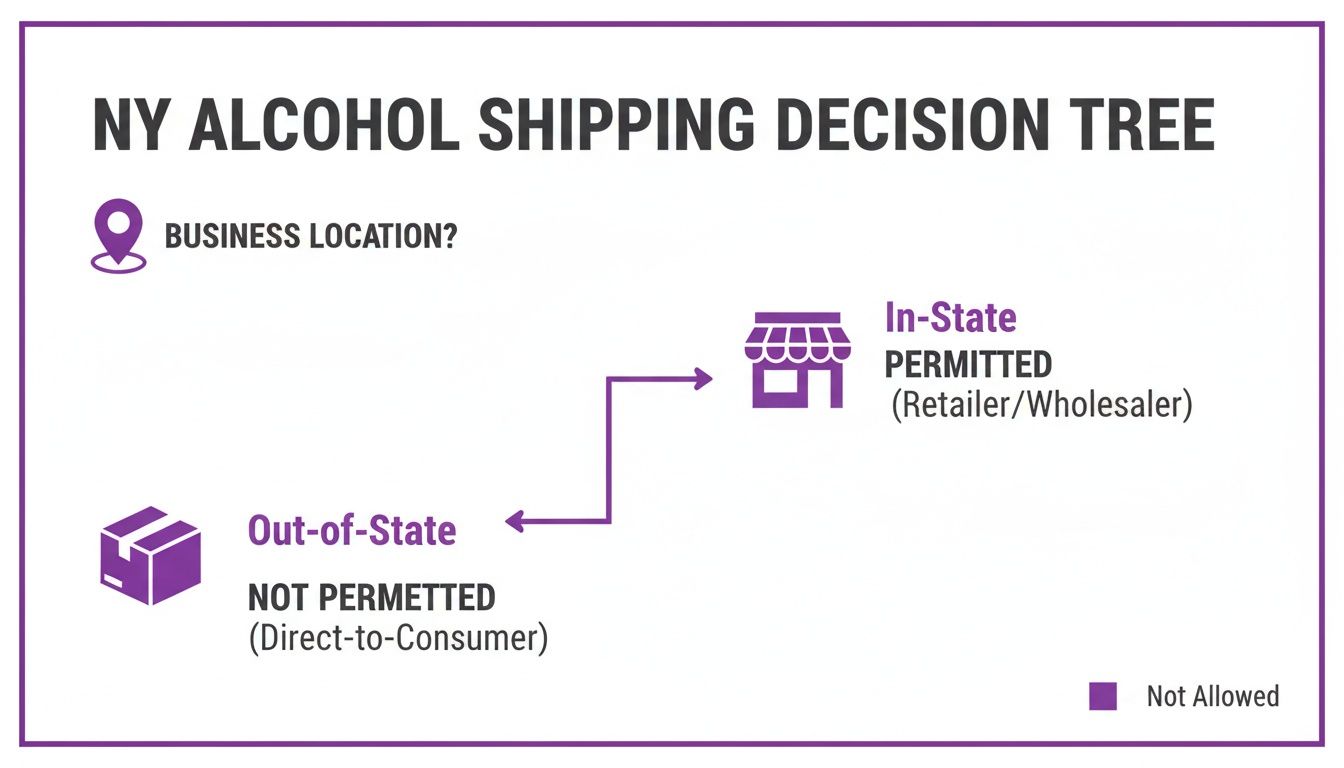
As you can see, the path to legal shipping forks right at the beginning based on where you're located and then branches out depending on what you sell.
Spirits Shipping: A Tale of Two Laws
When it comes to spirits, the rulebook gets much tighter. The laws here have been a hot topic recently, with some major legal shifts. For a long time, DTC shipping of spirits was a hard no, but a game-changing law now allows in-state New York distilleries to ship their bottles directly to consumers within the state.
This was a huge win for local craft distillers, opening up a crucial sales channel. But—and this is a big but—the law didn't give the same permissions to distilleries outside of New York.
For out-of-state distilleries, the door to New York's DTC market is still mostly shut. The state's law has a "reciprocity" clause, which means an out-of-state distillery could only ship to New York if its home state lets New York distilleries do the same.
This has created a tough spot for distillers in states that don't have those reciprocal deals in place. As you can find in some insights on parkstreet.com about New York's framework, the contrast is stark: an out-of-state winery can ship up to 36 cases a year with a license, while an out-of-state distiller can't ship a single bottle directly to a consumer.
Beer Shipping: The Most Restricted Category
If you’re in the beer business, the DTC laws in New York are among the strictest in the entire country. For an eCommerce shop, the message is pretty blunt: shipping beer directly to New York consumers is almost completely off-limits.
Sure, some in-state breweries might have special permits for limited, local deliveries using their own vans. But there is no broad approval for shipping beer through common carriers like FedEx or UPS. Out-of-state breweries are shut out entirely. This slams the door on the DTC eCommerce channel for pretty much any craft brewery hoping to sell in the state.
Securing the Right Licenses and Permits to Ship
Think of licensing as the foundation for your entire shipping operation. Without the right permits, everything you build is on shaky ground and at risk of collapsing. For any eCommerce business eyeing the New-York market, tackling the licensing process is often the most intimidating part. Let's cut through the paperwork jungle and make sure your business is built on a solid legal footing from day one.
The New York State Liquor Authority (NYSLA) is the agency you'll get to know well. Their website is the official source for every form and requirement, so making it your first stop is a smart move.
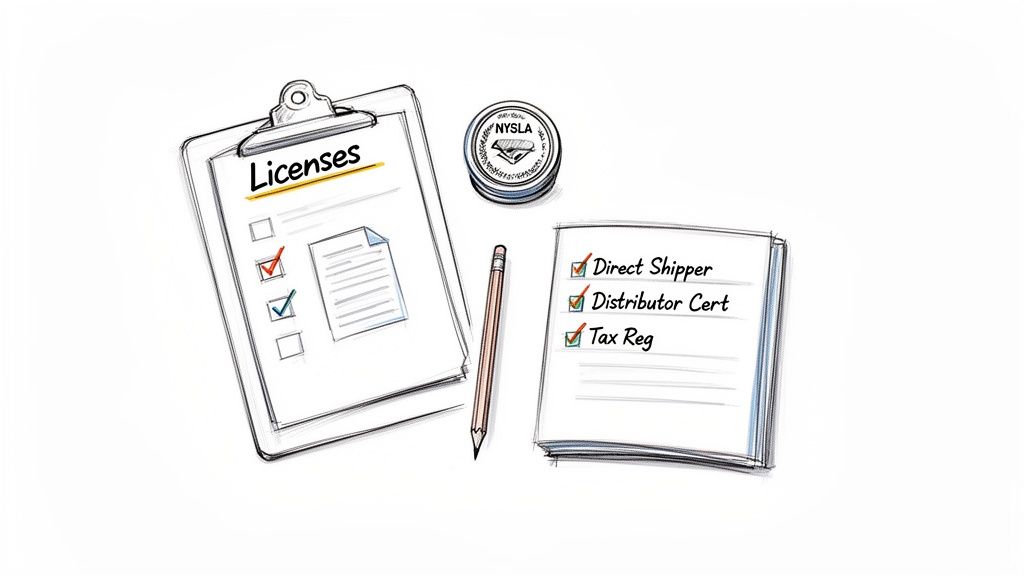
This is where you'll find the applications for the permits you need, including the crucial Direct Shipper's License for wineries.
The Essential Licenses for Shipping
The specific permit you need hinges entirely on what you sell and where your business is physically located. Each license has its own set of rules, fees, and application quirks. It's definitely not a one-size-fits-all system, so figuring out the correct permit is job number one.
Here’s a breakdown of the most common licenses for direct-to-consumer shipping in New York.
- Out-of-State Direct Shipper's License: This is the golden ticket for out-of-state wineries. It gives them the legal green light to ship up to 36 cases of wine per year to a single New York consumer.
- In-State Winery License: Wineries located within New York get DTC shipping privileges under their standard manufacturing license. No extra shipping permit is needed to serve customers inside the state.
- In-State Distillery License & Tax Certificate: This one is a bit more complex. Licensed New York distilleries have DTC shipping rights, but recent legislative changes added some new hoops to jump through.
The new framework for distilleries is a perfect example of how quickly New York's alcohol shipping laws can change. Staying on top of these regulatory shifts is absolutely critical.
New Rules for New York Distilleries
A recent and significant legislative update has changed the game for in-state distilleries. The state restored their ability to ship directly to consumers, but not without adding new compliance hurdles.
To legally ship DTC, a New York distillery must now obtain a certificate of authority from the New York State Department of Taxation and Finance and register as a distributor under state tax law. This is in addition to their existing NYSLA license.
On top of the extra paperwork, this new system comes with specific costs. Distilleries now owe an annual licensing fee of $125 to the state and are on the hook for calculating and remitting taxes based on each shipment’s final destination. For a deeper dive, check out this overview of New York's direct-to-consumer shipping law for producers.
Your Licensing and Permit Checklist
Trying to navigate the application process without a clear plan is a recipe for frustration. Use this checklist to get organized and make sure you’ve covered all your bases before shipping your first box.
- Identify the Correct License: First, pinpoint the exact permit for your business based on product type (wine or spirits) and your location (in-state vs. out-of-state). Applying for the wrong license is a common—and costly—mistake.
- Gather Required Documentation: Most applications demand a deep dive into your business details. You’ll typically need your federal basic permit, business formation documents, personal info for all principals, and a diagram of your licensed premises.
- Complete and Submit the Application: Fill out the NYSLA forms meticulously. Any errors or missing info can cause major delays or even get your application denied. Thankfully, most submissions are now handled online.
- Pay All Associated Fees: Licensing isn't free. Budget for application fees, which can run from modest amounts to several hundred dollars, plus the annual renewal fees to keep your license active.
- Register with the Department of Taxation and Finance: This is a non-negotiable step for anyone shipping alcohol into New York. You have to register to collect and send in New York sales and excise taxes. Skipping this is a serious violation that can put your entire shipping permit at risk.
By following these steps, you can turn the daunting task of licensing into a manageable process and pave the way for a compliant, successful eCommerce business in New York.
Mastering the Core Rules for Every Shipment
Getting your license is the first big step, but staying compliant day-to-day is the real challenge. Once you’re cleared to ship, every single package has to follow a strict set of rules. Think of these as your shipping department's daily playbook—they’re non-negotiable and key to keeping your license safe.
These core rules boil down to three critical areas: bulletproof age verification, exact packaging and labeling, and sticking to volume limits. Nail these details, and you’ll turn complex legal requirements into a smooth, repeatable part of your daily operations.
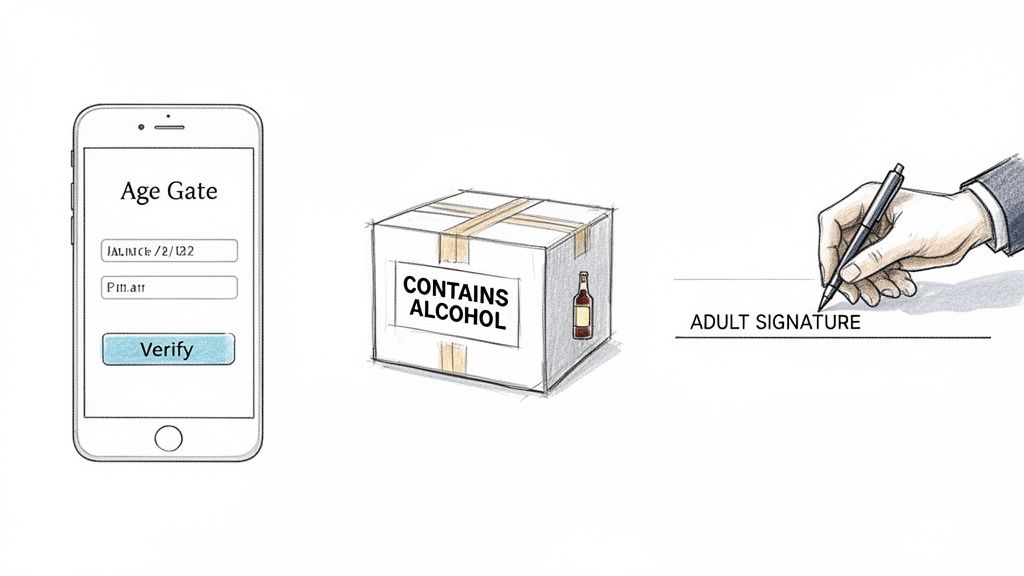
Unfailing Age Verification Procedures
Keeping alcohol out of the hands of minors is the absolute foundation of New York’s shipping laws. The state and its carriers take this incredibly seriously, and you need to as well. This means a two-step verification process: one at the point of sale and another at the customer's door.
First, your online store must have a solid age gate that stops anyone under 21 from even browsing your products. But that’s just the first line of defense. The most important check happens at delivery.
Every single alcohol shipment in New York must be signed for by an adult who is 21 or older. No exceptions. The delivery driver is legally required to check a valid government ID before handing over the package. Just leaving a box on the porch is a major violation.
This isn't just red tape; it's a core part of the state's public safety strategy. With New York's underage drinking rate at 26.4 percent, regulators see strict enforcement at the final point of delivery as a critical compliance tool. You can find more data on how shipping laws impact state consumption rates in this detailed report from the R Street Institute.
Proper Packaging and Labeling Requirements
How you pack and label your shipments isn’t just about getting the product there safely—it’s a legal requirement. The box must clearly announce what's inside to both the carrier and the recipient. Trying to hide the contents is a direct violation of state law and your carrier agreement.
Common carriers like FedEx and UPS have their own specific labeling rules you have to follow. Generally, every package must have labels that clearly state:
- Contains Alcohol: This tells everyone handling the package what's inside.
- Adult Signature Required: This is the driver’s cue that the package can't be left unattended and needs an in-person, 21+ signature.
These labels are the final checkpoint, making sure everyone involved knows the package requires special handling. For a step-by-step look at these carrier-specific rules, check out our guide on how to complete the FedEx alcohol shipping account setup.
Adhering to Strict Volume Limits
Finally, if you're a winery shipping with a Direct Shipper's License, you have to track how much you sell to each customer. New York law caps these shipments at a maximum of 36 cases per individual per year. Each case can’t contain more than nine liters.
This requires a rock-solid system for tracking customer purchases over a rolling 12-month period. Going over this limit, even by accident, can get you in hot water with the NYSLA. Your eCommerce platform needs to be set up to monitor and enforce this cap automatically, ensuring every order you ship is compliant.
Automating Compliance to Prevent Costly Errors
<iframe width="100%" style="aspect-ratio: 16 / 9;" src="https://www.youtube.com/embed/m6RPjjuLjJA" frameborder="0" allow="autoplay; encrypted-media" allowfullscreen></iframe>Trying to manually check every single order against New York's maze of alcohol shipping laws isn't just a headache—it’s a recipe for expensive mistakes. One wrong shipment to a prohibited ZIP code or a slip-up on a customer's yearly volume limit can trigger audits, hefty fines, or even the loss of your shipping license.
This is where automation becomes your most valuable employee. By setting up automated shipping rules in your eCommerce store, you’re essentially creating a digital compliance officer that works around the clock, 24/7. This system instantly checks an order's destination against the rules you've set, making sure you only ship what's legal to where it's legal. It transforms a reactive, error-prone process into a proactive, foolproof workflow.
How Automated Shipping Rules Work
Think of shipping rules as a set of "if-then" instructions for your store’s checkout. You set the conditions once, and the system enforces them automatically, without you lifting a finger. This approach is absolutely critical for navigating the complex patchwork of regulations found in New York alcohol shipping laws.
For instance, a New York distillery can ship spirits to customers inside the state but is barred from shipping to most other states. A manual process would require a team member to painstakingly check the shipping address for every single order containing spirits—a tedious task where it's easy to make a mistake.
With an automated system, you can build a simple rule:
- IF a customer's cart contains a product from the "spirits" category,
- THEN only allow shipping to addresses within New York.
If a customer from New Jersey tries to buy that bottle of gin, the system will politely inform them that the item can’t be shipped to their location. This prevents an illegal sale before it even happens, keeping you compliant and giving the customer a clear, immediate explanation. For a deeper dive, check out our guide on automated shipping compliance for WooCommerce stores.
This screenshot shows just how easy it is to build a rule blocking specific product categories from shipping to certain states.
The interface gives you granular control, letting you define exactly which products are restricted and where those restrictions apply, all from one straightforward dashboard.
Turning Legal Headaches into a Smart Workflow
The real power of automation goes far beyond just blocking states. You can create rules for almost any scenario, turning complicated legal requirements into a seamless part of your daily operations.
Here are a few practical examples:
- Blocking Dry ZIP Codes: Some towns or counties within New York might have local restrictions. You can upload a list of these "dry" ZIP codes and create a rule to block all alcohol shipments to those specific areas.
- Managing Product-Specific Rules: A winery might be licensed to ship wine to a particular state but not the brandy they also produce. Automation handles these product-specific permissions without any trouble.
- Enforcing Carrier Rules: If your agreement with FedEx or UPS says you can't ship alcohol to P.O. boxes, an automated rule can stop customers from entering one at checkout.
By automating these checks, you free up incredible amounts of time and mental energy. Instead of sweating every order, you can trust your system to enforce New York's intricate laws correctly, every single time. It's the ultimate safeguard against the costly consequences of human error.
To take your efficiency even further, many businesses are using tools like legal document automation software to manage other parts of their compliance paperwork. Integrating technology at multiple levels of your business creates a powerful, error-resistant operation.
Ultimately, automating your shipping compliance is about building a scalable and resilient business—one that can grow without outgrowing its ability to follow the rules.
Understanding the Penalties for Non-Compliance
Knowing New York's alcohol shipping rules is one thing, but truly understanding the consequences of breaking them is what separates the serious businesses from the ones taking a major gamble. Let's be clear: violating these regulations isn't a minor slip-up. It can trigger severe penalties that jeopardize your entire operation. The New York State Liquor Authority (NYSLA) does not mess around with illegal shipments.
Think of an NYSLA compliance audit like a surprise visit from the IRS—it’s a serious event with major implications. The penalties for non-compliance aren't just a slap on the wrist. They're designed to ensure only licensed, responsible sellers are in the market, protecting both consumers and the state's tax revenue.
The Spectrum of Penalties
Violations can result in a range of disciplinary actions that escalate quickly depending on the offense. For a growing eCommerce business, these consequences can be devastating.
The most common penalties include:
- Steep Financial Fines: These can climb from hundreds to thousands of dollars for each violation. A single illegal shipment can trigger a significant financial hit.
- License Suspension or Revocation: For repeat or serious offenses, the NYSLA can suspend or completely revoke your shipping license. This effectively shuts down your access to the entire New York market.
- Criminal Charges: In the most extreme cases, like knowingly shipping large volumes of alcohol without a license or selling to minors, violations can lead to misdemeanor or even felony charges.
The loss of a shipping license is often the most damaging outcome. It not only cuts off a revenue stream but also permanently damages your business's reputation and makes it incredibly difficult to get licensed in other states.
Building a Proactive Defense
The only way to avoid these penalties is to build a rock-solid, proactive compliance strategy from day one. This goes beyond just reading the rulebook; it means putting systems in place that prevent mistakes from ever happening. More than just knowing the rules, putting robust compliance training best practices into action is essential to proactively handle the significant risks and steer clear of harsh penalties.
Your compliance checklist should treat these actions as non-negotiable:
- Secure and Maintain Correct Licensing: Make sure you hold the proper, active license for your business type and location before shipping your first package. No exceptions.
- Implement Ironclad Age Verification: Use a two-step process: an online age gate at checkout and a mandatory adult signature (with ID check) at the customer's door for every single shipment.
- Automate Shipping Rules: Use tools like Ship Restrict to automatically block illegal shipments based on the product type, the destination state, or even specific "dry" ZIP codes.
- Keep Meticulous Records: Maintain detailed logs of all sales, customer data, and shipments. You’ll need them for tax reporting and to be ready for any potential audits.
By embedding these practices into your daily operations, you stop hoping for compliance and start guaranteeing it.
New York Alcohol Shipping FAQs
Even with a solid grasp of New York's alcohol shipping laws, you're bound to run into some specific, nagging questions. Certain scenarios just aren't black and white. This section tackles some of the most common questions we hear from eCommerce businesses trying to navigate the Empire State.
Can I Ship Beer Directly to a Consumer in New York?
For most businesses, the answer is a hard no. New York has some of the most restrictive laws in the country when it comes to direct-to-consumer (DTC) beer shipping. While the state has carved out clear paths for licensed wineries and in-state distilleries, breweries simply don't get the same treatment.
Sure, there are a few narrow exceptions. Some in-state breweries can deliver locally with their own vehicles if they hold the right permits. But for eCommerce stores relying on common carriers like FedEx or UPS, shipping beer is basically off-limits. If you're an out-of-state brewery, the door is shut completely—you cannot legally ship beer directly to a New York consumer, period. The safest bet for your store is to assume it's not allowed.
What Are the Tax Obligations for Shipping Alcohol to New York?
If you've gone through the trouble of getting a license to ship alcohol into New York, your work isn't done. You are absolutely required to register with the New York State Department of Taxation and Finance. Think of it as a non-negotiable step two in your compliance journey.
Once you're registered, you have two main tax duties:
- You must collect and remit all relevant state and local sales taxes for every single order.
- You also have to pay New York's alcoholic beverage excise taxes. The rates will change depending on the type and volume of alcohol you're selling.
Keep meticulous records of every sale you make into New York. Messing up your tax collection or payments can lead to some painful financial penalties and could even put your shipping license at risk.
Does My Choice of Shipping Carrier Matter?
It absolutely matters. Picking a carrier like FedEx or UPS isn't just about logistics; it's a critical compliance decision. These companies have their own stringent rules layered on top of state law, and they will only partner with licensed, approved alcohol shippers.
Before you can even think about sending your first box, you have to set up a special account that includes an alcohol shipping agreement. This is a specific contract where you agree to their terms. Carriers demand specific packaging and labeling for every shipment, making it crystal clear that the box contains alcohol and needs an adult's signature. They won't touch a shipment from an unlicensed seller. You have to get in touch with your carrier directly and make sure your account is properly set up for alcohol before you start shipping.
Trying to manage these complex rules by hand is a huge risk. Ship Restrict takes the guesswork out of compliance by creating smart shipping rules that block prohibited orders before your customer can even check out, saving you time and preventing expensive mistakes. Learn how Ship Restrict can protect your business.
Automate Alcohol Shipping Compliance
Stop worrying about restricted states. Ship Restrict handles it automatically.

Cody Yurk
Founder and Lead Developer of ShipRestrict, helping e-commerce businesses navigate complex shipping regulations for regulated products. Ecommerce store owner turned developer.
Automate Alcohol Compliance
- Block restricted states
- No more cancellations
- Set and forget
3-day free trial · Card required